“Earth-shaking”
News on the Mars side operations was overtaken during Thanksgiving week by rumours that SAM may have uncovered something quite amazing in carrying out its first analysis of soil collected from the Rocknest area.
The rumours started on November 20th, when National Public Radio featured a report on Curiosity’s progress in a programme segment called Joe’s Big Idea. This included a recording of comments from MSL’s Principal Investigator (PI), John Grotzinger made while equipment for the interview was being set up.
“We’re getting data from SAM as we sit here and speak, and the data looks really interesting,” Grotzinger is heard to comment, before going on, “The science team is busily chewing away on it as it comes down.”
Which is really not that exceptional as comments go. The problems really started after reporter Joe Palca, despite his own explanation as to why Grotzinger was unwilling to delve further into the initial findings from SAM until more data had been received an analysed, framed what Grotzinger was describing as “earth-shaking” – a highly emotive term suggestive that something truly stunning had been found. Palca added to the suspense by including a clip of Grotzinger saying, “This data is gonna be one for the history books. It’s looking really good.”
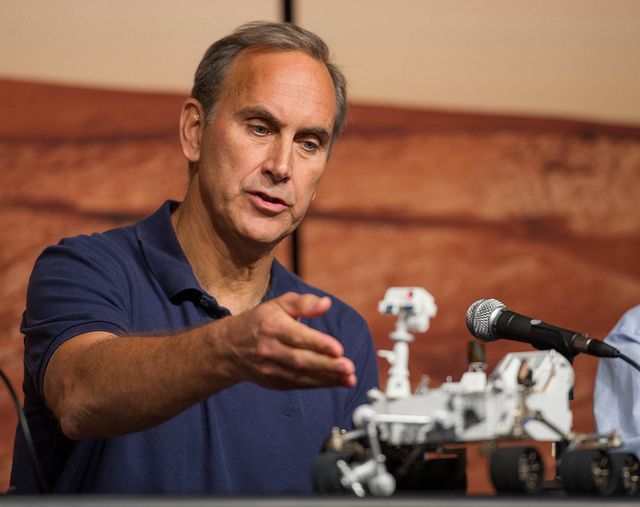
This lead to a raft of Internet headlines reflecting the sensational nature of the term “earth-shaking”, and analyses as to what it all might mean – including the idea that SAM had indeed achieved its primary goal, and discovered evidence that Mars was once capable of being the abode of life – if not organic material itself.
Such was the furore caused, that by November 26th, NASA was engaged in fire-fighting all the speculation. In commenting on Grotzinger’s “One for the history books”, NASA’s Guy Webster stated, “John was delighted about the quality and range of information coming in from SAM during the day a reporter happened to be sitting in John’s office last week. He has been similarly delighted by results at other points during the mission so far … As for history books, the whole mission is for the history books.”
Taken in context, Grotzinger’s comments are actually relatively innocent; Curiosity has so far operated well beyond expectations in terms of its ability to image, explore and analyse its surroundings. Mission scientists have frequently talked into terms of the remarkable nature of the data being returned not because it is “earth-shaking” but because it is of a quality which has been far greater than anticipated or which Earth-based simulations suggested could be achieved on Mars.
However, the rumours that NASA has found something of major import have continued to circulate on the basis of the venue for the next planned public update on the mission’s progress, which will take place on Monday 3rd December, at the Fall Meeting of the American Geophysical Union (AGU). The use of such a high-profile annual conference as a venue for a mission update had led some commentators to conclude that NASA has indeed uncovered something of major significance with SAM. So much so that the space agency issued a very firm denial of this being the case in a press release on November 29th, which reads in part:
Rumors and speculation that there are major new findings from the mission at this early stage are incorrect. The news conference will be an update about first use of the rover’s full array of analytical instruments to investigate a drift of sandy soil. One class of substances Curiosity is checking for is organic compounds — carbon-containing chemicals that can be ingredients for life. At this point in the mission, the instruments on the rover have not detected any definitive evidence of Martian organics.
Even Curiosity attempted o quell the rumours with a series of Tweets also sent on the 29th November, 2012, including:

That NASA are holding a press conference at the AGU meeting is not actually unusual. Such conferences are often the best way for mission scientists to discuss their work and findings with their peers all under the same roof. This is why NASA has a long history of holding such updates at conferences such as the AGU – a history which includes updates on Curiosity’s predecessors on Mars, Spirit and Opportunity.
Storms of Another Kind
While all the brouhaha related to SAM was raging on Earth, Curiosity, Opportunity and the Mars Reconnaissance Orbiter (MRO) were involved in observing a storm of a different kind – that of a large regional sand storm in the southern hmisphere.
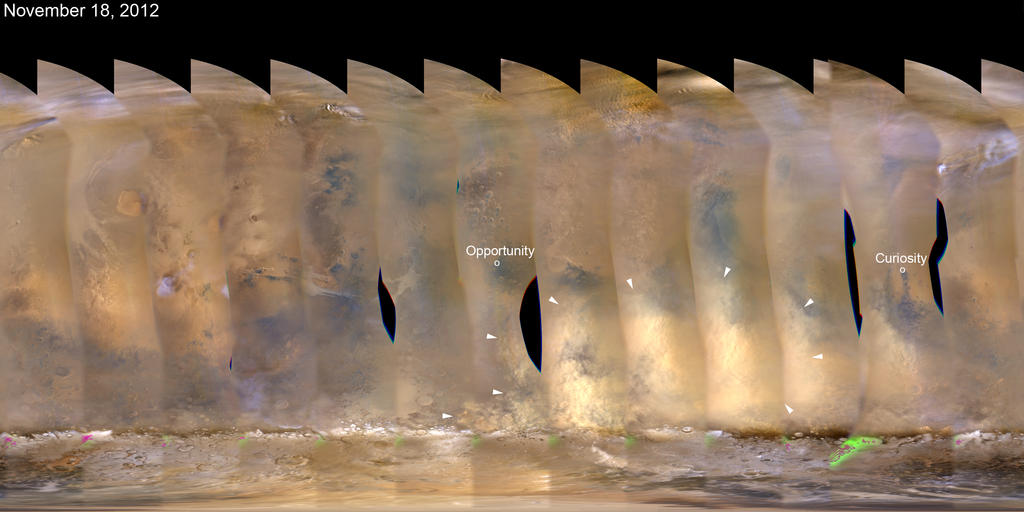
Dust storms are a common factor on Mars and tend to occur during seasonal shifts, when the Martian atmosphere undergoes significant change of the kind described in my last report on the MSL mission. This particular dust storm first became noticeable on the 10th November, 2012, growing in size over the course of the next week to a point where both Opportunity and Curiosity could measure its impact, and there were concerns that the storm could be on its way to becoming a global phenomena – again a not entirely uncommon occurrence. However, by November 28th, the storm had started showing signs of abating.
While the storm came no closer than some 1,347 kilometres (837 miles) from Opportunity (which does not have an on-board weather station), the MER rover nevertheless recorded a slight drop in atmospheric clarity as a result of the storm lifting and spreading so much dust into the thin atmosphere. Curiosity, also well clear of the storm, was able to use the REMS (Rover Environmental Monitoring Station) instruments to measure the impact of the storm on the air pressure in Gale Crater.

The ability for such a storm to be monitored from both space and measured with environmental instruments on the surface of the planet marks another “one for the history books” where Curiosity is concerned – as it is the first time since the 1970s and the era of the Viking missions that NASA have been able to do so.
All images reproduced courtesy of NASA/JPL

 Inara Pey: Living in a Modemworld