 It’s been a busy week on Mars.
Following the identification of a further rock target for study, Curiosity spent Sol 54 (September 30th) conducting contact science with the rock, dubbed Bathhurst Inlet by mission personnel, using APXS and MAHLI.
These studies were concluded on Sol 55 when Curiosity used the ChemCam laser, telescope and spectrometer to analyse the chemical / mineral composition of the rock. Following this, the rover manoeuvred some 23.5 metres (77 feet) to an area of sand called Rocknest, which Mastcam images had revealed as a possible location in which to test part of Curiosity’s sample acquisition system.

Rocknest, an area of wind-blown sand, had initially been imaged on Sol 52, and earmarked as a potential location for sample acquisition tests. The area is around 5 metres by 1.5 metres (16ft by 7ft), and the fact that it appeared to comprise wind-blown deposits suggested it would be an ideal target as the sand is liable to be relatively loosely packed and offer samples which can be acquired relatively easily and which could be used to perform an important task.

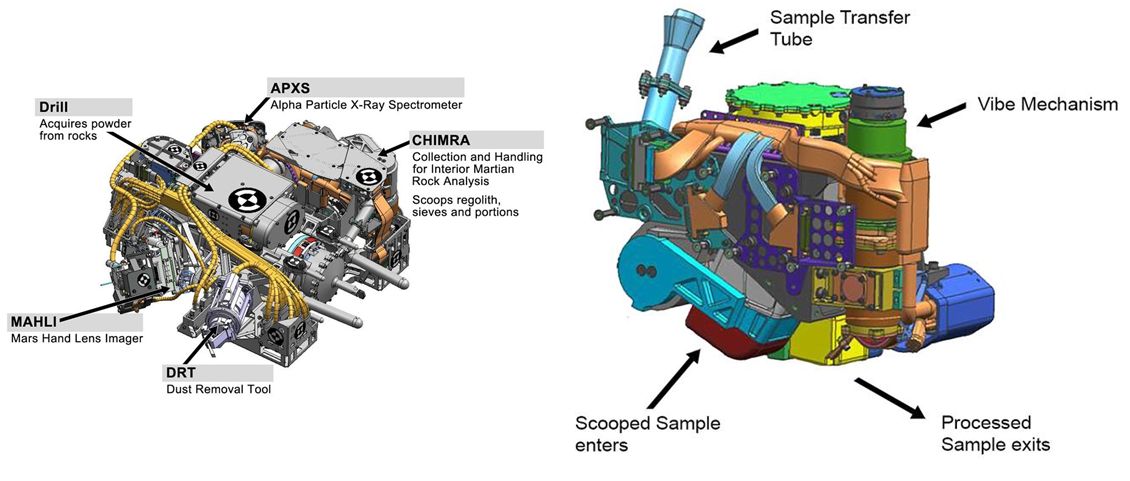
Samples can be acquired by Curiosity in one of two ways: using a drill system or via a scoop, both of which are located on the turret at the end of the rover’s robot arm. The activities at Rocknest are focused on the use of the scoop, which can acquire around 20 grams of material at a time for delivery to SAM, the Sample Analysis at Mars system, and CheMin, the Chemistry and Mineralogy system, Curiosity’s two on-board sample analysis systems.
The scoop is part of a complex system called CHIMRA (Collection and Handling for In-Situ Martian Rock Analysis) contained within the turret. This processes samples gathered from both the scoop and the drill system, ready for them to be passed to the rover’s on-board systems. However, before the system can be used, it must be properly prepared and undergo a special “cleaning” process. It is this “cleaning” which is the focus of operations at Rocknest.
On Sol 56, Curiosity further manoeuvred itself a further six metres (20 ft) to get close to a ripple of sand within Rocknest which had been selected for the sample testing. The Dynamic Albedo of Neutrons (DAN) instrument was also used during Sol 56 to measure subsurface hydrogen levels, as was the Radiation Assessment Detector (RAD), designed to characterise the broad spectrum of radiation environment around the rover, and the Rover Environmental Monitoring Station (REMS) – Curiosity’s weather station.
In order to ensure the sand is suitable for the “cleaning” process, mission scientists and engineers needed to understand more about it. To this end, and on Sol 57, Curiosity was commanded to drive onto the ripple, rotate its wheels through 30-degrees and then reverse off. The Purpose of this was two-fold: firstly, it helped to confirm the sand’s consistency and that it is in fact packed loosely enough for the scoop to obtain samples. Secondly, it exposed material beneath the surface layer, allowing it to be further characterised.

Please use the page numbers below left to continue reading this article

 Inara Pey: Living in a Modemworld