Destination: ISM

Grid: Second Life

The Rocket Ring

Given I’ve written about my very tenuous link to the space shuttle Endeavour, I thought that for this instalment of Destination: I’d take a look at the International Spaceflight Museum (ISM).

ISM is perhaps one of the most famous destinations in Second Life and a fabulous example of what can be achieved through dedication and hard work on the part of a group of enthusiasts. Starting modestly on the sim of Spaceport Alpha, the ISM now covers two sims – Alpha and Bravo, and forms the hub of a group of (non-affiliated) sims dedicated to science, the environment, technology and space – including NASA’s own CoLab sim. The museum and its sims are overseen by the ISM Corporation, a Kansas, USA, non-profit organisation currently seeking 501c3 tax exemption with the US IRS.
ISM arrival: LEO

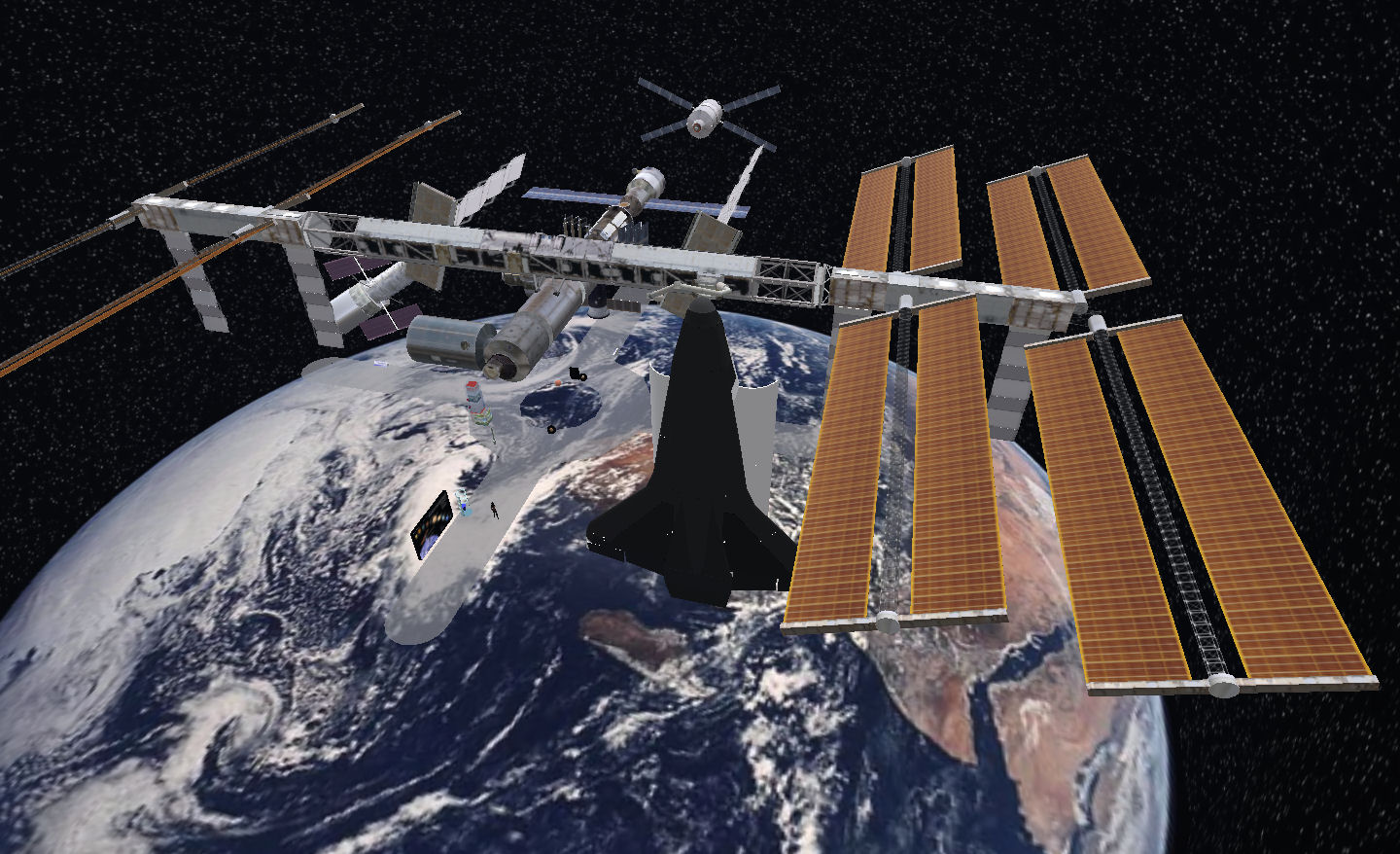
As one would expect from a long-established SL facility that tackles such an engaging and absorbing subject as the exploration of space, ISM is exceptionally well-thought out. Use the main LM (from Search), and you’ll find yourself in low Earth orbit, standing on a platform with the glorious arc of the Earth below you and the magnificent and somehow delicate form of the International Space Station overhead, complete with space shuttle (the Endeavour!) and two Soyuz craft docked with it, while a European Automated Transfer Vehicle makes its final approach to dock. Also hanging in space beside the station, a little incongruously, is the Hubble Space Telescope.

Trivia quiz plinth

The first thing that strikes you on arriving – after the magnificence of the display around you, is the sheer care that has been put into things. Around the walkway are hovertext icons, carefully positioned so they don’t intrude on your wanderings, but which provide a wealth of information. Additionally, each of the models in the exhibit is accompanied by a clickable plaque that will take you to a dedicated, multi-lingual wiki page that provides detailed information on the exhibit.

Also located on the platform is the main teleport unit / ISM map, and the first station in the museum’s Trivia Quiz. In this, you collect game cards by answering questions on space and space exploration. Cards can be redeemed at the ISM gift shop (or that’s the theory; to be honest, I’ve never found the object used to redeem the cards – but the quiz is still fun).

Travel to the Planets

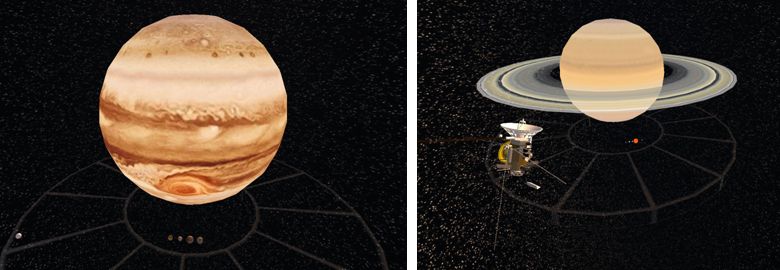
The teleporter will carry you to any of the planets in the solar system, where you can find out more out our celestial neighbours and any space missions that have visited them. It’s actually while on the solar system tour that things get very slightly irritating.
On the surface of Mars

While the exhibits are informative and well laid-out, the fact is that once you’re away from the arrival area, it’s pretty hard to get off the tour – there are no “return” teleport points. So if you opt to hop directly to, say, Mars, finding your way back to Earth, Venus or Mercury is a tad difficult.

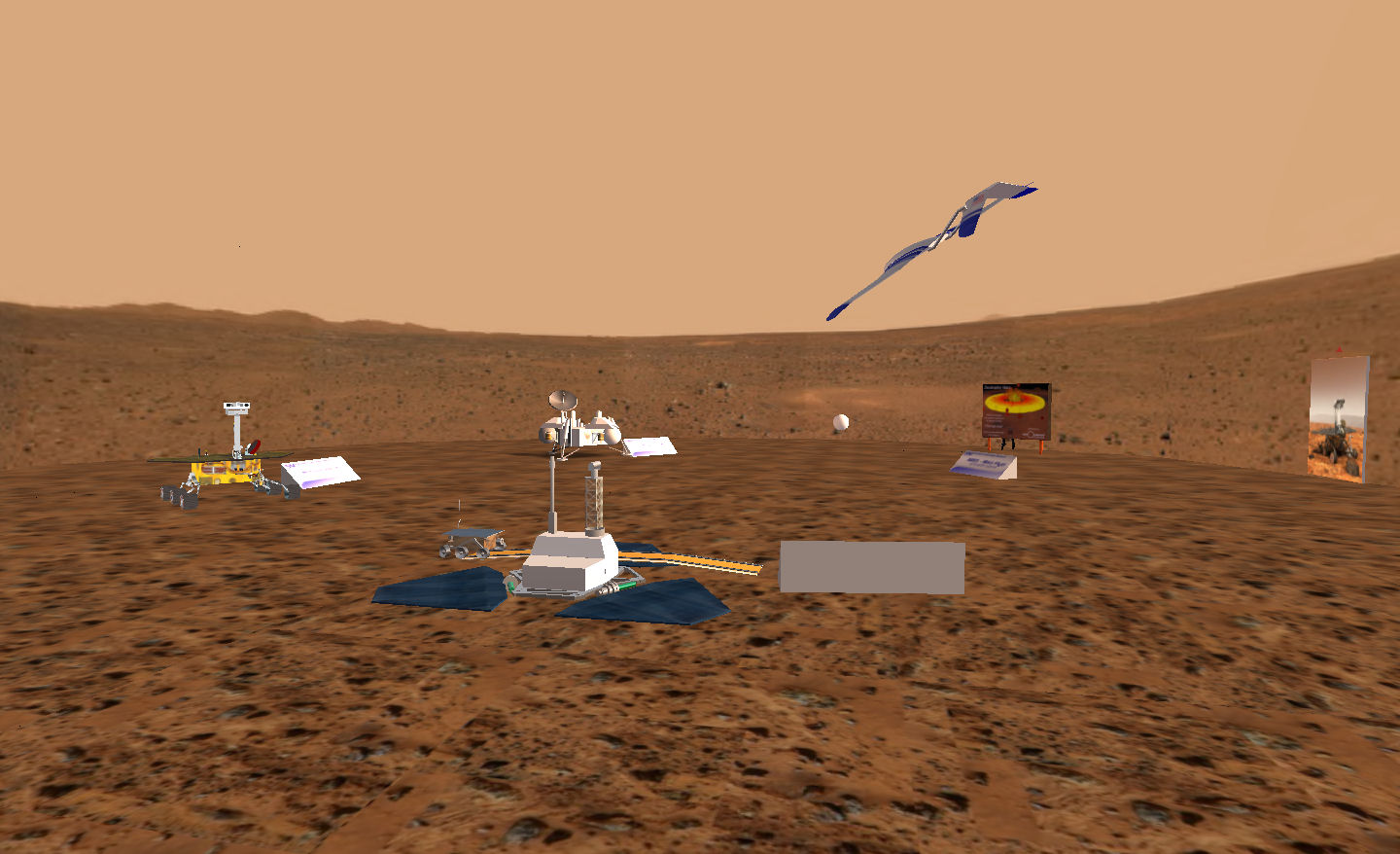
Each of the displays exists in its own sphere or cube, with (again), plenty of information to absorb as you admire them. Were I to pick a favourite, it would be Mars – but then that planet has always held a mystical fascination for me – simply because you can pay a visit to the surface of our oft-visited neighbour in space.

The Pluto / Charon display, ostensibly marking the “end” of the solar system, allows you to take a peek at some of our nearest interstellar neighbours as it includes a three-dimensional model of our corner of the galaxy, complete with clickable stars!
Jupiter (left) and the Galilean moons; Saturn (right) and the Cassini / Huygens mission

The Pluto / Charon display also appears to offer a novel way of moving on in your explorations: a parachute to get you down to the ground! This is something of a novel approach, to be sure, but as I have my own chute, I strapped it on and stepped off the edge of the catwalk only to splat myself on the ground as the lag prevented my chute from opening in time. Ah, well.

Feet on the ground – head in the clouds

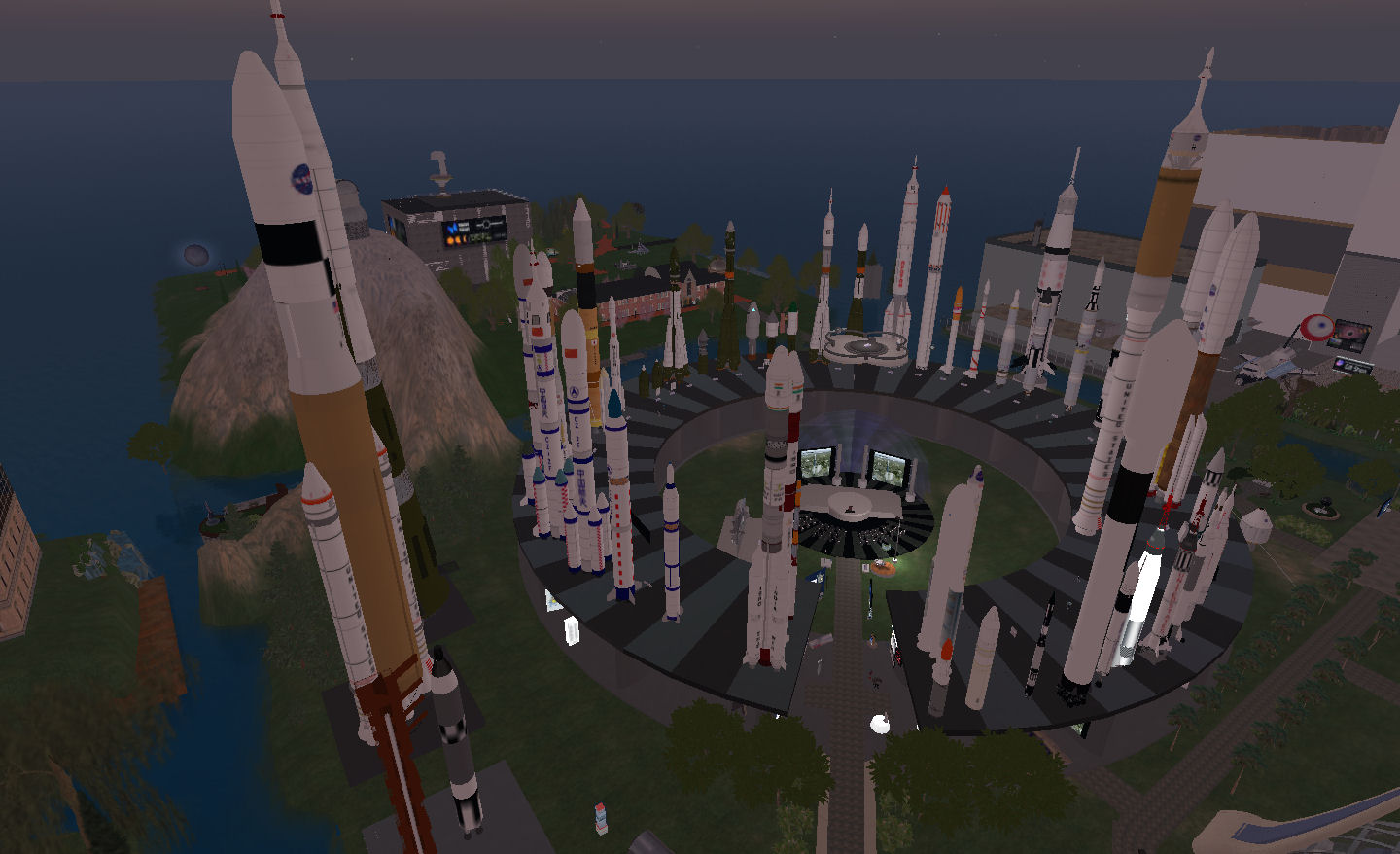
Fortunately, no-one ever dies in SL, so after picking myself up and dusting myself down in the hope that no-one noticed, I found myself in the middle of the Rocket Ring. Here you can learn about all the rockets ever flown – and some that never did or have yet to take to the skies. In the centre of the garden is the ISM theatre, which frequently hosts talks on space flight, space exploration, astronomy and the like, and which broadcasts a NASA TV fee during space missions. Under the Rocket Ring you can find a wealth of other information – some of which may help you with questions from the 2nd Trivia Quiz plinth, which also can be found here as well.

Not all the displays are static, either – you can, for example you can ride atop a Titan II rocket in a Gemini capsule into outer space, our climb aboard a space shuttle and have a look around. You can also visit the Planetarium and take in a show. And if you don’t fancy trudging around the sims, try taking the tour ride – just make sure you can get seated before the vehicle moves off!
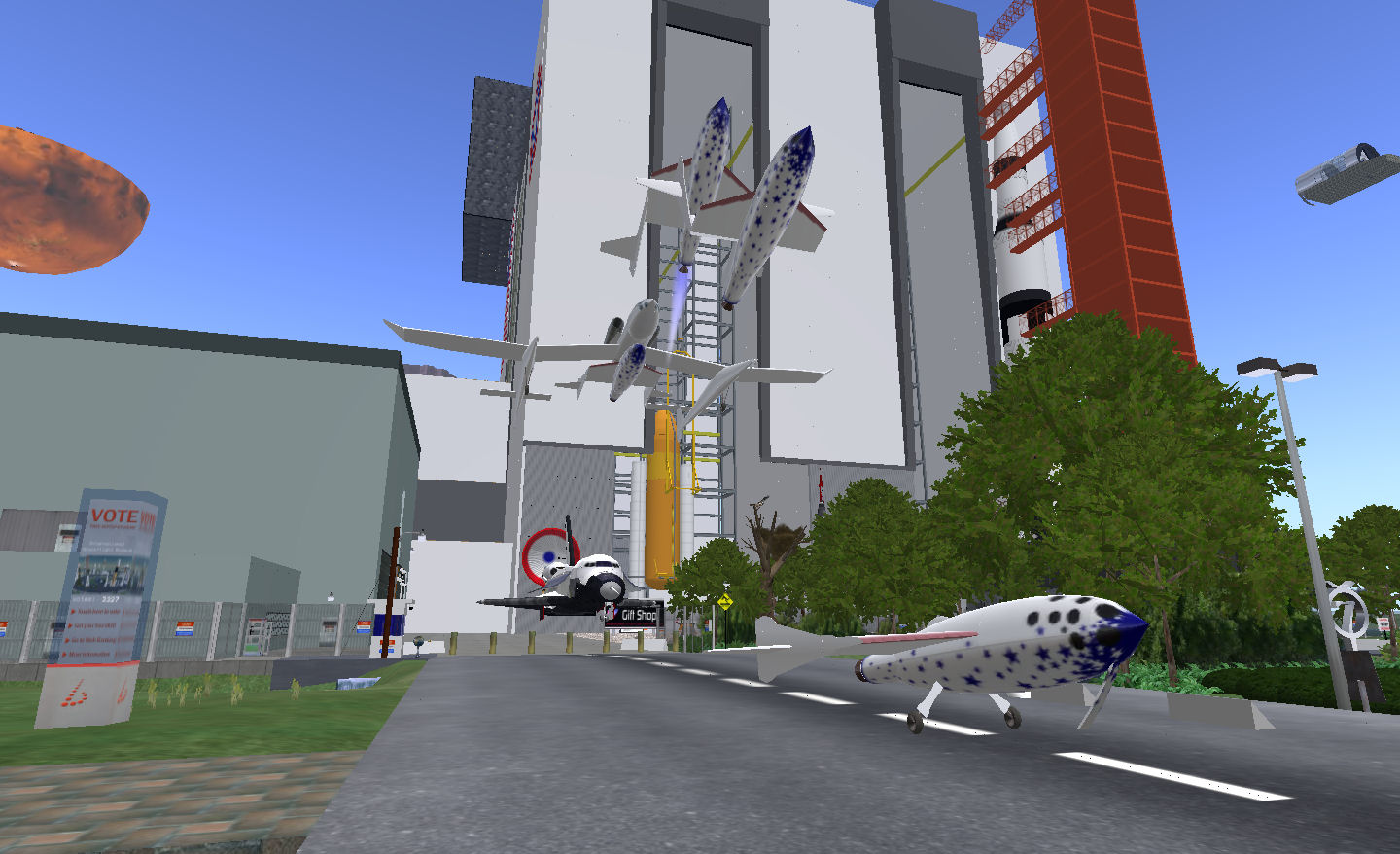
Spaceship 1, The Shuttle and Spaceport Bravo

Across the water, in Spaceport Bravo (be a little careful around the sim boundary, the crossing can be rough) sit replicas of some of the more famous buildings from America’s Kennedy Space Centre – including the imposing bulk of the Vehicle Assembly Building. Here you can see the huge Saturn V rocket, used to launch men to the Moon, find out about other hardware, past and present…and complete another part of the Trivia Quiz. Atop the Vehicle Assembly Building is the observation deck; turn your draw distance up and enjoy the view (just be sure to notch it back down again to reduce the lag when you leave).

While the ISM is not officially linked to or affiliated with NASA, it is bounded on two sides by NASA sims: NASA CoLab and the Explorer sim, operated by NASA / JPL. Both of these are well worth a look around as a part of your visit.

There are some problems with the museum, lag being perhaps the biggest. There are 14,229 prims scattered around the sim in dozens of exhibits and buildings – that’s a lot of drawing for your Viewer to handle. There are also information givers, web page redirectors, scripted vehicles and displays, all of which contribute to the server-side load. Given this, lag is understandable, and because of it – while it is tempting to pump up Draw as far as possible to see everything – I’d recommend that, unless you have a super high-end system, you keep draw turned down while moving around, and slide it back up while looking at individual exhibits on the ground. I’d also advise you limit your flying; the lag can make this a questionable activity – you can easily hit a sim boundary without warning as the lag grabs you, and end up rubber-banding hither and thither or getting unceremoniously dumped on another sim.

Away from the in-world experience, the ISM website offers a wealth of information on the museum, those responsible for it, what is going on in terms of upcoming events and a whole host of other information and news. The site is extremely well presented with excellent navigation. Of equal use is the ISM Wiki – reached via any of the in-world exhibit plaques. While this can interrupt the immersive experience while actually touring the ISM, it contains masses of information that is well-worth a look-in – and it does so in multiple languages, providing everyone with a chance to delve into it.
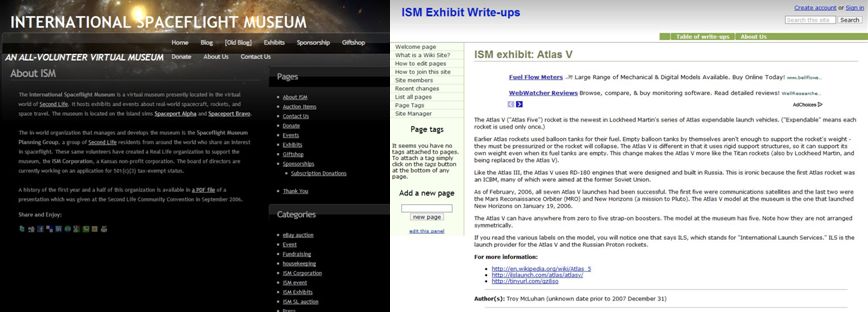
ISM website and wiki

Overall, ISM is one of the best attractions put together within Second Life. Whether you are a space enthusiast or just casually interested in taking a look, it has a lot to offer and represents an immersive and educational experience. The “wow!” factor tends to be high, and the exhibits are stunning both for the care and detail that has gone into their construction, and because of what they represent; the exploration of space and our understanding of the universe around us are truly awe-inspiring. And the ISM delivers much of that awe directly to your monitor screen.

But don’t just take my word for it – go pay a visit yourself!

Related Links


Destination: SS Galaxy

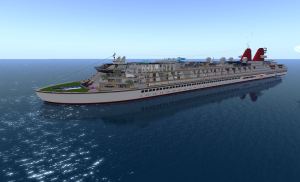
It’s three sims in length, you need to set your draw distance to over 600 metres if you want to see it all in one go, and the upper deck is over 30 metres above sea level.
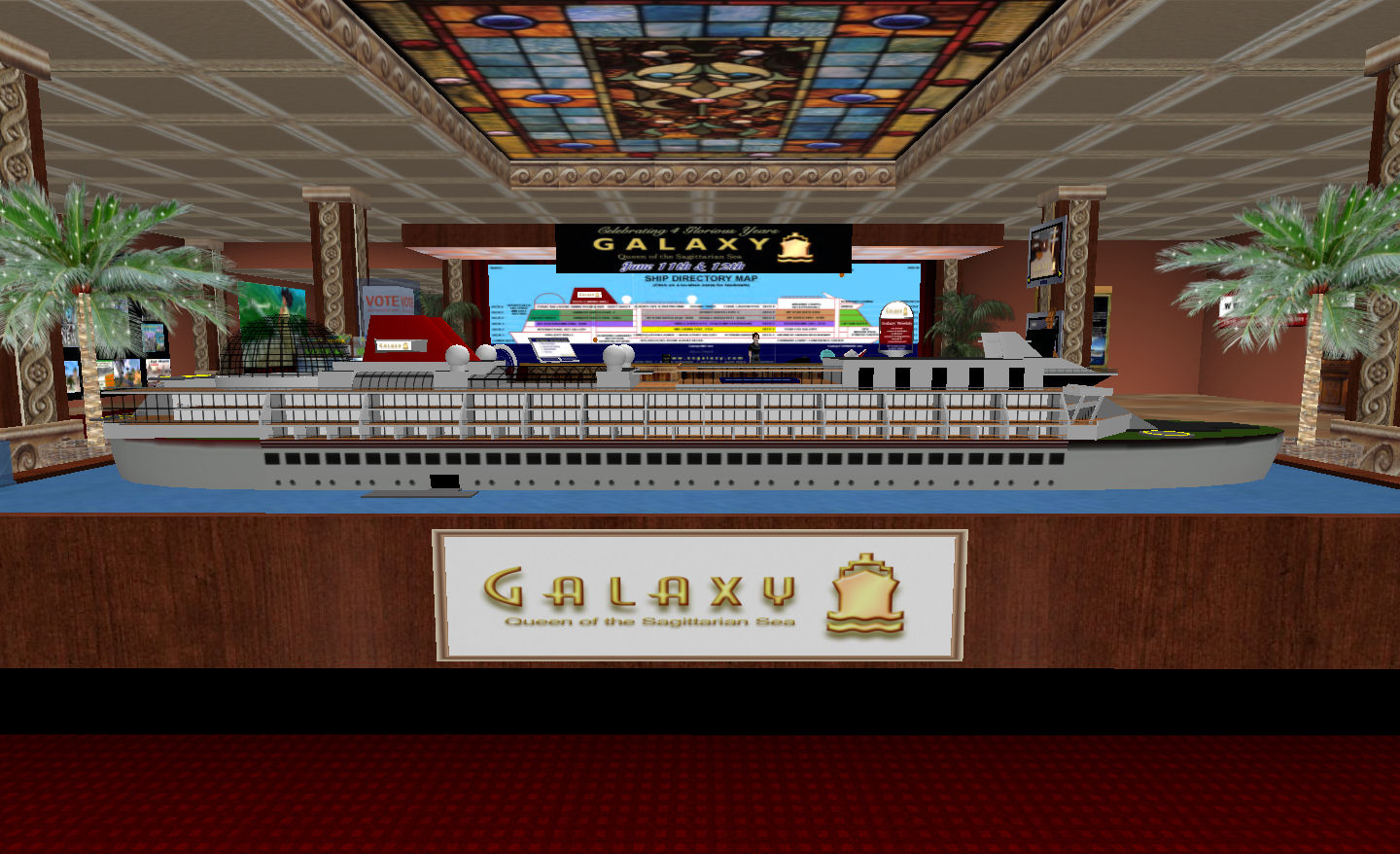
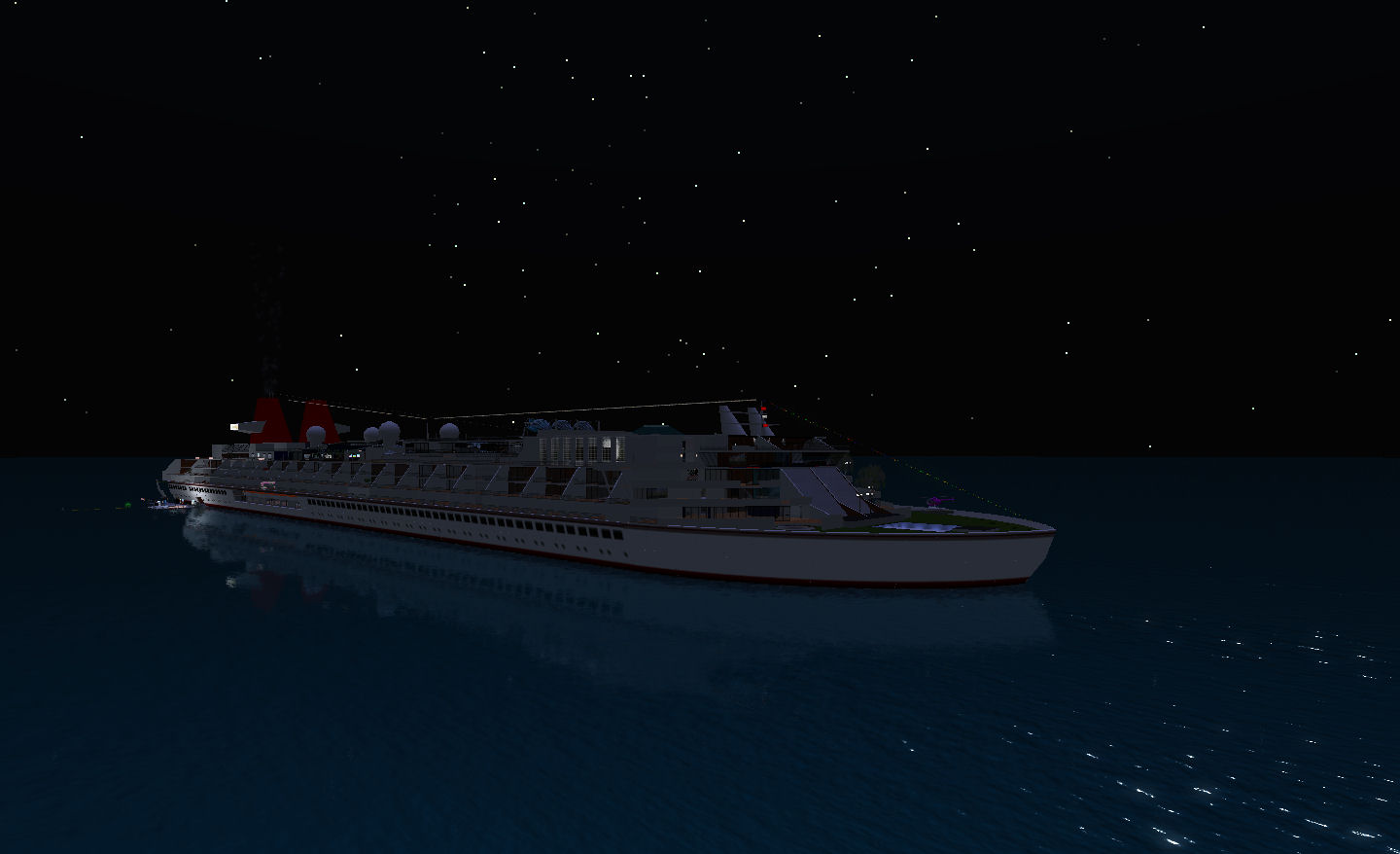
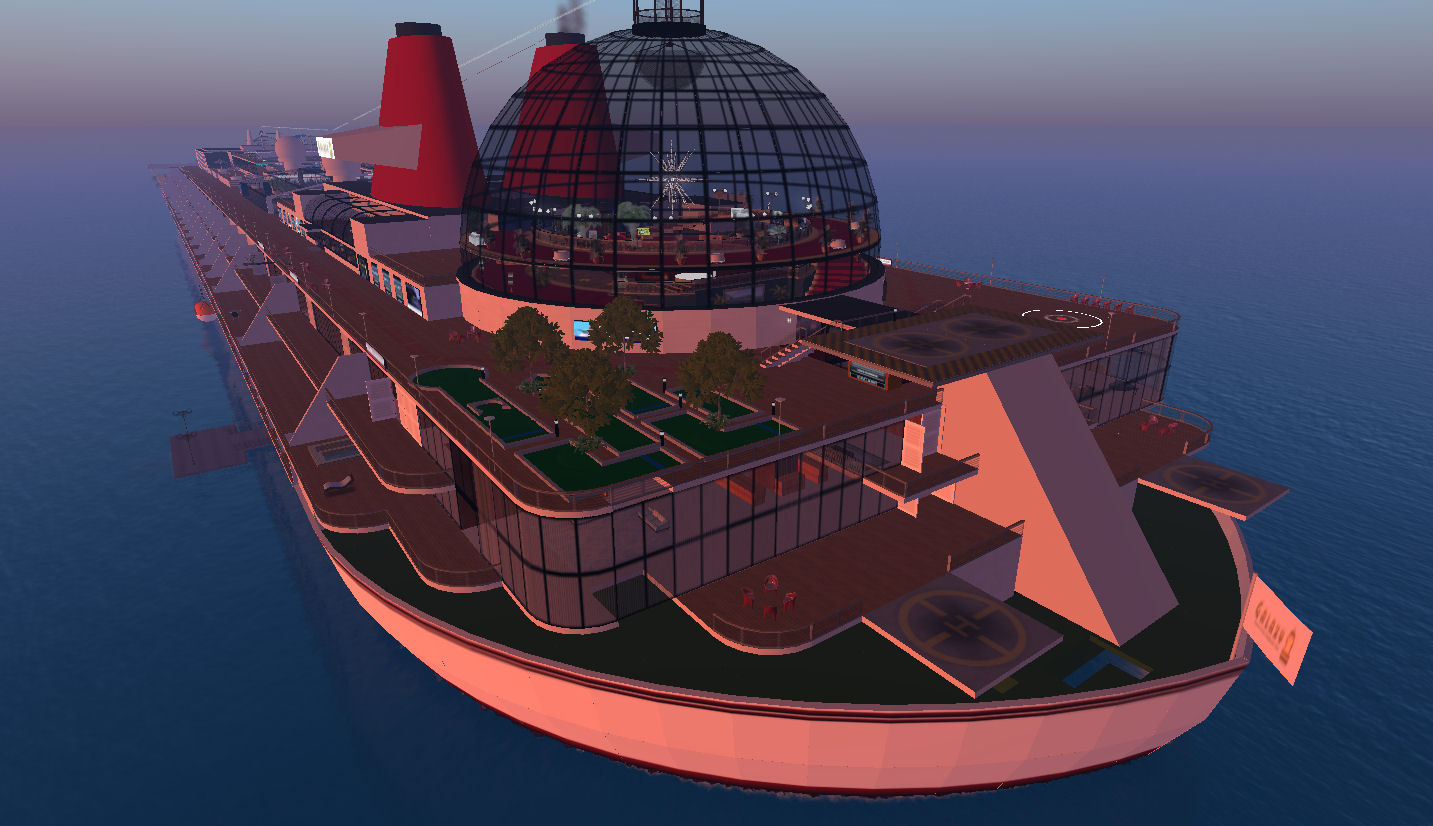
However you look at it, the SS Galaxy is an amazingly impressive build. Cruise ship, wedding venue, ballroom, recreational centre, shopping mall, home – the ship is all of these, and more. I first came across her when looking for a new dance venue and had no idea what to expect. Since that time, she’s become a familiar place I love to visit and introduce friends to.

The model of the Galaxy and the deck plan

If you use the Landmark Tp, you’ll arrive at the default boarding point on a floating pier located towards the aft end of the ship. Unless you have Draw turned up, it’s hard to appreciate exactly what you’re facing – but don’t let that put you off.

The pier itself forms a part of the ship’s recreational facilities, offering dinghy sailing, fishing, scuba diving, windsurfing and jet skiis. For the romantically inclined, there are wooden rez-on-demand rafts that will take you on a tour around the ship. The rafts provide a gentle commentary about the Galaxy, slowing periodically alongside points of interest. Set your local time to midnight if you want to add to the romance and enjoy a cuddle as you sail! If you prefer, you can take one of the rez-on-demand dinghies and plot your own course around the ship.

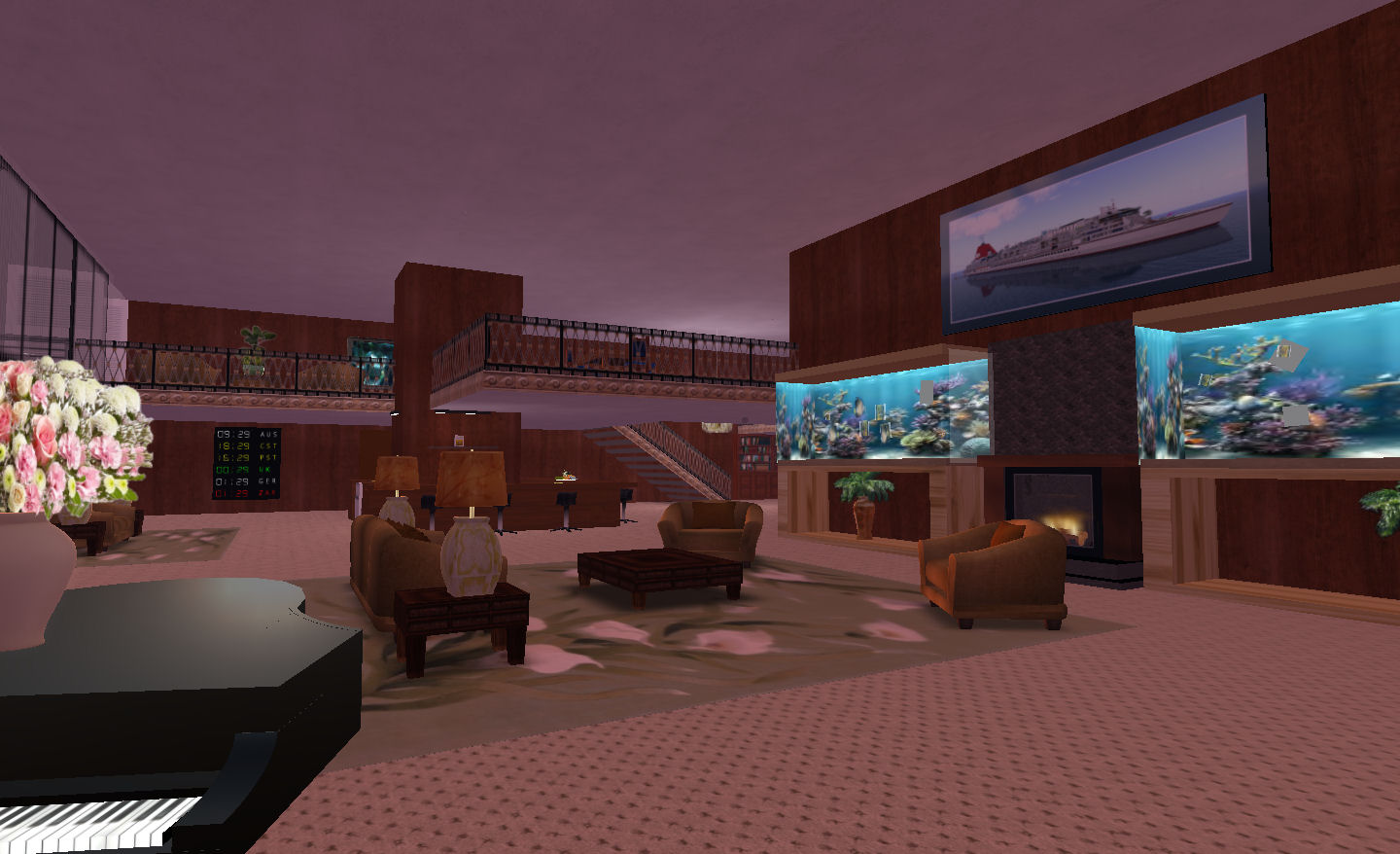
Entering the Galaxy, you might think you’re actually arriving at a luxury hotel – the embarkation area resembles an upmarket hotel lobby, complete with glass-panelled ceilings and rich carpeting on the floors. Pride of place here goes to a scale model of the ship, with a wall-mounted deck plan and guide located on the far wall, behind the main information desk. To the left lays the main section of the aft shopping mall, while to the right a broad companionway leads forward through the centre of the ship.

The Galaxy at night

As the embarkation area is in the aft sim, it’s usually best to start your exploration here and gradually work your way forward. To do this, take the elevator up to Deck 5. This will deposit you in one of the galleried walkways that lead you past some of the many suites and staterooms that are available for rent. Some of these are quite huge, and extend over two or three  decks of the ship, offering plenty of room and balconied views out over the sea. Continue aft past these and up a short flight of steps and you arrive on the stern deck – and a recreational heaven.

Stern recreation area and helipads

Here you can try your hand at putting (L$10 for 30 mins), or go sky diving (a personal favourite from waay back) – standard and pro chutes on sale at the vendors or pick up a basic freebie – and even add a bubble game to your skydiving fun;  if you’re feeling really energetic, take a short walk up the starboard side and give the rock climbing wall a go. If none of this grabs you, plonk yourself in one of the deck chairs and watch the world go by – you might even witness the comings and goings of a helicopter or two over the aft helipads (four in total: two for public use, two for the use of the occupiers of the ship’s two stunning Aft Staterooms, which are provided fully (and tastefully) furnished and which have a personal prim allowance on top).

Zodiac ballroom

Directly forward of the recreation area and helipads sits the huge dome of the Galaxy’s galleried Zodiac Ballroom with its circular dance floor, raised stage, upper gallery seating area and – way up at the top of the dome – a private dance area just for two.

Passing through the ballroom, you arrive at the upper section of the aft shopping mall, with doors either side leading back out to the upper deck. Take the port side doors, and you’ll find yourself coming out near another game I’ve always enjoyed aboard the Galaxy – the skeet / clay pigeon shooting (L$10 a game).

Moving forward from here, you’ll come to the first of the sim boundaries that divide the ship into three parts. At one time these were highlighted – and needed to be, as crossings could be a bit rough; but in difference to those that say “sim crossings are getting worse”, here’s one place where that is not the case. Approach the crossing gently (eyes on your co-ordinates!), and you’ll get over it with virtually *no* rubber-banding.

One of the two aft staterooms

Once across the boundary, you’re in the midships section of the liner, and can visit the ice skating rink, take a splash in the upper deck pool area, or pop down and walk among the trees of the arboretum. The pool and rink offer plenty of room for fun, with skates available from the rink-side vendor in the case of the latter.

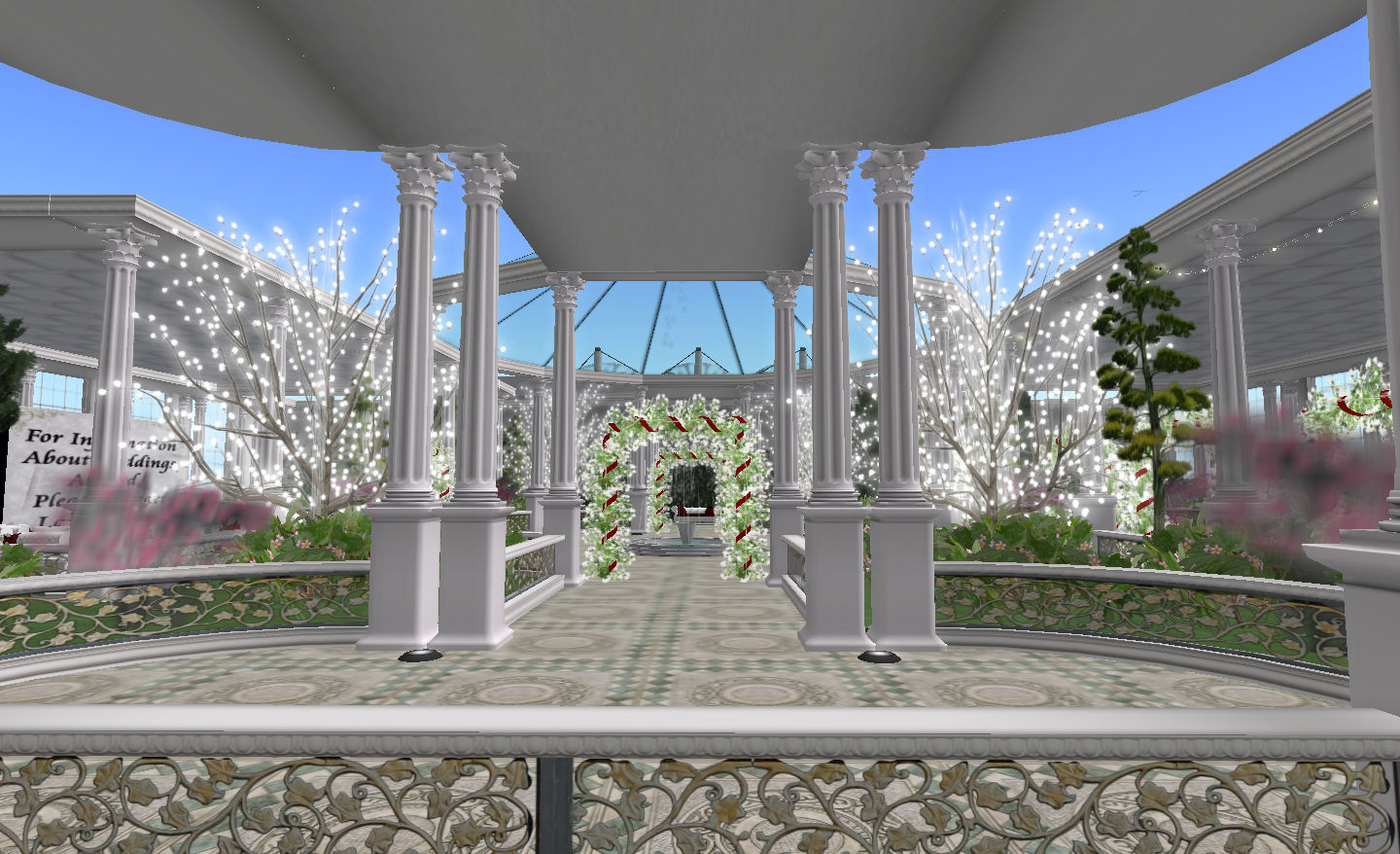
The forward end of the ship houses the huge and ornate wedding area, complete with trestles of flowers, tables, chairs, a dance floor, reception area and the ceremonial area. A chapel is located in one corner of this area, providing a place for quiet introspection.

The wedding chapel and reception area

Across the companionway from the chapel is the ship’s bridge, where you can take a look over the controls and generally play Captain. Above this is the forward observation lounge with room for dancing or sitting and chatting. Directly below the bridge are the Galaxy’s two enormous forward suites, each of which spans three decks.

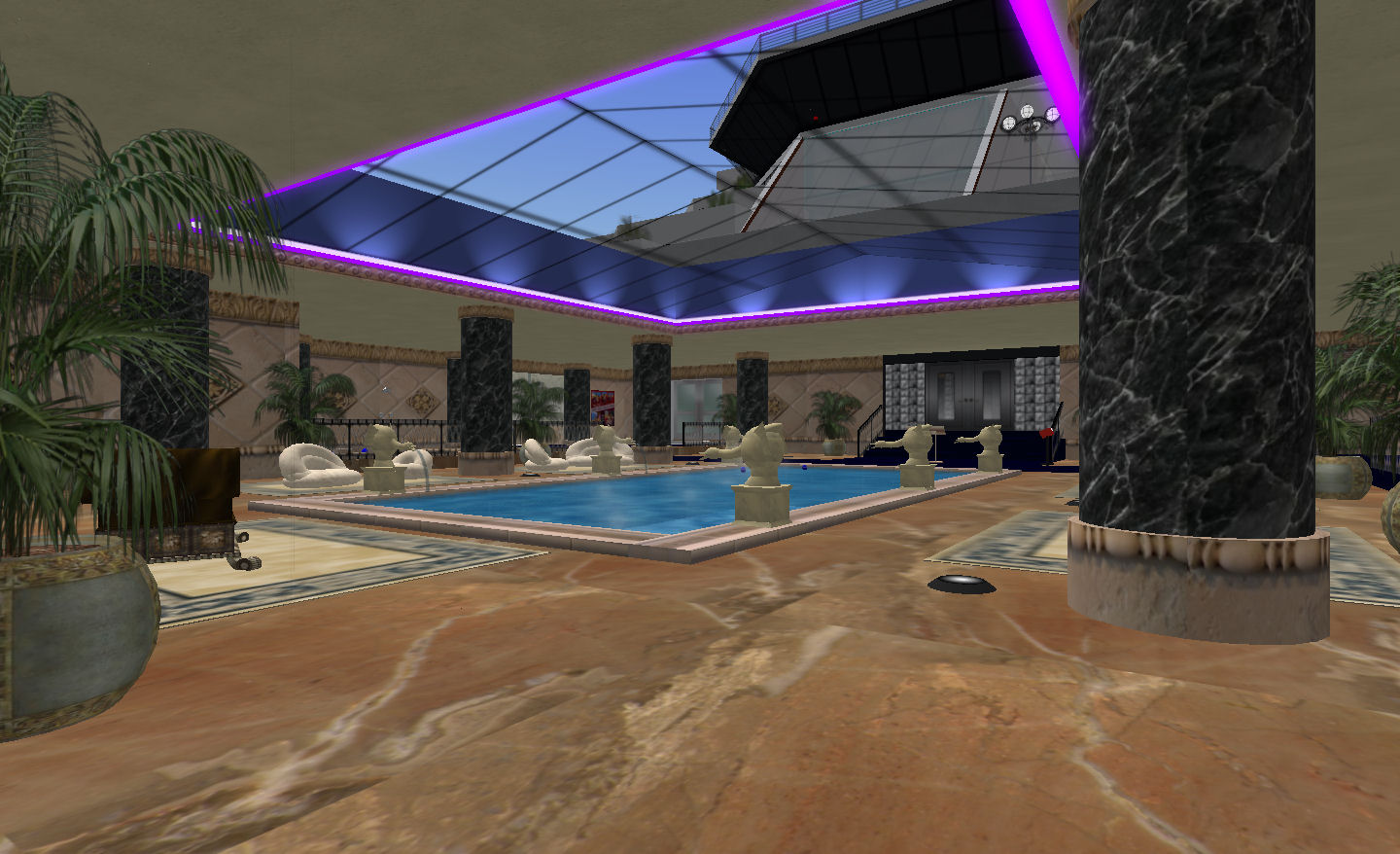
Also at the fore end of the ship lay the Boiler Room Nightclub and the Galaxy’s spa and fitness centre. The latter includes a pool, sauna, Jacuzzi and exercise machines for that perfect pumped prim look – note that it is also “clothing optional”!

Dining out, Japanese-style

For those who like dining out in Second Life, the Galaxy offers a choice of restaurants. My personal favourite is the Japanese garden, featuring individual chalets where you can dine in comfort, drinking in the night-time ambience and enjoying the company of friends.

And it doesn’t end there – there is more to discover in and around the SS Galaxy, but I’m going to leave this as a taster and tease. If you want to find out more, you should take time out and pay the SS Galaxy a visit – you won’t be disappointed.

The spa’s swimming pool

Places mentioned in this article

Recommendations when visiting the Galaxy

  • Make sure you turn up your draw distance as far as your system can comfortably handle
  • If you want to get around the ship quickly, make sure you pick up and Information Card from one of the many note card givers around the ship – they contain a host of useful landmarks
  • Be aware that the ship is home to a lot of people as well as a place to visit
  • Give yourself plenty of time to explore
  • Keep an eye out for the holodeck
  • If you’re confused as to where you are, look out for one of the cutaway plans of the ship to orient yourself.
A life on the ocean wave: staterooms, suites and cabins for rent

Related Links

Wow…just wow!

Dad e-mailed this video link, shot from Soyuz TMA-20 on the 8th June 2011.

Naysayers and the Doom of Second Life

The world is full of naysayers; the virtual world doubly so. It seems we cannot get through a single week without someone raising a cry that Second Life is either dying, dead, or en route to the hospital while undergoing CPR.
This isn’t a new phenomenon; the doom of Second Life has been oft-predicted over the years, with a notable increase following the “boom” period of 06/07; the cry frequently being heard from both users and mainstream sources. More recently, self-styled virtual worlds /social media pundit Hamlet Au (Wagner James Au), rarely misses an opportunity to pronounce SL as having entered a phase of terminal decline (damn you, pesky users!).

The Chicken Little Syndrome

It cannot be denied that apart from the odd blip, Second Life has plateaued, concurrency remains fairly flat, and while we’ve been seeing a recent upturn in new user sign-ups, it’s unclear as to whether the sign-ups are new users (and if so, whether they are being retained), or whether they are existing users trying out the new sign-up process and creating alts for other purposes. On top of this, the economical stats, despite all the fiddling and tweaking that has gone on around them on-and-off for over a year new, remain relatively level outside of the SL Marketplace.

But, a lack of highly visible growth doesn’t actually equate to the platform “dying” in any way. As mentioned above, it’s very easy to take things out of context or be highly selective in which data you use to make a point. Take Hamlet Au’s recent “deathwatch” claim. On the surface it makes worrying reading: the grid is losing large number of sims (74 in one month!) representing large amounts of income for LL ($250,000!), all of which is “extremely significant” (i.e. “ominously bad”) for SL.

Except that as I pointed out, Hamlet arrives at this sensationalist viewpoint through a bad case of selective reading. The very source he quotes goes a long way towards undermining his position:  end-of-month sim losses tending to be countered by new sim leases the following month; the figures for March 2011 actually showing LL’s sim revenues increased by 1%, and so on.

Another thing somewhat taken out of context and used to paint a black picture of Linden Lab were last year’s layoffs. When announced, people preferred to pooh-pooh the Lab’s official line that the layoffs were part of a strategic restructuring, and instead sagely pronounced they were “proof” that the company was in deep financial do-doos. However, in doing so they tended to overlook the Lab’s history in the two years prior to the lay-offs.

Up until 2008, Linden Lab had, staff-wise, expanded at a pace which matched the growth of Second Life, to reach around 250 when Mark Kingdon joined the company as the new CEO. At that time, Philip Rosedale was, somewhat prematurely, talking in teems of massive expansion:

“We’re looking for someone who has experience with and a passion for growing this type of company — a software platform company — from 250 people to thousands of people, which is where we think it’s going,”

Sure enough, following Kingdon’s appointment, the company did start hiring at an impressive rate, taking on around 100 staff between March 2008 and June 2010 – a figure well ahead of any matching upturn in the take-up / use of Second Life in any market sector. While there was much ado during that period about the SL Enterprise product and Linden Lab trying to transform Second Life into a viable corporate business platform, it was questionable as to whether all the hires made during that period were actually required and sustainable.

History now shows us that the answer to that question has been “no”. Second Life has failed to come anywhere near being a credible business platform in the terms the LL themselves touted; the Second Life Enterprise product has been scrapped. As such – and while undoubtedly traumatic for those involved – the lay-offs do appear to have been driven by a strategic decision to refocus on the company’s core business and bring staffing levels back in line with the needs of the platform rather than any knee-jerk reaction to a financial “crisis”.

Money Talks

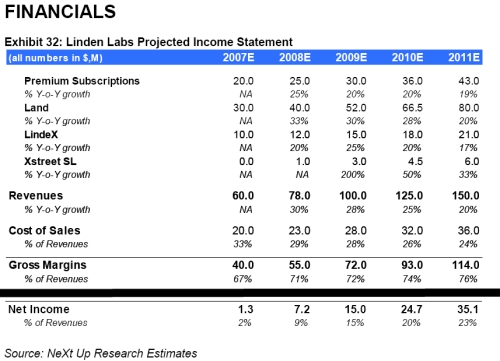
On the subject of finances, and while LL aren’t in the habit of giving out financial data, let’s again look at recent history. Back in 2008, and before his view of Second Life soured, Hamlet himself estimated Linden Lab could well be clearing between $40 and $50 million profit a year, based on an income stream of around $96 million.

Of course, since then, we’ve had a global financial crisis, the Lab itself has (see above) made unwise investments and tried to shift its focus in to unfounded markets which ultimately failed to pay off, and so on. By mid-2009, Mark Kingdon was candid enough to admit that while the figure wasn’t as high as Hamlet’s estimate, the company was still in good health, financially. Indeed, in that year, NeXt Up was estimating the Lab’s revenues could hit the $100 million mark. So while the company was undoubtedly suffering from increased overheads, a massive upswing in expenditure (staff increases, foreign offices, etc.) – is it really credible that by 2010, things had reached a state where the company was teetering on the edge?

I have a hard time accepting that. Even if profits were halved between 2008 and 2010, that still leaves Linden Lab generating a modestly-healthy $22 million a year, and that’s without taking into consideration the growth of the Grid itself (some 11,000 regions added), which helped generate entirely fresh income for Linden Lab. Indeed, in what was to be one of his last official statements for Linden Lab, Mark Kingdon went on record in June 2010, stating:

“The fact is our underlying financial health is very strong. We’re on pace this year for record revenue, record user numbers and record user-to-user transactions – among other positive indicators [my emphasis].

Now, “record revenue” may not automatically translate to “record profits”, but by the same measure, it also doesn’t mean the company has been losing money hand-over-fist. The truth is going to be somewhere in the middle, and liable to be the case that while profits were reduced during that period, LL nevertheless remained as healthy and as viable as it had ever been – which is again a long way short of falling off the cliff in terms of solvency.

Of course, this doesn’t mean everything is rosy in the garden of Second Life. People – the Lab’s Board included – have been expecting stellar things from the platform, and these clearly have yet to materialise – if indeed they ever will. There are issues that need to be sorted with regards to the scalability, stability and usability of the platform; there are equally valid questions around how LL can constructively engage with its user community and draw in and retain new users. There are even bigger questions to be asked as to whether or not Second Life and its ilk really do have a truly “mass market” appeal.

But none of these are indicative of a company that is teetering on the edge of financial disaster, and commentators who constantly try to slant things in that direction really aren’t doing themselves any favours.

Sincerely, Disgruntled of Second Life

Dear Linden Lab,

Things have never been easy in Second Life, for you, for us, for anyone. But once upon a time when you were about to start working on something that might affect us all in world, or when you discovered something was going borky, you’d have the decency to tell us. There would be a nice little blue pop-up appear in the top right-hand corner of the screen advising users of this, that or the other. When issues were resolved, there would be a nice little notice telling us so.

It was informative; it was helpful; it was reassuring to know you guys were out there, keeping an eye on things and letting us know what was going on. It gave us a nice warm fuzzy feeling inside. In short, it was communicative.

And then one day it stopped, leaving us with no option but to find out about Things Going Wrong or that planned maintenance had started by experiencing it the hard way: through teleports failing or transactions going astray or No Copy items poofing into the ether, never to be seen again.

Now, I appreciate that you cannot be on top of absolutely everything. The unexpected isn’t exactly predictable; that’s why it’s called “the unexpected”, right? I mean, I understand that. No-one can reasonably ask you to always get the word out before people start having issues and problems. But when you are aware of problems or when you yourselves are about to start Doing Things, is it really too much to ask that you actually, well, let us know in-world?

Yes, I know you try to keep us informed via the Grid Status Page and Twitter; but frankly, not everyone has a Twitter account. And even those of us who do find that having to keep one eye on it and one eye on the Grid Status Page tends to be a tad disruptive of the old immersive in-world experience we all know and love.

Surely it’s not that hard to renew the old in-world notices to all and sundry? After all, what is preferable: being told database maintenance is underway and that logins are suspended, or deciding to log out for a few minutes while you make a cuppa only to have the log-in screen gloatingly inform you you cannot now log back in?

I know which I’d prefer. So how about it? Pretty please?

Sincerely,

Disgruntled of Second Life.

Mesh uploads to be gated

Tateru Nino relays the news that Mesh imports to Second Life are to be separately gated. According to the SL wiki page on Mesh Upload Enablement:

“In order to prevent usage of intellectual property with the mesh upload tool, prior to uploading a mesh with a Mesh enabled viewer, 2 checks will occur before the user will be allowed to upload. The first check will be to verify payment information is on file and the second is a chance to educate the user with a short tutorial. After the user completes the tutorial, they will be enabled to upload content.

“A flag will be added to the CSR tool which will allow supoort [sic] to enable and if approriate disable the ability to upload mesh. The viewer will use the user’s enable mesh flag to activate the upload mesh capability. If it is disabled, a message will appear and a link to the secondlife.com link for the tutorial. The scope of this testing is to confirm expected results for this setting on Mesh and non Mesh viewers as well as test the tutorial and ensure it enables mesh ability accordingly.”

Once the criteria of having PIOF and going through the tutorial have been met, people will essentially be “licensed” to upload mesh creations. However, like any license, the ability to upload mesh can be revoked:

“If Lab determines user is in violation of IP mesh upload terms, user can be indefinitely flagged as not mesh enabled regardless of how many times they continue to complete the tutorial.”

Clearly this is intended to help deal with matters relating to IP and copyright violations, DMCA claims and suchlike, all vital to protect the authors of mesh files and content in the event of theft. Let’s face it, the whole issue of IP and copyrights are convoluted when it comes to mesh; therefore caution is required.

 Take a look at the picture on the left. It’s a mesh model of Frank Lloyd Wright’s famous Kaufman house, “Fallingwater”. It’s available on a website for $75.00USD. It can apparently be purchased legally.

But who actually owns the copyright? The website? The creator? Or the Frank Lloyd Wright Foundation?

The question is important because the FLW Foundation is jealously guarding anything and everything it considers to be its intellectual property. Just last year, after cooperating with it, they issued cease and desist letters against the Frank Lloyd Wright Museum in Second Life, forcing it to close its doors. As such, who is to say that even a product like this, brought in good faith, will not land someone wishing to upload it to SL up in a world of hurt? And the FLW Foundation isn’t alone in guarding its property.

Right now, mesh is the elephant in the room; hard to ignore, but not the easiest thing to deal with. The risk of copyright violations, claims of illegal usage, the potential involvement of legal teams from major organisations is a risk; just a glance at all the Star Wars, Star TreK, DC Comics and other meshes available off the web has to give rise to the question, “Yes, but how much of it is actually licensed? Ergo, Linden Lab need to take steps to protect themselves against major upsets and openly discouraging people from knowingly uploading content they shouldn’t be bringing in-world – and making the accounts they use to upload said content personally linked to those using them is certainly one way of going about it.

But it also means that those creators who would stick to only uploading their own creations but who have preferred not to / been unable to give PIOF are going to find themselves ostracised, and this could well result in the new requirement being subject to upset and consternation.

Gating uploads also has a secondary potential benefit: mesh is both an unknown quantity and a complex subject. While it has been under extensive testing on the beta grid, its still not entirely clear as to what impact it might have on the main grid – and there is a risk that poorly-developed meshes could do more harm than good when it comes to sim performance. Ergo, providing a means of blocking ill-developed models from being imported until such time as the creator can improve their technique and keep within whatever parameters are required without having to block their account in its entirety would also seem to be a wise step to take.