The Beagle had landed

An artist's impression of Beagle 2 on Mars (credit: European Space Agency)
An artist’s impression of Beagle 2 on Mars (credit: European Space Agency)

In June 2003 the European Space Agency launched a pair of vehicles to Mars. The larger of the two, an orbiter vehicle called Mars Express, is still in operation today, albeit often overlooked by the media in favour of its American cousins also in orbit around the Red Planet.  The other vehicle, piggybacking on Mars Express, was a tiny lander (quite literally, being just 39 inches across) called Beagle 2.

Designed to search for signs of life, past or present on Mars, Beagle 2 was the Mission That Almost Never Was, because at the time it was proposed, no-one outside of those wanting to build it, wanted it. And yet, even today, the science package it did eventually take to Mars is one of the most remarkable feats of science engineering put together, with capabilities that will not be repeated until NASA flies their one tonne Mars 2020 mission at the start of the next decade.

Sadly, for all its innovation and despite overcoming the odds to actually fly to Mars, Beagle 2 never achieved its goals; all contact was lost on the very day it was due to land on the Red Planet, December 25th, 2003. What happened to it remained a mystery for twelve years, but on Friday, January 16th, members of the Beagle 2 team were able to reveal that the fate of the plucky little lander was now known.

The Beagle 2 story begins in April 1997, when the European Space Agency held a meeting to discuss the possibility of flying an orbiter mission to Mars in 2003, following the failure of an earlier mission. This new mission would be called “Mars Express”, both in recognition of the exceptionally short lead-time to develop and fly it, even using instruments and systems developed for the failed mission, and for the fact that in 2003, Earth and Mars would be the closest they’ve been for some 60,000 years, allowing anything launched around the middle of that year to reach Mars in a comparatively short time.

Colin Pillinger, the man very much at the centre of Beagle 2, and who brought the mission to the public eye

Professor Colin Pillinger, a planetary scientist and a founder of the Open University’s prestigious Planetary Science Research Institute (since merged with the OU’s Department of Physics and Astronomy), attended the meeting together with his wife Judith, also a planetary scientist. At the time, Professor Pillinger was one of a number of scientists involved in investigating whether or not biogenic features had been discovered in a meteorite found in Antarctica, but which had originated on Mars.

This particular debate was focused on a piece of rock called ALH84001, regarded as one of the oldest pieces of the Solar System, being just over 4 billion years old, and which formed at a time when Mars was likely a warm wet planet. It had been raging for a year with no sign of abating, and Professor Pillinger had already come to the conclusion that one way to settled it would be to put a life sciences package actually on Mars.  He realised the proposed Mars Express mission presented the perfect opportunity for doing so, as did his wife. So much so, that by the time they got back to the UK, she had the perfect name for a mission designed to seek out evidence of life on Mars: Beagle 2, named for the vessel commanded by Captain Robert FitzRoy that carried Charles Darwin on his seminal voyage of discovery.

The microscopic structures revealed by a scanning electron microscope deep within a fragment of ALH84001 that suggested biogenic origins
One of the microscopic structures revealed by a scanning electron microscope deep within a fragment of ALH84001 that suggested biogenic origins

Given all of the controversy surrounding ALH84001 and the question of possible microbial life on Mars that dated back to the Viking Lander experiments of the 1990s, you’d think the ESA would jump at the opportunity to put a life sciences mission on Mars. Not so; for one thing, others also saw Mars Express as an opportunity to fly their projects to Mars and were busy lobbying. More to the point, it was held that the 6-year time frame for developing a lander mission from scratch was too short.

However, Colin Pillinger was not one to be deterred. In the UK he brought together a team from academia and industry, including Doctor Mark Sims, who was to prove pivotal in the  engineering design of the lander. With many of those involved in the nascent project initially working on it entirely in their own time, Beagle 2 rapidly developed from a series of rough designs “on the backs of beer mats”, to a proposal which, when presented to ESA managers, so impressed them, they provisionally agreed to the idea of flying a lander to Mars – but only if the UK was able to fund it. No money would be forthcoming from ESA.

Dr. Mark Sims of the University of Leiceter, who lead the engineering team responsible for Beagle 2, seen with another model of the lander (image: University of Leicester)
Dr. Mark Sims of the University of Leicester, who lead the engineering team responsible for Beagle 2, seen with another model of the lander (image: University of Leicester)

Thus began one of the most remarkable public relations exercises in annals of space history, with Beagle 2 becoming a household name in the UK, as Colin Pillinger sought to promote in on television, the radio, through newspaper and magazines, and giving public presentations. Space advocacy groups were rallied to the cause, celebrities were brought in to add their weight to things, Parliament and industry were lobbied and won over. In the end, the entire £44 million (US $70 million) was raised, with 50% coming from the UK government and the rest from the private sector.

Continue reading “The Beagle had landed”

The human adventure is just beginning

Orion EFT-1 lifts-off exactly on time, 12:05 UTC, on Friday, December 5th, 2014
Orion EFT-1 (Exploration Flight Test 1) lifts-off exactly on time, 12:05 UT, on Friday, December 5th, 2014

Friday, December 5th marked what will hopefully be the first genuine step humans take in exploring the high frontier of space without total reliance upon robot vehicles. It came in the form of the launch, at 12:05 UT, of the first space vehicle in over forty years to be specifically designed to carry a crew beyond the limits of low Earth orbit and out into the depths of the solar system: the Orion Multi-purpose Crew Vehicle.

Originally, the lift-off had been planned for Thursday, December 4th. However, a series of incidents involving a small boat compromising the range safety exclusion zone, difficult winds over the launch pad, and then technical issues with two fuel valve systems aboard the Delta IV Heavy rocket, prompted the delay of the mission by 24 hours. But when the mission did get under way, it did so flawlessly, and continued in that manner right through until splashdown 4.5 hours later.

The two fairings which protect the Service Module as it sets between the Orion capsule and the upper stage of its launch booster (and which also take a fair amount of the dynamic pressures the vehicle experiences during launch) are jettisoned

Orion launched precisely on time, lifting-off in the post-dawn light of Florida’s Space Coast, and rising smoothly from Launch Complex 37 at Canaveral Air Station. The textbook launch was followed by a mission that followed the flight plan with amazing accuracy to the point where the craft, after a journey that carried it further than any vehicle intended to carry humans has flown in 42 years, and  which saw it punch its way back through the Earth’s atmosphere at 32,000 kph, splashed down just three kilometres or so from its planned target point.

The mission, called Exploration Flight Test 1, was uncrewed, and intended to test all of the critical systems for the vehicle with the exception of the Service Module, which won’t fly until the next Orion mission in 2017. Through the flight all of the system vital to the safety of a crew were put through their paces: the Launch Abort System, radiation protection, heat shield, and multiple parachute systems and the floatation system, together with all the vehicle’s complex flight avionics and software.

The limb of the Earth as Orion reaches some 4,000 km from its home, on its way to over 5,800 km, before making its return

So well did the vehicle perform through the flight that it was, in some ways, mundane; milestones came and went without a hitch, with only the launch and re-entry / splashdown forming points of drama / excitement. But really, that’s the whole point; problems aren’t what you need on a space mission. Let Hollywood play with them, but leave them out of the real thing.

Following launch, the vehicle rapidly climbed to orbit, the Delta launch vehicle’s two side boosters dropping away after the first few minutes of the flight to leave the core booster to get the vehicle to its initial height. Separation of the upper stage, complete with the “dummy” Service Module and Orion capsule then occurred, follow by the jettisoning of the fairings covering what would normally be the Service Module, and the ejection of the Launch Abort System (which, in a real mission, would automatically pull the capsule, which it enshrouds during launch, away from the main rocket the millisecond a serious anomaly in the rocket’s flight status is detected).

Re-entry: a camera aboard Orion captures the limb of the Earth, with the flames of super-heated plasma just visible as the bow-shock wave of the craft's entry into the atmosphere generate temperatures of 2,200C (twice that of molten lava) directly in front of the capsule, and around 1,800C around it, all of which is prevented from burning-up the vehicle by the presence of the heat shield 2under" the capsule and the shuttle-like thermal tiles covering its conical sides
Re-entry: a camera aboard Orion captures the limb of the Earth, with the flames of super-heated plasma just visible at the top, as the bow shock compression of air in front of the craft generates enormous friction with the air around it. Temperatures within the plasma reach 2,200C (twice that of molten lava) directly in front of the capsule, and about 1,800C around it, all of which is prevented from burning-up the vehicle by the presence of the heat shield “under” the capsule and the shuttle-like thermal tiles covering its conical sides

Passing through the Van Allen radiation belts – a critical test for the vehicle’s radiation protection and its electronics – Orion rose to a height of over 5,800 km above the Earth prior to separating from the Delta upper stage and “dummy” Service Module to start its return to Earth under its own power. This allowed mission planners to test the vehicle’s propulsion systems, which also functioned perfectly and with a greater degree of accuracy than had been expected.

Indeed, the only “failures” encountered with the flight, were the loss of the parachute bay cover – a section of the spacecraft which protects Orion’s parachute systems, and which is jettisoned for later recovery following re-entry into the Earth’s atmosphere – and the first set of drogue ‘chutes deployed. Following splash down, it was discovered that one of the 35-6 metre diameter main parachutes had sunk before it could be recovered, and one of the five floatation devices used to right the craft should it land inverted in the water (it didn’t), had failed to inflate.  All of these are really minimal loses when compared to the overall success of the flight.

A great shot from the recovery ship USS Anchorage, sent via the NASA Google Hangout covering the mission, showing Orion EFT-1 descending under 3 fully deployed main parachutes

There will now be a three-year pause in Orion flights. This will allow the first Service Module to be built and delivered to NASA by the European Space Agency and, more particularly, allow NASA to complete the construction of the first in its new generation of launch vehicles, a rocket simply referred to as the Space Launch System.

Even so, and as I recently blogged, Orion EFT-1 marks the first step in what will hopefully, political will allowing, be a new era in the exploration of our solar system. As such, and despite more than fifty years having passed since the first man orbited the Earth, it is fair to say that where space flight is concerned, the human adventure is just beginning.


Orion: first flight time line

The moment of separation: Orion, shrouded by the Launch Abort System, and attached to the "dummy" Service Module / Delta upper stage combination at just after separation from the main stage of the Delta rocket. The two panels seen either side of Orion are the panel that protect the Service Module during ascent to orbit
The moment of separation: Orion, shrouded by the Launch Abort System, and attached to the “dummy” Service Module / Delta upper stage combination, just after separation from the main stage of the Delta rocket. The two panels seen either side of Orion protect the Service Module during ascent to orbit, and are jettisoned just ahead of the Launch Abort System

Update: Friday, December 5th. The Orion EFT-1 mission was a complete success, and I have an update available for those interested.

Update: Thursday, December 4th, 2014: due to a series of issues involving a boat straying too close to the launch pad, wind speeds around the pad exceeding safe limits, a fuel valve problem on two of the booster engines and – finally – concerns over the battery lief on Orion’s camera systems expiring due to lack of charge (with the fuel valve issues also unresolved) a decision was made to scrub the launch. A re-try will be made on Friday, December 5th, all major times given in the time line here remain the same, although NASA TV coverage will not commence until 11:00 UTC / 06:00 EST.

At approximately 12:05 PM UTC, on Thursday, December 4th, a Delta IV Heavy booster should lift-off from Launch Complex 37 at the Cape Canaveral Air Force Station (immediately to the south of NASA’s Kennedy Space Centre, and the home of the vat majority of America’s unmanned rocket launches).

Sitting at the top of the rocket, covered by the protective shroud of its Launch Abort System, will be America’s newest space vehicle, one that will – if all goes well, and political willingness is maintained – carry a crew to an asteroid in 2021, before taking humans back to the Moon, and then, perhaps around 2032, onwards to Mars and back.

The Orion "stack" at launch
The Orion “stack” at launch

The Orion Multi-purpose Crewed Vehicle (MPCV) is, as I’ve mentioned before in these pages, the first crew-capable space vehicle NASA has commissioned and will operate since the the space shuttle – a design itself rooted in the !970s. Yet in some respects, Orion evokes an even earlier era than that – the heady days of Apollo. Not only will it hopefully participate in lunar missions in the future, it actually resembles the Apollo Command Module, being a capsule vehicle, albeit one larger than Apollo (it can carry up to six crew, although four will likely be the usual crew number) and it is truly state-of-the-art in terms of design and capabilities.

This first launch will see Orion operated in an uncrewed proving flight, and will mark the start of a 4.5 hour mission that will see the capsule, complete with a “dummy” service module (again, like Apollo, Orion uses a Service module unit to supply life support, power and propulsion), travel further from the Earth than any vehicle designed to carry a crew has gone since the last of the Apollo Moon missions in 1972.

In doing so, the vehicle will be tested through the Van Allen radiation belts surrounding the Earth, and the capsule will be directed to re-enter the Earth’s atmosphere at around 80% of the velocity it would achieve on a return from a cislunar mission (that is, roughly 4,000 kph (2,500 mph) faster than the space shuttle ever returned to Earth).

For those interested in the mission, here’s a brief time line of events:

  • 03:50 UTC, December 4th / 10:50 EST, December 3rd: The mobile launch gantry starts to withdraw from the launch vehicle
  • 07:35 UTC / 02:35 EST, December 4th: Fuelling the Delta IV Heavy commences
  • 08:35 UTC / 03:35 ET: NASA flight control team take over from United Launch Alliance in managing launch preparations
  • 09:30 UTC / 04:30 EST: NASA TV coverage of the launch commences
  • 11:46 UTC / 06:46 EST: Terminal countdown hold for final pre-launch checks
  • 11:57 UTC / 06:57 EST: Go / No Go launch poll; Orion switches to internal power
  • 12::01 UTC / 07:01 EST:  Terminal countdown begins
  • 12:05 UTC: / 07:05 EST: Lift-off!
  • 12:05  through 12:22:39 UTC / 07:05 through 07:22:39 EST:  vehicle climbs to initial orbit of 185 x 888 kilometres (115 x 552 miles), during which boosters and first stage are jettisoned, as are the Service Module fairings and Launch Abort System. Orion and Service Module still attached to Delta upper stage
  • 14:00:26 UTC / 09:00:26 EST: Delta upper stage engine re-fires for 4:45 minutes, pushing the vehicle to its extended elliptical orbit that will carry it 5,800 km (3,600 miles) from Earth
  • 14:10-14:25 UTC / 09:10-0925 EST: Orion passes through Van Allen radiation belts; cameras turned off during this period
  • 15:10 UTC / 10:00 EST: Orion reaches furthest distance from Earth
  • 15:28:41 UTC / 10:28:41 EST: Orion capsule detaches from “dummy” service module / Delta upper stage
  • 15:35-16:10 UTC / 10:35-11:10 EST: Orions passes back through Van Allen radiation belts, reaction control motors used to initiate return to Earth
  • 16:18:35 UTC / 11:18:35 EST: re-entry into Earth’s atmosphere commences at 36,000 kph (20,000 mph)
  • 16:18:41-16:21:11 UTC / 11:18:41-11:21:11 EST: radio blackout & hottest period of re-entry with heat shield temperatures reaching 2,200C (4,000F), slowing the vehicle to around 480 kph (300 mph)
  • 16:24:29 UTC / 11:24:39 EST: parachute bay cover jettisoned (and also recovered after parachuting to its own splashdown)
  • 16:24:31 UTC / 11:24:31 EST: drogue parachute deployed, slowing vehicle from 480 kph (300 mph) to 160 kph (100 mph)
  • 16:25:40 UTC / 11:25:40 EST: main parachute deployed, slowing the vehicle from 160 kph (100 mph) to less than 30 kph (20 mph)
  • 16:28:29 UTC / 11:28:29 EST: Spashdown, to be followed by recovery by the USS Anchorage.
The boat (arrowed) that initially held the Thursday, December 4th launch, as it sits within the safety exclusion zone
The boat (arrowed) that initially held the Thursday, December 4th launch, as it sits within the safety exclusion zone. the first of several delays and issues which eventually resulted in the planned launch being scrubbed for 24 hours.

To infinity and beyond

Things are a tad quiet on the Mars news front, with Curiosity still on walkabout in the “Pahrump Hills”. So here’s a little round-up of some upcoming NASA news.

Orion Countdown

Thursday, December 4th should see the first launch of NASA’s next generation crewed space vehicle, the Orion Multi-purpose Crew Vehicle (MPCV). Superficially harking back to the days of the Apollo Moon landings, Orion is a two-stage vehicle comprising a capsule-like Command Module, capable of seating up to 6 astronauts, and a smaller Service Module, which supplies propulsion, power and life support. However, Orion is a lot more sophisticated than the Apollo craft, the capsule unit being a lot larger in both size and volume, and having the capabilities of both being reused and of making either a splashdown or landing on dry land on its return to Earth.

The Orions MPCV: an Apollo-like command module and, with its solar panels deployed, the Service Module
The Orion MPCV: an Apollo-like Crew Module and, with its solar panels deployed, the Service Module

As I’ve previously reported, this first launch of Orion will be uncrewed, serving to test the vehicle’s launch, flight and recovery capabilities in a mission lasting some 4.5 hours which will take the craft further from Earth than has been the case for any crewed vehicle since the last of the Apollo lunar missions in the 1970s. In doing so, the vehicle will be tested through the Van Allen radiation belts surrounding the Earth, and the capsule will be directed to re-enter the Earth’s atmosphere at around 80% of the velocity it would achieve on a return from a cislunar mission (that is, roughly 4,000 kp/h (2,500 mph) faster than the space shuttle ever returned to Earth).

Orion is designed to sit at the hub of NASA’s plans for the initial human exploration of the solar system. Its likely future uses include ferrying crews to the Moon and back and, in the 2030s, forming the command vehicle in a human mission to Mars.

An artist's conception of Orion delivering a large lunar lander to the Moon
An artist’s conception of Orion delivering a large lunar lander to the Moon

For lunar missions, Orion will, again like Apollo, be mated to a lunar lander, which it will ferry to the Moon, before the crew transfer to the lander and descend to the Moon’s surface. Again, the differences are that with the Orion mission, the MPCV can remain “parked” in lunar orbit unattended while the crew use their lander and equipment and facilities landed remotely on the Moon to spend weeks or Moons there, rather than days.

For missions to Mars, Orion will be part of a much larger vehicle, the details of which are still to be decided, but which is likely to be launched by Orion’s dedicated rocket, the Space Launch System (SLS), in a number of parts which will rendezvous in orbit prior to the crew flying to it via Orion and embarking. An Orion capsule would then serve as the Crew Return Vehicle, delivering the crew back to Earth at the end of there 3-year mission.

An Orion would serve as the Crew Return Vehicle to deliver the crew safely back to Earth at the conclusion of a nuclear-powered mission to Mars (NASA Design Reference Architecture mission)
An Orion would serve as the Crew Return Vehicle to deliver the crew safely back to Earth at the conclusion of a nuclear-powered mission to Mars (concept: NASA Design Reference Architecture mission)

Orion’s first mission will use a fully-functional capsule mated to a “dummy” service module (the actually service module is to be built by the European Space Agency, using the technologies developed in the hugely successful but grossly under-sung Automated Transfer Vehicle design, which has been quietly resupplying the International Space Station for the last five years (and refuelling it) with up to 7 tonnes of supplies per flight – more than double anything managed by the Russian Progress supply vehicles, the SpaceX Dragon and Orbital Science’s Cygnus vehicle.

In 2017, Orion will make an unmanned flight around the Moon (shown in the video below), this time using an actual Service Module and the SLS launcher, in what is being called the Exploration Mission 1. Then, in around 2021, Orion will fly its first crew in a mission to rendezvous and land on an asteroid.

New Horizons to Wake-up

Assuming all goes according to plan, two days after the Orion test flight, over 26 AU from Earth (AU being an astronomical unit – the average distance between the Earth and the Sun – that’s 149,597,871 kilometres or 92,955,807 miles), a tiny space craft will “wake up” from the third of three hibernation periods which have collectively lasted 31 months, allowing it to ready itself for its primary mission objective: a 6-month “flyby” of the dwarf planet Pluto, which should yield masses of information about that world and its major companion Charon.

after 10 years in space – the last 31 months of which have been largely in hibernation (other than brief periods of science data gathering), and a voyage through our solar system which has, like that of ESA’ comet-chasing Rosetta mission – provided many other opportunities for science discovery, New Horizons will commence its primary mission in January 2015, as it starts into its approach and fly-past of Pluto, Charon and their family of tiny “moons”, Kerberos, Styx, Nix and Hydra.

An artist's impression of New Horizon passing Pluto, with Charon and the Sun behind.
An artist’s impression of New Horizon passing Pluto, with Charon and the Sun behind.

No-one actually knows what New horizons will reveal; such is the distance between Earth and Pluto, we know very little about it in real terms, so the mission is very much like those of the pioneering days of space exploration, when we sent vehicle to Venus and Mars, not actually knowing for sure what they’d find.

Despite travelling at 1,600,000 kilometres a day, it will take New Horizons until July 2015 to reach its point of closest approach to Pluto – just 10,000 kilometres from the planet’s surface. The images and data it should return to Earth promise to be astounding.

And after July 2015? New Horizons will be heading out into deep space beyond our solar system, becoming only the third vehicle built by humans to do so, the other two being Voyagers 1 and 2. Providing it is still active, New Horizon should reach the heliosphere,  the “boundary layer” marking the divide between the solar system and interstellar space, in 2038. Between 2015 and then, the craft will be used to observe other Kuiper belt objects of interest and send back data on the space through which it is travelling.

Wanderers

Whether humanity ever joins Voyager and New Horizons in moving beyond our own solar system is a subject of popular debate. Given the distances involved between the stars, the only practical way of reaching solar systems beyond our own in through exotic methods – faster-than-light travel, wormholes, and the like – if we are to avoid centuries and generations travelling the interstellar void; and there is still no guarantee we’ll harness either.

But even should we remain locked inside our own solar system for centuries to come, we still have a vast range of environments to explore and possibly tame. This is something Erik Wernquist reminds us about in a stunning video he’s produced, using selected commentary spoken by the great Carl Sagan during his ground-breaking television series, Cosmos. This really is one to watch.

My thanks to Nalates Urriah for pointing me to Erik’s video.

Of Martian walkabouts, pictures from a comet, and getting ready to fly

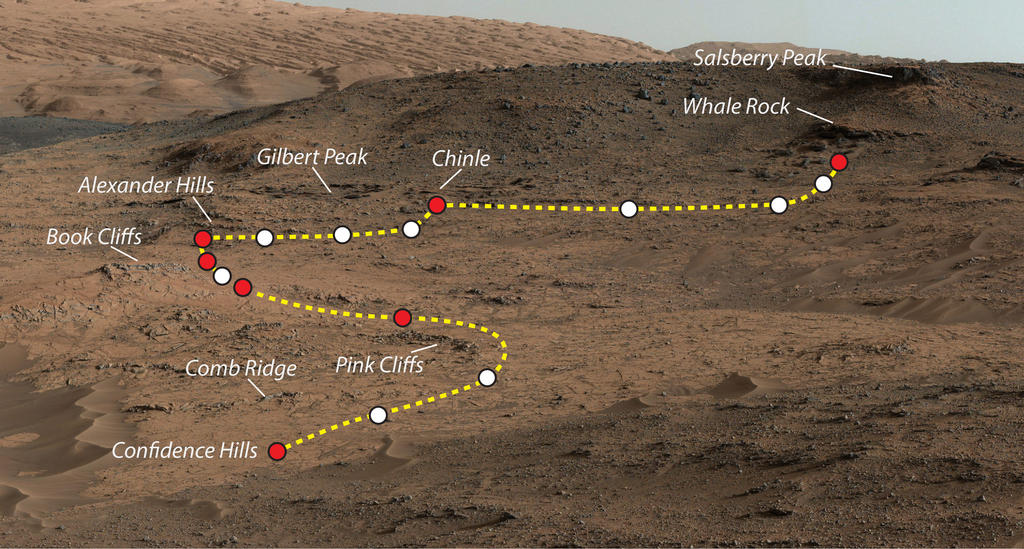
CuriosityIn my last report on the Mars Science Laboratory, I mentioned that Curiosity has been on a geology “walkabout” up the slopes of the “Pahrump Hills” at the base of “Mount Sharp” (more correctly, Aeolis Mons). The zigzagging route up through the area took the rover from “Confidence Hills” and the location of the last drilling operation up to a point dubbed “Whale Rock”, the drive being used to gather information on potential points of interest for further detailed examination.

The exposed rocks in this transitional layering between the floor of Gale Crater, in which Curiosity arrived back in August 2012, and the higher slopes of “Mount Sharp” is expected to hold evidence about dramatic changes in the environmental evolution of Mars. Thus, the “walkabout”  – a common practice in field geology on Earth – was seen as the best means of carrying out a reasonable analysis of the area in order for the rover to be most efficiently targeted at specific locations of interest.

Curiosity’s walkabout, from “Confidence Hills” to “Whale Rock” in October, the rover is now working its way back to various points of interest for further studies

“We’ve seen a diversity of textures in this outcrop,” Curiosity’s deputy scientist Ashwin Vasavada (JPL) said of the drive. “Some parts finely layered and fine-grained, others more blocky with erosion-resistant ledges. Overlaid on that structure are compositional variations. Some of those variations were detected with our spectrometer. Others show themselves as apparent differences in cementation or as mineral veins. There’s a lot to study here.”

During the drive, Curiosity travelled some 110 metres, with an elevation of about 9 metres, using the Mastcam and the ChemCam (Chemistry and Camera) laser spectrometer system to inspect and test potential points of interest for more detailed examination at a later date. Since completing that drive, the rover has been working its way back through Pahrump Hills, this time examining specific targets using the robot-arm mounted Mars Hand Lens Imager (MAHLI) camera and spectrometer. Once this work has been completed, specific targets for in-depth analysis, including drilling for samples will for the core activity of a third pass through the area.

So far, two specific areas have been identified for detailed examination. The first, dubbed “Pelona” is a  fine-grained, finely layered rock close to the “Confidence Hills” drilling location. The second is a small erosion-resistant ridge dubbed “Pink Cliffs” the rover drove around on its way up the incline.

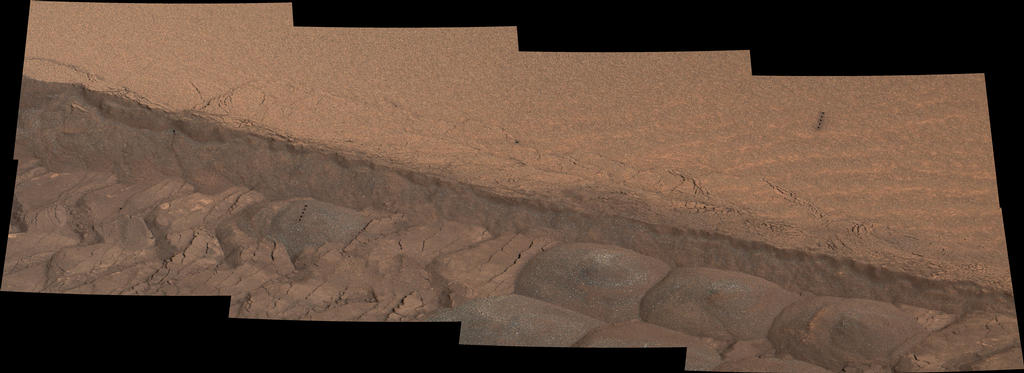
“Pink Cliffs” is roughly a metre (3ft) in length and appears to resist wind erosion more than the flatter plates around it.As such, it offers precisely the kind of mixed rock characteristics mission scientists want to investigate in order to better understand “Mount Sharp’s” composition. This image is a mosaic of 3 pictures captured on October 7th PDT, 2014 (Sol 771 for the rover) by Curiosity’s Mastcam. It has been white balanced to show the scene under normal Earth daylight lighting – click for full size.

Another target of investigation has been the edge of a series of sand and dust dunes right on the edge of “Pahrump Hills”.  In August 2014, Curiosity attempted to use these dunes as a means to more quickly access the “Pahrump Hills” area, but the effort had to be abandoned when it proved far harder for the rover to maintain traction than had been anticipated, particularly given the rover has successfully negotiated sandy dunes and ridges earlier in the mission. As a result, scientists are keep to understand more about the composition of the dunes.

On November 7th, Curiosity was ordered to venture onto the dunes very briefly in order to break the surface of one of the rippled dunes and expose the underlying layers of sand in an effort to better understand why the rover found the sand such hard going the first time around, and what might be within these wind-formed dunes that would prove to be so bothersome to driving over them. Data gathered from the drive is still being analysed.

Spanning roughly 1.2 metres from left to right, a wheel track breaks the surface of a dust sand dune ripple on the edge of “Pahrump Hiils”. The MSL science team hope the exposed material within the ripple will help them understand why Curiosity found these dunes hard-going when trying to cross them in August 2014.

The work in the “Pahrump Hills” area has given rise to concerns over one of the two lasers in the ChemCam instrument. As well as the main laser, known for “zapping” targets on the surface of Mars in order to reveal their chemical and mineral composition, the system uses a second laser, a continuous wave laser, used for focusing the ChemCam’s telescope to ensure the plasma flash of vaporised rock is properly imaged when the main laser fires. Data received on Earth when using the ChemCam to examine rocks on the first pass through “Pahrump Hills” suggests this smaller laser is weakening and may no longer be able to perform adequately.

If this is the case, the laser team plan to switch to using an auto-focus capability with the telescope so it will automatically focus itself on a few “targeting” shots from the main laser ahead of any data-gathering burst of fire, allowing for proper telescope calibration.

Continue reading “Of Martian walkabouts, pictures from a comet, and getting ready to fly”

Philae: “I’m here, not there!”

The first image from the surface of a comet, returned to Earth by the Rosetta lander Philae, November 13th, 2014. image: ESA/Rosetta/Philae/CIVA
The first image from the surface of a comet, returned to Earth by the Rosetta lander Philae, November 12th, 2014. image: ESA/Rosetta/Philae/CIVA

Wednesday, November 12th saw a remarkable feat take place over 515,000,000 kilometres from Earth as a small robotic vehicle called Philae, and a part of the European Space Agency’s Rosetta mission, landed on the surface of a comet, marking the very first time this has ever been achieved.

As I reported, immediately following the landing, getting a vehicle to rendezvous with a comet, enter orbit around it and deploy a lander to its surface isn’t easy – Rosetta is a mission 21 years old, with the spacecraft spending a decade of that time flying through space.

Mission control personnel react to the first telemetry received from Philae on it's initial contact with the surface of comet 67P/C-G
Mission control personnel react to the first telemetry received from Philae on its initial contact with the surface of comet 67P/C-G

Immediately following the landing, telemetry revealed things hadn’t gone to plan, although the lander itself was unharmed. Essentially, part of the landing system – a pair of harpoons designed to tether the lander to the comet’s surface as a direct result of the very weak gravity there – failed to operate as expected. Telemetry has shown that the tensioning mechanism and the harpoon activation process started, but the harpoons themselves did not fire. As a result, the vehicle actually “bounced” after its initial touch-down.

The initial touch-down was at 15:33 UT – precisely on schedule and on target. However, as the harpoons failed, the lander rose back up – possibly by as much as a kilometre – above the comet, before finally striking the surface again, two hours later. This means that even while celebrations over the initial landing were going on here on Earth (the initial signal confirming touchdown taking some 30 minutes to reach Earth), Philae had yet to make its second contact with the comet.

Philae (circled in red) en route to its landing site on 67P/C-G (visible top right)

This eventually happened at 17:26 UT, and was followed by another bounce, this one of a much lesser force, before the lander came to rest at 17:33 UT.

One of the consequences of this bouncing is that the lander is not actually in its designated landing zone – the comet is tumbling through space, and thus turning under the lander as it bounced. This means that while Rosetta and Philae are communicating with one another, the spacecraft’s orbital position around the comet is not optimal for the lander’s position, and is being refined to better suit Philae’s new location. An initial adjustment was made overnight on the 12th/13th November, and further adjust is likely to be made on Friday, November 14th. Currently, communications can occur between the two vehicles for just under 4 hours out of every 13.

Philae mission manager Stephan Ulamec explains where it is belived the lander resides, represented by the blue triangle (ESA press conference, Thursday, November 14th)
Philae mission manager Stephan Ulamec explains where it is believed the lander resides, represented by the blue triangle (ESA press conference, Thursday, November 14th)

This bouncing may explain why there was an initial problem with communications between the lander and the Rosetta spacecraft, as reported immediately after the initial landing telemetry was received: Rosetta was expecting Philae to be at a certain fixed position on the comet, whereas the lander was still in motion, and “moving away” from the landing site as the comet rotated. The task now is for Rosetta to visually locate the lander – which given the current orbital positioning, may take a little time; the next passage of the spacecraft over the region of the landing site will not start until 19:27 UT this evening. Mission planners hope the sunlight reflected by the lander’s solar panels might help in identifying Philae’s exact position.

A core worry for the mission team is that Philae has in fact come down in an area of shadow, possibly in a depression and close to one or two rocky “walls”, and it appears to only be receiving direct sunlight for around 90-120 mins as the comet tumbles, rather than the 6-7 hours planned with the target landing point. This potentially has serious implications for the lander’s power and science regime, although it is hoped that Philae might be able to adjust its position somewhat – the craft actually has the capability of “hopping” around by flexing its landing legs.

Continue reading “Philae: “I’m here, not there!””