Space Sunday: questions of life, and the “Commercial Nine”

A computer generated terraformed Moon. While it may not have looked like this in its past, the Moon may once not only have had an atmosphere and liquid water on its surface, it may have had conditions suitable for life. Credit: unknown, via Lunar wikia

Throughout human history – and outside of flights of fancy – the Moon has always been thought of as an airless ball of rock, tidally locked to Earth so that it shows the same, almost never-changing face to us in the night sky. But it may not always have been so.

In recent years, our perceptions of the Moon have been changing as a result of a number of studies and missions. In 2009, for example, India’s first lunar mission, Chandrayaan I, produced a detailed chemical and mineralogical map of the lunar surface, revealing the presence of water molecules in the lunar “soil”. In that same year, NASA launched a pair of missions to the Moon, the Lunar Reconnaissance Orbiter (LRO) mission and the Lunar Crater Observation and Sensing Satellite (LCROSS).

LCROSS was a small satellite designed to follow the upper stage of the rocket used to launch it and LRO to the Moon and analyse the plume of debris created by the impact of the upper stage with Cabeus crater in the Moon’s south polar region. The impact came with a kinetic energy equivalent of an explosion created using 2 tons of TNT, and LCROSS recorded strong evidence of water within the resultant impact plume.

For its part, LRO entered lunar orbit to commence a comprehensive campaign of mapping, imaging and probing the Moon’s surface and environment. In doing so, it further confirmed the presence of abundant concentrations of water in the lunar south polar regions. At the same time and LRO has been studying the Moon, an ongoing analysis of the rock samples brought back by the Apollo astronauts has revealed strong evidence for a large amount of water being present in the lunar mantle – possibly as much as is present in Earth’s upper mantle.

An artist’s impression of the 2009 LCROSS satellite “shadowing” the Centaur upper stage used to launch both it and the Lunar Reconnaissance Orbiter (LRO), as the upper stage heads towards its lunar impact. Credit: NASA

These results and findings have given rise to the idea that very early on in the Moon’s history conditions could have been very different to how it is now. In the immediate period following the Moon’s creation (roughly four billion years ago), there are a period when it was very volcanically active (about 3.8-3.5 billion years ago), releasing considerable amounts of superheated volatile gasses, including water vapour, from its interior. This outgassing could have given rise to an atmosphere around the Moon dense enough to support that water vapour condensing out into liquid on the surface which could have conceivably lasted for several million years whilst the atmosphere remained dense enough to support it, before it either (largely) evaporated or retreated underground to eventually freeze.

In their new study, published in July 2018, Dirk Schulze-Makuch, a professor of astrophysics at Washington State University, USA, and Ian A. Crawford, a professor of planetary science and astrobiology at Birkbeck College, University of London, UK, review the evidence for liquid water to have been present on the Moon and examine the potential for it to have been life-bearing. In particular, they note that when all is said and done, if the early conditions on the Moon did give rise to a dense atmosphere and a water-bearing surface, then the conditions there wouldn’t have been that different to those being experienced on Earth when life here was starting up, and would have occurred in the same time frame.

A false-colour image of the Moon’s south pole highlights areas that are in permanent shadow. These account for around 3% of the south polar region, and could be places where frozen water exists beneath the surface (note the blue colour is not indicative of water, but simply a means of highlighting the shadow spots). Credit: NASA Goodard Space Centre

It looks very much like the Moon was habitable at this time. There could have actually been microbes thriving in water pools on the Moon until the surface became dry and dead.

Dirk Schulze-Makuch, co-author of Was There an Early Habitability Window for Earth’s Moon?,
quoted in Astrobiology Magazine

So does that mean life, however transient, got a start on the Moon? Possibly; however, some have suggested rather than giving rise to life directly, the conditions on that early Moon might have been ideal for life from Earth to gain a toe-hold.

As noted, the period when the Moon may have had its dense atmosphere coincided with life starting on Earth in a period referred to as the Late Heavy Bombardment, (4.1 and 3.8 to 3.5 billion years ago). During that time, bacteria such as cyanobacteria were believed to be already present on Earth, even as it was being bombarded by frequent giant meteorite impacts (hence the period’s name). So the suggestion is that this bombardment could have thrown chunks of bacteria-laden rock into space, where they were “swept up” by the Moon, transferring the bacteria to its surface, where it might have taken hold.

It’s unlikely that if it go started, life on the Moon got very far; within a few million years after the end of the Moon’s volcanic period the atmosphere would have been lost, and conditions would have become far too harsh for life to endure. However, in noting this, Crawford and Schulze-Makuch use their study as a call for a more robust study on the potential ancient habitability of the Moon, including a hunt for possible biomarkers.

Not related to the article: this image taken by LRO in 2011 highlights the Apollo 17 landing site and areas explored by Gene Cernan and Harrison Schmitt in 1972. Credit: NASA / NASA Goddard Space Centre.

Such an endeavour would likely be focused on the lunar south polar regions, simply because of the potential abundance of subsurface frozen water there. And as it is, NASA, India and China are already committed to studying the region in great detail. NASA will initially do so from orbit, while the Indian Chandrayaan-2 mission will attempt to place a lander and rover close to the Moon’s south pole in 2019. Also in 2019, China will send its  Chang’e 5 mission to the Moon’s north polar regions to gather and return around 2 kg of rock samples for detailed analysis on Earth.

Continue reading “Space Sunday: questions of life, and the “Commercial Nine””

Space Sunday: an eclipse, a space ship, lasers and a birthday

The total lunar eclipse as seen over the columns of the acropolis. Greece, on July 27th, 2018. Credit: Valerie Gache / AFP Getty Images

Friday, July 27th marked the longest lunar eclipse of the 21st century, which was visible from southern Africa, Australia, and Madagascar, Europe, South Asia and South America. Although many of us in the UK largely (and typically!) missed out, as the summer heat wave gave way to rain and clouds, a bit of a double blow, given we were just outside the reach of totality.

For about half the world, the Moon was partly or fully in Earth’s shadow from 17:14 to 23:28 GMT; six hours and 14 minutes in all, with the period of totality – when the Moon lies entirely within the Earth’s shadow, and so is at its darkest – lasting from 19:30 to 21:13 GMT.

Another view of the eclipse from Greece: the Moon appears between the ancient gods Apollo and Hera in Athens. Credit: Aris Messinisaris / AFP / Getty Images

In a special treat, Mars, which is currently at opposition, sitting on the same side of the Sun as Earth, and thus at its closest to Earth (roughly 92 million km /  57 million mi), was visible just below the eclipsed Moon, appearing as a bright “star”. Those blessed with clear skies also had the treat of Saturn, Jupiter and Venus being visible in the sky as well.

The reason the eclipse lasted so long was that the alignment between Sun, Earth and Moon meant that the Moon was passing right across the middle of the disc of shadow cast by the the Earth. This also meant this eclipse created a particularly strong blood Moon. This is a phenomena caused by the lensing effect of the Earth’s atmosphere scatters blue light from the Sun outwards, whilst refracting red light inwards, so the Moon appears rusted as  seen from Earth.

The July 2018 blood moon, seen from Siliguri, India, on July 28th, 2018 (local time). Credit: Diptendu Duttadiptendu Dutta / AFP /Getty Images

Virgin Galactic Reach Mesosphere for the 1st Time

VSS Unity took to the skies on July 26th, 2018, and reached its highest altitude yet: 52,000 metres (170,800 ft), the highest any Virgin Galactic vehicle has thus far reached.

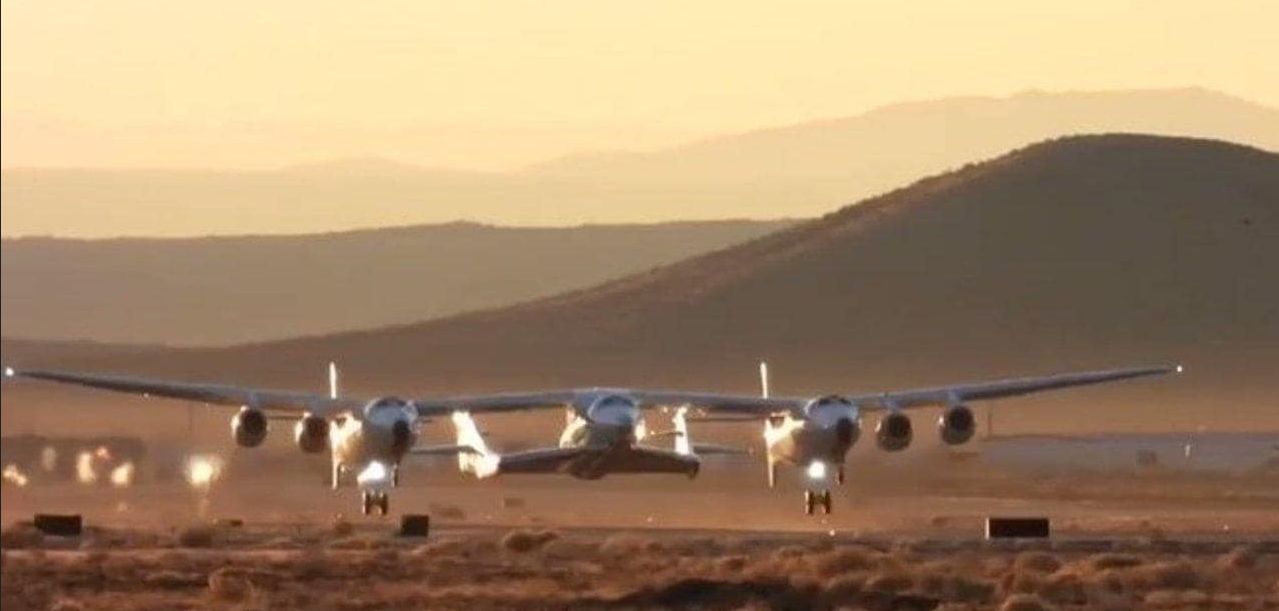
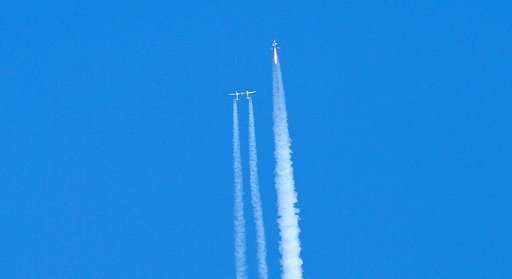
VMS (Virgin Mother Ship) Eve, the WhiteKnightTwo carrier aircraft, took off from the Mojave Spaceport at 15:45 GMT and climbed to an altitude of 14,000 metres (46,500 ft), prior to releasing Unity, which dropped clear prior to its single rocket motor being ignited. The engine burned for some 42 seconds, powering the vehicle into a near vertical ascent and a speed that reached Mach 2.47.

This was enough to propel Unity on a parabolic flight that topped-out at 52,000 m, inside the mesosphere, which spans heights from approximately 10 km (33,000 ft; 6.2 mi) to 100 km (62 mi; 330,000 ft), representing the heights to which Virgin Galactic flights will typically carry fare-paying passengers so they can enjoy around 5 minutes of weightlessness.

VSS Unity mid-flight on July 26th, 2018, as seen from a chase plane. Credit: Virgin Galactic / MarsScientific.com / Trumbull Studios

It was a thrill from start to finish. Unity’s rocket motor performed magnificently again, and Sooch [co-pilot Mike Masucci] pulled off a smooth landing. This was a new altitude record for both of us in the cockpit, not to mention our mannequin in the back, and the views of Earth from the black sky were magnificent.

– Virgin Galactic’s chief pilot, Dave Mackay

The mesosphere is sometimes referred to the “ignorosphere”, as it sits above the range of instrument carrying balloons, but well below the height from which it can be studied from space, and so remains one of the least-studied parts of the atmosphere. As well as carrying passengers aboard their vehicles, Virgin Galactic plan to change this by also flying experiments up to the mesosphere that might be used to probe it.

VSS Unity about to touch down, July 26th, 2018. Credit: Virgin Galactic

As with previous flights, today’s test flight was designed in part to gather additional data about conditions in the cabin during flight, but it also marks a significant step closer to the company starting commercial tourist flights, which are currently earmarked to commence in 2019, or possibly the end of 2018. Before that, however, the company will make at least one flight  with Unity’s motor fuelled for a full duration burn of 60 seconds. When that might be, and whether it might follow  directly on from this flight (which represented an 11 second longer engine burn than previous flights) or be worked up to, has yet to be stated.

When operational, VSS Unity will be joined by at least two more SpaceShipTwo vehicles, and – at some point in the next couple of years – an additional WhiteKnightTwo carrier vehicle, given the company are looking to operate flights out of Italy as well.

Continue reading “Space Sunday: an eclipse, a space ship, lasers and a birthday”

Space Sunday: British space ports and some female space firsts

The United Kingdom is to gain a vertical launch space port in what might at first appear to be one of the most unlikely of locations: the A’Mhoine peninsula in Sutherland, Scotland, one of the most northerly points in the UK’s mainland.

The announcement that the UK Space Agency has selected the location, sitting between the Scottish coastal villages of Tongue and Durness, was made on July 16th, 2018. The new facility will be kick-started by a new £2 million fund established to boost vertical space port development across Britain.  In addition, the Highlands and Islands Enterprise (HIE), a Scottish government agency, will be given £2.5m from the UK government to develop the space port which could be up and running by the early 2020s.

In all, the HIE claims to have secured a total of £17.3m to develop the facility: £10 million through the HIE itself, and the remainder being put forward by “other sources”. It was selected over proposed sites at Unst in Shetland, and North Uist in the Western Isles.

The UK’s first vertical launch facilities will be developed on the north coast of Scotland and serve the polar orbit market. Credit: The Guardian

Given that most launch facilities try to be as close to the equator as possible in order to gain and additional “boost” from the Earth’s rotational speed of 1,600 km/h when launching a space vehicle, siting a space port so far north might at first sound odd. However, the facilities to be built at A’Mhoine, which will initially employ around 40 people on-site and provide supply chain jobs for up to 400 more, is not designed to place payloads in near-equatorial orbits. Instead, it will offer a means to reach the highly sought-after polar orbit, so-called because the payload circles the Earth pole-to-pole.

This is an increasingly valuable orbital path as a payload in such an orbit can, over time, pass over just about every point on the surface of the Earth, thanks to both its orbit and the Earth’s own rotation. Thus, it’s an ideal orbit in which to place Earth observing satellites, weather satellites, climate observing satellites – even communications relays.

A high northern latitude launch centre is also ideal for placing satellites in Sun-synchronous orbits, which allow their solar panels to remain in permanent sunlight. Such orbits are popular again with weather and climate observing payloads and also spy and ELINT (electronic intelligence) gathering satellites.

The primary launch vehicle for use at the new site has already been selected. It will be provided by a consortium of US aerospace firm Lockheed Martin and start-up business Orbex. They plan to use the New Zealand developed Electron rocket, designed by Rocket Labs.

Newquay Airport, Cornwall, could become one of a number of horizontal launch centres in the UK, and has announced a strategic partnership with Virgin Orbit to fly 747 / LauncherOne missions out of the airport, possibly starting in 2021. Credit: Cornwall Council

In addition, the UK government is also looking to develop so-called “horizontal spaceplane operations” centres across the UK. One of the prime contenders for this type of operation is “Spaceport Cornwall”, focused on Newquay Airport. Coinciding with the Scottish launch facility announcement, it was confirmed by Cornwall Council, operators of the airport, that Virgin Orbit and the airport’s management had entered into a strategic partnership which could see the airport become a base of operations for Virgin Orbit’s LauncherOne / 747 carrier aircraft combination.

If all goes according to plan, the first 747 / LauncherOne flight from UK soil could take place in 2021. The agreement itself marks the second such arrangement Virgin Orbit has entered into with a European country – as I reported in my previous Space Sunday update, the company has also entered into an agreement with the Taranto-Grottaglie airport in southern Italy to operate flights from that airport, alongside possible tourist flights by Virgin Galactic.

Virgin Orbit could be operating its LauncherOne rocket at carrier 747 out of Newquay Airport, Cornwall, from 2021. Credit: Virgin Orbit

The UK is a leading developer and constructor of satellites and other space systems, both on its own, through the likes of Surrey Satellite Technology, BAE Systems, ADS, and so on, and through the European Space Agency.

Name Sought for ExoMars Rover

The UK is the prime contractor for the European Mars rover, due to lift-off for the Red Planet in 2020 and set to commence operations there in 2021. A part of the European Space Agency’s ExoMars campaign, the rover is within a formal name. So, to correct this, on July 20th, 2018, the UK Space Agency launched a public competition to give the rover a name.

Entries are open to all EU citizens and limited to one entry per person. Entrants must offer a name for the rover and give a 150-word explanation of why they think it should be used. Entries must be submitted no later than 23:59pm BST on October 10th, 2018, and the winner and three guests will be able to tour the Airbus facility where the rover is being built.

The UK is the second largest European contributor to the ExoMars mission, behind Italy, having invested around £270 million into the programme. Airbus Defence and Space UK is leading the build of the rover, with the Mullard Space Science Laboratory at University College London, developing the rover’s major “eyes”, a high-resolution 3D camera which will be used to look at the terrain and rocks to try to detect signs of life. In addition, Leicester University and UK-based Teledyne e2v are involved in developing the Raman Spectrometer on the rover, while the Science and Technology Facilities Council’s Rutherford Appleton Laboratory will be responsible for processing the data it delivers.

British astronaut Tim Peake announces the launch of the competition to name the ExoMars rover, with a full-scale mock-up behind him. Credit: Gov.uk

Those wishing to enter the competition to name the rover can do so via the link above. The full terms and conditions for the project are available here. However, for those so inclined, “Marsy McMarsface” has already been ruled out as an option! (If you don’t get the reference see here – and I should probably note that Boaty McBoatface will sail with the Sir David Attenborough as well!)

Continue reading “Space Sunday: British space ports and some female space firsts”

Space Sunday: of rockets and planets

SpaceX Crew Dragon (l) and the Boeing CST-100 Starliner: Further delays could threaten US access to the ISS. Credit: SpaceX / Boeing

The first SpaceX Crew Dragon (aka Dragon 2) vehicle destined to fly in space has arrived in Florida ahead of its launch, due in August 2018. The capsule is intended to be part of an uncrewed first flight to test the vehicle’s flight test systems.

Prior its transfer to Kennedy Space Centre (KSC), the capsule and service module were the subject of extensive thermal vacuum chamber tests at NASA’s Plum Brook Station in Ohio. The world’s only facility capable of testing full-scale upper-stage launch vehicles and rocket engines under simulated high-altitude conditions, the chamber is a vital part of pre-launch testing – although by the date of the capsule’s arrival at KSC, the results of the Ohio testing had not been made public.

SpaceX’s first Crew Dragon spacecraft is prepared to undergo testing at the In-Space Propulsion Facility of NASA’s Plum Brook Station in Sandusky, Ohio on June 13th, 2018. Credit: SpaceX

No official date for the first Crew Dragon flight has been released, but SpaceX are pushing ahead with work to prepare the vehicle for launch, in anticipation of the flight being given the green light for August. The test flight should see the uncrewed test vehicle fly to the International Space Station (ISS), with a follow-up 14-day crewed test flight due to take place in late 2018 / early 2019.

The arrival of the Crew Dragon test article at KSC came at the same time as a further US government report raised concerns about both SpaceX and Boeing – the other company contracted to make crewed flights to / from the ISS using their CST-100 Starliner capsule – being able to meet the current schedule for commencing formal operations.

A July 11th, 2018, report from the independent Government Accountability Office (GAO) points out that if any significant issues arise with either / both vehicles prior to their formal certification, it could see one or other or both companies being unable to commence active crew launches within the anticipated time frames specified by NASA. Were this to be the case, America would effectively be without the means to send astronauts to the Space Station, as the current contract to fly US crew aboard Russian Soyuz vehicles expires in November 2019.

Under the original schedule, the Boeing CST-100 was to have been certified for crew operations in January 2019, and the Crew Dragon in February 2019. However, both these dates were recently revised: the CST-100 certification slipping to December 2019 and Crew Dragon’s to February 2020.

With crew rotations to the ISS lasting 6 months, this slippage – which moved the first official crewed flights of both CST-100 and Crew Dragon to several months after the Soyuz contract ends – were not seen as a significant issue. However, the GAO report warns that certification of both vehicles could slip to around August 2020 should difficulties with either / both vehicles be encountered as a result of the test flights (or other reasons). This would potentially see a nine-month gap open between the last of the planned US Soyuz flights and a commencement of CST-100 / Crew Dragon flights, more than the span of a crew rotation, with no contingency currently in place to allow continued US access to the ISS until either of the new vehicles is ready to fly.

A “Temperate” Exoplanet?

Ross 128 is a red dwarf star just 11 light-years away from our Sun that over the years has been a source of interest for astronomers. First catalogued in 1926, the star is too faint to be seen with the naked eye, but is classified an old disk star with a low abundance of elements other than hydrogen and helium. Like most red dwarf stars, Ross 128 is given to violent flare activity, although its extreme age makes such events a lot less frequent than “younger” red dwarfs.

In mid-2017, Ross 128 caused something of a stir when a mysterious burst of signals was recorded apparently coming from its general vicinity. Dubbed the “Weird!” signals, the series of unusual “transmissions” were received by the  Arecibo radio telescope, Puerto Rico on May 12th/13th, 2017.

The 2017 Weird! signal that seemed to come from Ross 128 (but has never been re-acquired). Credit: UPR Aricebo

At the time, the signals caused a lot of excitement and talk of “aliens” being involved – although no planets had actually been detected around Ross 128. As I reported in July 2017, after further study, it was determined that the most likely explanation for the signals was that they’d been accidentally picked up from satellites occupying the same part of the sky as Ross 128 at the time Aricebo happened to be listening; all attempts to re-acquire them by numerous radio telescoped failed to do so.

While there is no reason to change the view that the odd signals of May 2017 were from local satellites rather than originating with Ross 128, in November 2017 it was confirmed the star does in fact have a planet orbiting it.

Referred to as Ross 128 b, the planet was first detected in July 2017 by a team operating the High Accuracy Radial velocity Planet Searcher (HARPS) instrument at the La Silla Observatory in Chile. However, it was not until November of 2017 that the astronomers were able to confirm that had located the planet.  Since then, the planet has been the subject of indirect scrutiny to try to better determine its characteristics, and the results are interesting.

The HARPS data initially suggested the planet to be roughly around the size of Earth and orbiting in the star’s habitable zone. However, further characterisation of the planet – including whether or not it has an atmosphere – has been hampered by the fact that its orbit around its parent star means it doesn’t actually transit between Ross 128 and Earth.

An artist’s impression of Ross 128 b orbiting its parent star. Credit: ESO/M. Kornmesser

As this presents a barrier to analysing the planet directly by the effect it and its atmosphere (if it has one) has on light coming from its parent star, astronomers instead turned to studying Ross 128 itself in their attempts to better understand the potential nature of Ross 128 b.  In particular, a team led by Diogo Souto of Brazil’s Observatório Nacional used Sloan Digital Sky Survey‘s APOGEE spectroscopic instrument to measure the star’s near-infrared light to derive abundances of carbon, oxygen, magnesium, aluminium, potassium, calcium, titanium, and iron.

Continue reading “Space Sunday: of rockets and planets”

Space Sunday: Kepler, China, and a voyage to the Sun

An artist’s rendering of Kepler in its heliocentric orbit. Credit: NASA

In March 2018, I reported that NASA’s exoplanet hunting Kepler mission might be drawing to a close. The end of the mission was threatened when engineers confirmed that the observatory was showing signs of running out of fuel.

Responsible for locating 70% of the 3,750 exoplanets discovered to date, Kepler was launched in 2009 and has been one of the most successful missions NASA has run. Unfortunately, as a result of a change to its operational parameters following the failure of two of the four reaction wheels used to hold it steady while observing distant stars, the observatory has had to increase its use of its propellant reserves. As a result, on July 2nd, 2018, NASA Kepler was ordered into a “no-fuel-use safe mode” after telemetry reported an “anomalous” drop in fuel pressure in the spacecraft.

The observatory will remain in this mode until August 2nd, 2018, when it is due to use its manoeuvring jets to orient itself so it can transmit the data collected on its last observational campaign – the 18th in its extended mission – to Earth via the Deep Space Network. During the time between now and August 2nd, engineers will attempt evaluate the status of the spacecraft’s propulsion system to determine if it has sufficient fuel left to allow it to resume observations in what is called Campaign 19, scheduled to begin August 6th, 2018.

Kepler has been tremendously successful by any measure. In addition to its impressive raw planet tally – liable to raise as there are still more than 2,000 planet candidates still to be vetted – the data gathered by Kepler since 2009 seems to suggest that 20% of Sun-like stars host a roughly Earth-size planet in the habitable zone — that just-right range of distances where liquid water could exist on a world’s surface.

During its primary mission, from 2009 through May 2013, Kepler stared at about 150,000 stars simultaneously, hunting for periodic dipping in their brightness that might indicate a planetary body moving in front of them. Since 2014, it has been engaged on its extended K2 mission, comprising a series of observational campaigns lasting 80 days apiece, each focused on a slightly different area of sky.

However, if this is the beginning of the end for Kepler, it’s not the end of our exoplanet hunting efforts: if all is proceeding as planned, the Transiting Exoplanet Survey Satellite, launched in April, 2018, should be taking over the task – although admittedly, news on its “first light” image, which was due in June, has yet to be released.

China’s Super-Heavy Launch and Reusable Rocket Capabilities

Speaking during an event in China at the end of May 2018, Long Lehao, a chief designer with the China Academy of Launch Vehicle Technology (CALT), gave an update on two of China’s new launch vehicles: the Long March 9 super booster and the partially reusable Long March 8 rocket.

The Long March 9 – referred to as the CZ-9, or Changzheng 9 in Chinese – is slated to enter service in 2030, and is central to China’s interplanetary ambitions. It is also a huge increase in scale a capability for the nation’s launch systems. The core three-stage rocket will stand 93 metres tall, using a 10-metre diameter first stage. It will be assisted at launch by four 5-metre diameter strap-on boosters – these alone being the same diameter as China’s Long March 5, currently the country’s most powerful rocket. The most powerful variant of the vehicle will be capable of launching 140 tonnes to low-Earth orbit (LEO), 50 tonnes to the Moon and around 44 tonnes to Mars.

China’s Long March 9 (CZ-9), flanked by launch vehicles past and present, including Russia’s never successfully flown N-1 lunar rocket from the 1960s. Via: Wikipedia

By comparison, NASA’s Space Launch System (SLS) vehicle will have a core stage 8.4 metres in diameter, with its most powerful variant (Block 2) capable of placing 130 tonnes into LEO, and SpaceX’s BFR with a 9-metre diameter core and be capable of putting 150 tonnes into LEO.

In his presentation, Long confirmed the first CZ-9 is slated for launch in 2030 – around the time the Block 2 variant of the SLS is due to fly. One of the first missions earmarked for the super booster is an automated Mars sample return mission, with crewed lunar missions also on the cards for the vehicle. In addition, the CZ-9 could be used to deploy a system of solar power satellites the Chinese government and military are said to be considering.

Meanwhile, the Long March 8, based on the core of China’s current mid-range launcher, the Long March 7, is expected to make its first flight in 2021. Capable of lifting a more modest 8 tonnes to LEO, the first stage of the booster is designed to be reusable, employing a similar methodology to SpaceX’s Falcon 9 first stages to return to Earth and land.

An artist’s impression of the Long March 8 first stage about to make a soft-landing at the end of a launch flight. Credit: Shanghai Academy of Spaceflight Technology

While the payload capacity of the Long March 8 might sound small, it is ideal for typical satellite payloads. More to the point, the use of the Long March 7 first stage means the system could be “upgraded” to work with that vehicle, which is capable of placing 13 tonnes into LEO.

Continue reading “Space Sunday: Kepler, China, and a voyage to the Sun”

Space Sunday: asteroids, telescopes and dust

Credit: Mopic/Shutterstock

Saturday, June 30th marked International Asteroid Day, a global event involving researchers, astronomy groups, space agencies and more talking about asteroids  – and the risk some of them present to Earth.

Since 2013, and the Chelyabinsk event which saw a meteor  roughly 20 metres across, caught on film as it broke up high over the Russian town, the tabloid media has seemingly been obsessed with reporting meteors about to collide Earth and wreak havoc.

Fortunately, the vast majority of the estimated 10 million objects which have orbits passing close to Earth – referred to as NEOs, for Near Earth Objects, are unlikely to actually strike our atmosphere or are of a small enough size not to pose a significant threat if they did, despite all the screaming of the tabloids.

A map showing the frequency of small asteroids entering Earth’s atmosphere between 1994 and 2013. The dot sizes are proportional to the optical radiated energy of impacts measured in billions of Joules (GJ) of energy. A total of 556 events are recorded on the map, representing objects ranging in size from 1m to 20m. Credit: NASA’s Near Earth Object (NEO) programme

Which is not to say NEOs don’t pose a potential threat. Not all of the 10 million objects with orbits passing close to, or intersecting, the orbit of Earth have been properly mapped. Take 2018 LA (ZLAF9B2), for example. As I reported at the start of June, this asteroid, some 2 metres across, was only identified a handful of hours before it slammed into Earth’s upper atmosphere over Botswana at approximately 17,000 kilometres per second, to be caught on film as it burnt up. The energetic force of the accompanying explosion has been estimated to have been in the region of 0.3 to 0.5 kilotons (300 to 500 tonnes of TNT).

To offer a couple of quick comparisons with this event:

  • The 2013 Chelyabinsk superbolide (roughly 10 times the size of 2018 LA (ZLAF9B2) disintegrated at an altitude of around at 29.7 km at a velocity between 60,000-69,000 km/h, producing an energy release equivalent to 400-500 kilotons (400,000-500,000 tonnes of TNT). This was enough to blow out windows and send 1,491 people to hospital with injuries, including several dozen temporarily blinded by the flash of the explosion. The first 32 seconds of the video below convey something of the force of that event.

  • In June 1908 a cometary fragment estimated between 60 and 190 metres cross disintegrated some 5 to 10 km above Tunguska, Siberia. This generated an estimated downward explosive force of between 3 to 5 megatons and an overall force of somewhere between 10 to 15 megatons (again for comparison, all the bombs dropped by allied forces in World War 2 amounted to around 3.4 megatons of combined explosive force). This is believed to have generated a shock wave measuring 5.0 on the Richter scale, flattening an estimated 80 million trees covering an area of 2,150 square kilometres. Were it to occur today, such an event would devastate a large city.

There are two sobering points with these two events. The first is that astronomers estimate only about one-third (1600) of objects the size of the Tunguska event meteoroid which might be among that 10 million NEOs have so far been mapped. The second is that many NEOs can remain “hidden” from our view. the Chelyabinsk superbolide, for example passed unseen as the Sun completely obscured its approach to Earth.

There have been several proposals for trying to deal with the potential risk of a PHA – Potentially Hazardous Asteroid – impact over the years. One currently in development is the NASA / Applied Physics Laboratory (APL) Double Asteroid Redirection Test (DART) mission intended to demonstrate the kinetic effects of crashing an impactor spacecraft into an asteroid for planetary defence purposes.

The target for this mission is rather interesting. DART will be launched on an intercept with 65803 Didymos, an asteroid around 750 metres across – but this will not be the vehicle’s target. That honour goes to a much smaller asteroid – around 170 metres across (so in the size range of the Tunguska object) – orbiting 65803 Didymos and informally referred to as “Didymoon”.

Originally, DART was to be a part of a joint NASA/APL and European Space Agency effort, with ESA supplying a vehicle called the Asteroid Intercept Mission (AIM). This would have been launched ahead of DART on a trajectory that would place it in orbit around the 65803 Didymos / “Didymoon” pairing, allowing it to track / guide DART to its target and record the entire impact and its aftermath.

AIM never received funding, leaving the NASA/APL mission, which is currently scheduled for launch in 2021 and will intercept “Didymoon” in 2022. However, in the last few weeks, ESA has announced a revised mission to 65803 Didymos called Hera. Like AIM, it is designed to orbit the asteroid and is moon, and a call has been made to combine it with DART under a new joint mission called Asteroid Impact and Deflection Assessment (AIDA).

This would require DART to be delayed for a number of years to give ESA time to obtain approval for Hera and design, build and launch the craft – so the intercept would not take place until 2026. While this is a delay, it would mean that scientists would be able to better characterise “Didymoon” ahead of DART’s arrival, and witness the impact and its aftermath in real-time.

The original DART / AIM mission – to study the use of kinetic vehicles to divert an asteroid – now potentially superseded by the DART / Hera mission. Credit: NASA / APL / ESA

It’s not clear whether or not DART will be delayed. If it isn’t, then it has been proposed DART carries a camera equipped cubesat similar to those AIM would have used in support of its mission. This could then be separated from DART ahead of the impact so it could image the event as it flies by “Didymoon”. The Hera mission would then arrive a few years after the impact and assess the outcome, including imaging the impact crater on the asteroid and changes to its orbit and its rotation, which can help scientists determine how efficient the impact was in transferring its energy into “Didymoon”.

Continue reading “Space Sunday: asteroids, telescopes and dust”