Space Sunday: Earth’s ice and Soyuz leaks

ICESat-2. Credit: NASA

In its final mission, the United Launch Alliance Delta II launch vehicle lifted NASA’s ICESat-2 (Ice, Cloud, and land Elevation Satellite 2) up into orbit. Designed to measure ice sheet elevation and sea ice freeboard, as well as land topography and vegetation characteristics, the mission is a follow-on to the ICESat mission of 2003 to 2010.

The launch vehicle lifted-off from Space Launch Complex 2 at Vandenberg Air Force Base in California at 06:02 local time (9:02 EDT; 14:02 BST). The satellite separated from the second stage about 53 minutes after lift-off, followed by four cubesat secondary payloads some 20 minutes later.

The half-tonne satellite, about the size of a small car, carries a single instrument: a laser altimeter called the Advanced Topographic Laser Altimeter System (ATLAS). It is designed to fire 10,000 laser pulses a second to obtain elevation data with an accuracy of half a centimetre, and will primarily be used to measure the elevation of ice sheets and changes in their size, but will also measure the height of vegetation on land.

The last ever Delta II lifts-off carrying the ICESat-2 mission to orbit, September 15th, 2018. Credit: NASA/Bill Ingalls

Originally, ICESat-2 had been due to launch in 2015 as a follow-up to the original mission. However, the complexity of ATLAS meant that the mission hit delays and overran its original budget, both of which left NASA facing an either / or situation: either divert funds from other Earth resources missions (such as the Pre-Aerosol, Clouds, and Ocean Ecosystem (PACE) satellite) and cancel them, or cancel ICESat-2.

The first ICESat revealed that sea ice was thinning, and ice cover was disappearing from coastal areas in Greenland and Antarctica. Due to the delays in developing and launching ICESat-2, NASA has relied on an aircraft mission, Operation IceBridge, to monitor ice elevation and gathering other data on ice changes in both the Arctic and Antarctic.

While there are those who like to believe human-made global warming doesn’t exist, and that the unprecedented increases in temperature Earth has experienced in the last 100 or so years is simply a matter of solar cycles (a view that actually does not stand up to objective scrutiny), global average temperatures are climbing year after year (four of the hottest years in modern times all taking place from 2014-2017), largely as a result of humanity’s constant reliance on fossil fuels for energy. This warming is contributing to the shrinking ice cover in the Arctic and Greenland and adding to sea level rises that threaten hundreds of millions of people living in coastal regions around the world, as well as contributing to further weather and climate changes.

An artist’s impression of ICESat-2’s ATLAS laser in operation. ATLAS is capable of firing 10,000 per second and will take measurements every 0.7 m (2.3 ft) along the satellite’s path. It will gather enough data to estimate the annual elevation change in the Greenland and Antarctic ice sheets even if it’s as slight as four millimetres. Credit: NASA

ICESat-2 should help scientists understand just how much melting the ice sheets are contributing to this sea level rise, with ATLAS being fired-up for the first time in orbit in around a week’s time.

The launch was the 155th and final flight of the Delta II, which first entered service in 1989. Once a mainstay of both government and commercial customers, the vehicle has seen decreasing use in favour of vehicles like the Delta IV and Atlas launchers and, more recently, SpaceX. In 2007, it was announced ULA would phase out the Delta II – although it has enough parts to build around half-a-dozen complete versions of the rocket. With NASA the only user for the vehicle, it has taken time to use these remaining vehicles, and the final vehicle will be used as a museum piece.

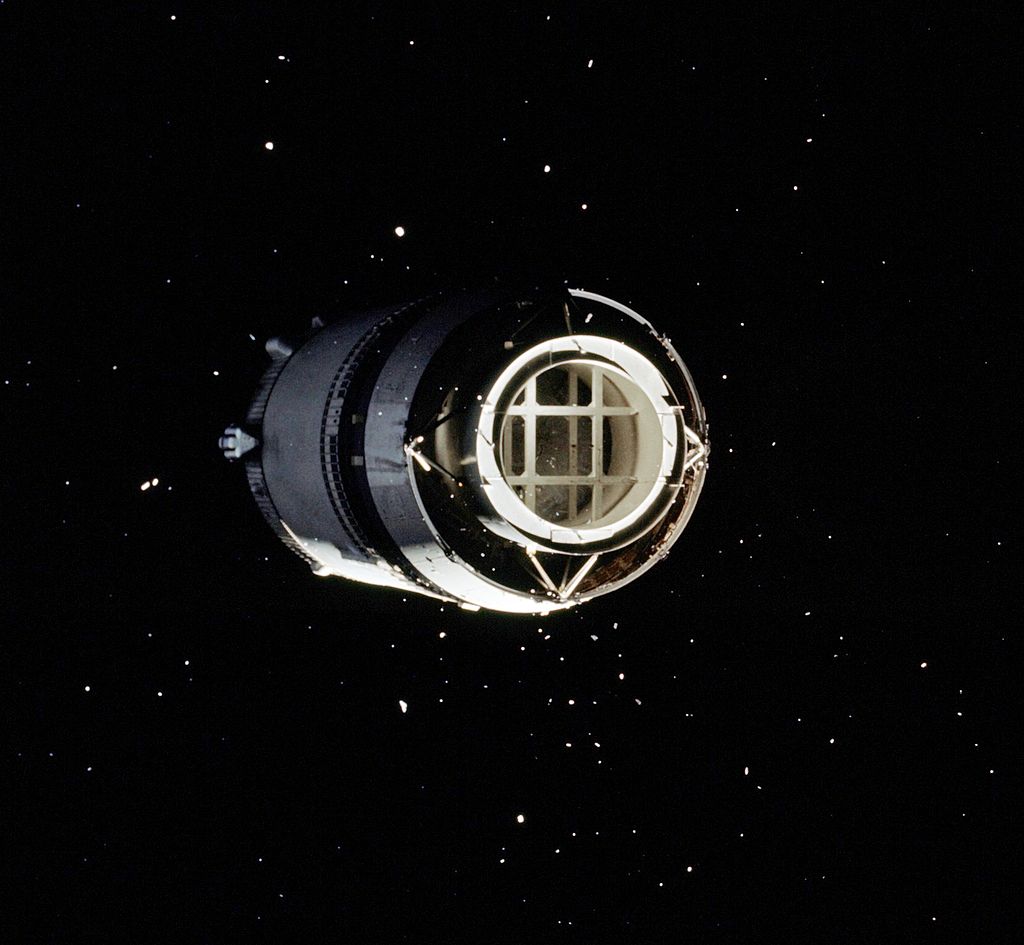
The Delta II occupies a unique place in history: it is the only rocket ever to recorded to have debris strike a human. In 1996, the US Ballistic Missile Defense Organisation (BMDO) launched the Midcourse Space Experiment (MSX) atop a Delta II. Ten months later, on January 22nd, 1997, the upper stage of the launcher re-entered the atmosphere and broke apart, the greater part of it burning up in a fireball over the mid-west United States.

Lottie Williams hold the debris from a Delta II upper stage, which struck her on the shoulder in January 1997. Credit: unknown

Witnessing the fireball while exercising in a park in Tulsa, Oklahoma, was Lottie Williams. Thirty minutes later, she was struck on the shoulder by a charred piece of metal about 15 cm (6 in) across and weighing about the same as an empty soda can. She was uninjured by the strike, and analysis of the object confirmed it originated from the Delta’s upper stage.

Continue reading “Space Sunday: Earth’s ice and Soyuz leaks”

Space Sunday: taking an elevator into space

An artist’s concept of a “carrier” – the “elevator car” of a space elevator – climbing the elevator cable. Credit: unknown

The space elevator is perhaps one of the most intriguing ideas for reaching space. It was first conceived as a thought experiment in 1895 by the grandfather of astronautics, Konstantin Tsiolkovsky. In it, he considered the building of a massive tower reaching up to geostationary orbit at 35,756 km (23,000 mi) above the surface of the Earth, and which at the top would have sufficient horizontal velocity to launch vehicles into orbit. The vehicles themselves would be carried aloft by elevators like the ones climbing the Eiffel Tower.

Tsoilkovsky knew the construction of such a tower would be next to impossible, there simply were no materials capable of withstanding the compressional pressures exerted the mass of such a tower as it was built upwards – nor are there today. However, in 1960, another Russian,  Yuri N. Artsutanov suggested that rather than building the elevator up from the ground, it could be built both down and out from geostationary orbit, using tension along the cable from its lower end and through the “counterweight” of the outward extent of its length to maintain is tautness and balance. Referring to the design as a “heavenly funicular”, Artsutanov estimated it would be capable of delivering up to 12,000 tonnes of payload to geostationary orbit per day.

An artist’s impression of a solar-powered car ascending the “Sky Hook”. Credit: unknown

Six years later, working entirely independently of Artsutanov, four American oceanographers – John Isaacs, Hugh Bradner, George Bachus and Allyn Vine (after whom the deep-ocean research submersible Alvin was named) – published their idea for a “sky hook” that essentially used the same approach: build a cable both “down” and “out” from a geostationary starting point. Their idea became the inspiration for Arthur C. Clarke’s 1979 novel The Fountains of Paradise, which did much to promote the idea of space elevators in the public mind.

Since then, the idea has received many re-visits, and has also given birth to a number of experiments and ideas for the use of tensile cables  – referred to as “tethers” for doing things like “lowering” experiments into the upper atmosphere for research (such ideas being tested during the space shuttle era) and for creating “artificial gravity” in spinning space vehicles travelling to Mars. A space elevator even appeared in Kim Stanley Robinson’s Mars trilogy as the means to get from orbit down to the surface of the planet. Today, the space elevator is the subject of study by the International Space Elevator Consortium (ISEC), which holds annual conferences on the subject and supports research programmes into space elevator concepts.

The appeal of space elevators  – if they can be built – is that they could deliver huge amounts of payload and manpower to orbit around Earth for a relatively low-cost when compared to using traditional rocket launches. And deliver them not just to geostationary orbit, but to other points above the surface of Earth, referred to as “way stations”.

For example, a “way-station” at around 420-450 km (262-281 mi) altitude would impart a horizontal velocity for vehicles “launched” from it to keep them in a low Earth orbit. similarly, a way station placed above the geostationary orbit point, at say 57,000 km (36,625 mi) would impart enough horizontal velocity to a vehicle “launched” from it that it could escape Earth on a flight to Mars.

The space elevator concept, show an ocean anchor point, and the various “way stations” along its length, capable of supporting operations a low Earth orbit (LEO), geostationary orbit (GEO) and high earth orbit (HEO) altitudes, the latter of which could support missions to Mars and further out into the solar system. Credit: ISEC

But before this can happen, there are some significant issues to overcome. The “simplest” of these is that of finding a suitable anchor point on Earth.

To work at geostationary orbit, the primary station on an elevator would have to be positioned over the equator. The problem here is, an awful lot of the equator is ocean (78.7%), making the construction of such an anchor-point at best difficult. While the remainder of the equatorial region is over land, it brings with it the overheads of political haggling and leveraging to gain an anchor-point.

In The Fountains of Paradise, Arthur C. Clarke solved this problem by conveniently moving Sri Lanka (which he called by its ancient Greek name of Taprobane (Tap-ro-ban-EE) 1,000 km (625 mi) south of its current position to straddle the equator. Unfortunately, we can’t do that in the physical world.

The more significant issues, however, are exactly how to build the elevator tether and how to gradually and safely lower it through the denser part of Earth’s atmosphere, and without its “downward” mass simply ripping it apart before it can be anchored.

The most promising material for the tether construction is carbon nanotubes (CNTs). These are artificially “grown” structures with a number of unusual properties, one of which it their sheer strength: up to 10 times that of an equivalent steel cable, which comes at a fraction of a cable’s mass. CNTs have been known about for around 20 years and are seen as having a range of potential applications: construction, electronics, optics, nanotechnology, etc. However, there is one slight issue with their use in large-scale projects. So far, no-one has successfully “grown” a nanotube longer than 1.5 metres.

Even so, experimental cables have been lifted to altitudes of around 1 km (0.6 mi) using weather balloons and had scale “carriers” run up and down them to test how an elevator tether and its payload would react to the influence of wind and weather. Now, researchers at the Shizuoka University Faculty of Engineering are taking the practical research a step further, by deploying an experimental “space elevator” in space.

On Monday, September 7th, 2018, the  Kounotori-7 H-II Transfer Vehicle (HTV) resupply vehicle is due to be launched to the International Space Station (ISS). As a part of the six tonnes of supplies the vehicle will be carrying will be two small “cubesats” – satellites that are each just 10 cm (4 inches) on a side.

Computer model of the cubesats and their (not to scale) tether deployed in Earth orbit. Credit: Shizuoka University

These will be deployed in space, connected by a 10 metre (33 ft) tether. Once the tether is under stable tension, a little electrically powered “car” will traverse it, marking the first time a vehicle has travelled along a tether in space. The test is intended to see how a space elevator tether might react to payloads moving along it in whilst in the “vacuum” of space, together with the stresses placed on it and its “anchor points”, etc.

It’s a small step along the way to establishing a space elevator, but the test will be watched with interest by Japan’s massive construction firm, Obayashi Corporation. In 2012, they announced they would have the world’s first space elevator operating by 2050. They are actively sponsoring research into CNT development, and believe the issues of growing long strands of CNTs and “knitting” them together into a tether will have been resolved by 2030.

Obaysahi Corporation’s design for their GEO station on the space elevator, which the company says will use “inflatable” modules to reduce mass. Credit: Obayashi Corp.

Continue reading “Space Sunday: taking an elevator into space”

Space Sunday: saving Oppy, ISS leaks, and humans to Mars

NASA’s MER rover, Opportunity (MER-B) arrived on Mars in January 2004. It has been in a “sleep” mode since the start of June 2018, as a result of a globe-spanning dust storm on Mars. Credit: NASA/JPL

NASA has announced it will undertake a 45-day campaign to try to re-establish contact with its long-lived Mars Exploration Rover (MER) Opportunity. in the wake of contact being lost was a globe-spanning dust storm started to grip Mars in June 2018.

After running its course for almost three months, the storm is now abating, and whilst not the biggest storm seen on Mars since “Oppy” arrived there it the start of 2004, it is one of the most intense in terms of the amount of dust thrown up into the Martian atmosphere.

Contact with the rover was lost in early June 2018. With sunlight barely able to penetrate the dust in the air, it is thought the rover went into hibernation to conserve battery power – terminating contact with Earth in the process.

The attempt to re-establish communications will commence once the tau in the region where “Oppy” is located has dropped below 1.5. Tau is the term used to measure the opaqueness of the dust in the Martian atmosphere, and it is usually around 0.5. Opportunity requires a tau of below 2.0 to avoid triggering its sleep mode, and by early June the value had reached 10.8 – making this dust storm the densest the rover has ever encountered during its fourteen years on Mars.

As a solar-powered vehicle, there are a number of risks Opportunity faces during a long duration dust storm. The first is that as the batteries cannot be charged, they could run out of sufficient power required to keep the rover’s sensitive electronics warm – although this is partially mitigated by the fact that during a storm like this, the heat normally radiated away by the planet gets trapped in the dusty atmosphere, raising the ambient temperature and thus offsetting the amount of power the rover needs to use to keep itself warm.

How the dust storm progressed. Taken 15 days apart through the same telescope and viewing the same face of Mars. On the left, taken on June 8th and the storm started to rise, features such as Syrtis Major ( the dark India-shaped marking below centre) are visible. On the right, taken on June 23rd, they are almost totally obscured by dust. Note that south is top the top of both images. Credits: Damian Peach (left) / Christopher Go (right)

To other points of concern with the rover are the potential for a clock failure, or what is called an “uploss” recovery being triggered. Opportunity’s on-board clock allows the rover to track when an orbiting satellite – vital for relaying signals from the rover to Earth – is above the local horizon, allowing Opportunity to make contact with Mission Control. If it has failed or now has an incorrect reading as a result of power fluctuations, “Oppy” might not be easily able to establish contact with Earth by itself. An “uploss” recovery is triggered when the rover has failed to establish contact with Earth for an extended period. There is a concern that if the rover didn’t enter its hibernation state correctly, the lack of any communications might have triggered this mode, forcing the rover to continuously re-try different methods to receive a signal from Earth, using up its power reserves.

The 45-day campaign will be a pro-active attempt to re-establish contact with “Oppy” from Earth by sending commands out to it. However, if there is no response from the rover, a grim warning was given in the announcement:

If we do not hear back after 45 days, the team will be forced to conclude that the Sun-blocking dust and the Martian cold have conspired to cause some type of fault from which the rover will more than likely not recover. At that point, our active phase of reaching out to Opportunity will be at an end.

– John Callas, Opportunity project manager, NASA Jet Propulsion Laboratory

This has drawn some sharp criticism from former members of the MER team, particularly those who worked with Opportunity. They point out that when communications were lost with the other MER vehicle, Spirit, in 2010, NASA spent 10 months trying to re-establish contact. In response to the criticism, NASA state that the 45-day period has been dictated by the decreasing amount of sunlight the rover is receiving as winter approaches, requiring the rover to start conserving power once more, but they will continue to listen for any attempts by the rover to re-establish communications after 45 day campaign has come to an end – they just won’t continue to try to make the connection pro-actively.

Even if communications are re-established, it doesn’t necessarily mean “Oppy” is out of danger; there is a chance that the storm has caused the rover to use its batteries for so long without charge, then may not longer have the capacity to charge correctly or to efficiently retaining their charge – either of which could severely impact further operations for the rover, and require careful assessment.

Soyuz Pressure Leak at the ISS

A Soyuz vehicle suffered a minor loss of cabin pressure whilst docked at the International Space Station (ISS), causing a bit of a fuss in some sectors of the media.

At around 19:00 Eastern Standard Time on August 29th, 2018, ground controllers noted a loss of atmospheric pressure in the orbital module of a Soyuz MS-08 docked to the station. While some media outlets reported the ISS crew “scrambled” to locate and patch the source of the pressure loss, the drop was so slight mission controllers decided to allow the 6-man crew to continue their sleep period aboard the station, and did not inform them of the issue until they were woken up at their scheduled time.

A Soyuz vehicle docked with the ISS (a second Soyuz is just visible, top reight of this image). The pressure leak occurred in the spherical orbital module directly attached to the space station. Behind this is the earth return module (and primary compartment for cosmonauts and astronauts when flying Soyuz) with the white section at the rear, with the solar panels, is the vehicle’s propulsion and power module. Credit: NASA / Roscosmos.

The leak was ultimately traced to a 2mm hole through the skin of the Soyuz module. A temporary fix was made using tape while the crew awaited instructions from Earth on how best to affect a more permanent repair. This actually highlighted a difference in approach between American astronauts and engineers and their Russian counterparts in handling situations.

The Americans – including Expedition 56 Commander Drew Feustel – were keen to explore and test options on Earth before determining on a curse of action out of concern that if options were not tested, then a repair could result in additional damage to the Soyuz. Russian engineers, however, proposed just the one approach to making the repair, and ordered the two Russian cosmonauts on the ISS – Oleg Artemyev and Sergei Prokopyev – to make the repair without any Earth-based testing, handling the situation entirely in Russian and using an interpreter to keep NASA personnel appraised of progress.

After completing the work, Artemyev and Prokopyev reported bubbles forming in the patch, but were instructed to leave it in place to harden over 24 hours. At the time of writing, the path appears to be holding, with no further leaks reported. The damaged Soyuz had been scheduled to make a return to Earth in December 2018 (each vehicle generally spending around 6 months berthed at the ISS alongside another Soyuz so they can be used as “lifeboats” by a station crew should they have to abandon the station for any reason), but as a result of the incident, mission controllers are contemplating using the vehicle in October, when three of the current ISS crew are due to return to Earth.

As the leak occurred in the Soyuz orbital module, it does not pose a threat to a crew: the module is only used during the time a Soyuz is en route to the ISS to give the crew a little more space. On a flight back to Earth the module is jettisoned along with the power and propulsion module, leaving the crew to return in the “mid-ships” Earth return capsule.

The cause of the leak is still being investigated, but suggestions are that it may have been a MMOD – a MicroMeteoroid (tiny piece of orbiting rock weighing less than a gramme but travelling at high-speed) or a piece of Orbital Debris (tiny fragment of debris from a space mission). Such strikes have occurred with the ISS in the past, but if this is the cause of the Soyuz leak, it will be the first time such a strike has directly resulted in a loss of atmospheric pressure either aboard the station or a vehicle docked with it, something that will add to concerns as to the amount of natural and human-made debris circling Earth.

Continue reading “Space Sunday: saving Oppy, ISS leaks, and humans to Mars”

Space Sunday: moon water and space telescopes

A visualisation of subsurface water ice deposits within PSR – permanently shadowed regions – of the Moon’s south pole, including the craters Cabeus, Shoemaker and Faustini. Credit: NASA Goddard Space Centre

The Moon is a fascinating place; there is no two ways about it. Like many bodies within the solar system, it is proving to be a lot more surprising than we’d previously thought. Up until 2009, for example, it was accepted that the Moon was a dry, arid place with little or no subsurface bodies of water ice. This idea was turned on its head in 2009 after India’s first lunar mission, Chandrayaan I, and NASA’sLunar Reconnaissance Orbiter (LRO) confirmed the presence of water ice within the so-called permanently shadowed regions (PSRs) – deep craters around the lunar poles which never see direct sunlight in their basins.

However, one of the questions surrounding these discoveries is just how much water might actually exist as ice within these shadowed craters? A new study,  published in August 2018, has sought to address this question; it is the work of Shuai Li – a post-doctoral researcher at the University of Hawaii, and  produced with the assistance of researchers from Brown University, the University of Colorado Boulder, the University of California Los Angeles, John Hopkins University, and NASA’s Ames Research Centre.

Li’s study focuses on data returned by NASA’s Moon Minerology Mapper (M³), flown aboard the Chandrayaan I mission. M³ was designed to measure light being reflected from the illuminated regions on the Moon, making its use over the PSRs had been considered of minimal value. Nevertheless, Li believed that what data M³ had gathered on the south polar craters might hep in determining the potential volume of water ice within those craters, as indicated by the Lunar Orbiter Laser Altimeter (LOLA), Lyman-Alpha Mapping Project and Diviner Lunar Radiometer Experiment on the LRO mission. However, what he found came as a complete surprise.

While I was interested to see what I could find in the M3 data from PSRs, I did not have any hope to see ice features when I started this project. I was astounded when I looked closer and found such meaningful spectral features in the measurements … We found that the distribution of ice on the lunar surface is very patchy, which is very different from other planetary bodies such as Mercury and Ceres where the ice is relatively pure and abundant. The spectral features of our detected ice suggest that they were formed by slow condensation from a vapour phase either due to impact or water migration from space.

– Shuai Li, leader of the study team


Exposed water ice (green or blue dots) in lunar polar regions and temperature. Credit: Shuai Li

While likely the results of vapour capture following asteroid impacts, Li’s study again opens the door as to how much sub-surface water ice might also exist deeper within the polar regions of the Moon. As I recently noted, a separate study, evidence has been put forward for periods in the Moon’s early history when liquid water existed on the lunar surface at a time when the Moon had a volcanically-induced atmosphere. Much of this water was likely lost to space as that atmosphere dissipated at the end of the Moon’s active volcanic period; however, some of it may have gone underground again, notably in these polar regions.

Either way, the existence of water ice deposits strengthen the case for a return to the Moon and – as NASA Administrator Jim Bridenstine recently indicated – see the establishment of a permanent human presence on the Moon.  An available and plentiful supply of water would go a long way to easing many of the logistical requirements for such a human presence. Once melted, a local supply of water can be filtered and purified to provide drinking water; it can also be used in construction work and as “grey” water for use in growing local foodstuffs through hydroponic or other means; it can be electrolysed to produce oxygen in support of the atmosphere within a base and hydrogen than could be used to power fuel cells, and so on.

The European Space Agency (ESA) in particular is researching ways and means to build a lunar settlement using what is called “in-situ resource utilisation” (ISRU), or the use of locally available materials. In particular ESA has been using locally available “lunar simulants” available here on Earth – notably certain types of volcanic dusts that have been shown to have very similar properties to the dry dust of the surface-covering lunar regolith on the Moon – to test potential options for base construction.

One of these I’ve again previously written about, is the idea of using regolith to effectively “3D print” a protective “shield” of regolith over the facilities of a lunar base to protect it against solar radiation. Referred to as “additive manufacture”, such a technique might be aided with a readily available source of water which can help mix the regolith into a cement-like form that can be “printed” over the structure of a base in layers. In addition, ESA is using a regolith simulant to make “bricks” which can be used to physically construct the walls, floors and ceilings of a base – a process that might again  be easier with a supply of water for use in the process.

A “lunar brick” produced by ESA using “3D printing” techniques and lunar regolith simulants. Credit: ESA

But it is in production of oxygen and hydrogen, as well as offering a source for liquid water, that the ice deposits offer the greatest potential benefit. Up until now, ideas for oxygen production on the Moon have focused on “cracking” the regolith to release the oxygen within it (thought to be around 40% by volume). This requires a lot of energy to achieve –  more than is needed to melt and electrolyse ice to produce both oxygen and hydrogen.

However, it’s not all plain sailing for humans on the Moon. The dust comprising lunar regolith is extremely electro-statically charged, making it stick to just about anything – so keeping it out of a lunar habitat could prove difficult. Worse, it also presents a range of potential health hazards – up to and including major respiratory problems such as lung cancer. These risks have yet to be fully assessed, and countering them as far as possible must be a priority before there can be real talk of a long-term human presence on the Moon.

But in the meantime, Li’s study potentially adds important food for thought for those thinking about establishing research facilities on the Moon.

Continue reading “Space Sunday: moon water and space telescopes”

Space Sunday: exoplanets, flying crews to orbit and a movie

Could up to 35% of the Earth-sized exoplanets so far discovered be “water worlds”? Credit: NASA

Exoplanets between 2 and 4 times the size of Earth may feature water as a large component in their make-up, with many comprising perhaps up to 50% water by weight (by contrast, Earth has just 0.02% water content by weight).

This is the conclusion drawn by an international team of researchers who have being pouring (pun intended) over data from the Kepler Space Telescope and the Gaia mission gathered on the 4,000+ exoplanets discovered thus far, many of which tend to fall into two categories: those with the planetary radius averaging around 1.5 that of the Earth, and those averaging around 2.5 times the radius of the Earth.

It was a huge surprise to realise that there must be so many water-worlds. We have looked at how mass relates to radius, and developed a model which might explain the relationship. The model indicates that those exoplanets which have a radius of around x1.5 Earth radius tend to be rocky planets (of typically x5 the mass of the Earth), while those with a radius of x2.5 Earth radius (with a mass around x10 that of the Earth) are probably water worlds. Our data indicate that about 35% of all known exoplanets which are bigger than Earth should be water-rich.

– Dr. Li Zeng of Harvard University, lead researcher on the study

The teams findings could have major implications for our understanding of the composition of Earth-sized exoplanets. However, if the team’s conclusions are correct, it doesn’t necessarily mean these are especially balmy places. Many orbit so close their parent stars their surface temperatures are liable to be in the 200-500o Celsius range (392-932oF), so the water on them is liable to be very different to how we find it on Earth, existing as saturating vapour in the atmosphere, then a world-girdling warm ocean with ice under increasing pressure below it, wrapped around a sold core.

Data from the European Space Agency’s Gaia mission was used by the researchers. Launched in 2013, Gaia is on a mission to take a “census” of one billion of the stars visible from its orbit around the Sun-Earth L2 position. And if that sounds a lot, it is actually represents just 1% of the galaxy’s total population of stars. Credit: ESA

The beauty of the model is that it explains just how composition relates to the known facts about these planets, and offers insight into how they were formed – most likely in a similar manner to the cores of the giant planets in our own solar system.

With a new generation of Earth-based telescopes capable of peering at distant planets currently gaining remarkable optical updates (such as ESO’s Very Large Telescope)  or under construction (the Giant Magellan Telescope or GMT), not to mention the James Webb Space Telescope and the Transiting Exoplanet Survey Satellite (see below for more in this), the hope is that the findings presented by the team will soon be backed-up with hard data as atmospheres around these distant worlds are properly characterised.

TESS Starts Work

TESS, the Transiting Exoplanet Survey Satellite launched on April 16th, 2018, has started its primary mission – taking over from the ailing Kepler mission in locating exoplanets. This initial primary mission will last for 2 years, in which it is anticipated TESS will pay particular attention to the 200,000 brightest stars around us in the hope of detecting planetary bodies in orbiting them. It will do this using the transit method of observation – looking for dips in the brightness of stars which might indicate the passage of an orbiting planet between the star and the telescope.

How TESS will survey the stars around it. Left: The combined field of view of the four TESS cameras. Middle: Division of the celestial sphere into 26 observation sectors (13 per hemisphere). Right: Duration of observations on the celestial sphere. The dashed black circle enclosing the ecliptic pole shows the region which JWST will be able to observe at any time. Credit: NASA Goddard Spaceflight Centre

The first data gathering element of the mission commenced on July 25th, and will continue through most of August before the data is transmitted by to Earth from TESS’s unique orbit, a “2:1 lunar resonant orbit“, which allows the craft to remain balanced within the gravitational effects of the Moon and Earth, providing a stable orbital regime which should last for decades.

As a part of the mission, the TESS science team aims to measure the masses of at least 50 small planets whose radii are less than four times that of Earth, offering the opportunity to characterise their likely structure and composition. Many of TESS’s planets should be close enough to our own that, once they are identified by TESS, scientists can zoom in on them using other telescopes, to detect atmospheres, characterise atmospheric conditions, and even look for signs of habitability.

In this latter regard, TESS will pave the way for detailed studies of candidate exoplanets by the James Webb Space Telescope (JWST), now scheduled for launch in 2021. While TESS cannot look for atmospheric or other signs of life on the distant worlds it locates, JWST will be able to do just that, which could see the 2020s a decade of remarkable extra-solar planetary discoveries.

Continue reading “Space Sunday: exoplanets, flying crews to orbit and a movie”

Space Sunday: to touch the face of the Sun

Ignition! The three main stages of the Delta 4 Heavy fire, starting the Parker Solar Probe on its mission to examine the Sun up close and personal. Credit: NASA

On the morning of Sunday, August 12th, 2018, NASA launched the Parker Solar mission, which it describes as being “to touch the face of the Sun”. It will be the first mission to fly through the Sun’s corona – the hazardous region of intense heat and solar radiation in the Sun’s atmosphere that is visible during an eclipse, and it will gather data that could help answer questions about solar physics that have puzzled scientists for decades. Over the course of its initial 7-years the Parker Solar Probe mission will allow us to better understand the fundamental processes going on in, on, and around the Sun, improving our understanding how our solar system’s star influences, affects and changes the space environment, through which we travel as the Earth orbits the Sun.

The probe and mission are named for Dr Eugene Parker, an American solar astrophysicist, who in 1958 first posited  the theory of the supersonic solar wind, and who also predicted the Parker spiral shape of the solar magnetic field in the outer solar system. Now 91, he was present at NASA’s Kennedy Space Centre as a distinguished guest of the agency, to witness the probe’s launch, the mission (and vehicle) being the first in NASA’s history to be named after a still-living person.

The Delta 4 Heavy carrying the Parker Solar Probe sits on the pad of Space Launch Complex (SLC) 37 at Canaveral Air Force Station, Florida, following the aborted launch attempt of Saturday, August 11th, 2018. Credit: Vikash Mahadeo / SpaceFlight Insider

Lift-off came at 03:31 EDT (6:31 GMT / 7:31 BST) on Sunday, August 12th, after the initial launch attempt was scrubbed on Saturday, August 11th, when a troubled countdown was halted just one-minute, 55 seconds before the engines on the United Launch Alliance (ULA) Delta 4 Heavy rocket were to ignite. The halt was called following a gaseous helium red pressure alarm, and investigations into its cause extended beyond the 65-minute launch window, resulting in the launch scrub.

The Sunday morning launch countdown proceeded without any significant hitches, and the Delta 4 Heavy – the most powerful rocket in ULA’s fleet of launch vehicles, comprising 3 Delta 4 first stages strapped side-by-side, the outer two functioning as “strap-on boosters” – lit up the Florida coastline as it took to the early morning skies.

Although a flight to the Sun might sound an easier proposition than reaching the outer solar system, it actually isn’t; it actually requires 55 times more launch energy than a launch to Mars. Hence why the relative small and light Parker Solar Probe, weighing just 685 kg (1,510 lb) at launch, required the massive Delta 4 and a rarely-used Star 48BV variant of the Payload Assist Module (PAM).

Originally developed as the upper stage for Delta 2 launch vehicles in the 1965, the Star family of solid-fuel PAM units were commonly used with the space shuttle for satellite launches from orbit: the shuttle would carry them aloft, release the PAM / Satellite combination, then move to a safe distance before the PAM motor was ignited to push the satellite on to its require Earth orbit. For the Parker Solar Probe, the Star 48BV was used to impart as much velocity as possible into the vehicle at is starts on it journey.

Dr. Eugene Parker, now 91, watches the launch of the probe named in his honour as it lifts-off from SLC-37, Sunday, August 12th, 2018. Credit: NASA / Glenn Benson

What makes a flight to the Sun so hard is that the Earth is moving “sideways” relative to the Sun at about 107,000 km/h (67,000 mph), and the probe has to cancel out a whopping 84,800 km/h (53,000 mph) of that “sideways” motion as it makes its way to the Sun in order to achieve orbit. At the same time, the probe needs to gain velocity as it moves in towards the centre of the solar system in order for it to balance the Sun’s enormous gravitational influence and achieve the required elliptical orbit.

The use of the Delta 4 / Star 48BV combination got both of these requirements started, by pushing the probe towards Venus in an arc that will both start to shed the “sideways” velocity, whilst also accelerating the craft in towards the Sun. But it will be Venus that does the real grunt work for the mission.

On October 1st, 2018, the probe will make the first of a series of flybys of Venus, where it will use the Venusian gravity to shed still more of the angular velocity imparted by Earth’s orbit and increase its velocity towards the Sun.

In all, seven such fly-bys of Venus will occur  over the 7 year primary mission for the probe, and while only the first is required to shunt the vehicle into its core heliocentric orbit, the remaining six play an important role in both maintaining the vehicle’s average velocity across the span of the mission and in gradually shrinking its elliptical orbit around the Sun as the mission progresses.

The first pass around the Sun  – and the start of the science mission – will occur in November / December 2018. At perihelion, the vehicle will be just 6.2 million km (3.85 million mi) from the Sun’s photosphere (what we might call its “surface”). During this time, the vehicle will be well within the corona, and will also temporarily become the fastest human-made vehicle ever made, achieving a velocity of around 700,000 km/h (430,000 mph) – that’s 200 km per second (120 mi/s), or the equivalent of travelling between London and Tokyo in around 50 seconds! At aphelion – the point furthest from the Sun, and brushing Earth’s orbit, the craft will be travelling a lot slower.

The corona is a very hot place – hotter than the “surface” of the Sun, however, it is also comparatively thin as far as an “atmosphere” goes. The distance at which Parker Solar Probe will be travelling from the Sun at perihelion, combined with its speed, mean that the ambient heat of the corona isn’t a significant issue. Direct sunlight radiating out from the Sun, however, is a significant problem.

Continue reading “Space Sunday: to touch the face of the Sun”