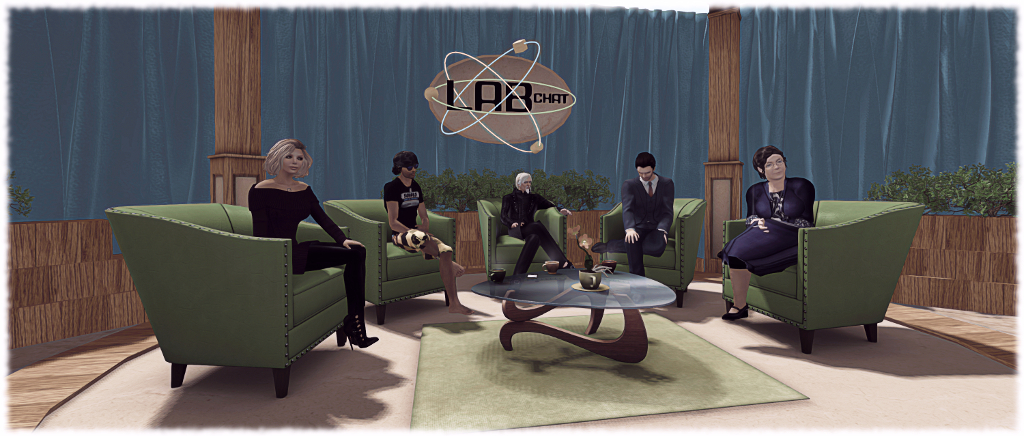
Friday, May 6th saw the third in the Lab Chat series take place in-world, featuring guests Oz Linden, the Director of Second Life Engineering, Troy Linden, a Senior Producer of Second Life and of course, Linden Lab CEO, Ebbe Altberg, in his alter-ego of Ebbe Linden.
The session focused on a mix of questions submitted to an official forum thread ahead of the event, and questions taken directly from the audience, and this transcripts offers a breakdown of the questions asked and answers given.
Please note that in places the audio presented has been edited to remove asides, repetition or removed inaudible elements, and so may differ in length and content to the official recordings made of the session. However, no attempt has been made to alter the content or context of the answers supplied by Ebbe, Oz and Troy.
For ease of reference, the session has been split into two parts, and the following Quick links will take readers to any specific topics of interest to them, and further topics can be navigated to by either returning to this page, or using the Quick Links summaries provided within the Bento / Second Life and Project Sansar pages.
Lab Chat is the name of the public Q&A series aimed at providing Second Life users with the opportunity to have their questions put to Lab management and personnel.
The first two sessions in the series took place in November 2015 and January 2016 respectively, with guest Ebbe Altberg, CEO of Linden Lab. Each event covered both Second Life and Project Sansar and saw Ebbe respond to questions selected from those put forward to a forum thread ahead of each event.
The third in the series will take place on Friday, May 6th, starting at 10:30 SLT at the Linden Endowment for the Arts Theatre. The guests for this session will be:
Ebbe Linden (Ebbe Altberg, the Lab’s CEO), who requires no introduction here. He’ll obviously be answering any questions on Project Sansar which are raised during the show.
Oz Linden, the Director of Second Life Engineering at Linden Lab, and is perhaps most noted for his involvement with viewer development, including contributions from the open-source community and TPVs. He oversees almost all aspects of the technical development of Second Life, both viewer and server, and works closely with his engineers and developers to ensure Second Life continues to be enhanced.
Troy Linden, a Senior Producer of Second Life at the Lab, and has been involved in bringing numerous high-profile projects within SL to fruition, and is currently engaged in Project Bento, the project to greatly extend the second Life avatar skeleton, which Oz’s team is currently working on together with members of the SL content creation community.
Because both Oz and Troy will be present at the show, the majority of the questions this time around will be focused on Second Life and Project Bento, so this is a great opportunity to find out what is being planned for Second Life, and what Project Bento is all about and what it might mean for you.
Among many other things, Bento offers the potential for animated facial expressions and animated fingers (shown in this video by Abramelin Wolfe) on mesh avatar models
The show will be recorded in audio, which will be made available some time after the show has wrapped. I hope to attend and produce a full transcript, and those wishing to catch-up on the first two Lab Chat sessions through this blog can do so by following the links below:
On April 14th news broke via Trend Micro security that Apple is deprecating support for QuickTime for Windows, despite the fact there are two critical vulnerabilities affecting the package, both of which were identified by Trend Micro under their Zero Day Initiative (ZDI), which will not be patched by Apple despite the fact information on both vulnerabilities, as specified in Trend Micro advisories ZDI-16-241 and ZDI-16-242 being passed to Apple in November 2015.
As a result of these vulnerabilities, which could leave Windows systems vulnerable to hijacking – although Trend Micro stress that there is no evidence so far of either being actively exploited – is to uninstall QuickTime for Windows (QuickTime for OSX is not affected).
The advice on uninstalling has most notably come from Trend Mirco, with the call being repeated across other on-line tech media, such as eWeek and The Register. Apple apparently opted to take the route of deprecating in March 2016 – but hasn’t really gone out of its way to really tell QuickTime for Windows users it is doing so, as ExtremeTech points out: the QuickTime for Windows landing page doesn’t reflect the status of the software, but simply references the “more secure” January update, while the Apple software update tool still pushed QuickTime at Windows users.
QuickTime is still widely used in Second Life for the shared viewing of streamed media, notably in cinemas across the grid (credit: Crap Mariner)
Obviously, the advisory is something all Windows users should heed. With or without the current ZDI vulnerabilities, the application has reached the end of its supported life. However, as Crap Mariner has been pointing out, there are still media systems which utilise QuickTime for streaming into Second Life, many within public cinemas across the grid. While it might be argued has to how widely such facilities are used, the Trend Micro advisory does heighten the need for in-world systems reliant on QuickTime to be updated / replaced.
Note: the following is based on a conversation at the end of the TPV developer meeting held on Thursday, April 7th. A video is available, and the discussion commences at the 37:43 mark. As such, the following is my interpretation on matters, rather than an official overview from the Lab.
As most people are aware, the Lab is working with a number of groups across Second Life to re-introduce the Community Gateway programme to help bring new users into Second Life. For more background on this, please refer to be September 2015 introductory blog post on the approach.
The original gateway programme was discontinued in August 2010, with the Lab citing several reasons for doing so, including issues around scalability and management oversight, together with question marks around its overall effectiveness in bringing new users into SL. However, there have been repeated calls over the years for it to be re-introduced, and the planned pilot programme is a response to these calls.
However, as I recently reported, there has been a slight issue around matters of legal compliance. Essentially, the Lab need to ensure that sensitive user information, such as account passwords, have to be handled directly by the Lab’s own registration services – they cannot be passed through a third-party service as would be the case with the new gateways, were they to use the current new user registration API.
To try to get around this, the Lab initially suggested the gateways make use of the “old” user registration API, as used with the original gateway programme. While this does handle account details through the Lab’s services, thus meeting legal requirements, it also has a major downside: there are no hooks into things like the web-based avatar picker. This means that when using it, new users cannot select a modern avatar, but instead are delivered in-world with either the default male or female Character Test Avatar (below) – hardly an ideal approach, given how the test avatars look.
The default Character Test Avatar, as used by the “old” new user registration API
In order to try to improve things, the Lab had toyed with the idea that users would be able sign-up through the third-party gateways, but would have a temporary account password delivered to them via e-mail from the Lab, which they could initially use to log-in to SL, and be able to change via secondlife.com.
While it is actually not uncommon for on-line services to use e-mail exchanges as a part of their sign-up process (e.g. to verify a person’s e-mail address), this approach was seen as potentially too intrusive with the SL sign-up, with fears raised that it could put new users off as the swap back and forth between sign-up pages and e-mail.
In response to this, the Lab are now proposing (and currently QA testing) an alternative approach. During the user registration process, the incoming new user is directed to a secure page hosted by Linden Lab, where they set-up their account details, before being returns to the gateway sign-up pages to complete their on-boarding and coming in-world (so it is like opting to pay for goods on website using your PayPal account and being redirected to PayPal’s secure server to make the payment before being returned to the website).
The new user sign-up process for the gateway programme currently in QA with the Lab, should present users coming into Second Life via a third-party gateway with a relatively transparent process which allows the Lab to meet its legal requirements on account information privacy. (Note: this diagram is for illustrative purposes only, and based on how the process has been explained during a meeting [42:35]. With the exception of the information handled by the Lab’s service, the number of steps involved in the process may differ in practice)Some concern has been voiced that this approach may still be off-putting to new users, however, it is hoped that it will be transparent enough to offer a more integrated sign-up flow than would be the case with the use of e-mails. There is still no indication as to when the revised API will be made available to groups in the trial gateway programme, but it has been approved by the Lab’s legal and compliance people, so hopefully once testing has been completed, we should hear more official news about it directly from the Lab. programme should resume moving forward “soon”.
Tyche Shepherd, who tracks land statistics in Second Life, issued a full Private Estate survey at the end of March 2016. It’s the first such survey she has published since the end of November 2013, representing a 28-month gap between reports. Given this, it makes for some interesting reading, some of which is highlighted below.
Overall, the distribution of regions between Full, Homestead and OpenSim in March 2016 remains very similar to that of November 2013 (in fact these figures tend to remain fairly constant as representative indicators of region distribution).
Year
Full
Homestead
OpenSpace
March 2016
53.9% (+/-1.28%)
45.6% (+/-1.28%)
0.5% (+/-0.18%)
November 2015
53.8% (+/-1.30%)
45.5% (+/-1.29%)
0.7% ( +/-0.21%)
Surveys based on 4,208 accessible regions in March 2016; 4,402 accessible regions in Nov 2013
However, Tyche indicates that, overall, the amount of private estate land has consolidated more within the top 20 estates over the 28-month period from November 2013 (39.5% of private estate land) through March 2016 (49.1%; +/- 1.3%). Using supplied list prices, Tyche estimates that the top 20 estates account for some 40.6% of total private estate tier, compared to 30.5% in November 2013.
In terms of regions held, of these top 20 estates, seven are actually under the Anshe Chung Studio (ACS) brand, accounting for 19.1% of private estate holdings, compared to 13.8 in November 2013 for ACS; again a significant increase.
Grandfathered Homesteads stand at around the 85.32% mark for 2016, compared to 82.4% in November 2013. The year-end reports do not indicate the percentage of Full private regions that are Grandfathered, but in a comment on SLU following the Lab’s announcement on Grandfathering and buy downs, Tyche indicates that the current number of Grandfathered Full private regions stands at just over 11%.
In terms of private region decline on the grid, Tyche offers the following:
November 2013
March 2016
28-Month Region Loss
%age Decline
19424
17549
1875
10.7%
Comparing annual region losses for the period January 2012 through December 2015 shows that overall, while the decline still continues, it has slowed considerably as a percentage of the total grid since hitting a peak in 2012. However, 2015 did see a slight increase in the rate of decline, but just under 1%.
2012
2013
2014
2015
Loss
%age
Loss
%age
Loss
%age
Loss
%age
2863
12%
1719
8.2%
673
3.5%
825
4.4%
In terms of revenue for the Lab, in November 2013 the Lab was generating approximately US$3,857,000 (+/- US$52,000) per month. By March 2016, this figure was approximately US $3,385,000 ( +/- US $43,000), representing a 12% decline in monthly private region revenues across the 28 months.
While this is a drop, and allowing for the fact that figures can only estimated, it would suggest that the Lab is still generating around $49 million revenue from tier (private + Mainland) at this point in time, representing approximately 80% of their total revenue. Taking into the assorted costs involved in running, maintaining and enhancing Second Life and the company as a whole, this would suggest the Lab is still reasonably profitable.
Which is not to say there are not other clouds on the horizon. The recent buy down offer on regions could pose a problem to small or medium-sized estates where full regions are concerned (given that the majority of Homesteads are already Grandfathered), as they may find meeting the up-front US$600 difficult to meet. If so, this could make it even harder for them to remain competitive on pricing with the larger estates, and potentially lead to further consolidation of land among the latter at the expense of smaller operations forced to turn in their cards.
Tyche’s ongoing reports make for interesting reading – particularly these month-end reports, which have been sadly missed (and my thanks to Ciaran Laval for pointing-out that we now have a new one to look at). As such, I hope the March update might signal the return of these reports are returning to something of a more regular appearance, assuming Tyche has the time to pull them together!
On Monday, April 4th, the Lab took a step to help those who are leasing a region (full or homestead) directly from the Lab with the opportunity to reduce their tier payments, by paying a one-off fee.
The blog post announcing the offer – which runs for a six-month period from April 4th through October 4th, 2016 – reads in part:
If you plan to hold onto your land for longer than 6 months, this is a great deal for you!
To take advantage of this offer, you’ll need to submit a Support Case using the Land & Region -> Region Buy Down case type. In that case you can provide us with the names of the regions you would like to buy down, and we will assess the appropriate buy-down fee per region.
There are some caveats to the offer: it cannot be combined with Education and Non-Profit discounts, nor can it be applied to Skill Gaming Regions. The quoted prices are also exclusive of VAT, if applicable.
Coming on top of the recent changes to region set-up fees, which is also referred to in the blog post, this is an interesting move by the Lab, indicating that they are trying to mix things up a little in an attempt to try to help with the issue of tier.
The 6-month period of the offer means those who take immediate advantage of it will effectively break even on the one-time fee cost, and will continue to enjoy the grandfathered tier status for as long as they hold the land. And, of course, grandfathered regions can now be transferred – although this does incur a further up-front fee (US $600 for a full region, $225 for a Homestead, for example). At the same time, it potentially offers the Lab something of a cash injection, making it almost a best of both worlds offer.
Tier will remain a contentious issue within Second Life, but the Lab is hoist by its own petard when it comes to taking broader steps with tier and possible tier reduction; there is only so much the company can do without risking hurting itself. As such, this is something of a welcome move, although it will be interesting to see how far down it reaches.


![The new user sign-up process for the gateway programme currently in QA with the Lab, should present users coming into Second Life via a third-party gateway with a relatively transparent process which allows the Lab to meet its legal requirements on account information privacy. (Note: this diagram is for illustrative purposes only, and based on how the process has been explained during a meeting [42:35]. The number of steps involved in the process may differ in practice)](https://modemworld.me/wp-content/uploads/2016/04/gateway-sign-up2.jpg)

 Inara Pey: Living in a Modemworld