Space Sunday: more NASA budgets threats

NASA’s Space Launch System (SLS) and Orion multi-purpose crew vehicle (MPCV):now earmarked for “phasing out” in the White House budget request for NASA. Credit NASA

In my previous piece on the NASA upcoming budget, as being put forward by the US 47th executive administration, I focused on how the proposal could impact NASA’s science capabilities. At the time, the entire budget request had yet to be published, and my article was based on what had been made public by way of passback documents circulating in Washington DC.

At that time, it was anticipated that the White House would push for around a 20% cut in NASA’s annual budget, the majority of which would target NASA’s Earth and Space Science operations. However,  on Friday, May 2nd, 2025, the  “skinny” version of the White House budget request was published, revealing that the administration is seeking an overall 24.8% cut in NASA’s spending compared to the agency’s existing budget. If enacted, it will be the biggest single-year cut in NASA’s entire history. And whilst around two-thirds of the proposed cuts do land squarely on NASA space / Earth science and legacy programmes, they do touch the agency’s human spaceflight ambitions as well.

First and foremost, the request calls for the immediate cancellation of the Lunar Gateway station (aka “Gateway”). This actually makes sense, simply because since its inception, Gateway has itself never made sense.

Starting as a series of studies called the  Deep Space Gateway (DSG) in the mid-2010s, it became an official NASA project under – ironically – the first Trump Administration, when it became the Lunar Orbital Platform-Gateway (LOP-G). It was presented at both a means to enable a return to the surface of the Moon and a gateway to the human exploration of the solar system. However, intended to occupy a Polar near-rectilinear halo orbit (NRHO) around the Moon, travelling up to 70,000 km from the lunar surface whilst never coming closer than 3,000 km, it has been more a limitation than an enhancement to lunar operations.

An artist’s impression of the first two modules of Gateway – the Power and Propulsion Element (PPE) and Habitation and Logistics Outpost (HALO) passing by the Moon. Credit: NASA

While this orbit would allow for uninterrupted communications between the station and Earth, it also introduced multiple complexities of operation into any return to the Moon. As a result, multiple ancillary reasons for Gateway’s existence were cooked up:  Earth sciences, heliophysics, fundamental space biology research, etc., all of which could be achieved more directly and cost-effectively through other means.

Thus, over the last 6 years Gateway has been consistently downsized and de-prioritised, constantly criticised by experts from within and outside NASA, and even seen as something of a complicated boondoggle in terms of design by those actually engaged in its design. Add to this the fact it offers little or nothing to lunar operations that could not be achieved from within a modest lunar orbit (200-300 km). Given all this, cancelling the project – even if it means pissing off international and commercial partners – is a sensible move.

As I noted in a recent Space Sunday report, the arrival of the Trump administration coincided with calls for the outright cancellation of NASA’s Space Launch System (SLS) on the ground of outright expense. but as I mentioned in that piece, any such complete cancellation of SLS would have left Artemis high and dry, and ideas of simply launching Orion utilising other launchers were as close to be nonsensical as to make no difference.

In a follow-up piece to that article, I suggested that a preferable approach would be to go ahead with Artemis with SLS until such time as the latter could be replaced. This is more-or-less what the Trump budget proposes, albeit it on a far tighter time frame; looking to “phase out” both SLS and Orion completely following the first lunar landing of the Artemis programme (Artemis 3), in favour of a “commercial” solution.

The Orion MPCV mounted atop its ESM and mating adaptor to be used in the Artemis 2 cislunar space mission, was officially handed over to NASA on May 1st, 2025. Credit: Lockheed Martin

Given that Artemis 3 is unlikely to fly before around 2028/9 (simply because the SpaceX lunar lander is unlikely to be ready before then), this does present an – albeit tight – window of opportunity; albeit one biased in favour of one commercial operator – SpaceX.

That company’s Crew Dragon vehicle has proven itself a remarkably versatile vehicle, capable of not only ferrying crews to the International Space Station, but also of carrying out space missions of 4-5 days duration in its own right. While its life-support and general facilities would require upgrade, as (likely) would the heat shield (which would have to protect the vehicle when re-entering Earth’s atmosphere at around 40,000 km/h compared to the 28,000 km/h experienced during a return from low-Earth orbit (LEO). But such upgrades are necessarily outside the realm of possibility.

A critical part of these upgrades would lie with the service module (aka “trunk”) supplying power and consumables (e.g. water and air) to Crew Dragon. This would have to be considerable beefier in terms of propellants and consumables it can carry, and also its propulsion. However, this is not something insurmountable. SpaceX has been working on a design for a “Dragon XL”, a large-capacity Cargo Dragon supported by an enhanced “trunk” which would have been used to support operations at Gateway. In theory, there’s a potential for this “trunk” to be enhanced into a suitable service module for Crew Dragon, allowing it to make trips to lunar orbit and back.

This does involve a number of challenges – one of them being how to launch such a combination. Currently, the heaviest payload SpaceX can send to the Moon is between 20-24 tonnes, using the Falcon Heavy (I am intentionally ignoring Starship here, as that is a long way from being anywhere near an operational, human-capable launch system). However, it’s unlikely a combined Crew Dragon + enhanced service module is going to fall within this limit (for example, the Apollo Command and Service modules massed 28.8 tonnes and Orion and its lightweight ESM mass 26.5 tonnes). Falcon Heavy is also not human-rated, so even if it could lob a Crew Dragon / enhanced service module combination to the Moon, it would need to undergo some degree of modification in order to gain a human flight rating, adding further complications.

Dragon XL: an uncrewed cargo vehicle NASA has requested from SpaceX to deliver cargo to to the Lunar Gateway station might help form a part of a replacement (also using Crew Dragon) for Orion to help deliver crews to lunar orbit. Credit: SpaceX

That said, even this is not a blocker: allowing for the risk of damage to the Crew Dragon’s heat shield, it might be possible to launch a crew to LEO atop a Falcon 9, allowing then to rendezvous and mate with an uprated service module and Falcon upper stage placed in to LEO by a Falcon Heavy. This would eliminate the need to human-rate Falcon Heavy whilst enabling the latter to launch a more capable combination of upper stage (to boost the combined Crew Dragon and service module onwards to the Moon) and service module to await the arrival of the Crew Dragon.

As noted, there are technical caveats involved in this approach. It also requires the provisioning of funding for said vehicle development – something not within the pages of this budget proposal; and it would make NASA exceptionally dependent on SpaceX for the success of Artemis.

Beyond changes NASA’s lunar ambitions, the 2026 budget request is seeking a reduction in International Space Station (ISS) spending of around half a billion dollars a year on 2024 spending, in “preparation” for the station’s 2030 decommissioning. The most immediate impact of the cut will be a reduction in overall ISS crew sizes, together with a reduction in the number of annual resupply missions – something that could impact the likes of Sierra Space with their contract for ISS resupply flights due to commence in 2026. In addition, the budget request seeks to “refocus” (aka “restrict”) research and space science activities in the ISS to those directly related to “efforts critical to the moon and Mars exploration programmes”.  However, what this precisely means is not made clear.

Whilst promoting human mission to Mars, the budget proposal offers little if anything concrete, other than the cancellation of the automated Mars Sample Return (MSR) mission, stating the return of any samples can be deferred until such time as humans reach Mars and can collect such samples directly.

Even in a massively simplified proposal from Rocket Lab (when compared to NASA’s multi-vehicle internationally-split idea), the Mars Sample Return Mission has been identified for complete cancellation. Credit: Rocket Lab

In this, MSR is the only science mission named for cancellation in the budget request. Given the manner in which NASA has consistently fumbled around with the mission over that last half-decade, its cancellation doesn’t come as a surprise. The non-mention of other programmes also doesn’t mean the concerns I raised in my previous Space Sunday have gone away; as noted, the budget request confirms the desire to make very deep cuts into NASA’s ability to carry out science and research across all disciplines.

Two additional programmes potentially impacted in this regard are the LandSat Earth imagining programme – which the Trump administration wants to see downscaled, and NASA’s research into what the administration calls “legacy space programmes” – such as their research into nuclear propulsion systems. The latter is again ironic given nuclear systems are potentially the most effective means of propulsion for Mars missions, and the budget request flag-waves the idea of humans to Mars.

As with Trump’s first term in office, the White House is seeking to eliminate all of NASA’s involvement in STEM and education (STEM being disgustingly referenced as being “woke” in the budget request). This includes cancelling the Established Programme to Stimulate Competitive Research (EPSCoR). This is again ironic, given that during his initial Senate confirmation hearings, prospective NASA Administrator Jared Isaacman (who is now almost certain to be confirmed, following a 19-9 vote by the Senate Commerce Committee) referred to EPSCoR as an “essential” NASA educational programme because “it helps connect students and researchers from underserved regions and institutions to the opportunities that NASA provides.”

In my last update, I noted that there is a reported desire among some within the Administration to see at least one NASA centre – The Goddard Space Flight Centre – to be closed. While the budget request does not directly earmark any NASA centres for closure, it does call for NASA to “streamline the workforce, IT services, NASA Centre operations, facility maintenance, and construction and environmental compliance activities”. As such, downsizing / closures remains a threat, and Goddard remains the centre with direct responsibility for many aspects of NASA’s science missions.

All of the above said, this is – at this stage at least – only a budget request. It remains to be seen as to how those in both side of Capitol Hill respond, and whether the White House will actually listen  if / when objections are raised. Given the attitude of many within (notably, but not exclusively) the Republican Party towards science, climate change, the environment, DEI (which the budget also targets), green initiatives, etc., I have my doubts as to whether strong objections to the cuts to NASA’s science programmes will be raised.

Certainly there has been some push-back from within the bipartisan U.S. Planetary Science Caucus, but thus far the loudest voices of protest have come from outside US government circles, such as the globally-respected American Astronomical society and The Planetary Society – two organisations well-versed in America’s leadership in the fields of space and science – among others.

If enacted, the 56% cut to the National Science Foundation, the 47% cut to NASA’s Science Mission Directorate, and the 14% cut to the Department of Energy’s Office of Science would result in an historic decline of American investment in basic scientific research. These cuts would damage a broad range of research areas that will not be supported by the private sector. The negative consequences would be exacerbated because many research efforts can require years to decades to mature and reach fruition. Without robust and sustained federal funding, the United States will lose at least a generation of talent to other countries that are increasing their investments in facilities and workforce development. This will derail not only cutting-edge scientific advances, but also the training of the nation’s future STEM workforce. These proposed cuts will result in the loss of American leadership in science.

– from a statement issued by the American Astronomical Society, May 2nd, 2025

As it is, NASA is already tightening its belt: on April 29th, 2025, it postponed the release of the Announcement  of Opportunity (AO) for the next Small Explorer (SMEX) mission.

Established in 1988 as a continuation of and enhancement to  the long-running Explorer Programme, SMEX focuses on well-defined and relatively inexpensive space science missions in the disciplines of astrophysics and space physics which cost less than US $170 million per mission (excluding launch). Currently, the last SMEX mission was selected in 2021, but its launch has been delayed until 2027. As such, the 2025 AO would have earmarked a launch window between 2027 and 2031 for the selected mission. However, given the potential for up to two-thirds of the agency’s astrophysics budget to be cut, NASA has indicated it would not now issue the SMEX AO “until at least 2026”.

It is anticipated that more upcoming requests for science mission proposals will be placed “on hold” whilst this budget request is debated.

Space Sunday: of budgets and proposed cuts

The Trump administration is seeking a 20% reduction in NASA’s budget for 2025/26. If met, it would likely killed projects such as the Nancy Grace Roman Space Telescope, seen here in an artist’s rendering. Credit: NASA

The National Aeronautics and Space Administration (NASA) has been a pioneer in all fields of space exploration, planetary Sciences, Earth sciences, meteorology (alongside of its sister agency, the National Oceanographic and Atmospheric Administration (NOAA) and its predecessor, the Environmental Science Services Administration (ESSA)). It has also been responsible for many advances in aircraft systems and aviation safety ever since its formation in 1958.

NASA, like any bureaucracy, hasn’t always got things right. Nor has it always gone about things in the right way – Project Artemis currently standing as prime example of this. But, in term of its size and federal budget allocation, NASA is perhaps one of the most cost-effective and successful US federal organs in modern history, with an ability to achieve so much with what amounts to so little.

As an illustrations of what I mean by the above. In 66 years of operations, NASA’s budget has rarely exceeded 1% of the US federal budget in any given year. In fact its peek budgetary allocations came – unsurprisingly – in the era of Apollo, but even then only reached a peak of 4.41% of the total US budget (1966). By the start of this century, NASA’s budget represented just 0.80% of federal spending and was in decline as a whole. For the last 15 years it has stabilised, but has rarely exceeded 0.50%.

In 66 years, NASA’s budget has rarely exceeded 1% of the US federal budget. It’s peak period lay in the Apollo era, when it averaged 2.43% over a 13-year period (1962-1974, including Apollo Skylab)

That’s a long way from being the kind of black hole of federal expenditure far too many people take it to be, and in terms of overall expenditure, NASA represents bloody good bang for the buck. Yet – and perhaps because of that incorrect public assumption – it remains a soft target with it comes to cutting the federal budget. Sometimes, admittedly, these cuts are driven by economic needs at the time, others are due political priorities pointing elsewhere. However, it is fair to say none have ever been driven a dogma of intentional deconstruction fuelled by ignorance; but that is what NASA is now facing under the current US administration’s budget proposals, leaked in part on April 11th, 2025.

These call for NASA’s budget to be reduced by 20% in the name of “cost-saving”. As the lion’s share of NASA’s budget – 50% in total – is devoted to all aspects of human spaceflight, and thus considered inviolable when it comes to cuts, the proposal directly targets NASA’s science, aeronautics, technology research and administrative budgets. They involve calls for the complete closure of at least one NASA research centre and a slashing on NASA’s overall science budget by as much as 50%.

There is nothing accidental about this targeting; the architect of the NASA cuts proposal is Russell Vought, one of those behind Project 2025, and a man known for his profound anti-science beliefs and doctrine. Such is his animosity – shared by others in the administration – towards subjects such as climate change, Earth observation and resource management, he is seemingly content to take a meat cleaver and hack off what is potentially NASA’s most cost-effective limb, one consistently responsible for delivering a wealth of invaluable knowledge to the world as a whole, simply to end the agency’s ability to carry out research into subjects he views with personal enmity.

Chief among these cuts is a two-thirds reduction in astrophysics spending (reduced to US $487 million); a 50% cut in heliophysics (down to US $455 million); more than 50% slashed from Earth sciences (down to just over US $1 billion) and 30% cut from planetary sciences  (reduced to under US $2 billion).

A 2010 view of a part of the NASA Goddard Space Flight Centre, Maryland. NASA’s first – and largest – research centre, the largest combined organization of scientists and engineers in the United States dedicated to increasing knowledge of the Earth, the Solar System, and the Universe via observations from space – under threat of closure. Credit: NASA

The budget also specifically earmarks the Goddard Space Flight Centre (GSFC), NASA’s first and largest science facility, with a staff of 10,000, for closure. The rationale for this, again, appears to be GSFC’s involvement in climate studies. However, such is the breadth and depth of its work, any such closure would cripple much of NASA’s research and science capabilities – something I’ll come back to below.

Within NASA, the proposal – initially dismissed by acting Administrator Janet Petro as “rumours from really not credible sources” when word surfaced about it ahead of its publication – is now being regarded as an “extinction level event” for NASA’s entire science capability.

The proposal has drawn sharp response from Capitol Hill, including the bipartisan Congressional Planetary Science Caucus, together with threats to “block” the budget’s move through the Senate.

If enacted, these proposed cuts would demolish our space economy and workforce, threaten our national security and defence capabilities, and ultimately surrender the United States’ leadership in space, science, and technological innovation to our adversaries. We will work closely with our colleagues in Congress on a bipartisan basis to push back against these proposed cuts and program terminations and to ensure full and robust funding for NASA Science in Fiscal Year 2026 appropriations.

– Congressional Planetary Science Caucus statement

Nominee for the post of NASA Administrator, Jared Isaacman, who is going through his confirmation process during April and already facing questions over his relationship with the SpaceX CEO (who is already impacting NASA through his DOGE scheme and in trying to influence the White House’s thinking over projects such as the ISS), described the budget proposal as “not optimal”, and stated that if confirmed, he would advocate “for strong investment in space science—across astrophysics, planetary science, Earth science, lunar science, and heliophysics—and for securing as much funding as the government can reasonably allocate.”

But while there may well be vows to block the proposed cuts and to “advocate” for science, concern has already been raised at to how effective or real they might be. The Trump administration has established a strong track record for decision-making by fiat, bypassing Congress altogether – and Congress (notably the House) has been largely content to sit and watch the edicts from the White House whoosh by.

Under US law, there is the means  for the Executive to arbitrarily impose budgets on federal agencies. The process is referred to as “impoundment”. In theory it can only be used following the start of the next government fiscal year – in this case, October 1st, 2025 – and then only if Congress and the White House remain at loggerheads over budgets. However, it has been reported that those in the White House see impoundment as a means to set budgets by executive decree, regardless of whether October 1st has been reached, in the expectation that should push come to shove, Congress will continue to sit on its hands.

GISS – First of 1,000 cuts?

Some proof of this might be evident in the case of the Goddard Institute for Space Studies (GISS). Established in May 1961, GISS is a research division of the Goddard Space Flight Centre, and since 1966 it has been located at the Armstrong Hall (named for Edwin Armstrong, not Neil), New York City.

Armstrong Hall, home of the GISS in New York City since 1966, now cut from federal building leases. Credit: NASA/Robert Schmunk

In the decades since its establishment, GISS has become renowned for its Earth Sciences research across a variety of disciplines, including agriculture, crop growth and sustainability and climatology. It has built some of the largest dataset on current and past climate trends and fluctuations. It has also contributed to the fields of space research, both on a cosmological scale and through multiple NASA solar system missions from Mariner 5 to Cassini-Huygens. Researchers at the GISS have been awarded the Nobel Prize for Physics, the Heinz Award and the World Food Prize for contributions to physics, science, environmental awareness, and improving the availability of food around the world.

In other words, it is a major centre for US scientific achievement.

However, on April 25th, 2025, the Trump Administration summarily cancelled the lease on Armstrong Hall – operated by Columbia University – ending GISS’s tenure there as from May 31st 2025. Again, The reason for this has been given “government waste of taxpayer’s money” (the lease had a further 6 years to run at a cost of US $3.3 million a year) – but the aim appears to be ending the GISS’s ability to conduct climate research.

Responding to the news in an e-mail to staff, GSFC director Dr. Makenzie Lystrup stated a confidence that the work of the GISS will continue, as its value is in “data and personnel”, not location, and promised to find the GISS a new home. However, given that GSFC is itself under threat, it remains to be seen whether a long-term future can be found for GISS and its data. In the meantime, all GISS staff have been placed on “temporary remote working agreements”.

Hubble at 35

The news of budget reductions potentially hitting NASA’s science capabilities come at a time when arguably what is one of its most iconic missions – the Hubble Space Telescope (HST) – celebrates 35 years of almost continuous operations (allowing for down-times due to on-orbit servicing and the odd moments in “safe” modes as a result of on-board issues).

Launched in 1990, Hubble’s story is one of triumph over near-disaster. On reaching orbit, a tiny error on the manufacture of is 2.4 metre diameter primary mirror came into focus – or rather, out-of-focus. Polishing on the perimeter of the mirror meant it was “too flat” by some 2200 nanometres (that’s 1/450 mm, or 1/11000 in). While tiny, the error was catastrophic in terms of Hubble’s clarity of vision, and effectively ended any chance of it carrying out cosmological observations before they started.

Fortunately, as we all know, NASA had the space shuttle, and Hubble had been specifically designed to be launched and serviced by that vehicle. It was therefore possible to come up with an ingenious solution to correct the error in the primary mirror – not by replacing it, but by giving Hubble a pair of “glasses” to correct its vision.

The first “lens in the glasses” took the form of deliberately introducing errors into the optics of the Wide Field and Planetary Camera 2 (WF/PC-2), an instrument already in development at the time Hubble was launched, and due to replace a similar instrument already on the telescope. These errors would completely cancel out the defects in the mirror’s surface, allowing the camera to take the required super-high resolution images with complete clarity.

The second “lens in the glasses” was an entirely new instrument called COSTAR (Corrective Optics Space Telescope Axial Replacement), designed to eliminate the mirror’s flaws from impacting the other science instruments on the telescope, until such time as these instruments could also be replaced by units with their own in-built corrective elements. COSTAR did require the removal of another instrument from Hubble – High Speed Photometer – but it meant Hubble would be able to carry out the vast majority of its science activities unimpeded.

To celebrate 35 years of observations by the Hubble Space Telescope, four iconic images to summarise the telescope’s abilities. Top left: Mars seen from a distance of 97.6 million km in December 2024. Top right: planetary nebula NGC 2899, some 3,000-4,000 light-years from the Sun. Bottom left: a portion of the Rosette Nebula some 5,000 light-years from our Sun. Bottom right: The galaxy NGC 5335, which is a flocculent spiral galaxy approx. 236 million light years from our Sun. Credit: NASA / ESA / STScI; Image Processing: Joseph DePasquale (STScI), Alyssa Pagan (STScI)

In December 1993, the shuttle Endeavour delivered the WF/PC-2 and COSTAR to Hubble, where they were successfully installed. By 2002, subsequent servicing missions had successfully updated all of the remaining science instruments on Hubble, allowing COSTAR to be returned to Earth. This occurred in 2009 when the final shuttle servicing mission replaced COSTAR with the Cosmic Origins Spectroscope (COS).

Throughout its life, Hubble has made thousands of observations and contributed massively to science programmes, our understanding of our solar system, galaxy, and the greater cosmos. It has participated in studies conducted around the world and contributed to a huge volume of science and education endeavours.  And despite failures, aging equipment and other issues, it repeatedly allows itself to be pulled out of every “safe” mode and resume operations through servicing missions and – since 2009 – via remote diagnostics and correction.

Such is its capacity to keep right on going, it is affectionately known as NASA’s Energiser Bunny by many in the programme.

All of which is made all the more poignant by the fact that NASA’s entire space observatories mission is at risk of closure as a result of the proposed Trump budget. Hubble, together with its semi-siblings, the James Webb Space Telescope (JWST) and Chandra X-ray Telescope (itself only saved from abandonment in March 2024) are all financed out of NASA’s Astrophysics budget, which the Trump administration wants to cut by 66%. Were this to happen, NASA would likely be unable to continue to operate all three telescopes – or even two of them – and certainly would be unable to complete and launch the Nancy Grace Roman Space Telescope. And even if one or more of the observatories were to survive the cuts, all are dependent on the Goddard Space Flight Centre for their operational and engineering infrastructure and support – which again, the budget proposing closing, a move that would kill the telescopes.

Hopefully, none of this will happen, but one cannot deny the dark shroud it casts over Hubble’s anniversary.

NOAA As Well

As noted, one of the most unsettling aspects with the proposed NASA cuts is the idea that the White House might seek to impose cuts and reductions by fiat, bypassing Congress with the use of executive orders.

This threat, is given weight by the fact that an initial 800 employees of the National Oceanographic and Atmospheric Administration (NOAA) were abruptly fired at the end of February 2025 on the grounds of “cutting costs”, the fact that they were “probationary” employees being disingenuously used to suggest they somehow weren’t qualified to work at the agency. Currently,  it appears that a further 1,000 positions at the agency still hang in the balance.

Nor does the threat to NOAA end there. The Trump budget proposal recommends cutting NOAA’s comparatively tiny US $7 billion budget by 25%. Specifically – and unsurprisingly – chief among the agency’s work targeted by the cuts is anything related to climate studies. In fact, in this area, the proposed cuts are closer to 75%, effectively ending all of NOAA’s research into climate change and weather (and no, the two are not the same).

GOES – Geostationary Operational Environmental Satellite – is a network of geostationary satellites jointly operated by NASA / NOAA for weather monitoring. Development of their next generation replacements could be put at risk as a result of proposed government budget cuts. Credit: NOAA / NASA

Although the administration has stated the National Weather Service will “not be touched”, both the layoffs in February and the proposed cuts could have potentially far-reaching impacts in that service’s capabilities. NOAA, in collaboration with NASA, currently operates three large Geostationary satellites for both weather forecasting and for gathering data on climate (called GOES). All three of the current units (only two of which are operational) are scheduled for replacement between 2032 and 2035. However, the Trump administration is also looking to end many joint ventures between NASA and NOAA. This, coupled with the proposed budget cuts means development of the replacement satellites could be impacted in the near future.

Further, by conflating “weather observations” with “climate change”, the administration has already severely impacted NOAA’s ability to carry out vital research into the development and operation of climate interactions that give rise to weather phenomena such as hurricanes.

NOAA was already stretched thin and understaffed. It’s going to go from stretched thin to decimated. NOAA provides most of the raw data and the models that predict hurricanes, and the hurricane forecasts many Americans see on their phones or TVs are created by the agency. Reducing the research and observation capabilities of the agency in this regard could regress hurricane forecasting capability by the equivalent of decades.

– Dr. Andrew Hazelton, former member of NOAA’s Hurricane Research Division.

All this comes at a time when the evidence for human activity being the single greatest release of greenhouse gasses into the environment, and thus the primary driver of climate change over and above any natural shifts in climate, are becoming more and more evident. As such, threats to Earth science budgets like those currently being proposed by the US administration, together with their headlong rush to increase US reliance on fossil fuels represents a further threat to our collective well-being.

Space Sunday: home again, a “good night”, and seeking biosigns

Crew Dragon Freedom splashes down off the Florida coast March 18th to conclude the Crew-9 mission. Credit: NASA/Keegan Barber

On Tuesday, March, 18th, 2025, A SpaceX Crew Dragon – mission Crew-9 – made a safe splashdown off the Florida coast prior to being successfully brought aboard the waiting recovery vehicle. This brought to an end what has been perhaps the most mis-reported human space mission thus far.

This is because the vehicle which carried NASA astronauts Barry “Butch” Wilmore and Sunita “Suni” Williams into space back in June 2024 was the much-troubled Boeing CST-100 Starliner. Whilst the vehicle reached orbit successfully, it suffered further problems with it primary propulsion system – located on the vehicle’s expendable service module. As a result, and exercising an understandable over-abundance of caution, NASA opted to leave Wilmore and Williams on the ISS until an alternate means of bringing them home could be scheduled.

However, at no time did this ever mean Williams and Wilmore were “stranded” on the ISS: just because NASA did not want to bring the astronauts back to Earth in an emergency did not ever equate to the agency being unable to do so. This was proven in July 2024 when, following the disintegration of a Russian satellite led to a short-term threat of possible debris impact with the ISS. As a result the station’s crew were ordered by NASA and Roscosmos to “shelter in place” aboard their respective space vehicles – including Wilmore and Williams aboard the CST-100 – in case an emergency departure and return to Earth was required if the debris could showed signs of intersecting the ISS in orbit.

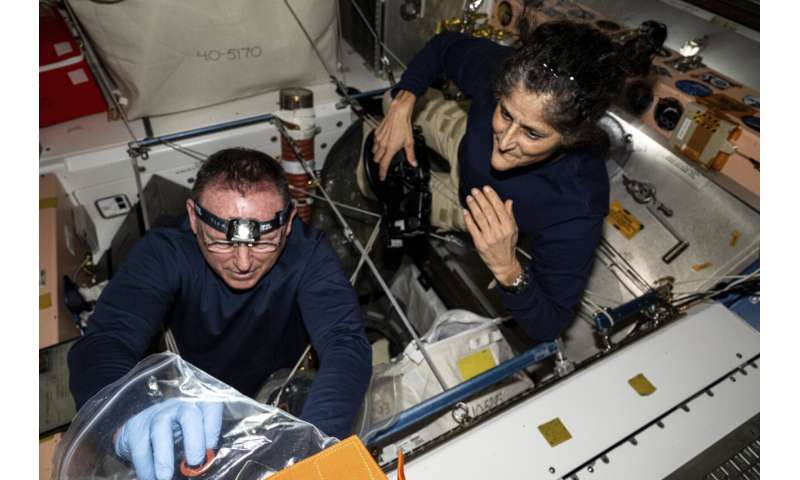
Sunita “Sunni” Williams (l) and Barry “Butch” Wilmore (r), pose aboard the docked Crew Dragon Freedom shortly after it arrived in September 2024, bringing Aleksandr Gorbunov and Nick Hick (sandwiched respectively between Williams and Wilmore) to the ISS. Credit: NASA

In fact, one of the reasons Starliner remained at the ISS even after the decision had been made to return Williams and Wilmore to Earth via other means was as much about providing them with a “lifeboat” return to Earth for as long as possible, as it was about carrying out further tests on the vehicle.

As it was, Starliner did eventually undock from the ISS in September 2024 ahead of the launch of the Crew 9 mission, with the crew capsule Calypso successfully landing on Earth at the end of a fully automated flight and despite two further system hiccups.  Meanwhile, the Crew-9 mission also arrived at the ISS in September 2024 to become NASA Expedition 72, with Williams and Wilmore slotting into the two Expedition 72 crew slots vacated for them, in order to see out the mission’s 170-day rotation on the station.

The rotation came to an end on Tuesday, March 18th, 2025 when Crew 9 – Williams and Wilmore together with mission commander Nick Hague and cosmonaut Aleksandr Gorbunov undocked from the ISS at 0505 UTC, their places having been taken by the Crew 10 / Expedition 73 crew, who arrived at the ISS two days previously.

A composite image showing astronauts Butch Wilmore (l) and Suni Williams (second from right), with Aleksandr Gorbunov (second from left) and Nick Hague being greeted by fellow astronauts and family members at Ellington Field, Houston after their flight from Florida. Credit: NASA

And while much has been made of Williams and Wilmore’s extended stay on the ISS, overall, the 286 days they spent on the station is not exactly record-breaking or that unusual. Among NASA’s astronauts, five others have spent longer periods of time on a single ISS crew rotation (even if their time was planned from the outset to be so), whilst four cosmonauts have spent in excess of 330 days each (437 in the case of Valeri Polyakov) on either the Soviet / Russian Mir station or the ISS. That said, Williams has now accumulated the second highest number of continuous days in space by a US astronaut – 608 days – slotting in behind Peggy Whitson who accumulated 675 days in space with NASA and a further 9 days as a private citizen astronaut on the Axiom Ax-2 mission.

What of Starliner?

Whilst Wilmore and Williams may not have been stranded in space, the Starliner programme does have issues, notably with the design of the four propulsion pods – dubbed “doghouses” because of their appearance – mounted on the Starliner’s service module, and which have yet to be fully resolved.

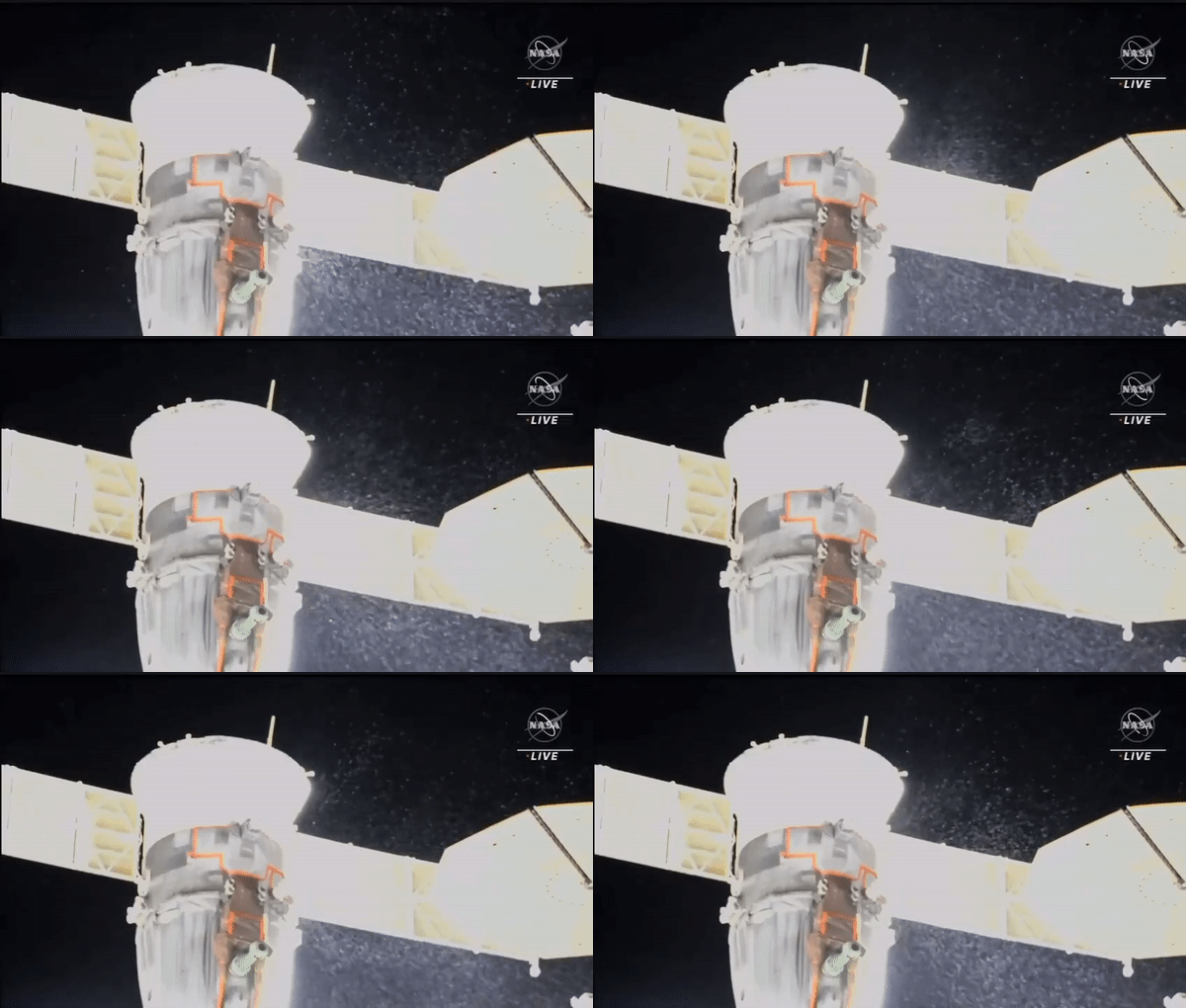
The CST-100 Starliner comprising the capsule Calypso and its service module slowly back away from the ISS following undocking in September 2024. Two of the problematic “doghouse” thruster pods are visible on the cylinder of the service module. Credit: NASA

The pods, each of which mounts five “large” orbital manoeuvring and control (OMAC) thrusters as a “primary” means of propulsion and seven smaller reaction control system (RCS) thrusters used for very precise manoeuvring and control, have been something of a bane to Starliner for the last several years. During preparations for the second uncrewed flight of the CST-100 system (itself the result of an embarrassing cock-up in integrating the timing systems between the launch vehicle and the Starliner craft in the first orbital test flight), it was found that a large number of the values within the thrusters had jammed, delaying the launch by several months, only for a number of the thrusters to have issues during the flight.

During the first Crew Test Flight with Williams and Wilmore, no fewer than five of the RCS thrusters failed during initial docking attempts at the ISS, although four were brought back on-line and the docking completed. This failure, coupled with the discovery that the issue was related to overheating within the “doghouse” units which had not been picked up during the development and testing of the units, then led to something of an embarrassing public spat between Boeing, as the main vehicle contractor, and Aerojet Rocketdyne, makers of the propulsion units, prior to NASA banging some heads together.

Since then, work on rectifying the propulsion unit issues has continued in near-silence. However, the return of the two astronauts to Earth inevitably caused some of the spotlight to swing back towards Boeing and Starliner and if / when / whether it night fly again. There is little doubt that NASA does want Starliner to continue: having all of their eggs in the Crew Dragon / Falcon 9 basket is far from ideal despite that successes of those systems thus far. This was something noted by Steve Stich, NASA’s Commercial Crew Programme Manager, following the Crew 9 splashdown.

We really need to get Boeing into a crewed rotation. Butch and Suni’s return on Dragon, to me, shows how important it is to have two different crew transportation systems, the importance of Starliner and the redundancy that we’re building into human spaceflight for our low Earth orbit economy.

– Steve Stich, NASA Commercial Crew Programme Manager

The Boeing CST-100 Starliner: A: Crew capsule (reusable) 1: Nosecone protecting the docking system during launch (expended) 2: Parachute cover (ejected during landing) 3: Crew access hatch 4: capsule RCS thrusters (x25) 5: Airbags (x6) 6: Heat shield (ejected during landing) 7: NASA Docking System port 8: Parachutes (x3) 9: Window (x3) B: Service module (expended) 10: Power umbilical connecting the command and service modules 11: Radiators (x4) 12: “Doghouse” thruster pods (x4) 13: Propellant tanks 14: Roll control thruster on “Doghouse” 15: Launch abort motors (x4) 16: Solar panels. Credit: NASA

While progress has been made on mitigating the overheating issue by means of changing the operating parameters of the thrusters software system so as to avoid the need for any excessive redesign of the “doghouse” systems, these changes will need to be tested at some point through an actual flight test – and the same is true of the more minor, but still required, alterations to the helium purge systems within the propulsion systems.  This raises another issue: should such a test be carried out via a crewed or uncrewed mission.

The final decision on this lies with NASA, although in their rare comments on the work, Boeing has been somewhat bullish, pushing for the flight to be crewed. For its part, the space agency will not be drawn on what form any additional test flight should take – only that the vehicle used should be “mission ready”, with Boeing in a position to rapidly pivot from completion of a test flight to flying a full crew rotation afterwards.

Even if we were to fly the vehicle without a crew in the return, we want that to be crew-capable. So, we want it to have all the systems in place that that we could fly a crew with. What we’d like to do is that one flight and then get into a crew rotation flight. So, the next flight up would really test all the changes we’re making to the vehicle, and then the next fight beyond that, we really need to get Boeing into a crew rotation. So, that’s the strategy.

– Steve Stich, NASA Commercial Crew Programme Manager

As to when any such flight might take place remains an open-ended question. NASA continues to signal it would like at least the test flight to occur in 2025, but the overall mission schedule for the ISS this year – crew rotation flights, resupply missions (including the demonstration flight of the Dream Chaser resupply vehicle) – mean that docking opportunities for any Starliner test flight are not that numerous in the near-to-medium term.

Blue Ghost says “Night-night” with Stunning Images

In my previous Space Sunday update, I wrote about the private Blue Ghost lander by Firefly Aerospace, which successfully touched-down on the Moon on March 2nd, 2025, marking the company as the first to carry out a “fully successful” (e.g. without rolling or toppling over) commercial lunar landing.

The Earth as captured by Blue Ghost from the surface of the Moon. Credit: Firefly Aerospace / NASA

Over the next lunar daylight period (14 terrestrial days), the vehicle carried out its assigned surface science work, with only the drill system – called LISTER (for Lunar Instrumentation for Subsurface Thermal Exploration with Rapidity rather than having any reference to a character from Red Dwarf) failing to operate as hoped, only reaching a depth of around 1 metre than the hoped-for 3 metres.

However, on Sunday, March 16th, the lander went quiet as the lunar night took hold, denying it the sunlight it needed to convert into electrical power and heat, and temperatures plummeted.

The “diamond ring” is a famous feature of solar eclipses seen from Earth. However, its one is the result of the Earth eclipsing the Sun, as seen from the Moon. Credit: Firefly Aerospace / NASA

While there is a chance residual energy stored in the lander’s batteries might be sufficient to keep its essential electronics functioning, the Firefly team are not expecting to be able to re-establish contact when daylight returns on the vehicle in April.

Rather than simply bid farewell to their plucky little lander, however, on March 18th, Firefly Aerospace, via NASA – the mission being part of NASA’s Commercial Lunar Payload Services (CLPS) programme – released some images captured during the mission to highlight its success. Taken in high definition, they are regarded as some of the best ever taken from the surface of the Moon, and I’ve reproduced some of them here for your appreciation.

As the Sun sets against the lunar horizon, its reflected light turn Earth into another “star” as seen from Blue Ghost, as Venus also appears a bright dot above and to the right of the Sun. Credit: Firefly Aerospace / NASA

Discovering Biosigns on Other Worlds Just Go Easier. Sort-of

So far, we’ve discovered in excess of 4,000 planets orbiting stars beyond our own, and while many are unlikely to support life of any kind, much less life as we know it, there are equally many that just might. The trick is actually recognising the fact they do across the vast interstellar distances involved.

Thus far, the common technique used to try to determine whether or not an exoplanet might harbour life is to look for biosignatures – the by-products of life processes – when analysing the composition of its atmosphere. However, there are a number of problems with this approach, including the fact that many biological interactions can be similarly produced through purely abiotic means such as inorganic chemical reactions, and determining one from the other over interstellar distances in next to impossible.

Might the study of hycean worlds help determine the presence of life beyond our own solar system?

To combat this, researchers from University of California, Riverside, have suggested that astronomers looking for potential signs of life examine the atmospheres of potentially habitable worlds for concentrations of methyl halides. These are gases combining a methyl group with a halogen atom – and they are only produced via organic means by anything from bacteria through to plants. Ergo, if they can be detected in the atmosphere of a planet, they would potentially point to some form of organic process at work on that world.

Clever, right? Well, yes, but there is a hitch. Even here on Earth, atmospheric concentrations of methyl halide are low and prone to being broken-up and “lost” within the general atmospheric “noise”, thus making them hard to detect – and this would likely be true for many potentially life-bearing worlds orbiting other stars. Fortunately, the researchers have an answered for that: look for methyl halides in the atmospheres of hycean worlds.

These are planets which have been shown to have hydrogen-rich atmospheres and are believed to have liquid water surfaces (“hycean” being a portmanteau of “hydrogen” and “ocean”). Generally, speaking, these worlds exist within the “Goldilocks zone” around their parent star: the region wherein all the “right” conditions come together to potentially give life the “kick start” it needs. Further, such are their general atmospheric composition and character, they could support far higher – and more detectable – concentrations of methyl halides.

In this, the researchers are supported by the fact that one biosignature appears to have been detected within the atmosphere of an exoplanet – dimethyl sulphide. This was reported as being discovered within the atmosphere of K2-18b, a hycean world, in 2023. And even while the overall number of hycean worlds thus far discovered is small, finding traces of methyl halides in the atmosphere of just one would be ground-breaking news.

Might the study of the water vapours ejected by Enceladus (seen here in false colour to highlight its surface structure) and Europa reveal the presence of methyl halides?

Another potential area where the detection of methyl halides might work is in the study of the water vapours expelled from the likes of Europa and Enceladus in our own solar system. Both of these moons give off plumes of water vapour through geysers, which in the case of Enceladus, is sufficient to actually help renew the otherwise unstable E- ring around Saturn. Were methyl halides to be found within these vapours (assuming they could survive in the tumult), it could dramatically increase the potential for one of these moons to be harbouring microbial life in its waters.

Space Sunday: debris and the Kessler syndrome; more Artemis

Space debris: defunct satellites, rocket stages, launch vehicle elements like payload fairings, complete or fragmented, has increasingly cluttered the space around Earth since the birth of the space age and now poses multiple threats. Credit: ESA

I’ve written about the issues of orbital space debris several times in these pages. It is estimated that there are 150 million pieces of space junk surrounding Earth. The vast majority of this debris is too small to be readily detected – minute pieces smaller than a centimetre; still large enough to do mischief to a satellite or other orbital vehicle, particularly if a cloud of them happen to strike – but of no significant threat to those of us on Earth or flying through the sky.

However, there are between 25,857 and 56,450 large object orbiting the Earth; of these, between 10,000 and 12,500 are operational satellites (the numbers vary based on the collective orbital regions studied), and the rest defunct satellites, rocket stages, payload fairing and other debris large enough to pose a range of issues. These present a range of problems, some of which are obvious, others perhaps less so.

For example, satellites and rocket stages in low-Earth orbit (LEO) can be directed to re-enter the atmosphere so that any parts surviving re-entry “safely” fall into the Pacific Ocean at “Point Nemo” (officially called the oceanic pole of inaccessibility), the furthest point from land in any ocean or sea, and a place 400 km from the nearest air or marine route. However, as “safe” as this is, as I recently noted – they result in an increase in high-altitude pollutants such as aluminium oxides that is on the increase (as I noted in that article, SpaceX’s Starlink is now responsible for some 40% of debris burning-up in the upper atmosphere and creating up to 5 tonnes of (mostly) aluminium oxide dumped in the mesosphere and stratosphere per day).

The Japanese ispace Hakuto-R 2 lunar lander mission, launched on January 15th, 2025, captured this image of Earth on January 31st, 2025. It is looking directly down on Point Nemo – the “spacecraft graveyard”. Credit: ispace

There are others who are less considerate in what happens to their satellites and the expended stages of their rockets. Russia, for example, has a habit of taking pot-shots at its own satellites, blowing them up (and thus increasing the amount of fast-moving debris and adding to the general confusion, whilst China just tends to leave rocket stages to make an uncontrolled re-entry which, whilst pointing in the general direction of Point Nemo, could equally result in debris striking populated areas.

Even SpaceX has been a little cavalier; three of their service modules – or “Trunks” – from Crew Dragon missions have survived re-entry to come down near populated areas. The first was largely glossed over (it fell on Australia); the next two came down in America – one within a glamping centre, the other actually striking a house in Florida (fortunately without loss of life or injury). These two were enough to persuade NASA and SpaceX to move Crew Dragon splashdowns from the Atlantic to the Pacific Ocean, so the vehicles would not be re-entering the atmosphere over the continental United States.

A piece of debris linked to the Crew-7 Dragon trunk that landed within a glamping site in North Carolina in May 2024. Credit: Future/Brett Tingley

However, this is just the tip of the iceberg. Not only is there a vast amount of debris occupying the various orbital planes – low Earth orbit (LEO), medium Earth orbit (MEO), Geostationary orbit (GEO), Sun synchronous orbit  (SSO) – over the years all of the smaller debris previously mentioned has come to be spread more broadly around the Earth and across different altitudes. And the amount of potential junk we’re casually lobbing up in the form of smallsats viewed as “no bother” as even in an uncontrolled re-entry at the end of their useful life, they will completely burn up, together with the rocket stages used to get them there, is now accelerating. In 2024, for example, there were 263 launches world-wide, most of them delivering multiple satellites to various orbits and leaving upper stages in what are called “superspreader orbits” – orbit beyond those occupied by satellites, so as to minimise collision risks between them. Taken together, all of this increases the risk of collisions – and not just between a couple of objects; there is a very real risk of one or more collisions leading to an event referenced under the term Kessler syndrome.

Also called collisional cascading, the Kessler syndrome envisages a  single collision between two fast-moving orbital objects generating debris which goes on to strike other orbital objects, shattering them, causing more debris, and so on through a cascading set of collisions that could destroy entire networks of satellites – and orbital facilities like space stations together with orbiting crewed space vehicles.  If you’ve seen the 2013 film Gravity starring and Sandra Bullock and George Clooney, you’ll have seen a visualisation of a Kessler syndrome event.

Kessler syndrome is particularly relevant to the crowded domain of low Earth orbit which is currently getting packed out thanks to the arrival of megaconstellations such as Starlink (currently 7,000 active and inactive, with a plan for 12,000 potentially rising to 40,000 in both LEO and MEO, together with China’s planned 14,000 strong Qianfan (“Thousand Sails”). Because of these and the overall increase of commercial activities in LEO, the risk of a Kessler syndrome event occurring is seen as being on the rise – as is its potential range of impact (no pun intended).

A 2023 axonometric view of Earth showing the space debris situation in different kinds of orbits around Earth. Credit: Pablo Carlos Budassi

In particular, a study conducted by a team from the University of British Columbia (UBC) and published in Scientific Reports noted that a widespread collisional cascade could result in multiple large-scale debris elements entering the atmosphere to rain down fragments across wides areas, not only putting lives on the ground at risk but also causing potential disruptions to air travel and airspace closures, even when there is no direct threat to people on the ground.

In this latter regard, the report additionally notes that even without a Kessler syndrome event, particularly busy concentrations of air routes – like southern Europe, the Mediterranean Sea and Middle East; the Caribbean and Central America; south-east Asia through the Philippines and around the South China Sea – now have a 1 in 4 risk of suffering significant disruption as a result of orbital debris falling through them, and this could rise to 1 in 3 in the next few years (although the chances of an individual aircraft actually being struck by debris will remain around 1 in 430,000).

The report also notes that this potential for disruption is not limited to just space debris re-entering the atmosphere; the increasing number of launches around the world could see something of an increase in vehicle losses at high altitudes during ascent, also causing short-term airspace restrictions and aircraft diversions. In this, the report references the loss of the Starship vehicle during the January 16th, 2025 IFT-7 sub-orbital flight by SpaceX.  The vehicle in question exploded at an attitude of 124 km, with wreckage falling over the airspace of the Caribbean and Greater Antilles, resulting in aircraft being diverted and airspace being temporary restricted to avoid the risk of aircraft passing through clouds of small debris which could be ingested by their engines with unwanted results. Also, and as a by-the-by, this mishap resulted in 85.5 tonnes of pollutants in the form of metal oxides and nitrogen oxides oxides dumped into the upper atmosphere – that’s 1/3 of the annual levels of such pollutants dumped on us from meteorites burning up in the atmosphere.


A video captured from an airliner flying over the Greater Antilles showing the break-up of the SpaceX Starship on January 16th, 2025

All of which underlines the fact that whilst space companies point towards their use of more environmentally-friendly propellants for the launch vehicles – notably with the move away from using kerosene – this is actually a very small step in tackling increasingly complex problems resulting from spaceflight.

Boeing Warn of SLS Layoffs

Following my last piece concerning NASA Project Artemis and – particularly – the Space Launch System (SLS) and Orion crew vehicle – Boeing has formally notified employees working on the SLS programme that there could be lay-offs coming.

To align with revisions to the Artemis program and cost expectations, today we informed our Space Launch Systems team of the potential for approximately 400 fewer positions by April 2025. This will require 60-day notices of involuntary layoff be issued to impacted employees in coming weeks, in accordance with the Worker Adjustment and Retraining Notification Act.

– Boeing Statement in the possible layoffs notification

SLS Core stage engine sections, 2022. Artemis 3 (l) being fitted with its four RS-25 motors; Artemis 4 (r) awaiting the same. Credit: NASA

The notification is seen as evidence that the Trump administration is moving towards an immediate cancellation of SLS – and possibly Orion. However, the wording of the Boeing statement might indicate otherwise. The company and its partners in Artemis, Lockheed-Martin and ULA have been under pressure from NASA to reduce costs, and have agreed to do so. With the SLS production line maturing the notification might by in line with that goal, Boeing having the confidence they can reduce the SLS workforce without impacting the programme. As it is, the vehicles  – both SLS and Orion – due to be used in the next three Artemis missions (2 through 4) are already well advanced: 

  • The Artemis 2 SLS is being stacked at Kennedy Space Centre, and the Orion vehicle for that mission is awaiting final testing.
  • Construction of the core stages for the SLS vehicles to be used with Artemis 3 and Artemis 4 have been under construction in parallel by Boeing at NASA’s Michoud Assembly Facility, and work has commenced on the Artemis 5 rocket’s core stage.
  • The Orion vehicles for Artemis 3 and Artemis 4 are at Kennedy space centre, undergoing assembly and integration.
  • The European Service Module (ESM) for Artemis 3 was shipped to Kennedy Space Centre from Germany in August / September 2024 while the ESM for Artemis 4 is currently under construction in Bremen, Germany.

However, if the Boeing notice has been issued over concerns about cancellation, then as I pointed out last time out, it would likely only serve to severely delay Artemis, because there just isn’t anything available to readily replace SLS or SLS + Orion. Also, there is an argument to be made that whilst Artemis in its current form with the fully expendable SLS is unsustainable, continuing with it for the time being might actually help move the programme towards any SLS replacement without the need to completely disrupt the entire Artemis programme.

Right now, only Artemis mission 2 through 5 are funded to any degree; 6 through 10 have yet to receive serious budget allocations – although this will have to start soon. As such, it would seem to make more sense to continue with Artemis 2 preparations and the development of the Artemis 3-5 flight hardware whilst redirecting funds that would otherwise go into the vehicles required for Artemis 6 onwards into the development of a more cost-effective architecture, such as modifications to New Glenn and the Orion launch Abort System to allow the one to launch the other, and the development of a means for Orion to dock with ULA’s Centaur upper stage whilst on-orbit (required to get Orion to cislunar space, New Glenn being unable to do so on its own).

February 2023: Artemis 2 Orion (r) during system integration work; Artemis 3 Orion (l) on a work stand and Artemis 4 Orion pressure module (c). Credit: NASA

Such an approach would both allow Artemis to meet current goals – and even provide a buffer if mission dates have to again slip – whilst the alternate hardware is modified, tested, rated, and called for flight. Thus, by the time Artemis 6 rolls around, the new architecture could be ready to make its debut in place of SLS, and no significant ground has been lost in moving Artemis forward. Additionally, the specific use of New Glenn / Centaur would both fit with the current Lunar Gateway architecture (possibly the one thing NASA really should abandon but likely won’t) and avoid the need to cancel and squander Orion.

However, this is pure conjecture. Whether the Boeing notification was issued in expectation of SLS cancellation or not, is something that is likely to become clear within the next month or two.

Space Sunday: of Artemis and Administrators

November 16th, 2022: the Space Launch System (SLS) rocket lifts-off on its maiden flight, lifting an uncrewed Orion MPCV capsule on the Artemis 1 mission to test the latter on an extended flight to cislunar space and back to Earth. Credit: Joel Kowsky

NASA has announced the push-back of Project Artemis missions in the continuing efforts to return to the Moon with human missions, and with the announcement has come renewed calls for the cancellation of the Space Launch System rocket.

During a December 5th, 2024 briefing, NASA management confirmed that Artemis 2 – the mission to fly a crew of four around the Moon and return them to Earth – will now not occur until April 2026, slipping from the target launch month of September 2025. As a result, the first attempt at a crewed landing under the project – Artemis 3 – has been rescheduled for a mid-2027 launch.

The most significant reason for delaying the missions relates to issues with the primary heat shield on the Orion MPCV (multi-purpose crew vehicle). As I’ve reported in these pages, this heat shield suffered greater than expected wear and tear during the unscrewed test of Orion on a flight around the Moon in December 2022 – something first release to the public in detail in May 2024.

The Artemis 2 crew (l to r: Canadian Space Agency astronaut Jeremy Hansen and NASA astronauts Christina Koch, Victor Glover, and Reid Wiseman) outside the Astronaut Crew Quarters inside the Neil Armstrong Operations and Checkout Building during an integrated ground systems test at Kennedy Space Centre, September 20th, 2023. Credit: Kim Shiflett

More recently, NASA has indicated that it has identified the root cause of the issues, with comments at that time appearing to suggest part of the solution might involve charges in the construction of the heat shield itself, particularly as the October 2024 update on the issues, Lori Glaze, acting deputy associate administrator, NASA Exploration Systems Development Mission Directorate indicated that while NASA were confident about the cause, as the heat shield for this mission “is already built”, the agency was at that time unsure as to how best to protect the crew during the critical re-entry into the Earth’s atmosphere at the end of the mission.

For assorted reasons, the Orion capsule operates differently to the Apollo Command Module capsule. As it returns to Earth at a high velocity than Apollo, the Orion vehicle does not perform a single re-entry into the atmosphere as Apollo did; instead, it performs what is called “skip guidance”. This involved dipping briefly into the upper atmosphere and using it to reduce speed, prior to making a final re-entry.

The overall goal of this approach is to allow the Orion vehicle to experience somewhat lower temperatures (although still in the order of around 2,700oC) during its “proper” re-entry, than would otherwise be the case were it to simply slam into the atmosphere a-la Apollo and use the friction of that re-entry to slow itself.

A view of the heat shield used on the Orion vehicle during the Artemis 1 mission. The scoring and surface damage to the surface of the heat shield was expected as a part of the ablative process during atmospheric re-entry. However, the large areas of deeper pitting and cratering – called “char loss” – were not. Credit: NASA

However, following the investigations into the excessive pitting (called “char loss”) seen with the heat shield used with Orion on Artemis 1, was an unforeseen result of the skip guidance approach.

While the capsule was dipping in and out of the atmosphere as part of that planned skip entry, heat accumulated inside the heat shield outer layer, leading to gases forming and becoming trapped inside the heat shield. This caused internal pressure to build up and led to cracking and uneven shedding of that outer layer.

– NASA Deputy Administrator Pam Melroy, December 5th, 2024

During the briefing, it was confirmed that no significant redesign of the heat shield is required to overcome this problem; rather the re-entry trajectory for all Artemis crewed missions must be altered in order to minimise the char loss seen with Artemis 1 (remembering that while severe, the damage done to the heat shield in that mission did not reach a point of threatening the overall integrity of the Orion capsule).

For Artemis 2, engineers will limit how long Orion spends in the temperature range in which the Artemis 1 heat shield phenomenon occurred by modifying how far Orion can fly between when it enters Earth atmosphere and lands.

– NASA Artemis FAQ, December 5th, 2024

While an adjustment to the mission parameters is not as drastic as having to build an updated version of the heat shield, it does still require significant computer modelling, updates to flight software on Orion and a re-training of the Artemis 2 crew so they are familiar with the new flight envelope, control protocol and dealing with any alarms / emergencies during the revised re-entry phases of the mission. Hence pushing back Artemis 2 until early-to-mid 2026.

While this does have a knock-on effect for Artemis 3, other factors have come into play which have also contributed to the delay in that mission; some of which many observing Artemis and the choices made (myself included) have long anticipated.

Whilst announced on December 5th, 2024, slippage of the Artemis 3 mission to land a crew of two on the surface of the Moon was seen as inevitable by many thanks to the slow development of the SpaceX HLS vehicle the sheer complexities of the launch system on which it depends. Credit: SpaceX

Chief among these is the fact that the SpaceX Human Landing System (HLS) vehicle – a modified SpaceX Starship just wasn’t going to be ready for use in 2026; in fact, there is much to suggest the vehicle will not be ready for any planned 2027 launch of Artemis 3, and that a more reasonable expectation for any Artemis 3 launch would be late 2028, earliest.

However, there are some other factors involved in the Artemis 3 delay; given the changing dynamics and plans for Artemis lunar missions, there is a requirement to make improvements to Orion’s on-board environmental systems. These will not take as long as getting the SpaceX Starship system to the point where it can properly carry out the roughly 12-16 launches required just to get the HLS vehicle to the Moon (leave alone actually construction and testing of the lunar landing vehicle ahead of and use by the crew), but they are a issue which need to be factored into the mission delays.

“Scrap SLS”

The December 5th Artemis announcement saw a further renewed expectation of, and calls for, the cancellation of NASA’s Space Launch System (SLS).

The largest calls for this have come from the SpaceX fan community who frequently (and unfairly) compare the cost of SLS to that of the SpaceX Starship, although there have also been repeated concerns raised from within the US government, such as buy the Government Accountability Office (GAO) and NASA’s own Office of Inspector General (OIG) that the overall cost of SLS is entirely unsustainable.

The core stage of the first SLS rocket to fly being moved between facilities at NASA’s Michoud Assembly Facility in New Orleans in January 2020, as part of preparation for it to be loaded onto a shipping barge for transport to Kennedy Space Centre, Florida. Credit: NASA

In particular, the latter offices note that SLS launches will cost around US $2.5 billion each. This includes all elements of a vehicle and the facilities required to launch it – the rocket, its boosters, the re-usable Orion crew vehicle + its service module, the cost of all launch support facilities, etc., together with the cost of future enhancement to the system, such as the Exploration Upper Stage (EUS) which will allow SLS to carry even heavier payloads to orbit. The cost per launch also takes into account the on-going expenditure in developing the system (US $26.4 billion, 2011-2023). As such, and while by no means cheap, its high cost is perhaps better understood.

However, cost isn’t actually the issue here. Rather it is capability. Simply put, there is no other launch system available that is either capable of launching a crewed Orion vehicle to the Moon or rated to do so.

To get to the Moon, the 26.52-tonne Orion and its European Service Module require an additional booster to send them on their way to the Moon. Currently, this booster is the 32.74 tonne Interim Cryogenic Propulsion System (ICPS) for the Space Launch System. It is the only human-rated upper stage capable of boosting the Orion+ESM mass to the Moon and it is only designed to be used by SLS.

The Interim Cryogenic Propulsion Stage (ICPS) of the SLS – a crucial component in getting Orion to the Moon. Credit: NASA

And therein lies the rub; whilst people have been bandying ideas of “alternatives” to SLS around like sending human-rated payloads to the Moon is akin to playing with Lego  – just stick the bits together you need and away you go, this just isn’t the case.

For example, Falcon Heavy might well be able to lob Orion+ESM+ICPS to LEO off its own back when used in fully expendable mode, a) it must be rated for human flight first; b) it will require significant, potentially costly, and certainly time-consuming, modifications to its core stage and (likely) to the ICPS. These latter points remain true even if the launch is split (e.g. one vehicle to launch Orion+ESM and a second to launch ICPS), which would allow the core and booster stages of Falcon Heavy to be recovered.

And while a split launch might also allow the use of Blue Origin’s New Glenn as an alternative to Flacon Heavy, (a) and (b) remain constraining factors. This is also true of another idea: launching Orion + ESM on New Glenn and then use the Centaur stage of ULA’s Vulcan-Centaur as the kick stage to send them on to the Moon after a rendezvous and docking. But again, again, Centaur is not human rated, and Orion+ESM are not designed to be used with Centaur off-the-shelf. Also, Neither system (nor the ICPS for that matter) are designed for the necessary kind of on-orbit rendezvous and docking, thus, these proposals all add complexity to each and every mission.

An artist’s impression of an Orion vehicle and its European Service Module attached to the ICPS of a Space Launch System, as they orbit Earth. Credit: NASA

This is not to say such alternatives cannot be made possible; it isn’t even necessarily (in the face of SLS launch costs) how much they will cost to bring about; it is the time they would require in order to become feasible, particularly in adapting the disparate system (Orion+ESM (and possibly the ICPS) and Falcon Heavy and/ or New Glenn, and / or the Centaur upper stage) to all play nicely together and reach a point where human missions using them can start. I would venture to suggest reaching such a point in the 2-2.5 years between now and the launch of any Artemis 3 mission (the SLS for Artemis 2 having already been fabricated + currently undergoing assembly / stacking at Kennedy Space Centre) probably isn’t that realistic.

And time is the critical issue here; no programme or project is really “too big to fail”; the more the time frame for Artemis and getting humans back onto the surface of the Moon get repeatedly drawn out (+ the more it is seen to be sucking up available budgets), then the greater the risk an administration and / or Congress could pull the plug to cut losses.

Which is not to say NASA and its incoming new Administrator shouldn’t take a good look at alternate strategies over SLS (and potentially even Orion); rather, they should have a very good game-plan and very realistic numbers on how to proceed and make good on their lunar aspirations before they simply yank out the plug on SLS.

Isaacman Nominated as New NASA Administrator

On December 4th, 2024, the incoming Trump administration announced its choice for the post of NASA Administrator: Billionaire Jared Isaacman, the founder of Shift4, a Payment financial technology company he founded whilst just 16 and which he turned into a multi-billion dollar success.

Jared Isaacman in the cockpit of one of his just fighters

Passionate about flying and (at least) the human exploration of space, Isaacman is a qualified jet fighter pilot (although has not served in the US military), operating one of the largest fleeting of privately-held jet fighters through another of his ventures, Draken International, a company contracted to provide pilot training to the United States armed forces. He also flies as a part of the Black Diamond Jet Team air display team, and as a solo air show pilot flying a MiG-29UB. And if that weren’t enough, he set a world record in 2009 for circumnavigating the world in a light jet (a Cessna Citation), taking just less than 62 hours to complete the flight, operating the aircraft with two others.

In terms of space activities, his is best known for leading the Inspiration4 private mission to space in 2021, and more recently, the first in a series of planned Polaris missions to orbit, Polaris Dawn, which saw him become the first private citizen to complete what is called a SEVA – or stand-up EVA -, partially-exiting the Crew Dragon space vehicle, a feat also completed by SpaceX employee Sarah Gillis in the same mission.

All of this has resulted in many responding to his nomination as positive movet – and again, some circles see it as a sign that SLS will likely be cancelled: Isaacman has been a strong critic of the system, and clearly leans towards more partnerships such as the one directly benefiting SpaceX. Indeed, his closeness to SpaceX and the fact he has consistently refused to reveal his own financial ties to he company has already caused some concern on Capitol Hill.

Isaacman has also used his position as an “independent space entrepreneur” to call into question NASA pursuing similar deals it has made with SpaceX with other commercial entities, such as Blue Origin. In particular, he is highly critical of NASA working with Blue Origin to develop the latter’s alternative – and potentially more practical / cost-effective and certainly more sustainable – Blue Moon family of lunar landing vehicles, openly stated he “doesn’t like” the fact NASA awarded a second contract for reusable human and cargo lunar landing systems.

Given this, some senators are concerned over questions of Isaacman’s overall neutrality when it comes to NASA contracts, and have indicated this is liable to factor into any confirmation hearings involving him.

Space Sunday: big rockets and (possible) ISS troubles

A shot from the “flap cam” on Starship, showing the Super Heavy immediately after separation during IFT6. Note the residual gases burning within the hot staging ring. Credit: SpaceX

The sixth integrated flight test (IFT-6) of the SpaceX Starship / Super Heavy behemoth took place on Tuesday, November 19th, 2024, and proved to be perhaps the most successful test yet of the system, even though the core aspect of the first part of the flight didn’t occur.

The vehicle lifted-off from the SpaceX Starbase facility at Boca Chica, Texas at 22:00 UTC. All 33 Raptor-2 engines on the Super Heavy booster ignited, and the massive vehicle lifted-off smoothly. All continued to run, and the initial phases of the flight passed without incident: the vehicle passed through Max-Q, reached Most Engines Cut-Off (MECO) at 2 minutes 35 seconds, leaving it with just three motors running.  Seven second later, hot staging occurred, Starship firing all 6 of its engines and then separating from the booster.

Starship IFT6 rising from the launch facilities, November 19th, 2024. Credit: Redline Helicopter Tours

This was followed by the booster flipping itself onto a divergent trajectory to Starship and re-igniting the ring of 10 inner fixed motors to commence its “boost back”: gradually killing it ascent velocity and bringing it to a point where it could commence a controlled fall back to Earth, and then a powered final descent into being caught b the Mechazilla system on the launch tower, as seen during the October flight.

However, during the boost-back, the call was made to abort the attempt at capture, and to instead direct the booster to splashdown in the Gulf of Mexico. The booster then went through a nominal descent, dropping engines first (and causing them to glow red-hot during the compression of air inside their nozzles, despite the fact none were firing).

Booster in the water: seconds after splashdown, a single motor still running, the Super Heavy booster sits in the Gulf of Mexico. Credit: SpaceX

At just over 1 km altitude, the 13 inner motors did right, all of them firing for some 7 seconds and reducing the rocket’s descent from 1,278 km/h to just 205 km/h. At this point nine of the ten motors on the inner fixed ring shut down, with one appearing to run a second or so longer. When it shut down, there was a belch of flame of the base of the booster, which might indicate an issue.

Nevertheless, the three central motors continued to operate, gimballing to bring the booster to a vertical position and a brief hover right above the water before cutting off and allowing the rocket to drop end-first into the sea. Remaining upright for a moment, the booster then started to topple over. However, as the live stream cut away at that point, it was down to other camera to capture the subsequent explosion due to water ingress around the super-hot engines, etc., which destroyed the rocket.

“There’s the kaboom!” Shots from onlookers demonstrating that 13 super-heated engines and their plumbing and residual gases in propellant tanks don’t play nice with cold sea water, as the Super Heavy booster explodes

The Starship vehicle, meanwhile, made it to orbit and continued on over the Atlantic and Africa to  the Indian Ocean, where it went through its de-orbit manoeuvres.

Whilst in the coast phase of the flight, the vehicle had been due to re-ignite one of its vacuum engines to demonstrate this could be done in space. This occurred at 37 minutes 46 seconds into the flight, the motor running for about 4 seconds. Although brief, the re-light was a milestone – Starship will need the capability while on orbit in the future.

A camera in Starship’s engine bay captures the steady firing of one of its vacuum Raptor-2 motors during the flight’s orbital coast phase. Credit: SpaceX

The Starship’s return to Earth was anticipated as being potentially “whackadoodle”, and subject to possible vehicle loss. This was because SpaceX had removed elements of the thermal protection system designed to protect the vehicle from burning-up during atmospheric re-entry.

The purpose in removing tiles from the vehicle was to expose parts of the hull where, if Starship is also to be “caught” by the Mechazilla system on its return to Earth, it will need exposed elements on the side bearing the brunt of the heat generated by re-entry into the atmosphere, and SpaceX wanted data on how the metal of the vehicle held-up to being exposed to plasma heat, particularly given the previous two flights had seen plasma burn-through of at least one of the exposes hinges on the vehicle’s aerodynamic flaps.

The leading edge of a flap show clear signs of impending burn-through during re-entry – but the damage is a lot less than previous flights. Credit: SpaceX

As it turned out, the vehicle managed very well during re-entry; there was a significant amount of very visible over-heating on the leading edge of a flap, but even this was less than seen in IFT4 and IFT 5. It’s not clear as to how much damage the exposed areas of the vehicle suffered were TPS tiles had been removed, but given the vehicle survived, any damage caused was clearly not sufficient to compromise its overall integrity.

The drop through the atmosphere was visually impressive, the flight so accurate that as the vehicle flips itself upright at less than 1 km above the ocean, the landing zone camera buoy anchored ready to record the splashdown can clearly be seen. Immediately after entering the water, the Starship toppled, bursting into flame – but this time not immediately exploding.

After fling half-way around the world, the Starship vehicle is about to splashdown just a handful of metres from the camera buoy (arrowed, top right)at the landing zone. Credit: SpaceX

Whilst a booster catch might not have been achieved, IFT6 can be classified a success. All criteria but the catch of the booster was achieved, and even though the later was lost as a result of a forced splashdown, the successful diversion of the booster to do so demonstrates an ability for SpaceX to divert a vehicle away from a landing tower in the event of an issues with the tower – providing said issues are spotted earl enough.

The flip side of this is that it exposes an inherent weakness in the system; the reason for the abort was that the actual launch of the vehicle had caused damage to the launch tower and its communications systems, calling into question its ability to make the catch. Tower / launch stand damage has been a recurring theme with Super Heavy launches, although the degree of damage caused has been dramatically reduced.

The moment before splashdown, as seen from the Starship flap cam (l) and the remote camera buoy (r). Credit: SpaceX

Even so, the fact that comms systems could be KO’d reveals how vulnerable the system is to a potential loss of vehicle (and the knock-on impact in terms of “rapid reusability”), particularly if there is no close-at-hand and available launch / catch tower available to take over the role. And while this abort was called when the vehicle was still 87 km altitude, with lots of time to bring it safely into a splashdown, can the same be said if an issue occurs when the vehicle is just 13 km above ground? Or ten? Or two? Or if the malfunction occurs in the final engine burn?

ISS Reports “Toxic Smell” and Atmosphere Scrubbed

Update: Several hours after this article was published, NASA issued a statement on the event described below.

Reports are surfacing of possible toxic contamination board a resupply vehicle at the International Space Station (ISS). Initial news on the situation was broken by the highly-reliable Russian Space Web, operated by respected space journalist and author, Anatoly Zak, but that the time of writing this piece, western outlets had not reported the story, which is still breaking.

On November 21st Russia launched the automated Progress MS-29 resupply vehicle to the International Space Station (ISS), carrying some 2.487 tonnes of supplies, including 1.155 tonnes of pressurised supplies, 869 Kg of propellants; 420 kg of water and 43 kg of nitrogen gas.

Cosmonauts Ivan Vagner and Alexei Ovchinin monitor the automated approach and docking of Progress MS-29 at the Poisk module of the Russian section of the ISS. The majority of Progress dockings are automated, but members of the crew are on hand to manually intervene if required. Credit: Roscosmos / NASA

After being placed in an initial parking orbit, the vehicle rendezvoused with the ISS on November 23rd, manoeuvring to dock with the zenith port of the Poisk module (mini research module – MSM 2), attached to the Zvezda main module of the Russian section of the station. Following docking, the vehicle was secured and the pressure between the module and Progress vehicle pressurised to allow the hatches between the two to be opened.

However, the hatch to the Progress has to be immediately closed due to a “toxic smell” and a potential contamination hazard in the form of free-floating droplets. Following the securing of the hatches, NASA’s flight controllers apparently ordered the activation of the Trace Contaminant Control Sub-assembly (TCCS) in the International section of the ISS, a system designed to remove traces of potential airborne contaminants, effectively scrubbing the atmosphere in the ISS, with the Russian crew activating a similar system within the Russian section for around 30 minutes, with the cosmonauts themselves donning protective equipment (as reported last week, the main hatch between the two sections of the station is now kept shut due to a continuous leak of air through the Russian Zvezda module).

Progress MS-29 approaching the ISS, November 23rd, 2024. Credit: Roscosmos

The cause of the smell and the overall status of the MS-29 vehicle have yet to be determined; this is a developing story.

New Glenn Gets Ready

Blue Origin is approaching a readiness to launch their new heavy lift launch vehicle (HLLV), the New Glen rocket.

Earlier in November I reported on the new rocket’s first stage being rolled from the Blue Origin manufacturing facilities at Kennedy Space Centre to the launch preparation facilities at Space Launch Complex 36 (SLC-36), Cape Canaveral Space Force Station. These facilities already held the rocket’s upper stage, which had undergone a series of static fire tests of its motors whilst on a test stand at the pad earlier in the year.

Integrating the first and upper stages of the first New Glenn rocket to fly. Credit: Blue Origin

Since the arrival of the 57.5 metre long first stage at the integration facility at SLC-36, Blue Origin engineers have been preparing the vehicle for launch. By November 14th, the first and second stages of the rocket has been integrated with each other, and worked moved to integrating the payload and its protective fairings to the rocket.

Originally, the inaugural flight for the massive rocket – capable of lifting up to 45 tonnes to low Earth orbit (LEO) – was to have been the NASA EscaPADE mission to Mars. However, due to complications, the flight will now be the first of two planned launches designed to certify the system for the United States Space Force’s National Security Space Launch (NSSL) programme. The payload for the flight will be a prototype of Blue Origin’s Blue Ring satellite platform, a vehicle capable of delivering satellites to orbit, moving them to different orbits and refuelling them.

The fully assemble rocket, two stages plus the payload and its protective fairings, backs towards launch pad SLC-36, Cape Canaveral Space Force Station, November 21st, 2024. Credit: Blue Origin

On November 21st, the completed rocket – over 80 metres in length – rolled out of the integration facility and delivered to SLC-36, where it was raised to a vertical position, mounted on the 476-tonne launch table designed to support it and keep it clamped to the pad.

The actual launch date for the mission has yet to be confirmed, but it will see the company both launch the rocket and attempt to recover the reusable first stage, called So You Think There’s a Chance? Following separation from  the upper stage of the rocket, the first stage will attempted to make and controlled / power decent to and landing on the Blue Origin’s Landing Platform Vessel 1 (LPV-1) Jacklyn.

The New Glenn rocket mounted on its 476-tonne launch table at SLC-26, November 21st, 2024. Credit: Blue Origin

Artemis 2 Vehicle Progress

Even as NASA’s Space Launch System (SLS) continues to face a potentially uncertain future due to its per-launch cost, the second fully flight-ready vehicle continues to come together at NASA’s Kenned Space Centre in readiness for the Artemis II mission.

The mission, which is targeting a launch in late 2025, is due to carry a crew of four – Reid Wiseman (Commander); Victor Glover Pilot; Christina Koch, flight engineer and Jeremy Hansen (Canada), mission specialist – on an extended flight of up to 21 days, commencing with the crew aboard their Orion Multi-Purpose Crew Vehicle (MPCV), being placed in low Earth orbit, prior to transiting to a high Earth orbit with a period of 24 hours.

The Artemis II mission profile – click for full size, if required. Credit: NASA

Once there, they will carry out a series of system checks on the Orion and its European Service Module (ESM), as well as performing rendezvous and proximity flight tests with the rocket’s Interim Cryogenic Propulsion Stage (ICPS), simulating the kind of rendezvous operations future crews will have to do in order to dock with the vehicles that will actually carry them down to the surface of the Moon and back. After this, the crew will make a trip out and around the Moon and back to Earth.

The Orion capsule for the mission is nearing completion, with core assembly completed and the internal fixtures, fittings and systems on-going. Earlier in November 2024, and sans its outer protection shell and heat shield, it was subjected to a series of pressure tests to simulate both the upper atmosphere and space to ensure it had no structural integrity issues.

The core stage of the Artemis II SLS rocket, complete with its four main engines, inside NASA’s gigantic Vehicle Assembly Building (VAB). One of the base segments of a solid rocket booster (SRB) can be seen in the background. Credit: NASA

Meanwhile, the SLS vehicle itself has commenced stacking. The core stage, with is massive propellant tanks and four RS-25 “shuttle” engines, arrived at the Vehicle Assembly Building (VAB), Kennedy Space Centre, in July 2024, and since this has been undergoing much work whilst still lying on its side.

More recently, work on stacking the two solid rocket boosters (SRBs) developed from those used with the space shuttle, that will help power it up through the atmosphere has also commenced.

A crane inside the VAB prepares to lift one of the SRB motor sections and its assembly gantry, ready to place it on the back of a transport vehicle. November 13th, 2024. Credit: NASA

The SRBs comprise 5 individual segments which need to be manufactured and then bolted together, prior to being filled with their wet cement-like solid propellant mix. The base segments of these boosters include the rocket motor and guidance controls, and on November 13th, these were rolled into the Vehicle Assembly Building on special transport / stacking gantries. Over the next several months, the two SRBs will be assembled vertically in one of the bays within the VAB, and then loaded with their propellant and capped off.

Once the SRBs are ready and their avionics, etc., checked out, the core stage of the SLS will be hoisted up into one of the VAB’s high bays, moving to a vertical orientation as it does so. It will then be lowered between the two SRBs so that they can all be joined together. After this the ICPS will be moved up into position and mated to the top of the core stage of the rocket, and then work can commence stacking the Orion and its ESM and their launch fairings.

The SRB motor and its mounting gantry on the transporter, ready to be moved to the VAB bay where stacking can commence, November 13th, 2024. Credit: NASA

Whether or not Artemis II makes its planned late 2025 launch (no earlier than September) is open to question; currently, NASA has yet to fully complete the work on ensuring the already manufactured heat shield for the mission’s Orion vehicle is fit for purpose, per my previous report on heat shield issues.