Curiosity: arrival

Shadow on the ground, Curiosity on Mars – one of the first images to be sent to Earth from the newly arrived rover (credit: JPL)

At 06:14  BST (05:14 UTC), Curiosity, NASA’s latest and largest rover vehicle, officially arrived on the surface of Mars at the end of a 570-million-km journey, and the start of what promises to be a truly remarkable international mission (the science package that forms the heart of the mission – the Mars Science Laboratory itself – includes instruments from Canada, France, Spain, Russia, Germany, the UK and Finland as well as the United States, while scientists from around the world will be directly involved in analysing data and images returned by the rover).

The entire landing sequence – referred to as the EDL, for Entry, Descent and Landing – proceeded flawlessly, with telemetry confirmed the rover was on the surface of Mars arriving at mission control 06:32, after being relayed to Earth via an orbiting space craft above Mars and the Canberra Deep Space Communications Complex, Australia.

The landing was followed around the world, via NASA TV web feeds, Twitter and through the unique perspective of NASA’s Eyes on the Solar System, which presented a simulation of the entire EDL phase of the mission which could be played in real-time as events unfolded 246 million kilometres (154 million miles) away.
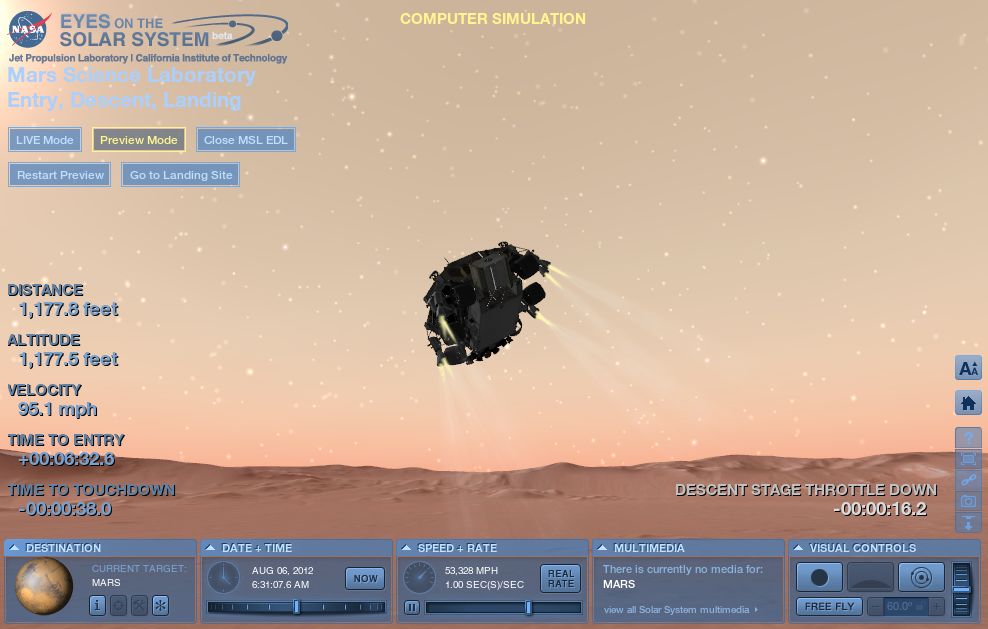
The descent stage simulated by Eyes on the Solar System (NASA)

The excitement of the event was genuinely palpable; not only was there the massive question as to whether the vehicle survive the “seven minutes of terror”, as the EDL had been dubbed by the mission team, there was concern whether NASA’s Mars Odyssey orbiter – the only vehicle in Mars orbit capable of relaying data received from Curiosity directly to Earth – would in fact be able to do so.

The 11-year-old orbiter has been struck by a series of problems over the last year, the most recent of which occurred immediately prior to an orbital manoeuvre designed to put the vehicle on the correct track in order to be overhead as Curiosity landed on Mars. While that problem have been successfully overcome, there was concern that the orbiter might fail to complete a final orientation manoeuvre designed to correctly align its antennae so it could act as a relay – and the manoeuvre itself could not be carried out until just 15 minutes prior to Curiosity arriving on Mars.

While NASA’s Mars Reconnaissance Orbiter (MRO) and Europe’s Mars Express were also on-hand to capture data transmissions from Curiosity, neither one has the ability to simultaneously receive data from the surface of Mars and transmit it directly back to Earth. Instead, telemetry from Curiosity would have to be recorded and then relayed to Earth many hours after then landing period. Thus, without Mars Odyssey, mission control – and the world at large – would have no idea as to Curiosity’s fate for a considerable period of time after the event.

As it was, everything worked flawlessly. Not only were the Odyssey team able to ensure the vehicle was on the right track ahead of EDL, the entire landing process ran to almost precisely to the projected schedule, key events occurring a matter of seconds behind the times being played-out on the Eyes on the Solar System EDL simulation.

For those used to the button-down shirt formality of NASA so beloved of Hollywood and familiar from achieve footage of the Apollo missions, the informality at JPL may have come as something of a surprise. As EDL progressed, team members passed jars of peanuts around, taking handfuls and munching on them in a long-standing tradition dating back to Ranger 7, the first US probe to successfully transmit close images of the lunar surface in 1964. Then, as Allen Chen, the EDL’s Flight Dynamics and Operations Lead announced, “Touchdown confirmed, we’re safe on Mars!” the room erupted into scenes of heartfelt jubilation with shouts, cheers, hugs and even one or two little dances.

Adam Steltzner (right), the man who lead the team responsible for the Curiosity’s descent and landing systems, reaction to the first images received from Curiosity on Mars (credit: Brian van der Brug/Los Angeles Times-POOL)

Even with Odyssey on track and correctly oriented, there was still some doubt as to how much data would be relayed before Mars Odyssey dropped below the horizon relative to Curiosity and direct contact from the rover was lost. As well as transmitting confirmation it was down and relatively safe, the rover had been pre-programmed to record a number of rapid-fire images using the front and rear hazard avoidance cameras (Hazcams) in order to give some visual indication of the vehicle’s general condition / possible orientation. However, the window for data transmission was so tight, there was doubt that any of the images would be captured, compressed and transmitted prior to Odyssey moving out of range.

Use the page numbers below left to continue reading
2012: a Martian Curiosity

Update, Monday August 6th: Curiosity arrived on Mars, on time and on target, the start of what promises to be a remarkable mission of exploration. Mars was good, and allowed the rover to pass images over to Mars Odyssey for transmission to Earth. Read my report.

Later today – or in the early hours of the morning of Monday 6th August if you live on the East Coast of the USA or in Europe, something very, very remarkable will take place above the magnificent vistas of Mars: NASA’s latest mission to the Red Planet will arrive in a quite spectacular manner.

The Mars Science Laboratory (MSL) mission is the biggest single payload yet sent to Mars. It comprises a rover vehicle called Curiosity, weighing-in at almost a tonne, carrying  a sophisticated science laboratory that gives the mission its name. The latter is designed to study the Martian climate and to analyse soil and rock samples to assess what the Martian environment was like in the past in terms of its potential to have been the abode of life. To contribute to thee goals, MSL has six primary mission objectives:

  1. Determine the mineralogical composition of the Martian surface and near-surface geological materials.
  2. Attempt to detect chemical building blocks of life (biosignatures).
  3. Interpret the processes that have formed and modified rocks and soils.
  4. Assess long-timescale (i.e., 4-billion-year) Martian atmospheric evolution processes.
  5. Determine present state, distribution, and cycling of water and carbon dioxide.
  6. Characterize the broad spectrum of surface radiation, including galactic radiation, cosmic radiation, solar proton events and secondary neutrons.

In addition, and while en-route to Mars, the mission has been measuring the radiation exposure experienced by the interior of the vehicle while in interplanetary space in order to better understand that medium in preparation for manned deep-space missions into the solar system.

The Rover

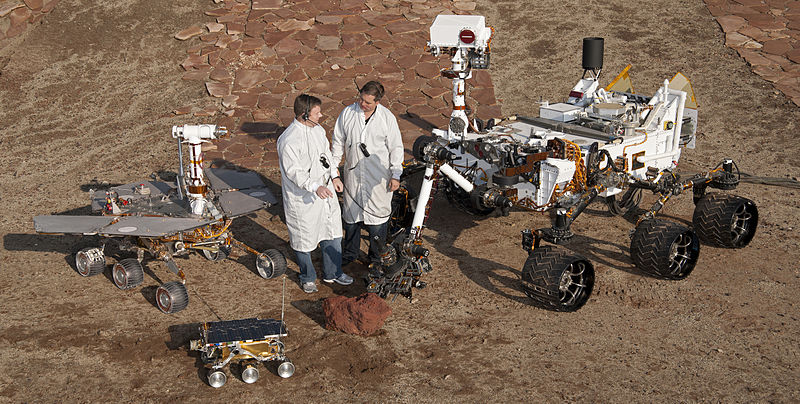
While some to the media descriptions have been prone to exaggeration where Curiosity is concerned (comments like “the size of an SUV” leading people to visualise something the size of a Range Rover or Jeep Cherokee), one should not doubt that, comparatively speaking, the rover is big. At around 3 metres (approx 10ft) in length, Curiosity is almost twice the length of the Mars Exploration Rovers (MER) Opportunity and Spirit already on Mars, while at 900kg (1984 pounds), it is almost two-and-a-half times heavier than their combined weight.

Comparative rover sizes. Foreground: Mars Pathfinder (1997); left: Mars Exploration Rover (2003-present); right: MSL (credit: NASA)

The MERs, which arrived on Mars in 2003, were both solar-powered, as was NASA’s first mission to put a rover on Mars – the tiny Sojourner, which formed a part of the Mars Pathfinder mission of 1997. As such, the MERs were expected to only operate for some 90 days apiece – even though Opportunity is still functioning today (over 3,100 days into the mission). One of the reasons for the 90-day limit placed on the MER missions was the expectation that the rovers solar arrays would become less and less effective as the mission progressed due to the accumulation of Martian dust on their flat surfaces, reducing the amount of sunlight they could convert into power for the rovers’ battery systems. This actually did occur, but so did a series of (initially unexpected) “cleaning events”, which saw the Martian wind periodically remove dust from the arrays, restoring some of their ability to harness sunlight.

MSL is expected to operate for far longer than the MERs – a full Martian year (just under 687 days) being the planned initial mission period. It also carries far more science and other equipment on-board. As such, solar power for the vehicle is impractical. Instead, it will be powered by a radioisotope thermoelectric generator (RTG), which utilises heat from the radioactive decay of plutonium-238. This produces around 110 watts of electrical power, generating around 2.5 kilowatt hours per day (compared to the 0.6 kilowatt hours per day generated by the MERs). In addition, the heat generated by the radioactive decay is used to warm fluids which are circulated through the rover keep electronics and other systems at acceptable operating temperatures during the harsher periods of the Martian / seasons.

MSL is not the first time RTGs have been flown to Mars by the United States; both of the Viking Landers of the 1970s were RTG-powered, and both of them, like Spirit and Opportunity, functioned well beyond their original mission times, with Viking Lander 1 operating for over six years and Viking Lander 2 for just over three-and-a-half years.

The late Carl Sagan and a full-size model of the Viking Lander from the 1970s (the Lander was similar in size and mass to the MSL)

Once on the surface, Curiosity will be able to traverse the terrain at a maximum speed of some 90 metres (300ft)  per hour, with average traverse speeds of around 30m (100ft) per hour. This compares to the MERs traversing around 100 metres per day, and means that over the course of the initial mission period, the rover should cover a minimum of some 19 kilometres (12 miles) during the initial mission period (Opportunity has, to date, travelled some 34.6 kilometres (21.5 miles). The rover will be able to calculate the distance it has travelled by means of the unique pattern the wheel treads will leave in the Martian sand; included in the thread pattern is the Morse code pattern for JPL (·— ·–· ·-··), which will be imprinted on the Martian soil once every revolution (JPL standing for “Jet Propulsion Laboratory, MSL’s “home”).  In addition, Curiosity will be able to roll over obstacles approaching 75 cm (30 in) in height.

Curiosity’s wheel treads include the Morse code pattern for JPL (·— ·–· ·-··) to help the rover calculate the distance it has travelled (credit: JPL)

Science Instruments

Some 80 Kg of Curiosty’s mass comprises the camera systems, scientific instruments, experiments and operating systems themselves. These include two on-board computer systems responsible for managing all of the rover’s operations. Both of these are radiation-hardened, with one forming the back-up to the other in case of unexpected failure. Each computer has just over 2Gb of memory and a RAD750 CPU.  For navigation, the computers are supported by an Inertial Measurement Unit (IMU) that provides 3-axis information on its position.

MSL includes a suite of camera systems, which will be used for a range of functions, including autonomous navigation, hazard avoidance cameras (using pairs of black-and-white cameras mounted at each corner of the rover), a “Mars Hand” camera mounted on the rover’s robotic arm (which has a reach of some 2 metres) capable of taking microscopic images of rock and soil, a “ChemCam” which uses an infra-red laser to vaporise rock and soil samples and then collecting a spectrum of the light emitted.

MSL science instruments and cameras (credit: JPL)

From a public perspective, however, the two most interesting camera systems aboard the rover are liable to be the Mars Descent Imager (MARDI) and the MastCam. MARDI will be used during the final moments of MSL’s Martian arrival (dubbed, with good reason, the “seven minutes of terror” – see below). This is designed to start operating when the MSL and its decent unit are some 3.7 km above the surface of Mars and continue through until the vehicle is some 5 metres above the surface. It will take images at 1600×1200 pixel resolution with a 1.3 millisecond exposure time and at a rate of some 5 frame per second.

The MastCam sits (as the name suggests) atop the rover’s mast, some 1.97m above the bottom of the rover’s wheels. This system provides multiple spectra and true color imaging with two cameras. The cameras can take true color images at 1600×1200 pixels and up to 10 frames per second hardware-compressed, high-definition video at 720p (1280×720). As such, it is liable to be images and film from this camera that will capture the imagination of people from around the globe, with the two cameras in the system given between 1.25 and 3.67 higher spatial resolution than the panoramic cameras carried by the MERs when operating at its highest (black and white) resolution of 1024×1024 pixels.

NASA JPL provides a comprehensive overview of the complete science package for those who are interested.

Use the page numbers below left to continue reading