Work continues on readying Curiosity for surface operations on Mars, with characterisation phase well underway.
The week has seen the rover’s Chemistry and Camera system – ChemCam – undergoing its calibration tests using a target system located towards the back of the rover, while scientists have been looking for candidates for the first full test firing of the system at a suitable surface target.
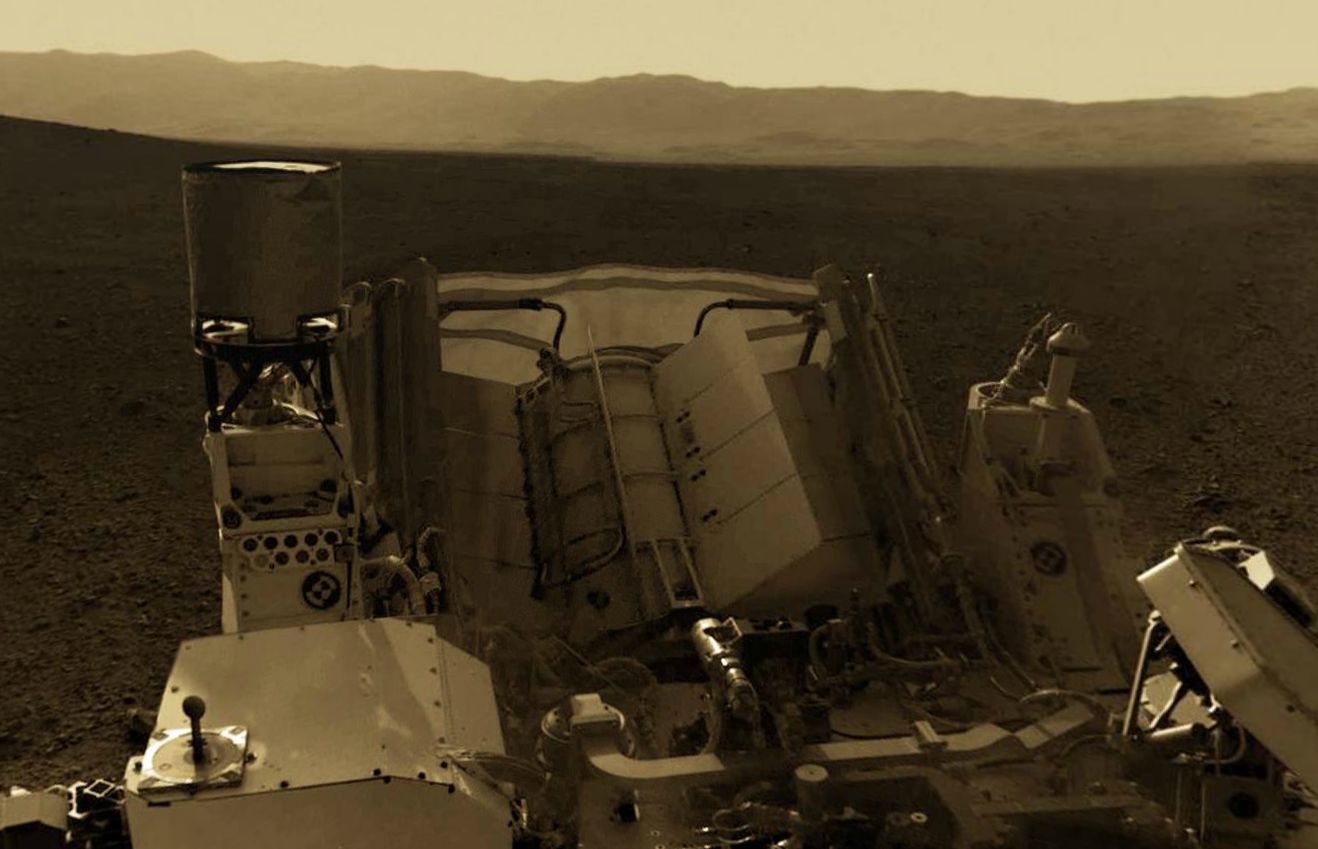
ChemCam is a complex system split between Curiosity’s mast and body. The mast unit is the large box-like unit at the top of the mast. It contains a laser unit, a remote micro-imager (RMI) and a telescope for focusing both.
The Chemcam mast element
The body unit carries three spectrographs for chemical analysis and has its own power supply and an electronic interface to the rover’s central computer system.
ChemCam has two main functions, split between the laser system (the Laser-induced Breakdown Spectroscopy (LIBS), to give it its proper name) and the Remote Micro-Imager (RMI).
LIBS is designed to fire series of laser pulses at a target spot smaller than 1 millimetre on the surface of rocks and soils, vaporizing it. Light from the resultant plasma is captured by the telescope and sent via fibre-optics to the on-board spectrographs for analysis, which should provide information in unprecedented detail about minerals and micro structures in Martian rocks. Additionally, the laser can be used to remove dust from the surfaces of rocks, allowing the drill on Curiosity’s hand to obtain samples of the rock free from surface contaminants.
The RMI provides black-and-white images at 1024×1024 resolution in a 0.02 radian (1.1 degree) field of view – approximately equivalent to a 1500mm lens on a 35mm camera. RMI has two functions. In the first, it will be used in conjunction with LIBS to identify suitable targets and target locations (targets can be selected autonomously or via Earth-based selection and command). Working independently of LIBS, it will be used to obtain close-up images in support of robot arm-mounted experiments or provide images of very distant objects.
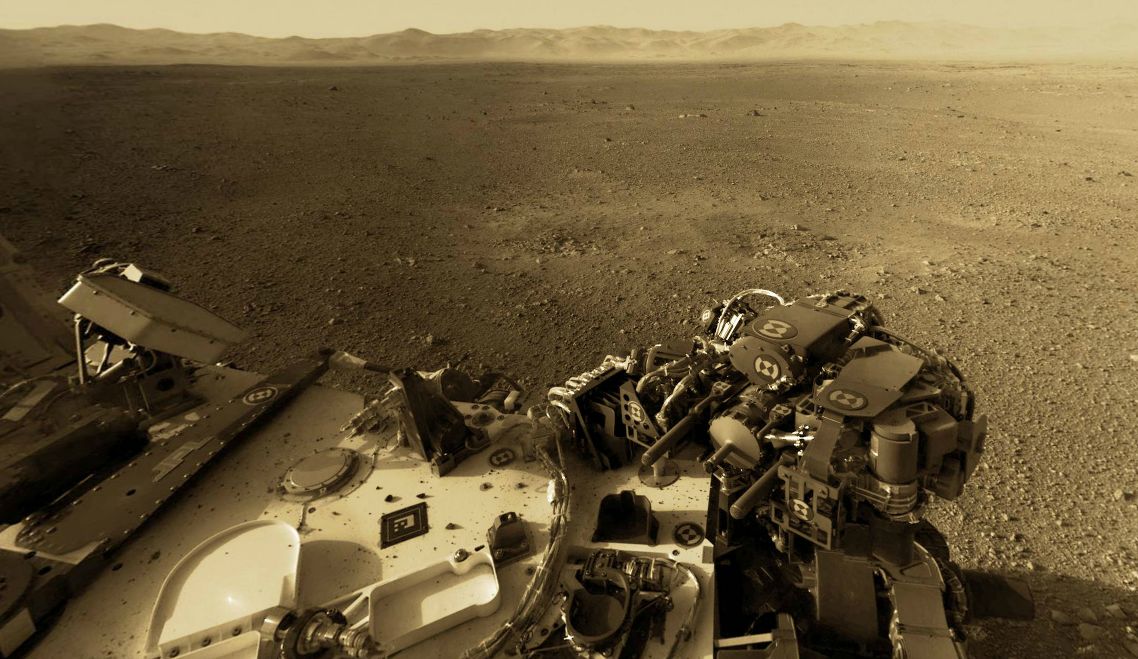
This week, ChemCam was calibrated using a target system mounted on the rear section of the rover, mounted below the UHF antenna. As a result of this, ChemCam was confirmed ready for operations, and is expected to make it first test-firing on an actual Martian rock sample on Saturday August 18th. The sample is provisionally designated N165, and sits a short distance from the rover.
ChemCam’s first Martian target
ChemCam is a joint US / French experiment, with the US Los Alamos National Laboratory providing the body unit, the French national space agency (CNES) proving the mast unit (RMI, laser, etc.) and JPL the fibre-optic link between the two.
Curiosity should be resuming the characterisation phase tests following the upgrading of the on-board computer systems to the R10 flight package. Following the upgrade, NASA hosted a teleconference in which it was indicated the software transition proceeded smoothly and successfully.
This week will see the REMS system commence continuous operations, so mission scientists are hoping to get the first complete 24+ hour Sol cycle of weather data returned later in the week. The mission planners are also looking to run another series of high-resolution images of “Mount Sharp”, right up to the peak of the mound, now that the rover’s orientation relative to the ground and the Sun are understood.
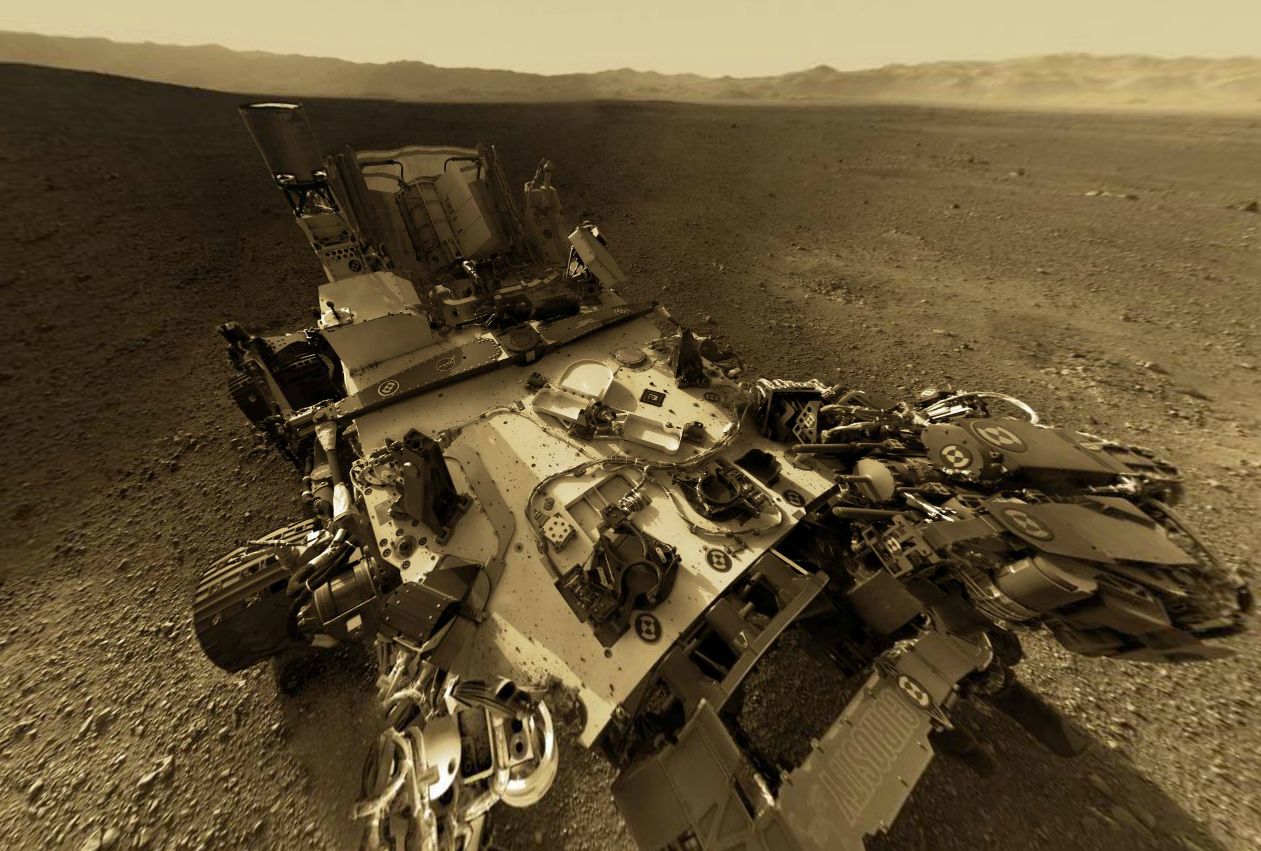
Curiosity – an initial self-portrait via 360
With the successful software transitioning, the characterisation phase for the rover now enters stage 1b characterisation (the first week having been 1a characterisation). This will see more of the rover’s science systems enter operation, and preparations made for Curiosity’s first drive. This will be preceded on Sol 13 by a static test of the rover’s steering actuators. The initial drive – probably no more than a few metres and turning the rover in an arc – is currently scheduled for Sol 15.
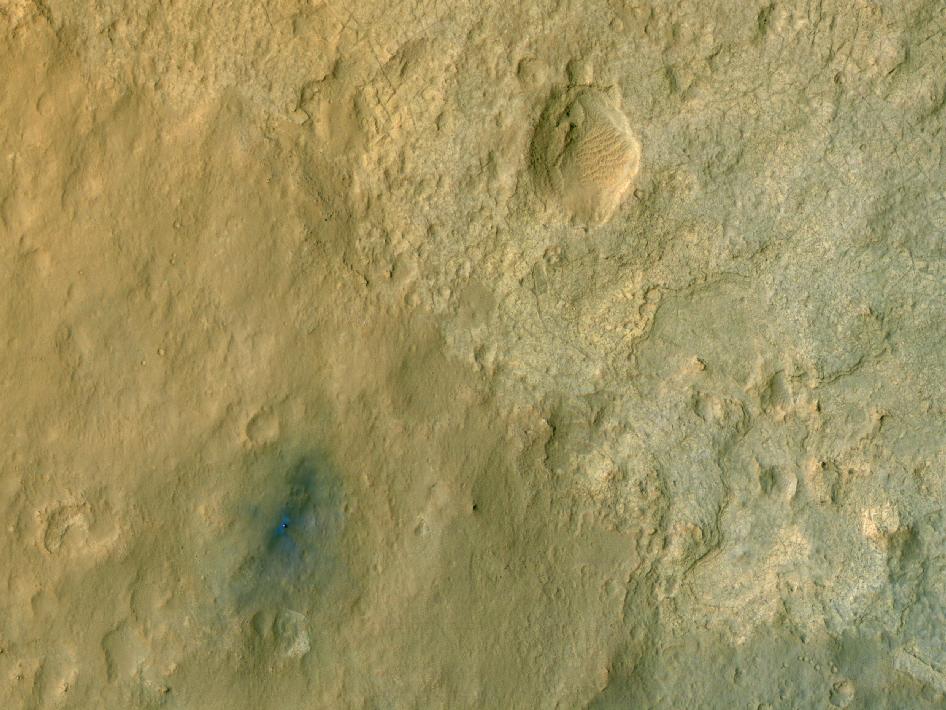
Curiosity on Mars: captured by MRO’s HiRISE. The discolouration around the rover is the result of soil disturbances from the descent stage engines. The blue hue is due to over-emphasis in the colour processing and is not thought to indicate anything unusual in the properties of the rocks
It is estimated that the 1b characterisation phase will last a couple of weeks, and should result in everything aboard the rover being declared as commissioned and ready for operations with the exception of the robot arm and hand. These will be tested during a third characterisation phase (called “characterisation 2”), which is still around a month away. In the period between the end of characterisation 1b and characterisation 2, the rover will be commencing an initial set of science operations using its other instruments.
As it stands, mission staff are already building up a plan for the rover’s traverse from the landing zone to the slopes of “Mount Sharp”. The mound is only around 8 kilometres (5 miles) from the rover, but the route will not be direct, and there are a number of mesas the rover must navigate around – and which may themselves have points of interest to be investigated, although the aim is to get the rover into the ravines cutting into the slopes of the mound, rather than in diversions elsewhere.
A close-up of Curiosity’s “hand” (centre right), with the blast patterns from the descent stage motors just beyond. The paddle-shaped high-gain antenna is to the left
Mission Trivia: Does Curiosity Dream of Electric Sheep?
To conserve power, Curiosity has what is called a “sleep state” in which the main computers are hibernating and systems are largely running in a minimal state. During this time, monitoring the rover’s status and condition is the responsibility of a small monitoring system independent of the rover’s computers. JPL engineers refer to the data returned from this unit (the MRU) as Curiosity’s “dream state”.
See Gale crate for Yourself
Want to see Gale Crater exactly as Curiosity sees it as the Mastcam is rotated through 360-degrees? Want the ability to zoom in and out of images and have a look at the rover itself?
Photographer Andrew Bodrov has taken images captured by Curiosity’s Mastcam last week and put them into a superb 360-degree interactive panorama, allowing you to see Gale Crater, the surface of Mars and the rover itself in marvellous detail (the images of the rover used here are captured from the view).
The back of the rover. On the left: the UHF antenna; on the right, the low-gain antenna (LGA). In the middle: the rover’s RTG power source
To take a look for yourself, visit the 360cities.net website (unfortunately, WordPress.com blew a raspberry at attempts to embed the view here).
Curiosity continues to operate well on Mars, with the MSL mission’s characterisation activity phase proceeding precisely as planned.
The last two Sols have been the focus of some intense work, including preparing the rover for what NASA has dubbed its “brain transplant”.
Like all computers, Curiosity’s computers have finite storage capacity, and to cram all the code required for the mission aboard the rover would be impossible. So the software in broken-down in sections that equate to various phases of the mission. The software is then uploaded to the rover and committed to its on-board computers as it becomes required, over-writing the previous mission phase software.
Prior to its arrival on Mars, Curiosity’s software was concerned with three things: the cruise phase of the mission (keeping the vehicle on-course for Mars and the planned landing site and correctly oriented for both this and communications with Earth); carrying out experiments to monitor radiation in interplanetary space and how it penetrates the vehicle (part of planning for a manned mission to Mars); and the EDL (Entry Descent, Landing) phase of the mission itself. Now the rover has landed, that software package (called the R9 Flight Software Package) has done its job, and so needs to be replaced with the software (called the R10 Flight Software Package) required for Curiosity to operate on Mars.
Sol 3
The day began with the upload of R10 files to Curiosity. Installation did not immediately take place – it is planned to commence on Sol 5 – but the rover’s back-up computer was powered-up and checked-out ready for the upcoming software upgrade. The transition will be handled on a per computer basis, in case anything unforeseen occurs. The software will, among other things, allow the robot arm and Curiosity’s “hand” of instruments to be activated and checked out. The software also contains software related to Curiosity’s ability to drive on Mars and self-navigate.
Curiosity in action: the “hand” deployed on the end of the 2-metre robot arm with the MAHLI camera visible on the top of the hand and in the foreground
The hand is crucial to the mission, containing a range of instruments capable of a range of tasks including: viewing surface features in extreme close-up (the MAHLI camera); gathering soil and dust samples from the surface; scraping the surface of rocks and drilling into them to obtain samples, and so on, all of which can be returned to the rover’s onboard analysis lab.
The Mastcam completed final calibration and then undertook a 360-degree look at Gale Crater around the rover with 130 images, each compressed into a 144×144 pixel format, returned to Earth and used to create the first colour panoramic view of the rover’s location.
The Navcams were used to take high resolution images of the rover’s deck, taking a number of shots which revealed the vehicle to have some small debris scattered on the deck as a result of jet-wash from the descent stage motors, but nothing serious. These images were returned together with the low-res colour images during the scheduled overhead passes of Mars Odyssey and the Mars Reconnaissance Orbiter (MRO).
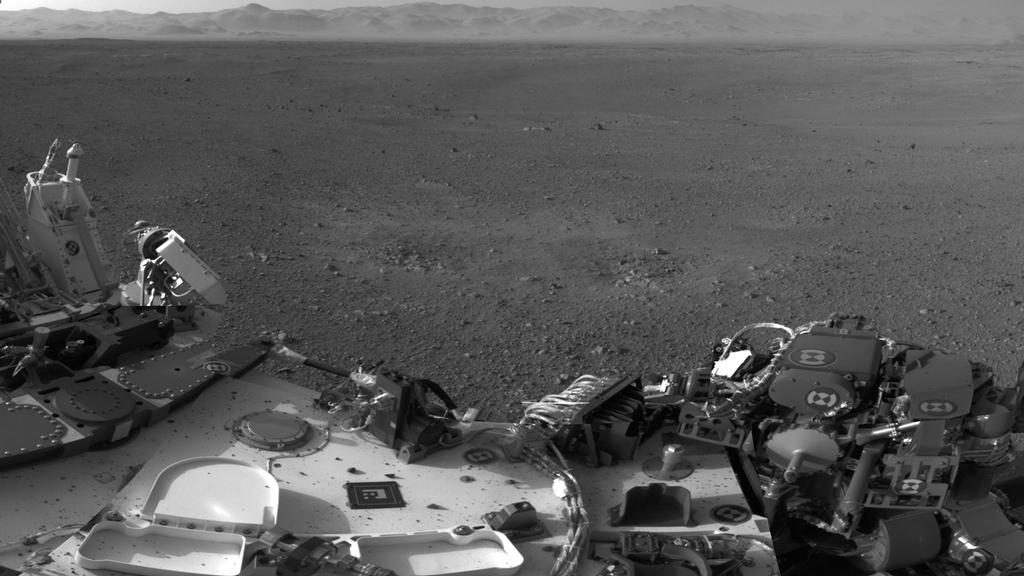
Hi-res Navcam image of Curiosity’s rear deck – see description in the main text
Image above: Curiosity’s rear deck. One the extreme left of the image, angling away from the deck is the RTG housing at the back of the rover. Immediately to the right of this, sitting on top of the raised structure is the arrow-like low-gain antenna (LGA). In front of this and side-on to the camera is the high-gain antenna (HGA). The rim of Gale Crater is the line of sun-brightened hills on the horizon.
Sol 3 also saw initial check-outs completed on a range of other instruments on the rover: the Alpha Particle X-ray Spectrometer (APXS), Chemistry & Mineralogy Analyzer (CheMin), Sample Analysis at Mars (SAM), and Dynamic Albedo Neutrons (DAN), all of which were successful. instruments were all successful. Issues with the Remote Environmental Monitoring Station (REMS) were resolved, allowing both REMS and RAD (Radiation Assessment Detector) to return further data on the environmental and climatic conditions in Gale Crater to Earth.
Another hi-res image of the rover’s deck
Image above: a further image of Curiosity’s deck taken as the Navcam rotates more towards the front of the rover in relation to the previous image. The LGA, HGA and drive system arm can still be seen to the left. In the right foreground is the rover’s “hand”, still in its stowed position against the front of the vehicle. Pebbles and dirt can clearly been seen on the rover’s deck, thrown-up by the jet-wash from the descent stage motors. Blast marks from the motors can themselves be seen a short distance from the rover.
Sol 4
Sol 4 was a relatively quiet day for the mission. Work continued on preparing the rover to transition to the R10 Flight Software. Key capabilities in the R10 package, as mentioned above, enable full use of Curiosity’s robotic arm and hand, and includes advanced image processing to check for obstacles while driving. This software will enable Curiosity far more autonomous than is the case with Opportunity, allowing it to make much longer drives along routes it identifies for itself and to avoid potential hazards along the way.
During the period of the transition, science and check-out operations have been deferred, and while the rover did return some images and additional data to Earth, the focus was on readying the on-board systems for the new software. The transition itself is expected to run through the weekend, with an end-time targeted for August 13th (PDT) Earth time. While this work is ongoing, the mission scientists have been putting together a geological map of a rough 390 square kilometre (150 square mile) region of Gale Crater, including the landing zone.
Elsewhere in JPL, and following the successful MSL landing, a unique video was cut together mixing footage from the “seven minutes of terror” simulation of Curiosity’s arrival on Mars with scenes from mission control at JPL during the actual sequence of events from EDL. The result is a unique film that puts a new perspective on the mission and the landing sequence.
Mission Trivia
Curiosity’s Sol 3 wake-up call came in the form of Good Mornin’ from Singin’ in the Rain.
Jut after I pressed my most recent update on the Mars Science Laboratory mission, NASA JPL release the first low-resolution colour panoramic view of Gale Crater captures by Curiosity’s Mastcam.
The images were captured by the Mastcam system’s 34 mm fixed focal length camera mounted towards the top of the rover’s remote sensing mast (it is the Mastcam camera on the left of this image).
First colour panoramic view of Gale Crater from Curiosity’s Mastcam
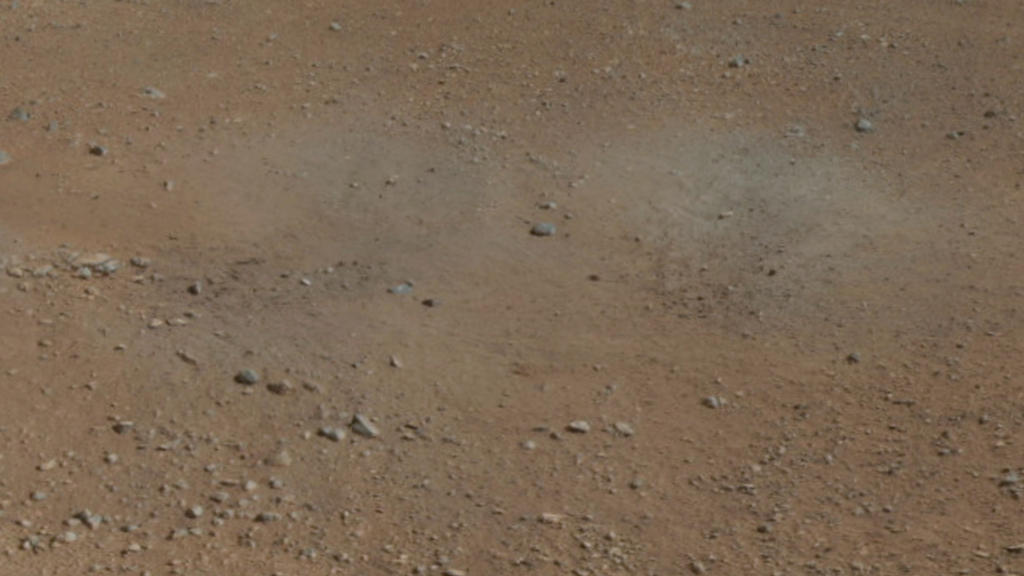
The mosaic is made up of 130 images each compressed into a 144×144 pixel format for transmission to Earth. The complete set of images has been brightened in the processing as Mars only receives half the sunlight Earth does, and these images were captured in the late Martian afternoon. The black areas denote areas outside the view of the Mastcam. The grey patches on the ground to the left and right of the rover are the result of the blast from the descent stage’s radial motors striking the ground and blowing away the topsoil, and these are already the subject of study by the science team on the mission.
A closer view of one of the blast areas resulting from the MSL’s descent stage motor thrust
The dunes on the horizon are also visible in the black-and-white panoramic view captured by Curiosity’s Navcam on Sol 2, but in this image they reveal some interesting hues that suggest they are comprised of different materials or textures.
Selected high-resolution (1200×1200 pixel) images from the panorama are expected to be returned to Earth later.
Image credit: NASA / Caltech / Malin Space Science Systems (MSSS)
It’s been an amazing few days since Curiosity landed on Mars. The rover is off to a good start in what is called the “characterisation activity phase” of the mission, which is scheduled to last around a month.
The rover landed on Mars at 15:00 “Mars time”, equating to 06:14 BST on August 6th, or 22:14 PDT August 5th, at NASA’s Jet Propulsion Laboratory in Pasadena, with confirmation being received on Earth at 06:32 / 22:32 respectively .
This marked the start of the rover’s first day on Mars, officially designated Sol 0. Activities during Sol 0 comprised releasing various instruments and protective covers, such as those over the Hazcams at the front and rear of the rover, checking-out the UHF telecommunications system and the rover motor controller, confirming its orientation (facing a heading of 112.7 degrees (+/- 5 degrees) and with a slight tilt) and relaying some 5 Mb of data back to Earth via Mars Odyssey.
Sol 1
Sol 1 saw the rover gather data from the Radiation Assessment Detector and Rover Environmental Monitoring Station instruments and further tests on the high-gain antenna (HGA), located towards the back of the vehicle. This is important, as the HGA enables the rover to communicate directly with Earth when it is above the rover’s horizon, rather than signals having to be relaid via Mars Odyssey and Mars Reconnaissance Orbiter (MRO) – although both of these will continue to be used when direct rover-Earth lines of communications are unavailable.
Curiosity took its first colour image of Mars using the Mars Hand Lens Imager, or MAHLI, located on the robot arm. This image appeared oddly rotated due to the arm being in its stowed position, MAHLI pointing outwards on the front left side of the rover.
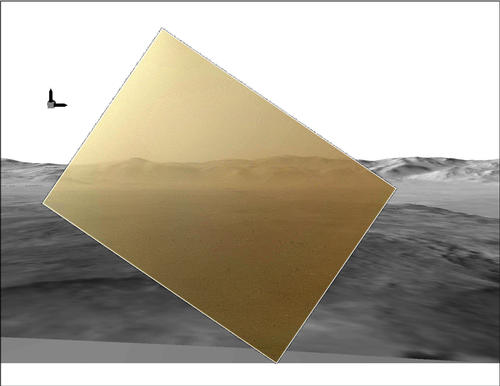
First MAHLI image, taken with the camera in its stowed position, looking over the side of the rover. In the distance is the rim of the crater
The image appears cloudy as it was taken before MAHLI’s protective cover was still in place, coated by a film of dust thrown-up by the descent stage motors during landing. The image is facing north, and the visible ridge is the rim of Gale Crater, with the peak to the left being some 1,150m (3,775 ft) high and 24 km (15 miles) from the rover
Sol 1 also saw the rover complete an initial deployment of the forward remote sensing mast to enable calibration of the navigation cameras (Navcams) to commence. Calibration was expected to take around a Sol to complete, as test images of targets on the rear section of the vehicle had to be returned to Earth in order for any “manual” adjustments yo the camera systems to be calculated and then transmitted back to the rover.
MAHLI’s image (above) given context is a computer simulation of Gale Crater developed from hi-resolution images returned by MRO’s HiRISE and the High Resolution Stereo Camera on Europe’s Mars Express.
During Sol 1, MRO also captured a fabulous image of the landing zone from some 300 km above the surface of Mars, using it’s HiRISE camera system. The image clearly shows the shadow cast by Curiosity, together with parachute and aeroshell to the left and slightly below it (approx. 615m away) and the impact points for the heat shield (some 1.5 km (1 mile) from the rover) and descent stage. The latter, having flown clear of the rover’s landing-zone, impacted on the surface around 650 metres from the rover, leaving a classic oblique impact mark (common to asteroids striking a planet), which forms an arrow pointing back towards the rover. This image was later combined with images of Mars to create a short movie called Zooming in on the scene of Curiosity’s Landing.
Sol 2
Curiosity’s remote sensing mast, seen fully deployed prior to launch in 2011
On Sol 2, Curiosity completed calibration testing on the Navcams, and raised the remote sensing mast to its fully deployed position. An initial high-resolution image was then captured by the Navcam, looking out over the front of the rover (part of an exercise to help confirm the rover’s alignment relative to the sun).
The first image taken by the Navcams following full deployment of the remote sensing mast. The cameras are looking forward and down over the front of the rover, away from the sun (what JPL calls the “anti-sun” image)
Following this, the mast was rotated, allowing the Navcams to be used to capture images of the rover’s immediate surroundings, including a 360-degree panoramic collage of Gale Crater and Aeolis Mons (referred to as “Mount Sharp” by NASA, the unofficial name given to the mound prior to its naming by the IAU). The panoramic view was initially returned to Earth as a collage of thumbnail images.
The first 360-degree panoramic view of the landing site and Gale Crater returned as thumbnails by Curiosity
As it is currently only available at thumbnail resolution, the panoramic view was somewhat overshadowed by high-resolution images also returned by the Navcams, which stand as promise of things to come once the Mastcams start operations.
The Navcams were also used to image elements of the rover itself in order to gain a further indication of the vehicle’s overall condition, and these revealed no nasty surprises, and were later strung together to give and overhead “fish-eye” view of Curiosity (see the image towards the end of this article).
Use the page numbers below left to continue reading
Earlier today I commented on the fact that NASA hoped that the Mars Reconnaissance Orbiter would be able to capture an image of Curiosity as it descended through the Martian atmosphere.
Well – take a look at these pictures!
MRO captures MSL / Curiosity, still within its aeroshell and suspended beneath its parachute (credit: NASA)And a closer view (credit: NASA)