Space Sunday: of Martian water, avalanches and postcards

A false-colour image of Hale Crater on Mars showing recurring slope lineae (RSL) flowing downhill, which are inferred to have been caused by contemporary flowing water, hydrated salts detected within the dark-colours RSLs tending to confirm they hypothesis they were created by free-flowing water.
A false-colour image of Hale Crater on Mars showing recurring slope lineae (RSL) features flowing downhill. Hydrated salts detected within the dark-coloured RSLs tend to confirm the hypothesis they were, and are, created by free-flowing water.

On Monday, September 28th, NASA held a special press conference which, they had promised, would “solve” a “major” mystery about Mars.

As I noted in my Space Sunday update prior to the conference, the major speculation was that the US space agency would be discussing what are called recurring slope lineae (RSL) features on Mars.

RSLs have been the subject of intense debate and discussion since 2011, when an undergraduate called Lujendra Ojha published the first in a series of papers on their presence on Mars.  In essence, they are ridges and rills which appear on the slopes of hills and craters, notably in the equatorial regions of Mars. The significance here being that on Earth, identical features are always the result of free-flowing water.

Given that it is known that Mars once supported liquid water on its surface, the presence of these features wouldn’t be that exceptional were they part of the ancient landscape. However, as the “recurring” in the title suggests, the Martian RSLs appear to be active – recurring frequently, sometimes on the seasonal basis. renewing and growing, with new ones also being periodically created.

Two images studied by Ojha showing the flank of the same crater and showing what appear to be active RSLs.
Two images studied by Ojha showing the flank of the same crater. On the left, from 2007, a number of older RSLs, faded due to dust deposits, appear with a relatively new, dark RSL. By 2012 (on the right), that RSL feature has also faded, but a further new one has appeared

Given the overall similarities between RSLs seen on Mars and those seen on Earth, particularly in Antarctica, the common belief has been that liquid water is responsible for the features on Mars. If true, then it would indicate two things.

The first would be that Mars would appear to have a subsurface water table of some description – which would be consistent with the idea that as the planet lost its atmosphere, whatever water remained on the surface may have retreated underground. The second is that it would seem to indicate that Mars is still in some way geologically active, with some mechanism at work forcing this water to the surface and creating these sudden, if short-lived outflows.

The NASA conference coincided with the publication of another paper in Nature Geoscience by Ojha and his colleagues. both pointed directly to water being the cause of the Martian RSLs. In particular, they both report that spectral analysis of some of the more recent and broader RSL channels shows they are rich in hydrated salts, which strongly indicates the presence of water. These salts are consistent with the chemical signatures of magnesium perchlorate, magnesium chlorate and sodium perchlorate.

This is significant because the presence of perchlorate deposits in water can work to prevent that water freezing solid in the kind of summer daytime temperatures – around -23C (-10F) – often experienced in the regions where these RSLs are found. Thus, if held in suspension, they would create a watery brine capable for fluid motion, and which, if released in significant enough amounts, could give rise to the RSLs prior to the water itself sublimating rapidly into the tenuous Martian atmosphere, leaving the hydrated deposits behind.

Nepalese born
Nepalese born Lujendra Ojha is the student who started the investigations into RSLs and their possible relation to free-flowing liquid water on Mars (image: The Himalayan)

The conclusion is that it is indeed liquid water that is causing these RSLs on Mars, and that this water is in a liquid, rather than solid state, at least during certain periods, such that it can be forced to the surface.

However, all is still not entirely clear – something which tends to cast a shadow on the idea of a “mystery” having been “solved”. For one thing, if the RSL rills are below a certain width, they are entirely devoid of any hydrated deposits. This could mean that some other process is involved in their formation, which has yet to be determined. Further, the mechanism which is actually responsible for forcing the water to the surface a creating the outflow which result in these RSLs is still unknown.

Continue reading “Space Sunday: of Martian water, avalanches and postcards”

Space Sunday: of blood moons, Mars, Pluto and Ceres

A lunar eclipse "blood moon" seen Idaho, December 2011 (image: Matt Mills / Reuters)
A lunar eclipse “blood moon” seen Idaho, December 2011 (image: Matt Mills / Reuters)

The night of Sunday 27th / Monday 28th September  promises a very special astronomical event for those fortunate enough to have clear skies overhead and are willing to stay up late (in the UK and Europe). It will see a total lunar eclipse take place at the time when the Moon reaches perigee, its closest approach to Earth in its orbit and giving rise to both a so-called “supermoon” and a “Blood Moon”.

A “supermoon” occurs when a full moon coincides with the time when the Moon is nearing its minimum distance to Earth, a distance of roughly 363,000 kilometres (226,875 miles), leading to it appearing 7-8% larger than when seen as a full Moon at other points in its orbit. A “blood moon” is the result of the Earth’s atmosphere, lying between the Sun and Moon, scatter blue light more strongly than red, so the latter reaches the Moon more strongly, giving it a reddish-brown colour when seen from Earth.

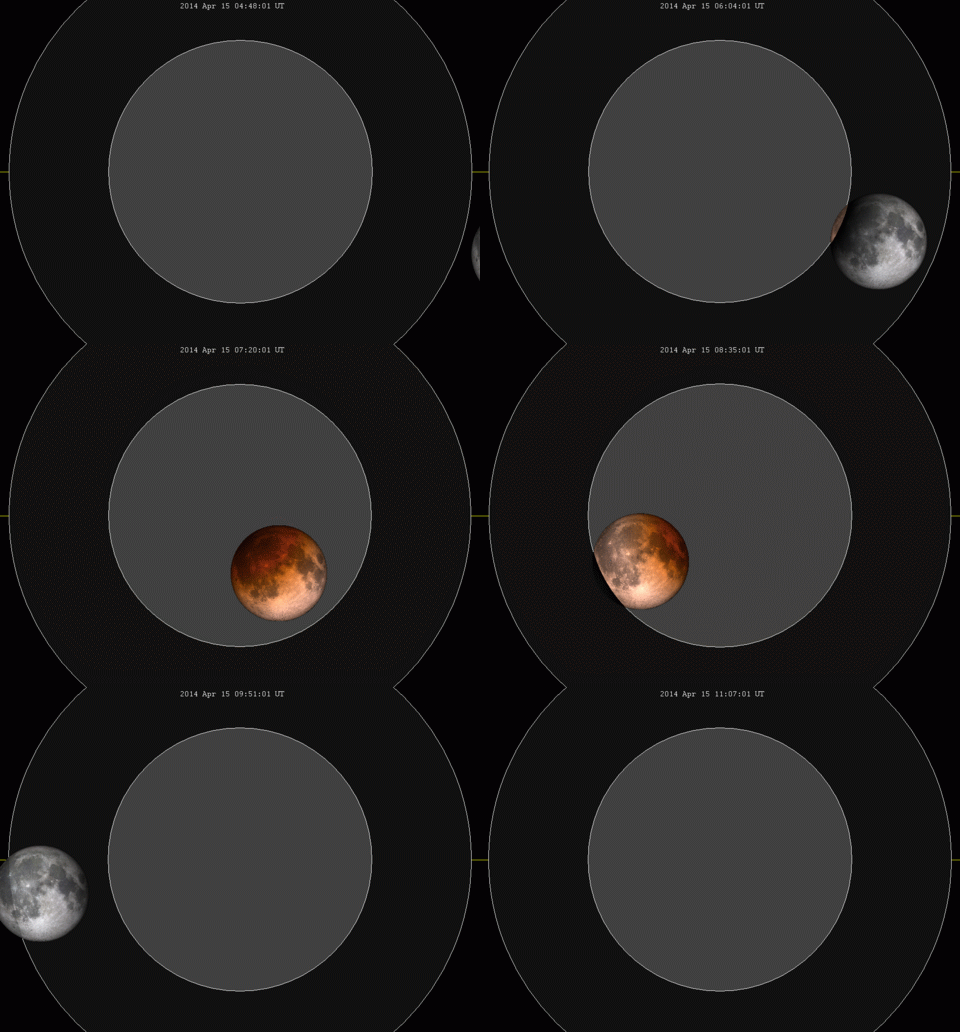
A total lunar eclipse occurs when the Sun, Earth and Moon are lined up so that th Earth is between the Sun and Moon, and the later sits within the Earth's shadow
A total lunar eclipse occurs when the Sun, Earth and Moon are lined up so that the Earth is between the Sun and Moon, and the latter sits within the Earth’s shadow (image: NASA)

Lunar eclipses are not that rare – this one will be the second of 2015, for example. However, “supermoons” are somewhat rarer. The last was in 1982, and the next will not be until 2033. So, if you want to see a really big blood moon, and you live in Western Europe, West Africa, the Eastern side of the USA and Canada or south America, then the 27th / 28th September is the night to do so. People further afield – eastern Asia, the middle east, eastern Europe and the western sides of Canada, the USA and South America will see a partial eclipse.

In the UK, the period of eclipse will start at around 01:00 BST (00:00 GMT) on the morning of Monday, 28th September, and run through until around 05:00 BST (04:00 GMT). That’s from 20:00 through to around 01:00 EDT in the USA / Canada, and 02:00 through 06:00 CET in Europe).

A total lunar eclipse and the gradual change in the Moon’s colour as seen from Earth which sees total lunar eclipses sometimes referred to as “blood moons” – the result of sunlight passing through the Earth’s atmosphere and striking the Moon’s surface (animation: Wikipedia)

The eclipse brings to a close what is referred to as a “tetrad” of total lunar eclipses – that is, four occurring “back-to-back”, with no partial eclipses between them, the first of which occurred in April 2014 and the “middle two” in October 2014 and April 2015. Some have a misguided view that this “tetrad” as being of particular significance because such events are “rare”, and this particular one started on the Passover.

However, while there can be long periods of time between occurrences of tetrads, they can also pop-up relatively frequently. For example, this century will see a total of nine tetrads occur, the first having taken place in 2003/4. Nor is the fact that this particular series started on the Passover particularly unusual; there have been eight tetrads so far coinciding with Passover since the first century AD.

So, if you are in a position to see the eclipse, you can leave the tinfoil hat on the table and step outside quite safely. Totality should occur around two hours after the eclipse starts (e.g. 03:00 BST in the UK / 04:00 CET, 22:00 EDT on the 27th September), and that’s the best time to enjoy the blood moon in all its glory.

The eclipse will also give NASA the chance to measure the full range of temperature variations during  such an event. This will be done by the Lunar Reconnaissance Orbiter (LRO), a solar-power vehicle which has been observing the Moon since 2009.

Normally during an eclipse, the LRO has most of its systems powered down to reduce the load placed on the battery systems. However, mission controllers are confident they will be able to run an instrument which will allow it to accurately measure the amount of heat loss the surface of the Moon experiences when inside the Earth’s shadow, further helping them to understand the composition of the Moon’s regolith and its function as an insulator.

Continue reading “Space Sunday: of blood moons, Mars, Pluto and Ceres”

Space Sunday: see Pluto’s mountains and the size of the Solar System

Back lit by the sun: Pluto's hazy atmosphere seen from just 18,000km (11,000 miles) and 15 minutes are the point of closest approach to the planet by the New Horizons spacecraft on July 14th, 2015. To the upper right of the planet can be seen the icy expanse of "Sputnik Planum", bordered below and to the left by tall mountains, and to the right by what appears to be glacial outflows. Image courtesy of NASA / JHU / APL,
Backlit by the Sun: Pluto’s hazy atmosphere seen from just 18,000km (11,000 miles) and 15 minutes are the point of closest approach to the planet by the New Horizons spacecraft on July 14th, 2015. To the upper right of the planet can be seen the icy expanse of “Sputnik Planum”, bordered below and to the left by tall mountains, and to the right by what appears to be glacial inflows. Image: NASA / JHUAPL / SwRI (click for full size)

Just when you thought images of Pluto returned by the New Horizons spacecraft could get any more awe-inspiring, NASA / JHU  APL release a set of raw images that are utterly stunning.

The images come from the wide-angle Ralph/Multispectral Visual Imaging Camera (MVIC) on the space craft and were captured just 15 minutes after the vehicle reached is point of closest approach to the little world, and thus from a distance of just 18,000 km (11,000 miles) from Pluto.

The stunning vistas presented in the image show the ice plains of “Sputnik Planum” bordered to the left and from below by Pluto’s huge mountain ranges, informally named Hillary and Norgay, Montes after the first partnership to successful reach the summit of Mt. Everest here on Earth. All of this is dramatically backlit by sunlight reflected through Pluto’s hazy atmosphere to create a wonderful scene said to be reminiscent of views of the Antarctic viewed from space or very high altitude.

A closer view: In this image just 380 km (230 miles) across, shows "Sputnik Planum" bordered to the west by towering mountains reaching up to 3,500 metres (11,000 ft) in altitude. In the foreground sit the informally-named Norgay Montes, and on the skyline to the top and left of the image, the Hilary Montes
A closer view: in this image just 380 km (230 miles) across, shows “Sputnik Planum” bordered to the west by towering mountains reaching up to 3,500 metres (11,000 ft) in altitude. In the foreground sit the informally named Norgay Montes, and on the skyline to the top and left of the image, the Hillary Montes. Image: NASA / JHUAPL / SwRI (click for full size)

However, the images aren’t just notable for the panoramic beauty; they actually reveal a lot about what is happening in the Plutoian atmosphere. Because of the back lighting from the Sun, the high-resolution MVIC has revealed just how complex Pluto’s atmosphere is, comprising multiple layers of nitrogen and other gases rising to around 100 km (60 mi) above Pluto’s surface (and visible as a banding in the images above).

“In addition to being visually stunning, these low-lying hazes hint at the weather changing from day-to-day on Pluto, just like it does here on Earth,” said Will Grundy, lead of the New Horizons Composition team from Lowell Observatory, Flagstaff, Arizona.

What is also exciting the science team is evidence within the images for Pluto having a complex “hydrological” cycle which seems to be comparable in some ways to that found on Earth – only on Pluto, it involves nitrogen ice, rather than water ice.

When compared with images captured as New Horizons approached Pluto, the MVIC images further suggest that the regions eastward of “Sputnik Planum” appear to have been encroached over time by ices and material possibly evaporated from the surface of “Sputnik Planum” to be deposited on the higher lands as a new ice blanket, which in turn appears to have formed glacial formations flowing back into “Sputnik Planum”.

Glacial flow on Pluto: deposits of frozen nitrogen which have accumulated on the uplands on the right side of this 630 km (390 mi) wide image has formed glacial flows leading from the uplands beck into "Sputnik Planum" draining from Pluto’s mountains onto the icy plain through the valley system indicated by the red arrows (the valleys average between 3 and 8 km (2 and 5 mi) in width). In the meantime, the ice of the plain appears to be flowing outwards and towards the uplands, as indicated by the blue arrows. Image: NASA/JHUAPL/SwRI.
Glacial flow on Pluto: deposits of frozen nitrogen which have accumulated on the uplands on the right side of this 630 km (390 mi) wide image has formed glacial flows leading from the uplands beck into “Sputnik Planum” draining from Pluto’s mountains onto the icy plain through the valley system indicated by the red arrows (the valleys average between 3 and 8 km (2 and 5 mi) in width). In the meantime, the ice of the plain appears to be flowing outwards and towards the uplands, as indicated by the blue arrows. Image: NASA / JHUAPL / SwRI (click for full size)

“We did not expect to find hints of a nitrogen-based glacial cycle on Pluto operating in the frigid conditions of the outer solar system,” said Alan Howard, a member of the mission’s Geology, Geophysics and Imaging team from the University of Virginia, Charlottesville. “Driven by dim sunlight, this would be directly comparable to the hydrological cycle that feeds ice caps on Earth, where water is evaporated from the oceans, falls as snow, and returns to the seas through glacial flow.”

To Scale: The Solar System

We’re all familiar with the idea that the solar system is so vast, that it is almost impossible to show the Sun and the major planets proportional to one another and at a scale where all the later are both visible and have orbits which can be adequately encompassed in an easily viewable space.

1972: The Blue Marble (click to enlarge)

Obviously, some models do exist; the Lowell Observatory in Arizona, USA, for example, has a walk that allows visitors to travel from the sun and by each of the planets, but it’s not always easy to clearly grasp the sheer scale of things. The same goes for digital models (and a few have been built within virtual worlds like Second Life).

With this issue of scale and proportion in mind, Wylie Overstreet and Alex Gorosh set out to produce a scale model of the solar system that might help people understand just how vast our planetary back yard is when looked at on a human scale.

They started with a blue marble to represent the Earth, echoing the famous photograph taken on December 7, 1972, by the crew of Apollo 17 en route to the Moon and which NASA dubbed the Blue Marble.

Continue reading “Space Sunday: see Pluto’s mountains and the size of the Solar System”

Space Sunday: of selfies, sprites, and black holes

CuriosityCuriosity, NASA’s Mars Science Laboratory rover has departed “Marias Pass”, a geological contact zone between different rock types on the slopes of “Mount Sharp”, some of which yielded unexpectedly high silica and hydrogen content.

As noted in a recent space update in these pages, silica  is primarily of interest to scientists, because high levels of it within rocks could indicate ideal conditions for preserving ancient organic material, if present. However, as also previously noted, it may also indicate that Mars may have had a continental crust similar to that found on Earth, potentially signifying the geological history of the two worlds was closer than previously understood. Hydrogen is of interest to scientists as it indicates water bound to minerals in the ground, further pointing to Gale Crater having once been flooded, and “Mount Sharp” itself the result of ancient water-borne sediments being laid down over repeated wet periods in the planet’s ancient past.

Curiosity actually departed “Marias Pass” on August 12th, after spending a number of weeks examining the area, including a successful drilling and sample-gathering operation at a rock dubbed “Buckskin”, where the rover also paused to take a “selfie”, which NASA released on August 19th. It is now continuing its steady climb up the slopes of “Mount Sharp.”

A low-angle self-portrait produced from multiple images captured by the Mars Hand Lens Imager (MAHLI) camera mounted on the "turret" at the end of the rover's robot arm. The images were taken on August 5th, as the rover was parked at the "Buckskin" rock formation from which it gathered drill samples
A low-angle self-portrait produced from multiple images captured by the Mars Hand Lens Imager (MAHLI) camera mounted on the “turret” at the end of the rover’s robot arm. The images were taken on August 5th, as the rover was parked at the “Buckskin” rock formation from which it gathered drill samples

As it does so, initial analysis of the first of the samples gathered from “Buckskin” is under-way. It is hoped with will help explain why the “Marias Pass” area seems to have far higher deposits of hydrogen bound in its rocks than have previously been recorded during the rover’s travels. This data has been supplied by the Dynamic Albedo of Neutrons (DAN) instrument on Curiosity, which almost continuously scans the ground over which the rover is passing to gain a chemical signature of what lies beneath it.

“The ground about 1 metre beneath the rover in this area holds three or four times as much water as the ground anywhere else Curiosity has driven during its three years on Mars,” said DAN Principal Investigator Igor Mitrofanov of Space Research Institute, Moscow, when discussing the “Marias Pass” DAN findings. Quite why this should be isn’t fully understood – hence the interest in what the drill samples undergoing analysis might reveal.

A stunning vista: the slopes of "Mount Sharp" as seen by Curiosity as it commenced the upward drive away from "Marias Pass". Captured by the rover's Mastcam systems, the image shows an intriguing landscape, with the gravel and sand ripples typical of much of the terrain over which the rover has passed in the foreground. In the middle distance sit outcrops of smooth, dust-covered bedrock, above which sit sandstone ridges. On the horizon sit rounded buttes, rich in sulfate minerals, suggesting a change in the availability of water when they formed - click image for the full size version
A stunning vista: the slopes of “Mount Sharp” as seen by Curiosity as it commenced the upward drive away from “Marias Pass”. Captured by the rover’s Mastcam systems, the image shows an intriguing landscape, with the gravel and sand ripples typical of much of the terrain over which the rover has passed in the foreground. In the middle distance sit outcrops of smooth, dust-covered bedrock, above which sit sandstone ridges. On the horizon sit rounded buttes, rich in sulfate minerals, suggesting a change in the availability of water when they formed – click image for the full size version

The drilling operation itself marked the first time use of the system since a series of transient short circuits occurred in the hammer / vibration mechanism in February 2015. While no clear-cut cause for the shorts was identified, new fault protection routines were uploaded to the rover in the hope that should similar shorts occur in the future, they will not threaten any of Curiosity’s systems.

A Flight over Mars

With all the attention Curiosity gets, it is sometimes easy to forget there are other vehicles in operation on and around Mars which are also returning incredible images and amounts of data as well – and were doing so long before Curiosity arrived.

One of these is Europe’s Mars Express, the capabilities of which come close to matching those of NASA’s Mars Reconnaissance Orbiter. Mars Express has been in operation around Mars for over a decade, and in that time has collected an incredible amount of data.

At the start of August, ESA released a video made of high resolution images captured by the orbiter of the Atlantis Choas region of Mars. This is an area about 170 kilometres long and 145 wide (roughly 106 x 91 miles) comprising multiple terrain types and impact craters, thought to be the eroded remnants of a once continuous ancient plateau. While the vertical elevations and depressions have been exaggerated (a process which helps scientists to better understand surface features when imaged at different angles from orbit), the video does much to reveal the “magnificent desolation” that is the beauty of Mars.

Continue reading “Space Sunday: of selfies, sprites, and black holes”

Space Sunday: active Ceres, open Mars, and shooting stars

Dawn mission patch (NASA / JPL)Dawn, the NASA / ESA joint mission to explore two of the solar system’s three “protoplanets” located in the asteroid belt between the orbits of Mars and Jupiter, continues to intrigue scientists as it studies Ceres, the second of its primary targets.

As I reported in June 2015, Dawn is part of a broader effort to better understand the origins of the solar system and how the planets actually formed; all of which might give us greater understanding of how life arose here on Earth.

Launched in September 2007, Dawn arrived at Ceres in March 2015, after a 2.5 year transit flight from Vesta, its first destination, which it had been studying for 14 months following its arrival in July 2011. Because of their relative size – Ceres accounts for around one-third of the total mass of the asteroid belt – both of these airless, rocky bodies are regarded as dwarf planets, rather than “simple” asteroids. However, Ceres is proving to be quite the conundrum.

At the start of July, Dawn completed the first part of its high-altitude survey of Ceres and fired its low-thrust ion drive to start a series of gentle manoeuvres to reduce its orbit around from 4,400 kilometres (2,700 miles) to 1,450 kilometres (900 miles). It’s now hoped that from this lower orbit, the space craft will be able to discover more about some of Ceres’ more mysterious features.

One in particular has been the subject of much debate. It started when Dawn imaged a series of bright spots within the crater Occator as it made its initial loop around Ceres to enter orbit. Since that time, it has repeatedly images the bright spots, and their presence has also been confirmed by the Hubble Space Telescope.

A June 6th image of the bright spots within a crater on Ceres, captured by Dawn on June 6th, 2015, from a distance of
A Dawn spacecraft image of the bright spots within a crater on Ceres, captured on June 6th, 2015. With the vehicle now entering a much lower altitude mapping mission, it is hoped that even more detail on the spots  – and the faint haze discovered within the crater – will be obtained

Currently, it is believed the bright marks might either be salt deposits or water ice (the European  Herschel Space Observatory had previously found evidence of water vapour on Ceres).  However, while the science team aren’t leaning either way, their mission briefing on July 21st, leant some weight to the bright spots perhaps being water ice. This came in the form of an announcement that he 92 kilometre (57 mile) wide Occator has its own, very localised atmosphere focused around the bright areas.

The evidence for this comes from images of the crater taken from certain angles which reveal a thin haze covering around half of the cater, but not extending beyond its walls. Th thinking is that this haze is perhaps the result of the ice in the bright area – if they are ice – sublimating out.

However, if this is the case, it actually raises a further mystery: why the haze? Generally, such sublimation would lead to the resulting gases dissipating very quickly, without forming a haze. One hypothesis is that Ceres’ gravity, which is somewhat higher than might be expected for a body of its size) may be and influencing factor.

The 5 km high "pyramid" mountain pokes up above the limb of Ceres. Flat-topped, it has streaks of bight mateiral on its flanks giving the impression something has been flowing down it.
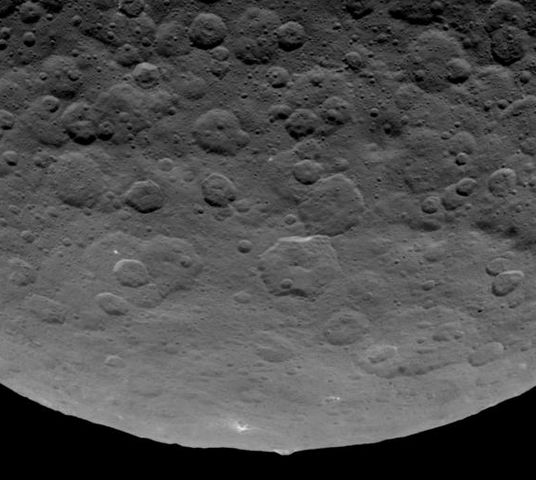
The 5 km high “pyramid” mountain pokes up above the limb of Ceres. Flat-topped, it has streaks of bright material on its flanks giving the impression something has been flowing down it.

The bright spots aren’t the only curious feature on Ceres. Dawn has also spotted numerous long, linear features whose cause is unknown, as well as one big mountain that mission team members have dubbed “The Pyramid.” This massif, about 5 km (3 mi) in height, and around 30 km (19 mi) across at its base, is oddly flat-topped and has streaks of bright material on one of it flanks, as if something has been cascading down the slope. What this might indicate has planetary scientists scratching their heads at this point.

With all the mysteries thrown up by New Horizon’s recently flyby of Pluto, and Dawn’s discovery of mysterious features on Ceres, it really is becoming a case that the tiny worlds of our solar system are perhaps the most perplexing.

Three years ago, in August 2012, NASA’s Mars Science Laboratory rover, Curiosity, arrived in Gale Crater, Mars. Since that time, the rover has made some remarkable discoveries, as reported in this blog over the years.

To mark the anniversary of the landing, NASA has launched two new on-line tools designed to open the mysterious terrain of the Red Planet to anyone with an interest in planetary exploration.

Experience Curiosity allows users to journey along with the one-tonne rover on its Martian expeditions. The program simulates Mars in 3-D, using actual data returned by the rover and NASA’s Mars Reconnaissance Orbiter (MRO). It also uses a  game-ready rover model based entirely on real mechanisms.

Experience Curiosity allows you to learn about the rover using a 3D model which can be manipulated and driven, using a WebGL application

User are able to drive the rover, examine it, call up data on key components, witness the driving view from different cameras on the rover, and operated the robot arm. Activities are a little basic, but as this appears to be a part of NASA’s Eyes On project, capabilities may grow over time.

Mars Trek is a much more expansive tool – one which is actually being used in the planning for the Mars 2020 rover mission. It features interactive maps, which include the ability to overlay a range of data sets generated from instruments aboard spacecraft orbiting Mars, and analysis tools for measuring surface features. Standard keyboard gaming controls are used to manoeuvre the user across Mars’ surface, and topographic data can be exported to 3D printers to allow the printing of physical models of surface features.

The map view and be manipulated in 2D or 3D, data on various surface missions is provided, compete with the ability to zoom into the surface locations for these missions, making for a visually impressive model.

Continue reading “Space Sunday: active Ceres, open Mars, and shooting stars”

Space Sunday: Mars rocks, Ceres glitters, Pluto beckons

CuriosityOperations on and around Mars are resuming following the June 2015 conjunction, which saw Mars and Earth on opposite sides of the Sun, a time which makes reliable two-way communications hard-to-impossible due to the Sun’s interference, so vehicles operating on and around the Red Planet are placed in autonomous modes of relatively safe operations.

For the NASA rovers, Opportunity and Curiosity, this meant parking and waiting for reliable communications to be restored. However, now that Mars has once again emerged from “behind” the Sun, Curiosity is preparing to study the confluence of at least two different types of rock formation on the slopes of “Mount Sharp”.

As noted in my recent Curiosity updates, the Mars Science Laboratory (MSL) had been attempting to reach such a confluence, dubbed “Logan Pass”, but the terrain leading to that location proved more difficult from had been hoped. As a result, the rover was redirected towards another point leading up to higher elevations dubbed “Marias Pass”, and a small valley where the rock formations meet.

A mosaic showing the contact layers near the location dubbed “Marias Pass” on “Mount Sharp”. In the foreground is pale mudstome, similar to that studied by Curiosity at “Pahrump Hills” in 2014. Overlaying this stratigraphically is sandstone that the rover team calls the “Stimson unit.” The images used in this mosaic were captured by Curiosity’s left Mastcam on May 25th, 2015 (Sol 995 of the rover’s surface mission). The colour has been approximately white-balanced to resemble how the scene would appear under daytime lighting conditions on Earth.

The two types of rock are a pale mudstone, similar in appearance to the bedrock studied at “Pahump Hills”; the other is a darker, finely bedded sandstone sitting above the Pahrump-like mudstone, which has been dubbed the “Stimson unit”. In addition, the valley also has a sandstone with grains of differing shapes and colour which the science team wish to examine in more detail as well, having already identified a potential target within it they’ve named “Big Arm”.

“On Mars as on Earth, each layer of a sedimentary rock tells a story about the environment in which it was formed and modified,” NASA spokesman Guy Webster said during a status update on the mission which explained the science team’s interest in the area. “Contacts between adjacent layers hold particular interest as sites where changes in environmental conditions may be studied. Some contacts show smooth transitions; others are abrupt.”

Curiosity is expected to spend the next few weeks examining the rock formations before resuming its trek up the side of “Mount Sharp”.

Dawn Over Ceres

Dawn mission patch (NASA / JPL)

On Monday, June 30th, The joint ESA / NASA Dawn deep space mission completed the second of its orbital mapping phases of Ceres, which it has been carrying out since May at a distance of some 4,400 kilometres (2,700 miles).

During July, the spacecraft will engage in a series of gentle manoeuvres that will allow it to reduce its orbit to 1,450 kilometres (900 miles), ready to start a further surface mapping and investigation mission in early August.

Ceres has revealed it has a much more varied landscape that Vesta, its slightly smaller “sister” protoplanet, which the Dawn spacecraft studied over a prior if 14 months in 2011/12, prior to reaching Ceres in March 2015. One particular point of interest on the latter is a grouping of bright surface features located within a crater some 90 kilometres (55 miles) across.

The most recent images returned be Dawn of these spots reveals they are more numerous than had first been thought, with the largest approximately 9 km (6 miles) across.  It is believed these bright spots are the result of ice or salt, although other causes may be possible; spectra of the region should reveal far more as the spacecraft reduces its orbit.

A closer view of the bright areas inside a crater on Ceres, captured by the European imaging systems aboard the Dawn mission on June 9th, 2015 (credit: NASA/JPL-Caltech/UCLA/MPS/DLR/IDA)

In addition to the bright spots, the latest images also show a pyramid-like mountain with steep slopes rising to a height of about 5 km (3 miles) from a relatively flat area on Ceres, which has also provoked scientific interest. Ceres is also richly cratered, like Vesta; however, unlike Vesta, many more of the craters on Ceres have central peaks associated with them, evidence of their formation being the result of surface impacts. Images have also revealed evidence of other activities on the rocky, barren surface: slumps, landslides and lava-like flows, all indicative of Ceres perhaps having been somewhat more active in its formative years than Vesta.

Continue reading “Space Sunday: Mars rocks, Ceres glitters, Pluto beckons”