Saturn’s giant moon, Titan, has been a source of speculation of decades. Shrouded in a dense, methane-nitrogen rich atmosphere, potentially harbouring a liquid water ocean beneath its crust, the moon has long be thought to have the conditions in which basic life might arise.
The joint NASA-ESA Cassini-Huygens mission has, over the span of thirteen years, added immeasurably to our understanding of Titan – and to the mysteries of its potential. In doing so, it has also provided us with evidence of processes taking place which are the precursors to the development of life. For example, we know that within Titan’s ionosphere, nitrogen, carbon and hydrogen are exposed to sunlight and energetic particles from Saturn’s magnetosphere. This exposure drives a process wherein these elements are transformed into more complex prebiotic compounds, which then drift down towards the lower atmosphere and form a thick haze of organic aerosols that are thought to eventually reach the surface.
However, while the drivers of the process are known, the nature of the process itself has been something of a mystery – one which an international team of scientists led by the University College London (UCL) think they now understand. In Carbon Chain Anions and the Growth of Complex Organic Molecules in Titan’s Ionospherethe team identify Titan’s upper atmosphere contains a negatively charged species of linear molecule in Titan’s atmosphere called “carbon chain anions” – which, it has in the past been theorised, may have acted as the basis for the earliest forms of life on Earth.
The molecules were detected by CAPS, the Cassini Plasma Spectrometer, as the vehicle passed through the upper reaches of Titan’s atmosphere on a final flyby before commencing its “Grand Finale” of flights between Saturn and its rings. The discovery came as a surprise, as carbon chain anions are highly reactive, and should not survive long in Titan’s atmosphere. However, what particularly caught the attention of the science team was that the data show that the carbon chains become depleted closer to the moon, while precursors to larger aerosol molecules undergo rapid growth. This suggests a close relationship between the two, with the carbon chains ‘seeding’ the larger molecules – those prebiotics mentioned above – which then fall to the surface.
How complex molecules are thought to form in Titan’s atmosphere. Credit: UCL
“We have made the first unambiguous identification of carbon chain anions in a planet-like atmosphere, which we believe are a vital stepping-stone in the production line of growing bigger, and more complex organic molecules, such as the moon’s large haze particles,” said Ravi Desai, the lead author for the study in a press release from UCL.
He continued, “This is a known process in the interstellar medium – the large molecular clouds from which stars themselves form – but now we’ve seen it in a completely different environment, meaning it could represent a universal process for producing complex organic molecules. The question is, could it also be happening at other nitrogen-methane atmospheres like at Pluto or Triton, or at exoplanets with similar properties?”
With its rich mix of complex chemistry coupled with its basic composition, Titan is something of a planetary laboratory; one which probably mirrors the very early atmosphere surrounding Earth before the emergence of oxygen-producing micro-organisms which started the transformation of our atmosphere into something far more amenable for the advance of life. As such, the discovery of carbon chain anions in Titan’s atmosphere potentially confirms that long-held theory that they help kick-start the life creating processes here on Earth, and suggest conditions on Titan might allow the same to happen there. It also offers insight into how life might start elsewhere in the galaxy.
“These inspiring results from Cassini show the importance of tracing the journey from small to large chemical species in order to understand how complex organic molecules are produced in an early Earth-like atmosphere,” Dr Nicolas Altobelli, ESA’s Cassini project scientist, said in the same press release. “While we haven’t detected life itself, finding complex organics not just at Titan, but also in comets and throughout the interstellar medium, we are certainly coming close to finding its precursors.”
Dream Chaser ISS Flights target 2020 Commencement
Sierra Nevada Corporation (SNC) has confirmed than United Launch Alliance (ULA) will provide the veritable Atlas V booster as the launch vehicle for the Dream Chaser Cargo mini-shuttle, which will be joining fleet of uncrewed vehicles from America, Russia and Japan keeping the International Space Station (ISS) supplied with consumables, equipment and science experiments. The company also indicate that launches of the vehicle could start in 2020.
The Altas V – Cream Chaser Cargo launch configuration. Credit: United Launch Alliance
Dream Chaser was originally conceived to fly crews to and from the ISS as part of NASA’s commercial crew transportation joint venture with the private sector. Four companies vied for contracts to supply NASA with vehicles capable of shuttling up to six personnel to and from the space station. Despite being one of the most advanced of the designs in terms of feasibility and development, the Dream Chaser was not selected for that work, with NASA opting for the SpaceX Dragon 2 vehicle and Boeing’s CST-100 Starliner capsule.
However, support within the US space agency for the Dream Chaser continued, allowing SNC to propose the development of Dream Chaser Cargo, a revised version of the original concept, capable of supplying up to 5.5 tonnes of cargo to the ISS. In January 2016, in renewing its contract with SpaceX (Dragon) and Orbital ATK (Cygnus) for such resupply missions, NASA extended it to include SNC. This was followed a year ago by formal approval being given for Dream Chaser missions to the ISS, which allowed SNC to push ahead with testing of the revised vehicle.
Dream Chaser will launch atop the commercial Atlas V in its most powerful configuration, dubbed Atlas V 552, with five strap on solid rocket motors and a dual engine Centaur upper stage. The cargo vehicle will be held inside a five metre diameter payload fairing with its wings folded. Cargo will be carried both within the vehicle itself and in a support module mounted on the rear of the spacecraft, which will also house a docking adaptor for connecting with the space station. The latter will be supplied to SNC by the European Space Agency, which is also supplying NASA with the Service Module for the Orion multi-Purpose Crew Vehicle.
The Dream Chaser Cargo, built by SNC, and the International Berth and Docking Mechanism, to be supplied to SNC for Dream Chaser flights by the European Space Agency. Credit: SNC
In addition to flying up to 5.5 tonnes to the ISS, Dream Chaser Cargo will be able to return some 2 tonnes of equipment, experiments and other items from the space station to Earth, where it will make a conventional runway landing using the former space shuttle runway at Kennedy Space Centre – or any other suitable landing facility in the United States.
It is expected that Dream Chaser cargo will fly a total of six missions to the ISS between 2020 and 2024, when it is currently anticipated the space station will be decommissioned.
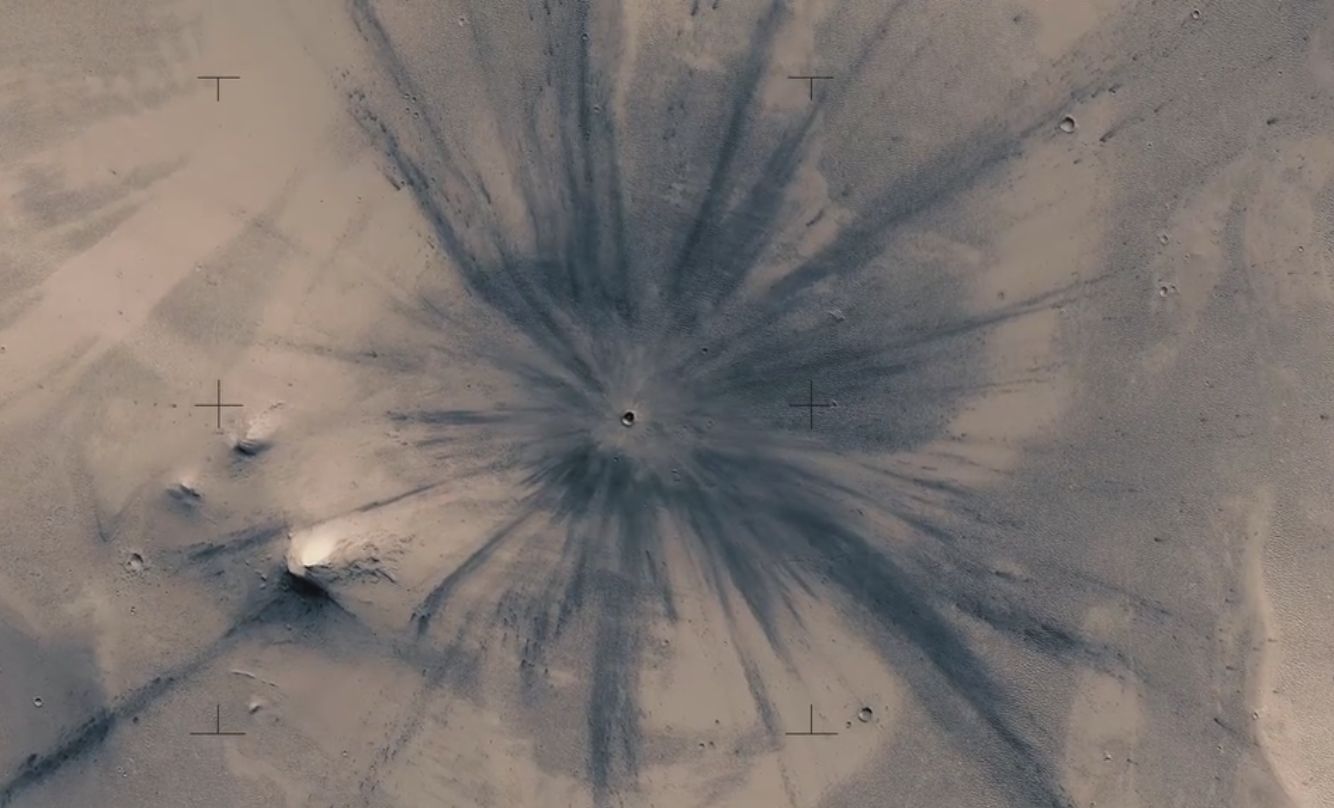
An impact crater which formed between July 2010 and May 2012 and imaged by the HiRISE camera on the Mars Reconnaissance Orbiter, is one of the locations featured in “A Fictive Flight Above Real Mars” by Jan Fröjdman. Credit: Jan Fröjdman; original anaglyph image NASA/JPL / University of Arizona
Ever wondered what it would be like to actually fly over Mars? I have – although I admit, I’m utterly entranced by that red world and the potentials it presents. Finnish film-maker Jan Fröjdman has as well – only he’s taken the idea a step further and produced a remarkable video, A Fictive Flight Above Real Mars. Last just over 4.5 minutes, the film takes us on a flight over some of the must remarkable scenery imaginable, using high-resolution images and data returned by NASA’s Mars Reconnaissance Orbiter (MRO).
It’s a stunning piece showing many of the more intriguing features of Mars: the recent impact crater see in the still at the top of this article; the ice walls and melt holes of the Martian poles; gullies and cliffs rutted and marked by RSLs – recurring slope lineae – which might or might not be the result of liquid activity; the ripples of sand dunes, and the winding forms of channels which might have been shaped by the passage of water.
To make the film, Fröjdman used 3-D anaglyph images from HiRISE (the High Resolution Science Imaging Experiment aboard MRO), which contain information about the topography of Mars surface. The work involved manually picking more than 33,000 reference points in the anaglyph images, and then processing the results through six pieces of software to achieve a sense of motion and panning across the surface of Mars.
In putting the film together, Fröjdman wanted to create a real feeling of flying over Mars and of recapturing the feel of video footage shot by the Apollo astronauts as they orbited the Moon. To help with the latter, he overlaid the video with image cross-hairs of the kind seen in some of the Apollo footage, and added little bursts of thruster firings to simulate a vehicle manoeuvring in the thin atmosphere. The film concludes with a main engine firing, presumably to lift the vehicle back into orbit.
NASA and SpaceX Consider Red Dragon Landing Site
And staying with Mars: NASA and SpaceX have started the process of selecting a landing site for SpaceX’s planned Red Dragon mission to Mars in 2020. The ambitious mission will see the company attempt to land a 10-tonne Red Dragon capsule on Mars purely by propulsive means. While paid for entirely by the company, the mission will feature a science suite provided by NASA.
There are two major criteria governing any landing site location: scientific interest, and the potential for colonisation – the 2020 mission being the first of a number which SpaceX plans to uses as precursors for human missions to Mars. As such, it had initially been decided that any landing sites put forward must be near the equator, for solar power; near large quantities of ice, for water and at low elevation, for better thermal conditions.
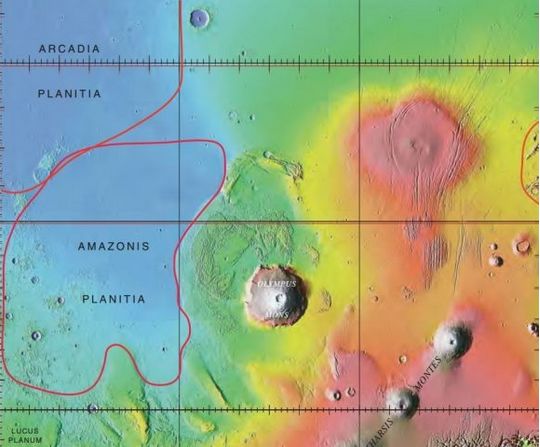
NASA initially identified four potential locations on Mars’ northern hemisphere which meet the broad criteria for the mission – but examination of three of them using the HiRISE system on the Mars Reconnaissance Orbiter showed they are rocky enough to pose a threat to landing a vehicle the size and mass of Red Dragon. This currently leaves a short-list of one, in the shape of Arcadia Planitia, a smooth plain containing fresh lava flows and which has a large region that was shaped by periglacial processes which suggest that ice is present just beneath the surface.
Acadia Planitia is the current sole contender to be the landing site for the SpaceX Mars 2020 mission
However, negating this is the plain’s relatively high northern latitude (40-60 degrees north), which would reduce the amount of sunlight a base of operations there would receive in the winter months. While Amazonis Planitia to the south offers a similar youthful surface, much of which is relatively smooth, it is largely volcanic in origin and unlikely to harbour sub-surface water ice which can be easily accessed.
Given both of these point, it is likely other possible landing sites will be proposed in the coming months.
Curiosity Reveals More Wheel Damage
It’s been a while since my last report on NASA’s Mars Science Laboratory rover, Curiosity. This is mostly being the updates coming out of JPL have slowed mightily in recent months.
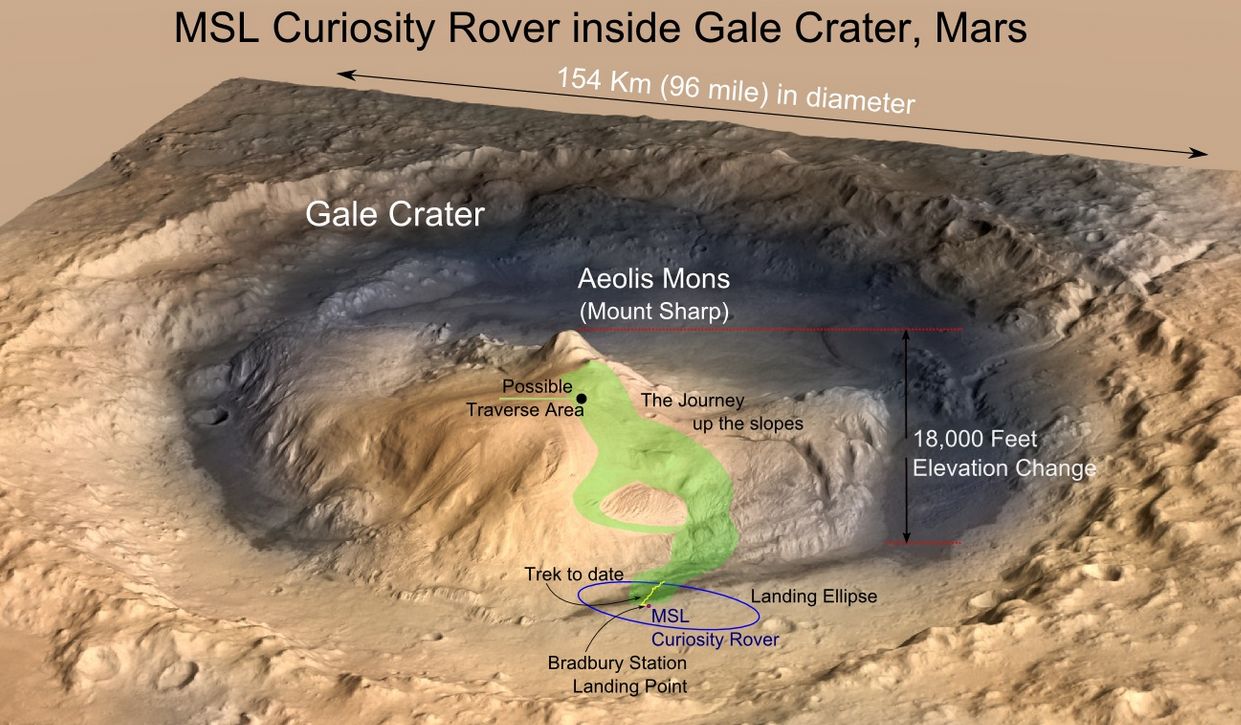
At present, Curiosity is examining sand dunes on the lower slopes of “Mount Sharp”. Once finished, it will proceed up higher to a feature known as “Vera Rubin Ridge”, inspecting a layer that is rich in the mineral hematite. From there, it will proceeded to even higher elevations to inspect layers that contain clays and sulphates. This will require a drive of some 6 km (3.7 mi) uphill, and so will require time to complete.
A recurring area of concern for the mission – albeit not serious at this point – is the wear and tear on the rover’s wheels. In 2013, Curiosity suffered greater than expected damage to its six wheels while traversing some exceptionally rough terrain. Although the damage was nowhere near severe enough to impeded the rover’s driving abilities, it did result in engineers keeping a much closer eye on the condition of Curiosity’s wheels using the imaging system mounted on the rover’s robot arm.
The latest of these checks was performed on Sunday, March 19th, 2017, and it revealed two small breaks in the raised treads (“grousers”) on the rover’s left middle wheel. These seem to have occurred since the last wheel check at the end of January, 2017. These treads perform two major tasks: bearing the brunt of the rover’s weight and providing most of the traction for a wheel.
The broken “grousers” (“treads”) on one of Curiosity’s six wheels, together with older puncture holes through the wheel, as imaged on March 19th, 2017. Credit: NASA/JPL
Following the 2013 damage, testing on Earth suggested that significant breaks in three “grousers” on a wheel would indicate it has passed 60% of its expected lifespan. However, the mission team emphasise the rover has already driven more than 60% of the total distance needed for it to make it to all of its scientific destinations. As such, while the breaks will be monitored, they are not a cause for immediate or grave concern.
Overall, confidence remains high that Curiosity will achieve all of its expected science goals and will likely make an extended traverse up the side of “Mount Sharp”.
A rover’s progress: the 16 km (10 mi) travelled by Curiosity so far, and potential for future explorations up the side of Aeolis Mons. Credit: NASA/JPL / T. Reyes
The NASA Eagleworks EmDrive prototype. Credit: NASA Eagleworks / NASA Spaceflight Forum
The radio frequency (RF) resonant cavity thruster, or EmDrive (pronounced “M-drive”) as it is more popularly known, has been a source of much controversy since the idea first came into the public eye around 16 years ago, and the debate has been heating up again over the last few months.
First proposed by British engineer Roger Shawyer in 1999, the EmDrive is supposed to be the world’s first working reactionless drive, a means of generating thrust without the use of any propellant. Over the years, it has undergone investigation and testing by a number of organisations and agencies before being quietly pushed aside, while some critics have been publicly scathing of the whole idea, labelling it the “impossible drive” as it violates the fundamental law of conservation of momentum (summed up in Newton’s third law, “for every action, there is an equal and opposite reaction”). Even so, research and testing has continued.
The EmDrive supposedly generates thrust by reflecting microwaves between opposite walls of a cone-shaped cavity. In principle, no microwaves or anything else leaves the device, and so it is considered reactionless – although Shawyer states that it isn’t, because the propulsive force is created by a “reaction between the end plates of the waveguide and the Electromagnetic wave propagated within it.”
The attraction of the drive is that were it to work, it could provide an almost endless supply of thrust for satellites and other spacecraft, opening the door to flights to Mars in just 70 days as opposed to the 180-234 days currently required using conventional means. The problem is no-one has actually got the idea to work. Researchers at the at the Northwestern Polytechnical University (NWPU) in Xi’an, China, thought they had in 2012, but further testing in 2014 revealed the thrust apparently created by their EmDrive test rig was actually due to a faulty power connector causing false readings.
Now, however, it seems that a test rig operated by NASA’s Eagleworks Laboratory might actually have demonstrated that in principle an EmDrive could work. News on the testing has actually been leaking out of the laboratory for the past 2-3 months – and has rightfully been met with a healthy dose of scepticism. However, a paper from the team carrying out the research was submitted for peer-review through the Journal of Propulsion and Power, a publication maintained by the American Institute of Aeronautics and Astronautics (AIAA) – and is said to have passed muster.
NASA’s Johnson Space Centre, Texas, the home of the Eagleworks Laboratory. Credit: NASA / James Blair
So, does this mean the EmDrive works? Well – no. The peer-review process means that no discernible flaws have been found in the methodology and testing carried out by the Eagleworks team, meriting the idea worthy of further investigation and research. It doesn’t mean fault or error may not yet be found going forward.
One major means of testing the theory of the EmDrive would be to build a working unit and place it in space and see if it works. This is precisely what US engineer Guido Fetta hopes to do. He is planning to place a small version of his Q-Drive (derived from the EmDrive) in orbit for 6 months aboard a CubeSat (between 10×20×30 cm and 12×24×36 cm in size), and then try over six months to manoeuvre the CubeSat using the drive. He’s not alone; China similarly plans an on-orbit test of an EmDrive prototype, although no dates have been specified for them mission.
Did Spirit Find Signature of Past Martian Life?
NASA’s MER rover, Spirit (MER-A) and Opportunity (MER-B) arrived on Mars in January 2004, and Opportunity continues to explore the planet today. Credit: NASA / JPL
In January 2004, NASA landed two solar-powered rovers, Spirit and Opportunity on Mars. There primary mission was scheduled to last just 90 days – but Opportunity is still operating today, almost 13 years after it arrived on Mars. Sadly, Spirit was not so lucky; in May 2009, it became stuck in a “sand trap” and unable to free itself, eventually losing power as its solar panels could not be oriented towards the winter Sun on Mars, and falling silent in May 2010.
Nevertheless, Spirit gathered a huge amount of data and images, some of which is being re-examined by scientists Steven Ruff and Jack Farmer from Arizona State University as a result of their field expeditions to Chile – and they believe the rover may have come across evidence for past Martian life.
While examining images of a plateau of layered rocks dubbed “Home Plate”, examined by Spirit in 2006, Ruff and Farmer noticed the ground was covered in multiple nodular masses of opaline silica with digitate structures strikingly similar to structures they have encountered within active hot spring/geyser discharge channels at a site in northern Chile called El Tatio.
This is a region which, due a rare combination of high elevation, low precipitation rate, coupled with a high ultraviolet irradiance, is regarded as a potential analogue for past conditions on Mars. What’s more, as a volcanic are, it shares much in common with “Home Plate”, which is believed to be an explosive volcanic deposit created when hot basalt rock came into contact with liquid water. Part of the formation may actually be an extinct Martian fumarole.
An image of “Home Plate” showing a mass of opaline silica nodules, captured by NASA’s Spirit rover in 2006, and a photograph showing similar formations at El Tatio, Chile Credit: ASU/Ruff & Farmer
The opaline silica Ruff and Farmer found at El Tatio have been shown to be largely of biotic origin; that is, created by microbes. Could this be the same for those Spirit saw at “Home Plate” in 2006? Ruff and Farmer believe it might.
“Although fully abiotic (physical rather than biological) processes are not ruled out for the Martian silica structures, they satisfy an a priori definition of potential biosignatures,” the researchers state in a paper on their work. A biosignature is defined by NASA as “an object, substance and/or pattern that might have a biological origin and thus compels investigators to gather more data before reaching a conclusion as to the presence or absence of life.”
A closer view of the structures as images by Spirit in 2006, and a an image of the opaline silica at El Tatio taken at the same distance and resolution. Credit: ASU/Ruff & Farmer
Ruff and Farmer note that while they cannot prove nor disprove a biological origin for the structures imaged by Spirit at “Home Plate”, they should be regarded as a potential biosignature by NASA’s own definition of the term. They go on to state that the only way to be sure would be for a robust examination to be made of the “Home Plate” location, perhaps by NASA’s upcoming Mars 2020, were it to be sent to that region, or through the examination of another region of Mars which is identified as being geographically and geologically similar.
Virgin SpaceShipTwo Flies
Virgin Galactic’s SpaceShipTwo vehicle, VSS Unity completed its first free flight test on Saturday, December 3rd, after a month’s delay due to a combination of high winds and an unspecified technical issue, which combined to leave the vehicle able to make just a single captive / carry flight with its carry / launch aircraft, WhiteKightTwo.
VSS Unity seen from a chase plane as it glides towards touch-down on Saturday, December 3rd, 2016. Credit: Virgin Galactic
The unpowered flight, took place over the Mojave Air and Space Port in California and was the first in a series of around 10 – the precise number will depend on how well the targets for each flight are met – such tests the vehicle will make before Virgin Galactic move to powered flight tests using their new rocket motor for the vehicle, which has so far only been tested on the ground.
“It’s a happy day to be here,” Virgin Galactic’s founder, Sir Richard Branson said just before WhiteKnightTwo lifted SpaceShipTwo aloft. “We’ve got an exciting year ahead, and this is just the start of it.”
VSS Unity comes to rest on the runway after a successful first flight test. Credit: Virgin Galactic
As TGO Flexes Its Muscles, More Ice Found on Mars
ESA’s Trace Gas Orbiter (TGO), which arrived in orbit around Mars in October, has yet to reach its primary science orbit but it is already flexing its muscles.
On November 22nd, as TGO swept over Mars on one of its current 4.2 day elliptical orbits, a test was carried out on its ability to relay data from the Martian surface to Earth, acting as a go-between for both the Curiosity and Opportunity rovers. As well as carrying a suite of science instruments and camera systems, TGO also carries a communications relay package from NASA called Electra, which allows the spacecraft to successful receive and store communications from NASA’s surface vehicles and then relay them to Earth.
Currently, TGO’s orbit carries it from just 300km (200 mi) above the surface of Mars all the way out to 98,000 km (60,000 mi), limiting its effectiveness as a communications relay. However, this will be lowered and circularised in the coming months to just 400 km (250 mi) above the planet, at which point TGO will be perfectly positioned to carry out its primary science mission and act as a relay for current and future surface missions, including Europe’s own ExoMars rover.
The relay test came at a time when ESA were working on calibrating TGO’s instruments during the close flights over Mars in each of it current orbits around the planet. These calibration tests included initial use of the orbiter’s “eyes”, the Colour and Stereo Surface Imaging System (CaSSIS), which yielded, in the mission team’s words, “spectacular” results.
CaSSIS is an impressive system, capable of capturing still images and video across a number of colour wavelengths, and in 3D if required. All of CaSSIS’s capabilities were exercised during the test as the orbiter passed over Hebes Chasma, an eight km (5 mi) deep trough just to the north of the mighty Valles Marineris. The images collected during the pass have a resolution of 2.8 metres per pixel. To put that in perspective, it’s the equivalent of flying over New York city at 15,000 km/h (9,375 mph) and simultaneously getting sharp pictures of cars in Philadelphia.
The stereo capabilities of CaSSIS will allow scientists to build topographical 3D images of the surface on Mars, such as this test model, built from images of the Noctis Labyrinthus at the north-eastern end of the Vallis Mariners. Credit: ESA / Roscosmos / CaSSIS / UniBE
Once TGO reaches its operational orbit towards the end of 2017, CaSSIS will be capable of acquiring 12-20 high-resolution stereo and colour images of selected targets per day.
Meanwhile, NASA’s Mars Reconnaissance Orbiter (TGO) has located another gigantic water ice deposit lying just under the Martian surface. The ice, lying beneath the planet’s Utopia Planitia, was located using MRO’s ground-penetrating Shallow Radar (SHARAD) instrument.
Utopia Planitia: home of a massive water ice deposit the size of New Mexico, and sitting just below the surface of Mars – click for full size. Credit: NASA
Estimated to be bigger than the US state of New Mexico and containing more water than Lake Superior, it is the second massive ice deposit SHARAD has found in just over a year. The first exists as a deposition averaging 40 metres (604 ft) think, extending almost all the way from the planet’s mid latitudes up to north polar region and covers an area the size of Texas and California combined.
The ice under Utopia Planitia – the landing site for NASA’s Viking 2 mission of the 1970s – is between 80 to 170 metres (260 feet to 560 ft) in thickness, comprises around 85% water ice (the rest being dirt and other deposits), and – most crucially – lies between 1 and 10 metres (3 and 30 ft) beneath the surface, potentially making it an accessible resource for future human missions to Mars.
NASA Considering Foreshortening Orion Crewed Flight
NASA is considering a shorter mission for the first crewed flight of its Orion Multi-Purpose Crewed Vehicle.
Originally, the flight was to have comprised a “slow cruise” out to the Moon of between 3 and 6 days, followed by three days in lunar orbit before making a similar 3-6 day “slow cruise” back to Earth. However, under the new plans being considered, Orion and its crew would be placed in a high Earth orbit (HEO) with an apogee of 35,000km (21,875 mi), where it would remain for a day, before separating from the Exploration Upper Stage (EUS) of its Space Launch System rocket and suing its Service Module motor to enter a trans-lunar injection orbit, for a single free-return flight around the Moon without ever going into orbit there.
Orion’s first mission may now only comprise a flight around the Moon, rather than orbiting it. Credit: Cosmic Pearl
“We’ve effectively designed this mission to be commensurate with the amount of risk we’re taking with crew on the vehicle for the first time,” Bill Gerstenmaier, NASA associate administrator for human exploration and operations said when announcing the new plan. “We’ve tailored the mission to be appropriate with the risk we’re willing to take.”
Two particular risks worried mission planners: a failure with the Orion’s life support system in what would be its first space-based test with a crew aboard, or a failure with the Service Module’s engine which might leave them stranded in Lunar orbit. The redesigned mission means the life support system can be tested whilst in HEO, and the service module motor only needs to be fired once, when boosting Orion towards the Moon.
The revised Exploration Mission 2 flight plan (click to enlarge). Credit: NASA
The change in approach does not affect the Exploration Mission 1 flight, scheduled for 2018. That mission is expected to last around 25 days, with an uncrewed Orion vehicle placed in lunar orbit for several days before it returns to Earth. However, it does open the door to a more gradual approach to extending Orion’s capabilities, with NASA now planning one Exploration Mission a year being flown between 2023 and 2030.
Most of these flights will be cislunar operations, with EM-6 (2026) earmarked as the asteroid rendezvous mission originally scheduled to take place in 2023 as EM-3, but which has been pushed back as a result of delays in the Asteroid Redirect Mission (ARM), its necessary precursor. EM-10 would mark the likely transition from cislunar missions to BEO (“Beyond Earth Orbit”) missions directed towards Mars, utilising Orion and expanded capabilities such as habitat modules and possible nuclear-powered propulsion units.
July 10th: Jupiter with Io, Europa and Ganymede as seen by Juno after the craft had finished its critical orbital burn to slip into a 53.5 day orbit around the giant planet on July 4th. Credit: NASA/JPL / SwRI / MSSS (click and image for full size)
The banner image, captured by NASA’s Juno spacecraft, might look like the one I used in my last Space Sunday update, but there is one important difference. The images used last time around had been captured by Juno on June as it approached the Jovian system on June 29th, five days before the craft had to complete a critical engine burn whilst almost scraping the planet’s cloud tops, to place itself in an extended orbit around Jupiter. The image above was captured on July 10th, as Juno headed away from Jupiter, having successfully completed the manoeuvre.
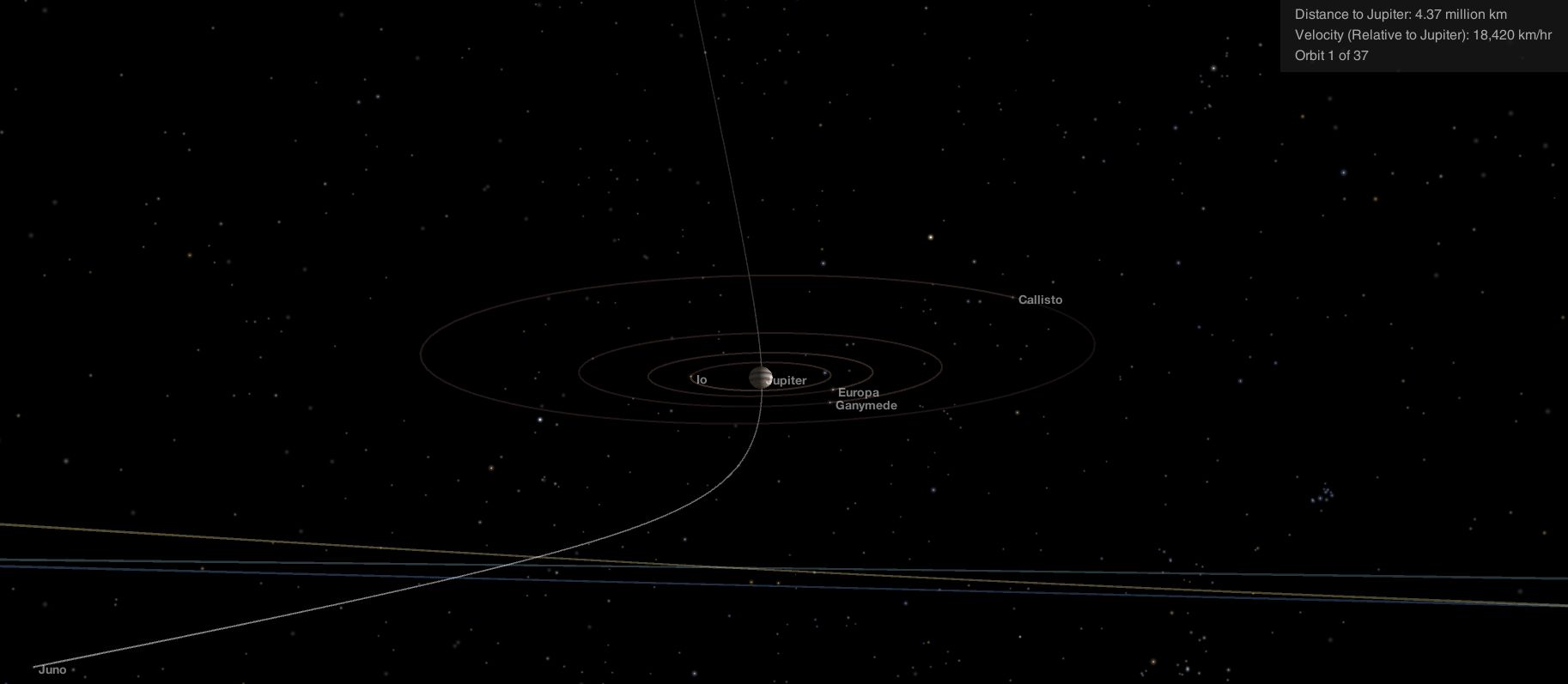
At the time the picture was captured, 17:30 UTC on July 10th, 2016, Juno was already 4.3 million kilometres (2.7 million miles) distant from the planet, and heading away from it at a relative velocity of 18,420 km / hour (11,446 mph) and decelerating under the influence of the Jupiter’s gravity.
Juno’s flight around the poles of Jupiter and it’s position on July 10th, as seen using the NASA Eyes simulator (click for full size)
Juno’s imaging system – JunoCam – had, along with other major systems aboard the craft, been shut down prior to the July 4th engine burn, both to conserve power – Juno had to turn its solar panels away from the Sun during the burn manoeuvre, limiting the available electrical power – and to protect them through the initial passage through Jupiter’s tremendous radiation fields. It wasn’t until July 6th that the instruments were all powered back up, and after testing them, the July 10th exercise was the first opportunity to have a look back at the Jovian system.
Juno will keep travelling outwards from Jupiter until the end of July, slowing to a relative velocity of just 1,939 km/h (1212 mph), before it starts to “fall” back towards the planet, making a second close flyby on August 27th. At this time, the craft will pass just 4,142 km (2,575 mi) above the Jovian cloud tops at a speed of 208,11 km/h (129,315 mph). More importantly, all of vehicle’s science instruments will remain powered-up, and JunoCam in particular should gain some stunning images of Jupiter during this second close pass.
To celebrate Juno’s arrival around Jupiter, NASA released a time-lapse video of the Jovian system as seen by the approaching spacecraft. It begins on June 12th with Juno 16 million km (10 million mi), and ends on June 29th, when JunoCam was shut down and Juno was 4.8 million km (3 million mi) distant.
Made possible by Juno’s high angle of approach into the Jovian system, it is the first close-up view of celestial harmonic motion we’ve ever had. Also, the 17-day duration of the movie means we see Callisto (flickering very faintly) make a full orbit around Jupiter, and get to see Ganymede, Europa and Io (counting inwards towards the planet) each experience eclipse as they pass through Jupiter’s shadow. Note that the flickering exhibited by the moons is an artefact of JunoCam, which is optimised to image bright features on Jupiter, rather than capturing the (relatively) dim pinpoints of the distant moons as they circle the planet.
Curiosity Resumes Operations as 2020 “Sister” Takes Shape
In my last update I reported that NASA Mars Science Laboratory, Curiosity, had entered a “safe” mode on July 2nd. On July 9th, the mission team successfully recovered the rover from this safe mode – a precautionary state the rover will set for itself should it detected an event which could damage its on-board systems – and then subsequently returned Curiosity to a fully operational status on July 11th.
The cause of the problem lay in a glitch in one of the modes by which images are transferred from the memory in some of the rover’s camera systems to its main computers. This generated a data mismatch warning, prompting the rover to active its “safe” mode and call Earth for assistance. Use of this particular data transfer mode between the identified camera systems and the computers is now being avoided in order to prevent a repeat of the problem.
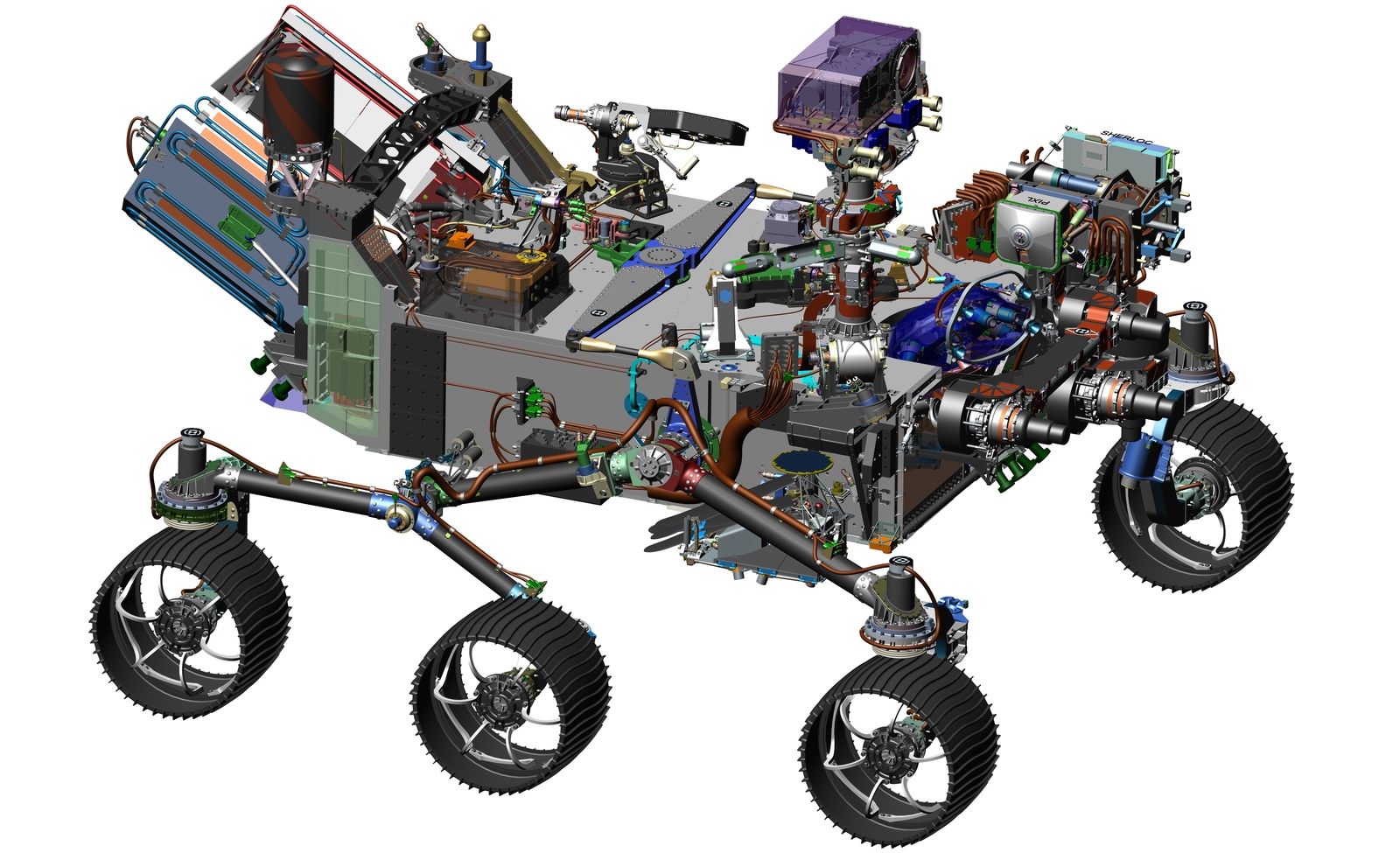
Meanwhile, NASA’s next rover mission – designated Mars 2020 at present, as it will launch in the summer of that year to arrive on Mars in February 2021 – is taking shape. The basic vehicle will be based on the Curiosity class of rover, but will carry a different science suite and have somewhat different capabilities.
A CAD image of the Mars 2020 rover: visibly similar to MSL’s Curiosity rover. Credit: NASA
In particular, the new rover will carry an entirely new subsystem to collect and prepare Martian rocks and soil samples which can be stored in sample tubes. About 30 of these sample tubes will be deposited at select locations, so that they might be collected by a possible future automated mission and returned to Earth for direct analysis for evidence of past life on Mars and possible health hazards for future human missions.
Two science instruments mounted on the rover’s robotic arm will be used to search for signs of past life and determine where to collect samples by analysing the chemical, mineral, physical and organic characteristics of Martian rocks, while a suite of advanced camera systems will be housed on the vehicle’s mast. As with Curiosity, Mars 2020 will carry a comprehensive meteorological suite for monitoring the Martian environment and weather, together with a ground penetrating radar system for determining what is going on under the rover’s wheels.
“NASA did it again!” an elated Scott Bolton, Principal Investigator for the Juno mission to Jupiter, announced on the night of Monday July 4th / Tuesday July 5th. He was speaking shortly after the Juno space craft, having travelled 2.8 billion kilometres (1.7 billion miles), achieved an initial orbit around the largest planet in the solar system, becoming one of the fastest human made objects ever built.
“We are in orbit and now the fun begins, the science,” he added during the post-insertion press briefing. “We just did the hardest thing NASA’s ever done! That’s my claim. I am so happy … and proud of this team.”
Solar powered Juno successfully entered a polar elliptical orbit around Jupiter after completing a must-do 35-minute-long firing of the main engine known as Jupiter Orbital Insertion or JOI. The vehicle approached Jupiter over the planet’s north pole – an orbit which will afford some unique views of Jupiter and its system of rings and moons in the coming months.
Due to the time delay, some 48 minutes for a one-way signal, Juno completed the insertion burn entirely on autopilot and, for this initial pass through the planet’s radiation belts, with many of its more critical systems powered-down as a precaution and to preserve battery power – the manoeuvre meant Juno had to turn its solar panels away from the Sun, limiting its ability to generate electrical power for all of its systems.
This image was captured by Juno on June 29th, 2016, and was the final picture taken by the vehicle’s camera prior to major systems being shut down as a precautionary move while the craft made an its initial approach over Jupiter’s north pole. Visible and labelled are the Galilean moons, which today form just 4 of the 53 named moons orbiting the planet
As I reported last week, the do-or-die burn of the Leros-1b engine had to be carried out flawlessly if the spacecraft were to achieve and initial orbit around Jupiter. By the time it started at 20:18 PDT on Monday July 4th (04:18 UT, Tuesday July 5th), Juno had already accelerated to an incredible 250,000 kph (156,000 mph) relative to the planet, as a result of Jupiter’s massive gravity well, and the 35-minute engine burn was designed to reduce this huge speed by just 1,939 kph (1212 mph).
As tiny as this velocity change might sound, it meant the difference between Juno simply whipping around Jupiter to be thrown back out into deep space and being trapped in a 53.5 day orbit are the planet by that same enormous gravity well. In October 2016, a further 22-minute burn of the Leros-1b will reduce this orbital period to just 14 day, allowing the primary science mission to commence.
Scott Bolton (with arms raised) celebrates Juno’s orbital insertion burn flanked by members of the mission team (l to r) Goeff Yoder, Diane Brown, Rick Nybakken, Guy Beutelschies, and Steve Levin Credit: AP Photo / Ringo H.W. Chiu
That mission is all about peering far beneath Jupiter’s banded clouds for the first time and investigating the planet’s deep interior with a suite of nine instruments. The hope is that Juno will probe the mysteries of Jupiter’s genesis and evolution, and by extension, how we came to be. Or, as Scott Bolton phrased it, “The deep interior of Jupiter is nearly unknown. That’s what we are trying to learn about. The origin of us.”
Life on Titan Without Water?
Further out in space and orbiting Saturn, is massive Titan, another of the solar system’s enigmas. Examined by the NASA Cassini space vehicle and (briefly) by the European Space Agency’s Huygens lander, Titan is fascinating for a number of reasons, including the fact it is the only natural satellite known to have a dense atmosphere rich in minerals and hydrocarbons.
Huygens revealed Titan has a very mixed surface environment, complete with hydrocarbon seas, lakes and tributary networks filled with liquid ethane, methane and dissolved nitrogen. This surface is also very young; while Titan has been around since very early in the solar system’s history – some 4 billion years – the surface environment is estimated to be somewhere between 100 million to 1 billion years old; suggesting geological processes have been and are at work.
Titan’s structure, which includes a subsurface liquid water ocean sealed beneath a mantle of ice just below the moon’s thin trust (via wikipedia)
All of this – particularly the thick atmosphere (which has a comparable density to that of Earth), the presence of hydrocarbon rich liquids (which also fall as rain) – has caused many astronomers and planetary scientists to speculate that Titan might have all the prebiotic conditions necessary to kick-start life. The only thing which has been seen as potentially mitigating this is the absence of surface water.
However, a team of scientists from Cornell University, New York, led by Dr. Martin Rahm, has proposed that condition on Titan are such that it might support life even without the presence of water.
An image of Titan’s surface, as taken by the European Space Agency’s Huygens probe as it plunged through the moon’s thick, orange-brown atmosphere on Jan. 14, 2005. Credit: ESA / NASA / JPL / Univ. of Arizona
Specifically, the team has been examining the role that hydrogen cyanide (HCN) might have on Titan. This is an organic chemical, which although poisonous to life today, is seen in some circles as a precursor to amino acids and nucleic acids, and thus a basic building block in the development of organic compounds which in turn might give rise to life.
In particular, hydrogen cyanide is the most abundant hydrogen-containing molecule in Titan’s atmosphere – although it is missing from the moon’s surface – and has some unique properties. It can, for example, react with itself or with other molecules to form long chains, or polymers. One such polymer is called polyimine, which is capable of absorbing light of many wavelengths and might therefore as as a catalyst for photochemically driven chemistry, some of which might be prebiotic in nature and which might in turn give rise to more complex organic reactions.
NASA’s Curiosity rover has resumed its long, slow climb up the slopes of “Mount Sharp”, the 5 km high mound abutting the central impact peak of Gale Crater on Mars.
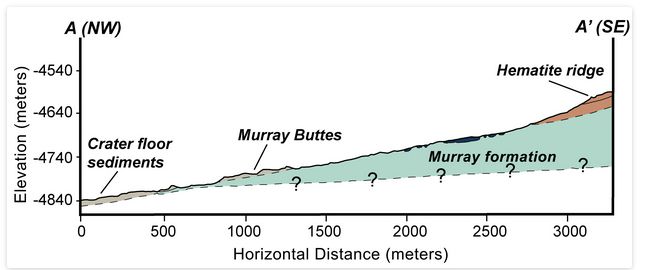
For the last few months, the rover has been easing its way over what is called the “Murray Formation”, a transitional layer marking the separation points between the materials deposited over the aeons to create the gigantic mound, and the material considered to be common to the crater floor. Named in honour of the late co-founder of The Planetary Society, Bruce Murray, the formation comprises a number of different land forms, which the rover has been gradually examining.
On June 4th, 2016, Curiosity collected its latest set of drilling samples – the 11th and 12th it has gathered since arriving on Mars – on the “Naukluft Plateau”, a further region of sandstone within the Murray Formation, similar to the area dubbed the “Stimson Formation”, where the rover collected samples in 2015.
The Murray formation extends about 200 metres (650ft) up the side of “Mount Sharp”. Starting at the “Pahrump Hills” below “Murray Buttes” in late 2014, Curiosity is about one fifth of the way across the region, spending extended periods examined various features within the formation. Credit: NASA JPL
The aim is to carry out comparative geology between the two sites to determine whether or not their formation is related. The “Stimson Formation” sandstone strongly suggested it has been laid down by wind after the core slopes of “Mount Sharp” had been laid down by sedimentary processes the result of Gale Crater once being home to s huge lake, but which had then been subjected to fracturing by the passage of water. These bands of fractured sandstone have become more prevalent as the rover has continued up through the “Murray Formation”, so it is hoped that by obtaining samples from “Naukluft Plateau”, the science team will gain further understanding of precisely what part water played in the evolution of the slopes of “Mount Sharp” after the lake waters had receded.
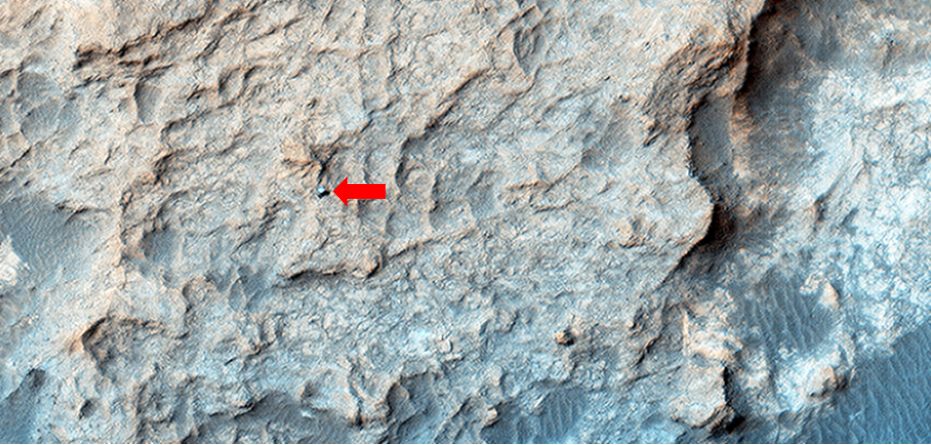
The HiRise imaging system on the Mars Reconnaissance Orbiter (MRO) captured the Mars Science Laboratory rover Curiosity on the Naukluft Plateau in May 2016 Credit: NASA/JPL / University of Arizona
Since completing the drilling operations, Curiosity has turned south, and is now climbing the mound “head on”, rather than gradually zig-zagging its way upwards.
The MSL rover has also provided geologists with another surprise. In mid-2015, the rover collected samples from a rock dubbed “Buckskin”. Reviewing the analysis of the minerals in the samples, as discovered by Curiosity’s on-board laboratory suite, scientists have found significant amounts of a silica mineral called tridymite.
“On Earth, tridymite is formed at high temperatures in an explosive process called silicic volcanism. Mount St. Helens, the active volcano in Washington State, and the Satsuma-Iwojima volcano in Japan are examples of such volcanoes,” said Richard Morris, a NASA planetary scientist at Johnson Space Centre. “The tridymite in the Buckskin sample is thought to have been incorporated into “Lake Gale” mudstone as sediment from erosion of silicic volcanic rocks.”
The find is significant because although volcanism did once take place on Mars, it has never been thought of as being silicic volcanism, which is far more violent that the kind of volcanism associated with the formation of the great shield volcanoes of the Tharsis Bulge and other regions of Mars. So this discovery means geologists may have to re-think the volcanic period of Mars’ early history.
China Launches Long March 7
Saturday, June 25th saw the inaugural launch of China’s Long March 7 booster, a vehicle I wrote about back in April 2016. The launch was also the first from China’s fourth and newest space launch facility, the Wenchang Satellite Launch Centre, located on Hainan Island, the country’s southernmost point.
The Long March 7 is a core component to China’s evolving space ambitions. Classified as a medium lift vehicle, it can carry around 13.5 tonnes to low Earth orbit (LEO), it will operate alongside China’s upcoming heavy lift launcher, the Long March 5. This craft will be capable of lifting around the same payload mass directly to geosynchronous orbit, and around 25 tonnes to LEO. Both vehicles will play a lead role in China’s plans to expand her explorations of the Moon, establish a permanent space station in Earth orbit by 2022, and reach Mars with automated missions.
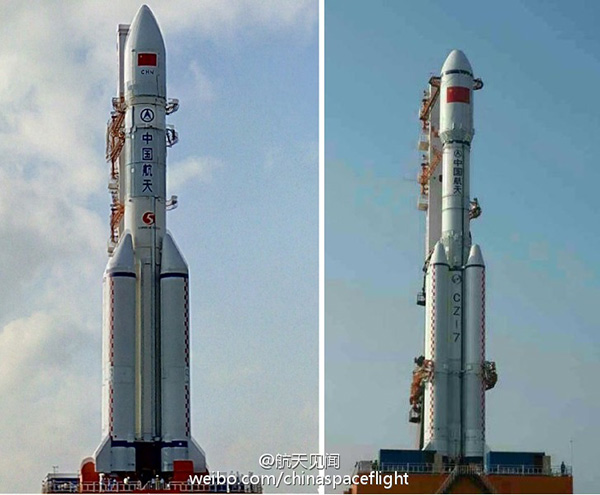
China’s Long March 7 (right) launched on it inaugural flight on Saturday, June 25th. The bigger Long March 5 (left) is due to launch later in 2016. Credit: China state media
The inaugural launch of the Long March 7 took place at noon GMT on Saturday, June 25th (20:00 local time). It carried a Yuanzheng 1A upper stage and a scale model of China’s next generation crewed orbital vehicle into an orbit of 200 km (120 mi) by 394 km (244 mi) as confirmed by US tracking networks.
Yuanzheng is an automated “space tug” China has used numerous times to deliver payloads to their orbits, and is capable of re-using its engine multiple times. It is most often used to boost China’s communications satellites into higher orbits.
The sub-scale capsule was used to carry out an atmospheric re-entry test to gather data which will be use to further refine and improve the re-entry vehicle which will form a part of China’s replacement for its ageing, Soyuz-inspired Shenzhou crew vehicle. This unit returned to Earth, landing in a desert in Inner Mongolia on Sunday, June 26th, after orbiting the planet 13 times. Also aboard the vehicle was a “cubesat” mission to test a navigation system, and a prototype refuelling system.












 Inara Pey: Living in a Modemworld