Space Sunday: samples from Mars

Artist’s concept of the Rocket Lab Mars Ascent Vehicle lifting-off from its lander vehicle, carrying samples collected by the NASA Perseverance rover. Credit: Rocket Lab

Returning samples from Mars is proving difficult for NASA to get sorted – which, considering plans of various forms have been under consideration since before Apollo 11 landing on the Moon, might sound confusing. However, early proposals for such a mission were hampered by the fact that the density of Mars’ atmosphere was unknown, making the analysis of preferable vehicle masses and trajectory options to achieve a successful atmospheric entry somewhat difficult.

Things became easier in this regard following the successful Viking mission landings in the mid-1970s, but there were still significant technical issues to overcome – such as the number and type of vehicles required to reach Mars, land safely, obtain samples get them safely back to orbit and from there back to Earth.

A 1993 concept for a Mars Sample Return mission using ISU – the use of the Martian atmosphere to produce the propellant the sample capsule (top of the vehicle) required to achieve orbit – in order to try to reduce mission complexity and mass. Credit: NASA

Such were the complications involved that even as relatively recently as 2002, some at NASA felt that skimming a vehicle through the upper reaches of the Martian atmosphere and which used an aerogel to collect samples that would include high-altitude dust would be a easier proposition than trying to gather samples from the planet’s surface.

Also since the early 2000s, efforts have focused on the potential for international / joint efforts to recover samples from Mars, perhaps the most notable being the proposal NASA-ESA sample recovery mission, intended to recover sample tubes deposited on Mars by NASA’s Mars 2020 Perseverance mission.

However, even this has suffered from spiralling costs – in part due to an increasing reliance on complex technologies. By 2022, the mission required no fewer than five vehicles (not including Perseverance): a sample retriever lander + ascent vehicle (NASA); a sample return vehicle (ESA); and a sample collection lander and rover combination (ESA) – later replaced by two Ingenuity-class helicopters to – gather sample tubes deposited by Perseverance. This complexity and cleverness resulted in the cost estimates for the mission surpassing US $11 billion by April 2024, with the return of any samples collected by the Mars 2020 mission unlikely to occur before 2040.

A concept rendering of the original NASA/ESA Mars Sample Return mission showing the ESA Mars return vehicle (top right), the ESA sample recovery rover (centre) and the NASA sample lander / MAV combination (right). The Perseverance rover is show on the left as the collector of the samples. Note that Earth is shown for reference only, and is not to scale. Credit: NASA
As a result, NASA sought alternate architectures to complete such a sample return mission possible, turning to external expertise as well as looking to its own capabilities. The idea here would be to reduce costs and return samples gathered by Perseverance in a more reasonable time frame than 2040.

On January 7th, 2025, NASA announced it intended to spend a further 18 months studying two alternate architectures by which to recover sample caches created on Mars by Perseverance. One leverages technologies developed by NASA, whilst the other involved commercially-developed technologies, with both utilising the existing proposal for the European-built Earth Return Orbiter (ERO) from the mission architecture outlined above to return the gathered samples to Earth.

The principle difference between the two options is that the NASA option proposes using the “skcrane” system sued to which both the Curiosity and Perseverance rovers to deliver the same recovery lander / ascent vehicle onto the surface of Mars, whilst the second would utilise a commercial “heavy lander”. Exactly what form this would take is unclear from the NASA statement – however, both Blue Origin and SpaceX have tried to muscle-in on the mission, suggesting the use of variants of their Blue Moon and Starship lunar landers. In both mission outlines, Perseverance would be used to deliver sample tubes to the sample return craft.

A comparison of the size of the existing design for the MSR lander (right) with a smaller concept proposed by JPL that can use the proven “sky crane” landing system. Credit: NASA/JPL

Exactly how much of an improvement / cost reduction these two methodologies will bring over current plans is very debatable; NASA’s own estimates put the two options at a cost of between US $7 and $8 billion – which is about the same as original estimates for the NASA-ESA proposal at the time when it was already causing concerns, having risen to US $7 billion from an intended cost of US $4 billion. Further, NASA suggests that while either approach might achieve a sample return by 2035 – a more likely timeframe is 2035-2039; hardly any improvement at all over the current 2040 timeframe.

Hence why, perhaps, Peter Beck’s Rocket Lab has placed a formal request with the incoming Trump administration to re-examine sample return mission options rather than green-lighting the updated NASA approach. This is because Rocket Lab – at NASA’s request – has developed a completely alternate sample-return architecture designed to fit NASA’s requested mission cap of US $4 billion, whilst potentially returning the sample to Earth by 2031/32.

The Rocket Lab Mars Sample Return mission concept. Credit: Rocket Lab

Whilst on the surface as complex as NASA’s joint approach with ESA, the Rocket Lab mission is actually far more direct and lightweight, comprising a total of three launches from Earth, and six vehicle elements. These comprise:

  • The Mars Telecommunications Orbiter (MRO): this would offer an orbital communications relay for the rest of the mission – and other Mars surface missions.
  • The Mars Entry and Descent System (EDS): an aeroshell vehicle carrying within it the Mars Lander and the Mars Ascent Vehicle (MAV).
  • The Earth Return Orbiter (ERO), which includes the Earth Entry System (EES).

Rocket Lab’s mission would proceed as follows:  a Rocket Lab Neutron launcher is used to send the MRO to Mars. This is followed by to further Neutron launches, one for the EDS and one for the ERO. On arrival at Mars, the MRO arrives first, entering an orbit where it can act as communications relay. The EDS then makes a direct atmosphere entry, protecting the lander / MAV through the heat of atmospheric entry prior to the lander making a parachute descent and propulsive landing.

A photo montage of ten sample tubes set on the surface of Mars by the Mars 2020 rover Perseverance as a cache for possible return to Earth by a sample return mission. Credit: NASA

The latter will be made close to one of the sample caches created by Perseverance, allowing it to collect up to 20 sample tubes (depending on the size of the cache) – although how this will be done is not fully defined in the rocket Lab proposal. The sample tubes are delivered to the MAV on the top of the lander, the MAV using the lander as its launch pad to return to orbit.

Once in orbit, the MAV rendezvous with the ERO, transferring the sample container to the ERO, which sterilises it using onboard systems as it returns the container to Earth and uses the EES to deliver the sample container back to Earth’s surface.

While Rocket Lab might seem an unlikely candidate for a Mars Sample Return mission when compared to the likes of SpaceX, the company arguably has a lot more experience with the technologies required for such a mission. The company has supplied elements used within several Mars missions from the Mars Science Laboratory onwards – including developing solar arrays for power, support systems to maintain vehicles while en-route to Mars, and build the EscaPADE Mars orbiters and their support bus, and re-entry technologies being utilised by other companies.

The six vehicle elements of the Rocket Lab MSR proposal, forming three distinct launch vehicle payloads. Credit: Rocket Lab

It’s not clear how the incoming NASA Administrator (whether it be Jared Isaacman or someone else)  will respond to Rocket Lab’s request; a lot, in this regard, might be dependent upon how much influence Elon Musk  – whose SpaceX, like it or not, still very much depends upon NASA and government contracts for its survival – welds over NASA’s decision-making in the coming months.

Big Birds Set to Fly

Two significant launches are due to take place in the coming week, one of which could mark the entry of a significant new player in the space launch market.

Blue Origin’s massive New Glenn vehicle, of carrying up to 45 tonnes of payload to orbit – although for the most part it will likely carry far less than that – is due to lift off from Space Launch Complex 36 at Canaveral Space Force Station at 06:00 on Monday, January 13th. It’s a mission I’ve written about extensively already, but there is a lot riding on the broad success of the mission in delivering its upper stage and payload to orbit.

New Glenn on the SLC-36 launch pad at Cape Canaveral Space Force Station in Florida, in December 2024. The flight is now targeting a January 13th launch. Credit: Blue Origin

New Glenn has, from the outset, been designed to fulfil a wide variety of roles, from delivering individual and multiple satellite payloads to orbit and to places like the Moon, through to playing a crucial role in helping Blue Origin and its partners establish their planned Orbital Reef space station, to even carrying out human-rated launches. As a payload launcher, it will – subject to a second qualifying flight after this one – be used for US government launches as well carrying out commercial launch operations.

This first flight will carry a prototype of Blue Origin’s Blue Ring orbital vehicle as the payload – although it will not separate from the vehicle’s upper stage – and will attempt a recovery of the core booster on the landing recovery ship Jacklyn, some 1,000 km off the Florida coast.

Some will likely point to Wednesday, January 15th as being more important, as it is on that day at 22:00 SpaceX is due to carry out the seventh integrated flight test of their Starship / Super Heavy behemoth,  featuring the first flight of their Block 2 version of the Starship vehicle.  This features revised forward aerodynamic flaps (used to control the vehicle during its fall through the atmosphere), a 25% increase in propellant load, a 3.1 metres increase in length and an updated thermal protection system.
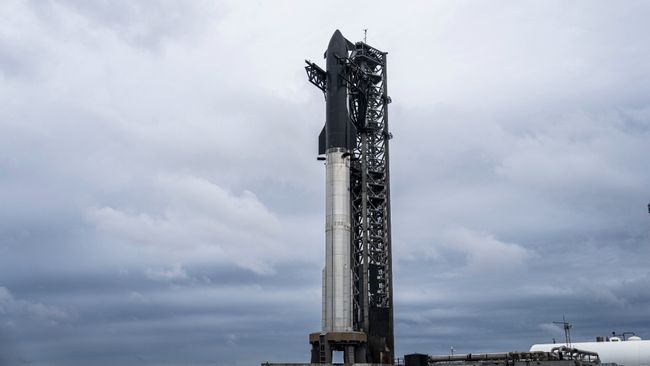
SpaceX Starship 33 stacked on top of Booster 14, ahead of the seventh orbital flight test, currently targeting a January 15th launch. Credit: SpaceX

Overall, the flight should follow a similar format to Flight 6 – attempting a recovery of the booster at the launch site and the Starship vehicle splashing down in the Indian Ocean. However, a test of the thermal protection system and the deliberate exposure of parts of the vehicle to the heat of re-entry might result in its complete loss. This flight will also see the first attempt to deploy Starlink communication satellite “simulators” from the payload bay.

Starship, with its stated payload capability of up to 100 tonnes far outclasses New Glenn in lifting capabilities – but contrary to SpaceX fans, this actually does not guarantee the vehicle is destined for commercial success once it reaches any form of operational status beyond being a Starlink delivery mechanism. A lot in this regard depends on the price-point for launches with the system, and the continuing downwards trend in the size and mass of many classes of satellite which make smaller, low-cost launchers potentially far more attractive for such launches (I’m deliberately ignoring the claims that Starship is about opening Mars to colonisation, as that had a world of issues in its own right).

I’ve have a report on the flights – assuming they go ahead – in the next Space Sunday.
Space Sunday: 1,000 sols and counting

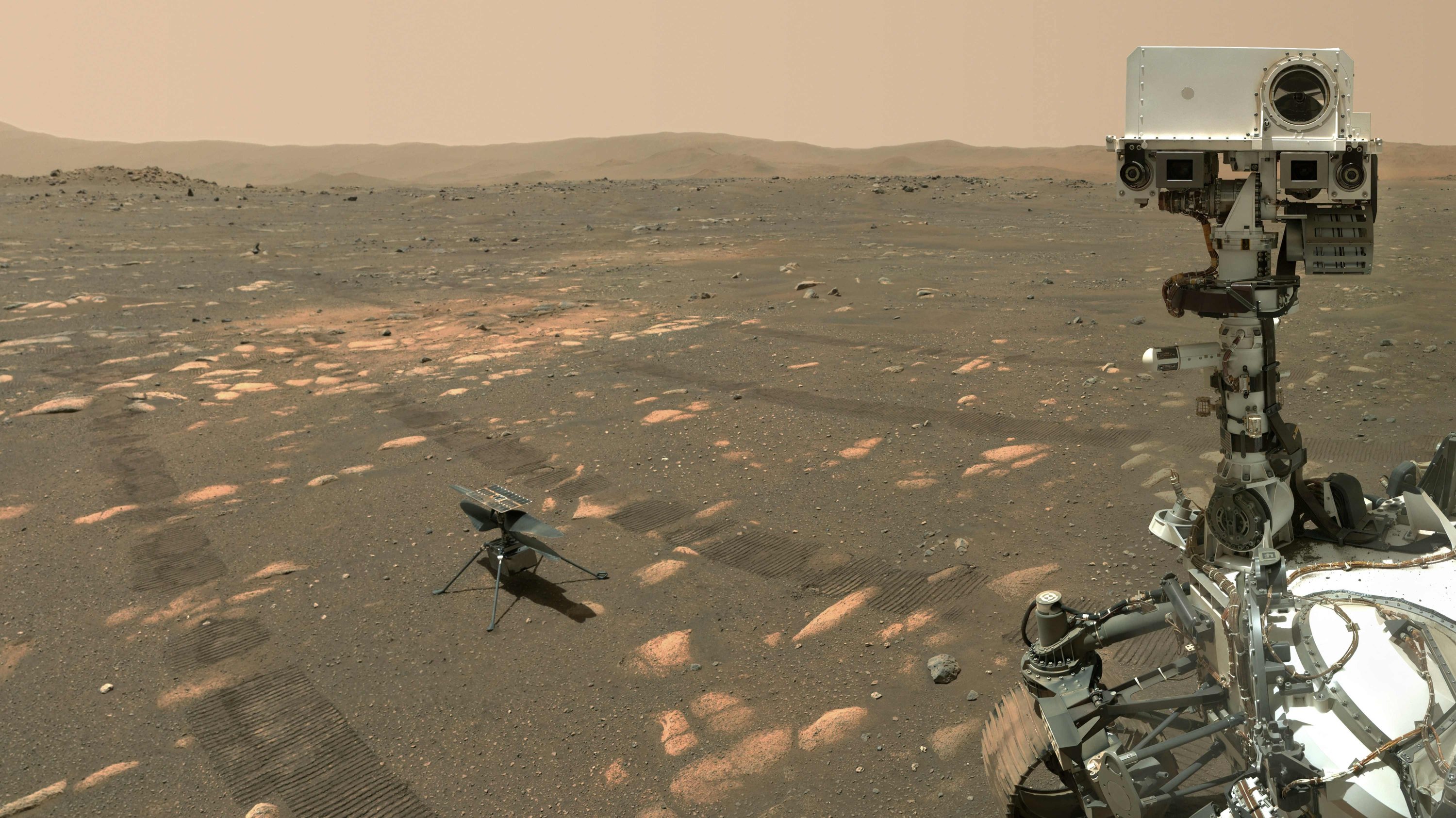
NASA’s Perseverance Mars rover using the WATSON camera mounted on its robot arm to take this “selfie” showing the rover’s camera mast looking at WATSON and the Ingenuity helicopter sitting on the surface of Mars after being dropped there by the rover. This image was r=taken on the 46th sol of the mission (April 6th, 2021). Credit: NASA/JPL/ASU/MSSS

1,000 Martian sols ago, two further ambassadors from Earth arrived on the Red Planet, winched safely down onto the floor of Jezero Crater by a hovering “skycrane”. Since then, both have performed their work near-flawlessly over a period of almost 3 terrestrial years – one doing do for far, far longer than its designers and operators had ever hoped. They are, of course, the Mars 2020 mission rover Perseverance and its companion “Mars Helicopter” Ingenuity.

The mission actually arrived on Mars on February 18th 2021, but the passing of 1,000 sols (as the local Martian day is called) is an excellent opportunity to review the Mars 2020 mission as a whole, and look to the future.

Ingenuity had a planned mission duration of 90 terrestrial days during which it was expected to be able to make up to five flights; no-one really knew how well the craft’s batteries, electronics and mechanical systems would stand up to the hostile conditions on Mars once operations got underway. But as of December 2nd, 2023, the 1.8 kg drone has complete 64 flight and clocked up just over 2 hours of airborne time. In doing so, it has proven that entirely automated flight on other planets without direct human control is possible, and that a small, camera-equipped aerial vehicle can work in tandem with ground units to help reconnoitre potential routes of exploration and identify potential points of scientific interest.

Perseverance, meanwhile, has spent the intervening time studying an ancient river delta within the crater, believed to have formed as water poured down from the plains above early in Mars’ history, depositing clays and other minerals as they gradually flowed outwards and eventually gave rise to a lake within Jezero. The primary mission for the rover has thus far been to explore the delta and seek both evidence of past habitability and search for actual biosignatures indicative of past life. In doing so, Perseverance has gathered 23 air and soil samples, some of which may be returned to Earth in a future (if controversial, in terms of NASA funding) sample-return mission.

In this false-colour image of Jezero Crater, the river that once broached the crater walls and carried water into its basin to form a shallow lake can be seen on the left, with the river’s delta clearly visible on the crater floor. The colours are intended to highlight different mineral deposits within the delta, with green representing the widespread carbonates. Most recently, Perseverance has been exploring the green-tinted area above the main river channel. Credit: NASA/JPL/ASU/MSSS

The data gathered by the rover confirms that Jezero Crater – originally formed some 4 billion years ago via an asteroid impact – was subject to multiple periods of flooding which took place over an extended period commencing several hundred million years after the crater was formed. These periods of flooding initially gave rise to the deposition of sandstone and mudstone in the crater, suggesting a modest lake was created. Later, this lake underwent a more sustained period of cyclic flooding and evaporation, giving rise to the deposition of salt-rich mudstones as the waters expanded and contracted.

At its peak, it is believed the lake was perhaps 35 kilometres in diameter and 30 metres deep. Later, as Mars’ climate became more erratic, the crater was subjected to sudden, violent bursts of flooding from above, with large rocks and boulders from outside of the crater being deposited within it by repeated flash floods before the lake – and all surface water on Mars – slowly vanished, being lost to space through evaporation as the atmosphere was lost, or ras a result of it retreating underground, where it froze.

Of the samples gathered and studies by the rover’s on-board science lab, many carried tantalising markers which might be associated with the formation of basic forms of life. These include carbonates, minerals that form in watery environments often favourable to the development of organic molecules (although the molecules themselves could be the result of either organic or inorganic reactions within the water). The rover has also found quantities of fine-grained silica and deposits of phosphate, both of which have been rich in carbonates, and which are respectively known to both preserve fossilised microbes and help microbes kick-start their life processes here on Earth – although evidence of them doing the same on Mars remains elusive.  Some of the carbonate-carrying phosphates have been found to contain iron, something again associated with life here on Earth.

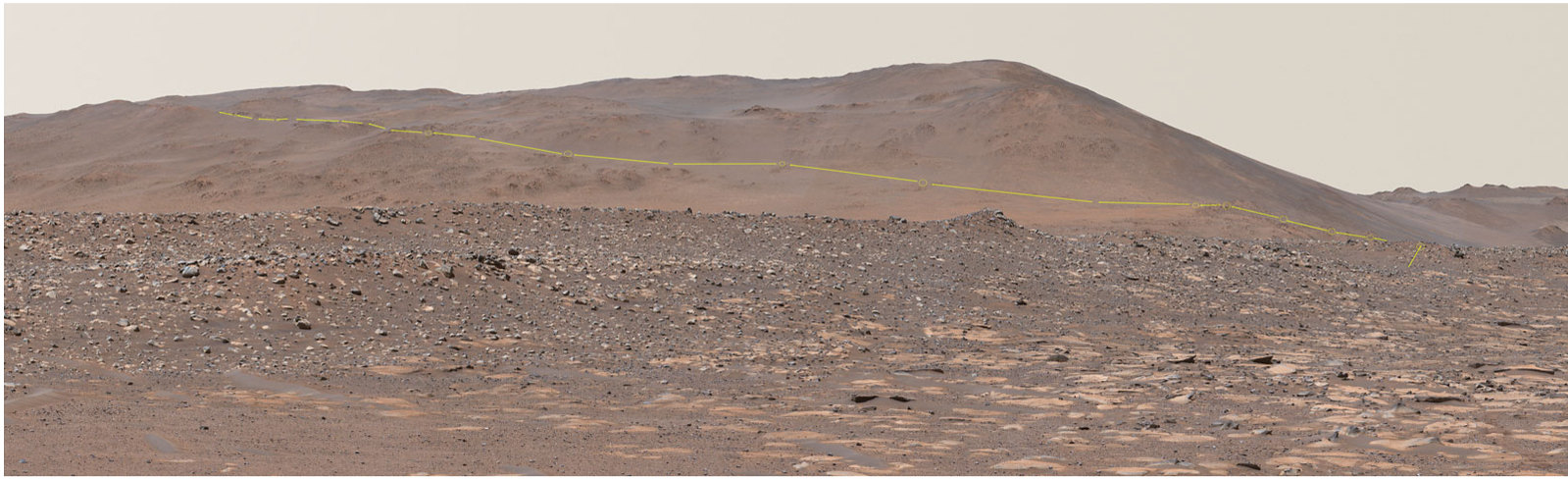
December 2023 is a key month for Perseverance, as it brings to a close the rover’s fourth science campaign within Jezero Crater and the start of a new endeavour. Commencing in 2024, Perseverance will follow the course of the river bed back towards the crater wall – a distance of around 4 km – to where mission personnel believe they have located an “easy” climb up the crater walls and which intersects the river’s channel at its lower end.

This image of Jezero Crater, captured by NASA’s Perseverance rover, shows the potential route (yellow line) that the robot may take to the crater’s rim. Credit: NASA/JPL/ASU/MSSS

Climbing the crater up to the plains above will expose Perseverance’s science instruments to bedrock and material even older then the outflow plain it has thus far studied, allowing it to reach back to the time the crater was formed. Along the way it will be able to both study the changing rocks and any atmospheric changes as it climbs upwards. As well as analysing the rock samples it gathers, the rover will also store some in the remaining 13 sample tubes contained in its belly, allowing them to be cached together with some of the remaining tubes of material gathered from the crater floor so that an alternate collection of samples can await the arrival of the still-to-be-fully-defined sample return mission, should landing within Jezero itself prove too difficult for the proposed lander part of the mission, and the samples cached there are abandoned.

 Video Promotes Rosalind Franklin

If fortune favours the unfortunate, the next rover to trundle across the surface of Mars will be Europe’s long-awaited Rosalind Franklin. Originally called the ExoMars rover, this vehicle has suffered a number of setbacks during its 20 years in development and pre-flight hell. However, (and touching large amounts of wood, given I have something of a loose association with the mission), things are currently on course for an October 2028 launch, that the European Space Agency felt confident enough to release a new promotional video showcasing the mission.

Some 60% heavier and slightly larger than NASA’s Mars Exploration Rovers Opportunity and Spirit, the European rover is, like them, solar-powered. It also shares a similar mission arc as both of the MER rovers and the nuclear-powered Curiosity and Perseverance: to locate evidence for water on Mars and seek out evidence for past signs of life. However, in one respect its mission does differ, as Rosalind Franklin will also focus seeking evidence for current microbial life on Mars.

To assist with the latter, the rover will be equipped with a drilling mechanism capable of reaching up to two metres beneath the planet’s surface – far beyond depths so far plumbed in the search for evidence of Martian microbial life – with the samples gathered then put through extensive study and analysis by the rover’s multiple science systems.

The landing site for the mission is Oxia Planum, a region located between two outflow channel systems: Mawrth Vallis to the northeast and Ares Vallis to the southwest. Scientists believe this region will contain remnants of the planet’s wetter past, increasing the potential for finding evidence for past or even current microbial life on the planet. Once there – the flight to Mars will take almost exactly 2 years, courtesy of the capabilities of its launch vehicle – Rosalind Franklin will travel up to 70 metres a day when on the move, with an overall primary mission expected to last some 7 months.

Voyager 1 Hits Problems

Humanity’s first interstellar ambassador, Voyager 1, is now just over 47 years into its voyage and more than 162 AU (or 24 billion kilometres) from Earth – and like all of us as we grow older, it is increasingly showing signs of its age. Already, the more energy-intensive science instruments on the lonely spacecraft have been shut down, and engineers have had to repeatedly work their way gingerly around assorted problems the craft has encountered; such is the distance separating vehicle and home planet that even the tiniest errors risks breaking all communications.

An artist’s impression of a voyager probe in deep space. Credit: NASA

Most recently, Voyager 1 has started having issues with two key systems: the Flight Data System (FDS) and the Telemetry Modulation Unit (TMU). The latter is responsible for transmitting to Earth data on the spacecraft’s condition, orientation, etc., together with information from its operational science instruments, and receiving and managing communications from Earth. The data it sends is gathered by the three computers of the FDS, which combine everything obtained from the other instruments and sub-systems into a single package for the TMU to send. Except recently, all the TMU has been sending is a repeating pattern of meaningless binary, although it has continued to act on messages from Earth.

It had been thought the problem lies with the TMU itself, but after careful and painfully slow diagnoses (round-trip communications between Voyager 1 and Earth are on the order of 45 hours); the problem was found to be within the FDS. Over the weekend of December 9th/10th, mission engineers ordered the FDS to perform a sequential restart, which it was hoped would kick-start the system into once again passing meaningful data to the TMU. It didn’t.

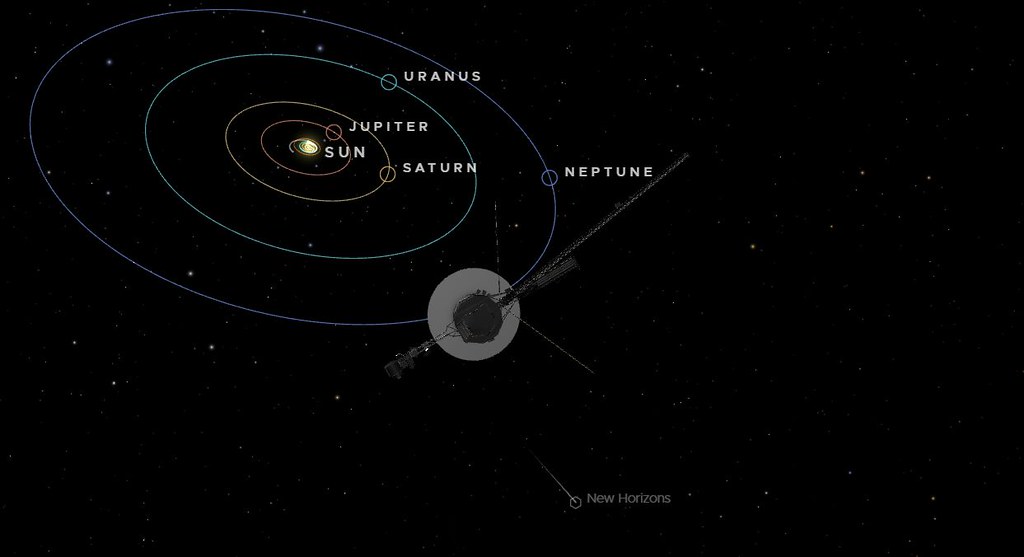
Created using NASA’s Eyes on the Solar System, this image shows what it might be like to look back at our solar system from 162 AU

So currently, Voyager 1 remains capable of receiving commands from Earth, but it cannot provide any understandable feedback on whether anything succeeded, or what systems are trying to report back through the FDS. As such, the Voyager mission team have indicated it will take several weeks to formulate a new plan of action in order to try to resolve the problem.

Spaceplanes, Spaceplanes

Both the United States and China were due to launch their highly secretive, automated “spaceplanes” this past week – although as it turned out, only one of them actually did so.

The United States X-37B programme had been due to commence its seventh mission – and the fourth flight of the 2nd of the two X-37B craft the US Space Force and US Air Force jointly operate – on December 14th. It was to be the first flight of the craft atop a SpaceX Falcon Heavy, seen as offering the craft the ability to fly missions at much higher orbits than can be achieved using its over launch vehicles – the ULA Atlas V 501and the Falcon 9 Block 4 -, potentially allowing for more flexible and even longer-duration on-orbit operations.

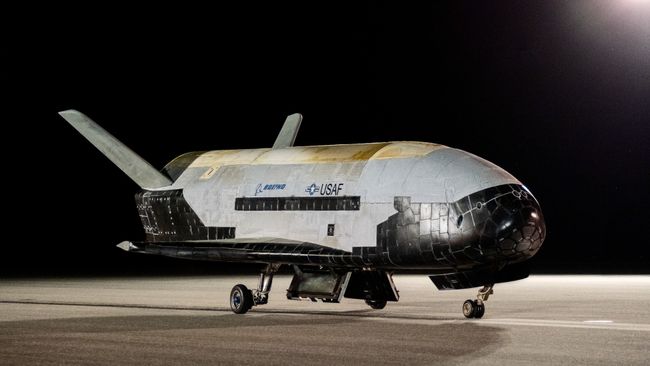
The USSF / USAF X-37B (vehicle 1), shortly after its return to Earth on November 22nd, 2022, following a 908-day orbital mission. Credit: US DoD

The cause of the delay has not been stated, but appears to have been called by SpaceX rather than the US DoD, and following the postponement, the Falcon Heavy was removed from Pad 39A at Kennedy Space Centre. At the time of writing, no revised launch target has been announced.

China, however, so no such delays in the third flight of its Shenlong “Divine Dragon” spaceplane, which lifted-off from the Jiuquan Satellite Launch Centre on December 14th, as planned, using a Long March 2F booster.

Little is actually known about the Chinese vehicle – although there is an emerging consensus that it is potentially similar in overall size and form to the US X-37B. The craft first flew the craft in September 2020 and then was launched a second time in August 2022 – this mission lasting for 276 days, which is still a small fraction of the time the US craft tends to spend in orbit (908 days on its last mission). That said, the second Shenlong mission did cause surprise and concern in the west when it apparently launch / placed / jettisoned something into space  – China has remained tight-lipped as to what it was.

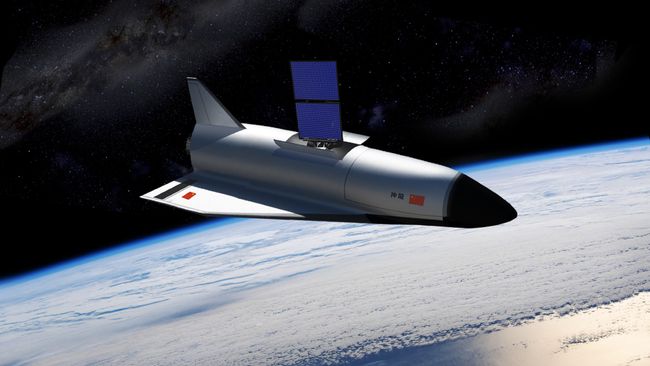
An artist’s rendering of what the Chinese automated space plane might look like. Credit: Erik Simonsen / Getty

No information on the flight or its potential duration has been given by the Chinese authorities, with the official statement post-launch something of a laconic repetition of the announcements which followed the first two flights of the vehicle.

The test spacecraft will be in orbit for a period of time before returning to the domestic scheduled landing site. During this period, it will carry out reusable technology verification as planned to provide technical support for the peaceful use of space.

– Official and bland Chinese statement following the latest Shenlong launch

That both vehicles were originally intended to launch so close together is not a coincidence. The USSC/USAF has been very open in its desire to learn more about the Chinese vehicle’s purpose and capabilities – and the China probably likewise want to know more about the American vehicle. Thus, having them in space at the same time allows the two nations to observe one another’s craft via Earth-based means and – perhaps – mimic the manoeuvrings of one another’s vehicles.

Space Sunday: a 20-year Mars Express

A farewell to Earth: an image of our Earth and her Moon, captured by ESA’s Mars Express mission as it heads towards Mars, June 2003. Credit: ESA

When discussing the robotic exploration of Mars, the focus tends to be on the current NASA missions: the Mars Science Laboratory (MSL) rover Curiosity and the Mars 2020 rover Perseverance and its flight-capable companion, Ingenuity. This is because of all the active Mars missions, these are the most visually exciting. But it does mean the other missions still operating around Mars – a total of 8, including China’s Tainwen-1 orbiter and Zhurong rover and UAE’s Hope mission – tend to get overlooked.

One of those that tends to get overlooked is actually the second longest running of the current batch, the European Space Agency’s Mars Express, the orbital component of a 2-part mission using the same name. This recently celebrated the 20th anniversary of its launch (June 2nd, 2003) and will reach the 20th anniversary of its arrival in its operational orbit around Mars on December 25th, 2023.

The mission’s title – “Mars Express” – was selected for a two-fold reason. The first was the sheer speed with which the mission was designed and brought together as a successor to the orbital component of the failed Russian Mars 96 mission, for which a number of European Space Agency member nations had supplied science instruments, using an ESA-designed satellite unit (based on the Rosetta mission vehicle).

An artist’s impression of Mars Express passing over Mars in its extended elliptical orbit. The two long booms extending fore-and0aft from the vehicle are part of the MARSIS sounding radar designed to locate frozen bodies of water beneath the planet’s surface. Credit: ESA 

The second was the fact that 2003 marked a particularly “close” approach of Earth and Mars in their respective orbits around the Sun, allowing the journey time from one to the other to be at the shorter end of a scale which sees optimal Earth-Mars transit times vary between (approx.) 180-270 days. In fact, Earth and Mars were at the time the “closest” they have been in 60,000 years, hence why NASA also chose that year to launch the twin Mars Exploration Rover (MER) mission featuring the Spirit and Opportunity rovers.

Taken as a whole, the Mars Express mission is perhaps more noted for its one aspect that “failed”: the British-built Beagle 2 lander (named for the ship that carried Charles Darwin on his famous voyage). This was a late addition to the mission, and the brainchild of the late Professor Colin Pillinger (whom I had the esteemed honour to know ); given it was effectively a “bolt on” to an established ESA mission, it was subject to extremely tight mass constraints (which tended to change as the Mars Express orbiter evolved). These constraints led to a remarkable vehicle, just a metre across and 12 cm high when folded and massing just 33 kg, yet carrying a considerable science package capable of searching for evidence of past or present microbial life on Mars.

Sadly, following its separation from Mars Express on December 19th, 2003, ahead of both vehicles entering orbit around the planet and a successful passage through the upper reaches of Mars’ atmosphere, Beagle 2 never made contact following its planned arrival on the planet’s surface. For two months following the landing, repeated attempts to make contact with it were made before it was finally officially declared lost. While multiple theories were put forward as to what had happened, it wasn’t until 12 years later, in 2016 – and a year after Collin Pillinger had sadly passed away – that evidence was obtained for what appeared to have happened.

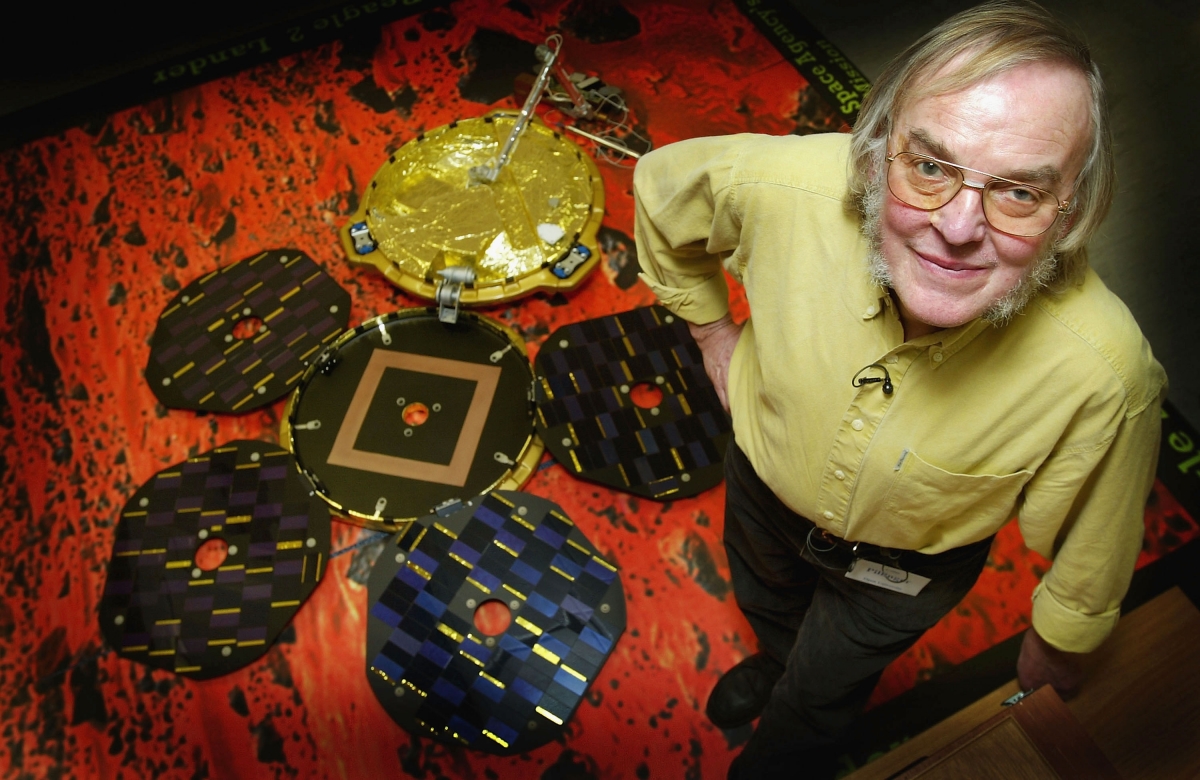
The late Professor Colin Pillinger pictured with a full-scale model of the Beagle 2 lander in its deployed mode, showing the four solar array “petals” unfolded from the vehicles “cover” to expose the communications antenna, the the power and science instruments – including the little’s landers robot arm and “PAW” – the Payload Adjustable Workbench – designed to study the rocks around the lander and obtain samples of rock and soil for on-board analysis. Credit: Getty Images

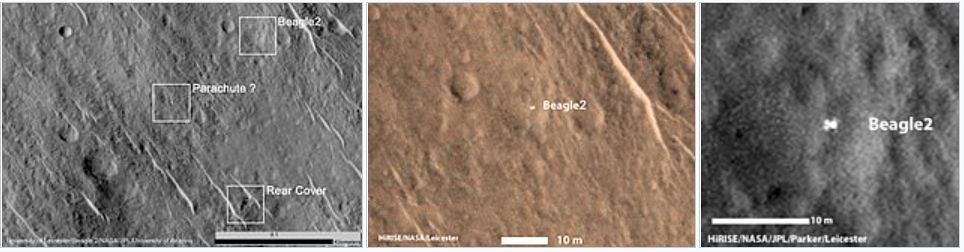
Using a technique called super-resolution restoration (SRR) on images obtained by NASA’s Mars Reconnaissance Orbiter in 2015 and which appeared to show the lander intact on the surface of Mars, experts were able to enhance them to a point where they appeared to show it had in fact managed to land safely on Mars and had partially deployed its solar arrays.

The significance here is that due to its mass and size constraints, Beagle 2 was of a unique design, resembling an oversized pocket-watch and its cover. The “watch” contained the science and battery power systems, and the “cover” the communications system and flat antenna, with four round solar arrays stacked on top of it.

Following landing, Beagle 2 was supposed to fold back its “lid”, and then deploy the four arrays like petals around a flower. This would allow the arrays to recharge the lander’s batteries so it could operate for at least a Martian year, and expose the communications antenna. However, after enhancement using SRR, the NASA images appeared to show only two of the solar array petals had actually deployed; the other two remaining in their “stowed” position, blocking the lander’s communications antenna and denying it with a sufficient means to recharge its batteries.

Left: the MRO image of the Beagle 2 landing site captured in 2015 showing the lander, what appears to be its parachute and its backshield. Centre: an enlargement of the orbiter using traditional processing enhancements, including the use of false colour to try to increase the available detail. Right: the SRR work, appearing to show the lander with 2 (of 4) solar arrays deployed. Credit: NASA / ESA

However, there is one further element of intrigue: because it was known initial communications with Earth might be delayed – Beagle 2 was reliant on either Mars Express itself to be above the horizon post-deployment, or failing that NASA’s venerable Mars Odyssey orbiter – the lander was programmed to go into an automated science-gathering mode following landing. As the science instruments were quite possibly able to function, some of them might actually have deployed, allowing data to be recorded Solid State Mass Memory (SSMM) – data which might still be available for collection were the lander to ever be recovered by a human mission to Mars.

The mystery over the lack of contact with Beagle 2, coupled with the arrival of NASA’s Spirit and Opportunity on Mars at the start of 2004 combined to mean that Mars Express received very little attention following its arrival in its science orbit on December 25th, 2003 – and apart from occasional reporting on its findings, this has continued to be the case for the last 20 years.

The 82 km wide Korolev crater located in the northern lowlands of Mars, home to a body of water ice 1.8 km deep and up to 60 km across. This image was created from a series captured by the High Resolution Stereo Camera (HRSC) on Mars Express, and has a resolution of roughly 21 metres per pixel. Credit: ESA / DLR

Which is a shame, because in the time, Mars Express has carried out a remarkable amount of work and has been responsible for some of the most remarkable images of Mars seen from orbit. 0For example, and just as a very abbreviated list intended to outlines the diversity of the orbiter’s work, within two months of its arrival around Mars, it was able to confirm the South Polar icecap is 15% water ice (the rest being frozen CO2).

In April and June 0f 2003, the vehicle confirmed both methane and ammonia to be present in the Martian atmosphere; two important finds, as both break down rapidly in Mars’ atmosphere, as so required either a geological or biological source of renewal.

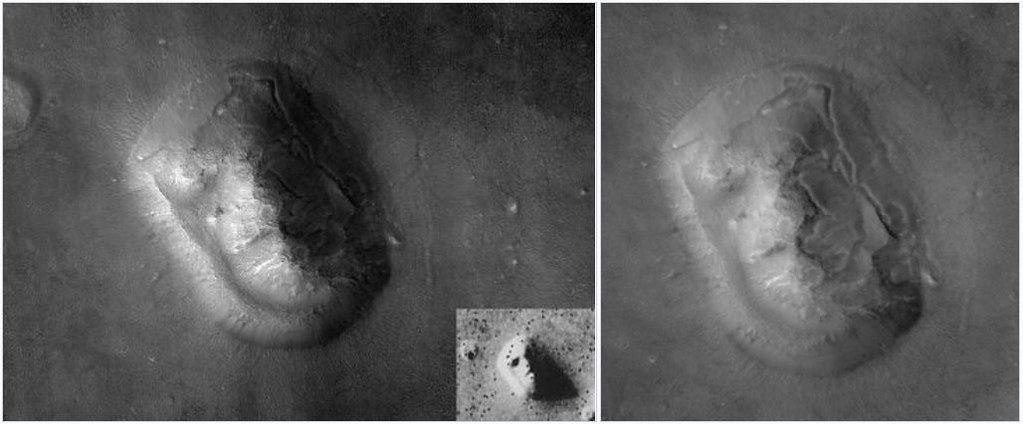
Pareidolia at work: the Cydonia mesa said to be carved into a “human face” following the Viking missions of the 1970s, as seen by NASA’s Mars Reconnaissance Orbiter  (2007 – left) and Mars Global Surveyor (2001- right), compared to the Viking image which gave birth to the myth of the “face”. Credit for all images: NASA 

In 2006, the orbiter put another nail in the coffin of the “ancient Martians” theories which abounded following the the Viking missions in the 1970s. In one set of images of the Cydonia region of Mars taken by the orbiter vehicles, there was a was a mesa which, thanks to the fall of sunlight, and the angle at which the image was taken, appeared to give it the appearance of a “face”. This quickly spiralled into ideas the 2 km long mesa had been intentionally carved as a “message” to us, together with claims of pyramids and the ruins of a city close by.

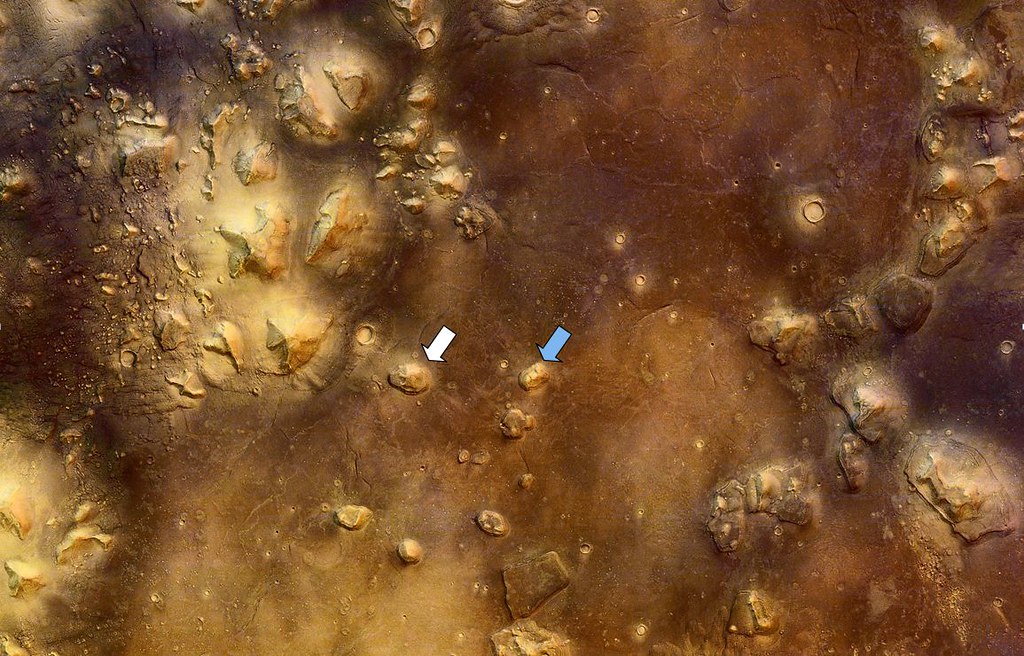
All of this was the result of pareidolia rather than any work by ancient Martians – as evidenced by much higher resolutions of the mesa taken by NASA’s Mars Global Surveyor orbiter in 2001, and Mars Reconnaissance Orbiter in 2007 (above). Mars Express further demonstrated the effects of pareidolia in an image of Cydonia captured in 2006, which showed both the “face” mesa, and – around 50 km to the west – another which looks like a skull. While the latter mesa is also visible in some of the Viking era images, it is no way resembles a skull; the resemblance on the Mars Express image again being the result of natural influences – the fall of light, etc., – coupled with the human brain’s propensity to impose recognisable form and meaning to shapes where none actually exists.

A 2006 image of the Cydonia region, captured by Mars Express, demonstrating the pareidolia effect associated with the so-called “face”. Arrowed in blue is the mesa supposedly carved into the form of a “face” in a similar manner to how it was “seen” by Viking in 1976, together with a “skull” mesa close by (some 50 km away), which looked nothing like at skull when reviewed in the Viking images. Credit: ESA

Continue reading “Space Sunday: a 20-year Mars Express”

Space Sunday: a rover and some astronomy

After a treacherous journey, NASA’s Curiosity Mars rover has reached an area that is thought to have formed billions of years ago when the Red Planet’s water disappeared.
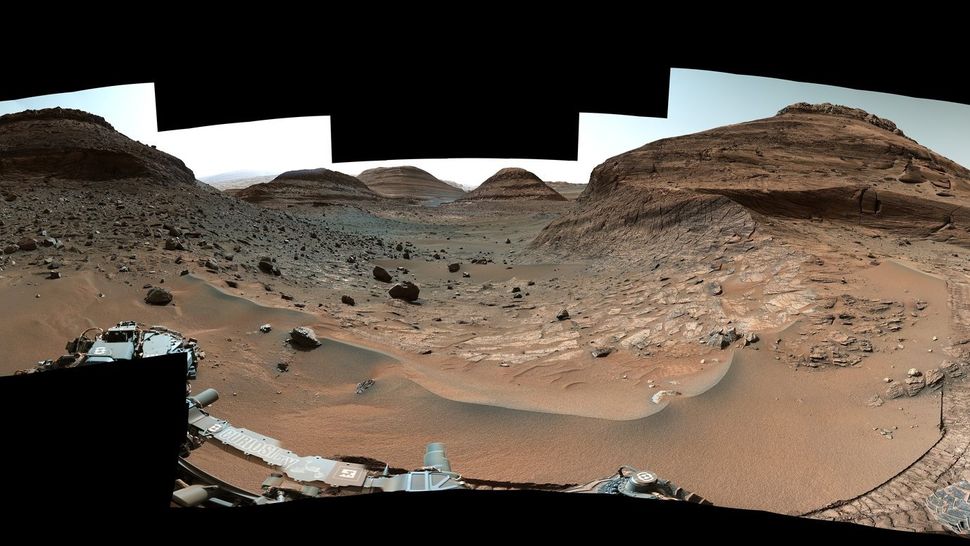
Lying part-way up the slopes of “Mount Sharp”, the mound of material deposited at the centre of Gale Crater (and formally called Aeolis Mons), is rich in salty minerals scientists think were left behind when the streams and ponds on the slopes of the mound finally dried up. As such, this region could hold tantalizing clues about how the Martian climate changed from being similar to Earth’s to the frozen, barren desert we know today.

These salty minerals were first spotted from orbit by NASA’s Mars Reconnaissance Orbiter before Curiosity arrived on Mars in 2012, and that discovery marked the deposits as a prime target for the rover to examine.  However, such is the rich diversity of rocks and minerals making up “Mount Sharp”, all of which have been subject to examination by the rover, it has taken the mission almost a decade to reach this “prime” target.

Even so, before Curiosity could obtain any samples from the site, the rover faced a couple of challenges.

The first lay in the fact that the rover’s position on “Mount Sharp” meant that the mission team had to drive and position the rover to ensure its antenna could remain aligned with the various orbiters it needs to use to communicate with Earth; this made navigating to the deposits a challenge, as has ensuring it can reach rocks that might yield interesting samples.

A view through “Paraitepuy Pass” captured by the MastCam on NASA’s Curiosity rover on August 14th, 2022, the 3,563rd Martian day, or sol, of the mission. Credits: NASA/JPL / MSSS

The second required further tests had to be carried out on the rover’s sample-gathering drill to ensure it would handle the stresses in cutting into the region’s rocks. As designed, the drill was intended to use a percussive action as it drilled into any target- but as I’ve reported in these pages, this hammering action started to affect the drilling mechanism as a whole, so a new algorithm was created and uploaded to the rover to minimise any use of the percussive action.

Because of this, the mission team now approach each sample gathering operation with an additional step: after scouring the surface of a sample rock to remove dust and debris, the team then position the drill bit against the rock and attempt to scratch the surface – any resultant marks would be a good indication the rock is soft enough to be drilled without the need for the hammer option.

In the case of this rock – nicknamed “Canaima” – no marks were left, indicating it might prove a difficult subject. However, a further test with the drill head turning revealed it could cut the rock without the use of the hammer action, so on October 3rd, 2022, Curiosity successfully obtained its 36th sample for on-board analysis.

A MastCam view of the 36th successful sample hole Curiosity has drilled, this one on the sulphate-rich rock dubbed “Canaima.” Inset: the hole as imaged by the Mars Hand Lens Imager (MAHlI) mounted on rover’s robot arm, along with the drill mechanism. These mages were taken on October 3rd, 2022, the mission’s 3,612th Martian day, or sol. Credits: NASA/JPL / MSSS

The route to this sulphate-rich area also required Curiosity pass through a narrow, sand-rich location dubbed “Paraitepuy Pass”, bordered on either side by slopes the rover could not drive over or along. Such is the nature of the sand the rover took over a month to traverse the pass, moving cautiously in order to avoid getting bogged-down. This meant that the rover celebrated its 10th anniversary crossing the pass.

The challenges also haven’t ended; the salty region comprises rocky terrain that is so uneven, it will be difficult for Curiosity to place all six wheels on stable ground. This isn’t a problem when on the move, but it could limit science operations in the area: if all of the rovers wheels are not in firm contact with the ground under them, operators won’t risk unfolding its instruments-loaded robot arm in case it clashes with jagged rocks.

Even so, the rover still has a lot of opportunities for science and discovery as it continues to climb “Mount Sharp”.

JWST Wows, HST, Chandra and IXPE Respond

It is now 100 days since the James Webb Space Telescope commenced operations, and in their most recent updates, NASA released a stunning image the observatory captured of the iconic Pillars of Creation.

The Pillars of Creation as imaged by the James Webb Space Telescope. Credit: NASA / ESA

Located in the Serpens constellation, roughly 6,500-7,000 light-years from Earth, the Pillars are gigantic “elephant trunks” of interstellar gas and dust, a birthplace of new stars,  constantly, if slowly being changed by the very stars born within them. They were imaged by the Hubble Space Telescope (HST) in 1995, the image becoming famous the world-over despite HST imaging them again it 2014. However, the image developed by JWST’s Near Infra-red Camera (NIRCam) eclipses the Hubble image, revealing the pillars and their surroundings in incredible detail.

Newly formed stars lie outside of the column. Seen merely as a few bright red orbs with strong diffraction spikes radiating from them, they are reveal by JWST as in their truer colours – blues, yellows, whites, indicative of their spectral classes, a veritable sea of stars, These are the stars that are causing the pillars to change and collapse as a mix of their gravities and radiative energy influence their form.

The Pillars of Creation as images by the Hubble Space Telescope in visible light (1995 – left) and by the James Webb Space Telescope in the near infra-red (right – 2022). Credit: NASA / ESA

Also visible along the edge of the pillars are wavy forms, the ejections of gas and dust from stars that are still forming. The crimson glow seen within some of these wave-like forms is the result of energetic hydrogen molecules interacting with the supersonic outbursts of the still-forming stars. Within the cloudy forms of the pillar are red points of light – newly-formed stars that are just a few hundred thousand years old, the light just stars to break through the surrounding clouds of dust and material.

Around all of this is a translucent blue glow, a mix of dust and gas known as the interstellar medium, found in the densest part of our galaxy’s disk. It serves to block the view of the deeper universe, bringing the Pillars of Creation to the fore.

This new view of the Pillars will help researchers revamp their models of star formation by identifying far more precise counts of newly formed stars, along with the quantities of gas and dust in the region. Over time, they will begin to build a clearer understanding of how stars form and burst out of these dusty clouds over millions of years.

Continue reading “Space Sunday: a rover and some astronomy”

Space Sunday: minerals on Mars, space politics and more Dream Chaser

As I looked at the Mars 2020 mission in my previous Space Sunday piece (see: Space Sunday: A year on Mars and the Polaris Programme), I thought it time to catch up on some of the most recent news about NASA’s other “big rover” working on Mars, Perseverance’s “older sister”, Curiosity, the rover of the Mars Science Laboratory (MSL) mission, which will mark its tenth anniversary on Mars later in 2022.

Curiosity’s mission to Gale Crater, almost half a world away from Perseverance continued onwards despite the dearth of regular updates posted to the official blog (but them, updates on Perseverance have been far less voluminous than see during the first year of MSL operations on Mars, largely thanks to NASA opting to make greater use of social media tools like Twitter to hand out bite-size nibbles of updates.

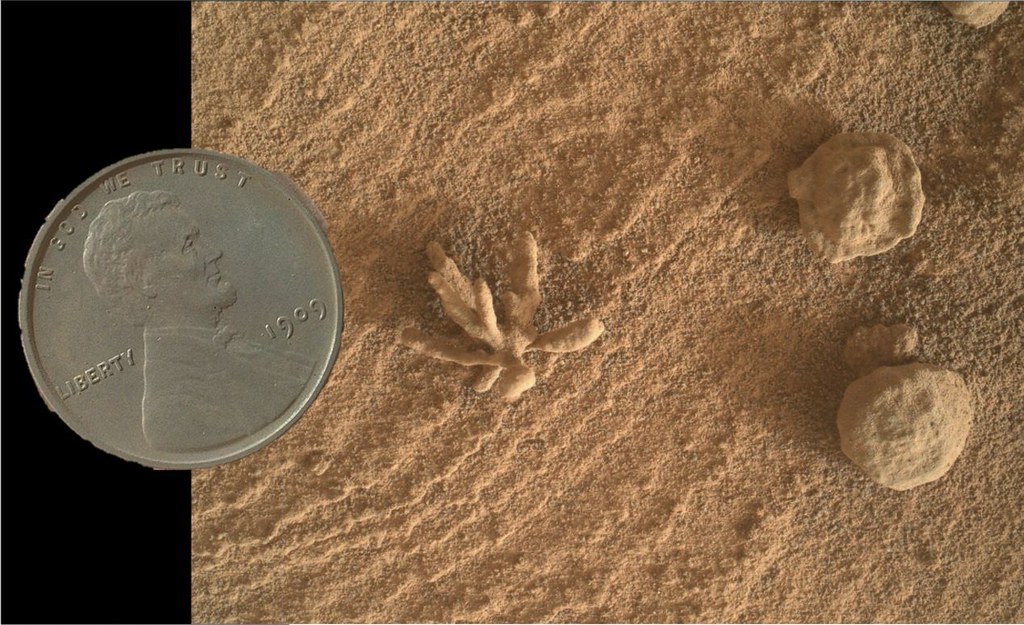
However, one recent discovery that got some hearts all a-flutter recently was that of a curious formation Curiosity imaged on flank of “Mount Sharp”, the huge mound rising from the middle of the crater – and officially called Aeolis Mons. At first glance, it appears to show a petrified flower sprouting from the surface of the planet – and while it is most certainly not any such thing or even the first of these formation Curiosity had encountered – the raw images captured by Curiosity were released sans any indication of scale, getting some website and individuals a little over-excited.

The “raw” image of the “flower-like” object captured by the Curiosity rover on February 25th, 2022 (mission Sol 3397 by the Mars Hand Lens Imager (MAHLI) instrument mounted on the rover’s robot arm. Credit: NASA/JPL

The object is in fact a mineral structure called a diagenetic crystal cluster. Essentially they are a collection of crystals formed by mineral precipitating from water, undergoing diagenetic recombination in the process, creating this beautiful, but tiny three-dimensional structures.

In fact, the rover first encountered structures like this since around Sol 870 of the mission, as it explored the Pahrump Hills at the base of “Mount Sharp”. However, this particular structure is somewhat different, as the structures found at Pahrump were formed by sulphate (salt) crystals, leached out of receding waters as the lakes that once repeatedly filled Gale Crater finally vanished. This structure formed from salts and other minerals, and most likely formed inside a small rock over which water coming off the slopes of “Mount Sharp” once flowed, before it was left to the mercy of the Martian wind, which slowly eroded it over the aeons until only this delicate-looking but tough structure remained.

The same image of the structure, this to overlaid with a to-scale US Lincoln penny (one of which also adorns Curiosity’s bodywork), provided by mission scientist Abigail Fraeman to give an impression of the object’s actual size. Credit: NASA/JPL / A. Faeman

The other interesting point with the image is the manner in which it was created. For most its mission, Curiosity has captured images of objects and structures, stored them, and then transmitted them to Earth for post-processing. Here, however, MAHLI took around eight images of the object all from very slightly different angles. The images were then processed by the rover itself, using a software package referred to as the onboard focusing process, which allowed them to be combined and adjusted to produce a single frame of great depth and detail that could then be transmitted to Earth.

In fact, so detailed is the  structure – dubbed Blackthorn Salt – in the image, and such is the depth afforded by the picture Simeon Schmauss was able to produce a 3D model of it using Sketchfab, allowing us to see it really up close and from almost any angle – click the image below and see for yourself. However, when doing so, please note that the blurred and “draped” grey elements seen “hanging” from the structure’s arm / branches when looking at it from the side are not a part of the structure, but are artefacts of the Sketchfab rendering process, as the image from MAHLI doesn’t show what is directly below the arms / branches.

Curiosity itself continues to explore and climb “Mount Sharp”, attempting to make its way to higher slopes. Most recently, it has been making its way along a shallow and short “valley” that will hopefully provide access to the “Greenheugh Pediment” – a comparatively gentle slope, formed by water erosion and lying at the base of the mound’s steeper slopes. It is hoped that by crossing the Pediment will lead to a long valley (Gediz Vallis), which is hoped will provide a route further up “Mount Sharp”.

Since arriving on Mars in august 2012, the rover has travelled 27.3 kilometres and has gathered and analysed 34 rock samples and six soil samples, all of which indicate Gale Crater was once a warm, wet environment that may well once have harboured all the fundamentals for life to form.

Curiosity’s route up “Mount Sharp” from Pahrump Hills to its currently location, where it is making its way towards “Greenheugh Pediment”, which offers a way to Gediz Vallis (below the bottom edge of this image), a route upwards to the upper reaches of the mound, and which appears to be a confluence of numerous channels, possibly formed by water, running downslope from the high ground. Credit: NASA/JPL

Russia Stops Soyuz Launches out of Europe’s Spaceport, French Guiana

Following the sanctions imposed on Russia due to the invasion of Ukraine, Roscosmos has announced it is halting all cooperation with Europe with regards to Soyuz launches out of Europe’s Spaceport, French Guiana and withdrawing its 87 support personnel from the launch site.

The announcement will immediately impact the launch of two Galileo navigation satellites that had been scheduled for April aboard Soyuz, and potentially a follow-up launch of another pair of Galileo satellites due later in the year.

Also potentially impacted are Two ESA missions: the EarthCARE Earth science mission (developed in partnership with JAXA (Japanese space agency) and scheduled for February 2023, and the Euclid infrared space telescope (March 2023), together with the French government’s military CSO-3 reconnaissance satellite.

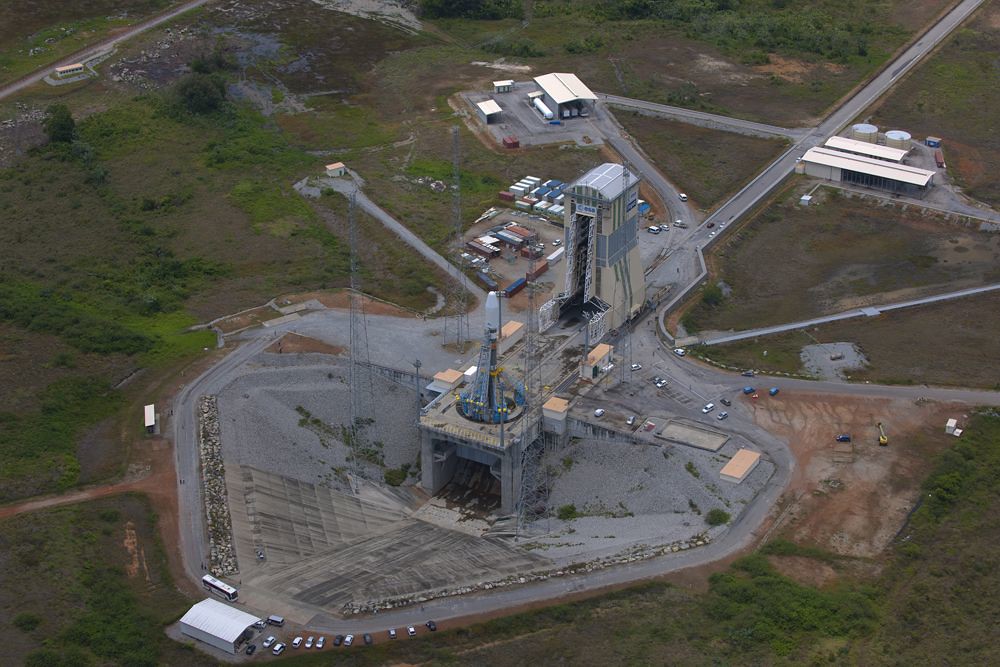
The Soyuz launch platform at Europe’s Spaceport, Kourou,

Soyuz is offered as a launch vehicle through French launch service provider Arianespace alongside of Ariane and Vega launch vehicles, with Arianespace, through its shareholding in Starsem, can also broker payload launches on Soyuz out of the Baikonaur spaceport, Kazakhstan. However, the future of Soyuz launches out of French Guiana has been the subject to debate for some time, given that Arainespace has been keen to move customers to their new Ariane 6 and Vega-C launchers, both of which are set to enter service from 2022.

No comment has been made by either the European Space Agency or Arianespace on the matter – but both are due to meet to discuss matters on Monday, February 28th. In terms of space cooperation, suspending Soyuz launches out of French Guiana is pretty much the only lever on space matters Russia can pull without adversely impacting their own operations; something that is in stark contrast to 2014, when Russia annexed Crimea.

At that time, the United States was reliant on Russia for both crewed launches to the ISS, and the supply of RD-180 motors used by the Atlas 5 vehicle. However, the US now has the SpaceX Crew Dragon vehicle for ISS missions, which should, in 2023, be joined by Boeing’s Starliner, while United Launch Alliance will be retiring the Atlas 5 (there are only 25 more launches on the books, and has sufficient RD-180 motors for many of those flights).

Dmitry Rogozin, the head of Roscosmos also suggested that sanctions could impact Russian co-operation with the ISS, warning that without Russian support, the space station could fall into “uncontrolled descent from orbit and then falling onto the territory of the United States or Europe”.

Progress resupply craft (green, in the background of this image) have generally used to periodically boost the altitude of the ISS – a job previously performed by the US space shuttle. However, there is no reason why the Orbital Science’s Cygnus resupply vehicle could not perform the same role. Credit: NASA

The threat is based on the fact that Russian Progress resupply vehicles are periodically used to raise the space station’s orbit as drag with the tenuous atmosphere causes it to lower. However, the US and Japan both have the potential means to boost the orbit, whilst away from Rogozin’s tweets, NASA and Roscosmos alike have stated ISS operations continue to pretty much be “business as usual”.

Notably excluded from any threats – for the time being – is the European ExoMars mission, due to see the Rosalind Franklin rover and a Roscosmos-made lander launched to Mars from Baikonur in September atop a Proton-M rocket. This is a particularly critical launch, as the available window only lasts 12 days and if missed will mean another 26-month delay to the mission, which had initially been set to launch 2020.

Space Image of the Week¹

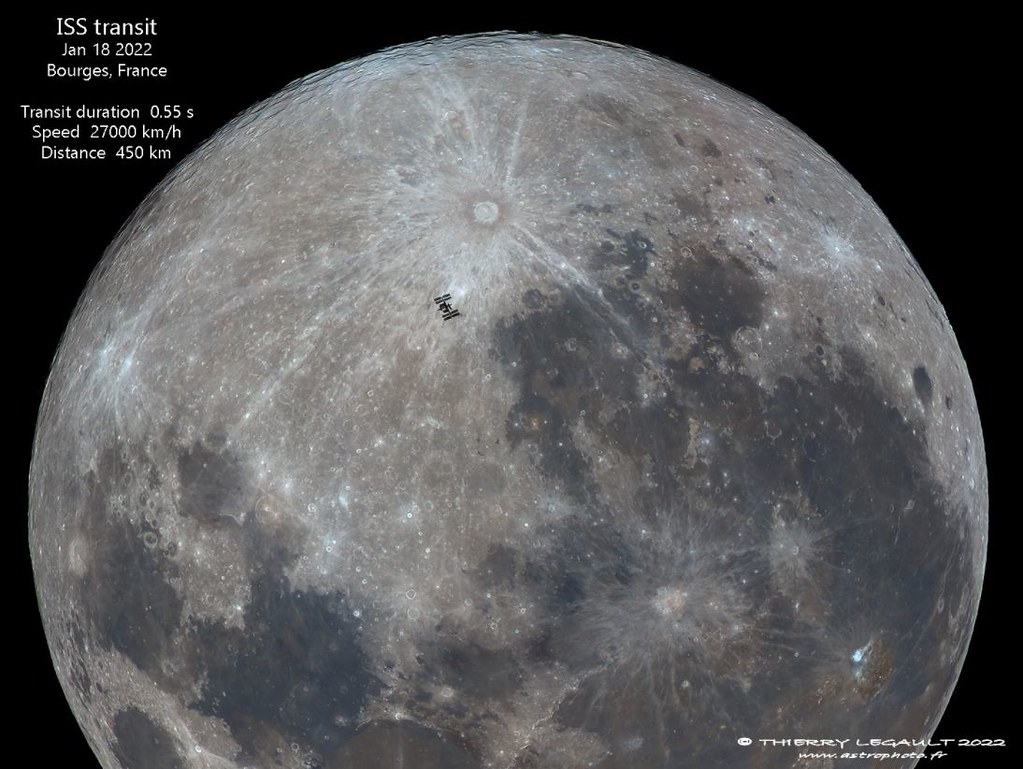
I am virtually sure it’s the most detailed ISS lunar transit to date 😊
I had to ride 250 km from home and find a remote place in the countryside between the blankets of fog, for this 1/2 second transit at 27000 km/h.

– Thierry Legault

The above comments refer to the image below, showing the International Space Station crossing between Earth and the Moon, captured by French amateur astronomer and astro-photographer Thierry Lagault, who travelled from Paris to Bourges in January 2022 in the hope that the winter weather would allow him to capture the space’s passage across the full Moon.

ISS lunar transit by Thierry Legault, Note the image is oriented so south is at the top of the image. The bright crater above and to the right of the ISS in Tycho. Credit: Thierry Legault.
The image is being credited at one of the most detailed pictures of a ISS lunar transit every captured. It is so detailed, is it possible to see details of the primary solar arrays at either end of the station’s main truss structure, as can the structure of the station’s pressurised modules.

An enlarged version of the image, rotated through 90º so that south is to the right, reveals even more detail – the Russian modules of the ISS pointing towards the top of the image, and the US / international modules pointing down.

ISS lunar transit by Thierry Legault (enlarged and rotated). Credit: Thierry Legault.

Continue reading “Space Sunday: minerals on Mars, space politics and more Dream Chaser”

Space Sunday: A year on Mars and the Polaris Programme

Mars 2020 rover Perseverance. Credit: NASA/JPL

On February 18th, 2021, NASA’s Mars 2020 mission arrived in Jezero Crater, Mars to commence operations.

In the year since then, the 1 tonne Perseverance rover and its tiny companion, the 1.8 Kg helicopter drone Ingenuity, have achieved a tremendous amount, with Ingenuity far exceeding expectations and the rover really still in the earliest phase of its mission (it’s “sister” rover, Curiosity has now been exploring Gale Crater on Mars for over nine years).

Currently, Perseverance is close to wrapping up its first science campaign, studying the basin of the 45 km wide Jezero Crater, a place believed to have once been the home of a lake billions of years ago, and which features some of the oldest rocks scientists have been able to study up close via a rover.

Nor is the rover studying those rocks purely in situ. As I’ve reported in these pages, the rover has been gathering samples in seal containers which – much later in the mission – be deposited in at least one cache on the surface of Mars to await collection by a hoped-for future sample return mission.

So far, six samples have been gathered, and while Martian pebbles got caught in a part of the sample transfer mechanism in January (see: Space Sunday: pebbles, ALH84001 and a supernova) suspending further coring operations, these were finally cleared at the end of the month, leaving the way clear for the rover to collect two more samples in the next couple of weeks.

A raw (unprocessed for Earth lighting conditions) image taken via the forward Hazard Avoidance Cameras (Hazcams) on NASA’s Mars 2020 rover Perseverance as it uses its robot arms to examine an area of exposed rock dubbed “Rimplas” during the rover’s return trip to its landing point. This image was captured on February 8th, 2022 (Sol 345 for the mission). Credit: NASA/JPL

These will come from a type of dark, rubbly rocks seen across much of the crater floor and which have been dubbed Ch’ał (the Navajo term for “frog”). It is hoped that if returned to Earth, samples of these rocks could provide an age range for Jezero’s formation and the lake that once resided there.

The samples Perseverance has been collecting will provide a key chronology for the formation of Jezero Crater. Each one is carefully considered for its scientific value.

– Thomas Zurbuchen, associate administrator of NASA’s Science Mission Directorate

As well as gathering and assessing samples, Perseverance has used the MOXIE (Mars Oxygen In-Situ Resource Utilisation Experiment) to produce oxygen from the Martian atmosphere – such capabilities will be vital for future Mars missions, not only for producing oxygen, but also methane fuel.   

The rover also recently broke the record for the most distance driven by a Mars rover in a single day, travelling 320 metres on February 14th, 2022. This was achieved using the AutoNav software that allows Perseverance to find its own path around rocks and other obstacles.

Having spent the first year of operations studying the crater floor, Perseverance recently started heading towards one of the major features within the crater, a large river delta that once helped feed water into the crater.

On Earth, river deltas are great at preserving carbon-containing organic compounds – the building blocks of life as we know it. As such, much of the rover’s second year on Mars will be spent exploring and study the Jerero river delta.

We are incredibly excited to finally get to the delta [it is] the reason we chose the landing site, and we hope to get to it later this spring. Once we’re there, we’ll be able to look at the bottom of the ancient lake that once filled Jezero to search for signs of ancient microbial life, and we plan to spend the whole next year travelling through the ancient lake deposits and ancient river deposits that are within the delta.

– Briony Horgan, associate professor of planetary science at Purdue University

In order to reach the delta, Perseverance has been backtracking from a rugged part of the crater floor called “South Séítah”, which it has been exploring for the last several months, and will return to its landing site – now called Octavia E. Butler Landing – in the next two week or so. From there, it will drive west to reach the delta region.

While this might sound a long-winded way of doing things, the fact is that the route back from “South Séítah” is known and therefore “safe”, and the landing site provides direct access to the river delta. Whereas going “cross country” from “South Séítah” to the delta would take the rover across a dune field, with the risk of it becoming stuck.

Exactly where the rover will start its studies in the delta has still to be determined, as there are several points of interest that have already been spotted by the science team. One of these is a hilly feature dubbed “Kodiak Hill”, which the rover imaged from the landing point just after it arrived on Mars, and which could provide a good vantage point from which to properly survey the delta as a whole.

It’s likely a final determination of where to go to first with the delta  may be made with the assistance of Ingenuity.

Having completed its regime of five test flights early in the mission, during which Perseverance was relegated to the role of passive observer, the little drone has completed a total of 19 flights and doesn’t show any sign of stopping. While there had been some concern that a recent dust storm might impact its ability to obtain sufficient sunlight to keep its batteries charged, Ingenuity came through in good condition and, once its batteries had been fully charged, proved itself to be able to take to the air once more.

Ingenuity manages to catch Preservice in one of the images it captured which manoeuvring during a test flight in April 2021. Credit: NASA/JPL

For the majority of its flights, Ingenuity had acted as an aerial scout for Perseverance, imaging its surroundings in order to help mission planners determine potential route the rover could follow and / or identify potential points of interest the rover could be directed to study. As such, it has proven itself an invaluable part of the overall mission and more than proven the benefit of having UAVs operating in support of surface missions.

I’ll continue to report on the mission’s progress – and that of Curiosity, as and when NASA provides updates.

Isaacman’s Polaris Programme

Jared Isaacman, the billionaire who paid for and commanded the first non-professional astronaut flight into space, Inspiration4 in September 2021 aboard a SpaceX Crew Dragon vehicle (see: Space Sunday: Inspiration4 and Chinese Flights), is now planning a series of similar space flights  – potentially culminating in the first crewed flight of the Starship vehicle.

On February 14th, 2022 Isaacman announced the establishment of the Polaris Programme, which will run in cooperation with SpaceX.

Polaris is a series of pioneering Dragon space missions that will aim to rapidly advance capabilities for human exploration. This programme has been purposefully designed to advance long-duration human spaceflight capabilities and guiding us toward the ultimate goal of facilitating Mars exploration.

– Jared Isaacman, February 14th

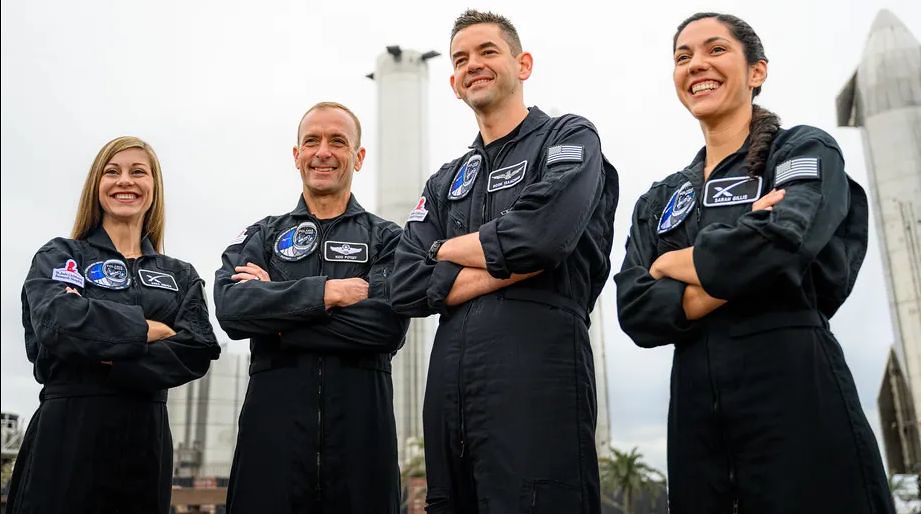
Thus far, only the first mission in the programme has any specifics associated with it – and these are sketchy in places, at least for the moment. Called Polaris Dawn, it appears to be jointly funded by Isaacman and SpaceX. It will take place no sooner than the last quarter of 2022 and will comprise Isaacman as commander, Scott “Kidd” Poteet, a retired Air Force pilot who was one of the ground directors for the Inspiration Inspiration4, as pilot and mission specialists Sarah Gillis and Anna Menon, both SpaceX employees – Menon is married to Anil Menon, a former SpaceX flight surgeon who left the company to join NASA at the end of 2021 as part of its latest astronaut intake.

The other details revealed for the mission are:

  • It will aim to break the record for the highest Earth-orbiting crewed space flight That record was set in 1966, when Charles “Pete” Conrad Jr and Richard F. Gordon Jr piloted Gemini 11, the ninth crewed flight of that series in an extended elliptical orbit with a perigee of just 268 km and an apogee of 1,368 km.
  • This high altitude will allow the crew to study the radiation environment at the edge of interplanetary space – which is vastly different to that experienced by the majority of people who have flown into space – human missions rarely exceed 450 km above the Earth.


The Polaris Dawn crew (from L to R): Anna Menon, Scott Poteet, Jared Isaacman, and Sarah Gillis. Credit: Polaris Programme/John Kraus
  • The programme will aim to “raise funds and awareness” for St. Jude Children’s Research Hospital (the Inspiration4 mission raised a total of US $240 million for the hospital) as a part of “a global health initiative” that will involve SpaceX, their Starlink satellite broadband network. But again, precise details as to what this will mean / entail were no elaborated.
  • The flight will include the first EVA (extravehicular activity) spacewalk by a commercial crewed mission.

This last aspect has drawn the most attention, as it will entail the entire crew utilising a modified version of the suits currently worn by crews using Dragon to fly to / from the International Space Station. It will also be a further hark-back to the Gemini (and Apollo) missions. Like the vehicles used in those programmes, Crew Dragon does not carry an airlock, so the entire vehicle will have to be depressurised the the EVA – something that shouldn’t be a problem, as the vehicle has from the start been designed to be able to vent down to vacuum. However, the exact purpose of the EVA – together with the overall science objectives for the mission – has yet to be detailed.

How many Polaris missions will take place after Dawn is unclear; in terms of Crew Dragon, Isaacman appears to suggest the number of missions will be dependent on how quickly Starship moves from development through operational status as a cargo vehicle to being capable for flying with crews.

This is not something that we can expect in the next few years; SpaceX have a lot to do just to prove Starship and Super Heavy form a viable cargo launch vehicle, after which the vehicle will have to go through an assessment and rating to clear it for flying crews and passengers. This is itself not a simple process – for example, it is expected that crewed launch vehicle have so form of abort / escape system, something  Elon Musk has thus far only “supposed” this could be possible for Starship.

However, for all the gaps in what has thus far been presented, the Polaris Project would appear to be an interesting new venture – one the goals that again reach beyond mere space tourism.