Second Norway: the future is bright

Second Norway, March 2020

Following my March pieces on Second Norway and Sailors Cover East and the issues of their respective futures (see: Second Norway & Sailor’s Cove East: rumours & statements – March 23rd and Second Norway and Sailor’s Cove East – status update – April 3rd), I was contacted by Vanity Bonetto, CEO of Luxory and Willowdale Estates, asking if I could put her in contact with Ey, as she had an interest in taking on Second Norway.

Given that Vanity has been able to take over a number of smaller SL estates that have got into difficulties over the years and then turning them around (she took over Willowdale some two years ago when it was just 30 regions – today it comprises some 250 regions), I was only too happy to handle introductions and then get out of the way and let them discuss matters.

Discussing Second Norway’s future with Vanity (l) and Ey (r)

Those discussions have now led to a positive outcome, and I’m happy to be able to provide a further update on all that has happened /  will be happening (although those reading Ey’s Bad Elf blog will already be aware of the situation 🙂 ).

In short, all regions in Second Norway will be continuing, but under the management of Vanity and the Luxory team, with Ey, Mialinn, SlaYeR joining them. Going forward, they will be managing the Second Norway Airport and the social community aspects of the estate.

I hope that before long Mialinn, SlaYeR and I can invite people to fun nights in the SN club with DJs, quizzes and general jibberish talk, just like in the old days.

– Ey Ren

To directly support the land management aspects of the estate, Vanity is bringing on a dedicated team of sales and support agents.

One of my experienced sales team members will be leading things. It takes around four weeks for new agents to get up to speed with our processes, so the new team will have time to learn while we’re redeveloping parts of the estate.

– Vanity Bonetto

For the present, the estate is to be split into two working parts. Note that this is not an actual physical divide in the regions, but rather a means to differentiate areas in terms of the work that will be taking place. Under it, the southern regions, which include places such as Bryggen, the stave church and Second Norway Airport (SNO) will initially remain largely unchanged, with the airport re-opening for business.

The development plan
Meanwhile, the northern regions will undergo an overhaul by Vanity’s landscaping team. This work will be extensive, and requires those residents in them to at least temporarily relocate. It’s a hard thing to do, but one seen as necessary; however, incentives will be offered to encourage people to return once the work has been done. The redevelopment also means that the estate’s regional express train tracks will be removed – but the system will return once the work has been completed.

It’s the only way to upload new terrain files – but we will extend special offers to all current and former residents so that it will pay out for them and make it worth to return to Second Norway in some weeks.
The island to the north will be updated, and over time we’ll offer more to the east and then progress south and demand requires. These island will be of different shapes and sizes. There will be multiple parcels close to the airport while the regions in the north, east and south will offer more privacy.

– Vanity Bonetto

To help with the transitioning, some of the current Second Norway residents have been shown the new designs for the regions that Vanity’s team have been putting together in the Luxory Estates “Lab regions”, and the feedback has been positive.

An example of the new Second Life regions under development at the Luxory lab regions. Note the tall columns are the rezzer systems for deploying each island’s features

A further benefit of the transfer of ownership is that the remaining 17 regions of Sailor’s Cove East can be retained, although not as they currently are. Rather than competing with the 24 regions Patrick agreed to take over, these regions will now be relocated to Second Norway and form a part of the redevelopment work.

As it is, the transfer of ownership from Ey to Vanity and Luxory estates was concluded on Friday, April 24th. The path is now clear for the work in overhauling the northern regions to commence, and for Ey and his team to start on a new chapter in the history of the Second Norway Airport and the social aspects of the estate.

I am relieved and happy that Vanity has agreed to take ownership of Second Norway …  I would like to express my gratitude towards the residents who have been living in Second Norway for years and have been very good sports when it comes to these changes.

– Ey Ren

On my part, I’m happy to see the Second Norway / SCE situation resolved so positively, and I particularly look forward to further covering the work at Second Norway. My thanks to both Vanity and Ey for keeping me in the loop on matters, and for spending time with me on April 27th.

Sources

A journey to Orkney in Second Life

Endless 58-58N, April 2020 – click any image for full size

Orkney is an archipelago in the Northern Isles of Scotland, about 16 km from the coast of Caithness, comprising some 70 islands, of which 20 are inhabited, the largest being simply called Mainland. It is now also the subject of the latest region design by  Sombre Nyx called Endless 58-58N – in recognition of both her Endless region builds and Orkney’s northerly latitude (58º 58′ north).

Presenting an archipelago within an area just 256m on a side is not easy, but Endless 58-58N does so quite magnificently. True, there are off-sim surrounds that can help give the sense of depth to a location, however, how well they work can be a matter of debate. Here, by combining them with a hazy Windlight environment, Sombre has created a setting that perfectly captures the sense of being within a group of islands caught within the hazy coolness of the North Atlantic.

Endless 58-58N, April 2020

Thus Endless 58-58N is an engaging representation of Orkney’s gentle rugged beauty, with the focus on the South Isles as then encompass the natural basin of Scapa Flow, once the home of Britain’s Grand Fleet, and the place where the German Imperial German Navy was scuttled in 1918, the vessels that could not be salvaged becoming  – along with a number of sunken British ship – a popular dive spot.

That the region appears to be a representation of Scapa Flow and the larger islands surrounding it comes not only from region’s introductory note card, by by the shape of the largest island in the region, which has the look of part of Mainland, Orkney’s largest island. Also, the tall finger of rock that rises from the south-west side of the second largest island carries with in a suggestion of The Old Man of Hoy, another of the islands that surround the bay.

Endless 58-58N, April 2020

Orkney has a long history of occupation dating back to Mesolithic and Neolithic times. Much evidence of this can still be found among the island, including the Standing Stones of Stenness and the Ring of Brodgar. To reflect this, Endless 58-58N includes its own standing stones, watching over the sheep that graze on the slopes below them.

There is no set route to exploring the region – from the landing point, visitors can wander where they will. As with Orkney and the wilds of Caithness, this is an open, rolling setting with few trees, but with coastal areas raised in hard, rugged cliffs. A small fishing wharf with piers and boats sits at the foot of one of these cliffs, just over a cottage-topped hill from the landing point. A single road runs back from this little port to where a deck sits out over the waters of the bay, offering a place to sit and appreciate the view.

Endless 58-58N, April 2020

Getting to the other two islands of the region is a case of flying, there being no obvious ferry or rowing boat to take. Do note, however, that there is a separate parcel to the south-west of the region sitting between the large island and its two small neighbours that has ban lines active, so care should be taken in that area.

Endless 58-58N is a region that deserves to be seen first-hand; minimal yet rich in detail, perfectly set within its windlight environment and with subtle celebrations of Orkney’s history, it is genuinely a delight to visit and photograph. Keep an eye out for the local seals as well!

Endless 58-58N, April 2020

With thanks to Shawn for the pointer!

SLurl Details

A Devil’s Bend in Second Life

Devil’s Bend National Park, April 2020 – click any image for full size

We came across Devil’s Bend National Park, a region design by Aiden Caudron and occupying a Full region using the full region land capacity bonus, after poking at the Recently Added category of the Destination Guide.

Intended to offer the look and feel of a rugged national park, the setting is an interesting mix of public and residential spaces (the former well scattered across the region so as not to interfere with exploration). Raised into a high plateau, the park is a series of dusty trails running under rich fir foliage and over deep ravines by means of wooden bridges, together with wooden board walks that wind through the ravines and cling to the sides of cliffs as they rise and fall through the park.

Devil’s Bend National Park, April 2020

The landing point sits at the visitor centre, a small lodge sitting at the side of one of the dusty roads. From here lie a choice of routes – one of which is reasonably short inasmuch as it crosses a bridge to reach two of the rental properties before coming to an end. Taking the road in the other direction is more constructive for explorers, as it winds much further through the park and offers a means to reach some of the wooden  walkways.

This is a place with a curious (in an interesting way) feel to it: open spaces, winding trails, and walks that are in keeping with the overall theme of a national park; but at the same time, the rental properties have something of a run-down feel to them; fenced gardens are overgrown, the houses faded by the sun and looking a little the worse for wear.

Devil’s Bend National Park, April 2020

Meanwhile, the north-east and northern side of the region are closed to public access – that is, the road is unexpectedly blocked by the wreck of a school bus. This appears to be less to do with matters of privacy and more with the fact that a major bridge has partially collapsed. Whether this is the result of an earthquake or rockfall – or both – is unclear; but the damage is such that it does bring the route to an abrupt end. Nevertheless, the use of the wrecked bus to block the road, together with the dilapidated state of the buildings beyond it suggest perhaps another narrative for this northern side of the region.

Follow the roads and the wooden board walks up to the summits of the park, and you may find yourself passing through at least one tunnel boring through the rock. It leads the way to a zip line that can be used for riding past a waterfall and back to the road below. Should you miss the tunnel, you can make your way to the radio mast on the highest peak – but be aware that the radio station close by is now a private home.

Devil’s Bend National Park, April 2020

I mention the tunnel, as tunnels are very much the secret to the park – threading through its rocky mass is a network of them, together with  chambers. Some are interconnected, others run on their own. Whilst most of the chambers do not hold a secret waiting to be found, they and the tunnels add a dimension to exploring the park that can keep visitors engaged for no small amount of time.

Rich in detail and offering numerous opportunities for exploration (and a café where visitors can rest should walking get a little too much), Devil’s Bend makes for an engaging visit. The texture load can have an impact if you’re running with all of the viewer’s bells and whistles engaged (particularly shadows), but this shouldn’t be a reason for not visiting, nor does it detract from the rugged charm of the region.

Devil’s Bend National Park, April 2020

SLurl Details

Dya’s Scent of the Caribbean in Second Life

Dya’s Scent of the Caribbean, April 2020 – click any image for full size

I arrived in-world on April 17th, 2020, to a message from Dya OHare inviting me to hop over to her latest region design, Dya’s Scent of the Caribbean, which now supersedes her Abandoned Vacation Spot design I blogged back in February (see: An abandoned vacation spot in Second Life).

The new setting, as might be gathered from the name, presents Dya’s take on a Caribbean setting, and is with her previous build, she packs a lot of detail into the region, offering a real taste of the tropics with nicely placed touches that add authenticity to the setting while the overall layout once again suggests a place much larger than a single region.
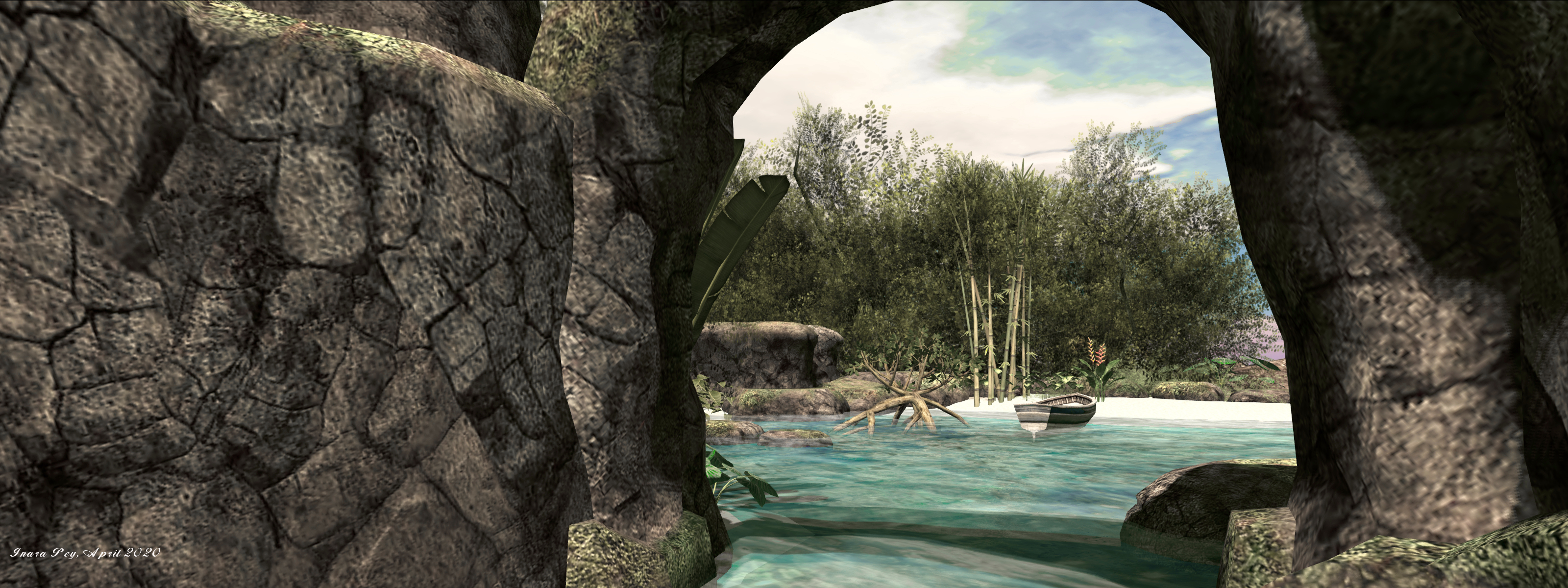
Dya’s Scent of the Caribbean, April 2020

This is one of the smaller, cosier Caribbean islands, surrounded by clear blue waters that gently shoal to a sandy apron that encloses the island on three side – and gives the impression it might completely surround it at low tide. The island raises its sapphire back from surrounding sea and sand, presenting a roughly diamond shape with an south-eat to north-west orientation. The landing point lies towards the former, located in a little commercial hamlet that sits on the top of the island, its single pedestrian street flanked on either side by a number of small businesses, including what might best be described as a boutique hotel, together with a bar and local small diner.

Looping around this tiny slice of urban life is is dusty track of a road that offers the primary means of exploring on foot as it curls and branches its way between uplands and beaches and rocks. Follow it south and behind the bulk of the taller commercial properties, and it’ll take you to a dead end and a tongue of sand that licks its way up over the grass with an invitation to walk across it. Doing so brings you to a stretch of golden sand that is watched over at one end by a whitewashed lighthouse, and at the other by beach house that offers shade from the Sun’s heat and glare and a cooling freshwater pool. Just offshore, the point at which the sandy shelf surrounding the island gives way to deeper waters is marked by a ring of anchored buoys (actually denoting the region’s edge).

Dya’s Scent of the Caribbean, April 2020

Take the road the other way from the landing point and it’ll offer a looping walk around the northern aspect of the island, rising and falling in response the land’s own undulations. A modest motel sits on the western side of this road, offering a view (partially obscured by trees) of the ocean, which here meets the unyielding rock of the isle, as the tide appears to be in.

Further along the road sits a little chapel facing steps that climb up to a little shanty village of corrugated tin huts straddling the island’s backbone,  the road again looping around it below. Just past the chapel and the step up to the shanty, the road offers a glimpse down into one of the island’s secrets: a landlocked cover of clear water that tumbles from a waterfall and sheltered by rocky walls and the verdant greenery of the island. Cut off from the open sea by a further beach, this cove is an attractive hideaway, perhaps now filled by freshwater given the sea apparently can no longer reach it.
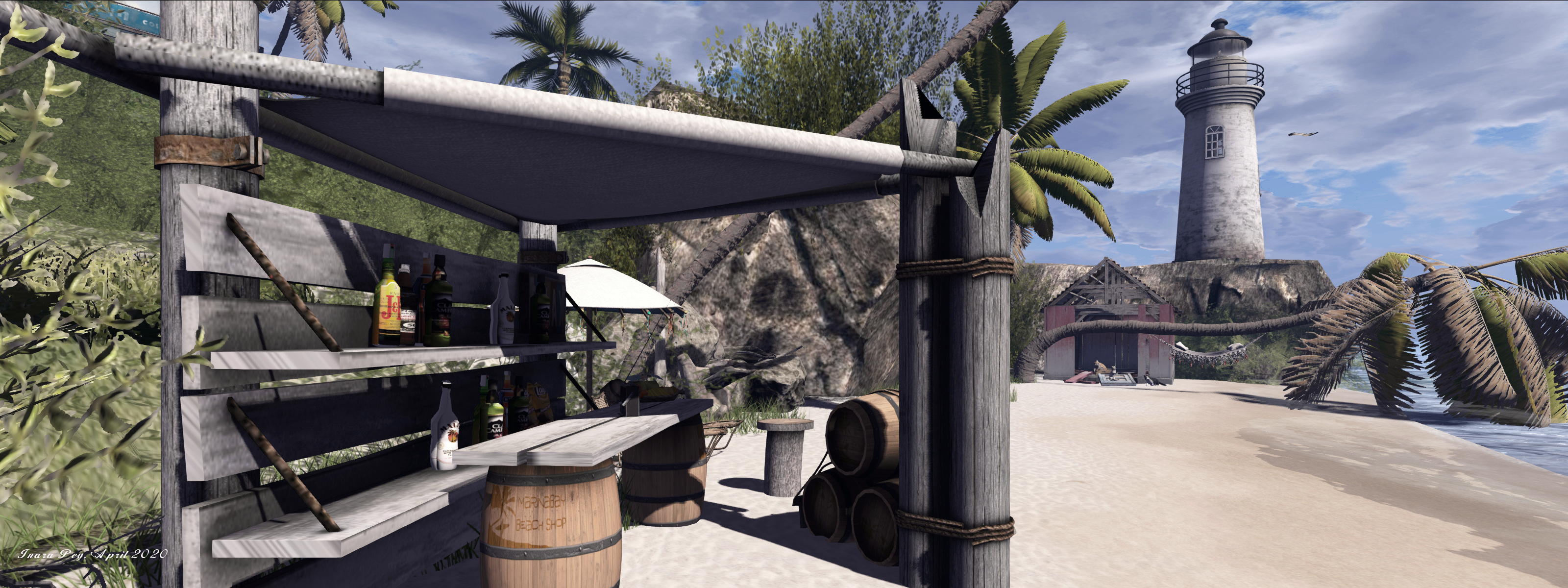
Dya’s Scent of the Caribbean, April 2020

After curling around the north-western headland, the road loops back towards the landing point once more, passing as it does so a set of stone steps that offer the way down to what would appear to be – at low tide at least – the island’s largest expanse of sand. With the tide in, most of this is covered covered by water – if only moderately so – meaning a walk out to the tiki bar that marks where the depths significantly increase is actually going to be something of a wade / swim. For those not feeling so energetic, there is shade to be found under an awning set out over the ruin of an old boat further along the beach.

Like her previous build, Dya offers something of a story with this setting. Little clues are scattered about that suggest this island perhaps sits not in the present, but in the last of 20-30 years ago: the style of car parked here, the only Honda mopeds scattered around, and so on. Certainly, it would appear to be a place that is showing signs of age: paintwork on buildings, rowing boats and elsewhere is all well sun-bleached, while board walks out on the water are in a sorry state of repair – even the plumage on one of the island’s parrots is looking a little careworn!
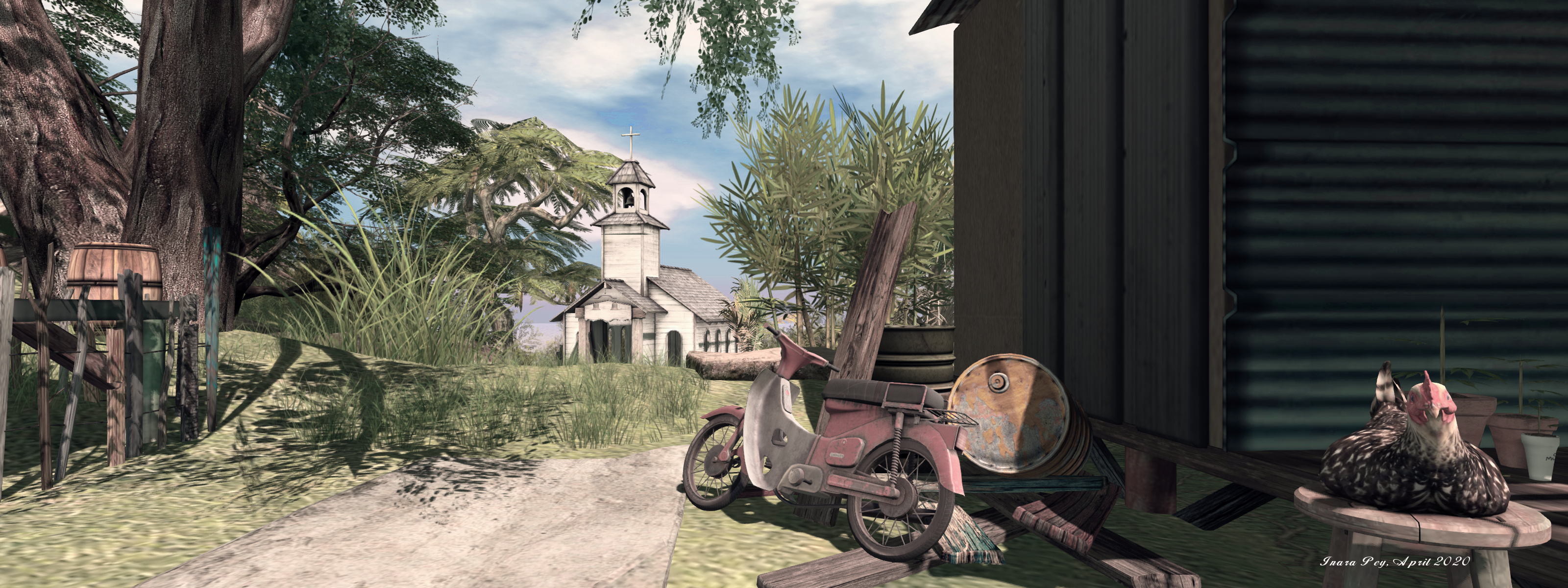
Dya’s Scent of the Caribbean, April 2020

All of this suggests this isn’t one of the Caribbean’s more popular tourist stop-off points, but at the same time, all of the little touches waiting to be found – like a glimpse of a Bob Marley photo through an open door here, the roadside fish stall there, the fading beat of reggae music to be heard drifting through the air as one explores, clearly indicate the island is very much home to those who live on it.

Dya tells me this design will likely remain in place for at least six weeks, although she will continue to add to it / tweak it (a hurricane may apparently be on the way!), so there is plenty of time yet to visit. For now, and given the weather in my part of the physical world has gain turned cold and damp, I’m off back to Dya’s beach house with its shade, pool and – hopefully – a glass of chilled white wine as should be used to counter the Sun’s heat!
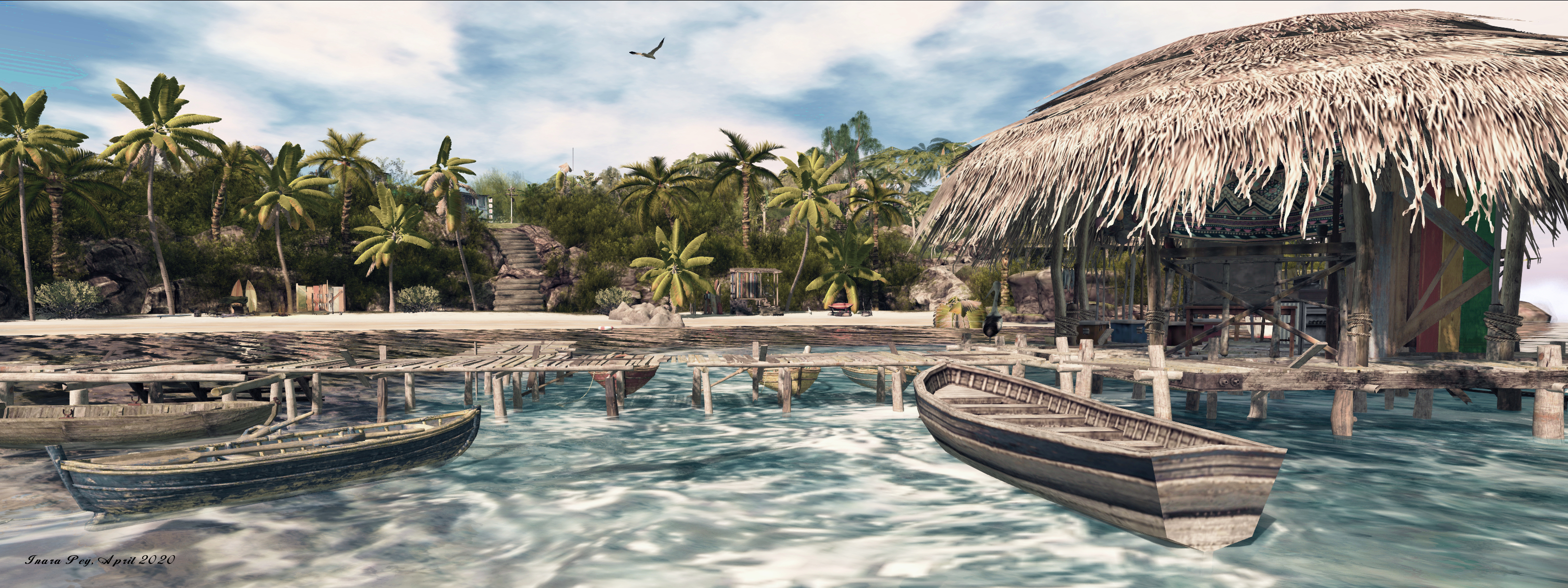
Dya’s Scent of the Caribbean, April 2020

SLurl Details

A desert ghost town in Second Life

Kolmannskuppe, April 2020 – click any image for full size

On April 10th, 2020, Serene Footman opened his latest limited-time region build to once again transport us to one of the most unusual places to be found on Earth.

I tend to wax lyrical over Serene’s designs, and for three good reasons: the first is they are invariably elegant in design and statement, packed with details that may be both obvious and subtle, whilst also incorporating Serene’s own recognisable individuality of touch that has marked all of his designs. The second is that they demonstrate that while Second Life sets the imagination free and can become the home of the strange, the out-of-the ordinary and the unique – so too can the physical world around us, which is every bit as richly diverse as anything to be found in-world; the difference is, Second Life offers the means for to visit such places where otherwise they might forever be out of out reach save for photographs and videos seen in publications and on-line.

The third reason is that his builds are always educational, both in terms of what can be achieved in Second Life with care and forethought in design and because as soon as I visit one of his designs, I’m reaching for the encyclopaedia and calling up my search engine to find out as much as I can about the locations he picks, so I might broaden my own knowledge.

Kolmannskuppe, April 2020

And so it is with Kolmannskuppe – The Ghost Town of Namib Desert, his build for April 2020, which brings to SL the long-deserted mining town of Kolmannskuppe or (to give its name in Afrikaans) Kolmanskop located on the inter-coastal erg of the southernmost reaches of the massive Namib desert in modern-day Namibia, but was at the time of the town’s founding, German South West Africa.

Named for a nearby kopje, or hillock, which had in turned been dubbed Kolmannskuppe “Kolman’s Head” after the wagon driver who had been forced to abandon his wagon there after a particularly violent sand storm in 1905, the town came to prominence as one of the first areas along the Namib coast to experience a diamond rush.

Three years later, a railway was being built between the territory’s major harbour town of Lüderitz on the coast and the inland town of Aus. The man in charge of the work was German-born August Stauch, who has moved to the territory in the hope of alleviating his asthma. An amateur mineralogist in his spare time, Stauch became fascinated the tales surrounding the territory’s founder, Franz Adolf Eduard Lüderitz (after whom the the harbour town was named) and his belief the region contained diamonds just waiting to be found.

Kolmannskuppe, April 2020

So firm was his belief Lüderitz had been correct, Stauch obtained a prospecting licence and told his railway workers to bring him any unusually shiny stones they might turn over whilst digging to lay the train line’s foundations, and in April 1908, one of his aides, Zacharias Lewala – who had previously worked at the Kimberley diamond mines in South Africa – did just that. Systematically searching the area Lewala had been scouting, Stauch found more of the stones and took them to Lüderitz, where his friend and mining engineer Sönke Nissen confirmed they were diamonds.

Using Stauch’s prospecting licence, the two men secured a 75-acre claim at Kolmannskuppe. At first they tried to keep the mine and their growing wealth secret, but news inevitably spread, sparking a diamond rush into the area, and Kolmannskuppe  grew to become an extremely wealthy settlement, boasting all the amenities of a modern town: a rail link to Lüderitz (itself massively enriched by the flow of diamonds from Kolmannskuppe  and further deposits found to the north), its own tram service, a host of civic facilities and utility services form a hospital (with the southern hemisphere’s first x-ray machine) through a theatre, ballroom and casino to its own power station and ice-making factory.

Kolmannskuppe, April 2020

The town reached its peak in the years immediately before and after the first world war. However, the discovery of a huge deposits of diamonds 270 km to the south around the mouth of the Orange River that did not require complex mining, resulted in many from Kolmannskuppe simply up and moving south, leaving their homes and possessions to the sands of the desert. These moves marked the start of 3-decade decline for Kolmannskuppe, the last inhabitants leaving the town to the shifting desert sands in 1956.

More recently, Kolmannskuppe has become a tourist attraction – if one that is corporately managed, De Beers and the Namibian government jointly funding it. This remaining buildings sit alongside a dusty road, dunes of tufted sand wrapping themselves around wooden, sun-bleached walls that are so leached of moisture they don’t so much fall down as crumble away. It’s a place that is beloved of photographers, artists and film-makers for its sense of desolation and nature’s reclamation of man’s fragile foot-hold in this harsh desert environment. As Serene notes in his own informative blog post on the setting, it is in some ways a contrived and artificial location, centred upon the hulking form of the former casino (and now the nexus for tourists) – but it is undeniably photogenic and captivating.

Kolmannskuppe as it is today. Via Wikipedia

It is in this form that Serene captures the town, and does so quite magnificently, from the high shoulders and roof of the former casino through to the crumbling skeletons of houses and the bare bones of former utilities. While some of the house styles may be more esoteric than those of the actual town, he has perfectly captured and embodies the spirit of Kolmannskuppe, right down to the touches of corporate artificiality, such as the misplaced baths.

As the same time, he has added his own touches, notably in the form of multiple places where visitors can sit and immerse themselves in the setting, watching the coming and going of others, the entire region surrounded by high dunes that mirror the Namib’s reputation for sand dunes that can reach heights of up to 300m. Rounded-out by the presence of oryx gazella, Kolmannskuppe – The Ghost Town of Namib Desert is yet another remarkable location presented by one of Second Life’s foremost region designers.

Kolmannskuppe, April 2020

SLurl and Links

Sea Brook’s haven in Second Life

Sea Brook, April 2020 – click any image for full size

A full region using the full region land capacity bonus, Sea Brook is a remarkable setting that offers a stunning location that forms a rich, eye-catching, highly-photogenic haven of a destination that offers a tour de force of what can be achieved with vision and considered execution in region design in Second Life.

The work of Muira (Angelique Vanness) on behalf of Rahnn Parker (Rahnn) and Carrie Parker (Cari2017), the region is a tour de force demonstration of Muira’s remarkable eye for region design, something I first noted in 2019 after visiting Season’s Cove (now closed, but see The magic of Season’s Cove in Second Life). As with that design, this is one that again feels far bigger than its 256m on a side size. In this instance, the sense of size and space is made all that more remarkable by the fact that much of the centre of the region is given open to open water.

Sea Brook, April 2020

The water takes the form of an extensive lake fed by falls that drop from a massive up-thrust of rock that rises to the north-east of the region in great granite or basalt blocks, topped by high fir trees. A broad, paved footpath winds its way around the lake’s shoreline in a loop, connecting three small terraces that thrust their own out into the clear blue waters. One of these terraces  forms the regions landing point, whilst all three present impressive views over the lake. At one end, this footpath connects to an imposing lodge that whilst grand in size, utterly fits with its surroundings. To the other end the path gives way to a rocky path – one of two in fact – that switch-backs up to the top of the high plateau.

Between the lake and the waters beyond the edge of the region, the land is entirely-low-lying with the exception to the huge plateau. Theses lowlands are rich is detail and  – if I might use the term again – present an expansive setting. Rich in tall Scots pines, they are marked by gravel tracks that run around the outside of the paved path around the lake, the woodlands between pavement and gravel cut through with winding trails that allow visitors to wander and discover all that lies under the shade of the trees: ponds, little camp sites, a children’s playground, picnic spots – the list is extensive without – the setting ever feeling crowded.

Sea Brook, April 2020

The paths also provide links to other locations within the region. These include a west side beach, tucked between two headlands. One of these is home to the ruins of an ancient church that now offers a cosy retreat. A second, intact chapel forms a book-end to the ruins, sitting on a low hills on the other headland, resting atop a low hill that allows it to look north across the beach towards the ruins of its companion.

East and south, behind the great lodge – which appears to be open to the public and itself offers an impressive place to explore – the land opens a little as at sits between rocky highlands and a growth of mangroves that surround one of the smaller islands sitting just off the coast. This little island is home to an old gazebo that offers a place to dance. Across the narrow channel separating the gazebo from the lodge, sits a little fenced meadow, a place where visitors can rez a horse to ride around the region – something that is well worth doing.

Sea Brook, April 2020

Atop the plateau there is yet more to discover, the switched paths leading up to it connected one to the other by gravel trails that wind across the plateau, separating the woodlands to offer obvious paths for people (and horses) to follow and which take visitors past table-top games, and along an arched path to another dance area that offers an elven theme.

As with the lands below, the plateau is also cris-crossed by wooded paths that reveal more secrets among the trees, and which I’m not going to spoil by mentioning here. However, I will say that look carefully enough and you will find a zipline that runs down to the little finger-like island rising from the middle of the lake and where bumper boats can be rezzed by those looking for a little fun.

Sea Brook, April 2020

Nor is this all; below the plateau, and nestled in the roots of the cliffs, are wooden doors awaiting discovery. They lead to a network of tunnels and chambers that run through the rocks from on side to the other. With paved floors and faced stone walls, these tunnels and the halls and rooms that open off of them make for an intriguing point of exploration on their own; one looks like a former wine cellar, others present more intimate spaces.

A truly stunning design, Sea Brook is absolute perfectly set within the encircling region surround of high mountain peaks that – with the right windlight – give it tremendous depth, this is not a setting to be missed. It has a huge amount to discover (I’ve only scratched the surface here), and is finished with a matching sound scape.

Sea Brook, April 2020

SLurl Details