Space Sunday: space rescue and big boosters

The three “stranded” Shenzhou-20 tiakonauts aboard the Shenzhou-21 vehicle, about to depart the Tiangong space station. Credit: CMSA

“Stranded” runs the risk of becoming one of the most over-wrought terms used by the by western media in regards to on-orbit human space operations. In recent times it has been used on two occasions, both involving US astronauts, when calling on it was for more about creating sensational headlines than reporting the overall situation.

The first came in 2022/23 when Soyuz MS-22, docked at the ISS, was struck by a small meteor in December 22, severely damaging its lift support cooling systems. Following reviews of the impact, it was agreed that the crew of three – Sergey Prokopyev, Dmitry Petelin, and NASA astronaut Francisco Rubio – would remain on the ISS until the next Soyuz vehicle could be launched uncrewed in February 2023 and then serve as the means to return the three to Earth.

However, this decision did not leave the three men “stranded” in orbit. After extensive testing and computer modelling, Roscosmos determined that should an emergency evacuation of the station be required, Soyuz MS-22 could make a return to Earth carrying Prokopyev and Petelin and without broiling them to death. Arrangements were therefore made for Rubio to b3e able to return to Earth alongside the NASA / SpaceX Crew 5 astronauts should the need arise. Ultimately, these contingencies were not required; the uncrewed Soyuz MS-23 arrived at the ISS ahead of the MS-22 vehicle departing, resolving the issue. MS-22 subsequently made an automated return to Earth during which temperatures within the descent module did not exceed the upper safety limits for flying a 2-man crew home.

Video of the Soyuz MS-22 coolant leak, December 14th 2022. Credit: NASA

In 2024 much of the news media positively relished the idea that two US astronauts – Barry Wilmore and Sunita Williams – were “stranded” in space when the Boeing CST-100 Starliner they were testing had issues with its thruster systems. Whilst Boeing were confident the issues did not put the astronauts at risk (and indeed, the vehicle made a successful automated return to Earth in September 2024), the decision was made to keep Wilmore and Williams on the station until the next crewed mission to the station – NASA / SpaceX Crew 9 – could be launched, but only with two crew aboard so as to leave the remaining seats free for Williams and Wilmore.

The Crew 9 vehicle eventually launched in September 2024, after the Starliner vehicle had departed the ISS to make room for it. To ensure Wilmore and Williams were not “stranded” in an event of an emergency during the period between the departure of Starliner and the arrival of Crew 9, contingencies were put in place to enable them to return to Earth with the crew of NASA / SpaceX Crew 8. But again, none of this was required. Wilmore and Williams continued to work alongside their colleagues on the ISS, fulfilling the roles vacated by the two Crew 9 astronauts left on the ground, and came home on that vehicle in March 2025, never once having been truly “stranded”.

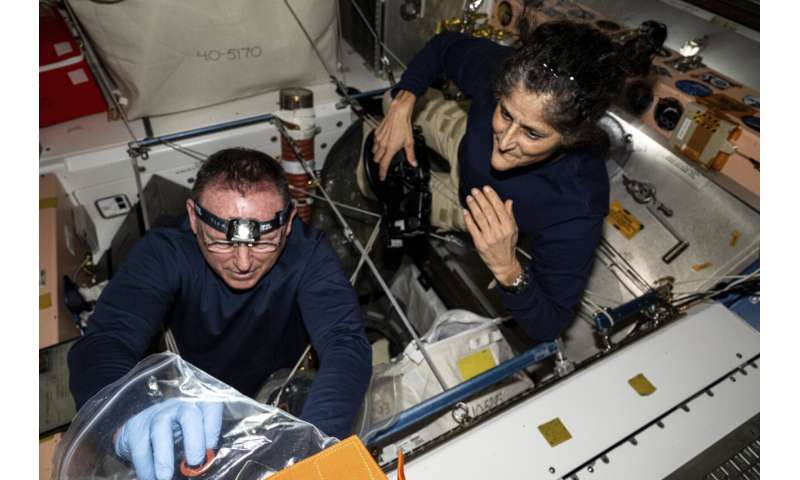
The “stranded” Barry “Butch” Wilmore and Sunita “Suni” Williams working aboard the ISS during their longer-than-originally-planned stay in 2024/25. Credit: NASA

In the past couple of weeks “stranded” has again been rolled-out by the media, this time in reference to the Chinese Tiangong space station – and this time it does have an underlying cause for concern.

On October 31st, 2025, Shenzhou 21 arrived at the Chinese space station with three crew aboard – mission commander Zhang Lu, Wu Fei and Zhang Hongzhang. They were due to carry out several days of formal hand-over with their comrades Chen Dong, Chen Zhongrui and Wang Jie, who has been aboard the station since April 2025, prior to the latter three boarding their Shenzhou 20 spacecraft and making a return to Earth.

However, at the start of November, 2025, tiny fragments of debris struck Shenzhou 20, and the homecoming crew’s departure would be delayed until the damage to their vehicle had been fully accessed. This assessment revealed the integrity of a viewport on the vehicle’s orbital module had been compromised, and as a result Shenzhou 20 was deemed unsuitable for returning the crew to Earth. Instead, they came home on Shenzhou 21 on November 21st, thus leaving the crew of that mission, Zhang, Wu and Zhang without a means to evacuate the station in an emergency.

And this is where their situation differs to those of the Boeing Starliner crew and Soyuz MS-22: there are no contingencies available except for CMSA to launch an automated Shenzhou vehicle to Tiangong at the earliest opportunity. Fortunately, CMSA work their manned launch vehicles in pairs so that while launches are 6-months apart, at the time of any given launch the vehicle intended to follow it is in a state where it can be readied for launch in a relatively short time should it be required. In this case, CMSA appear to be targeting November 25th, 2025 as a launch date for Shenzhou 22 – although this has not been officially confirmed.

The Shenzhou 21 crew of Zhang Lu (centre), Zhang Hongzhang (left) and  Wu Fe, now awaiting the automated launch and arrival of Shenzhou 22 to become their ride home at the end of the 6-month stay aboard Tiangong. Credit: CMSA 

This still leaves the Shenzhou 21 crew in an uncomfortable position, and highlights a growing concern about human space operations in low Earth orbit: it’s getting increasingly crowded with junk and debris, and collisions and impacts are growing increasingly likely.     As it is, both the ISS and Tiangong have to make at least 2 significant orbital adjustments a year to avoid debris (with the ISS having to do so five times in 2023), whilst a 2024 European Space Agency study highlighted the fact that there are more than 6,000 items of man-made debris on low Earth orbit of 10 cm or greater in size spanning altitudes of between 375-600 km, marking many of them as potential threats to both the ISS and Tiangong, which orbit between (370-460 km).

Nor does it end there. A study carried out in 2023 revealed that low Earth orbit is seeing debris of 6cm and larger increase at a rate of 2,400 object per year.

A 2023 axonometric view of Earth showing the space debris situation in different kinds of orbits around Earth. Note how the low Earth orbit is seeing an annual net increase in debris estimated at 2,400 items a year (includes objects down to around 6 cm in size). Credit: Pablo Carlos Budassi

As such, the Shenzhou 21 crew situation has given rise to renewed calls for some form of “space rescue” system to be implemented. The problem is – how? There is a degree of commonality in space vehicle design – docking mechanisms for connecting modules to one another and for connecting spacecraft to said modules or, potentially, to one another, are now built to a common standard: the International Docking System Standard (IDSS). However, it’s not entirely clear how closely nations like China adhere to the IDSS. Further, while IDSS may allow rendezvous and docking between craft, it doesn’t specify standards for things like consumable transfers between craft, such as might be required in an emergency (e.g. air, water, propellants).

In addition, the majority of crewed vehicles currently operating aren’t really designed to go pottering around from point-to-point offering assistance. A Soyuz or Crew Dragon from the ISS can’t simply pootle over to Tiangong and offer assistance were its required. The two stations are in very different orbits relative to one another, and the nature of orbital mechanics mean that trying to get from one to the other would likely exhaust a vehicle’s propellant reserves.

This means that in order to be effective, any rescue system need to be both specialised and available on a launch-as-needed basis. But again, this is easier said than done. Who should develop and operate such a system? Who should pay for it? Where should it be based; on the ground, with an entire supporting launch infrastructure with all the complexities that entails, or in orbit – with all the very different complexities that entails? Should the system be crewed, and if so, by whom and on what basis (civilian? military?) or fully automated?

Currently, there are no easy answers – but with commercial activities in Earth orbit about to increase tenfold as companies look towards flying their own orbital research and tourist facilities and their own crew vehicles to link them with Earth, then it is becoming increasingly imperative serious thought is given to try to find answers – and act on them.

Never Tell Me the Odds Comes Home, Blue Origin Reveal Plans

The first stage booster used in Blue Origin’s highly-successful NG-2 mission (see Space Sunday: New Glenn “welds” it on second flight!) has returned to Blue Origin’s facilities at Cape Canaveral Space Force base on November 20th. It will now undergo a examination and refurbishment in readiness for its next flight, which could be as soon as January or February 2026.

The 57.5 metre tall New Glenn first stage Never Tell Me the Odds sits proudly on the deck of the Landing Vessel Jacklyn after the highly successful NG-2 mission of November 13th, 2025. Credit: Blue Origin

The Booster, called Never Tell Me the Odds in a reference to the difficulties involved in bringing a 57.5 metre tall, 7 metre diameter booster back to Earth from the edge of space and landing it smoothly on a vessel 600 km out in the Atlantic – appeared to be in remarkably good condition following its flight as it was delivered to the company’s launch preparation facilities close to Launch Complex 36, from where it had launched on November 13th.

The reason for looking so pristine (particularly in reference to the sooty state of recovered Falcon 9 boosters) is really down to the “clean burn” of the BE-4’s liquid oxygen / liquid methane propellants; it should not be taken as any indication the stage is fit to fly at this point in time. That determination will only come following a complete and careful examination. However, simply seeing it back at CSSF and LC-36 is undeniably a positive further step for Blue Origin.

At around the same time as Never Tell Me the Odds returned to base, Blue Origin revealed its future plans for New Glenn.

New Tell Me the Odds being wheeled into the Blue Origin hanger at Launch Complex 36, Canaveral Space Force Station on November 20th. In the hanger it will undergo extensive inspection and refurbishment in readiness for its next flight. Credit: Blue Origin

In the near-term, the company plan to start operating the vehicle with uprated engines, with the seven BE-4 first stage motors able to generate 4.5 million pound of thrust at lift-off (up from 3.9 million) and the two BE-3U motors of the upper stage increasing their combined thrust from 320,000 pounds to 400,000. Engines of both types capable of handling this increased output have already been tested on the ground, so it might not be too long before they start to be used on New Glenn launches.

In the medium-term, the company also hopes to make the payload fairings recoverable / reusable. Doing so could help support increased flight rates and lower launch costs. However, as SpaceX discovered (albeit by having to go for a complex recovery system of parafoils and high-speed chase boats which looked spectacular but proved impractical), making payload fairings recoverable and actually recovering them in a cost-effective manner might not be that easy.

Most intriguingly and long-term, Blue Origin announced an entirely new variant of New Glenn – the “9×4” – a reference to the fact that it will use 9 BE-4 engines in the first stage (rather than seven) and four in the upper stage (rather than two), whilst maintaining the same overall design and diameter across the two stages (although both will be longer to account for the increased propellant requirements).

This new behemoth is intended to deliver up to 70 tonnes to low Earth orbit, 14 tonnes to geosynchronous orbit and 20 tonnes to the Moon, all with the first stage reusable. In addition the diameter of the payload fairings atop the second stage will be increased from 7 metres to 8.4 metres to handle particularly large payloads (such as space station modules).

A composite image released by Blue Origin CEO David Limp showing the comparative sizes of the current New Glenn (left, mounted against its launch support arm), Saturn V (centre) and the proposed New Glenn 9×4. Credit: Blue Origin

It is because of the latter capability – 20 tonnes to the Moon compared to New Glenn’s 7 tonnes – that some are already suggesting the “9×4” should be given a name of its own: the “New Armstrong”, after Neil Armstrong, the first man to set foot on the Moon. Blue Origin has not responded to these calls as yet.

Exactly how commercially viable such a vehicle would be within the commercial sector is hard to say. The SpaceX Falcon Heavy has already demonstrated that launchers with lifting capabilities of 50 tonnes or more really don’t play much of a role in the commercial launch business, instead primarily relying on government contracts. One potential area of use for the New Glenn “9×4” could be in lifting elements of the in-development Orbital Reef commercial space station, a project being led by Blue Origin and Sierra Space – but such work is liable to be niche, rather than a mainstay of revenue generation.

The GEO capability perhaps has more appeal – a 20-tonne capacity could in theory allow the “9×4” to rideshare communications satellites to orbit, reducing the launch costs to customers, with the company’s Blue Ring orbital “tug” positioning them. However, it is in the government sector and lunar operations theatre that the new behemoth would potentially have a role. A 14-20 payload capacity would be very attractive for military launches and to efforts such as Artemis and in launching deep-space science missions into the solar system.

The increased payload capability for New Glenn 9×4, together with the size increase for payloads its new fairings would enable, could significantly benefit the development of Orbital Reef, the space station facility being developed by Blue Origin in partnership with Sierra Space and the support of Boeing and others. Credit: Blue Origin / Sierra Space

Again, Blue Origin has offered no time frame on when the “9×4” will enter service; however, the degree of commonality it has with New Glenn likely means its development cycle could be relatively brief. In reporting on it, some pundits have suggested the “9×4” could have a maiden launch in 2027, although this does seem a tad ambitious, particularly given Blue Origin’s “soft and gentle” approach. As such, 2030 would seem a more reasonable time frame for “9×4” to start flights.

Some have already suggested that “9×4” could be a viable replacement for NASA’s Space Launch System (SLS) rocket in carrying crews to the Moon. However, and as I’ve noted in these pages, replacing SLS is easier said than done. Whilst New Glenn has been designed from the ground-up to be capable of making crewed launches (something SpaceX’s Starship most definitely is not in its current configuration), there is currently no crewed vehicle it is actually capable of launching. Orion, for example, the only crewed vehicle the US has that is specifically designed to handle carrying crews from Earth to Cislunar space, is currently completely incompatible with New Glenn.

An artist’s rendering of New Glenn 9×4 launching. Credit: Blue Origin

But that said, it is not entirely inconceivable that, given a suitable amount of time (and remember, SLS systems for Artemis 2 through 5 are already well in hand in terms of construction), and with Artemis 5 realistically unlikely to launch before 2031, there is potential for Lockheed Martin and Blue Origin to put their heads together to see if they could develop a means by which Orion could be launched by New Glenn “9×4” to launch Orion. This would still likely require some form on on-orbit propellant resupply – but that would likely only be a single additional launch, so it’s not entirely out of the question (given SpaceX plan to launch around 8-12 Starships for every vehicle it sends to the Moon).

That said, New Glenn being used in crewed lunar missions is not something I’d personally put my money on right now; it just seems so much better suited to rapid cargo delivery to the Moon, again particularly when compared to Starship – even if the latter could in theory carry 5 times more per vehicle to the Moon.

Space Sunday: New Glenn “welds” it on second flight!

Lift-off! With a massive plume of steam and water from the deluge system forced away from the launch pad by the 7 BE-4 engines, Blue Origin’s New Glenn mission 2  featuring the reusable first stage Never Tell Me the Odds, rises from Launch Complex 36 at Cape Canaveral Space Force Station, Florida, November 13th, 2025. Credit: Blue Origin

Thursday, November 13th, 2025 witnessed the second launch of New Glenn, the heavy lift launch vehicle from Blue Origin, marking the system as 2 for 2 in terms of successful launches, with this one having the added bonus of achieving an at-sea recovery for the rocket’s first stage, in the process demonstrating some of New Glenn’s unique capabilities.

In all, the mission had four goals:

  • Launch NASA’s much-delayed ESCAPADE (ESCApe and Plasma Acceleration and Dynamics Explorers) mission on its seemingly indirect (but with good reason) way to Mars.
  • Carry out a demonstration test of a new commercial communications system developed by private company Viasat.
  • Act as a Second National Security Space Launch demonstration, clearing New Glenn to fly military payloads to orbit.
  • Successfully recover the first stage of the rocket – which is designed to be re-used over 25 flights – with an at-sea landing aboard a self-propelled ocean-going landing platform.

Of these four goals, the recovery of the first stage booster was regarded more of an added bonus, were it to occur, rather than an overall criteria of mission success. This was reflected in the name given to that first stage: Never Tell Me the Odds (which sci-fi fans may recognise as a quote from the Star Wars franchise – bonus points if you can name the film, scene and speaker! 😀 ).

The first attempt to launch the rocket – officially designated GS1-SN002 with informal reference of NG-2 – was actually made on Sunday, November 9th, 2025. However, this was scrubbed shortly before launch due to poor weather along the planned ascent path for the vehicle. A second attempt was to have been made on November 12th, but this was called off at NASA’s request because – and slightly ironically, given the aim of the ESCAPADE mission – space weather (a recent solar outburst) posing a potential risk to the electronics on the two ESCAPADE satellites during what would have been their critical power-up period had the launch gone ahead.

Thus, lift-off finally occurred at 20:45 UTC on November 13th, with the 98-metre tall rocket rising into a clear sky from Launch Complex 36 at Cape Canaveral Space Force Station, Florida in what was to be a flawless flight throughout. As with New Glenn’s maiden flight, the vehicle appeared to rise somewhat ponderously into the sky, particularly when compared to the likes of Falcon 9 and Falcon Heavy.

The reason for this is simple: New Glenn is a very big vehicle, closer in size to NASA’s Saturn V than Falcon 9, and carrying over double the propellant load of the latter. So, whilst they are individually far more powerful than Falcon 9’s nine Merlin engines, the seven BE-4 engines powering New Glenn off the pad have a lot more inertia to overcome, hence the “slow” rise. Falcon Heavy, meanwhile has the advantage in that while it can carry a heavier payload (with a caveat I’ll come back to), it also has an additional 18 Merlin engines to get it going.

New Glenn approaching one minute into its flight on November 13th, 2025. Credit: Blue Origin
Anyway, once clear of the tower, the launch proceeded rapidly for the initial 14 minutes of powered ascent, with the highlights being:

  • At 3 minutes 9 seconds after launch, having powered the rocket to an altitude of 77 kilometres, the first stage motors shut down and a few second later the upper stage separated, pushed clear of the first stage by a series of spring-loaded rods, allowing it to ignite its two BE-3U motors without damaging the first stage.
  • Immediately following this, two significant steps in the flight occurred completely autonomously.
    • In the first, the flight control systems on the rocket’s upper stage recognised that the first part of the vehicles ascent had been optimised for first stage recovery, rather than achieving orbit. They therefore commanded a “pitch up” manoeuvre, significantly increasing the upper stage’s angle of ascent, allowing it to reach its intended initial orbit.
    • In the second, the first stage used its reaction control systems (RCS) to enter a “coast” phase, essentially a controlled free-fall back towards Earth, re-orienting itself ready to perform a propulsive breaking manoeuvre.
  • After 50 seconds of continued ascent following separation, the upper stage of the rocket successfully jettisoned its payload fairings, exposing the two small ESCAPADE satellites, to space.
Circled in red: the payload fairing protecting the ESCAPADE and Viasat payload are jettisoned by New Glenn’s upper stage. Credit: Blue Origin / NASA
  • Dropping in free-fall for some four minutes, the rocket’s first stage re-lit three of its BE-4 motors at an altitude of around 66 km, slowing its re-entry into the denser atmosphere.
  • Following the re-entry burn, the motors shut down and the stage used the aerodynamic “strafes” close to its engine exhausts together with the upper guidance fins, to take over “flying” itself down towards the waiting landing vessel.
  • At 8 minutes 33 seconds after launch, the three centre Be-4 motors re-lit again at an altitude of just under 2 km, slowing the stage and bringing it to an upright position in preparation for landing.

It was at this point that New Glenn demonstrated the first of its unique characteristics: it brought itself to a near-hover abeam of the landing vessel prior to deploying its six landing legs. It then gently crabbed sideways until it was over the landing ship before gently lowering itself to a perfect touch-down right in the middle of the landing ring painted on the deck.

Captured from on the the range safety vessels near the Landing Platform Vessel Jacklyn, 600 km off the Florida coast, these three shot show Never Tell Me the Odds apparently overshooting the landing ship, then coming to a hover and translating back over the vessel’s deck to touch-down safely. Credit: Blue Origin

Immediately on touch-down, special pyrotechnic “disks” under the booster’s landing legs fired, effectively welding the stage to the deck of the ship to eliminate any risk of the booster toppling over during the return to port.

Called “energetic welding”, this capability has been developed by Blue Origin specifically for New Glenn landings at sea, but is seen as having potential uses elsewhere when “instant bonding” of this kind is required. Once the booster has been returned to port, the bonding disks can be separated from both ship and booster with no damage to the latter and a minor need to replace some of the deck plating on the former.

Two images captured from a video camera on the Landing Platform Vessel Jacklyn showing two of the “energetic welding” disks under the feet of the New Glenn booster firing to fix the rocket to the deck of the ship. Credit: Blue Origin

New Glenn’s ability to hover is also worth addressing. Some have claimed that this capability detracts from New Glenn as a launch vehicle as it reduces the amount of payload it might otherwise lift to orbit. Such claims are misplaced: not only is the amount of propellant used during a hover quite minimal overall, it clearly allows New Glenn to make much more of a controlled landing than can be achieved by the likes of SpaceX Falcon 9 stages, thus increasingly the booster’ survivability. Also, as experience is gained with further stage recoveries, there is no reason to suppose the ability to hover / translate / land cannot be further refined to use less propellant than may have been the case here.

And this point brings me back to comparative payload capabilities. It is oft pointed out that whilst big, New Glenn is a “less capable” launch vehicle than SpaceX Falcon Heavy on the grounds the latter is able to lift 63 tonnes to low Earth orbit (LEO) and 27.6 tonne to Geostationary Transfer Orbit (GTO), compared to New Glenn “only” being able to manage 45 and 13.6 tonnes respectively.

However, these comparisons miss out an important point: Falcon Heavy can only achieve its numbers when used as a fully expendable launch system, whereas New Glenn’s capabilities are based on the first stage always being recovered. If the same criteria is applied to Falcon Heavy and all three core stages are recovered, its capacity to LEO is reduced to 50 tonnes – just 5 more than New Glenn, whilst its ability to launch to the more lucrative (in terms of launch fees) GTO comes down to 8 tonnes; 5.6 tonnes less than New Glenn (if only the outer two boosters on a Falcon Heavy are recovered, then it can lift some 16 tonnes to GTO; 2.4 tonnes more than New Glenn). Given that reusability is supposedly the name of the game for both SpaceX and Blue Origin, the two launch systems are actually very closely matched.

But to return to the NG-2 flight. While the first stage of the rocket made its way down to a successful landing, the upper stage continued to run its two motors for a further ten minutes before they shut down as the vehicle approached the western coast of the African continent. Still gaining altitude and approaching initial orbital velocity, the upper stage of the rocket “coasted” for 12 minutes as it passed over Africa before the BE-3U motors ignited once again, and the vehicle swung itself onto a trajectory for the Sun-Earth lagrange L2 position, the two ESCAPADE satellites separating from it some 33 minutes after launch.

ESCAPADE: the Long Way to Mars

That New Glenn launched the ESCAPADE mission to the Sun-Earth L2 position rather than on its way to Mars has also been a source for some confusion in various circles. In particular, a common question has been why, if New Glenn is so powerful, could it not lob what is a comparatively small payload – the two ESCAPADE satellites having a combined mass of just over one tonne – directly to Mars.

The answer to this is relatively simple – because that’s what NASA wanted. However, it is also a little more nuanced when explaining why this was the case.

The twin ESCAPADE spacecraft, Blue and Gold (with the mission at that time referred to as EscaPADE) in a clean room at Rocket Lab, the company responsible for building them on behalf of NASA, prior to being shipped to Kennedy Space Centre. Credit: Rocket Lab

Interplanetary mission are generally limited in terms of when they can be optimally launched in order to be at their most efficient in terms of required propellant mass and capability. In the case of missions to Mars, for example, the most efficient launch opportunities for missions occur once every 24-26 months. However, waiting for such launch windows to roll around might not always be for the best; there are times when it might be preferable to launch a mission head of its best transfer time and simply “park” it somewhere to wait until the time is right to send it on its way.

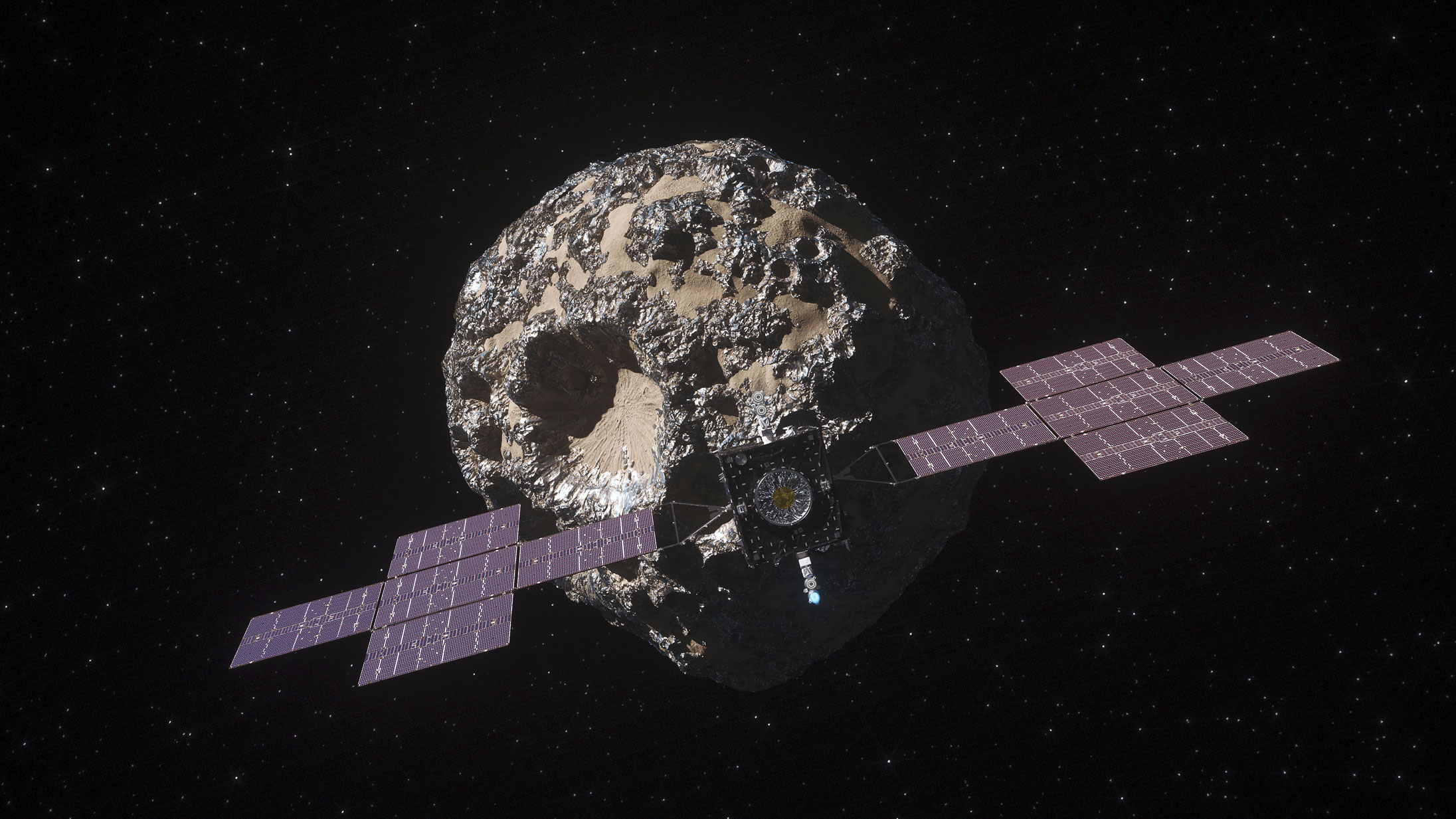
During its development, ESCAPADE – as a low-cost mission intended to be developed and flown for less than US $55 million – had originally been intended to piggyback a ride to Mars aboard NASA’s much bigger Psyche mission. This mission would be heading to asteroid 16 Psyche, but in order to reach that destination, it would have to perform a fly-by gravity assist around Mars. Thus, it became the ideal vehicle on which ESCAPADE could hitch a ride, separating from the Psyche spacecraft as the latter approached Mars in May 2026.

However, Psyche’s  launch was pushed back several times, such that by the time it eventually launched in October 2023, the additional delta-vee it required in order to still make its required fly-by of Mars was so great, there was no way the two ESCAPADE satellites could carry enough propellants to slow themselves into orbit around Mars after Psyche dropped them off. Thus, the mission was removed Psyche’s launch manifest.

Originally, ESCAPADE would have hitched a ride to Mars on NASA’s Psyche mission spacecraft, seen in this artist’s rendering approaching it intended target for study, the asteroid 16 Psyche. However, delays in launching the Psyche mission meant ESCAPADE had to be removed from the mission. Credit: NASA

Instead, NASA sought an alternative means to get the mission to Mars, eventually tapping Blue Origin, who said they could launch ESCAPADE on the maiden flight of their New Glenn vehicle at a cost of US $20 million to NASA, and do so during the 2024 Mars launch window opportunity.

Unfortunately, that maiden flight of New Glenn was in turn pushed back outside of the Mars 2024 launch window (eventually taking place in January 2025), leaving it unable to both launch ESCAPADE towards Mars and achieve its other mission objective of remaining in a medium-Earth orbit to demonstrate a prototype Blue Ring orbital vehicle. And so NASA opted to remove ESCAPADE from that launch and instead opt to test out the theory of using parking orbits for interplanetary missions, rather than leaving them on the ground where they might eventually face cancellation – as was the case with Janus, another mission which was originally to have flown with the Psyche mission, but was also pulled from that launch due to its repeated delays.

Using ESCAPADE to test the theory of parking orbits also made sense because of the mission’s function: studying the Martian magnetosphere and its interaction with the Solar wind. Whilst the Sun-Earth L2 position doesn’t have a magnetosphere, it is subject to the influence of the solar wind. Given just how valuable a piece of space real estate its is proving to be with several mission operating in orbits around it, understanding more about the role the solar wind and plasma plays in the overall stability of the region makes a lot of sense – and ESCAPADE’s science capabilities mean its two satellites can carry out this work whilst they loiter there through 2026.

Currently, both satellites are performing well, having unfolded their solar arrays and charged themselves up. As noted, they will make a fly-by of Earth in late 2026 to slingshot themselves on to Mars, which they will reach in 2027. On their arrival, they will initially share a highly elliptical orbit varying between 8,400 km and 170 km above the surface of the planet, operating in tandem for six months. After this, they will  manoeuvre into different orbits with different periods and extremes, allowing them to both operate independently to one another in their observations and to also carry out comparative studies of the same regions of the Martian magnetosphere from different points in space.

What’s Next for New Glenn?

As of the time of writing, Never Tell Me the Odds remains at sea aboard the landing platform vessel Jacklyn. Following its successful landing, the booster went through an extensive “safing” procedure managed by an automated vehicle, during which propellants and hazardous gasses were removed, and its systems purged with inert helium. Assuming it is in a condition allowing it to be refurbished and reused as planned following its return to dry land, the stage will most likely re-fly in early 2026 as part of an even more ambitious mission.

Never Tell Me the Odds re-lights three of its BE-4 motors, creating an atmosphere shockwave (to the right of the booster) as it drops back into the denser atmosphere ahead of landing. If all goes according to current plans, this stage will be refurbished and used to power New Glenn’s next launch, currently targeting early 2026 with a lunar mission. Credit: Blue Origin via a NASA observation aircraft

GS1-SN002-2, provisionally aiming for a January 2026 launch, is intended to fly the Blue Moon Pathfinder mission to the Moon, where it will attempt a soft landing as part of a demonstration of capabilities required for NASA’s Project Artemis. Blue Moon is the name given to Blue Origin’s family of in-development lunar landing craft, with Blue Moon Mark 1 being a cargo vehicle capable of remote operations and delivering around 3 tonnes of materiel to the surface of the Moon per flight, and Blue Moon Mark 2 being a larger crewed vehicle capable of delivering up to 4 people at a time to the Moon for extended periods.

Both of these craft use common elements: avionics, propulsion systems (the BE-7 cryogenic engine), navigation and precision landing systems, data and communications systems, etc.  Blue Moon Pathfinder is intended to demonstrate all of these systems and capabilities, landing the vehicle on the Moon within 100 metres of a designated landing point. If successful on all counts, GS1-SN002-2 will not only demonstrate / confirm the reusability of the New Glenn first stage, it will provide a very clear and practical demonstration of Blue Origin’s emerging lunar mission capabilities, something which may well justify claims that the company is somewhat ahead of SpaceX in having a lunar landing capability that could meet the 2027/28 launch time frame for Artemis 3, the first crewed mission of the programme intended to land on the Moon.

Space Sunday: NG-1 and IFT-7

New Glenn NG-1 rises from SLC-36, Canaveral Space Force Station, Florida, on the morning of January 16th, marking the start of the vehicle’s maiden flight. Credit: Blue Origin

This past week marked several space launch events and announcements, including India’s first successful on-orbit rendezvous and docking between two of its satellites, However, for this edition of Space Sunday, I’m focusing on the two “biggies” of the week.

New Glenn NG-1: Primary Goal Met, even with Booster Lost

On Thursday, January 16th, 2025, Blue Origin’s New Glenn rocket finally lifted off on its maiden flight after multiple delays over a 4-year period.

Originally targeting 2020/21 for a first launch, New Glenn was delayed numerous times both as a result of changes to the vehicle’s overall design (some coming as late at 2018), technical issues in development, external forces such as the COVID-2 pandemic, and as one Blue Origin executive put it in 2018, “we study a little too much and do too little.”

Such was the delay that the company lost the chance to debut New Glenn with a high-profile launch – that of NASA’s EscaPADE mission to Mars. In late summer of 2024, the US space agency became concerned enough over Blue Origin’s ability to meet the required November 2024 launch window for the mission, the decision was made to push back EscaPADE to a spring 2025 launch date. Instead, the first New Glenn flight – NG-1 – took place with a prototype / demonstrator payload of another of the company’s vehicles, Blue Ring. This is a spacecraft platform designed to support spacecraft operation, under development by Blue Origin. The platform is to be capable of refuelling, transporting, and hosting satellites.

An artist’s impression of a Blue Ring vehicle in Earth orbit with its pair of 22-metre solar arrays deployed to provide electrical power and propulsion. Credit: Blue Origin

With a payload capacity of up to three tonnes and fully able to be refuelled itself, Blue Ring is capable of performing the role of a space tug, moving payload between orbits and itself capable operating in geostationary orbit, lunar orbit, cislunar space and within the Earth-Moon Lagrange points. This makes it a highly flexible vehicle, something added to by its mix of electric and chemical propulsion systems and its ability to be carried by a range of launch vehicles as well as New Glenn.

This first flight on Blue Ring did not see the vehicle detach from the rocket’s upper stage; instead, the launch was to test of whether New Glenn could accurately deliver it to an assigned orbit with a high level of accuracy and whether the vehicle’s own flight and data-gathering systems operated correctly. Both of these are key to both New Glenn and Blue Ring gaining certification to carry out US National Security Space Launch (NSSL) operations.

New Glenn on the launch stand at SLC-36, as seen from the just off the Florida coast. Note the large black object alongside the rocket is the Launch Table, a platform used to hold the rocket in both its horizontal orientation when being rolled-out from the integration building to the pad, and provide launch-tower like support when the vehicle is upright. Credit: Blue Origin

Lift-off for NG-1 came at 07:03 UTC on January 16th, the 98 metre tall two-stage vehicle rising from Space Launch Complex 36 at Canaveral Space Force Station. All seven BE-4 liquid oxygen / liquid methane engines on the first stage worked flawlessly, successfully pushing the vehicle up to a stage separation some 21 km above the Earth. The upper stage then lifted the Blue Ring pathfinder into an elliptical medium Earth orbit (MEO) with an apogee of 19,300 km and a perigee of 2,400 km at a 30-degree inclination (and not a “low Earth orbit” as some outlets reported) some 13 minutes after launch.

While the payload did not separate from the New Glenn upper stage, its on-board systems did power-up, allowing it to provide detailed telemetry as to its position and orbit – confirming it had deviated less than 1% from its optimal orbital track. Over a 6-hour period the pathfinder vehicle completed all assigned tasks, and the New Glenn was “safed” (all remaining propellants and any potentially hazardous elements such as batteries, vented / jettisoned).

All of this marked a highly successful maiden flight for New Glenn – which already has a fairly full launch manifest. However, there was one hiccup: Like SpaceX’s Falcon family, New Glenn’s first stage is designed to be recovered and re-used; and while ambitious, Blue Origin hoped to achieve what it admitted was “secondary goal” on the flight, and one unlikely to happen, a successful recovery of the NG-1 first stage aboard the Landing Platform Vessel Jacklyn, station-keeping some 1,000 km off the Florida coast.

However, following second stage separation, the first stage of the booster entered into a re-entry burn using three of its main engines, and at T+ 7:55, telemetry froze at the planned end of that burn, indicating the stage had been lost at an attitude of approximately 26.5 km while travelling at some 6,900 km/h.

Exactly what happened is unclear – the stage loss is now subject to a Federal Aviation Administration (FAA) Mishap Investigation which, following standard FAA practice, will be led by Blue Origin as the launch vehicle operator, and subject to FAA oversight. It is not clear at present in this investigation will impact on upcoming New Glenn launches; that will depend on what is identified as the cause of the loss.

Starship IFT-7: Booster Caught, but Exposed the Risks

Almost on January 16th, 2025, SpaceX attempted the seventh integrated flight teat (IFT) of their Starship / Super Heavy (S/SH) launch system. The launch featured Booster 14 (a Block 1 – i.e. “original version”- vehicle) and a Ship 33, a Block 2 craft said to feature multiple updates and improvements to increase “reliability, capability and safety”.

Chief among the changes to the Block 2 series of Starship vehicles and their predecessors are:

  • An increase in hull length by 3.1 metres.
  • Redesigned forward aeroflaps, which are smaller and thinner than Block 1, thinner, and positioned both further forward and more leeward (further “up” the hull relative to the heat shield in an attempt to reduce their exposure to plasma flow heating during re-entry).
  • A 25% increase in overall propellant load.
  • Redesigned flight avionics, improvements to the interstage venting.

Additionally, Block 2 vehicles are specifically designed to fly with the upcoming Raptor 3 engine, which is an even lighter variant of the motor (1.525 tonnes), wither greater maximum thrust (280-300 tonne-force (tf) at sea level compared to Raptor 2’s 230 tf). However, Ship 33 flew with Raptor 2 motors. The Block 2 vehicle is also the first variant of Starship reportedly designed to lift 100 tonnes of payload to LEO.

IFT-7 was to be a further proving flight for S/SH, with a number of core milestones:

  • Vehicle launch with booster recovery.
  • Starship sub-orbital insertion & on-orbit re-light of engines.
  • Starship deployment of a dummy Starlink payload via a “pez dispenser” hatch.
  • Starship re-entry test and possible splashdown.

It’s important to note that whether or not Ship 33 survived re-entry was to be questionable. Ship 33 had a reduction in the area of its hull covered by thermal protection system tiles in an attempt to reduce vehicle mass and complexity, and intentionally had a number of tiles removed from various points to test the ability of the steel used in the vehicle to withstand heating (the areas devoid of tiles will eventually mount the “catch pins” required during launch tower recovery operations.). Therefore, the loss of this vehicle during re-entry was considered likely, even if everything else went smoothly.

Ship 33 and Booster 14 lift-off from Boca Chica, Texas at the start of IFT-7, January 16th, 2025

IFT-7 launched from the SpaceX facilities at Boca Chica, Texas, at 22:37 UTC, and the initial ascent proceeded smoothly. At 2:32 into the flight and at around 60 km altitude, the booster shut down all but its central three directional motors ready for “hot staging” – the ignition of Ship 33’s six motors and its separation from the booster. This took place at T+ 2:46, the booster immediately re-lighting all but one of its inner ring of 10 fixed motors at the start of the boost-back manoeuvre designed to stop its ascent and push it back towards the launch point.

Boost-back lasted some 42 seconds before the inner ring of motors on the booster shut down again, immediately followed by the jettisoning of the hot stage (the ring mounted between the booster and the starship and used to deflect the latter’s exhaust flames away from the former during the hot staging sequence. At this point the booster was in an aerodynamic fall / glide back towards Boca Chica, the fall becoming increasingly vertical as it closed on the launch point.

Just over 3 minutes after shutting-down from boost-back, all 10 motors on the booster’s inner ring re-lit at approximately 1.2 km altitude, slowing its decent, before shutting down a final time 8 seconds later, allowing the three directional motors to both continue to slow the boosters descent to a hover and guide it between the “chopstick” arms of the launch tower’s “Mechazilla” mechanism for a successful “catch”, marking a successful conclusion to the initial two milestones for the flight.

Meanwhile, Ship 33 continued its ascent towards a sub-orbital trajectory. Then, at 7:39 into the flight and at an altitude of 141 km, telemetry indicated one of Ship 33’s inner three inner sea-level Raptor motors prematurely shut down. Fourteen seconds later, livestream camera footage appeared to show flames from an internal fire passing over the exposed hinge mechanism of an aft flap. This is followed by telemetry indicating the loss of a second sea-level Raptor, together with one of the outer three vacuum-optimised Raptors, likely resulting in an off-centre thrust from the three remaining motors (only one of which – the central sea-level motor – could be gimballed to provide directional thrust to counter the thrust bias from the two fixed outer motors.

At 8:19 into the flight, and at altitude of 145 km, telemetry indicates the last of the remaining central motors and one of the two outer motors were no longer functioning. Seven seconds later, telemetry freezes, suggesting at this point the vehicle was breaking up. As has been seen from numerous videos released over social media, it appears the vehicle exploded (euphemistically called “a rapid unscheduled disassembly” by SpaceX, a term making light of the potential harm such an event can cause).

A close-up of a still from the IFT-1 livestream showing one of the hinge mechanisms on a aft flap of Ship 33 – flames are just visible passing through the aperture. Credit: SpaceX

SpaceX founder Elon Musk made light of the event, stating SpaceX had already likely identified the cause – a propellant leak resulting in a fire within the aft section of Ship 33 – and the next flight, planned for February will not be affected.

Whether this is the case or not remains to be seen; like it or not, the FAA have called for a mishap investigation; there’s also the fact the break-up of Ship 33 highlights the potential risk of flights out of Boca Chica. These carry ascending vehicles directly over over the Caribbean and close to many of the islands and archipelagos forming the Greater Antilles (including the Bahamas, Cuba, the Turks and Caicos, Hispaniola, Puerto Rico and the Virgin islands) – thus presenting a high risk of debris falling on populated areas.

As it is, debris from this flight has been reported as striking the Turks and Caicos Islands (fortunately without injury), and the spread of debris required the delay and diversion of numerous flights from and into the region (whilst passengers in some already in the area witness the aftermath of the vehicle’s destruction). These points alone warrant a review of the risks involved in launches out of Boca Chica.

Space Sunday: big rockets and (possible) ISS troubles

A shot from the “flap cam” on Starship, showing the Super Heavy immediately after separation during IFT6. Note the residual gases burning within the hot staging ring. Credit: SpaceX

The sixth integrated flight test (IFT-6) of the SpaceX Starship / Super Heavy behemoth took place on Tuesday, November 19th, 2024, and proved to be perhaps the most successful test yet of the system, even though the core aspect of the first part of the flight didn’t occur.

The vehicle lifted-off from the SpaceX Starbase facility at Boca Chica, Texas at 22:00 UTC. All 33 Raptor-2 engines on the Super Heavy booster ignited, and the massive vehicle lifted-off smoothly. All continued to run, and the initial phases of the flight passed without incident: the vehicle passed through Max-Q, reached Most Engines Cut-Off (MECO) at 2 minutes 35 seconds, leaving it with just three motors running.  Seven second later, hot staging occurred, Starship firing all 6 of its engines and then separating from the booster.

Starship IFT6 rising from the launch facilities, November 19th, 2024. Credit: Redline Helicopter Tours

This was followed by the booster flipping itself onto a divergent trajectory to Starship and re-igniting the ring of 10 inner fixed motors to commence its “boost back”: gradually killing it ascent velocity and bringing it to a point where it could commence a controlled fall back to Earth, and then a powered final descent into being caught b the Mechazilla system on the launch tower, as seen during the October flight.

However, during the boost-back, the call was made to abort the attempt at capture, and to instead direct the booster to splashdown in the Gulf of Mexico. The booster then went through a nominal descent, dropping engines first (and causing them to glow red-hot during the compression of air inside their nozzles, despite the fact none were firing).

Booster in the water: seconds after splashdown, a single motor still running, the Super Heavy booster sits in the Gulf of Mexico. Credit: SpaceX

At just over 1 km altitude, the 13 inner motors did right, all of them firing for some 7 seconds and reducing the rocket’s descent from 1,278 km/h to just 205 km/h. At this point nine of the ten motors on the inner fixed ring shut down, with one appearing to run a second or so longer. When it shut down, there was a belch of flame of the base of the booster, which might indicate an issue.

Nevertheless, the three central motors continued to operate, gimballing to bring the booster to a vertical position and a brief hover right above the water before cutting off and allowing the rocket to drop end-first into the sea. Remaining upright for a moment, the booster then started to topple over. However, as the live stream cut away at that point, it was down to other camera to capture the subsequent explosion due to water ingress around the super-hot engines, etc., which destroyed the rocket.

“There’s the kaboom!” Shots from onlookers demonstrating that 13 super-heated engines and their plumbing and residual gases in propellant tanks don’t play nice with cold sea water, as the Super Heavy booster explodes

The Starship vehicle, meanwhile, made it to orbit and continued on over the Atlantic and Africa to  the Indian Ocean, where it went through its de-orbit manoeuvres.

Whilst in the coast phase of the flight, the vehicle had been due to re-ignite one of its vacuum engines to demonstrate this could be done in space. This occurred at 37 minutes 46 seconds into the flight, the motor running for about 4 seconds. Although brief, the re-light was a milestone – Starship will need the capability while on orbit in the future.

A camera in Starship’s engine bay captures the steady firing of one of its vacuum Raptor-2 motors during the flight’s orbital coast phase. Credit: SpaceX

The Starship’s return to Earth was anticipated as being potentially “whackadoodle”, and subject to possible vehicle loss. This was because SpaceX had removed elements of the thermal protection system designed to protect the vehicle from burning-up during atmospheric re-entry.

The purpose in removing tiles from the vehicle was to expose parts of the hull where, if Starship is also to be “caught” by the Mechazilla system on its return to Earth, it will need exposed elements on the side bearing the brunt of the heat generated by re-entry into the atmosphere, and SpaceX wanted data on how the metal of the vehicle held-up to being exposed to plasma heat, particularly given the previous two flights had seen plasma burn-through of at least one of the exposes hinges on the vehicle’s aerodynamic flaps.

The leading edge of a flap show clear signs of impending burn-through during re-entry – but the damage is a lot less than previous flights. Credit: SpaceX

As it turned out, the vehicle managed very well during re-entry; there was a significant amount of very visible over-heating on the leading edge of a flap, but even this was less than seen in IFT4 and IFT 5. It’s not clear as to how much damage the exposed areas of the vehicle suffered were TPS tiles had been removed, but given the vehicle survived, any damage caused was clearly not sufficient to compromise its overall integrity.

The drop through the atmosphere was visually impressive, the flight so accurate that as the vehicle flips itself upright at less than 1 km above the ocean, the landing zone camera buoy anchored ready to record the splashdown can clearly be seen. Immediately after entering the water, the Starship toppled, bursting into flame – but this time not immediately exploding.

After fling half-way around the world, the Starship vehicle is about to splashdown just a handful of metres from the camera buoy (arrowed, top right)at the landing zone. Credit: SpaceX

Whilst a booster catch might not have been achieved, IFT6 can be classified a success. All criteria but the catch of the booster was achieved, and even though the later was lost as a result of a forced splashdown, the successful diversion of the booster to do so demonstrates an ability for SpaceX to divert a vehicle away from a landing tower in the event of an issues with the tower – providing said issues are spotted earl enough.

The flip side of this is that it exposes an inherent weakness in the system; the reason for the abort was that the actual launch of the vehicle had caused damage to the launch tower and its communications systems, calling into question its ability to make the catch. Tower / launch stand damage has been a recurring theme with Super Heavy launches, although the degree of damage caused has been dramatically reduced.

The moment before splashdown, as seen from the Starship flap cam (l) and the remote camera buoy (r). Credit: SpaceX

Even so, the fact that comms systems could be KO’d reveals how vulnerable the system is to a potential loss of vehicle (and the knock-on impact in terms of “rapid reusability”), particularly if there is no close-at-hand and available launch / catch tower available to take over the role. And while this abort was called when the vehicle was still 87 km altitude, with lots of time to bring it safely into a splashdown, can the same be said if an issue occurs when the vehicle is just 13 km above ground? Or ten? Or two? Or if the malfunction occurs in the final engine burn?

ISS Reports “Toxic Smell” and Atmosphere Scrubbed

Update: Several hours after this article was published, NASA issued a statement on the event described below.

Reports are surfacing of possible toxic contamination board a resupply vehicle at the International Space Station (ISS). Initial news on the situation was broken by the highly-reliable Russian Space Web, operated by respected space journalist and author, Anatoly Zak, but that the time of writing this piece, western outlets had not reported the story, which is still breaking.

On November 21st Russia launched the automated Progress MS-29 resupply vehicle to the International Space Station (ISS), carrying some 2.487 tonnes of supplies, including 1.155 tonnes of pressurised supplies, 869 Kg of propellants; 420 kg of water and 43 kg of nitrogen gas.

Cosmonauts Ivan Vagner and Alexei Ovchinin monitor the automated approach and docking of Progress MS-29 at the Poisk module of the Russian section of the ISS. The majority of Progress dockings are automated, but members of the crew are on hand to manually intervene if required. Credit: Roscosmos / NASA

After being placed in an initial parking orbit, the vehicle rendezvoused with the ISS on November 23rd, manoeuvring to dock with the zenith port of the Poisk module (mini research module – MSM 2), attached to the Zvezda main module of the Russian section of the station. Following docking, the vehicle was secured and the pressure between the module and Progress vehicle pressurised to allow the hatches between the two to be opened.

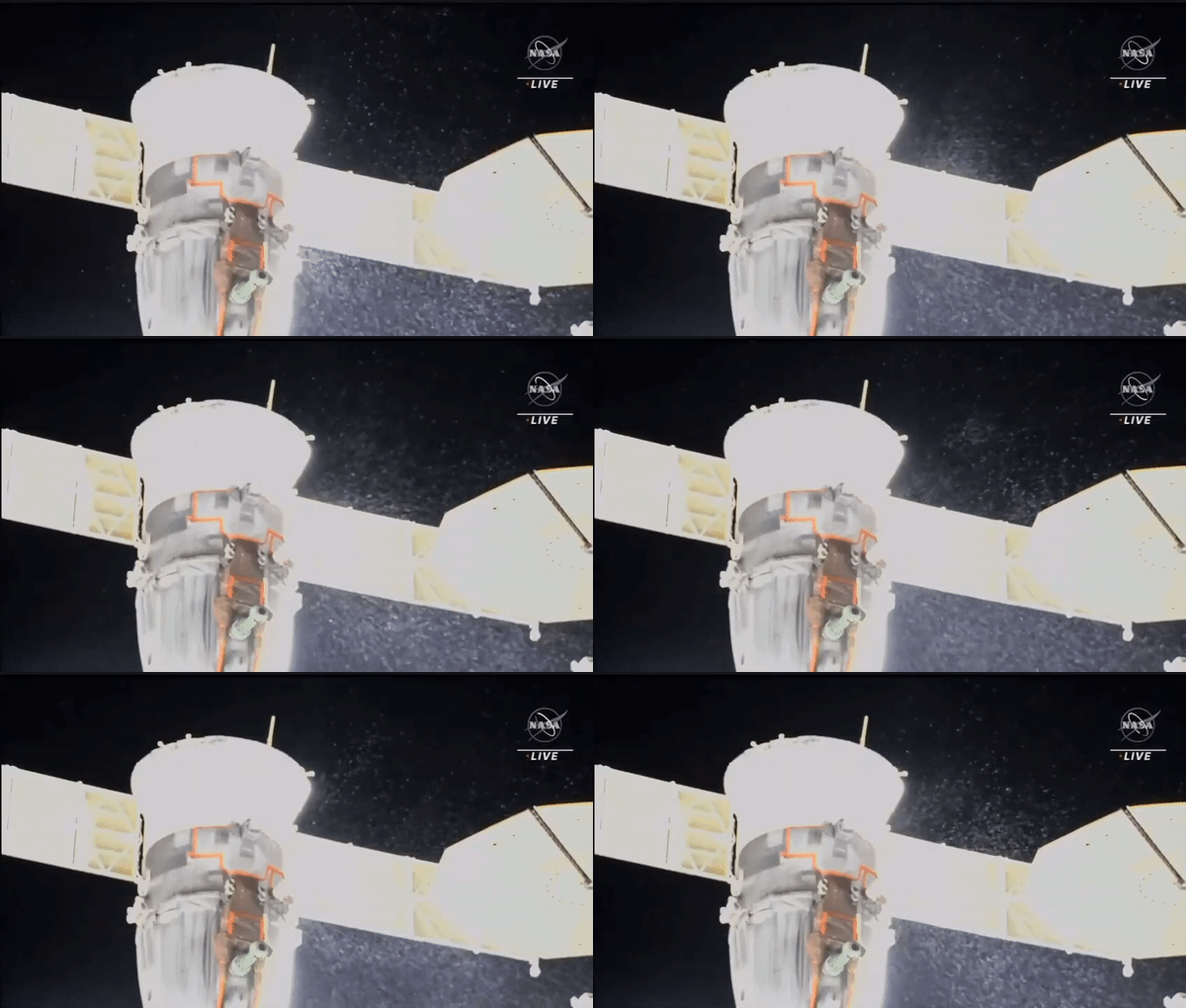
However, the hatch to the Progress has to be immediately closed due to a “toxic smell” and a potential contamination hazard in the form of free-floating droplets. Following the securing of the hatches, NASA’s flight controllers apparently ordered the activation of the Trace Contaminant Control Sub-assembly (TCCS) in the International section of the ISS, a system designed to remove traces of potential airborne contaminants, effectively scrubbing the atmosphere in the ISS, with the Russian crew activating a similar system within the Russian section for around 30 minutes, with the cosmonauts themselves donning protective equipment (as reported last week, the main hatch between the two sections of the station is now kept shut due to a continuous leak of air through the Russian Zvezda module).

Progress MS-29 approaching the ISS, November 23rd, 2024. Credit: Roscosmos

The cause of the smell and the overall status of the MS-29 vehicle have yet to be determined; this is a developing story.

New Glenn Gets Ready

Blue Origin is approaching a readiness to launch their new heavy lift launch vehicle (HLLV), the New Glen rocket.

Earlier in November I reported on the new rocket’s first stage being rolled from the Blue Origin manufacturing facilities at Kennedy Space Centre to the launch preparation facilities at Space Launch Complex 36 (SLC-36), Cape Canaveral Space Force Station. These facilities already held the rocket’s upper stage, which had undergone a series of static fire tests of its motors whilst on a test stand at the pad earlier in the year.

Integrating the first and upper stages of the first New Glenn rocket to fly. Credit: Blue Origin

Since the arrival of the 57.5 metre long first stage at the integration facility at SLC-36, Blue Origin engineers have been preparing the vehicle for launch. By November 14th, the first and second stages of the rocket has been integrated with each other, and worked moved to integrating the payload and its protective fairings to the rocket.

Originally, the inaugural flight for the massive rocket – capable of lifting up to 45 tonnes to low Earth orbit (LEO) – was to have been the NASA EscaPADE mission to Mars. However, due to complications, the flight will now be the first of two planned launches designed to certify the system for the United States Space Force’s National Security Space Launch (NSSL) programme. The payload for the flight will be a prototype of Blue Origin’s Blue Ring satellite platform, a vehicle capable of delivering satellites to orbit, moving them to different orbits and refuelling them.

The fully assemble rocket, two stages plus the payload and its protective fairings, backs towards launch pad SLC-36, Cape Canaveral Space Force Station, November 21st, 2024. Credit: Blue Origin

On November 21st, the completed rocket – over 80 metres in length – rolled out of the integration facility and delivered to SLC-36, where it was raised to a vertical position, mounted on the 476-tonne launch table designed to support it and keep it clamped to the pad.

The actual launch date for the mission has yet to be confirmed, but it will see the company both launch the rocket and attempt to recover the reusable first stage, called So You Think There’s a Chance? Following separation from  the upper stage of the rocket, the first stage will attempted to make and controlled / power decent to and landing on the Blue Origin’s Landing Platform Vessel 1 (LPV-1) Jacklyn.

The New Glenn rocket mounted on its 476-tonne launch table at SLC-26, November 21st, 2024. Credit: Blue Origin

Artemis 2 Vehicle Progress

Even as NASA’s Space Launch System (SLS) continues to face a potentially uncertain future due to its per-launch cost, the second fully flight-ready vehicle continues to come together at NASA’s Kenned Space Centre in readiness for the Artemis II mission.

The mission, which is targeting a launch in late 2025, is due to carry a crew of four – Reid Wiseman (Commander); Victor Glover Pilot; Christina Koch, flight engineer and Jeremy Hansen (Canada), mission specialist – on an extended flight of up to 21 days, commencing with the crew aboard their Orion Multi-Purpose Crew Vehicle (MPCV), being placed in low Earth orbit, prior to transiting to a high Earth orbit with a period of 24 hours.

The Artemis II mission profile – click for full size, if required. Credit: NASA

Once there, they will carry out a series of system checks on the Orion and its European Service Module (ESM), as well as performing rendezvous and proximity flight tests with the rocket’s Interim Cryogenic Propulsion Stage (ICPS), simulating the kind of rendezvous operations future crews will have to do in order to dock with the vehicles that will actually carry them down to the surface of the Moon and back. After this, the crew will make a trip out and around the Moon and back to Earth.

The Orion capsule for the mission is nearing completion, with core assembly completed and the internal fixtures, fittings and systems on-going. Earlier in November 2024, and sans its outer protection shell and heat shield, it was subjected to a series of pressure tests to simulate both the upper atmosphere and space to ensure it had no structural integrity issues.

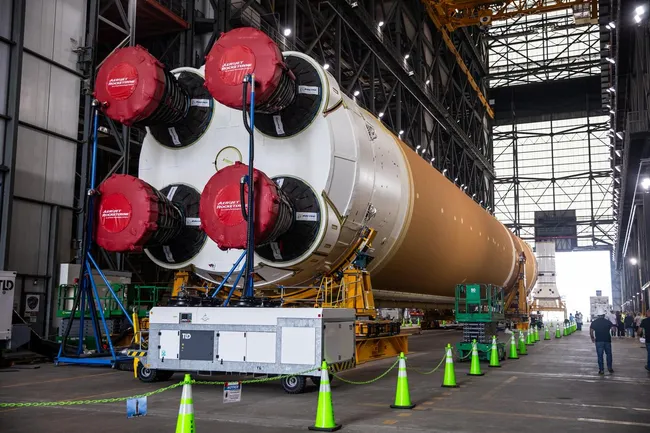
The core stage of the Artemis II SLS rocket, complete with its four main engines, inside NASA’s gigantic Vehicle Assembly Building (VAB). One of the base segments of a solid rocket booster (SRB) can be seen in the background. Credit: NASA

Meanwhile, the SLS vehicle itself has commenced stacking. The core stage, with is massive propellant tanks and four RS-25 “shuttle” engines, arrived at the Vehicle Assembly Building (VAB), Kennedy Space Centre, in July 2024, and since this has been undergoing much work whilst still lying on its side.

More recently, work on stacking the two solid rocket boosters (SRBs) developed from those used with the space shuttle, that will help power it up through the atmosphere has also commenced.

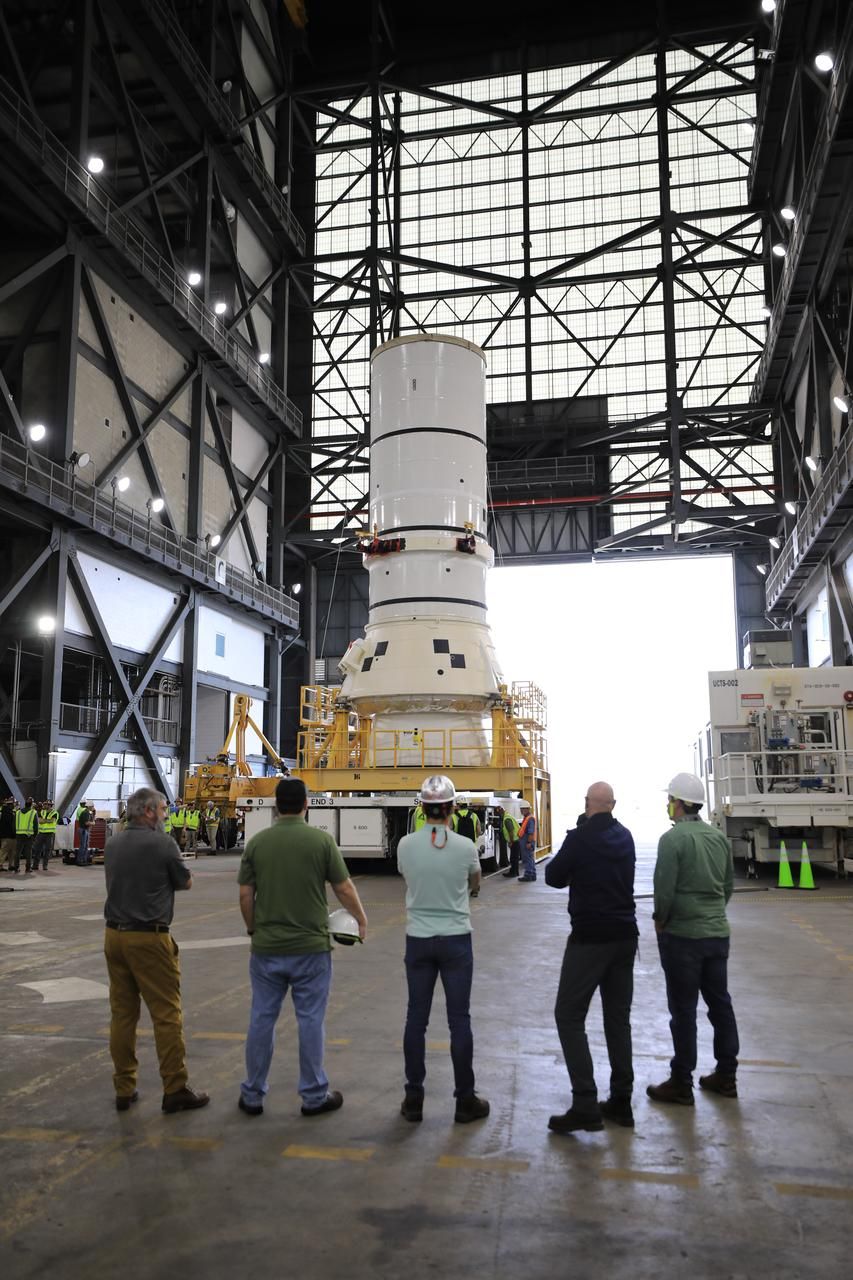
A crane inside the VAB prepares to lift one of the SRB motor sections and its assembly gantry, ready to place it on the back of a transport vehicle. November 13th, 2024. Credit: NASA

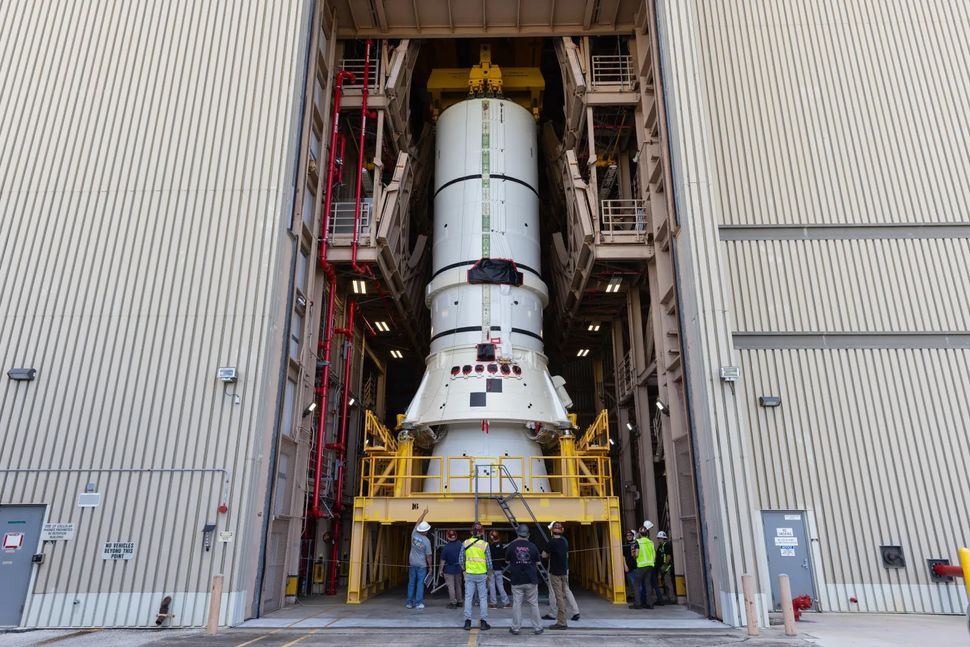
The SRBs comprise 5 individual segments which need to be manufactured and then bolted together, prior to being filled with their wet cement-like solid propellant mix. The base segments of these boosters include the rocket motor and guidance controls, and on November 13th, these were rolled into the Vehicle Assembly Building on special transport / stacking gantries. Over the next several months, the two SRBs will be assembled vertically in one of the bays within the VAB, and then loaded with their propellant and capped off.

Once the SRBs are ready and their avionics, etc., checked out, the core stage of the SLS will be hoisted up into one of the VAB’s high bays, moving to a vertical orientation as it does so. It will then be lowered between the two SRBs so that they can all be joined together. After this the ICPS will be moved up into position and mated to the top of the core stage of the rocket, and then work can commence stacking the Orion and its ESM and their launch fairings.

The SRB motor and its mounting gantry on the transporter, ready to be moved to the VAB bay where stacking can commence, November 13th, 2024. Credit: NASA

Whether or not Artemis II makes its planned late 2025 launch (no earlier than September) is open to question; currently, NASA has yet to fully complete the work on ensuring the already manufactured heat shield for the mission’s Orion vehicle is fit for purpose, per my previous report on heat shield issues.