Space Sunday: exoplanets update

K2-18, a red dwarf star with its two “super-Earth”planets: K2-18c and, foreground, K2-18b, orbiting in the star’s habitable zone. Credit: Alex Boersma

K2-18 is a red dwarf star system located about 111 light-years from Earth in the constellation Leo. It has been of interest to astronomers because it is home to an exoplanet – K2-18b, also referred to as EPIC 201912552 b, discovered in 2015 by the Kepler Space Observatory.

At the time of its discovery, K2-18b was placed within its parent star’s habitable zone, and was believed to be receiving around the same about of radiation as Earth does from the Sun. However, at the time of its discovery, it was unclear if the planet was a rocky super-Earth or a mini-Neptune gas planet. Because of this, an international team of scientists have been studying the planet using the High Accuracy Radial Velocity Planet Searcher (HARPS) instrument at the European Southern Observatory.

They had been intending to more accurately characterise K2-18b’s mass, the first step in determining it’s atmospheric properties and bulk composition. And they actually succeeded, determining that K2-18b has a mass of about 8.0 ± 1.9 Earth masses and a bulk density of 3.3 ± 1.2 g/cm³. This is consistent with a terrestrial (aka. rocky) planet with a significant gaseous envelope and a water mass fraction that is equal to or less than 50%. This makes K2-18b is either a super-Earth with a gases atmosphere, or it is a “water world” with a surface layer of thick ice.

However, the team also found something that had not been expected: a second planet orbiting K2-18.

Now referenced as K2-18c, this planet is much closer to its parent star than K2-18b, orbiting its parent once every nine terrestrial days. The team responsible for the discovery believe the planet is 7.5 ± 1.3 Earth masses, making it a “warm super-Earth”. It is far too close to its parent star to be within the habitable zone, making it an unlikely candidate to support life. It was most likely “missed” by Kepler both because of its proximity to the star, and because its orbit does not lie in the same plane.

The discovery of K2-18c was actually made in October 2017. But because it had been missed by Kepler, those detecting it were initially cautious with their findings and sought to further verify them before announcing the find. As the study’s lead, Ryan Cloutier of the University of Toronto said:

When we first threw the data on the table we were trying to figure out what it was. You have to ensure the signal isn’t just noise, and you need to do careful analysis to verify it, but seeing that initial signal was a good indication there was another planet… It wasn’t a eureka moment because we still had to go through a check list of things to do in order to verify the data. Once all the boxes were checked it sunk in that, wow, this actually is a planet.

However, now it has been discovered, it will be the subject of further investigation – as will K2-18b.

In fact, given the findings of the study, K2-18b is now considered as having a reasonable chance that it might have conditions suitable for life. Thus, it is now likely to be a candidate for study by the James Webb Space Telescope (JWST) when it starts operations in 2019.  JWST will be able to probe the planet’s atmosphere and determine how extensive it is, its composition, and what lies beneath it – be is a planet of an ice-covered ocean or a dry, rocky world – or something between the two.

In addition, the K2-18 system further underlines M-class red dwarf stars as the home of multi-planet systems, while the relatively proximity of K2-18b make it a prime target to further our understanding of the atmospheres around Earth-type exoplanets.

Icy Worlds Might Offer More Chances for Life and Rocky Planets

That K2-18b might be an icy water world fits with the findings of a new study form the  Harvard Smithsonian Centee for Astrophysics, which suggests such planets might be far more prevalent in the galaxy than rocky Earth-type planets.

When we discuss exoplanets, there is a tendency to focus on those within the so-called habitable zone around a star, because this is the most likely region where conditions – based on our own solar system – where life is to arise.

However, as the new study notes, there are actually two other planets within the Sun’s habitable zone where conditions are such that life either never got started or didn’t last that long (Venus) and another where life, if it got started, would have encountered environmental conditions which may have limited it or again, destroyed it. However, there are at least five worlds outside of the Sun’s habitable zone  – Europa, Ganymede, Enceladus, Dione and Titan – which all have the potential to support life. Thus, the so-called “habitable zone” around a star need not necessarily be the only place where conditions for life to arise might exist.

Icy worlds with sub-surface oceans may be more common than rocky world in the galaxy – and offer more chances for life to arise. Credit: unknown

Using the solar system as a basis for modelling, the researchers widened their consideration of habitability to include worlds that could have subsurface biospheres. Such environments go beyond icy moons such as Europa and Enceladus and could include many other types deep subterranean environments.

They then went about assessing the likelihood that such bodies are habitable, what advantages and challenges life will have to deal with in these environments, and the likelihood of such worlds existing beyond our Solar System (compared to potentially habitable terrestrial planets).

There are several advantages to “water world” when it comes to harbouring life. They tended to be internally heated (keeping the ocean liquid), may suffer of tectonic activity (as is now thought to be the case with Europa), which could pump living-forming energy and minerals into their oceans, while their icy crusts could offer shielding from harsher UV radiation and cosmic rays (energetic particles). The latter could be a major consideration considering the propensity for re dwarf stars to form planetary systems, and the fact they tend to be quite violently active.

Overall, the researchers determined that a wide range of worlds with ice shells of moderate thickness may exist in a wide range of habitats throughout the cosmos. Based on how statistically likely such worlds are, they concluded that “water worlds” like Europa, Enceladus, and others like them are about 1000 times more common than rocky planets that exist within the habitable zones of their parent stars.

Cross-section of Saturn’s moon Enceladus, showing how hydrothermal vents in the seabed could give rise to hotspots with sufficient heat and mineral release to support life – as well as heat the ocean under the ice and generate the plumes images by the Cassini mission. Credit: NASA/JPL / SwRI

However, while such worlds might be more common, there are negative aspects to the findings. Ice covered ocean worlds would lack sunlight as a source of energy, limiting the available energy supply to localised sources – ocean bottom fumeroles, etc., which in turn limit the size of available biospheres where life might survive – and tectonics could lead to these energy sources shifting or even dying. Also, nutrients needed to support life would likely be available in lower concentrations. That these worlds are ice-covered also makes identify whether the do in fact support life nest to impossible.

Thus, the finding could indicate that basic life might be far more prevalent in the galaxy – but also potentially much harder to detect.


Space Sunday: return to the extra-solar visitor

An artist’s impression of 1I/2017 U1 (or `Oumuamua), which was first seen by the Pan-STARRS 1 telescope in Hawaii on October 19th, 2017, and subsequently studied by a number of telescopes around the world, including the VLT of the European Southern Observatory (ESO) Credit: ESO / M. Kornmesser

On October 30th, 2017 I wrote about the extra-solar body which had crossed the orbit of Earth after swinging around the Sun during a rapid flight into and back out of the solar system. The object, originally designated A/2017 U1 and then as 1I/2017 U1 (the “1I” indicating it is the first positively identified interstellar object we’ve observed in 2017), was initially spotted on October 18th in Hawaii by the Pan-STARRS 1 telescope. Since then it has been closely tracked by astronomer around the world. What is particularly interesting about it is that Sun-orbiting eccentricity of between 0 (a circular orbit), and 1 (a parabolic orbit). Anything above 1 would tend to point to an object being entirely extra-solar in origin. A/2017 U1 has an orbital eccentricity of 1.2.

Since that time, the object has been under intense study, as has been reported in the media, and is proving to be most unusual. Now dubbed `Oumuamua, roughly translated as “scout” (ou being Hawaiian for “reach out for” and mua meaning “first, in advance of” – which is repeated for emphasis). At first thought to be a comet on account of initial observations, it was reclassified as an asteroid following more details observations.

In particular, observations made using the Very Large Telescope (VLT), operated by the European Southern Observatory (ESO) at the Paranal Observatory in Chile revealed the object to be cigar-shaped, rather than being a more rounded shape, as had been expected. Overall, it is estimated to be around 400 metres (1312 ft) in length, and approximately 40-50 metres (130-162.5 ft) in height and width. It is tumbling .

Using the VLT, ESO were able to accurately measure the brightness, colour and orbit of the asteroid and refine measurements of its trajectory as it leaves the solar system at a stunning 95,000 km/h (59,000 mph). These have revealed that `Oumuamua varies dramatically in terms of brightness (by a factor of ten) as it spins on its axis every 7.3 hours. As Karen Meech of the Institute for Astronomy in Hawaii explained in an ESO press release, this was both surprising and highly significant:

This unusually large variation in brightness means that the object is highly elongated: about ten times as long as it is wide, with a complex, convoluted shape. We also found that it has a dark red colour, similar to objects in the outer Solar System, and confirmed that it is completely inert, without the faintest hint of dust around it.

These observations also allowed Dr. Meech and her team to constrain `Oumuamua’s composition and basic properties. Essentially, the asteroid is now believed to be a dense and rocky asteroid with a high metal content and little in the way of water ice. It’s dark and reddened surface is also an indication of tholins, which are the result of organic molecules (like methane) being irradiated by cosmic rays for millions of years.

The measurements confirmed that the asteroid came to us from the general vicinity of Vega  in the Constellation of Lyra, and has taken around 300,000 years to reach the solar system, which it has been passing through for the last 20,000. However, whether it originated around Vega is still being debated. Some of those observing the object believe it could have been wandering the interstellar void for 45 million years, having originally been ejected from a stellar system in the Carina–Columba association, which had once been far more aligned with the constellation of Lyra, relative to the solar system.

Passing through most of the solar system at a speed of around 80.0oo km/h (58,000 mph), the asteroid gradually accelerated under the Sun’s gravity so that it reached a velocity of 315,700 km/h (196,000 mph) at perihelion – the point closest to the Sun, which it reached on September 17th, 2017. Since then, the object has been heading away from the Sun and decelerating, again under the influence of gravity, passing the orbit of Earth in October. It will pass Jupiter’s orbit in May 2018, Saturn’s orbit in January 2019, and Neptune’s orbit in 2022, passing onwards through the solar system. It will be another 20,000 years before the object re-enters the interstellar medium.

Even it is of extra-solar origin, `Oumuamua is seen as being of significant import for our understanding of the formation of other solar systems. If nothing else, a study of the asteroid as it continues onward and outward from the Sun could potentially teach us a lot about its origins and the likely conditions within the system where it was born.

To this end, there have been numerous calls for the development of one or more missions to investigate the asteroid, some of which, such as Project Lyra, are already being mapped out.  However, planning such a mission is one thing – actually pulling it off is quite another. `Oumuamua is currently travelling at 95,000 km/h (59,375 mph) – a velocity it will now more-or-less maintain.That is equivalent to 5.5 AU (Astronomical Units – the average distance from Earth to the Sun) per year, or 26 metres (84.5 ft) per second – what is technically referred to as its hyperbolic excess velocity.

Project Lyra points to NASA’s Space Launch System rocket (left and centre) and the SpaceX Interplanetary System launcher (aka the BFR, right), as possible launch vehicle for a mission to intercept an extra-solar body. Credit: SpaceX

No space vehicle launched from Earth has been able to attain that kind of velocity – even the fastest human-made objects in space, Voyager 1, and the fastest space probe at launch, New Horizons, are both only managing around two-thirds of that velocity. So just getting to a point where we can launch a vehicle capable on eventually matching the speed of the asteroid is a major challenge  – without the worry of getting it to a speed where it might eventually catch with `Oumuamua at a speed which would allow it sufficient time to gather data on the rock as it flies by, rather than shooting right on past it at such a speed, it has next to no time to gather data of significant value. Nevertheless, the proponents of Project Lyra are going so far as to suggest a mission might rendezvous with  `Oumuamua and gather samples for on-board analysis.

Of course, the asteroid will be travelling through the outer solar system – and by that I mean the Kuiper Belt outwards to, and through, the Oort cloud – for thousands of years; it’s not just going to vanish in a decade or so. So this does give some leeway. An encounter with  `Oumuamua within the Kuiper Belt for example (say, 50-200 AU from Earth) wouldn’t need to be launched for another 5-10 years. This could potentially allow for the use of an upcoming launch vehicle, such as NASA’s Space Launch System rocket or even SpaceX’s gigantic Interplanetary Transport System launcher, the BFR.

However, looking towards an encounter that far from earth still means that the probe would have to achieve a hyperbolic excess velocity of up to 76 metres (247 ft) per second – or half as much again as the asteroid’s velocity – again calling into question the effectiveness of a mission in gathering and returning data. Certainly, at those kinds of speeds, an actual rendezvous with `Oumuamua to gather a sample would be out of the question.

An alternative approach might be more “slow and steady” approach using solar sail technology – such as that being developed with projects such as the Breakthrough Initiatives’ Starshot. This might allow a vehicle propelled by an earth-based array of lasers to eventually catch the asteroid, and with a rate of steady acceleration, overhaul it at a rate at which data can be gathered in earnest. However, such technology is in its infancy; thus the chances of such a mission being used for catching `Oumuamua are perhaps slim. However, development of the technology and a mission for intercepting an extra-solar object in the future a distinct possibility – particularly as it is now estimated at least one extra-solar object passes through the solar system a year.

Whether intended to study `Oumuamua or one of these other interstellar wanderers, any such mission – using rockets, ion drive propulsion, solar sail technologies -, if pursued, could led to technological breakthroughs as well as scientific rewards. As the project authors note:

As 1I/‘Oumuamua is the nearest macroscopic sample of interstellar material, likely with an isotopic signature distinct from any other object in our solar system, the scientific returns from sampling the object are hard to understate. Detailed study of interstellar materials at interstellar distances are likely decades away, even if Breakthrough Initiatives’ Project Starshot, for example, is vigorously pursued. Hence, an interesting question is if there is a way to exploit this unique opportunity by sending a spacecraft to 1I/‘Oumuamua to make observations at close range.

[A] mission to the object will stretch the boundary of what is technologically possible today. A mission using conventional chemical propulsion system would be feasible using a Jupiter flyby to gravity-assist into a close encounter with the Sun. Given the right materials, solar sail technology or laser sails could be used… Future work within Project Lyra will focus on analysing the different mission concepts and technology options in more detail and to down select 2 – 3 promising concepts for further development.


Space Sunday: exoplanets and launch systems

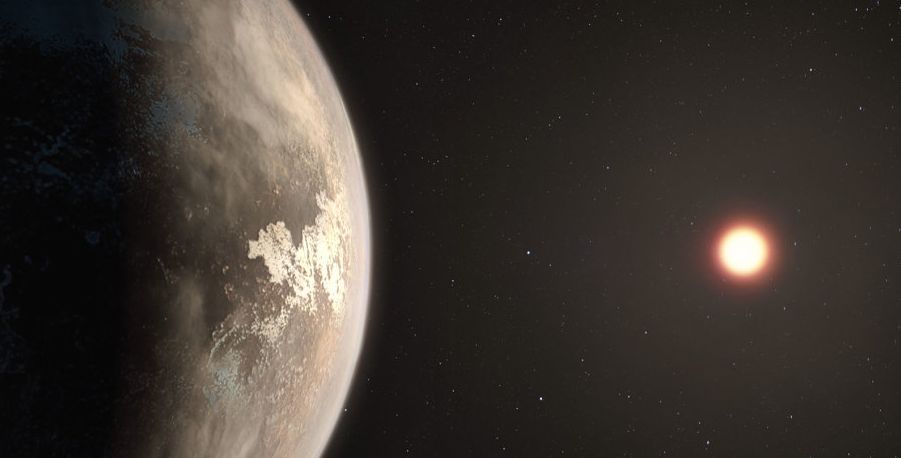
An artist’s impression of Ross 128. Credit: ESO / M. Kornmesser

The European Southern Observatory (ESO), responsible for finding a planet orbiting the Sun’s nearest stellar neighbour, Proxima Centauri (see here for more), has now discovered another exoplanet orbiting a nearby star.

The star in question is Ross 128, a red dwarf located in the constellation of Virgo. As I’ve previously noted, red dwarf stars tend to be extremely violent in nature. Their internal action is entirely convective, making them unstable and subject to powerful solar flares, generating high levels of radiation in the ultraviolet and infra-red wavelengths which can leave planets like the one orbiting Proxima Centauri or those orbiting TRAPPIST-1 unlikely to support life.

However, Ross 128 is different. It is a “quiet” red dwarf; it experiences less in the way of flare activity, meaning any planets orbiting it will be exposed to less radiation and stellar wind. In particular, the planet discovered by ESO could potentially be habitable.

The planet, designated Ross 128 b, was discovered using the ESO’s High Accuracy Radial velocity Planet Searcher (HARPS), located at the La Silla Observatory in Chile. HARPS uses measurements of a star’s Doppler shift in order to determine if it moving back and forth, a sign that it has a system of planets. The data gathered by the instrument allowed astronomers to confirm Ross 128 b is a rocky world, with roughly 35% more mass than Earth, orbiting Ross 128 at a distance of about 0.05 AU, and with a period of 9.9 Earth days.

Measurements of Ross 128’s likely radiative output, combined with the planet’s distance from the star put it on or near the star’s habitable zone – the region around a star where a solid body planet might have both an atmosphere and liquid water on the surface. It receives around 38% more light from its star than Earth does from the Sun. This has allowed the team making the discovery to estimate that Ross 128 b’s equilibrium temperature is likely somewhere between -60 °C and 20 °C – close to what we experience here on Earth, making it a temperate planet.

That Ross 128 is a “quiet” older red dwarf, less prone to violent outbursts, means Ross 128 b may well have retained any atmosphere which may have formed around it. Whether or not Ross 128 b has an atmosphere has yet to be determined; if it does, given the planet is likely to be tidally locked, with the same same side always facing towards its star, any atmosphere the planet may have could be subject to extreme weather.

Even so, given what is currently known about Ross 128 b, were it to have an atmosphere and liquid water on the surface, it would be the closest potentially habitable exoplanet to Earth so far discovered. This alone means Ross 128 b is liable to be the subject of a lot of additional study over the coming months.

Nor is this the first time Ross 128 has been in the news this year. In July 2017, Abel Méndez, an astrobiologist at the Arecibo Radio Telescope, reported that on May 12th, 2017, during a 10-ten observation of Ross 128, the telescope received a 10-minute wide-band radio signal “almost periodic” in natures, and which decreased in frequency.

While some were quick to link this event with the November discovery of Ross 128 b, it’s worth pointing out that Arecibo, the Green Bank Telescope in West Virginia and the Allen Telescope Array (ATA) in northern California, have all spent time listening to Ross 128 without any of them hearing any repeat of the signal. Currently the most widely accepted explanation for the May 2017 signal is radio frequency interference from a satellite orbiting the Earth.

A Lava World with an Atmosphere?

And staying with exoplanets, 55 Cancri e, also named Janssen, has also been in the news this week.

One of the few exoplanets discovered prior to the Kepler mission, it is one of five planets orbiting 55 Cancri A, the G-class main sequence star which forms one half of the binary star system 55 Cancri, some 41 light years away from the Sun, in the constellation of Cancer. At 7.8 Earth masses, and with a diameter almost 50% that of Neptune, it has the distinction of being the first “super-Earth” discovered in orbit around a main sequence star similar to the Sun.

An artist’s impression of super-Earth exoplanet 55 Cancri e and its parent star. Credit: NASA/JPL

Discovered in August 20o4, the planet has been subject of extensive study. As the closest planet to its parent, it takes 2.8 days Earth days to complete one orbit, and is tidally locked, always keeping the same side facing its parent. A study of the planet using the Spitzer space telescope in 2013 led astronomers to the conclusion 55 Cencri e is likely carbon planet, dominated by lava flows on its sunward side. In 2016, observations using the Hubble Space Telescope indicated the planet may have a thin hydrogen and helium atmosphere with suggestions of hydrogen cyanide.

However, an international team led by Cambridge University in the UK, has been re-examining the data gathered by the Spitzer space telescope. Using an improved model of how energy would flow throughout the planet and radiate back into space, their findings indicate that temperatures on the “dark” side of the planet average 1,300 to 1,400 oC (2,400 to 2,600 oF), much closer to to the average 2,300 oC (4,200 oF) on the sunward side than previously thought.

These finding suggest 55 Cancri e has a far denser, more complex atmosphere than had been thought, one which acts as transfer mechanism for circulating heat around the planet. What’s more, this atmosphere may well contain nitrogen, water vapour and even oxygen—molecules found in our atmosphere, too—but with much higher temperatures throughout.

The overall conditions on the surface of the planet preclude free-flowing water or the opportunity for life to arise, but they also present a further mystery. Given its proximity to its parent star, in theory 33 Cancri 2e’s atmosphere should have been stripped away aeons ago by the solar wind. so there are still mysteries with the planet yet to be resolved.

Continue reading “Space Sunday: exoplanets and launch systems”

Space Sunday: ancient oceans, comets from beyond, and exoplanet hunting

Dawn mission patch. NASA/JPL

Studies of Ceres, the largest dwarf planet within the orbit of Neptune, and the focus of the joint NASA / ESA Dawn mission for the last 30 months, are beginning to be published at a high rate of knots. In my previous Space Sunday I covered the report that the water ice discovered around Ernutet crater was likely of local origin. Now, two further studies point to Ceres once having a liquid water ocean.

The first study used gravity measurements to characterise Ceres’ interior, the second sought to determine its interior structure by studying its topography. Both came to similar conclusions.

The NASA team conducting the gravity measurements used data gathered by the spacecraft, together with an analysis of gravity-induced variations in the vehicle’s orbit around the dwarf planet as tracked by NASA’s Deep Space Network (DSN) and an analysis of the gravity anomalies associated with four of Ceres’ most notable surface features: the craters Occator (famous for having bright deposits in its basin which caused excitement in the early months of the spacecraft’s time at Ceres), Kerwan and Yalode, and Ceres one significant mountain, Ahuna Mons. This allowed them to draw a number of conclusions, the most notable being Ceres was once very geologically active, and that its surface crust has an overall density closer to that of ice than rock.

The second study focused on investigating the strength and composition of Ceres’ crust and deeper interior by studying the dwarf planet’s topography. By modelling Ceres’ crustal flow, the researchers determined that it is a mixture of ice, salts, rock, and clathrate hydrates, crystalline water-based solids resembling water ice but with up to 1,000 time its strength.

Diagram showing a possible internal structure for Ceres. Credit: NASA/ESA/STScI

The researchers further determined this high-strength crust probably rests on a softer layer that contains some liquid, allowing Ceres’ topography to deform over time, smoothing down features that were once more pronounced and producing the surface environment we see today.

Taken together, these studies suggest that Ceres once had a sub-surface ocean, likely kept liquid by internal heating (which has been suggested by other studies). This ocean may have been similar to the liquid water oceans thought to exist under the surfaces of Europa and Enceladus today. However, in the case of Ceres, much of it has long since frozen out into the dwarf planet’s crust. Most, but not all. The studies, together with the visual evidence of cryovolcanism on Ceres suggest that beneath the frozen crust there is a “soft” layer, possibly a slushy, semi-frozen layer of liquid.

It’s not clear how liquid this residual ocean might be, but as Julie Castillo-Rogez, the Dawn project scientist at JPL and a co-author on both studies, explained, “More and more, we are learning that Ceres is a complex, dynamic world that may have hosted a lot of liquid water in the past, and may still have some underground.” It is also further evidence that many of the smaller bodies in the solar system from Pluto to the asteroid belt, have histories every bit as complex as the major planets in the solar system.

Have We Just Witnessed an Extra-Solar Visitor?

We’re familiar with the concept of comets. They generally originate from one of two points in the outer solar system. The Kuiper Belt,  extending from the orbit of Neptune (at 30 AU) to approximately 50 AU from the Sun, gives rise to what we call “short period” comets which follow a predictable orbit that swings them past the Sun on a regular basis. Halley’s Comet, with its 76-year period, is perhaps the most famous of these.

Then there is the Oort Cloud, predominantly comprising icy planetesimals believed to surround the Sun to as far as somewhere between 50,000 and 200,000 AU (0.8 and 3.2 light years), and thought to be the origin for “long period” comets with orbits around the Sun measured in the hundreds of years.

However, some astronomers believe the solar system might currently be being visited by an altogether rarer type of comet: one that originated in another star system.

A fast-moving object, designated A/2017 U1, was initially spotted on October 18th in Hawaii by the Pan-STARRS 1 telescope. Since then it has been closely tracked by astronomer around the world.  What is particularly interesting about it is that Sun-orbiting eccentricity of between 0 (a circular orbit), and 1 (a parabolic orbit). Anything above 1 would tend to point to an object being entirely extra-solar in origin. A/2017 U1 has an orbital eccentricity of 1.2.

Because of this high eccentricity, the Minor Planets Centre put out a call for more observations on the object in attempts to confirm it is likely extra-solar in nature. It passed around the Sun on September 9th, and was detected as it crossed back over Earth’s orbit on its way back out into space. At the time it was spotted, the comet was about 30 million km (19 million mi) from Earth, and travelling at a velocity of 26 km/s (16 mi/s) –  much faster than the velocity required to escape the Sun, but within ~5 km/s of other stars within the Sun’s stellar neighbourhood, further indicating an interstellar origin.

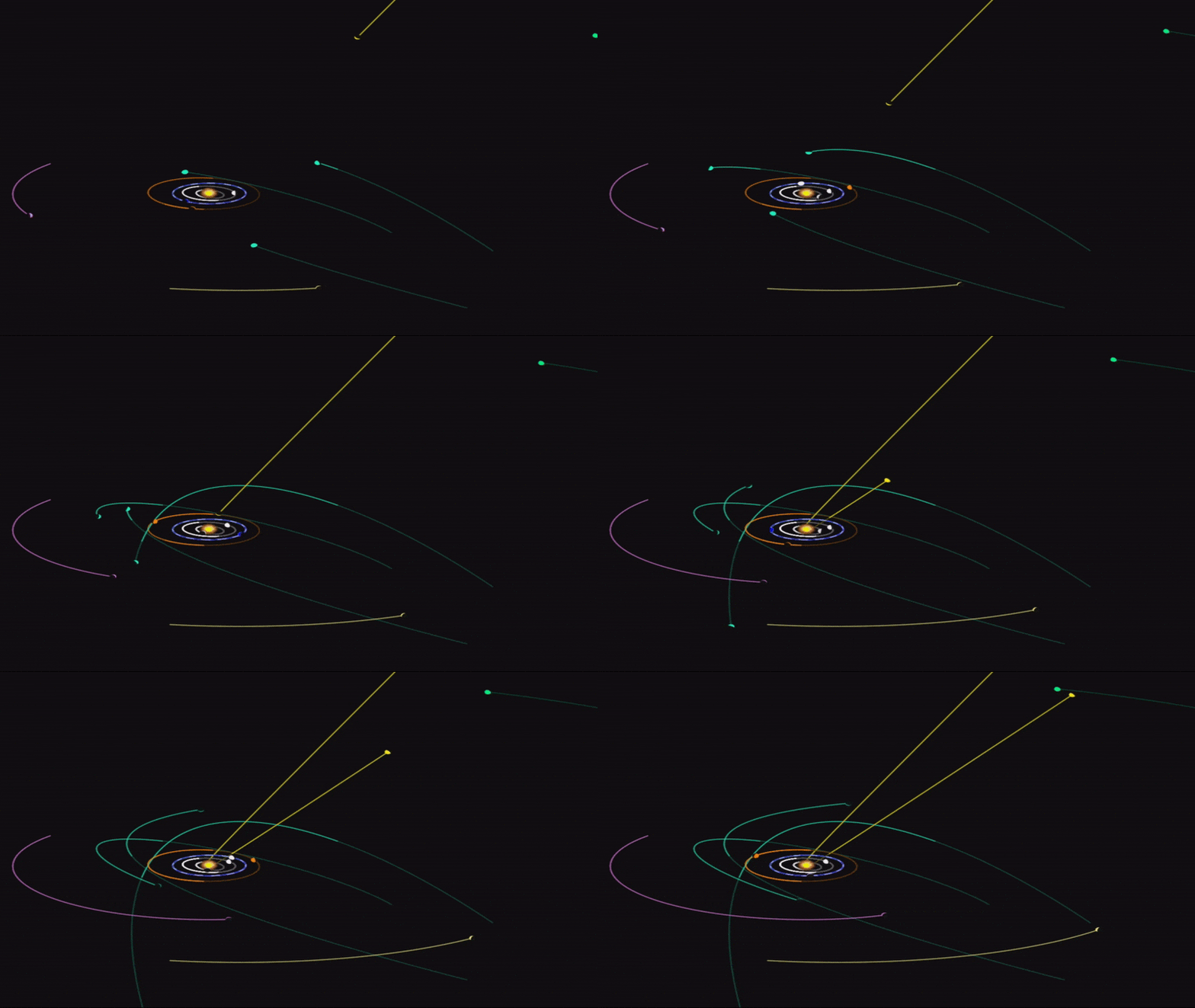
A simulation of A/2017 U1’s flight through the solar system. At the centre is the Sun and the inner planets, including Earth. The purple item in Jupiter, and the yellow object just beyond it is Saturn. The three pale green items are comets originating within the solar system, and the outermost bright green item represents the orbit of Uranus. A/2017 U1 is indicated by the yellow high inclination parabola, which has swung the object around the Sun. Travelling at 26 km/s, it will escape the Sun’s influence and head back out into interstellar space. Credit: Tony Dunn.

The object’s trajectory is also unusual, approaching the Sun from high above the plane of the ecliptic, and observations made from the Pan-STARRS 1 telescope in Hawaii, the William Herschel Telescope in the Canary Islands and the Very Large Telescope in Chile suggest the comet is a rocky / ice object roughly 160 metres along at least one of its axes.

Tony Dunn, an undergraduate physics and astronomy teacher at San Francisco State University has been running a series of computer simulations using tracking data on the comet, which he has been publishing on his Twitter feed. These suggest the comet may have originated as a body orbiting the star Vega, some 25 light years from the Sun; however, the likely point of origin is still being hotly debated and may never be accurately known.

Another simulation of the object’s passage through the inner solar system. Credit: NASA/JPL

If the object did originate in another star system, then it would suggest the other stars have rings or clouds or material surrounding them at great distances in a manner similar to the Oort cloud. It would also be confirmation of the idea that other stars passing within a few light-years of the Sun disturb the Oort cloud, causing objects there to be disrupted in their orbits, some of which fall towards the Sun and become long-period comets. Presumably, the Sun and other stars can influence rocky clouds around their neighbours in the same way – and that as well as falling towards their local star as comets, the disturbed objects can be kicked out of their local system to become interstellar wanderers.

“We have been waiting for this day for decades,” said Paul Chodas, responsible for NASA’s Centre for Near-Earth Object Studies (CNEOS), which has also been observing the object. “It’s long been theorised that such objects exist — asteroids or comets moving around between the stars and occasionally passing through our solar system — but this is the first such detection.”

“We have long suspected that these objects should exist, because during the process of planet formation a lot of material should be ejected from planetary systems,” Karen Meech, an astronomer at the Institute for Astronomy, Hawaii which operates the Pan-STARRs telescope, added. “What’s most surprising is that we’ve never seen interstellar objects pass through before.”

Continue reading “Space Sunday: ancient oceans, comets from beyond, and exoplanet hunting”

Space Sunday: when neutron stars collide

When neutron stars collide: an artist’s impression of the point when two neutron stars collided in the galaxy NGC 4993, 130 million years ago, and which are now increasing our understanding of neutron stars and the universe. Credit: SF/LIGO/Sonoma State University/A. Simonnet

Around the world on August 17th, 2017, some 70 telescopes and observatories – including the Laser Interferometer Gravitational-Wave Observatory (LIGO), responsible for confirming the existence of gravitational waves (see here and here for more) – quietly turned their attention on the same spot in the constellation Hydra.

“I don’t think it’s out of the question that this is the most observed astronomical event ever. It’s a thrilling notion, and a little overwhelming,” said LIGO spokesperson David Shoemaker. “We’ve got somewhere between a quarter and a third of all the world’s astronomers working with us.”

The reason? Hours earlier, an observatory in Chile had detected gravitational waves followed by a burst of gamma radiation – potentially the signature of two neutron stars colliding far beyond our galaxy. If so, the detection would be the first time gravitational waves have been observed originating from something other than the merger of two black holes. Hence, an alert was issued to observatories around the globe, resulting in the massed focusing on instruments on that single point in space.

Over the coming days, the data revealed that a collision between two neutron stars in what is referred two as a “kilonova”  – which sits between a star going nova and a super-massive star going supernova.  It marks the first confirmation that neutron star mergers can cause gamma ray bursts. However, there is much more to the event.

Neutron stars are the dense remnants of massive stars that long ago exploded as supernovae. The two stars in question are located in galaxy NGC 4993, 130 million light years from Earth. Originally, these stars were each around 10-20 times the mass of our sun; after each went supernova, they collapsed down to bodies around 16 km (10 mi) in diameter, comprised entirely of neutrons so densely packed, that despite their small size, each still had a mass perhaps twice that of our own Sun.

These two neutron stars, located close together, were gradually drawn together over the course of perhaps 11 billion years by their mutual gravities until they collided, venting huge amounts of energy across the spectrum and space-time in what astronomers call a “multi-messenger event”. It was the arrival of the light waves and gravitational waves here on Earth, 130 million years later, that astronomers from around the world were keen to observe, marking the first time a cosmological event of this nature has been observed in both gravitational waves and light, producing a huge amount of data for researchers to study.

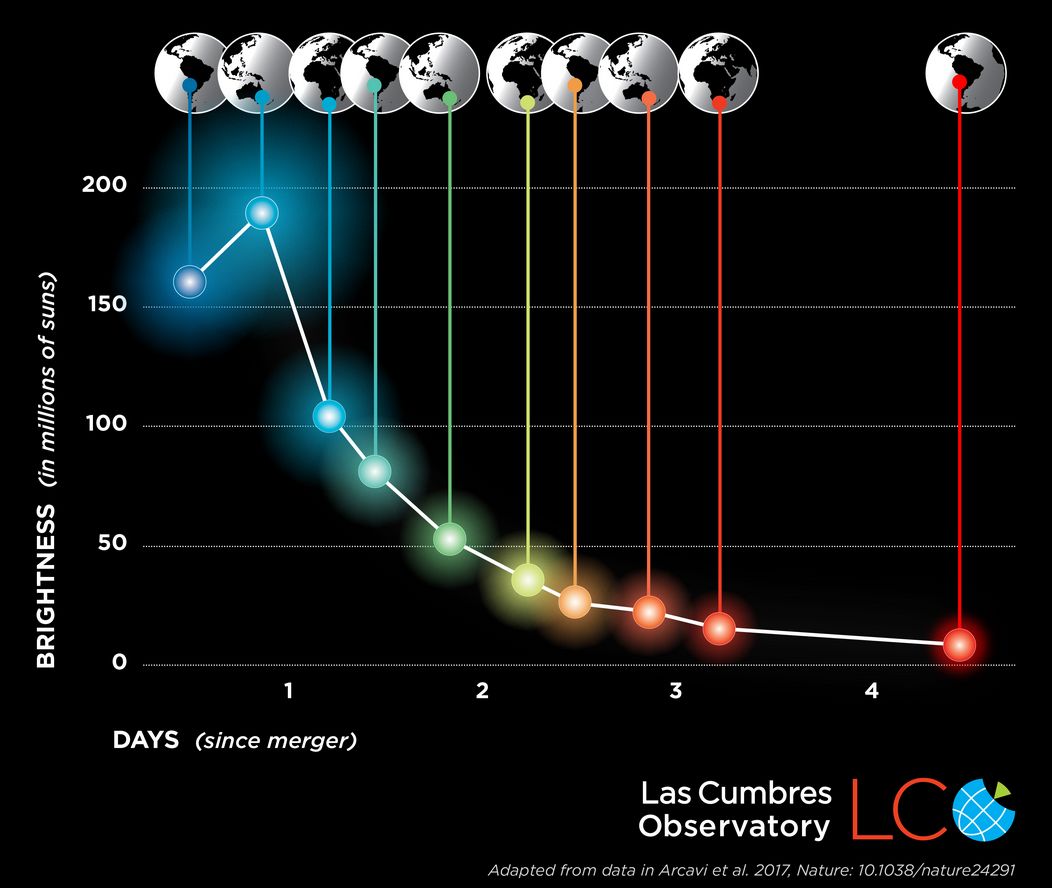
How the kilonova was initially observed through the initial days of visible light observation following the first indication of the collision through to the falling off of light from the initial explosive outburst of energy. Credit: Sarah Wilkinson / LCO.

Thanks to the alert sent out by the Chilean observatory, over 3,500 astronomers and more than 100 instruments  – including LIGO and a the Hubble Space Telescope responded, making the event the first to be observed through the detection of visible light and gravitational waves. Their findings are now being made public, and include some remarkable facts.

These include the first confirmation that neutron star mergers can cause gamma ray bursts – although there is some questions over what this might in fact mean. It also marks the first measurement of the universe’s expansion using gravitational waves.In addition, as the collision was recorded in wavelengths right across the electromagnetic spectrum, from radio to gamma rays, it is the first time a cosmological event of this nature has been observed in both gravitational waves and light. A further result of the observations is that astronomers have witnessed heavy elements being formed from the aftermath of the event.

“People have long suspected that heavy elements were made in neutron star mergers, but this is really the first time we’ve nailed that down,” Andrew Levan, an astronomer at the University of Warwick in the UK. “This merger made something like the mass of the Earth in gold, along with other heavy elements such as platinum, lead and uranium.”

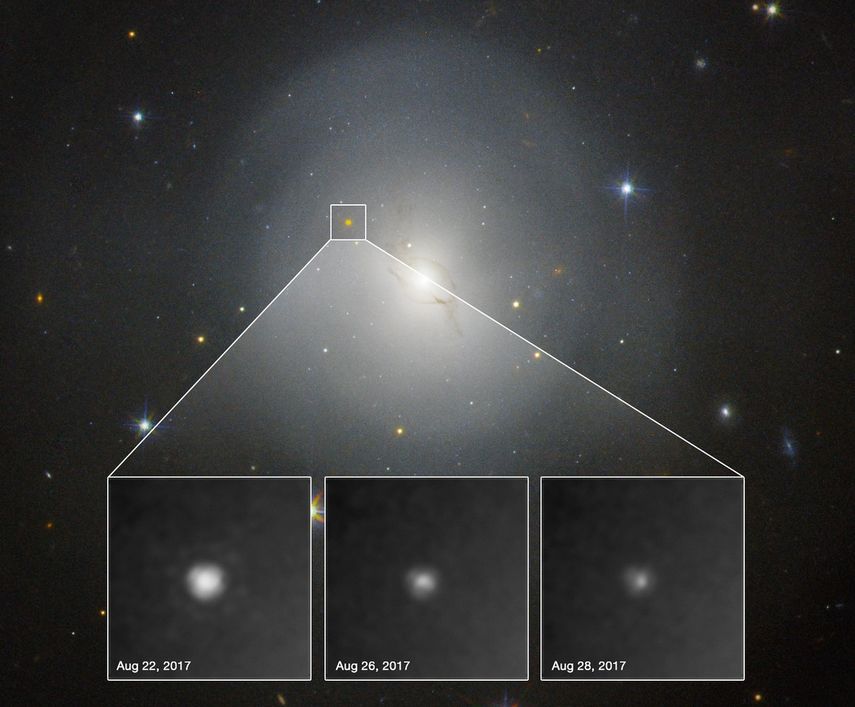
The kilonova as seen from the Hubble Space Telescope a few days after the explosion, tracking it as the initial light faded. Credit: NASA and ESA. Acknowledgement: A.J. Levan (U. Warwick), N.R. Tanvir (U. Leicester), and A. Fruchter and O. Fox (STScI)

It was actually the discovery that heavy elements were being formed in the material resulting from the collision which confirmed the event was an actual collision of two neutron stars. The elements would only be formed if neutrons were being ejected from the two stars to collide with lighter atoms in the surrounding space. Material would only be ejected if the objects in collision each had a surface, something black holes don’t have – they only have an event horizon.

This in turn indicated the event was far closer that the previous five detections of gravitational waves which have occurred since 2015. These have been the result of pairs of black holes merging, none of which have been closer than 1.3 billion light years away. That the gravitational waves were observed alongside of light waves also gave further confirmation of another of Einstein’s general relativity predictions: that light and gravitational waves travel and more-or-less the same speed.

Observations and data gathering continued after the initial explosion was detected, although the light from the collision faded over the 6-8 days following the event, and astronomers are keen to discover what has been left behind. Currently, the region of NGC 4993 where the kilonova occurred is obscured behind a cloud of matter and heavy elements, leading to questions on whether or not the two stars may have merged to form an even larger neutron star, or whether they collapsed into a black hole. Some of those studying the data gathered believe the gamma ray burst recorded after the initial detection of gravitational waves might be indicative of the latter, the result of matter left over from the event and collapse being drawn into the event horizon.

Summing up the significance of the event, astronomer Tony Piro from the Harvard–Smithsonian Centre for Astrophysics said, “The ability to study the same event with both gravitational waves and light is a real revolution in astronomy. We can now study the universe with completely different probes, which teaches things we could never know with only one or the other.”

Continue reading “Space Sunday: when neutron stars collide”

Space Sunday: radiation, rings and pollution

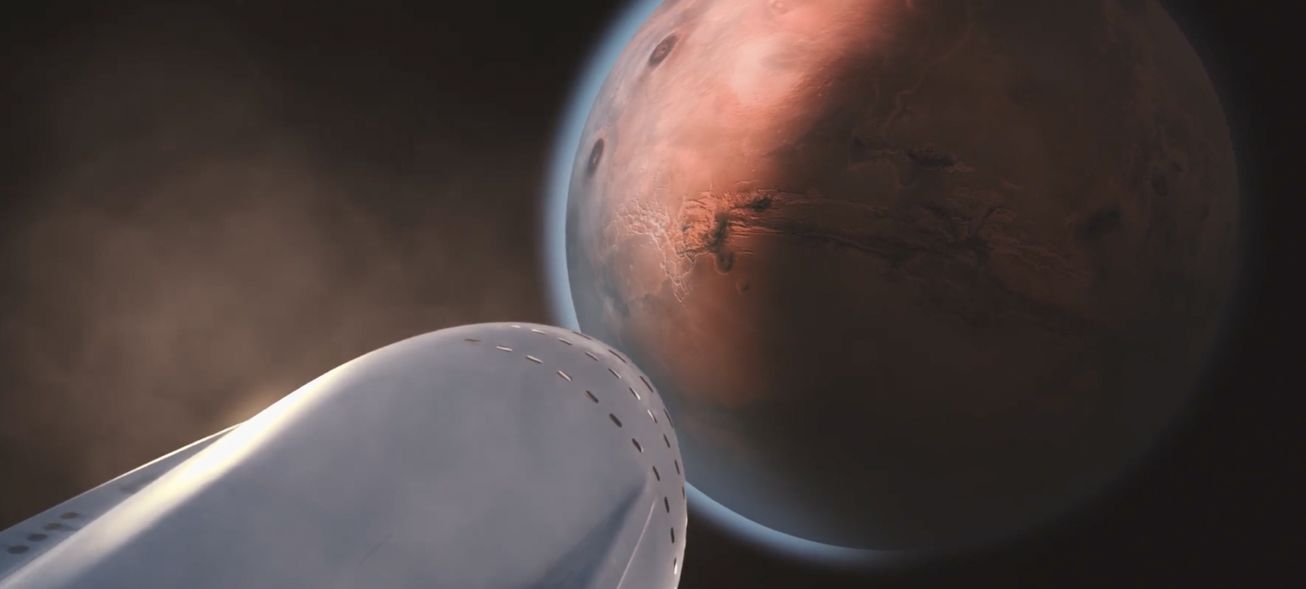
Missions like Elon Musk’s hopes for Mars need good radiation protection for crews – and NASA is working to bring this about. Credit: SpaceX

I’ve written several times about the risk radiation poses to dee space missions; particularly Galactic Cosmic Rays (GCRs), the so-called “background radiation” left over from the big bang. As I’ve noted, while solar radiation – up to and including Solar Particle Events (SPEs or “solar storms”) can be reasonably well dealt with, on account of the particles being relatively low-energy – 13 centimetres (5 inches) of water or similar liquid – is pretty good protection against the primary radiation threat of SPEs, for example – GCRs are far harder to deal with.

However, there are materials which can block them. Again, I’ve written about Hydrogenated boron nitride nanotubes (BNNTs). These are something being developed by NASA’s Langley Flight Centre in Virginia; extremely flexible, they can be used in the construction of key elements of space vehicles – walls, floors, ceilings, for example – and can even be woven into a material used as a lining in space suits to protect astronauts.  Similarly, borated polyethylene – already used for radiation shielding in nuclear reactors aboard US naval vessels, medical vaults and linear accelerators, among other applications – offers a means to provide primary radiation protection within the structure of space vehicles.

However, these are only effective in stopping primary radiation damage – that is, damage cause by the direct impact of radiation on living cells. A far, far greater risk people in deep space will face is from so-called secondary radiation,  particularly in the case of GCRs.  simply put, when a GCR particle collides with another, it sends energetic neutrons, protons and other particles in all directions, which can collide with others. It’s like a bullet striking something and scattering shrapnel, potentially doing damage to a lot of cells if they strike a living body. The problem here is that the more material used to block the effects of primary radiation damage, the more the risk of secondary radiation damage is increased.

Materials such as BNNTS and borated polyethylene could be used for surface vehicles and equipment as well

This means that there is unlikely to be a single solution to the issue of radiation exposure on deep space missions such as to Mars. Which is why scientists aren’t looking for one. NASA, for example has been conducting research into technologies such as BNNTs and magnetic shielding for space vehicles for over a decade. The latter, if possible, would use a magnetic field around a space vehicle to protect the crew, much as Earth’s magnetic field protects us. The problem here is that such systems currently require huge amounts of electrical power and can add a significant amount of mass to a space vehicle.

Another avenue of research being investigated is the use of pharmaceuticals as possible radiation inhibitors. Drugs such as potassium iodide, diethylenetriamine pentaacietic acid (DTPA) and the dye known as “Prussian blue” have for decades been used to treat radiation sickness. The theory is now that they could be used as part of a preventative regime of preventative treatment for astronauts on deep space missions.

The whole subject of radiation protection has become a focus in light of NASA’s “new” directive to return humans to the Moon and also because of Elon Musk’s determination to send humans to Mars, possibly as early as the mid-2020s. Because of this, NASA has been highlighting its research into radiation exposure management of late, which also includes solar weather forecasting (to help warn crews in deep space about the risk of SPEs, etc.), and in looking at 20+ years of orbital operations aboard the shuttle ISS and Russia’s MIr space station. All of this is leaving some at NASA feeling very positive about efforts to send humans beyond Earth orbit, as Pat Troutman, the NASA Human Exploration Strategic Analysis Lead, stated in a NASA press statement on the matter:

Some people think that radiation will keep NASA from sending people to Mars, but that’s not the current situation. When we add the various mitigation techniques up, we are optimistic it will lead to a successful Mars mission with a healthy crew that will live a very long and productive life after they return to Earth.

Whether progress on all fronts will be sufficiently advanced to encompass something like Elon Musk’s aggressive approach to human missions to Mars remains to be seen. However, with the “new” directive for NASA to return humans to the Moon, there’s a good chance we’ll see some of the current initiatives in radiation protection bearing fruit in the next few years.

The Risk Posed by Tiangong 1

Tiangong 1 (“Heavenly Palace 1”), the first Chinese orbital facility has been creating some sensationalist headlines of late.  Launched in 2011, the facility saw two crews spend time aboard it, prior to it being run on an automated basis from 2013. On March 21st, 2016 the Chinese Manned Space Engineering Office announced that they had disabled the facility’s data service in preparation for shifting their focus to the (then) upcoming Tiangong 2 facility and in allowing Tiangong 1’s orbit to decay so it would burn-up re-entering the upper atmosphere.

Tiangong 1. Credit: CMSE

The time-frame from re-entry was predicted to be late 2017 / early 2018. However, around the time Tiangong 2 was launched the Chinese space agency admitted they’d lost attitude control of the laboratory, so they could no longer orient it as it orbits the Earth. As a result, the facility has been under scrutiny from Earth by individuals and groups monitoring the rate of its orbital decay.

One of these observers is astrophysicist Jonathan McDowell of Harvard university. In early October he released a statement indicating that as a loss of attitude control coupled with increased atmospheric friction has resulted in a sharp decline in Tiangong 1’s altitude to the point where it could see the vehicle re-enter the Earth’s atmosphere in the next few months. He also noted – accurately – that some elements of the 8.5 tonne vehicle could survive re-entry and reach the surface of the Earth (something the Chinese have always noted).

Unfortunately, his report led to some sensationalist responses from portions of the media. For example, one UK media tabloid blasted: “Out-of-control space station to smash into Earth THIS MONTH…and it could hit ANYWHERE. … A MASSIVE space station is hurtling towards Earth!” (block capital their own, not mine); other newspapers also highlighted the upper-end of the risk posed by the vehicle’s re-entry.

Needless to say such reports wildly over-egg the situation. The reality is that Tiangong’s orbit carries it over vast swathes of ocean and large areas of sparsely populated land. As such, while there is a risk of parts of the station reaching the ground, the chances of them hitting a populated area are remote. In this, Tiangong reflects the US Skylab mission in 1979 and the Russian Salyut 7 / Cosmos 1686 combination of 1991. Both of these where much larger than Tiangong 1 (77 tonnes and 40 tonnes respectively), both made an uncontrolled re-entry, and in both cases, wreckage did not cause loss of life.

Continue reading “Space Sunday: radiation, rings and pollution”