Space Sunday: Tabby’s Star, NASA’s plans and the Moon’s atmosphere

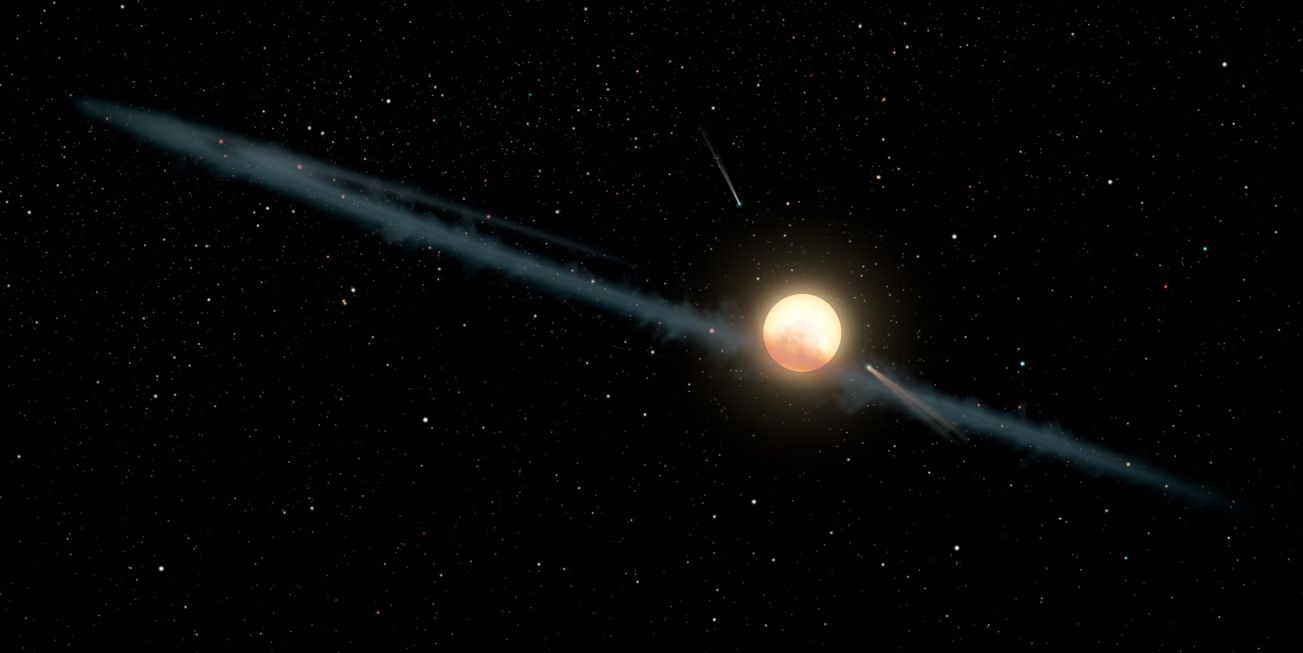
Is a circumstellar dust ring responsible for the irregular dimming of Tabby’s Star? Credit: NASA/JPL

Yet another study has appeared in an attempt to shed light (pun intended) on the mysterious behaviour of Tabby’s Star.

Regular readers of my Space Sunday columns will recognise this name as belonging to the more formally titled KIC 8462852, an F-type main-sequence star located in the constellation Cygnus approximately 1,480 light years from Earth (and which is also called Boyajian’s Star). This star experiences odd periods of dramatic dimming in its light output every so often (with the Kepler Space Observatory recording a loss of up to 22%), with the fluctuations lasting several solar days before it suddenly resumes its normal luminosity as observed from our solar system.

Many theories have been put forward for what is happening – most of which I’ve covered in these pages. They range from theories about vast alien mega-structures – such as a Dyson sphere, to theories of the star itself suffering what is called “avalanche” activity within itself, to ideas involving huge cometary clouds and giant ringed planets,  or just a single giant ringed planet being responsible.

In the most recent study, Extinction and the Dimming of KIC 8462852, a US / Belgian team of scientists suggest that “none of the above” might actually be the correct answer on why the star goes through its irregular dimming cycle. Instead, they argue it is the result of a huge but thin and uneven dust ring rotating slowly around the star.  What makes this theory particularly compelling is that it draws on three independently gathered sets of data in order to form the hypothesis.

The first of these data sources is NASA’s Spitzer Space Telescope, used to gather data on Tabby’s Star in the infra-red wave band during December 2016. The second is the Swift Gamma-Ray Burst mission, which gathered data on the star in the ultraviolet band during the same period of observation; also at the same time, the Belgian AstroLAB IRIS Observatory’s 68-cm (27-in) reflecting telescope gathered data in the visible light spectrum.

Artist’s concept of KIC 8462852, which has experienced unusual changes in luminosity over the past few years. Credit: NASA/JPL

What the team found, essentially, was that Tabby’s Star experienced less dimming in the infra-red band than in the ultraviolet – a strong indication that there was a mass of materials, each particle just a few micrometres in diameter, passing between the star and the observatories. While it had been previously suggested the dimming could be the result of an interstellar dust cloud lying somewhere in space between Earth and Tabby’s star, the team discounted this as a possible culprit.

Instead the team took their findings and charted known periods of dimming witnessed with Tabby’s Star and determined a circumstellar dust ring surrounding the star, and rotating around it one every 700 days would actually account for the majority of dimming periods observed from Earth. However, two types of even still do now fit the model.

The first of these is some very short-term “spurts” of dimming which have been noted during 2017. The second is the really large dips in luminosity seen by the Kepler Space Observatory. One potential explanation for the “spurts” of dimming, confirmed through multiple independent observations, is that they might be the result of a cometary cloud orbiting the star and coming between it and Earth. This was actually one of the earliest theories put forward to account for all of Tabby’s Star’s odd behaviour, but it fits the “spurts” of dimming a lot better.

The really big dimming periods, when the star appeared to lose up to 22% of its brightness pose their own problem. They were only observed by Kepler, and have yet to be seen to the same magnitude during any other period of observation, making quantifying them hard. Kepler itself is now studying stars in another portion of the galaxy, so cannot be used to further observe Tabby’s Star to see if such huge dips can again be seen.

Thus, there may yet be another mystery to Tabby’s Star waiting to be solved – or other theories on the fluctuating brightness which may yet be put forward. But for now, the circumstellar dust ring seems to be the most fitting explanation for much of the star’s odd behaviour.

The Moon’s Ancient Atmosphere

That’s the startling conclusion of a new study, supported by NASA’s Solar System Exploration Research Virtual Institute, and recently published in Earth and Planetary Science Letters.
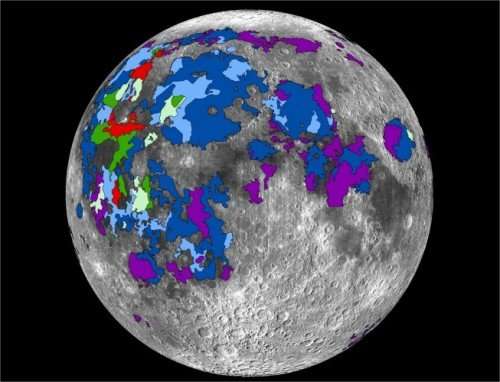
Map of basaltic lavas that emitted gases on the lunar nearside. Credit: Debra Needham
Map of basaltic lavas that emitted gases on the lunar near side. Credit: Debra Needham

That the Moon was subject to intense volcanic activity in its early history is evidenced by the massive  volcanic basalt maria (“seas”) on its surface. From Earth, these form the dark patches and patterns we can see with the naked eye. They were created three to four billion years ago, when the interior of the Moon was still hot and generating magmatic plumes. In places, these broke through the lunar crust, flowing outwards for hundreds of kilometres. Analysis of rock sample returned to Earth by the Apollo astronauts has long revealed these lava flows carried with them gases like carbon monoxide and the ingredients for water, sulphur, and other volatile elements.

In the study, work, Dr. Debra H. Needham, Research Scientist of NASA Marshall Space Flight Centre, and Dr. David A. Kring, Senior Staff Scientist, at the Lunar and Planetary Institute (LPI), used the amounts of trace gases and volatiles in the Apollo samples as a baseline for calculating the probable amount of gases released during those ancient lunar eruptions. Their findings suggest that the gases were released is sufficient quantities over a long enough period of time, reaching its peak around 3.5 billion years ago, to form a transient  lunar atmosphere. It then persisted for about 70 million years after the volcanic activity ended, before the bulk of the gases were lost to space.
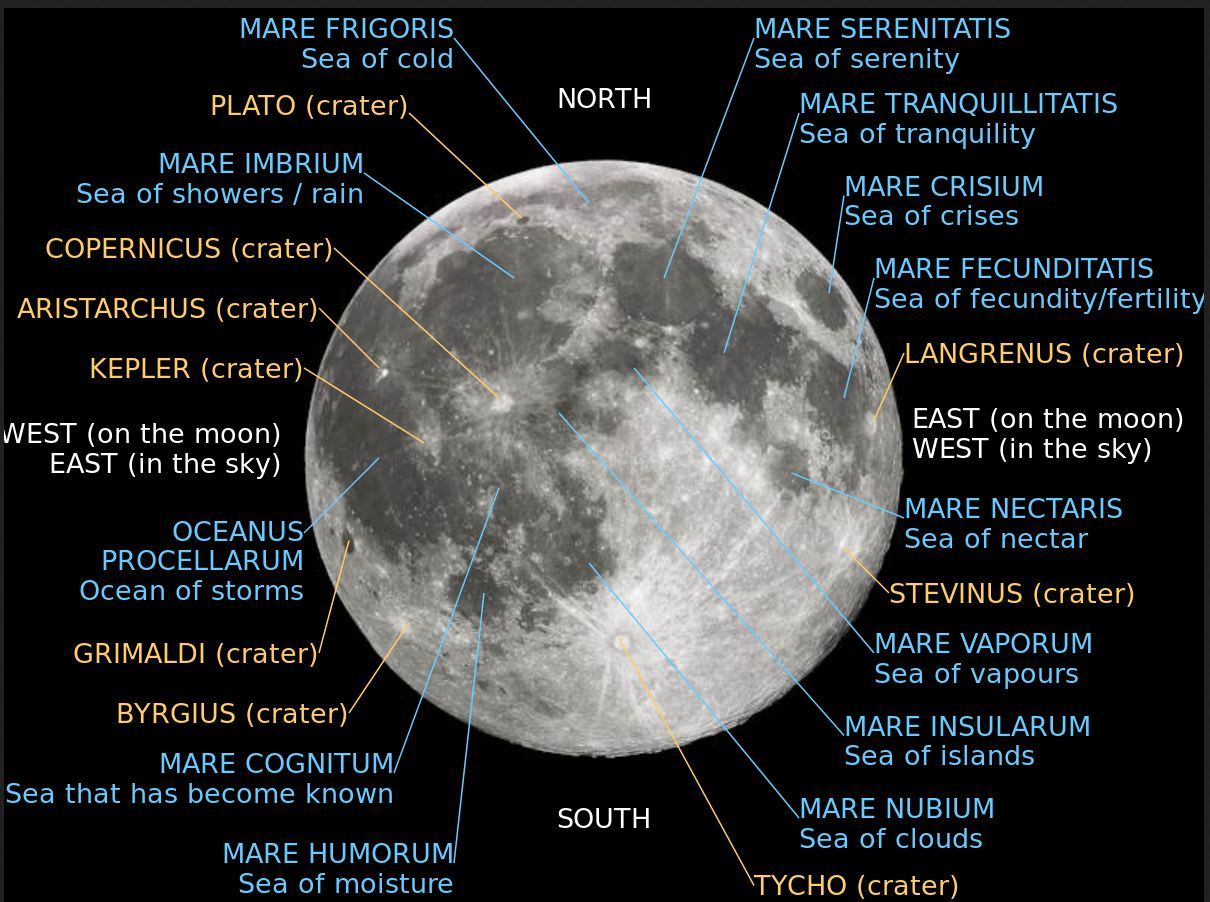
Distribution of the volcanic “seas” of the Moon (in blue) – sites of ancient eruptions. Credit: Nasa

The two largest pulses of gases were produced when lava seas filled the Serenitatis and Imbrium basins about 3.8 and 3.5 billion years ago, respectively. The margins of those lava seas were explored by astronauts of the Apollo 15 and 17 missions, who collected the samples that provided the ages of the eruptions.

This new picture of the Moon has important implications for future exploration. The analysis of Needham and Kring quantifies a source of volatiles that may have been trapped from the atmosphere in the cold, permanently shadowed regions near the lunar poles and may well provide a source of ice suitable for a sustained lunar exploration programme. Volatiles trapped in these icy deposits might be used  provide air and fuel for astronauts conducting lunar surface operations.

“We Chose To Go to the Moon, Because That’s What We Were Doing Anyway”

The re-invoked US National Space Council (NSC) held its inaugural meeting n Thursday, October 5th, 2017 at the Smithsonian National Air and Space Museum’s (NASM) Steven F. Udvar-Hazy Centre.

Chaired by the Vice President, the Council was originally  established in 1989 by then-President George H.W. Bush to serve the same purpose as the National Aeronautics and Space Council, which oversaw US space policy between 1958 and 1973. That NSC was disbanded in 1993 by the Clinton administration.

In this first meeting, the NSC sought to overturn NASA’s “Journey to Mars” endeavour in favour of a more focused plan to return to the Moon – or did they?
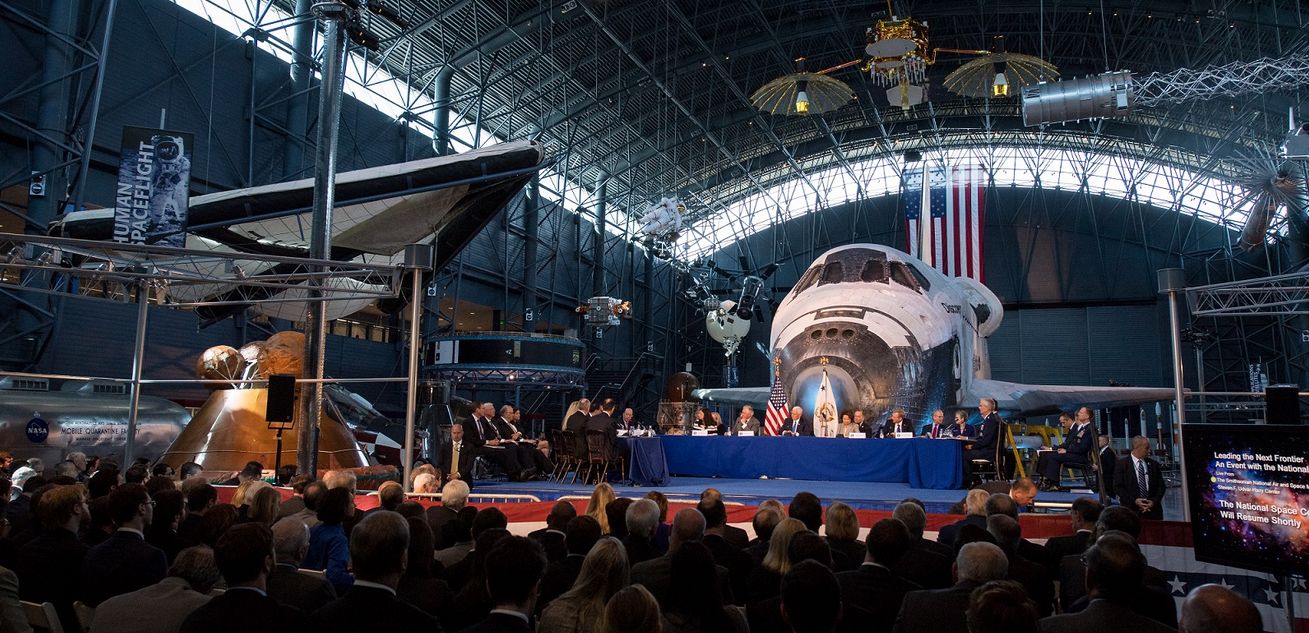
The inaugural meeting of the re-formed NSC, October 5th, 2017. Credit:  NASA / Joel Kowsky

But how new and bold is this directive?

The reality is, what Pence announced on behalf of the NSC on October 5th and despite all the hurrahs, is pretty much what NASA was already doing anyway, and had been doing since President Obama signed the NASA Authorisation Act of 2010. That is: build the Orion Multi-Purpose Crew Vehicle and the Space Launch System, establish the Deep Space Gateway in cis-lunar space as an “enabler” for lunar missions and missions to Mars, and develop a presence on the Moon while deferring Mars to some nebulous 2030s time frame. The only significant difference is the instruction for NASA to actually flesh-out the lunar outpost element.

On the one hand, this is good, as it means no mass overturning of the apple cart (a favourite past time of incoming administrations)  and a scramble to sort the apples out again. On the other, it still leaves NASA pursuing goals of questionable need – such as the Deep Space Gateway itself. Which, despite all the hype surrounding it, isn’t actually required for either for getting to the Moon or Mars. Rather, it is an objective that’s become fixed in the NASA mindset, and is now being rationalised on the basis that it is part of the mindset, rather than it offering a means to achieve things that cannot be better (and more cost-effectively) achieved through other methods.

What’s in a Name?
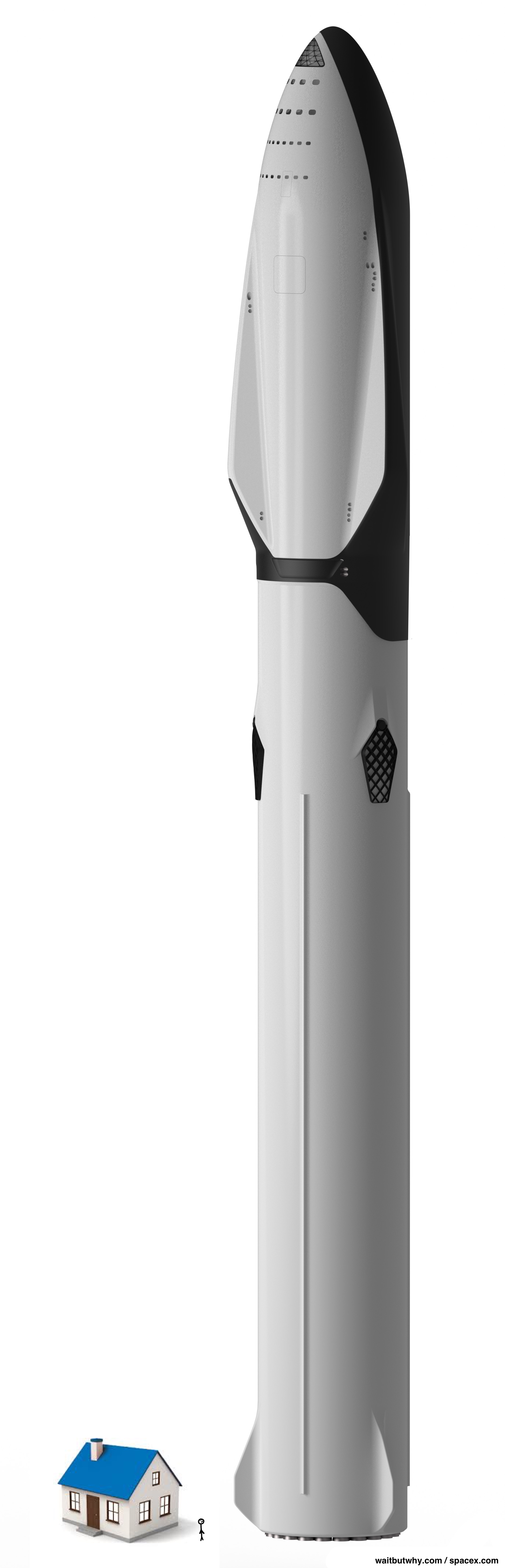
Making it safe to reference the “BFR” – the Big “Falcon” Rocket! Credit: SpaceX

At the 68th International Astronautical Congress (IAC) at the end of September, Elon Musk unveiled more of his thinking around sending humans to Mars.

The linchpin of his aspirations is the massive Interstellar Transport System (ITS) rocket SpaceX is developing. This has caused not a few parents some headaches when explaining things to their children, or created a dilemma when explaining the concept in polite company.

It’s not that explaining the ITS concept in complicated. Far from it. Rather, it’s the fact that Musk has chosen to present the ITS launch system using the acronym he originally defined for it: BFR. This, as just about everyone interested in space exploration knows, stands for “big f***ing rocket”. Descriptive yes, given the size of the beast (see right). But suitable for sensitive or young ears? Er, no, possibly not.

So, how does one deal with explaining what “BFR” means to said sensitive / young ears? SpaceX President Gwynne Shotwell recently offered a solution.

While addressing the National Space Council on October 5th, Shotwell – quite probably with a twinkle of humour in his eye –  played on the company’s use of “Falcon” in naming their rockets (the Falcon 9 and Falcon Heavy) to get around the BFR acronym.

“Last week,” he said. “Elon announced — or, basically, gave an update on,” he then paused a bit, before continuing, “the Big Falcon Rocket programme. The Big Falcon Rocket and Big Falcon Spaceship.”

So there you have it, a non-offensive and semi-accurate way to explain “BFR” to the kids!


Space Sunday: Mars visions, gateways and James Webb

Elon Musk has bold plans for building a permanent human presence on Mars. Credit: SpaceX

The 68th International Astronautical Congress (IAC) ran from September 25th to September 29th, 2017 in Adelaide, Australia, and brought forth a plethora of announcements, presentations and updates from all those involved in space exploration.

one of the more attention-grabbing announcements came – unsurprisingly – from Elon Musk and SpaceX. Already leading the way in private sector launches and launch vehicle reusability,  SpaceX has in many respects set the bar for the launch industry as a whole. Musk, meanwhile has raised eyebrows with his longer-term goals, which focus on human missions to Mars and – eventually – the colonisation of the Red Planet. At the September 2016 IAC, he laid the outlines for achieving these goals, and in 2017 he returned to the IAC to offer further updates and insights to the SpaceX approach.

Most surprisingly, given the company’s reliance on it for revenue generation, Musk indicated that he is prepared to phase out all Falcon 9 launch operations, including the yet-to-fly Falcon Heavy, at some point in the near future in order to focus the company on the development and operation of its Interplanetary Transport System (ITS), which Musk still likes to refer to as the BFR (for “Big F***ing Rocket” on account of its overwhelming size).

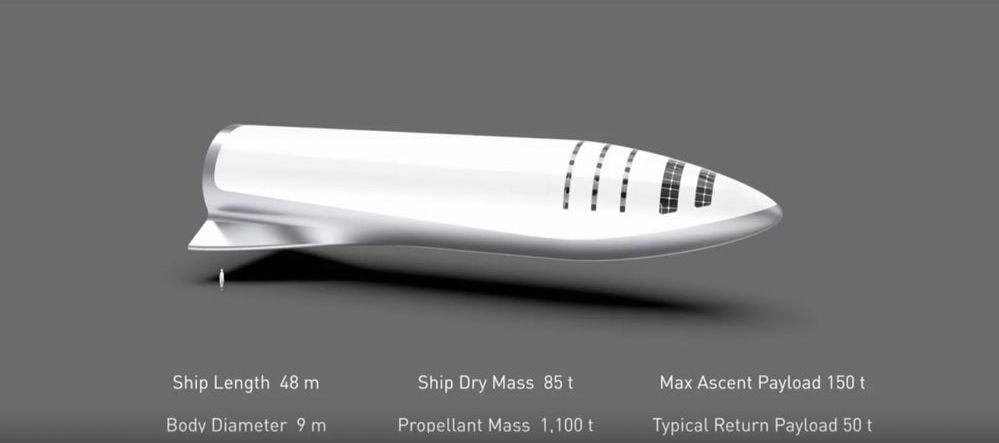
The updates ITS launcher, seen here in comparison to the Falcon 9 and Falcon Heavy, will be 106 metres tall, powered by 31 first stage engines (down from the original 42), and capable of lifting 150 tonnes to low Earth orbit. Credit: SpaceX

Fabrication of parts of the first ITS launcher – which is the linchpin for Musk’s Mars ambitions – has been in progress for some time, and SpaceX hope to start on the assembly of the first vehicle in the series in mid-to-late 2018. Musk is now so confident in the vehicle’s development status, he is hoping to have two of the launch vehicles ready to fly cargo missions to Mars during the 2022 launch opportunity – although he emphasised this time frame is “aspirational” rather than a fixed deadline.

This version of the ITS will be slightly scaled-down from the version announced last year, reducing the overall launch height and mass of the vehicle, and the number of main engines it will require – 31 instead of 42. The 2022 mission will have a two-fold purpose: deliver core components required for human operations on Mars to the surface of the planet; located subsurface water / water ice which could be extracted and used to generate oxygen which could be used within the atmosphere of a future base, and as an oxidizer in fuel used by vehicles making the return flight to Earth.

The upper stage of the ITS is an interplanetary craft powered by a mix of methane (CH4) and oxygen (both of which can be manufactured on Mars, allowing the craft to be re-fuelled there for return flights to Earth) and carrying either cargo in its upper section, or up to 100 passengers in 40 cabins and common crew spaces which offer living space in excess of the space found in an Airbus A380 airliner. Credit: SpaceX

According to Musk, should this mission proceed to plan, it will be followed in 2024 by four craft carrying a mix of equipment, supplies and crews to Mars to commence human exploration of the planet.

All of this is highly ambitious, technically and financially. On the technical front, there are significant issues to be addressed, most notably – but not limited to – that of the radiation threat posed by Galactic Cosmic Rays (GCRs). As I’ve pointed out in past Space Sunday articles on this subject, solar radiation – often seen as “the” radiation threat – can be managed relatively well, simply because it is generally low-energy radiation.

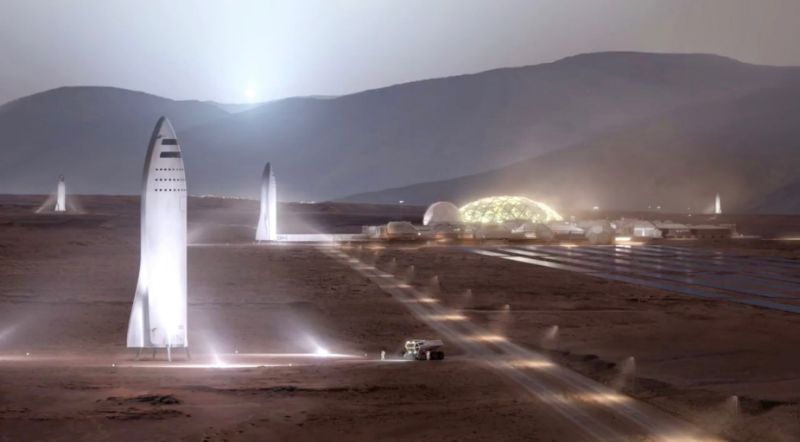
The ITS upper stage on the pad at Musk’s future Mars colony and awaiting refuelling / a return to Earth. Credit: SpaceX

GCRs, however, are high-energy particles which are much harder to deal with: and there is a lot of them in interplanetary space to deal with. Data from the Mars Science Laboratory’s flight to Mars in 2012 revealed that an unprotected astronaut on a similar flight would face the equivalent radiation dose as having a full-body CAT scan every 5-6 days for six months – definitely not a healthy proposition. There are technologies  being developed which can mitigate GCRs, such as such as hydrogenated boron nitride nanotubes (BNNTs), but these are still some way from being available for general use in spacecraft and spacesuit designs. Musk didn’t expand on how SpaceX plan to handle things like GCRs.

He was, however, more forthcoming on how SpaceX would finance the construction and operation of the ITS system. firstly, SpaceX will build up a “stock” of Falcon 9 units which could be used (and re-used) as launchers and components for Falcon Heavy launchers. Secondly, and once available, the revised ITS will be offered as a commercial launch vehicle capable of placing 100 tonnes into low Earth orbit and delivering objects to geostationary orbit or the moon; payloads could be single large items or multiple items. The plan is to use the stock of Falcon boosters through until customers have confidence in the ITS launcher (which will also be reusable) in order to switch over to using it, after which, all Falcon operations will be phased out.

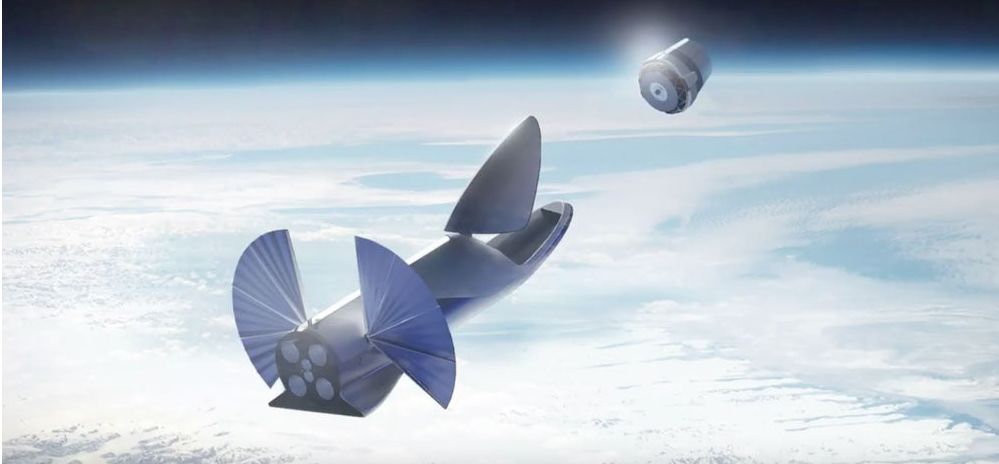
Musk plans to offer the ITS for launches to LEO, the space station, geostationary orbit and even to the Moon for cargo flights, etc. Shown here, an ITS upper stage with solar panels deployed, releases a large single payload into LEO. Credit: SpaceX

In addition, and with usual Musk showmanship, the entrepreneur indicated further revenue could be obtained by offering sub-orbital aerospace flights between major cities in record time. According to his calculations, he claimed that such flights could ferry customers between Bangkok and Dubai in just 27 minutes, or between Tokyo and Delhi in 30 minutes, using a smaller variant of the ITS.

Quite how these system would work or how the necessary support infrastructure needed to support launch / recovery / refurbishment operations around the globe would be financed was not made clear – nor was the potential cost of tickets.

Continue reading “Space Sunday: Mars visions, gateways and James Webb”

Space Sunday: the last goodbye, super-Earths and spaceplanes

September 14th, 2017. One of the final images captured by Cassini as it approaches Saturn for the last time, with mysterious Enceladus visible beyond the limb of the planet. The thin blue haze seen in the picture is the atmosphere above Saturn’s cloud tops, where the spacecraft finally disintegrated. Credit: NASA/JPL / Space Science Institute

At 12:55 UT (13:55 BST, 08:55 EST, 05:55 PDT) the very last signal was received from the NASA / ESA Cassini spacecraft as it entered the upper reaches of Saturn’s atmosphere before disintegrating and burning-up. It was received 83 by NASA’s ground station near Canberra, Australia, 83 minutes after being transmitted – by which time the probe had already been destroyed.

At mission control, at the Jet Propulsion Laboratory, operated jointly by NASA and Caltech in Pasadena, California, it was an emotional moment. For many, the mission had been a part of their daily lives for nigh-on 20 years.

“The signal from the spacecraft is gone and, within the next 45 seconds, so will be the spacecraft,” Cassini programme manager Earl Maize announced, his voice catching, to the team gathered in mission control. “I’m going to call this the end of mission.” He then turned to Spacecraft Operations Team manager Julie Webster and hugged her, before giving Linda Spilker, the Cassini Project Scientist a hug as well. That loss of signal came within 30 seconds of the time predicted ahead of Cassini’s final dive.

Cassini Project Manager Earl Maize (centre left) and Spacecraft Operations Team Manager Julie Webster embrace after the Cassini spacecraft plunged into Saturn, Friday, September. 15, 2017. Credit: NASA / Joel Kowsky

As I reported last week, The Cassini-Huygens mission has been an incredible voyage of discovery, revealing so much about Saturn, its rings and retinue of moons, including hints on the evolution of life itself and revealing how moons Titan and Eceladus may have all the right conditions to support basic life while Tethys could – like Enceladus – have a liquid water ocean under its ice.

Cassini’s final approach commenced on September 11th, as it started back towards Saturn having made a final pass between the planet and its rings and looping away from both the week before. Passing by Titan, and once more using the moon’s gravity to push it into the correct trajectory, the probe headed back for its final encounter with Saturn. The Titan fly-by presented a last opportunity to image and study the moon before Cassini’s imaging system was focused on Saturn for the first part of the final approach. Imaging Saturn ended on Thursday, September 14th as the vehicle re-oriented itself to gather as much data on its brief passage into the upper reaches of Saturn’s atmosphere.

Time line of the final plunge. Credit: NASA

As I’ve previously noted in my Cassini mission updates, the primary reason for sending the probe into Saturn’s atmosphere was because it had exhausted almost all of its on-board fuel supplies used to orient itself and to adjust its flight through the Saturnian system, and the mission team didn’t want to leave the probe tumbling around Saturn’s moons where it might one day impact one of them and contaminate it with both Earthly microbes which may be dormant inside the vehicle, and which radioactive debris from its electrical power generators.

However, an alternative would have been to use the last of the vehicle’s fuel to boost it away from Saturn and out into space, but the scientific return promised by a final plunge into the planet was too good to refuse. “Saturn was so compelling, so exciting, and the mission we finally came up with was so rich scientifically that we just couldn’t — we had to finish up at Saturn, not some place else.” Earl Maize stated during a press conference after the probe’s fiery end.

There are currently no planned missions that will follow Cassini-Huygens to Saturn, although there are proposals to send missions to Titan. However, while the active part of the mission has come to an end, it’s not an end of the mission’s science.

“We have collected this treasure trove of data, so we have decades of additional work ahead of us,” Linda Spilker, the Cassini Mission Scientist said. “With this fire hose of data coming back basically every day, we have only been able to skim the cream off the top of the best images and data. But imagine how many new discoveries we haven’t made yet! The search for a more complete understanding of the Saturn system continues, and we leave that legacy to those who come after, as we dream of future missions to continue the exploration we began.”

As a closing note – for now – it’s not often that a space mission gains an official music video; but Cassini-Huygen has been a major inspiration for many over the past two decades, it has earned not one, but three official music videos which form a suite of music by three composes: Iniziare (Italian: “to start” by Sleeping At Last, aka Ryan O’Neal), Kanna (Icelandic: “Explore” by Sarah Schachner) and Amaiera (“end” or “stop” by Joseph Trapanese). I’ve embedded the first part below.

SpaceX Launch X-37B

On Thursday, September 7th, a SpaceX Falcon 9 booster launched the US Air Force X-37B secret mini-shuttle into orbit ahead of the Florida coast being hit by hurricane Irma. It marked the 13th Falcon 9 launch of 2017, and the fifth flight overall for the X-37B.

The USAF’s X-37B Orbital Test Vehicle (OTV) on the runway at Kennedy Space Centre, May 7th, 2017, at the end of the 717-day OTV-4 mission, being “safed” by a Boeing team in protective suits to guard against harmful fumes and gases given off by the vehicle. Credit: USAF

OTv-5 (Orbital Test Vehicle flight 5) saw the automated spaceplane placed into a higher inclination orbit than previous missions – thus expanding the vehicle’s flight envelope. However, in keeping with previous missions, the USAF has remained mostly silent on the mission’s objectives or its intended duration, revealing only that one experiment flying is the Advanced Structurally Embedded Thermal Spreader II (ASETS-II), which will measure the performance of an oscillating heat pipe.

Previous OTV missions have been long-duration flights, with the maiden flight in 2010 lasting 224 days and 9 hours, which each mission lasting longer than the last, with the last mission completed, OTV-4,  totalling 717 days and 20 hours in orbit. The flights have, up until now, alternated between the two known X-37B vehicles, so although it has not been confirmed, it is believed this mission is being carried out by the first X-37B to fly in space.

The SpaceX Falcon 9 first stage descends to a safe landing at Cape Canaveral Air Force Station after sending the X-37B OTV on its way to orbit on September 7th, 2017. Credit: Ken Kremer

The launch took place from Kennedy Space Centre’s Launch pad 39A, which SpaceX has leased from the US space agency and refurbished to handle Falcon 9 and Falcon Heavy launches – and which is now liable to be the pad from which the company’s massive ITS super-heavy rocket will depart when it enters operations in the 2020s. After separating from the upper stage and its cargo, the Falcon 9 first stage performed a “burn-back” manoeuvre and flew back to SpaceX’s dedicated Landing Zone-1 (LZ-1) at Cape Canaveral Air Force Station alongside Kennedy Space Centre, offering spectators a superb view of the landing.

Continue reading “Space Sunday: the last goodbye, super-Earths and spaceplanes”

Space Sunday: water, spaceplanes and clockwork rovers

TRAPPIST-1 compared in size to our own Sun. Credit: NASA.

Since the February 2017 announcement on the discovery of seven rocky planets orbiting the nearby red dwarf star TRAPPIST-1, multiple studies have been conducted to ascertain whether any of the planets might harbour conditions suitable for life. The nature of their parent star would suggest this to be unlikely. However, an international team utilising the Hubble Space Telescope (HST) to study the TRAPPIST-1 system believe they’ve found evidence that some of the planets have the right conditions to allow liquid water to exist.

Vincent Bourrier, from the Observatoire de l’Université de Genève in Switzerland, and his team used the  Space Telescope Imaging Spectrograph (STIS) to study the amount of ultraviolet radiation each of the TRAPPIST-1 planets receives. If there were too much UV light, no water could survive on the surface because the water molecules would break up and escape through the top of the atmosphere as hydrogen and oxygen gas.

The team found that the inner planets in the system – TRAPPIST-1b and 1c – receive so much UV radiation from their sun, they may have lost more than 20 Earth-oceans worth of water in the course of their history, estimated to be between 5.4 and 9.8 billion years old. Thus, they are almost certainly devoid of water, and their surfaces are likely sterile. However, the findings also suggest the outer planets in the system – including the three within TRAPPIST-1’s habitable zone, may have lost less than three Earth-oceans’ worth of water throughout their history, and could possibly still possess liquid water, making them more amenable for life to rise.

As well as suggesting some of the TRAPPIST-1 planets may have liquid water present, the study has broader implications for the potential of other exoplanets harbouring life. Up to 70% of the stars in the Milky Way are believed to by M-class red dwarfs – and the majority of rocky exoplanets thus far found are orbiting such stars. So this study might indicate that many more of the exoplanets orbiting such stars could support liquid water and, perhaps, conditions suitable for life. However Bourrier and his colleagues emphasise that the study is not conclusive, and further research is needed to determine if any of the TRAPPIST-1 planets are actually watery.

SNC Prepares Dream Chaser for Glide Flight Testing and UN Mission

Sierra Nevada Corporation (SNC) carried out a “captive / carry” test of a Dreamer Chaser Cargo vehicle test article on August 31st, 2017. The flight, with the vehicle slung beneath a helicopter forms the first step towards the Dream Chaser Cargo carrying out glide flights and landings.

During the test, SNC collected data on the vehicle’s performance in flight, including operation of radar altimeters, air data probes and other systems that cannot be fully tested on the ground. The captive /  carry test followed a series of ground tests where the vehicle was towed behind a truck down a runway at speeds of up to 100 kph to ascertain its ground handling on landing.

The Dream Chaser Cargo test article is lifted aloft by helicopter in a captive/carry test. Credit: Sierra Nevada Corporation

SNC developed Dream Chaser to transport astronauts to and from the ISS. However, NASA selected capsule designs by SpaceX and Boeing. After a protest over the decision, filed with the U.S. Government Accountability Office, failed, SNC turned their attention to other potential uses for Dream Chaser.

One of these has been the development of a cargo variant to service the International Space Station (ISS) alongside existing resupply contractors,  Orbital ATK and SpaceX, and in 2016, NASA confirmed Dream Chaser Cargo has been selected to fly resupply missions to the ISS between 2019 and 2024.

On July 19th, 2017, it was announced that SNC had signed a contract with United Launch Alliance for the first two launches of these resupply missions, using the Atlas 5 552 launch vehicle. The first launch is scheduled for 2020 and the second in 2021, although NASA has yet to formally order any Dream Chaser flights.

A Dream Chaser Cargo vehicle will also be used in 2021 to launch the first United Nations mission into space. The United Nations Office of Outer Space Affairs (UNOOSA) said an agreement between them and SNC to fly the dedicated Dream Chaser mission is part of a broader effort by the office to increase access to space to emerging nations.

The mission will be open to all nations, but with a particular emphasis on those that don’t have the capabilities to fly their own experiments in space. UNOOSA are in the process of soliciting payload proposals with a goal of selecting payloads by early 2018 so that the winning countries have time to build them for a 2021 launch.

Unlike the majority of Dream Chaser Cargo missions, which will focused on ISS resupply work, the UNOOSA flight will see the vehicle placed in orbit around the Earth, and SNC have indicated the vehicle will be capable of operating freely in orbit for extended periods of time, should the UN desire a longer mission.

While billed as the UN’s first space mission, the Dream Chaser flight is part of UNOOSA’s Human Space Technology Initiative, launched in 2010 with the goal of providing developing countries the possibility to access space in microgravity conditions. Currently, the initiative includes two other major projects. The first is a cooperative project with the Japan Aerospace Exploration Agency (JAXA), designed to give developing nations the opportunity to launch cubesats from the ISS. Another programme, to be operated in cooperation with China’s space programme, will allow UN-backed missions to be flown aboard China’s space station, when it becomes operational in 2020.

Continue reading “Space Sunday: water, spaceplanes and clockwork rovers”

Space Sunday: an eclipse, a star, a moon and an asteroid

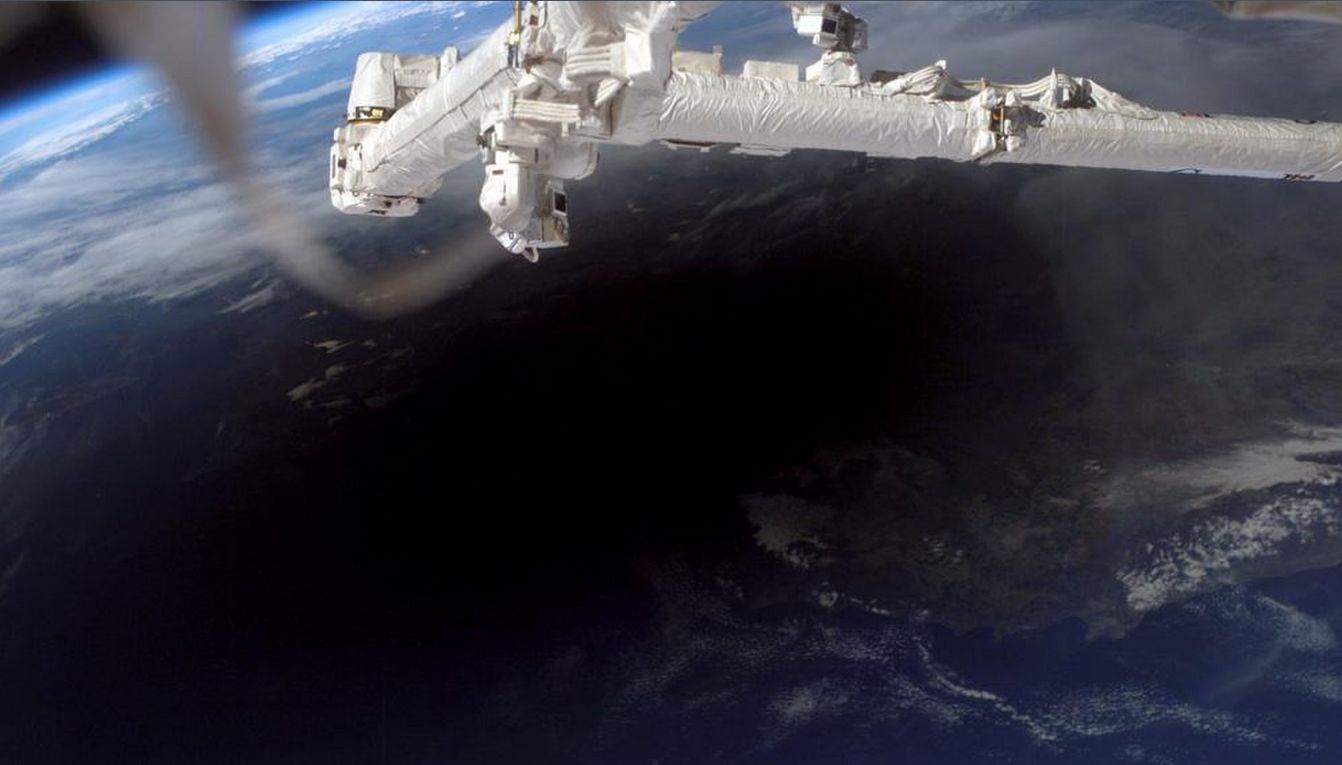
Eclipse 2017: the Moon’s umbra passes over the Earth as witnessed by the astronauts aboard the International Space Station, August 21st, 2017. Credit: NASA.

Eyes were on the sky across the world on Monday, August 21st, 2017, either directly or via live stream and television broadcasts, as people watched the 2017 total eclipse of the Sun. Millions of people in the continental United States were particularly well-placed to enjoy the spectacle first-hand as the line of totality tracked diagonally cross the country from Oregon to South Carolina.

NASA reported that some 90 million people viewed their Eclipse 2017 website on the day, with 40 million staying to watch their live stream of the event. Other organisations providing live streams of the eclipse also reported high numbers of hits / views of their coverage.

As one might expect, the event gave rise to some stunning photos and images which have been posted on Pinterest, Flickr, and other photo sharing websites, plus videos and animations. So much so that picking some out to highlight the event is  tough task – I suggest anyone wanting to recapture the event spend time on-line Googling the 2017 eclipse for reports and images. However, there were a couple of images that did leap out to me when looking through reports and photo sites.

The crew of the International Space Station (ISS), Commander Fyodor Yurchikhin and Sergey Ryazanskiy from Roscosmos, Randy Bresnik, Jack Fischer and Peggy Whitson from NASA and Paolo Nespoli from the European Space Agency), witnessed the Moon’s shadow on the Earth three times as the ISS repeatedly crossed the path of the eclipse as the space station orbits the Earth. This resulted in some remarkable images, including the one at the top of this report.

Uncredited image of an airliner passing between the eclipse and the photographer – note the solar prominence at the 1 and 3 o’clock positions. Click for full size.

One of the reasons astronomers are interested in total eclipses is that they provide ideal opportunities for studying the Sun’s corona and prominences – of which there were a number to be observed during this event. This is reflected in the second of my choices (above), which shows two prominences at the one and three o’clock positions rising “above” the Moon’s disk, as an airliner passes through the shot as well.

Jeff Seibert posted a video of images he captured of the eclipse from Santee, South Carolina. These offer a time-lapse of the start of the eclipse, views the famous “diamond ring” which immediately precedes / follows the period of totality and totality itself, revealing the Sun’s corona.

Five eclipses will take place in 2018. Two of these are total lunar eclipses and three are partial solar eclipses:

  • January 31st, 2018: total lunar eclipse, visible from north / east Africa, Antarctica, Asia, Australia, north / east Europe,  India, North America, north / west South America.
  • February 15th, 2018: partial solar eclipse, visible from Antarctica and southern South America.
  • July 13th, 2018: partial solar eclipse, visible from southern Australia
  • July 27th/28th total lunar eclipse: Africa, Antarctica, much of Asia, Australia, much of Europe, southern part of North America, South America.
  • August 11th, 2018: partial solar eclipse, visible from Arctic, north / west Asia, north / east Europe, northern North America.

The next two total solar eclipses will occur on July 2nd, 2019 and December 14th, 2020. he line of totality for both runs across South America.

Tabby’s Star: Giant Ringed Planet to Blame?

I’ve written several times over the last year about the mystery of Tabby’s Star – more formally known KIC 8462852, an F-type main-sequence star located in the constellation Cygnus approximately 1,480 light years from Earth. It’s been of particular interest to astronomers because it experiences massive and irregular dips in brightness of up to 22% at a time, which last for several days before it reverts to its “normal” brightness once more.

Numerous theories have been put forward on why the star is acting so oddly, from the idea that a race of aliens are building a mega-structure – perhaps a Dyson Sphere around it, through to it being a cloud of comets orbiting the star at a great distance, or that it is some kind of “avalanche” type of activity within the star itself.

In April / May, 2017, KIC 8462852 started on a further cycle of dimming, leading to a world-wide bulletin for astronomers to observe it. This resulted in a further theory that the cause of the dimming might be a combination of two clouds of asteroids and a giant ringed planet orbiting the star.

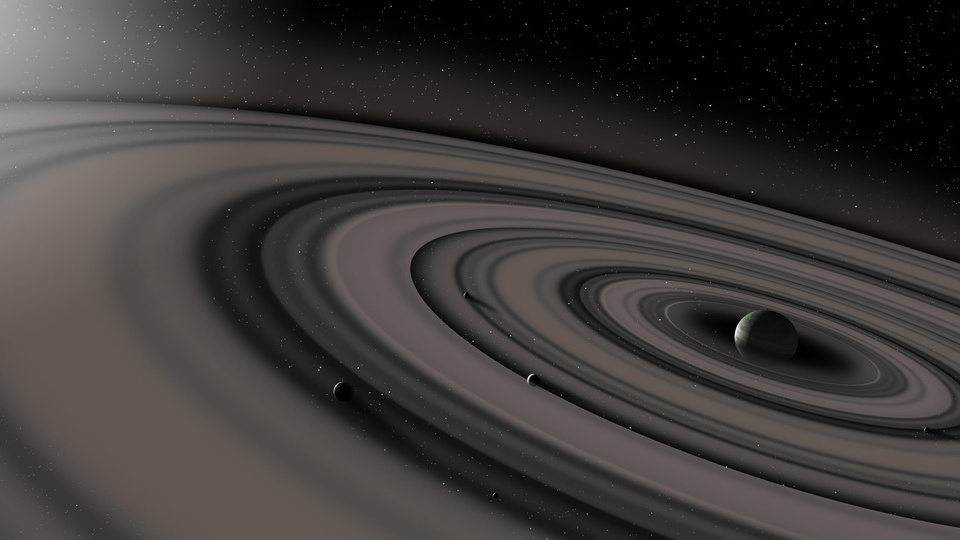
An artist’s impression of exoplanet J1047, thought to have an extended ring system around it. Could a similar planet and ring system account for the fluctuations we see in Tabby’s Star’s brightness? Credit: Ron Miller

This last theory relied on the asteroids occupying the trojan positions either side of the planet as all three orbit the star, making it a complex model. However, another team of researchers from the University of Antioquia in Colombia have now also suggested a ringed planet might be responsible, but in a way which doesn’t require the existence of massive asteroid clouds sharing in the planet’s orbit.

The researchers used data from past dimming events at KIC 8462852 to build a model of the system which shows that a Jupiter / Saturn sized gas giant, orbiting the star at a distance of about 0.1 AU and with an extended Saturn-style system of rings tipped at an angle relative to the planet’s orbital plane around the star could account for KIC 8462852’s apparent fluctuations in brightness.

At such a distance from the parent star, an inclined ring system would not remain relatively constant if form and position, as is the case with Saturn’s rings. Instead, it would undergo short-term changes in shape and orientation as a result of KIC 8462852’s gravitational influence. The researcher’s model shows that these changes would likely lead to changes of the depth of opacity in the ring system, further contributing to the witnessed irregularities in the star’s apparent brightness. As the rings and planet periodically transit between the star and observers on Earth.

A further compelling aspect of this research is that the oscillations in the proposed ring system of any planet orbiting Tabby’s Star could also explain the strangeness witnessed in the  light-curves found in a number of other stars believed to have planets orbiting them. In other words, it is entirely possible astronomers have already observed similar planetary ring systems elsewhere in the galaxy, but simply haven’t been recognised as such.

Like the other theories for KIC 8462852’s behaviour, this latest idea is not definitive; further, better studies of the star – potentially by the James Webb Space Telescope – are required before anything might be known with certainty. However, of all the proposals put forward thus far for the star’s odd behaviour when observed from our solar system, this one does have the virtue of being perhaps the simplest and the first to offer incidental corroboration through the behaviour seen when some other stars believed to have planets orbiting them.

Continue reading “Space Sunday: an eclipse, a star, a moon and an asteroid”

Space Sunday: total eclipse and exoplanet update

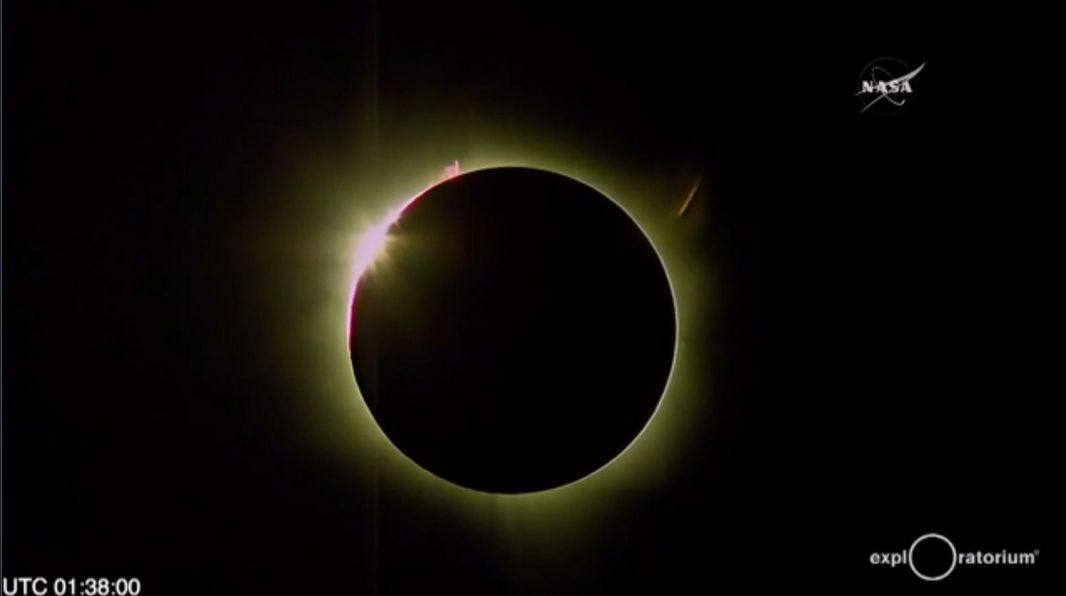
2016 total eclipse Credit: NASA Exploratorium webcast

On Monday, August 21st, the continental United States will experience its first total eclipse of the sun for 38 years (the last total eclipse visible from the USA having occurred in 1979). Providing the weather holds good along the path of the eclipse, an estimated 220 million people will be able to see the event – providing they take the proper precautions.

An eclipse is a periodic event, occurring when the Moon passes between the Sun and Earth and either fully or partially occults (blocks) the Sun’s light. This can happen only at new moon, when the Sun and the Moon are in conjunction as seen from Earth, in an alignment referred to as syzygy. There are actually four types of eclipse:

  • Partial – this occurs when the Sun and Moon are not exactly in line with the Earth, and so the Moon only partially obscures the Sun. Partial eclipses are virtually unnoticeable in terms of the sun’s brightness, as it takes well over 90% coverage to notice any darkening at all.
  • Annular – occurs when the Sun and Moon are exactly in line with the Earth, but because of the variations in the Earth’s distance from the Sun, and the variations in the Moon’s distance from the Earth, the apparent size of the Moon is smaller than that of the Sun. Hence the Sun appears as a very bright ring, or annulus, surrounding the dark disk of the Moon.
  • Total – occurs when the dark silhouette of the Moon completely obscures the intensely bright light of the Sun, allowing the much fainter solar corona to be visible. The complete coverage of the Sun’s disk by that of the moon – referred to as totality – occurs at its best only in a narrow track on the surface of Earth.
  • Hybrid (also called annular/total eclipse) – this shifts between a total and annular eclipse. At certain points on the surface of Earth, it appears as a total eclipse, whereas at other points it appears as annular. Hybrid eclipses are comparatively rare.

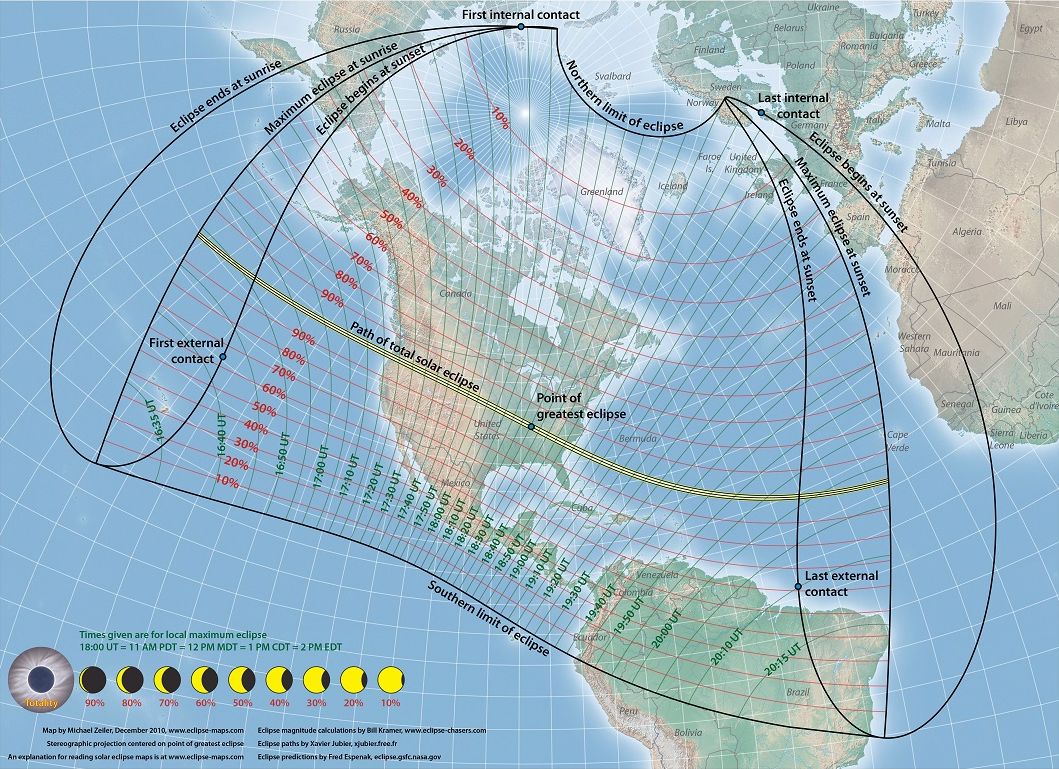
The last total eclipse took place in March 2016, and was visible from South/East Asia, North/West Australia, the Pacific and Indian oceans. The 2017 event will be visible in partial forms across every continent except Antarctica and Australia. However, the path of totality will only be visible across the continental United States.

Although totality slices through the U.S., partial phases of the eclipse touch on every continent except Antarctica and Australia. Credit: Michael Zeiler / The Great American Eclipse – click for full size

The path of totality will run from Oregon to South Carolina, as will be around 113 kilometres (70 miles) wide, offering people along it an unrivalled opportunity to view the eclipse  – weather permitting -, providing the right precautions are taken.

The most important aspect of viewing an eclipse “live” is never look directly at the Sun, even during the period of totality; you should at least use a solar filter or viewer. However, if you don’t have one or the other or any specialised kit, the best way to see the eclipse in the flesh is via pinhole projection. For those who are unable to see the eclipse first-hand, there are a wide variety of ways to watch the event on television or the Internet, including:

  • NASA Total Eclipse live stream is providing options to watch through NASA Edge, NASA TV, Ustream, YouTube and more. NASA’s Facebook page. These will show images of the eclipse, from 11 spacecraft, three aircraft and from more than 50 high-altitude balloons, and the astronauts on the International Space Station.
  • Slooh, the on-line community observatory, will run a webcast starting at 12:oo noon EDT (1600 GMT), as a part of a 3-day celebration of the eclipse.
  • The Virtual Telescope Project is hosting a free online observing session with views of the total solar eclipse beginning at 13:00 EDT (17:00 GMT).
  • The Eclipse Ballooning Project will be broadcasting live views of the eclipse from the edge of space via more than 57 cameras sent up on weather balloons.
  • CNN and Volvo will be providing a 360-degree view of the eclipse with 4K resolution from different locations along the eclipse path. The stream will also be viewable in virtual reality, which people can navigate by moving a phone or virtual reality headset. The live stream begins at 12:03 p.m. EDT (16:03 GMT).
  • ABC will air a two-hour special on the eclipse starting at 13:00 EDT (17:00 GMT). The broadcast will also be available on Facebook Live and YouTube

There are a number of terms common to eclipses which are worth mentioning for those who wish to follow the event, but are unfamiliar with the terminology. These include:

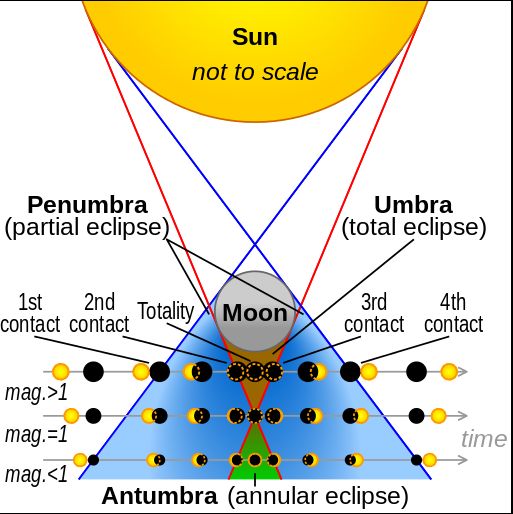
Eclipse Types (Moon and Sun not to scale). Credit: Cmglee
  • The umbra, within which the object in this case, the Moon) completely covers the light source (in this case, the Sun’s photosphere).
  • The antumbra, extending beyond the tip of the umbra, within which the object is completely in front of the light source but too small to completely cover it.
  • The penumbra, within which the object is only partially in front of the light source.
  • Photosphere, the shiny layer of gas you see when you look at the sun.
  • Chromosphere, a reddish gaseous layer immediately above the photosphere of the sun that will peak out during the eclipse.
  • Corona, the light streams that surround the sun.
  • First contact, the time when an eclipse starts.
  • Second contact, the time when the total eclipse starts.
  • Third contact, the time when the total eclipse ends.
  • Fourth contact, the time at which the eclipse ends.
  • Bailey’s beads, the shimmering of bright specks seen immediately before the moon is about to block the sun.
  • Diamond ring, the last bit of sunlight you see right before totality. It looks like one bright spot (the diamond) and the corona (the ring).

A total eclipse occurs when the observer is within the umbra (they are standing in the shadow cast by the Moon); an annular eclipse when the observer is within the antumbra, and a partial eclipse when the observer is within the penumbra.

As well as the passage of the Moon between the Earth and Sun, there are a number of Earthly effects to look for if you are in the path of totality, such as a the 360-degree sunset. This may also be accompanied by an “eclipse wind” as temperatures suddenly drop. And, of course, there is the rousing of nocturnal animals, fooled by the darkness, followed by a false dawn as the Moon moves away from between the Earth and the Sun, and an accompanying dawn chorus.

The period of totality lasts only a few minutes but offers a superb opportunity for observing the Sun and its corona – hence why NASA is using a chain of three aircraft to “chase” the eclipse as the Moon’s shadows travels at an average speed of 3,683 km/h (2,288 mph) west-to-east, enabling them to carry out an extended study of the corona.

The Moon’s shadow on Earth, as seen from the International Space Station on March 29th, 2006 as it passes over southern Turkey, Northern Cyprus and the Mediterranean Sea. Credit: NASA

As a point of historical interest, August 21st marks the 103rd anniversary of the 1914 total eclipse, which was seen from Scandinavia through to Turkey, the middle east and India. It was the subject of a number of expeditions being sent eastwards to the Baltic and Ukraine by Britain and other European nations with the intention of studying it – only for the conflagration of the First World War to erupt.

The war foiled attempts by a British expedition which intended to use the eclipse as a means to measure relativity; however, it did give rise to another mystery: whether or not a film of the eclipse apparently made in Sweden in 1914 is the real deal or not. If it is, it might be the oldest surviving footage of an eclipse.

If you are on the path of totality, and plan to view the eclipse, do please take the proper precautions and I hope the weather cooperates with you. I’ll be following things on-line.

Continue reading “Space Sunday: total eclipse and exoplanet update”