Space Sunday: a DART plus JWST and TRAPPIST-1 updates

NASA’s Double Asteroid Redirection Test (DART) vehicle under thrust as it closes on the asteroid Dimorphos as it orbits Didymos. Credit: NASA

On November 24th, 2021, NASA launched the Double Asteroid Redirection Test (DART) mission, a vehicle aimed at testing a method of planetary defence against near-Earth objects (NEOs) the pose a real risk of impact.

I’ve covered the risk we face from Earth-crossing NEOs – asteroids and cometary’s fragments that routinely zoom across or graze the Earth’s orbit as they follow their own paths around the Sun. We are currently tracking some 8,000 of these objects to assess the risk of one of them colliding with Earth at some point in the future. This is important, because it is estimated a significant impact can occur roughly every 2,000 years, and we currently don’t have any proven methods of mitigating the threat should it be realised. And that is what DART is all about: demonstrating a potential means of diverting an incoming asteroid threat.

Developed as a joint project between NASA and the Johns Hopkins Applied Physics Laboratory (APL), DART is specifically designed to deflect an asteroid purely through its kinetic energy; or to put it another way, by slamming into it, and without breaking it up. Both are important, because by simply slowing an Earth-crossing NEO along its orbit, we give time for Earth to get out of its way; then, by not causing it to break, then we avoid the risk of it becoming a hail of shotgun pellets striking Earth at some point further into the future.

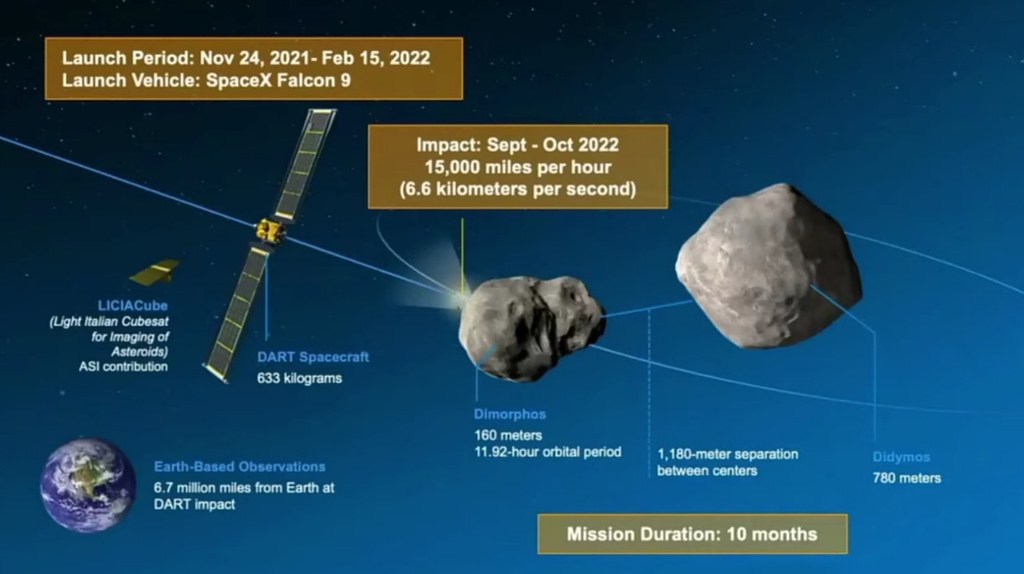
The DART mission. Credit: NASA

The target for the mission is a binary asteroid 65803 Didymos (Greek for “twin”), comprising a primary asteroid approximately 780 metres across, and a smaller companion called Dimorphos (Greek: “two forms”) caught in a retrograde orbit around it, with both orbiting the Sun every 2 years 1 month, periodically passing relatively close to Earths, as well as periodically grazing that of Mars.

Discovered in 1996 by the Spacewatch sky survey the pair has been categorised as being potentially hazardous at some point in the future. At some 160m across, Dimorphos is in the broad category of size for many of the Earth-crossing objects we have so far located and are tracking, making it an ideal target.

DART actually started as a dual mission in cooperation with the European Space Agency (ESA) called AIDA – Asteroid Impact & Deflection Assessment. This would have seen ESA launch a mission called AIM in December 2020 to rendezvous with Didymos and enter orbit around it in order to study its composition and that of Dimorphos, and to also be in  position to observe DART’s arrival in September 2022 and its impact with the smaller asteroid.

However, AIM was ultimately cancelled, leaving NASA to go ahead with DART. To reduce costs, NASA initially looked to make it a secondary payload launch on a commercial rocket. But it was ultimately decided to use a dedicated Falcon 9 launch vehicle for the mission, allowing it to make its September 2022 rendezvous with Dimorphos.

An artist’s impression of DART and the LICIACube cubesat, with Dimorphos and Didymos in the background. Credit: NASA

In order to impact the asteroid at a speed sufficient to affect its velocity, DART needs to be under propulsive power. It therefore uses the NEXT ion thruster, a type of solar electric propulsion that will propel it into Dimorphos at a speed of 6.6 km/s – which it is hoped will change the velocity of the asteroid by 0.4 millimetres a second. This may not sound a lot, but in the case of hitting an actual threat whilst it is far enough away from Earth, it is enough to ensure it misses the planet when it crosses our orbit.

This motor is powered by a deployable solar array system first deployed to the International Space Station (ISS). However, what is most interesting about these solar panels is that a portion of them is configured to demonstrate Transformational Solar Array technology that can produce as much as three times more power than current solar array technology and so could be revolutionary should it reach commercial production.

Accompanying DART is Light Italian CubeSat for Imaging of Asteroids (LICIACube), a cubesat developed by the Italian Space Agency, and which  will separate from DART 10 days before impact to acquire images of the impact and ejecta as it drifts past the asteroid. To do this, LICIA Cube will use a pair of cameras dubbed LUKE and LEIA.

As the cubesat is unable to orbit Didymos to continue observations, ESA is developing a follow-up mission called Hera, Comprising a primary vehicle bearing the mission’s name, and two cubesats, Milani and Juventas, this mission will launch in 2024, and arrive at the asteroids in 2027, 5 years after DART’s impact, to complete a detailed assessment of the outcome of that mission.

 ISS Gets a New Module

On November 26th, 2021, a new Russian module arrived at the International Space Station (ISS).

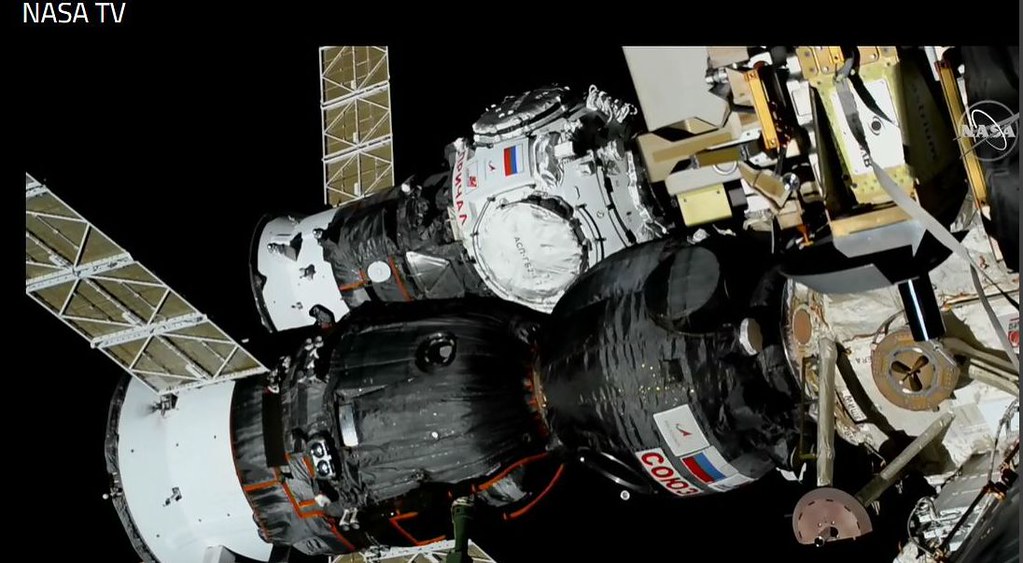
The Prichal, or “Pier,” module had been launched by a Soyuz 2.1b rocket out of the Baikonur Cosmodrome in Kazakhstan two days earlier. Mounted on a modified Progress cargo vehicle, the module was successfully mated with the Nauka module which itself only arrived at the station in July, at 15:19 UTC.

Carried by a Progress vehicle, the Prichal module approaches the ISS. Credit: NASA TV

The four-tonne spherical module has a total of six docking ports, one of which is used to connect it with Nauka, leaving five for other vehicles. However, when first conceived, the module was also intended to be a node for connecting future Russian modules.

But since that time, the Russian space agency, Roscosmos, has abandoned plans to support the ISS with additional modules. Instead, with relations with the west continuing to cool and the ongoing rise in nationalism in Russia, the agency has indicated it plans to orbit its own space station. This being the case, Prichal is viewed as the final element in the Russian segment of ISS, and potentially the first of the new station.

Unlike the arrival of Nauka in July, Prichal managed to dock with the ISS without the additional “excitement” of any thruster mis-firings. Now, the Progress carrier vehicle will remain attached to the module through until December 21st, allowing time for the Russian cosmonauts on the station to carry out a spacewalk to attach Prichal to the station’s power systems. Once it has been detached, the Progress vehicle will be set on a path to burn-up in the Earth’s atmosphere.

Visible over the top of a Progress resupply vehicle, the Prichal module and its Progress carrier can be seen docked with the nadir port of the Nauka module. Credit: NASA TV

As well as expending the docking facilities at the ISS, Prichal delivered some 2.2 tonnes of cargo and supplies to the station. The module will formally commence operations in its primary role in March 2022 with the arrival Soyuz MS-21.

Continue reading “Space Sunday: a DART plus JWST and TRAPPIST-1 updates”

Space Sunday: a little astronomy and a round-up

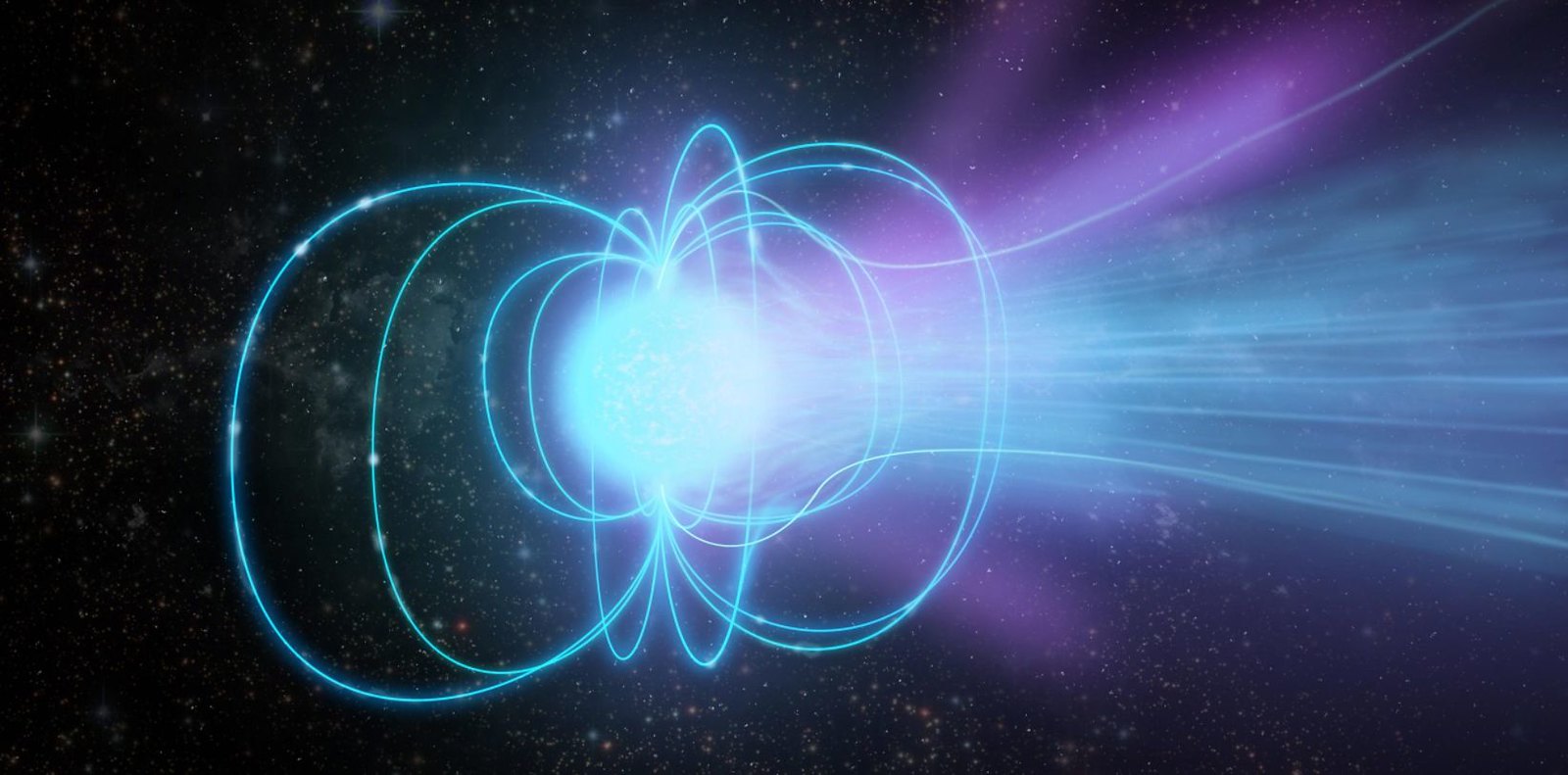
Artist’s conception of a magnetar — a super dense neutron star with an extremely strong magnetic field. In this illustration, the magnetar is emitting a burst of radiation. Credit: Sophia Dagnello, NRAO/AUI/NSF

Fast radio bursts (FRBs) are one of the strangest phenomena we’ve yet discovered in the cosmos – and they are also one of the most recent, the first one only being detected in 2007.

FRBs produce pulses in the radio part of the electromagnetic spectrum that last just a few thousandths of a second but produce as much energy as the sun does in a year. They are believed to originate within magnetars, a kind of ultra-dense neutron star (itself the collapsed remnants of a star) with an exceptionally strong magnetic fields which can warp their behaviour; however, this has yet to be confirmed.

Most FRBs have been detected originate in galaxies other than our own, and are very mixed in nature. Some FRBs emit energy just once but others can do so in repeated bursts. The thinking is that their intense bursts of energy is the result of some complex interaction between a magnetar’s massive magnetic field – trillions of times more powerful than Earth’s – and the outer layers of the neutron star itself, causing a massive explosion we later detect as radio waves.

One FRB that is known to recurring bursts is called FRB 121102, and is located in a dwarf galaxy 3 billion light-years from Earth. It was selected as a candidate for study using China’s  massive Five-hundred-metre Aperture Spherical radio Telescope (FAST), which only became operational in 2020. The hope was study of FRB 121102 would reveal the secrets of these strange objects, including their source and cause. Instead, the study has actually deepened the mystery.

The Five-hundred-metre Aperture Spherical radio Telescope (FAST) in China, the world’s largest (2.25 times larger than the former Arecibo Observatory radio telescope) and most sensitive radio telescope and nicknamed “Heaven’s Eye”

Prior to FAST turning its attention on FRB 121102, recorded observations by the likes of (the now defunct) Arecibo radio telescope suggested it gave off bursts of 10 radio pulses on a non-regular basis. However, FAST is so sensitive, found FRB 121102 can generate up to 117 pulses per hour, with some just a few thousandths of a second apart, with 1,652 bursts detected in the first 60 hours of observations!

Exactly how it can do this remains a mystery – but it suggests that the current theory of magnet field / star “surface” interactions is incorrect. Such interactions would generate violent outbursts of matter from the magnetar, and these would have to collapse to prevent them interfering with further bursts – and a few thousands of a second is too short a period in which this could happen.

No direct conclusions can be drawn from the study of FRB 121102; the international team behind it stating they now need to use FAST to study other repeating FRBs to see if they can find similar “hidden” bursts from them, in order that a more complete picture might start to be built up as to what might be happening, why, and how.

 The “‘Fridge” That Skimmed Earth

I’ve often written about NEOs, or near-Earth objects – chunks of rock in a range of sizes from just a few metres through to a few kilometres  – that orbit the Sun in a manner that means that periodically cross Earth’s orbit or can pass relatively close to us. Such is the threat posed by these objects should one of the large ones actually collide with Earth, considerable effort has been put into finding and tracking them, using their close passages to Earth to better track and predict their orbits in years to come.

As a result, many of the large NEOs have indeed been located and tracked; but there are still many hundreds, if not thousands, which, while not threatening all of civilisation on the planet, could still do much to totally ruin people’s day were they to enter the Earth’s atmosphere and explode under air pressure or even survive and strike a centre of population.

October 24th, 2021 saw a small reminder of this threat, when a chunk of rock about the size of a refrigerator and dubbed Asteroid 2021 UA1, skimmed past Earth, passing just 3,000 km above Antarctica. While the rock was too small to cause any real damage, had it entered the atmosphere, it would likely have completely burned up, it was not actually spotted until it was moving away from Earth once more, its approach having been lost in the glare of the Sun – hence why it acted as a reminder of the threat poised by larger NEOs – that we might not actually see them before them become a problem.

This is what happened in 2013, when a cometary fragment roughly 20 m across entered the Earth’s atmosphere to explode at an altitude of 26 km over the the Russian oblast of  Chelyabinsk. The blast yield of explosion was 400–500 kilotons of TNT, with the shockwave it generated damaging some 7,200 buildings in six cities across the region and injuring more than 1,500 people.

The passage of Asteroid 2021 UA1 is also a timely reminder that later in November, NASA plans to launch the Double Asteroid Redirection Test (DART), an attempt to test a method for diverting asteroids by hitting them with high-speed remote-controlled vehicles, and I’ll have more of that mission in an upcoming Space Sunday report.

Selected Round-Up

Hubble Remains in Safe Mode

As I noted in my last Space Sunday update, the veritable Hubble Space Telescope (HST) entered a “safe” mode intended to protect its science capabilities on October 25th, 2021. With science activities suspended, the instruments are said to be in “good health”. However, in providing an update to the situation, NASA revealed HST actually suffered two glitches in relatively short order.

The Hubble Space Telescope, seen in 2002. Credit: NASA

On October 23rd, the telescope’s science instruments issued an error code indicating the loss of an automated synchronisation message issued by the main computer to provide timing information to the science instruments, allowing them to properly respond to commands. This issue appeared to be corrected when a command was sent to the science instruments ordering them to reset; however, the October 25th issue appears to be related, in that “multiple losses of synchronisation messages” were reported immediately prior to the safe mode being triggered.

Right now, Hubble engineers have no idea what triggered the loss of the messages, and the focus is on trying to obtain further data from HST so a more proper diagnosis of what occurred, and what is required to bring Hubble back on-line.

Continue reading “Space Sunday: a little astronomy and a round-up”

Space Sunday: space stations, telescopes and images

A conceptual image of the completed Orbital Reef space station, with a mix of rigid and inflatable additional modules, and a Dreamchaser Cargo spaceplane docked to the right, and two Boeing CST-100 Starliners docked on the left. Credit: Blue Origin / Sierra Space

October 25th, 2021 saw an announcement that caught much of the space media by surprise during the proceeds of the 72nd International Astronautical Congress in Dubai, when Jeff Bezos’ Blue Origin and Sierra Space, the space development arm of the Sierra Nevada Corporation (SNC), revealed they plan to lead a multi-corporate venture to establish a commercial space station in Earth orbit by 2030.

Orbital Reef, as the facility is to be called, is intended to see the consortium led by the two companies establish the basics for the station by the later 2020s, allowing for a potential transition of orbital operational from the International Space Station (ISS) to Orbital Reef by the time the ISS is retired in 2030.

Under the partnership, Blue Origin will develop large-diameter core modules and utility systems, as well as provide launch services using its still-to fly New Glenn heavy lift launch vehicle (HLLV), whilst Sierra Space will provide additional inflatable modules for the facility, and use its Dream Chaser cargo space plane for resupply missions, and (at some point) the original crewed version of the space plane to transfer personnel to / from the station.

Conceptual rendering of Genesis Engineering Solutions “single person space vehicle”. Credit: Genesis Engineering Solutions

Other companies involved in the project include Boeing, who will supply a science module for the station provide their CST-100 Starliner crew vehicle for personnel transfers and provide all ground-based systems operations and support for the station, and Genesis Engineering Solutions will provide a “single person space vehicle” that is already being called the “space pod” for on-obit operations around the station in situations where “suitless” EVAs are desirable.

Blurb for the station states it will be used for a variety of roles: commercial ventures, research across a number of fronts (with Arizona State University leading a consortium of 14 international universities that plan to participate in the research work) and – inevitably – a vacation destination for those with deep pockets.

A promotional video for the station shows it have a long, pressured core module, complete with large windows, together with fore-and-aft docking ports for visiting space vehicles, and multiple port along its sides for the addition of permanent or temporary modules, which can also have their own docking facilities. However, this is said to be the “final” configuration of the station, complete with a multi-array solar power system; the initial “baseline” facility will be far smaller and more modest.

The completed station will be positioned at 500 km altitude – somewhat above the ISS’s nominal 475 km – and will be capable of supported up to 10 people at any one time, with 830 cubic metres of usable internal space – marking it as slightly smaller than the ISS – although this can, as noted, be expanded through the use of additional modules.

The announcement comes as one of several offered in response to NASA’s Commercial LEO Destinations programme, which will select up to four proposal for commercial facilities to replace the ISS, and finance the initial R&D ins each, with further funding to cover certifying the stations for use by NASA astronauts. However, both Sierra Space and Blue Origin have indicated they plan to move ahead regardless of any NASA seed funding.

A critical factor for the project will be Blue Origin’s New Glenn rocket. Development of this initially commenced as a design study in 2012, with the project formally announced in 2016. However, unlike the development of the SpaceX Starship / Super Heavy (which started development at the same time as New Glenn), it has yet to fly, and has seen a number of shifts in direction.

Like SpaceX’s Falcon 9 core stage and their Super Heavy booster, the first stage of New Glenn is intended to be reusable. However, earlier in 2021, the company announced plans to accelerate the development of a reusable upper stage, code-named Jarvis which – in grabbing a leaf from the SpaceX book of how to do things – will be in part be of a stainless steel construction. Because of this, coupled with issues experienced in developing the vehicle’s primary engine, the BE-4, the first flight of New Glenn most likely will not take place until very late in 2022, or early 2023, some three years behind the original target date.

Dreamchaser Cargo spaceplane and external unpressurised cargo module / power “trunk”. This craft is due to start flying to the ISS in 2022, and would be used to fly resupply missions to Orbital Reef. Credit: Sierra Space / SNC

While timeline slips in any developing project are to be expected (just look at NASA, or indeed, “Elon Time” vs actual time with SpaceX projects), the pace of development with New Glenn does question whether Blue Origin can meet a 5-7 year timeline to provide the core of a space station. By contrast, Sierra Space is due to start flying their Dreamchaser Cargo vehicle on resupply flights to the ISS in 2022, and prior to losing on a contract to fly a crewed variant of the vehicle to carrying astronauts to / from the ISS as part of NASA Commercial Crew Programme, SNC has continued to maintain research into a crewed version of the vehicle.

Other entities / consortiums throwing their hats into the ring to provide commercial orbital facilities include Axiom Space, with plans – as noted in past Space Sunday articles – to fly at least one module to the ISS in the mid-2020s, with the planes to use the module(s) it flies to the ISS as the core of a new station as ISS reaches its end-of-life at the end of the 2020s. Another consortium, Nanoracks, Voyager Space Holdings and Lockheed Martin, announced plans to fly a much more modest space station, Starlab. Utilising an inflatable module and core docking / power facility, Starlab would have an internal volume of 340 cubic metres and would be capable of supporting up to 4 people at a time.

Hubble Suffers Further Glitch

The Hubble Space Telescope (HST), the thirty-year-old veteran of orbital space science, suffered a further operational glitch on Monday, October 25th, unexpectedly switching itself into a “safe” mode that has suspended all science operations.

The switch-over happened after Hubble experienced synchronisation issues with its internal communications”; however, the telescope is reported to otherwise be in good health. This is the second time this year the telescope has switched to a safe mode – in summer an issue with the primary payload computer that took a month to diagnose and rectify, gave rise to concerns over HST’s future – although this issue is not as serious, but there is currently no estimate as to when normal operations might be resumed.

While it may not be considered serious, this latest issue is, however, indicative of HST’s advancing years and the fact that it was last serviced in 2009, so sadly, elements aboard it will be approaching their end-of-life – although it is hoped the telescope will be able to remain operation through until the late 2030s.

Continue reading “Space Sunday: space stations, telescopes and images”

Space Sunday: transporting a telescope, NS-18, Lucy and China

The James Webb Space Telescope (JWST), shown with the central segment of its gold mirror just visible above the compressed solar shield, housed within the inner casing and support structure of STTARS, is lowered towards the base of the container. Credit: Northrop Grumman / NASA

How do you ship a telescope several thousand kilometres without damaging it? You pack it in a special carry-case. How do you transport it in conditions that allow it and its ultra-sensitive components to remain completely clean with a strictly controlled environment? You ship it in a very special case. How do you do all this with a telescope that is 20 metres in length, 14 metres across and weighs 6.5 tonnes?

You get a really big special case – which is precisely what NASA has done with the James Webb Space Telescope (JWST). They call it STTARS – the Space Telescope Transporter for Air, Road and Sea, and it is pretty much as remarkable as the telescope itself.

Weighing 76 tonnes, STTARS is 33.5 metres in length, 4.6 metres wide and 5.5 metres high. It was built specifically to handle the shipping of various JWST components around the United States and bring them together at the Northrop Grumman assembly and integration facilities at Redondo Beach, California. And now it has been used to ship the completed telescope the 9,500 km California to the launch site in French Guiana.

STTARS, carrying the JWST, en route to Seal Station, California. Credit: NASA

STTARS is more than just a container. It is an ultra-clean, hermetically sealed environment designed to minimise all vibrations and G-forces that reach the telescope and its sensitive instruments during transport, while holding them in an atmosphere that is strictly regulated and allows for the presence of no more than 100 airborne particles greater than or equal to 0.5 microns in size within it. For reference, half a micron is just one hundredth of the width of a human hair!

To achieve this, STTARS also had to be built in an ultra-clean environment, and before each use it is subjected to a highly-detailed “cleaning” using high-intensity ultra-violet light to both locate contaminants so they can be removed, and to kill off microbes. Following installation, the unit is connected to a dedicated heating, ventilation, and air-conditioning (HVAC) system that maintains temperature, humidity and pressure precisely as the telescope experienced them within Northrop Grumman’s clean room. In addition, it contains special mounts and dampeners designed to hold the telescope securely and isolate it as much as possible from bumps and other forces when being moved around.

Even so, moving STTARS around still takes considerable care. For example, the 35 km drive from Northrop Grumman’s facilities the port at Naval Weapons Station Seal Beach in preparation from the journey to French Guiana was performed at an average speed of just 10-12 km/h to avoid undue bumps, and potholes along the route had to be repaired in advance. The journey was also carried out at night to both minimise traffic disruption and the amount of traffic vibration affecting STTARS and its cargo.

Once at Seal Beach, STTARS was carefully transferred to the MN Colibri for the trip to the European Spaceport – air transport having been ruled out both because of the amount of vibration and stress it could place on JWST, and because the 96-km journey from airport to spaceport in French Guiana would require the reinforcing of several bridges in order to support STTARS weight.

Built as a roll-on – roll-off (Ro-Ro) freighter by Maritime Nantaise, the MN Colibri is in fact a highly specialised vessel ideal for transporting JWST. Commissioned by the European Space Agency, it is also used to transport Ariane and Soyuz rockets and their cargoes from Europe and Russia and elsewhere in the world to the European Spaceport. Not only is she fitted with the kind of specialist equipment needed by sensitive HVAC systems, etc., she has the unique characteristic of being able to adjust her trim whilst at sea to reduce things like vessel roll to minimise the stresses placed on her cargo. Even so, travelling at an average 15-16 knots, her journey down the coasts of the United States and central America and through the Panama canal to Port de Pariacabo, Kourou, roughly 15 km by road from the space centre, took almost a month, the vessel arriving on October 12th.

The use of the MV Colibri meant that at no point did STTARS have to be transferred off of its transporter, again minimise vibration or other shocks being transmitted to the telescope (as well as reducing the risk of any form of unforeseen loading / unloading accident), allowing its special transporter and support equipment to been driven on to the vessel (with the assistance of a barge, purely due to the layout of the docks), be secured, and then driven off again for the journey to the space port, where it arrived on October 13th.

Over the next two months, JWST will be unpacked and given a careful check-up. It will then be prepared for launch, being mounted on its launch adaptor and Ariane upper stage, enclosed within its payload fairings and then integrated with the booster itself. Providing all goes according to plan, the telescope is due to be launched on December 18th, 2021.

Blue Origin NS-18

Wednesday, October 13th saw Blue Origin complete the 18th successful flight of their New Shepard sub-orbital system.

Aboard NS-18 were Blue Origin’s President of Mission & Flight Operations Audrey Powers, fare-paying passengers Chris Boshuizen, co-founder of the Earth-observation company Planet, and Glen de Vries, co-founder of the medical software company Medidata Solutions, and invited guest, actor William Shatner.

A camera mounted at the top of the New Shepard booster captures the capsule rising ahead of it following separation (l). And a high-resolution camera images the separated booster and capsule from Earth (r). Credit: Blue Origin

In the process, Mr. Shatner – best known for his roles at Captain James T. Kirk, police officer T.J. Hooker and eccentric lawyer Denny Crane – became the oldest individual to date to fly into space at 90 years of age – a record he could well hold for some time – and Chris Boshuizen became the first full Australian national to become an astronaut (not counting those who have flown space missions under dual nationality).

The live stream of the launch revealed that the company has been somewhat stung by the essay co-written by 21 current and past employees and recently published by The Lioness that cites safety and other concerns: the initial part of the live stream sounded more like an attempt to rebut the charges made than an attempt to cover the launch and flight.

NS-18 crew (l to r): Glen de Vries, Audrey Powers, William Shatner and Chris Boshuizen, share a moment holding on to the central table aboard their capsule as they experience micro-gravity. Credit: Blue Origin

Overall, the flight was, from an observational standpoint, uneventful. The vehicle lifted-off smoothly as scheduled, then climbed up through 57 km, where main engine cut-off (MECO) occurred. Moments after this, the capsule separated from the booster, and both continued to rise under their own inertia and in tandem, the capsule above and to one side of the booster to avoid collision.

Apogee was reached at 107 km, and the fall back to Earth began. At this point, the two parts of the New Shepard vehicle became more distanced from one another, the pencil- line booster, kept upright by deployable fins, dropping more-or-less vertically through the air, the rounded form of the capsule generating more air resistance and so falling at a slightly slower rate. This meant that the booster, re-firing its BE-3 engine at 1.2 km above the ground to ease itself into a touch-down, ended its forth flight before the capsule had got as far as deploying its parachutes.

Blue Origin NS-18 drifts towards landing under its three main parachutes. Credit: Blue Origin

The initial deployment of the capsule’s drogue ‘chutes at just under 2 km altitude, shaved 100 km/h from its descent speed  – from around 320 km/h to 221 km/h  – in 12 seconds, bringing the capsule down to a speed where the three main parachute could deploy, slowing the capsule a a fairly “gentle”22 km/h prior to touchdown.

Following his egress from the capsule, it was clear that Mr. Shatner had been profoundly affected by the flight and the site of Earth from space, as he talked in very emotional terms to Blue Origin founder Jeff Bezos (who initially and sadly appeared more interested in grabbing some champagne than in paying attention) about understanding the real fragility of the Earth, something which has remained his core point of discussion during interviews in the days following the flight.

In this, Mr. Shatner’s experience was perhaps a step apart from his fellow passengers, who – as with those of the MS-16 flight – seemed more interested in the “fun” of micro-gravity than in pondering deeper thoughts. We often – perhaps glibly – say that flying into space is a “life changing” experience; but William Shatner articulates this perhaps in a way we can finally understand, as he does the sheer fragility of our world  and its thin envelope of life-giving atmosphere. I would that more – particularly those in power – could share in his experience and realisation.

Continue reading “Space Sunday: transporting a telescope, NS-18, Lucy and China”

Space Sunday: Lucy in the sky and Captain Kirk

An artist’s impression of the Lucy spacecraft flying past the Trojan asteroid (617) Patroclus and its binary companion Menoetius in 2033. Credit: NASA

Update: The report on William Shatner flying on NS-17 has been revised to reflect the fact the launch has been pushed back 24 hours from Tuesday, October 16th, 2021 to Wednesday, October 17th, due to weather concerns.

One of the most ambitious robotic missions NASA has ever undertaken – in a long history of such missions – is due to be launched on Saturday, October 16th, 2021.

After lifting-off from Cape Canaveral Space Force Station by a United Launch Alliance Atlas V-401 vehicle, the Lucy space vehicle – centrepiece of a US $981 million mission of the same name – will commence a 12-year mission that will carry it, by means of three Earth gravity assists, to explore some of the earliest remnants of the solar system.

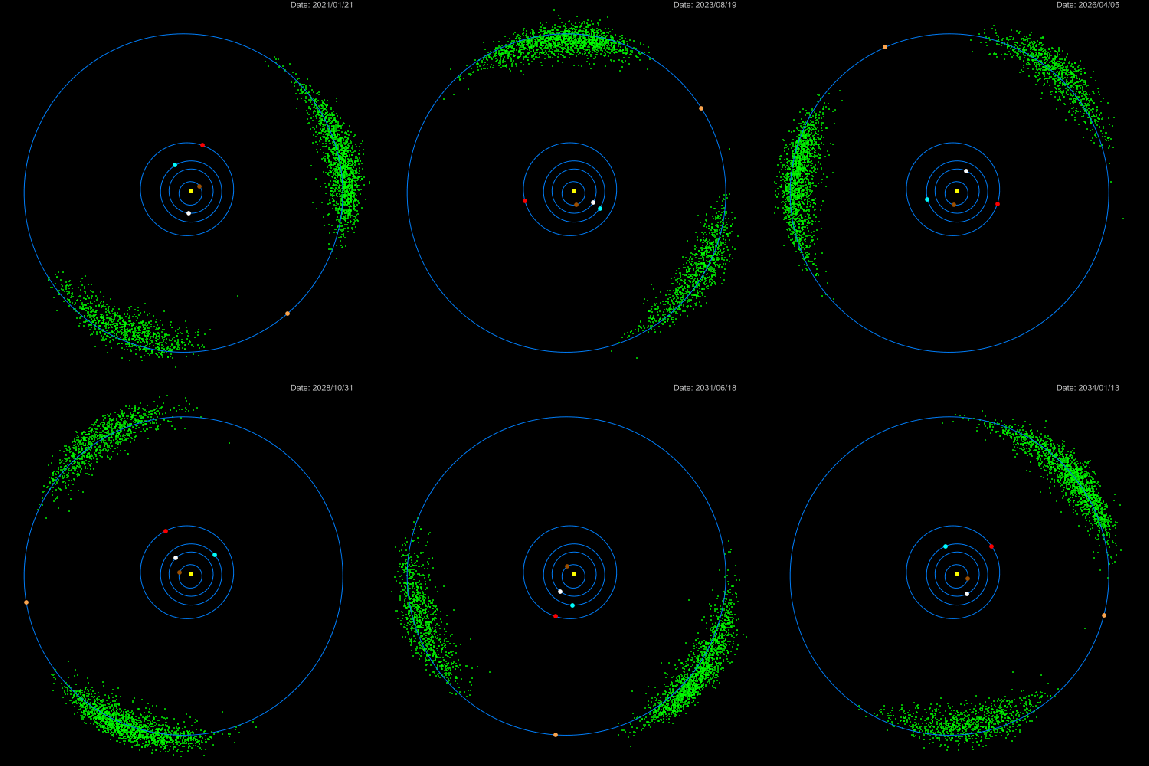
Computer model showing the Jovian Trojan asteroid clouds at the Jupiter-Sun L4 and L5 positions. Credit: Astronomical Institute of CAS/Petr Scheirich

These are the Jovian Trojan asteroids, the “leftovers” from the creation of the solar system. They orbit the Sun in two large clouds, one group, called the Greek Camp, leading Jupiter in its path around the Sun and that Jupiter-Sun L4 position, the other – the Trojan Camp – trailing behind the planet at the Jupiter-Sun L5 position.

The mission takes its name from the fossilised human ancestor (called “Lucy” by her discoverers) whose skeleton provided unique insight into humanity’s evolution. Likewise, it is hoped the Lucy mission will revolutionise our knowledge of planetary origins and the formation of the solar system.

The core element of the mission will be fly-bys of a total of asteroids, providing us with our first close-up view of all three major types of asteroids in the solar system. These are the D- and P-types that resemble those found in the Kuiper Belt of icy bodies that extends beyond the orbit of Neptune, and the D-type, which are found mostly within the main asteroid belt between Mars and Jupiter. All three types are thought to be abundant in dark carbon compounds, and that below an insulating blanket of dust, they might be rich in water and other volatile substances.

No other space mission in history has been launched to as many different destinations in independent orbits around our sun. Lucy will show us, for the first time, the diversity of the primordial bodies that built the planets. In order to do this, the mission will fly a complicated course: after launch, the craft will fly a circular orbit around the Sun close to Earth’s that will allow it use our gravity in 2022 to push it into a more elongated orbit, returning it to Earth once more in 2024, when it will again use our gravity to push it on toward the Greek Camp of Trojans.

Whilst on route, Lucy it will pass by the main asteroid 52246 Donaldjohanson, named for the discoverer of the Lucy hominin fossil. On reaching the Greek Camp in 2027, it pass through them, performing fly-bys of 3548 Eurybates and its companion Queta,15094 Polymele11351 Leucus, and 21900 Orus. Its orbit around the Sun will then bring it back to Earth in 2031, where it will once again use our gravity to swing it out into an orbit that will allow it to pass through the Trojan Camp of asteroids trailing behind Jupiter, which it will it 2033 and visit the binary asteroids 617 Patroclus and its satellite Menoetius. After this, the satellite will be in a stable 6-year orbit between the L4 and L5 clouds, and a mission extension will be possible.

The science payload for the mission comprises:

  • L’Ralph – a panchromatic and colour visible imager (0.4-0.85 μm) and infrared spectroscopic mapper (1-3.6 μm). It will be used to measure silicates, ices, and organics at the surface.
  • L’LORRI – a high-resolution visible imager that will provide the most detailed images of the surface of the Trojans.
  • L’TES – a thermal infrared spectrometer (6-75 μm) that should reveal the thermal characteristics of the observed Trojans and so inform scientists of the composition and structure of the material on the surface of the asteroids.
  • In addition, a radio science investigation will determine the mass of the Trojan asteroids by using the spacecraft radio telecommunications hardware and high-gain antenna to measure Doppler shifts.
The Jupiter-Sun L4 and L6 Trojan asteroid clouds and the course the Lucy mission will fly (in green) from Earth to the L4 group, then to the L5 group, passing via Earth. Credit: NASA

In keeping with the Voyager and Pioneer missions, the spacecraft is also adorned with a golden plaque containing its launch date, the positions of the planets at the launch date, the continents of Earth at the time of launch, its nominal trajectory, and twenty speeches, poems, and song lyrics from people such as Martin Luther King Jr.Carl SaganThe Beatles, and more.

It’s Space, Jim, But Not as You’ve Known it!

William Shatner: heading (briefly) towards the final frontier

Whilst the Federation Aviation Administration may be looking into the recent allegations about the safety culture at Jeff Bezos’ Blue Origin, the company has confirmed rumours that the next flight of its New Shepard sub-orbital system will include none other than William Shatner – most famous for his TV and film roles as Captain James Tiberius Kirk, commanding officer aboard the USS Enterprise, NCC-1701 – among the crew.

As one of four passengers on NS-18, Shatner will lift-off on Wednesday, October 13th, 2021 (the launch being pushed back 24 hours due to anticipated weather over the launch / landing sites). He’ll fly alongside Blue Origin’s Vice President of Mission and Flight Operations Audrey Powers and Chris Boshuizen, co-founder of the Earth-observation company Planet, and Glen de Vries, co-founder of the medical software company Medidata Solutions.

Rumours started circulating about Shatner’s participation more than a week ago, and was confirmed just after the controversy about Blue Origin’s alleged faulty safety culture hit the media. After initially tweeting his participation in the flight in terms of becoming a “rocket man” – a reference to his 1978 cover of Elton John’s famous hit, Shatner appeared in a special panel at New York’s Comic Con and admitted he has some trepidations ahead of the flight.

I’m terrified! I know! I’m Captain bloody Kirk – and I’m terrified!

– William Shatner joking about his nervousness at the New York Comic Con 2021

His participation in the flight at the age of 90 will mean Shatner is set to become the oldest human to date to fly into space, just a few months after the record was set by Mary “Wally” Funk, who participated in the first crewed flight of the New Shepherd vehicle at the age of 82.

Commenting on his presence on the flight, Powers noted that she feels like she will be flying with three of her heroes – Shatner and alter-egos of Kirk and Denny Crane, the role that again made him a household name as a Boston-based lawyer.

As with previous New Shepard flights, NS-17 will last around 10-11 minutes in total, with around 2-3 minutes spent in micro-gravity conditions.

Continue reading “Space Sunday: Lucy in the sky and Captain Kirk”

Space Sunday: strange worlds, telescopes and rockets

An image of GW Orionis, a triple star system with a mysterious gap in its surrounding dust rings. UNLV astronomers hypothesize the presence of a massive planet in the gap, which would be the first planet ever discovered to orbit three stars. The left image, provided by the Atacama Large Millimetre/sub-millimetre Array (ALMA) telescope, shows the disc’s ringed structure, with the innermost ring separated from the rest of the disc. The observations in the right image show the shadow of the innermost ring on the rest of the disc. UNLV astronomers used observations from ALMA to construct a comprehensive model of the star system. Credit: ALMA (ESO/NAOJ/NRAO), ESO/Exeter/Kraus et al.

GW Orionis is a triple star system roughly 1,300 light years from Earth sitting within an extended protoplanetary disc that surrounds all three. This disc has been intriguing astronomers for the last decade, and now a team believe they have evident that the disc is home to at least one planet.

Systems of multiple stars bound by gravity are believed to be at least as common within our galaxy as single-star systems (like the Sun), and as such have oft been depicted as the home of worlds with exotic skies (think Star Wars and Tatooine’s iconic binary sunsets). But if correct, this will be the first time we have discovered a planet occupying a circumtriple orbit.

Using observations from the powerful Atacama Large Millimetre/sub-millimetre Array (ALMA) telescope in Chile, a team of astronomers set out to analyse the extended dust ring surrounding the three stars and they orbit their common centre, only to discover that rather than being fairly uniform, the dust ring has a substantial and persistent gap within it.

After running through a wide range of simulations to explain the gap, including trying to find some bizarre form of “gravitational torque” imposed on the disc by the three stars, the team resorted to Occam’s Razor: the simplest explanation is likely the most correct. In this case, and as several of their models demonstrated, the most consistent means to create such a gap in the disc is to plonk at least one large planet, around the size of Jupiter, into it.

It’s really exciting because it makes the theory of planet formation really robust. It could mean that planet formation is much more active than we thought which is pretty cool.

– Jeremy Smallwood, study lead author

In fact, such is the size of the gap, it is conceivable that it might be home to several planets – all of which are far too faint and too distant to be directly observed, but some of which might be Earth-sized solid bodies. This doesn’t mean they might harbour life, but they would make for a fascinating study.

Further work is to be conducted in an attempt to confirm the team’s findings and possibly refine their model of this complex system.

NASA Round-Up

SLS Launch “Likely” to Slip to 2022

As I’ve noted in a number of Space Sunday updates recently, the first flight of NASA’s Space Launch System (SLS) rocket has increasingly looked like it will slip back into 2022, the result of a number of programmatic slippages that, together with restricted working practices introduced by NASA during a good part of 2020 to deal with the SARS-CoV-2 situation, have resulted in most / all of the “spare” time built into the programme to handle unanticipated delays being been eaten up.

Speaking on September 30th, 2021, NASA Associate Administrator Bob Cabana noted that while the agency was not committed to a specific launch date other than “late 2021” for the mission – called “Artemis 1” and intended to fly an uncrewed Orion capsule around the Moon and back in an extended flight – it will now “more than likely” see it slip into early 2022.

An unusual view of the first SLS stack inside NASA’s Vehicle Assembly Building at Kennedy Space Centre. A mass simulator on top of the rocket will soon be replaced by the Orion spacecraft. Credit: NASA/Frank Michaux

The vehicle stack of core stage, upper stage and solid rocket boosters have just completed a series of “modal tests” within the Vehicle Assembly Building (VAB) at the Kennedy Space Centre, Florida. These involved subjecting the stack to a range of vibrations and shaking it to determine the full range of frequencies and vibrations it will experience during launch and ascent in order to programme the flight software and navigation systems so they can be correctly responded to, and an deviance from the “norms” identified and dealt with.

These tests should have been completed in August 2021, paving the way for the Orion capsule and its service module to be mated with, and integrated into, the rocket. This work is now scheduled to commence on October 13th. After that, the entire stack will be rolled out to Launch Complex 39B for a wet dress rehearsal in which the core stage is loaded with propellants in a practice countdown that stops just before ignition of the four main RS-25 engines. Following the test, the rocket will roll back to the VAB for final reviews and pre-launch preparations, before taking a final ride to the pad ready for launch.

Space Telescopes Update

NASA’s James Webb Space Telescope (JWST), the next great space-based telescope, remains on course for a December 18th, 2021 launch. However, the observatory continues to be a source of controversy.

JWST is named for James E. Webb, the second NASA Administrator to be appointed, and the man who saw the agency through the Mercury and Gemini programmes – the latter critical to the Apollo lunar landings – between 1961 and 1968. However, prior to that, he served as Undersecretary of State from 1949–1952, a period which saw the “Lavender Scare”, when many LGBTQ people were driven from roles in government service – a fact that recently (and somewhat belatedly, given the life-time of the programme) has given rise to calls for the telescope to be re-named.

JWST with its primary mirror folded, undergoes a final testing in deploying its boat-like Sun shield earlier in 2021. Nasa has quietly stated that despite objections, the telescope will not be re-named. Credit: NASA

NASA had said it would look into the matter, but this week – without formal announcement or indication of precisely how it did so – leaked word via National Public Radio in the United States that it has conducted “an investigation” and found “no cause” for the telescope to be renamed. The decision and the manner in which NASA has handled it have heaped scorn upon the agency by those who launched the campaign and who signed a petition on the matter forwarded to NASA – many of whom are from the science and astronomy communities.

Elsewhere, the next space-based telescope NASA will launch after JWST – the Nancy Grace Roman Space Telescope (formerly WFIRST) – has received both good and bad news.

The good news is, the telescope successfully passed its critical design review, signalling that all developmental engineering work is now complete, and it can move on to the assembly and testing of the telescope itself.

A next-generation observatory, the NGRST will peer across vast stretches of space and time to survey the infrared universe. Thanks to the mission’s enormous field of view and fast survey speeds, astronomers will be able to observe planets by the thousands, galaxies by the millions, and stars by the billions. As such, it is very much an heir to the Hubble Space Telescope (HST) on which parts of it are based, and entirely complimentary to the work of JWST.

An artist’s rendering of the Nancy Grace Roman Space Telescope in space. Credit: NASA

The bad news is that the telescope – which the Trump Administration repeatedly tried to cancel despite its real-time low cost thanks to its use of “spare” HST elements – has now genuinely started to incur cost overruns. These are the direct result of the SARS-CoV-2 pandemic in 2020 as a result of the restrictive working practices NASA had to implement to protect their employees, together with disruption of critical supply chains also as a result of the pandemic. These have already caused a US $400 million increase in the telescope’s estimate US $3.9 billion cost, and further increases are now expected – although there is sufficient leeway in the NASA 2021-2022 budget to meet the added costs and the estimated 7-month delay so far incurred in the telescope’s development.

Continue reading “Space Sunday: strange worlds, telescopes and rockets”