Kiku Art Gallery: Daikota Wind – 18 Images Inspired by Asian Films
I was drawn to the boutique-style Kiku Art Gallery, operated and curated by Rafael Nightshade and Suzanne Logan – who also operates the Amatsu Shima estate within which the gallery is located – for an engaging and fun exhibition with combines Second Life photography with another visual medium: Asian Cinema.
Occupying the South room of the gallery, is 18 Images Inspired by AsianFilms by Daikota Wind, which also carries this shorter title Asian Cinema. As both titles suggest, the focus of the exhibition is on cinematic productions of the Far East, which film-making is (as if it needs saying) as rich and genre-spanning as cinema in the west (or anywhere else in the world).
Kiku Art Gallery: Daikota Wind – 18 Images Inspired by Asian Films
When considering Asian cinema, thoughts are likely to focus on the likes of Chinese (/Hong Kong) and Japanese productions which have a long history of western exposure (and inevitable re-makes / re-interpretations), together with – more recently – that of South Korea. Due to the prolific output of these three powerhouses, they do dominate this exhibition, although Indonesia and Thailand also get very honourable mentions. However, rather than focusing on national output, this exhibition seeks to offer insight into the aforementioned genre-spanning nature of Asian film-making.
To achieve this, Daikota presents 18 images of films ranging from action to thriller, passing by way of comedy, drama, fantasy, post-apocalyptic, romance and more, each image inspired either by a scene from the film it represents or from the posters used to advertise it. Each image shares its space with a brief synopsis of the film’s storyline.
Kiku Art Gallery: Daikota Wind – 18 Images Inspired by Asian Films
The images themselves appear to have been subjected to minimal post-processing, adding to their connection with the film they represent, rather than suggesting how the artists interprets the film. The accompanying text offers a fair description of each film’s plot, together with some insights by Daikota giving each one more of a personal feel.
Some of the films – Infernal Affairs, Crouching Tiger, Hidden Dragon, Ju-On, to name three, but Daikota’s images and synopses give them a freshness and vitality which certainly increases the desire to go and watch them. Light and engaging, 18 Images Inspired by AsianFilms offers a worthwhile exploration of Daikota’s photography and the films of the far east.
Kiku Art Gallery: Daikota Wind – 18 Images Inspired by Asian Films
NovaOwl, July 2023: Ninae Trallis – Do You Believe?
Recently opened within the main gallery at NovaOwl Community Centre & Gallery operated by ULi Jansma, Ceakay Ballyhoo & Owl Dragonash, is what might be called a 3-part exhibition of avatar studies by photographer-artist Ninae Trallis. I say three parts, because there are three elements of equal import within Do You Believe? – the images themselves (together with their supporting 3D elements), the selection of music offered with each picture, and how both resonate individually and jointly with our emotions / imaginations.
Unlike most exhibitions I’ve visited within the main gallery at NovaOwl, Do You Believe occupies both the 3-room gallery space and the adjoining space which had, during part visits, been generally given over to a café / lounge space – and rightly so, as these are genuinely captivating images. Ninae is one of the few artists in SL who focuses on avatar studies whilst largely eschewing the use of post-processing to enhance her images. Instead, she uses framing, composition, environment and the viewer – Black Dragon in this case – for her work, relegating tools such as Photoshop to the role of small-scale touching-up.
NovaOwl, July 2023: Ninae Trallis – Do You Believe?
This gives her images a crisp richness and depth which is immediately engaging. Her use of lighting ensures most colours are softened to natural pastels, while her use of black and white gives a further sense of authenticity of live and vitality. Each image sits as a single-frame story, expanded upon through the use of the 3D elements placed before and around the images. What that story might be folds another of the three elements into the exhibition: our imagination.
Through the title we are offered a challenge – to believe in … something. Through the images we are offered hints of ideas, some obvious, some more subtle: to believe in love, fantasy, the existence of fae and / or faerie tales, our own ability to create, to trust in another – be it with secrets, or hearts or even our submission to them – and not to fear rejection; to believe in the power of nature and in things unseen.
NovaOwl, July 2023: Ninae Trallis – Do You Believe?
How we might opt to interpret individual images is given a further little tilt in that each image is accompanied by a piece of music (click the music notes found to the lower left or right of each picture – under under the middle of a couple! – to be offered a You Tube URL to the music in question. As Ninae notes, these pieces, which range from classical pieces through soundtracks through to rock and pop ballads, might be completely unrelated to the image in question – like many of us (myself included), Ninae listens to music whilst the creative juices flow – but then again, they might not (as hinted by her use of “sometimes” in the notes accompanying the exhibition).
Which of these might be the case is left open to personal interpretation – and while some might appear “obvious” in their influence on the production of the image they accompany, the lyrics, when listened to in full, might actually suggest otherwise. But discerning whether or not the choice of music for any given piece is intentional or simply the result of it being a piece Ninae likes independently of the image is actually irrelevant here. Each piece, whether Chopin, Lewis Capaldi, Hans Zimmer, original composition or cover version, echoes that challenge of the exhibit’s title, the music mixing with the images to set our imagination free to reflect, to travel where emotions might lead, to conjure feelings and ideas in which might believe, however transitory their existence in our minds and imaginings.
NovaOwl, July 2023: Ninae Trallis – Do You Believe?
Rich and eye-catching – and potentially containing a little in the way of personal revelation through the selection of music as much as the images themselves (which adds to its beauty and mystique, Do You Believe? is an engaging, gently layered exhibition.
Nitroglobus Roof Gallery, July 2023: Kitten – Fourth Wall
July 2023’s exhibition at Nitroglobus Roof Gallery, operated and curated by Dido Haas, sees the return of Kitten (Joaannna), who this time brings her engaging monochrome photography, complete with a considered touch of depth of field to the gallery’s main hall, having previously appeared within the Annex (see: A Kitten’s Noir world in Second Life)
Fourth Wall is a considered study on the nuances of this artificial construct of the stage (and which might be seen to extend into the world of photography in a considered manner), and how that wall might be broken.
Within stagecraft, the term fourth wall refers to the convention by which actors focus their attention primarily on the dramatic world they inhabit, regardless of the presence of the audience (in what Konstantin Stanislavski called “public solitude”), as if an imaginary wall lies between the, preventing the audience from being seen. At the same time, that wall can be breached in both a subtle manner and also very directly.
Nitroglobus Roof Gallery, July 2023: Kitten – Fourth Wall
In modern times, the latter is most obviously seen where a performer clearly and directly addresses their audience. however, the more subtle breaching has always been present on within stage performances: whilst the physical presence of the audience might well be ignored, their energy and reaction to what they are seeing is not; instead, that energy and response is used by those on stage to inform and modulate their performance, even though they might never directly break the fourth wall.
With Fourth Wall, Kitten takes as her foundation the idea of a photoshoot. This style of photography folds within it a kind of fourth wall of its own; the models and set exist very separately to the viewing audience, yet they are connected by the presence of the camera itself. Thus, that imaginary wall can be breached both through subtleness and by direct engagement: the former by the fact the mere presence of the camera represents a pseudo-audience, one the models can use to imagine the responsive energy of any actual audience to their time and effort, using it to further inform and modulate their performance. At the same time, they can opt to directly breach the divide, simply be looking the camera in the lens and / or adopting a pose suggesting they are directly addressing who might be on the other side of the image.
Nitroglobus Roof Gallery, July 2023: Kitten – Fourth Wall
By mixing the poses and the “between takes” images, Kitten blends both ways in which the fourth wall is broken – but in doing so, she also leaves us with a conundrum to explore: how much of the breaching is intentional and how much of it is “accidental” (to use Kitten’s term) – the more subtle playing of (and with) the observer’s unseen presence and how it might be influence the model’s behaviour?
However, as Kitten notes herself, there is also a wider context and questioning here, one directed towards Second Life as a whole. As she notes, SL is, when all is said and done, an artificial environment. Yes, it is immersive and allows us to adopt role / personas. But it also allows us to breach the separating wall of the screen if we so wish – but how much more might we reveal more subtly? And what does this say about our relationship / understanding of this environment?
Nitroglobus Roof Gallery, July 2023: Kitten – Fourth Wall
Rounded out by a new lighting set by Adwehe, Fourth Wall is rich in visual content and in the expression of ideas and questions.
Kondor Art Centre: Janus Falls – Auguries of Innocence
Having opened on June 29th, 2023 at the main gallery area of the Kondor Art Centre operated and curated by Hermes Kondor, is an evocative and provocative exhibition by UK-based Janus Fall.
Combining classical poetry, digital images, global current affairs, the increasing dichotomies of society, and reflections on human nature, Auguries of Innocence is a visual essay of juxtapositions and contrasts offered as commentary on the current downward spiral of intolerant, insensitive, judgemental otherism (of others) and denial (of others and also of things like our impact on matter of climate change, etc.) which is too quickly becoming the accepted state of being within large portions of modern societies (particularly those known for their previously more liberal lean), when we really should by now know better.
Kondor Art Centre: Janus Falls – Auguries of Innocence
The exhibition takes its title from the 132-line, single stanza poem of the same name by William Blake. Like much of Blake’s work, the poem did not gain recognition until well after his death in 1827; in fact, despite being written in the early 1800s and going to be frequently quoted (particularly the opening four lines), it didn’t actually see the light of publication until the late 1860s.
In content, the poem might be seen as a plea by the poet for humanity to do better, lest we lose all we have been given under the judgement of God. In this it contrasts the cycle of nature, wherein the world is constant reborn and remade, all the time growing in both nurturing innocence and experience / interconnectedness, with the cycle of humanity, in which we are born into that same innocence of nature, only to push it aside as we grow into adulthood, replacing it with self-serving corruption and inhumanity towards others and nature.
However, the poem is not only notable for its content, but also in its structure, which is as intentionally complex as the subject matter it contains. Throughout its length, Blake frequently switches both rhyming schemes (e.g. alternative rhyme to rhyming couplets) whilst mixing different forms of meter (e.g. trochee and anapest) with the predominant iambic meter, whilst also using a range of literally tools such as alliteration, repetition, metaphor and – most notably – juxtaposition and paradox.
Kondor Art Centre: Janus Falls – Auguries of Innocence
Within this structure, the opening four lines act as both an overall introduction to the poem’s concepts and also offer guidance on how the imagery within the rest of the poem should be interpreted. Within Janus’ exhibition, those four lines perform something of the same purpose; working with a diary extract written by a 16-year-old girl seeking to escape the war engulfing her country, they offer both an introduction to the images presented within this exhibition and give context in how they should be viewed both cognitively and physically. In terms of the physical, they – and the extract from the diary – are to be found on the left front wall of the gallery as you enter it, to form a potential starting point for viewing the mages, encouraging visitors to progress from there and around the lower floor to the stairs and the upper level, thence back down to complete the circuit and finishing at the artist’s final notes and Memorial to a Woman in a Field.
The images are striking, Janus reflecting the diversity of styles and techniques Blake uses within his poem within each of her images. Where he uses metaphor, alliteration and simile, she uses technical and artistic approaches such as motion blur, superimposition and Chiaroscuro. However, most strikingly, Janus matches Blake’s use of juxtaposition within her images, most notably through the placement of the natural beauty of the women in her images against their backdrop. Whether drawn from images initially captured in Second Life or the result of digital manipulation of images produced outside of SL (and possibly using AI toolsets?) matters not.
Kondor Art Centre: Janus Falls – Auguries of Innocence
There is so much to unpack in these pieces, that it is possible to end up writing a treatise. The aforementioned Memorial to a Woman in a Field for example, offers so much to consider, from the manner in which it presents what should be harmony between people and humanity and nature, through to the way it offers a subtle reflection of Blake’s deeply held Christian beliefs whilst rejecting the constructs of organised religion for the manner in which it encourages the corruption of self through the promotion of judgemental intolerance and denial of anyone who can be branded as “others” – something which we can still see only too well within modern society.
However, rather than ramble on, I think Janus herself does more than enough to present her work as it should be seen and understood. Certainly, Auguries of Innocence does much to offer a questioning challenge to us, one with which Blake himself would doubtless agree: given it is now over 200 years since he wrote the opening lines of his poem, isn’t it about time we finally started putting aside self-centred and social indifference / cruelty to one another and tried to be better, both for the benefit of others and the world as a whole?
It was back to Psygallery, operated and curated by Twister Grut in mid-June for me, this time to view another pairing of exhibitions within the gallery spaces by two very different artists. While each is entirely independent of the other, they nevertheless might be seen as being linked by a thread of – well, life (or at least, within the context of celebrating life).
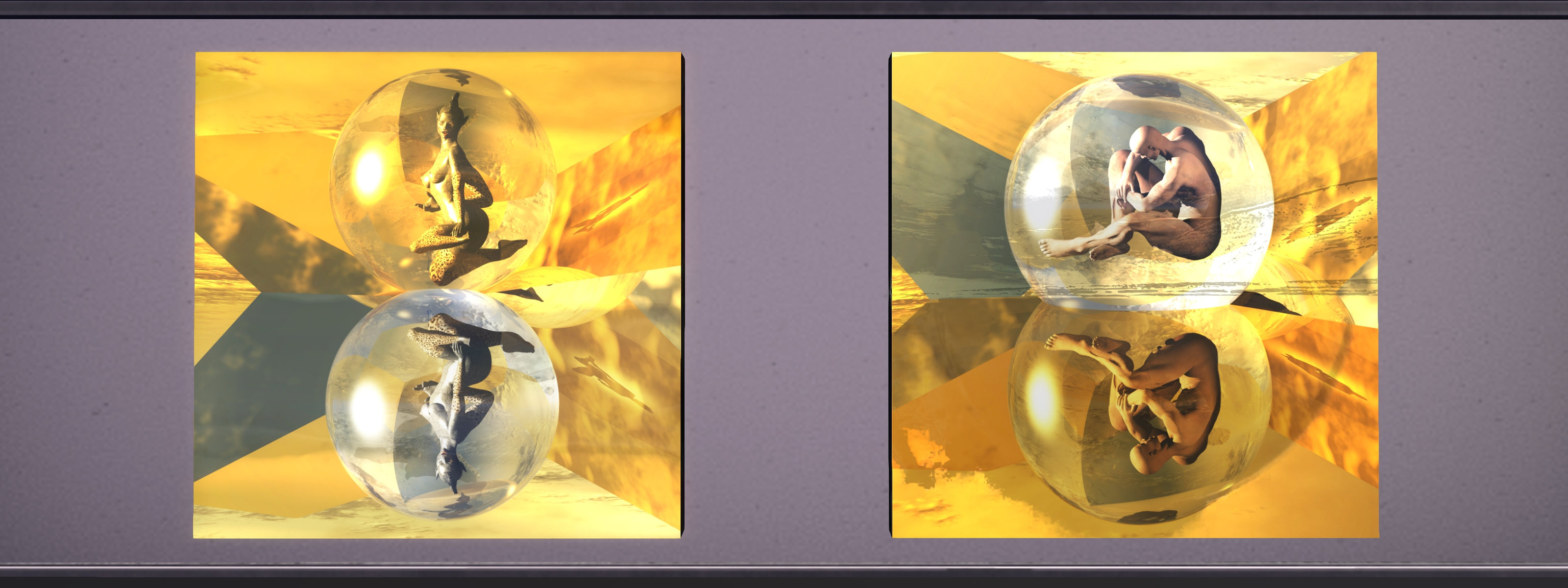
Within the two-level main hall of PsyGallery sits Embryos by TerraMerhyem. No liner notes are provided for this selection of work, spanning as it does both static and animated pieces. However, given it is by Terra, you can expect it to be nothing short of expressive, and each of the pieces visually engaging. The one set of notes that are provided come in the form of reminders on the floor of each level within the gallery that Advanced Lighting Model should be enabled (Preferences → Graphics → make sure the option is checked) in order to see the works at their best.
PsyGallery, June 2023: TerraMerhyem – Embryos
For most of us, the term embryo most likely brings to mind the stage of human life following fertilisation through until the ninth week after conception, with mental images of of the growing embryo lying within the womb as it commences its journey towards / into life. Some of this is perhaps evident in the static pieces presented here by Terra, showing as they do male and female human forms contained within protective spheres, like embryos within the womb. However, give that the figures in their spheres are fully-formed adults means this is not an artistic treatise on life per se; rather it is perhaps more of a comment on the fact that from beginning to end, life is a continuous process of growth, maturation, change and – for all of its gregarious opportunities – ultimately isolated and individual.
That no influence is exerted by the artist on how we opt to interpret these pieces, thus leaving us free to interpret them as some form of commentary – per the above – or purely as purely visually engaging, highly creative and imaginative pieces of art similarly enhances the appeal of the 2D pieces; allowing each to be taken as a whole unto itself, or – in the case of four of the pieces – artistic pairings.
Similarly, how we interpret the animated pieces, which mix 2D and 3D creations, is left to out own processes of thought and reaction to art and design. Utilising geometry, images and colour to rich effect, these are pieces literally pulsating – one might say beating with the rhythm of a healthy heart – in a manner which is strikingly beautiful whilst still carrying that suggestion of life and change we might opt to see as a possible message within the static pieces, through both the regularity of their pulsations and their gently repeating motions.
PsyGallery, June 2023: Canaris Restless – Summer Solstice
On the uppermost level of the gallery, and reached via the teleport board is Summer Solstice, a series of images by Canaris Restless offered as a visual essay on the subject of the titular event and how it is viewed by different cultures, past and present.
As Canaris notes, the Summer Solstice has been, and remains for many, a time of new beginnings, and / or renewal of life and growth; a time when all that is good about life is celebrated as the cycle of life moves ever forward; and within this might be ween the thread linking both of these exhibitions into something of a themed whole, if one chooses to do so.
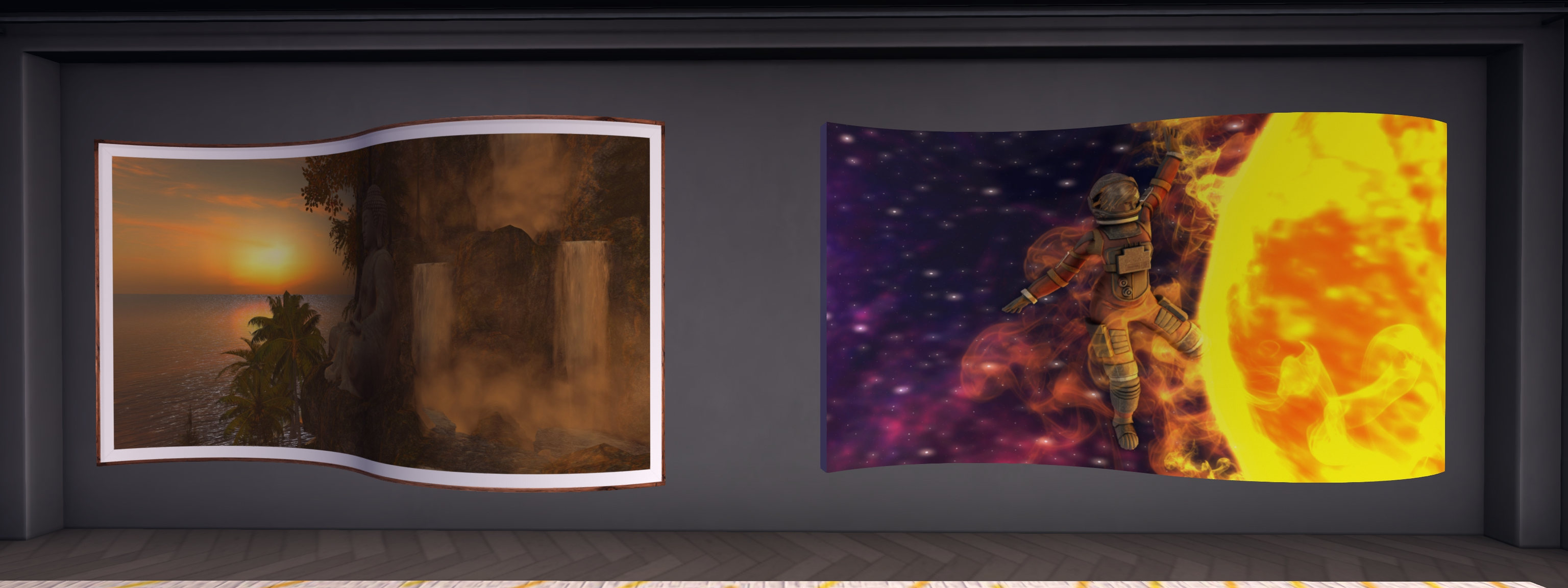
The smaller of the two installations, Summer Solstice is marked by Canaris’ elegant photography captured within Second Life and by free-standing displays of (literally) heliocentric art reminding us of the reality that the Sun – whilst perhaps not worshipped as once it was – truly remains the most prominent giver of life for our world.
PsyGallery, June 2023: Canaris Restless – Summer Solstice
Two very visually engaging exhibitions by two very different artists they many, but Embryos and Summer Solstice do compliment one another in terms of potential themes and ideas, so do be sure to see both when visiting.
Cica carries us to the magic of summertime night skies and coastal retreats with her installation Summer Night, which opened on June 16th, 2023. It’s another happy setting, rich in content and details that is light-hearted and intended to lift the spirit. utilising Cica’s custom textures to paint the terrain, the installation is set out on five landmasses of varying heights, between which, like an inlet or bay, a body of water flows.
The first of these landmasses sits as the landing point and presents itself as a broad deck or boardwalk, trees growing in the corners, and a huge fish spelunking down one hole in the boards and rising from a second, head and tail visible, but body lost to sight. a ladder spans the water horizontally to reach the local lighthouse, whilst a second ladder further to one side rises up to the decking covering the top of a flat-topped mesa and the bridge reaching across the deep chasm below to a little fishing town.
Cica Ghost: Summer Night, June 2023
Perched high above the waters, with nets hanging from walls and draped over red-tiled roofs, this is a place where dancing might enjoyed, where cats roam rooftops or await visitors at the local café and where walls have been used as canvases for painting little vignettes here and there. Down below in the bay proper, 2D waves rise and fall and fish and whales frolic even as a fishing boat sails by, whilst star fish climb the net cast up the side of the remaining headland, perhaps to dance under the beaming Moon floating just overhead.
The magic of this setting is that it it appears to have been drawn, literally and figuratively, from a childhood memory or a remembrance of childhood drawings. It doesn’t matter that fish appear to be floating above the waves alongside octopi, whilst crabs scuttle from side to side with claws raised in a cheer or the landscape appears the creation of pencil and paper rather than Mother Nature. What matters is the way the setting lifts the heart and encourages a smile, drawing visitors into it with a childlike joy, particularly when the more unusual sit points are discovered!
What’s more, all of this is caught under the most fantastic night sky, filled with stars, fish, the smiling faces of cats, starfish and more. It’s a sky guaranteed to capture the eye and heart as much as the rest.
Cica Ghost: Summer Night, June 2023
As is usual for Cica, Summer Night draws its name from a quote. In this case, a Haiku by Japanese poet and lay Buddhist priest, Kobayashi Issa (June 15, 1763 – January 5, 1828). Known simply as “Issa”, a pen name meaning Cup-of-tea, he is referenced as one of the Great Four haiku masters in Japan (along with Bashō, Buson and Shiki). The Haiku Cica has chosen is one of Issa’s most well-known and – for many – most perplexing (how can stars whisper, and to whom are they whispering?).
Summer night— even the stars are whispering¹
Kobayashi Issa
Cica Ghost: Summer Night, June 2023
However, there is no need to plumb the depths of Issa’s possible meaning here; it is enough to visit Cica’s Summer Night and enjoy it for all it is beneath its blanket of whispering, playful “stars”.
Yes, this doesn’t appear to follow the “5-7-5 rule” for a total of 17 phonetic units. However, that’s because it is a translation; the original Japanese version does follow the 17 phonetic “rule”. More particularly, it includes both a kireji (cutting word) and a kigo (seasonal reference), clearly marking it as a haiku, rather than something like a senryū.





 Inara Pey: Living in a Modemworld