Sweet Surrender, November 2024 – click any image for full size
Sweet Surrender is a Full region held and designed by Giulliana Dallaʂ (Giulliana Palen) and Fotis Dallas. It offers a multi-faceted location, rich with opportunities for exploration and photography, making full use of the available space to offer a little something for everyone. Whether you like tropical beaches, ancient ruins, brightly flowered gardens, hidden coves, underwater playgrounds, romantic spots, opportunities to dance or simply having somewhere to sit and talk or cuddle, then you’ll enjoy Sweet Surrender.
Sweet Surrender is a dreamy, romantic haven where love fills the air. It’s a place designed for intimate moments and magical connections. Soft lanterns cast a warm glow over cozy nooks perfect for cuddling, while a charming dance floor invites couples to sway under a canopy of twinkling stars. The gentle melodies of live acoustic music float through the night, creating an enchanting atmosphere where every glance, touch, and step feels like poetry in motion. Sweet Surrender is where hearts meet, and memories linger forever.
– Sweet Surrender About Land
Sweet Surrender, November 2024
The Landing Point sits within the north-west quarter of the region, just outside the Café de Paris. After being greeted by the local bird as he sings from a Tsukbai just outside the café, The basin looking to be employed as a means for patrons to rinse their hands after eating. From here, gravel paths offer several routes of exploration – which you take is entirely up to you.
You could for example, set out westwards to where the local lighthouse serves as a little store for Giulliana’s products whilst offering a lookout point over the sea and the sailing ship passing by, and to the headlands sitting to the north and the south. Between the lighthouse and each are, respectively, a shingle cove and the region’s tropical beach. However, the beach cove is only one of two to be found to the south; the second, and smaller of the two home to one of the region’s romantic / cosy locations.
Sweet Surrender, November 2024
The beach is accessible from the path running to the lighthouse and from a second path as it runs south to loop around a rocky hill topped by some of the ruins scattered throughout the setting. From here it is possible to reach the smaller cove mentioned above and also climb up along the top of the southern headland to reach another retreat, this one with a shine alongside it.
This loop of path also give access to another elevated lookout point, this with a southern beach below it. In forming its loop, the path also passes by one of the setting’s inland bodies of water. Another such body sits at the northern end of the region the broadest point of a spine of rock rising to run north from just behind the Café de Paris. This second body of water, fed by waterfalls, offers a place to dance or to sit on the deck of an overlook, a little camp site below.
Sweet Surrender, November 2024
A stream cuts the region in two from north to south, two bridges spanning it, one towards the middle of the region, the other crossing the gorge formed by the upland in part occupied by the dance area and waterfalls, and a large cabin presenting another retreat. A path runs running down the east side of this plateau to another shingle beach.
Is is on this eastern side of the setting that the region’s third inland body of water can be found, imaginatively formed by water piped through an old grand piano. Gravel paths wander over the grass and flowers and under the trees here, as with the western side of the region; and like that side of the setting, they lead visitors to the many attractions to be found here.
Sweet Surrender, November 2024
I’m not going to describe all that lies here – better for visitors to discover; What I will say that within this part of the region is an event space which – I think – will be the venue for music events within the region, starting on Friday, November 29th, and thereafter on the second Friday of each month; those who don’t feel like walking can take a horse if they wish. I’ll also say that the underwater element to the setting can be found to the north as well – look for the the arch under the stone and Poseidon standing guard.
With greenhouses covering dance floor, grottos hiding places to pass the time or dance, many places to sit with friends or a loved one, the aforementioned ancient ruins to explore, Sweet Surrender offers much for romantics and explorers alike – and with winter drawing in for those of us in the northern hemisphere, it offers and engaging summertime visit.
Monday, November 25th, 2024 saw the opening of the 2024 edition of We Orange The World, hosted by the Artsville Galleries and Community, and organised by Jerzzie Reece-Redstar. Featuring the work of 24 women from across Second Life, the exhibition is now in its 4th year, and is intended to run alongside the United Nations Women’s 16 Days of Activism Against Gender-Based Violence, which runs annually from November 25th through to December 10th inclusive.
According to the UN Office on Drugs and Crime (UNODC), violence against women – notably femicide, the intentional murder of a woman or girl purely on the basis of her gender – is on the rise globally. In 2023 alone, the UNODC produced data which showed that every ten minutes through the year, a woman or girl was murdered by their partner or a member of their family, and one in four adolescent girls was abused by a family member. Nor is the violence restricted to physical abuse: psychological violence is a very genuine thing – one that can extend into virtual spaces as well, thus adding a further layer of relevance to We Orange the World.
We Orange the World 2024
The United Nations Women’s 16 Days of Activism Against Gender-Based Violence was initiated in 1991 at the inauguration of the Women’s Global Leadership Institute, in an attempt to reverse the use of violence against women. It is used as a nexus strategy by individuals and organisations around the world to call for the prevention and elimination of violence against women and girls. Initially a civil society initiative, the campaign has – since 2008 – been supported by the UNiTE campaign, which runs parallel events with the aim of ending violence against women by 2030.
Within We Orange the World, now in its fourth year, artists have been invited to submit 2D and / or 3D art related to the general theme of the beauty and empowerment of women around the world. Entrants were asked to keep pieces positive, uplifting and empowering rather than negative in nature, otherwise subject matter and presentation were left up to the artists.
The exhibition area follows the same format as recent years: a central outdoor art display around the main event space as it sits under an appropriately orange sky (the use of orange and black through the setting, with other colours gently intruding, is striking in and of itself). This area hosts individual pieces by the majority of the artists as well as offering gifts to visitors.
We Orange the World 2024: Selen Minotaur
On the four cardinal point of the event / exhibition space, are are four indoor exhibition halls, each dedicated to larger exhibitions by Debra Katz, Selen Minotaur, Tess Carfagno and Ilyra Chardin; with Debra, Selen and Ilyra mixing 2D and 3D pieces in their installations. Finally, the four corners of the event area offer places of reflection, contemplation, music and remembrance.
We Orange the World traditionally includes daily events; unfortunately, no details beyond the first two days were passed to me in the invitation folder I received, and I didn’t find any information at the event itself. It is entirely possible such information is available of the event’s Facebook page, so if you have an account there (I don’t, so cannot confirm) do hop over and take a look for yourself there, just in case.
Les Bean at the Salty C, September 2024 – blog post
The following notes were taken from the Tuesday, November 26th, 2024 Simulator User Group (SUG) meeting. They form a summary of the items discussed, and are not intended to be a full transcript, and were taken from the chat log and Pantera’s video of the meeting, which is embedded at the end – my thanks to her for providing it.
Meeting Overview
The Simulator User Group (also referred to by its older name of Server User Group) exists to provide an opportunity for discussion about simulator technology, bugs, and feature ideas.
Meetings are open to anyone with a concern / interest in the above topics, and form one of a series of regular / semi-regular User Group meetings conducted by Linden Lab.
Dates and times of all current meetings can be found on the Second Life Public Calendar, and descriptions of meetings are defined on the SL wiki.
Simulator Deployments
On Tuesday, November 26th, 2024, the simulators on the Main SLS channel were restarted without no updates.
On Wednesday, November 27th:
An updated version of the Barbecue simulator update should be deployed to the BlueSteel RC. This includes: support for “alpha-gamma” which will allow an object owner to adjust some of the PBR alpha values that were impacting legacy things like hair; llSetAgentRot; a new warning on receiving direct IMs from Scripted Agents (“registered” bots). Rider describes this as “Bot confessions”: with IM sessions with bots there will be a warning sent to the receiver that they are having a conversation with a bot. Also, for viewer developers, there will be a bit of metadata attached to the IM_NOTHING_SPECIAL that indicates the sender is a bot.
The remaining RC channels will be restarted.
Apple Cobbler Update
Currently in testing on Aditi ( regions of Mauve and Jigglypuff for those wishing to test), and includes:
llTransferOwnership which enables a prim give itself to a new user (subject to owner permissions already set).
An extended llGiveInventory to allow for a destination folder (system folders + RLV/a) to be specified as well (+ the use of a parameter list, so further options can be added in the future).
llMapBeacon – like llMapDestination, but a) does not necessarily open the map window; b) can optionally open the map, with or without focus. This will also require a viewer update.
A new function for detecting attachments. If it is running with an experience it will be able to detect HUDs that also have scripts with the same experience (e.g. to ensure the correct HUDs are being used – this will not allow anyone to script to find out all the HUDs someone is using).
SL Viewer Updates
No updates with the current official viewers:
Release viewer: version 7.1.10.10800445603, formerly the DeltaFPS RC (multiple performance fixes, etc), dated September 11, promoted September 17 – No change.
Release Candidate: ExtraFPS RC, version 7.1.11.11750364439, November 12.
Performance improvements: enhanced texture memory tracking, broader hardware compatibility and higher FPS gain; additional code to improve texture streaming on rigged attachments (e.g. if an earring is made with 2K textures, the viewer will correctly calculate the required resolution for the textures and download them, rather than downloading the full 2K textures), etc.
Aesthetics improvements: new Antialiasing setting – SMAA; Contrast Adaptive Sharpening; Khronos Neutral Tone Mapping (can be changed to ACES via the RenderTonemapType Debug setting).
UI Optimisations.
In Brief
Please refer to the video below for the following:
A request to fix the long-standing (18 years!) to fix the issue of Modify becoming No Modify on being taken back to inventory if they have a things like No Mod script in their contents (the script should maintain its no Mod permissions, and the object should retain its Modify permission and not inherit No Mod from the script, etc.) as part of the work in tweaking permissions for llTransferOwnership() was seen as “out of scope” for this work.
A discussion relating to sitting height and a possible change in behaviour resulting from the fix for the recent “hovering on logging-in” issue affecting system shoe height adjustments (and whether the mentioned sitting issue is / is no a bug) – see Sitting height is now affected by system shoes.
A further discussion on region crossing and attachments and potential issues.
Further discussion around people being able to opt-out of the extended llGiveAgentInventory() capabilities so as to avoid things being dropped “anywhere” in their inventory.
This saw a re-hash of the idea that all items – whether received via the Marketplace, of in-world transfer, should go to a single, dedicated system folder clearly named, and then to sub-folders within it (e.g. “From Marketplace” and “In world”).
The above would help prevent a lot of confusion for newer users, as everything then receive goes into *one* system folder and they can find it). I would also allow users to retain better control over their inventories in terms of where items received finish up. However, it risks breaking functionality such as #RLV (which is in the process of being adopted by LL for their viewer).
The discussion also included a request that users be given an override to llGiveAgentInventory(), so that they can set the destination folder on being offered the item(s).
† The header images included in these summaries are not intended to represent anything discussed at the meetings; they are simply here to avoid a repeated image of a rooftop of people every week. They are taken from my list of region visits, with a link to the post for those interested.
Frost Peak, November 2024 – click any image for full sizeUpdate January 2025: Frost Peak has closed.
Winter is the quietest and most peaceful time of the year. Nature lies beneath a soft, white blanket, sleeping in gentle stillness. Snowflakes dance through the air like tiny, sparkling stars, quietly settling on the ground. Forget your worries for a moment and enjoy a warming mulled wine at the festively decorated Christmas market or an exciting train ride through the snowy landscape.
– Frost Peak About Land
Occupying a Homestead region, Frost Peak offers exactly what its About Land deception states: a winter’s setting rich in snow and opportunities to forget worries, relax and take photos, wander a little market or ride a train through the surrounding woods.
Frost Peak, November 2024
Designed by Yoyo Collas with the help of AmyDenise, the region near seamlessly blends itself with the outlying surrounds to present a place nestled within high mountains. The Landing Point sits towards the eastern end of the landscape (itself laid-out roughly east-to-west), where steps lead up to an arched entranceway passing under a grand festive tree.
At the foot of these steps is the first opportunity for photography – a horse-drawn sleigh with sitting for individuals or couples. A further place to pose can be found just across the track from the sleigh, in the form of a little glass-canopied bench and where a white stag watches over a small herd of deer.
Frost Peak, November 2024
Stand close the tracks long enough, and an open-topped train will clatter past, hauling a line of open-topped little carriages. Mindful somewhat of Stevenson’s Rocket (albeit with a cow-catcher on the front!), the little train huffs and puffs itself around an oval of track passing through the outer sides of the region at a speed that makes hopping on and off very easy.
The train is a good way to see the outlying woodlands of the region and the wildlife therein – bears, fawns, deer – and pass by the cosy home at the western extent of the land (and which appears open to the public if you fancy popping inside and warming yourself up). The tracks will also take visitors past a bridge and a deck which both provide access to the ice-skating track area.
Frost Peak, November 2024
Broad enough for ice dance around the little island in its midst, and close to the deck and below the slope leading up to the house, this frozen part of the setting throws two smooth arms around the middle of the landscape, possibly allowing a race or two around it, the route carrying skaters under the Landing Point’s huge tree in the process.
Passing through the tunnel under this tree from the Landing Point brings visitors to the Christmas / Winter market set within the innermost oval of the land, walls around most of it lifting it above the ice skating, other than at its western end where the snow-covered ground slopes gently down to the ice, a road also curling tail-like around it it from the market or offer a path from one to the other.
Frost Peak, November 2024
The market is home to a range of stalls and little shops, together with fairground rides, places to sit and plenty of life. One of the rides is a novel carousel in which the riders’ seating and mounts remain still, and the rest of the carousel itself slowly revolves around them! A curio it might be, but it also fits within the setting.
The life and liveliness comes in the form of static NPCs who are set as if wandering the stalls, seated in conversation, bartering over snacks, taking phots, and so on. They are joined by a couple of cats who look to be about to have a disagreement, and the local Elf and welfare team taking a break from sweeping the snow from the cobbles, before they make their way gnome (sorry! 😀 ), while pigeons and stags round-out the animal representative and snowmen keep their eyes on things.
Frost Peak, November 2024
The NPCs in the market aren’t the only ones to be found here, as those who ride / follow the train tracks will discover – folk are out for a walk around the tracks as well, while those looking for little places to sit and pass the time might want to seek out the old cable car cabin as it sits out on the ice or perhaps the cosy little forest shed across the ice from it, and watched over by a friendly owl.
Rich in details, easy on the eye, Frosty Peak is well put together to make a nicely relaxing visit.
Logos representative only and should not be seen as an endorsement / preference / recommendation
Updates from the week through to Sunday, November 24th, 2024
This summary is generally published every Monday, and is a list of SL viewer / client releases (official and TPV) made during the previous week. When reading it, please note:
It is based on my Current Viewer Releases Page, a list of all Second Life viewers and clients that are in popular use (and of which I am aware), and which are recognised as adhering to the TPV Policy. This page includes comprehensive links to download pages, blog notes, release notes, etc., as well as links to any / all reviews of specific viewers / clients made within this blog.
By its nature, this summary presented here will always be in arrears, please refer to the Current Viewer Release Page for more up-to-date information.
Note that for purposes of length, TPV test viewers, preview / beta viewers / nightly builds are generally not recorded in these summaries.
Official LL Viewers
Release viewer: version 7.1.10.10800445603, formerly the DeltaFPS RC, dated September 11, promoted September 17 – NO CHANGE.
Release Candidate: ExtraFPS RC, version 7.1.11.11750364439, November 12 – New.
A shot from the “flap cam” on Starship, showing the Super Heavy immediately after separation during IFT6. Note the residual gases burning within the hot staging ring. Credit: SpaceX
The sixth integrated flight test (IFT-6) of the SpaceX Starship / Super Heavy behemoth took place on Tuesday, November 19th, 2024, and proved to be perhaps the most successful test yet of the system, even though the core aspect of the first part of the flight didn’t occur.
The vehicle lifted-off from the SpaceX Starbase facility at Boca Chica, Texas at 22:00 UTC. All 33 Raptor-2 engines on the Super Heavy booster ignited, and the massive vehicle lifted-off smoothly. All continued to run, and the initial phases of the flight passed without incident: the vehicle passed through Max-Q, reached Most Engines Cut-Off (MECO) at 2 minutes 35 seconds, leaving it with just three motors running. Seven second later, hot staging occurred, Starship firing all 6 of its engines and then separating from the booster.
Starship IFT6 rising from the launch facilities, November 19th, 2024. Credit: Redline Helicopter Tours
This was followed by the booster flipping itself onto a divergent trajectory to Starship and re-igniting the ring of 10 inner fixed motors to commence its “boost back”: gradually killing it ascent velocity and bringing it to a point where it could commence a controlled fall back to Earth, and then a powered final descent into being caught b the Mechazilla system on the launch tower, as seen during the October flight.
However, during the boost-back, the call was made to abort the attempt at capture, and to instead direct the booster to splashdown in the Gulf of Mexico. The booster then went through a nominal descent, dropping engines first (and causing them to glow red-hot during the compression of air inside their nozzles, despite the fact none were firing).
Booster in the water: seconds after splashdown, a single motor still running, the Super Heavy booster sits in the Gulf of Mexico. Credit: SpaceX
At just over 1 km altitude, the 13 inner motors did right, all of them firing for some 7 seconds and reducing the rocket’s descent from 1,278 km/h to just 205 km/h. At this point nine of the ten motors on the inner fixed ring shut down, with one appearing to run a second or so longer. When it shut down, there was a belch of flame of the base of the booster, which might indicate an issue.
Nevertheless, the three central motors continued to operate, gimballing to bring the booster to a vertical position and a brief hover right above the water before cutting off and allowing the rocket to drop end-first into the sea. Remaining upright for a moment, the booster then started to topple over. However, as the live stream cut away at that point, it was down to other camera to capture the subsequent explosion due to water ingress around the super-hot engines, etc., which destroyed the rocket.
“There’s the kaboom!” Shots from onlookers demonstrating that 13 super-heated engines and their plumbing and residual gases in propellant tanks don’t play nice with cold sea water, as the Super Heavy booster explodes
The Starship vehicle, meanwhile, made it to orbit and continued on over the Atlantic and Africa to the Indian Ocean, where it went through its de-orbit manoeuvres.
Whilst in the coast phase of the flight, the vehicle had been due to re-ignite one of its vacuum engines to demonstrate this could be done in space. This occurred at 37 minutes 46 seconds into the flight, the motor running for about 4 seconds. Although brief, the re-light was a milestone – Starship will need the capability while on orbit in the future.
A camera in Starship’s engine bay captures the steady firing of one of its vacuum Raptor-2 motors during the flight’s orbital coast phase. Credit: SpaceX
The Starship’s return to Earth was anticipated as being potentially “whackadoodle”, and subject to possible vehicle loss. This was because SpaceX had removed elements of the thermal protection system designed to protect the vehicle from burning-up during atmospheric re-entry.
The purpose in removing tiles from the vehicle was to expose parts of the hull where, if Starship is also to be “caught” by the Mechazilla system on its return to Earth, it will need exposed elements on the side bearing the brunt of the heat generated by re-entry into the atmosphere, and SpaceX wanted data on how the metal of the vehicle held-up to being exposed to plasma heat, particularly given the previous two flights had seen plasma burn-through of at least one of the exposes hinges on the vehicle’s aerodynamic flaps.
The leading edge of a flap show clear signs of impending burn-through during re-entry – but the damage is a lot less than previous flights. Credit: SpaceX
As it turned out, the vehicle managed very well during re-entry; there was a significant amount of very visible over-heating on the leading edge of a flap, but even this was less than seen in IFT4 and IFT 5. It’s not clear as to how much damage the exposed areas of the vehicle suffered were TPS tiles had been removed, but given the vehicle survived, any damage caused was clearly not sufficient to compromise its overall integrity.
The drop through the atmosphere was visually impressive, the flight so accurate that as the vehicle flips itself upright at less than 1 km above the ocean, the landing zone camera buoy anchored ready to record the splashdown can clearly be seen. Immediately after entering the water, the Starship toppled, bursting into flame – but this time not immediately exploding.
After fling half-way around the world, the Starship vehicle is about to splashdown just a handful of metres from the camera buoy (arrowed, top right)at the landing zone. Credit: SpaceX
Whilst a booster catch might not have been achieved, IFT6 can be classified a success. All criteria but the catch of the booster was achieved, and even though the later was lost as a result of a forced splashdown, the successful diversion of the booster to do so demonstrates an ability for SpaceX to divert a vehicle away from a landing tower in the event of an issues with the tower – providing said issues are spotted earl enough.
The flip side of this is that it exposes an inherent weakness in the system; the reason for the abort was that the actual launch of the vehicle had caused damage to the launch tower and its communications systems, calling into question its ability to make the catch. Tower / launch stand damage has been a recurring theme with Super Heavy launches, although the degree of damage caused has been dramatically reduced.
The moment before splashdown, as seen from the Starship flap cam (l) and the remote camera buoy (r). Credit: SpaceX
Even so, the fact that comms systems could be KO’d reveals how vulnerable the system is to a potential loss of vehicle (and the knock-on impact in terms of “rapid reusability”), particularly if there is no close-at-hand and available launch / catch tower available to take over the role. And while this abort was called when the vehicle was still 87 km altitude, with lots of time to bring it safely into a splashdown, can the same be said if an issue occurs when the vehicle is just 13 km above ground? Or ten? Or two? Or if the malfunction occurs in the final engine burn?
ISS Reports “Toxic Smell” and Atmosphere Scrubbed
Update: Several hours after this article was published, NASA issued a statement on the event described below.
Reports are surfacing of possible toxic contamination board a resupply vehicle at the International Space Station (ISS). Initial news on the situation was broken by the highly-reliable Russian Space Web, operated by respected space journalist and author, Anatoly Zak, but that the time of writing this piece, western outlets had not reported the story, which is still breaking.
On November 21st Russia launched the automated Progress MS-29 resupply vehicle to the International Space Station (ISS), carrying some 2.487 tonnes of supplies, including 1.155 tonnes of pressurised supplies, 869 Kg of propellants; 420 kg of water and 43 kg of nitrogen gas.
Cosmonauts Ivan Vagner and Alexei Ovchinin monitor the automated approach and docking of Progress MS-29 at the Poisk module of the Russian section of the ISS. The majority of Progress dockings are automated, but members of the crew are on hand to manually intervene if required. Credit: Roscosmos / NASA
After being placed in an initial parking orbit, the vehicle rendezvoused with the ISS on November 23rd, manoeuvring to dock with the zenith port of the Poisk module (mini research module – MSM 2), attached to the Zvezda main module of the Russian section of the station. Following docking, the vehicle was secured and the pressure between the module and Progress vehicle pressurised to allow the hatches between the two to be opened.
However, the hatch to the Progress has to be immediately closed due to a “toxic smell” and a potential contamination hazard in the form of free-floating droplets. Following the securing of the hatches, NASA’s flight controllers apparently ordered the activation of the Trace Contaminant Control Sub-assembly (TCCS) in the International section of the ISS, a system designed to remove traces of potential airborne contaminants, effectively scrubbing the atmosphere in the ISS, with the Russian crew activating a similar system within the Russian section for around 30 minutes, with the cosmonauts themselves donning protective equipment (as reported last week, the main hatch between the two sections of the station is now kept shut due to a continuous leak of air through the Russian Zvezda module).
Progress MS-29 approaching the ISS, November 23rd, 2024. Credit: Roscosmos
The cause of the smell and the overall status of the MS-29 vehicle have yet to be determined; this is a developing story.
New Glenn Gets Ready
Blue Origin is approaching a readiness to launch their new heavy lift launch vehicle (HLLV), the New Glen rocket.
Earlier in November I reported on the new rocket’s first stage being rolled from the Blue Origin manufacturing facilities at Kennedy Space Centre to the launch preparation facilities at Space Launch Complex 36 (SLC-36), Cape Canaveral Space Force Station. These facilities already held the rocket’s upper stage, which had undergone a series of static fire tests of its motors whilst on a test stand at the pad earlier in the year.
Integrating the first and upper stages of the first New Glenn rocket to fly. Credit: Blue Origin
Since the arrival of the 57.5 metre long first stage at the integration facility at SLC-36, Blue Origin engineers have been preparing the vehicle for launch. By November 14th, the first and second stages of the rocket has been integrated with each other, and worked moved to integrating the payload and its protective fairings to the rocket.
Originally, the inaugural flight for the massive rocket – capable of lifting up to 45 tonnes to low Earth orbit (LEO) – was to have been the NASA EscaPADE mission to Mars. However, due to complications, the flight will now be the first of two planned launches designed to certify the system for the United States Space Force’s National Security Space Launch (NSSL) programme. The payload for the flight will be a prototype of Blue Origin’s Blue Ring satellite platform, a vehicle capable of delivering satellites to orbit, moving them to different orbits and refuelling them.
The fully assemble rocket, two stages plus the payload and its protective fairings, backs towards launch pad SLC-36, Cape Canaveral Space Force Station, November 21st, 2024. Credit: Blue Origin
On November 21st, the completed rocket – over 80 metres in length – rolled out of the integration facility and delivered to SLC-36, where it was raised to a vertical position, mounted on the 476-tonne launch table designed to support it and keep it clamped to the pad.
The actual launch date for the mission has yet to be confirmed, but it will see the company both launch the rocket and attempt to recover the reusable first stage, called So You Think There’s a Chance? Following separation from the upper stage of the rocket, the first stage will attempted to make and controlled / power decent to and landing on the Blue Origin’s Landing Platform Vessel 1 (LPV-1) Jacklyn.
The New Glenn rocket mounted on its 476-tonne launch table at SLC-26, November 21st, 2024. Credit: Blue Origin
Artemis 2 Vehicle Progress
Even as NASA’s Space Launch System (SLS) continues to face a potentially uncertain future due to its per-launch cost, the second fully flight-ready vehicle continues to come together at NASA’s Kenned Space Centre in readiness for the Artemis II mission.
The mission, which is targeting a launch in late 2025, is due to carry a crew of four – Reid Wiseman (Commander); Victor Glover Pilot; Christina Koch, flight engineer and Jeremy Hansen (Canada), mission specialist – on an extended flight of up to 21 days, commencing with the crew aboard their Orion Multi-Purpose Crew Vehicle (MPCV), being placed in low Earth orbit, prior to transiting to a high Earth orbit with a period of 24 hours.
The Artemis II mission profile – click for full size, if required. Credit: NASA
Once there, they will carry out a series of system checks on the Orion and its European Service Module (ESM), as well as performing rendezvous and proximity flight tests with the rocket’s Interim Cryogenic Propulsion Stage (ICPS), simulating the kind of rendezvous operations future crews will have to do in order to dock with the vehicles that will actually carry them down to the surface of the Moon and back. After this, the crew will make a trip out and around the Moon and back to Earth.
The Orion capsule for the mission is nearing completion, with core assembly completed and the internal fixtures, fittings and systems on-going. Earlier in November 2024, and sans its outer protection shell and heat shield, it was subjected to a series of pressure tests to simulate both the upper atmosphere and space to ensure it had no structural integrity issues.
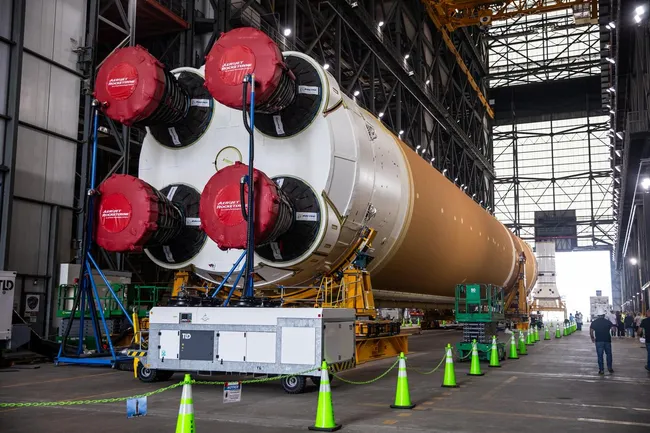
The core stage of the Artemis II SLS rocket, complete with its four main engines, inside NASA’s gigantic Vehicle Assembly Building (VAB). One of the base segments of a solid rocket booster (SRB) can be seen in the background. Credit: NASA
Meanwhile, the SLS vehicle itself has commenced stacking. The core stage, with is massive propellant tanks and four RS-25 “shuttle” engines, arrived at the Vehicle Assembly Building (VAB), Kennedy Space Centre, in July 2024, and since this has been undergoing much work whilst still lying on its side.
More recently, work on stacking the two solid rocket boosters (SRBs) developed from those used with the space shuttle, that will help power it up through the atmosphere has also commenced.
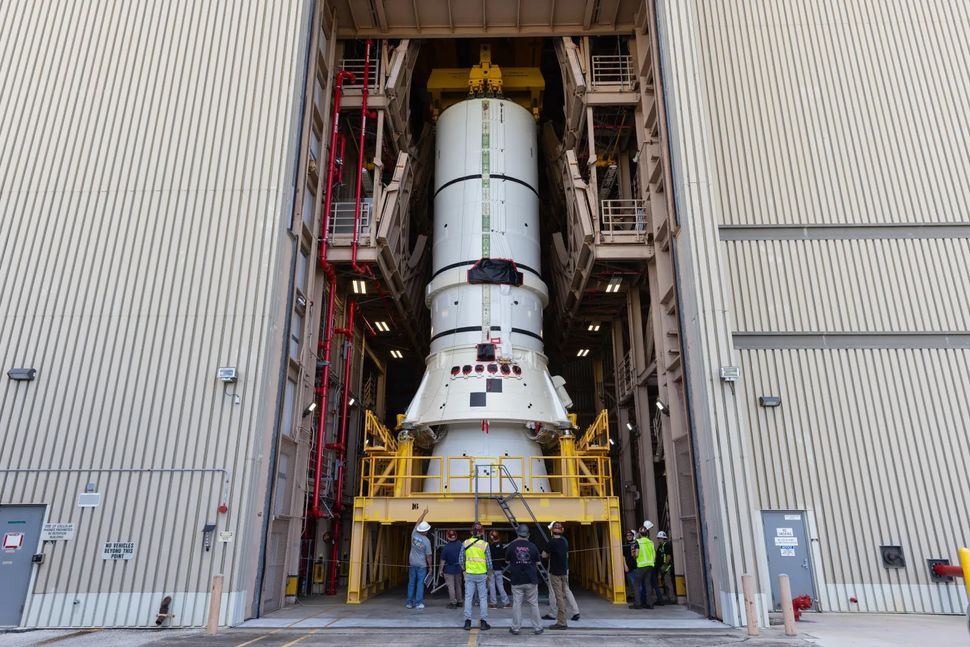
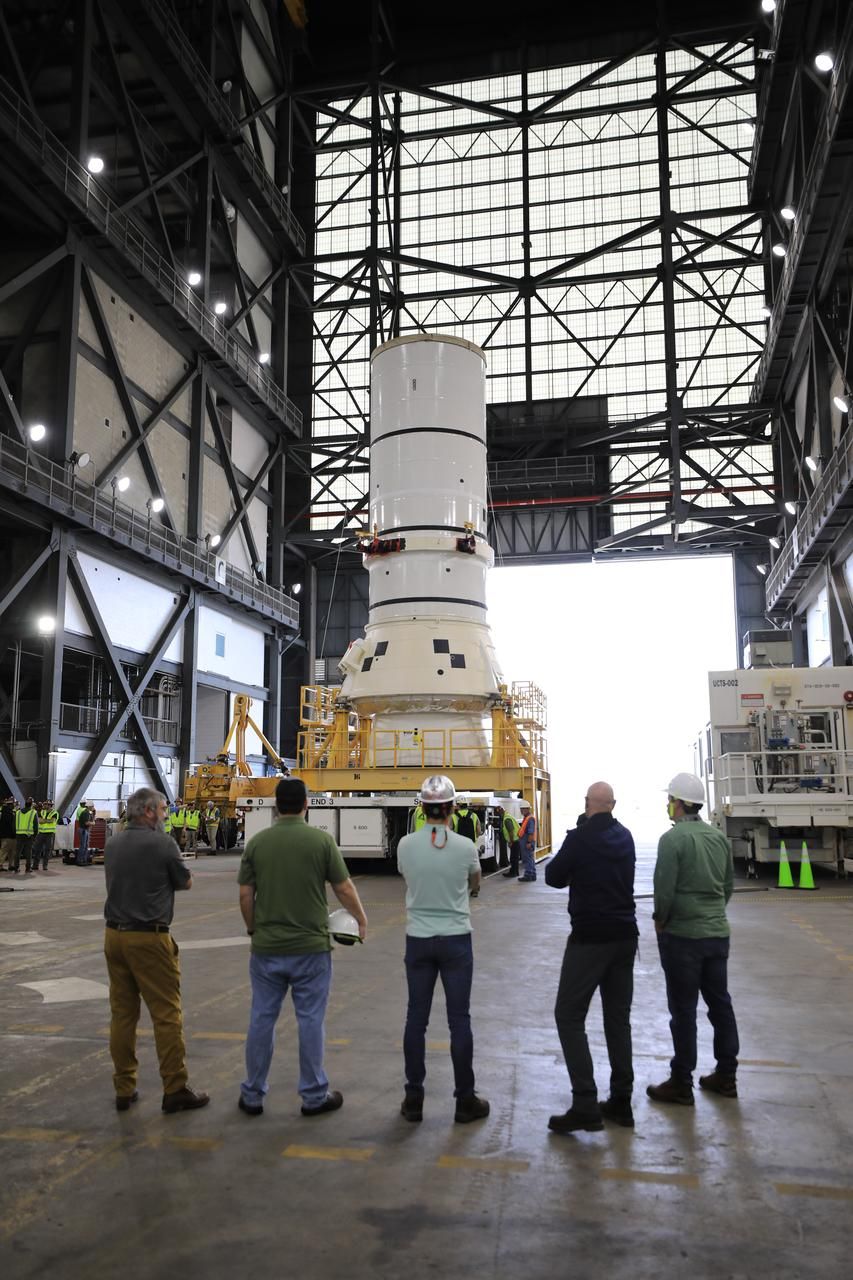
A crane inside the VAB prepares to lift one of the SRB motor sections and its assembly gantry, ready to place it on the back of a transport vehicle. November 13th, 2024. Credit: NASA
The SRBs comprise 5 individual segments which need to be manufactured and then bolted together, prior to being filled with their wet cement-like solid propellant mix. The base segments of these boosters include the rocket motor and guidance controls, and on November 13th, these were rolled into the Vehicle Assembly Building on special transport / stacking gantries. Over the next several months, the two SRBs will be assembled vertically in one of the bays within the VAB, and then loaded with their propellant and capped off.
Once the SRBs are ready and their avionics, etc., checked out, the core stage of the SLS will be hoisted up into one of the VAB’s high bays, moving to a vertical orientation as it does so. It will then be lowered between the two SRBs so that they can all be joined together. After this the ICPS will be moved up into position and mated to the top of the core stage of the rocket, and then work can commence stacking the Orion and its ESM and their launch fairings.
The SRB motor and its mounting gantry on the transporter, ready to be moved to the VAB bay where stacking can commence, November 13th, 2024. Credit: NASA
Whether or not Artemis II makes its planned late 2025 launch (no earlier than September) is open to question; currently, NASA has yet to fully complete the work on ensuring the already manufactured heat shield for the mission’s Orion vehicle is fit for purpose, per my previous report on heat shield issues.





 Inara Pey: Living in a Modemworld