[valium] – click any image for full sizeUpdated, January 2020: [Valium] has closed. SLurls have therefore been removed from this article.
[valium] is the name of the latest region design by Busta (BadboyHi) and held by Valium Lavender and to which I was pointed to by fellow SL traveller, Shakespeare. Busta’s designs are always been worthy of a visit (you can find out about Yasminia here and Meraki here), so I was keen to hop over and explore as the region officially opened its doors to the public on December 21st, 2018. And once again, both Busta and Valium are providing a region that is quite extraordinary in its eye-catching design.
A full region utilising the full region land capacity bonus, [Valium] is open to the public, although group membership is required. This is currently free, and will remain so through until January 7th, 2019, after which a L$250 fee will be applied. The latter is to both help with maintaining a certain sense of privacy for those renting properties on the region, and for a reason that will become clear later in this article. There are many places to be explored during a visit, but do be aware that there are the aforementioned private residences scattered around the region, so please do take care to avoid trespass when exploring.
[valium]
The Vision
To create a picturesque, rugged countryside setting with naturally beautiful nooks, twists, turns and hidden gems for public and private use. There are many public areas to explore and it will probably take several visits to see everything the sim has to offer.
– Valium Lavender, describing [Valium]
[valium]This is a marvellously diverse setting, ranging from high peaks to coastal areas, mixing little docks, headlands, remote dwellings, ruins, and islands (albeit one or two of them being off-sim).
The landing point sits towards the centre of the region, meaning that no matter where you go, there is something to explore. A terraced area, it overlooks the low-lying western side of the region where the ruins of a church sits on the largest of the region’s islands, beckoning visits to it as it rises among the trees guarding it.
[valium]While this island is connected to the rest of the land by three bridges, getting down to them from the landing point is a little circuitous, ensuring visitors have the opportunity to start explorations, as the route carries them over semi-paved areas, past the ruins of an old farmhouse (with one of the private residences just behind it), and on to the waterfront or for those who prefer, past an old folly and then down to the water’s edge, and second of the three bridges.
It is the multitude of footpaths that make exploring [Valium] a joy. Whether you go up or down, inland or directly (or as directly as you can!) to the coast, there is much to discover, appreciate and photograph. There’s the ruin of an old tower facing the church, for example, or the rickety cabin build out over the water to the north, caught in a local shower, or a further terrace sitting just above, and nestled below and clear of another of the private residences.
[valium]To the south-east sits a little commercial area, with a coffee-house sitting within a converted industrial building and offering outdoor seating with views of the local lighthouse. A further coffee-house, this one also providing music and dancing, sits on a wooden platform part-way up the island’s main peak, again offering marvellous views to the south and west.
There is so much about this region that is attention-taking that walking you through it with words is really a waste; [valium] truly is a place that deserves to be visited, and which can only be truly appreciated by doing so. There’s also another reason for visiting (and paying the group dues: Valium has decided a portion of the group membership fees, etc., will be forwarded to The Nature Conservancy, as she notes in the region’s website.
[valium]
[valium], a project from initial concept to the elaborate build, was created from visions of our naturally beautiful RL world. A place to explore and appreciate. With this in mind, I have decided to support a fantastic charity, The Nature Conservancy.
3400 lindens or more (out of group fees) per month [are donated] to The Nature Conservancy, a non-profit organization dedicated to land conservation and protection. Every acre they protect, every river mile restored, every species brought back from the brink, begins with us. Our support will help make a lasting difference around the world in 72 countries.
– Valium Lavender, describing [Valium]
[valium]I believe that until the group fee is introduced, there will be a donations kiosk available at the landing point, while if visitors would like to donate directly to the Nature Conservancy, there is a link on the information board and also in the [Valium] website. Should you take photos of the region during your visit, do consider sharing them with the region’s Flickr group.
Kudos to Busta and Valium on creating such an wonderful setting.
The majority of the following notes are taken from the Content Creation User Group (CCUG) meeting, held on Thursday, December 20th, 2018 at 13:00 SLT. These meetings are chaired by Vir Linden, and agenda notes, meeting SLurl, etc, are usually available on the Content Creation User Group wiki page.
With the Christmas / holiday break now on our doorstep, this was a short meeting.
SL Viewer
There have been two further viewer updates:
The Estate Access Management RC viewer updated to version 6.1.0.522564 on Wednesday, December 19th. See my preview of this viewer here for more information.
The Environmental Enhancement Project (EEP) project viewer updated to version 6.0.2.522550 on Thursday, December 20th.
Hover Height / Vertical Positioning Issue
Ever since server release 18#18.10.25.521081 was deployed at the end of October / beginning of November 2018, there have been reports of a hover height / positioning issue issue for full mesh avatars of less than “normal” height. This can leave such avatars floating 0.2 to 0.3 metres off the ground if non-height related changes are made after hover height has been set (BUG-225893).
Current Status
Anchor Linden has been investigating this, but is hampered by the fact the behaviour cannot be properly reproduced with consistency. This is making a root cause determination difficult. As this work is currently Anchor’s main focus at the moment, it means the Bakes on Mesh project is somewhat on hold.
Bakes On Mesh
Project Summary
Extending the current avatar baking service to allow wearable textures (skins, tattoos, clothing) to be applied directly to mesh bodies as well as system avatars. This involves viewer and server-side changes, including updating the baking service to support 1024×1024 textures, and may in time lead to a reduction in the complexity of mesh avatar bodies and heads.
This work does not include normal or specular map support, as these are not part of the existing Bake Service, nor are they recognised as system wearables. Adding materials support may be considered in the future.
As per the notes above, Bakes on Mesh is “on hold” at present while Anchor is otherwise engaged in bug hunting.
There are apparently a couple of issues with BoM still to be ironed out, and there is also an internal wiki issue preventing the Bakes On Mesh documentation being published on the SL wiki.
Allowing for the hover height / positioning issue mentioned above and the remaining work on Bakes on Mesh (+ the QA testing), it’s possible it will be a few weeks after the start of 2019 before this project progresses again.
Environment Enhancement Project
Project Summary
A set of environmental enhancements allowing the environment (sky, sun, moon, clouds, water settings) to be set region or parcel level, with support for up to 7 days per cycle and sky environments set by altitude. It uses a new set of inventory assets (Sky, Water, Day), and which include the ability to use custom Sun, Moon and cloud textures. These can be stored in inventory and traded through the Marketplace / exchanged with others, and can additionally be used in experiences.
The project also includes a new set of render shaders to support atmospheric effects such as rainbows, crepuscular rays (“God rays”), better horizon haze and fogging (but will not include rain / snow).
This week has seen updates to both the simulator code (available on Aditi for test, and also on limited release on Agni via the Snack RC channel) and, as noted above, to the viewer.
It’s hoped that the last of the shader work (e.g. crepuscular rays) will be completed in January.
The set agent environment scripted controls (allowing the entire environment for an avatar to be replaced when using an experience) is now in place.
Documentation for this will be pushed on the wiki after the holiday break.
Rider Linden is working on some further UI clean-up / clarification.
In Brief
There has been an issue with joint aliases not being correctly supported (the “avatar_xxx” aliases were not working for all the bones in the skeleton). Vir now has a fix for this, which should be appearing in the relatively near future.
Date of next CCUG meeting: Thursday, January 3rd, 2019.
Coming slightly later this year is the Lab’s annual snowball fight challenge. The challenge was issued in a brief blog post with the invitation:
Come one – come all to the Snowball Arena for a friendly ice battle of epic proportions! This Snowball Showdown means you’re free to pelt your fellow Second Life Residents and Lindens with a bevy of sparkling snowballs! But the Lindens and your fellow Residents get to return fire with their own avalanche of snow-arsenal.
The event itself will take place between 11:00-13:00 SLT on Friday, December 21st at – where else? – the Snowball Arena in Winter Wonderland.
As with previous years, Winter Wonderland is a 5-region experience which, for those who haven’t visited, includes the 2-region snowball fight arena, a winter snow track for snowboard and snow mobile racing, a skating ring, a Ferris wheel, and spaces to walk. The best place to start explorations is the Village of Light, where the Lindens tend to place a seasonal gift.
Weapons can be obtained at the entrances to the Snowball Arena – walk through the Village of Light and climb the steps up into the hills behind the village. Snowball guns can be collected at the vendors around the Snowball Arena.
Collect your weapons at the vendors in the Snowball Arena. If you are Premium, you can use your Premium Member’s Token or HUD to claim the Premium-only Snow Zooka weapon (outlines in red on the HUD and in the vendor, above)
For those who are Premium members and who haven’t participated in the snowball fight before, don’t forget you can use your Premium Member’s Token or HUD you can claim additional Snow Zooka weapon. If you don’t have the Token HUD, you can can claim them by picking up the latest Premium gift, the Winter Cabin from any of the Premium Gift Kiosks. You can find out more about the Winter Cabin via the Lab’s gift blog post.
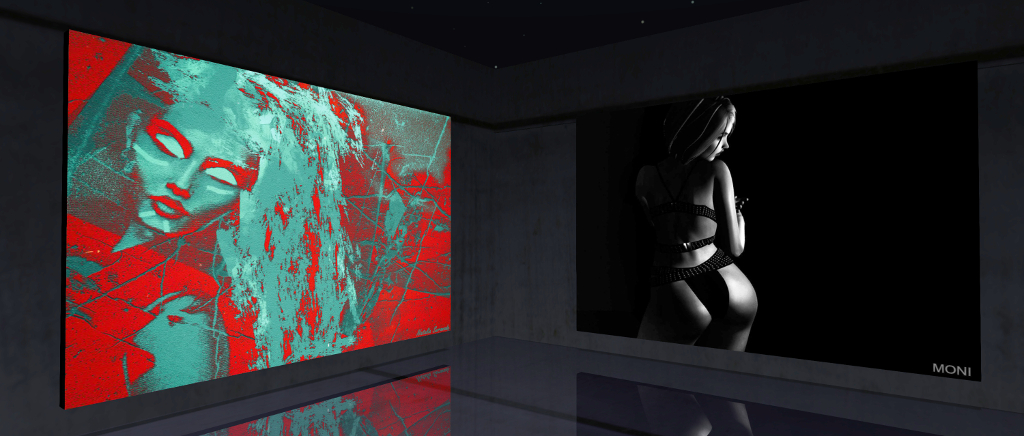
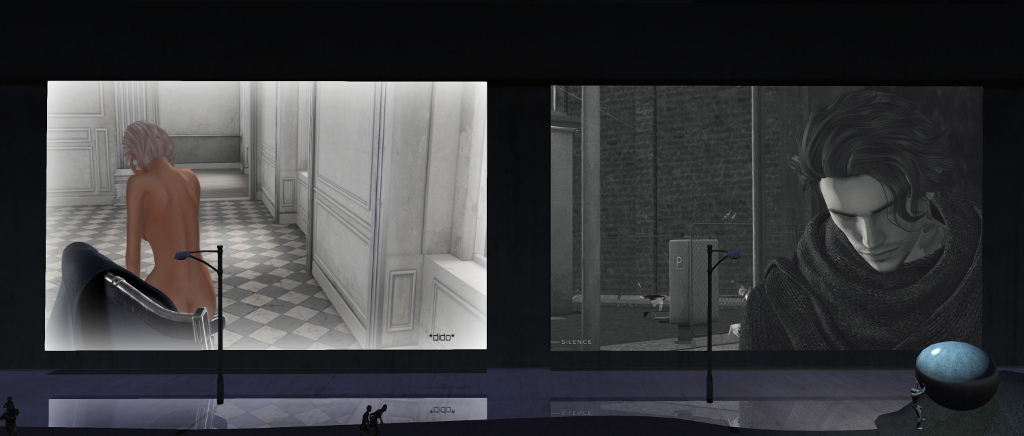
“I’m not promoting it heavily,” Dido Haas informed me, as we met at the end-of-2018 exhibition she is curating at her Nitroglobus Roof Gallery. “I had another exhibition planned, but it didn’t go ahead. So I’ll just place some pictures on Facebook, Flickr and the SL group.”
Which is not to say that the current exhibition is simply a fill-in; rather it stands in part as a retrospective of some of the memorable exhibitions Nitroglobus has hosted through 2018. It also offers the chance to appreciate Dido’s own work, and that of David, aka “Mr. Haas” or silence (jemapelSilence) that speak to their growing relationship.
Dido has a marvellous eye for art; as such Nitroglobus features a series of outstanding exhibitions each year – something that keeps me going back every month or so. As such, selecting artists and pieces for any kind of retrospective is going to be a challenge, but Dido nevertheless presents a considered series of pieces featuring Monique Beebe (who I confess is one of my favourite artists when it comes to narrative avatar studies), from her exhibition Changing Moods. Alongside of it is a piece by Natalia Serenade, as featured in her evocative exhibition, The Colour of Unspoken Words (read here for more).
Cold Frog, who presented Fading in January, can also be found, as can Nevereux, with a piece from Out ofHere, and Cat Boucher, who appeared at the gallery in August with Hypnopompia. Between and around these are images by Dido and David.
The latter are very intimate pieces, some which might be regarded as NSFW, but which are all richly evocative for the story they tell. The pictures by Dido also act as a possible lead-in to the permanent exhibition of her own work, which can be found n the gallery’s second hall, and reached via an interconnecting tunnel. I’ve always found Dido’s work wonderfully expressive and deeply personal, and thoroughly commend a walk through the tunnel to her display space if you have not previously done so during a visit to Nitroglobus.
While unplanned, the selection of art offered here also perhaps serves a further purpose: to whet our appetites for the exhibitions Dido will bring to us in 2019.
On Wednesday, December 19th, Linden Lab offered a look back at 2018 and something of a look ahead to 2019. There’s actually been a lot going on, although it is surprising to note that some of the bigger deliveries / anticipated deliveries actually first started to surface in 2017, when I reviewed / previewed them.
I’ll be taking a look through the major changes to Second Life myself in an upcoming blog post, so won’t delve too deeply into things here.
Unsurprisingly, Animesh is featured front-and-centre for the year’s delivery – although it’ll be early 2019 before we really start to see the impact this project has on the grid as a whole; many creators have yet to really embrace it, although there were certainly a lot of creative ideas put forward at the Content Creation User Group meetings.
The Lab’s post also focuses on the changes made to land pricing in SL – arguably the biggest set of changes in 2018. It’s fair to say that overall, the response to changes both Mainland and Private regions has been positive. In fact, it could be one – and I emphasise one, because there are others – of the reasons people might be spending less: with limited disposal income, people may have diverted some of their Second life spending away from buying things and into premium memberships and / or land.
For me, the big projects through 2018 and 2019 have been, and remain, the Environmental Enhancement Project (EEP) and the attempt to move Second Life to the cloud. The latter is hard to judge, as it is very much a behind-the-scenes move that has yet to really have an impact on the user-facing side of the platform. however, I fully expect we’ll be hearing more about it in 2019.
EEP, on the other hand, is something I think will help revolutionise the look of Second Life – even if not quite to the extent some may hope. As such, I’m actually more excited about this than Animesh (and have had great fun playing with EEP whilst it has been in beta testing).
In particular, it will finally bring environment control down to the parcel level, as well as allowing different environment settings at different altitudes. These two capabilities have, until EEP, been dependent on purely viewer-side support and limited to the use of the likes of Firestorm. With these capabilities now moving server-side, everyone gets to benefit from them, regardless of the viewer they’re using, and region / parcel holders finally get the opportunity to have users see their regions and locations as they desire (allow for people retaining the ability to override, viewer-side), and without having to request they change their viewer settings manually, or having to worry about whether or not the windlight they are using is generally available.
Again, EEP won’t be appearing fully until 2019, but the Lab’s blog post includes a nice little preview video by Silas Merlin that I’m taking the liberty of reproducing here.
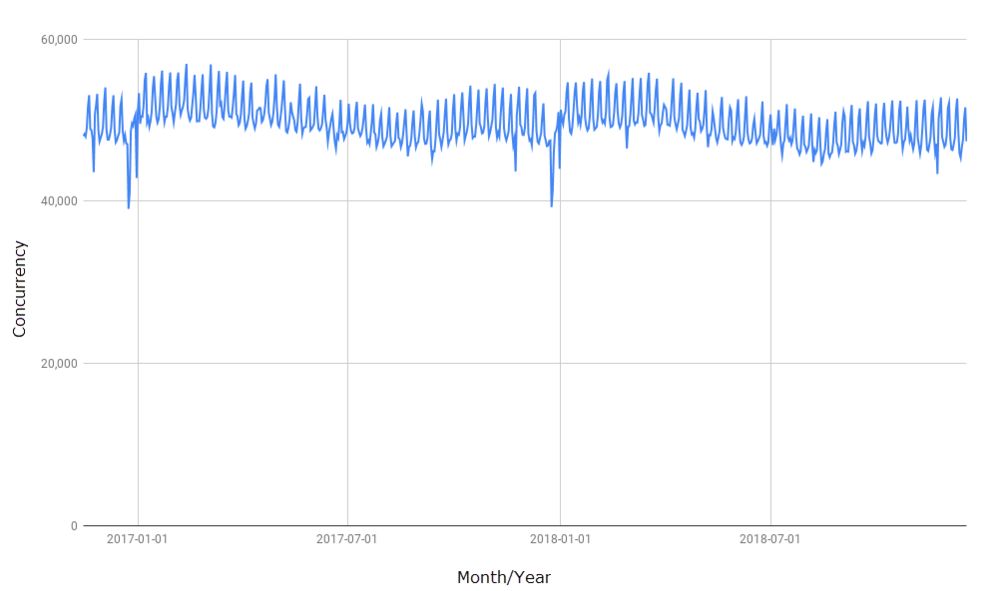
For me, the most interesting part of the Lab’s blog post comes at the end, starting with a chart showing average concurrency over the last two years. It shows levels to be relatively stable.
Of course, there might be a temptation to offer contrasts between this chart and others that report more in the way of averages over shorter periods – such as those found on the Firestorm log-in screen or via infographics such as those shown on Tateru Nino’s stats pages (which appear to be recording again after having problems earlier in the year). However, given there is no actual benchmark for the Lab’s chart, such comparisons would be somewhat off-base; the chart isn’t designed to show averages or daily high-lows. It simply shows a 730-day period in which the peak daily log-ins (I would assume) have remained pretty constant, despite all the claims of falling numbers.
The Lab’s two-year concurrency chart
The flipside of this of course, is that equally, it’s hard to really judge such a broad trend like as this, simply because it is likely taken from one data point, be it peak daily log-ins or something else. For example: if it is tracking just peak log-ins, what were the daily minimums? How long per day were the peak periods? have there been any changes in this over the two years?
A more interesting stat is that for the amount of USD cashed-out. Put at $65 million, this is only $2 million less than that quoted for 2017, and still above the US $60 million for 2016. As such, it stands at odds with claims that the Second Life economy has been in some kind of slump during at least the second half of 2018, suggesting that things have been relatively stable overall. Which is not to say that some merchants haven’t seen a downturn in sales; but these could be the result of people shifting their spending habits more that not spending their money – see my comment re land, above.
The final two listings on the Marketplace and the Destination Guide make for interesting reading, but little more – although the fact that men’s apparel comes in 10th on the Marketplace while women’s comes in second might be an interesting topic to plumb. Is it simply because there are fewer creators focusing on menswear, or is it a combination of fewer creators and male Second Life users perhaps being less driven by the demands of fashion?
As noted, I’ll have more on the technical and other updates to Second Life in an upcoming article, and for now will leave you to read the Lab’s summation in peace 🙂 .
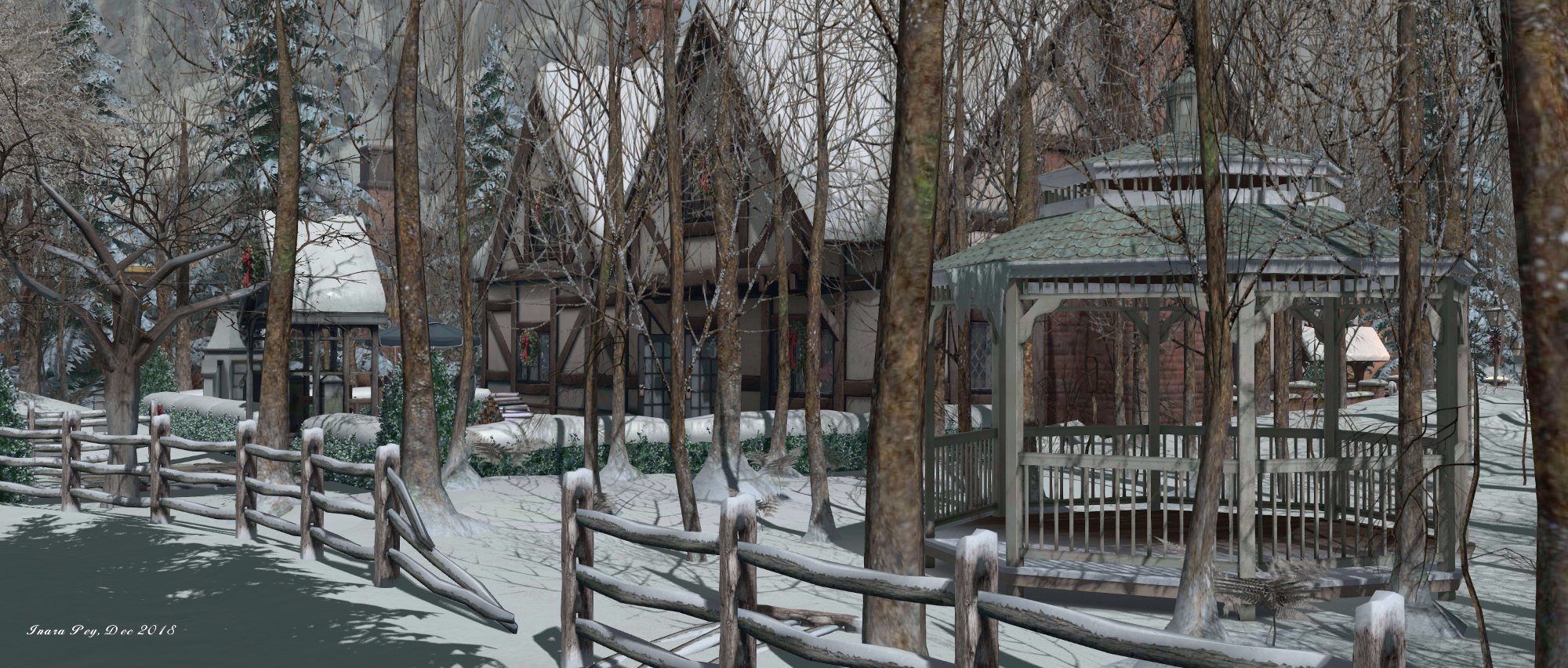
Zimminyville, created and maintained by Curfax Zimminy and Flo Zimminy (SweetFloXO), occupies a full region leveraging the full region land capacity bonus. It is one of the most remarkable regions we’ve yet visited, and is very much a place of two very different halves.
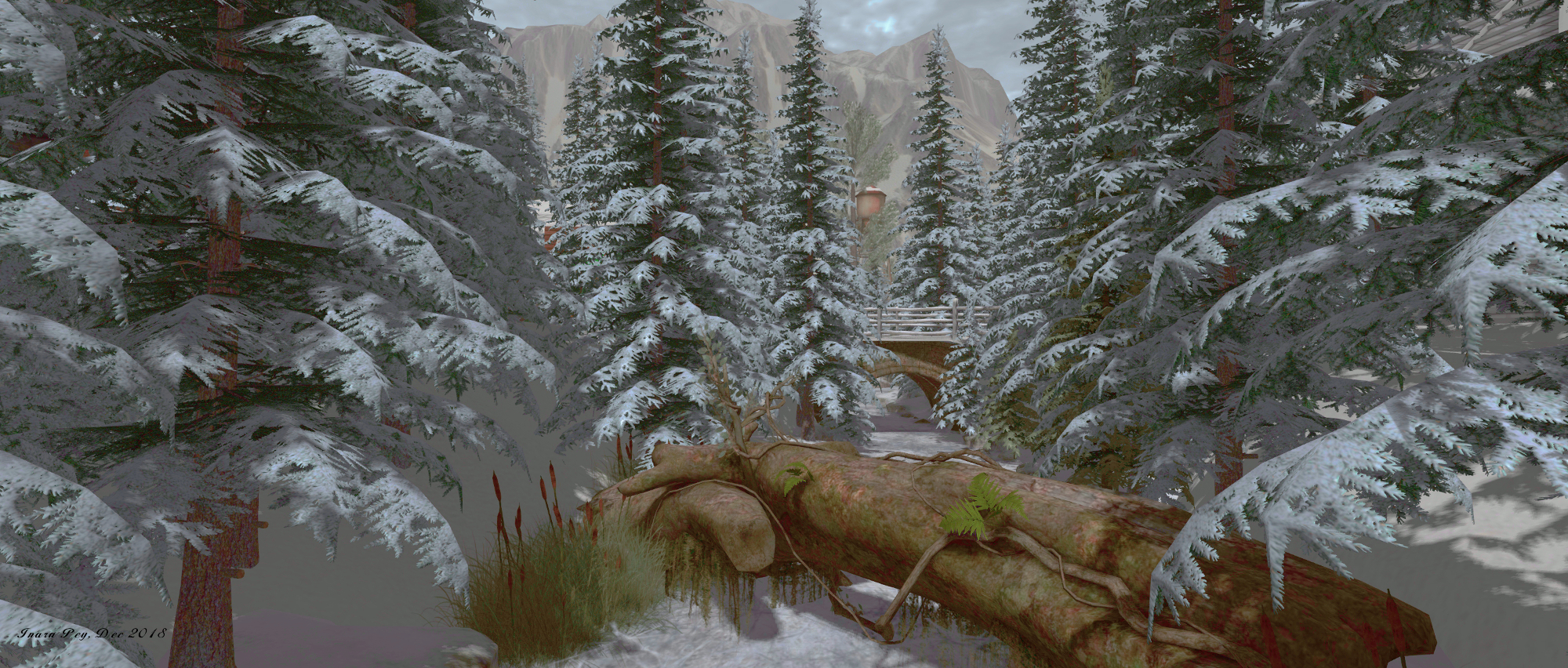
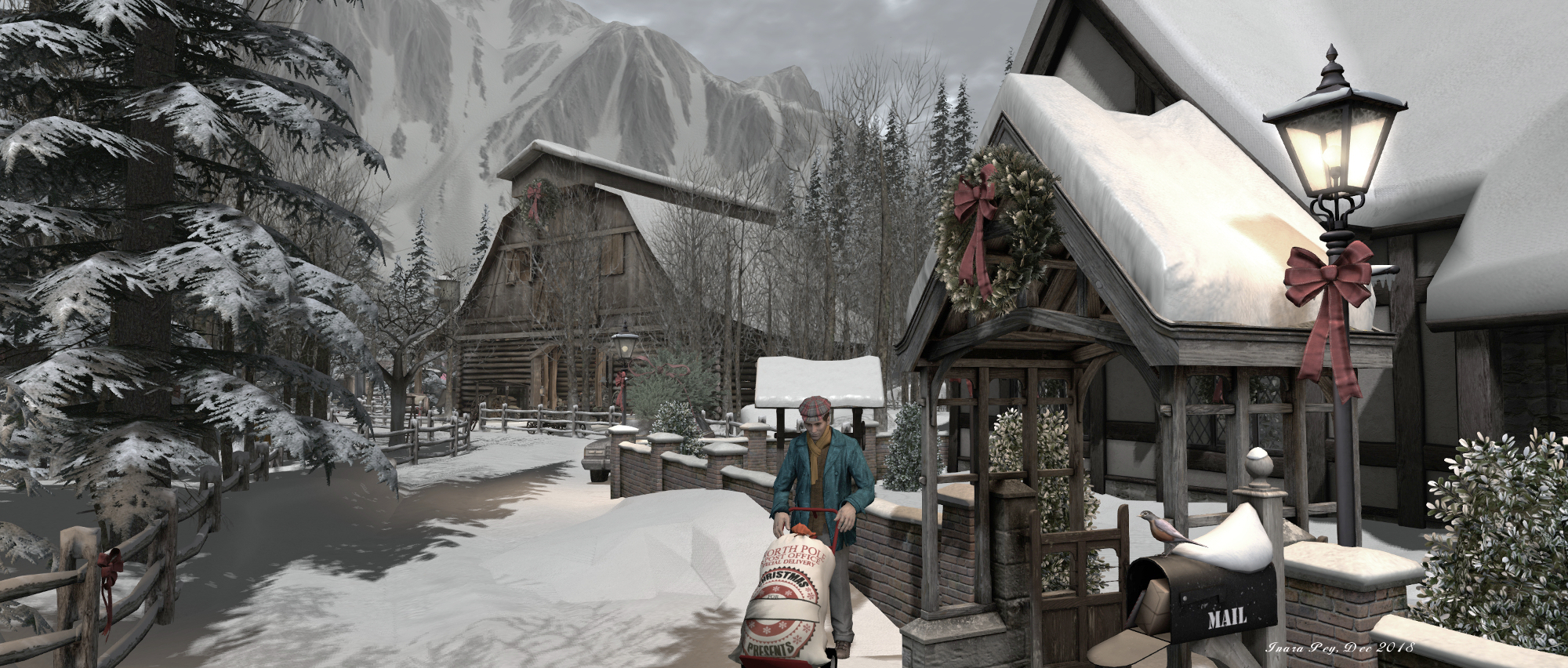
At the ground level is a town which, according to the About Land description, changes with the seasons, lies a small town. Right now it is caught in the midst of winter, snowbound and surrounded by high mountains. The landing point sits towards the centre of town, alongside a large mock-Tudor house that faces a large map showing the town’s layout, although specific points of interest aren’t labelled.
This lack of labelling (beyond the “you are here” pin) actually isn’t a disadvantage; snowy road wind their way through and around the landscape, and following them will lead you on a worthwhile tours of exploration. For the most part, the town has a feeling of being a small, but once industrious place; on the south side can be found large warehouse-like buildings that tower over the rest of the landscape.
However, and while fishing boat, crowded by ice floes, sits alongside a small wharf, it is clear that commerce has moved on for the most part. The brick-built warehouses have been converted for use as residences or bars, while the little harbour has the wreck of a trawler lying within it, preventing the use of a good portion of the wharf.
The water and piers continue along the west side of the town, marked by yet another sunken trawler. Again, while the might once have been a place of fishing commerce, the wharf here is now far more of a tourist attraction, a long, pleaant (if bracing, given the weather!), walk along the waterfront, complete with a launch point for balloon rides over the town. A second balloon can be found to the east, but lies separated from the town by a high spine of rock, home to fir trees and an old forest ranger’s station. A tunnel at the foot of this ridge offers a means from trains to reach the local terminus, complete with the bulk of vintage engine de-railed alongside and attesting the the age of the town.
A screen of trees also separates the terminus from the rest of the town, together with a little stretch of wilderness cut by a stream sealed under a layer of ice and – rather surprisingly – the bulk of an old space freighter, also seemingly converted into a home.
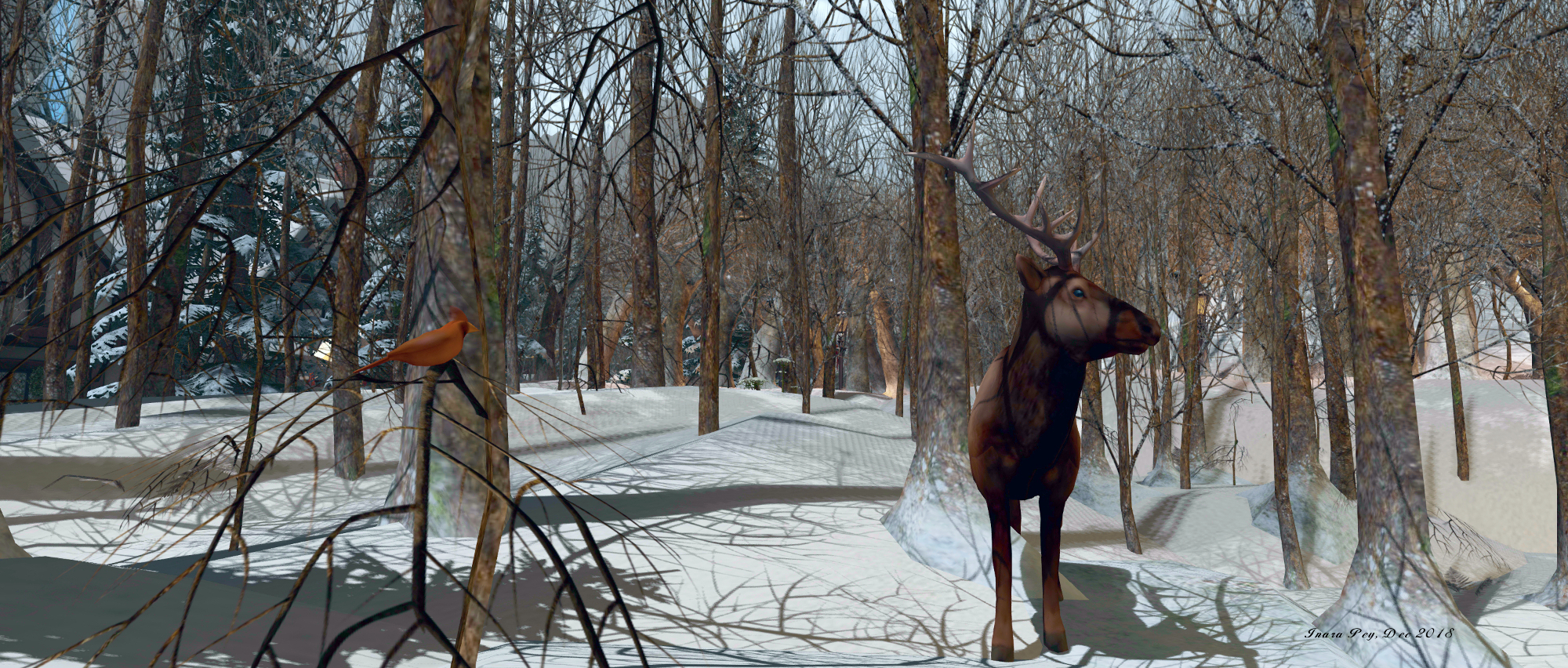
With its houses, winding roads, buildings old and new, Zimminyville has the look and feel of a remote town somewhere in high latitudes, possibly in North America. There is a wonderfully eclectic look and feel to the setting, from the drive-in theatre and its mixture of vehicles, to the juxtaposition of the converted space freighter with the nearby old windmill. However, the most interesting oddity in the setting is the presence of a large glass-and-steel pyramid that points a laser-like beam up into the sky.
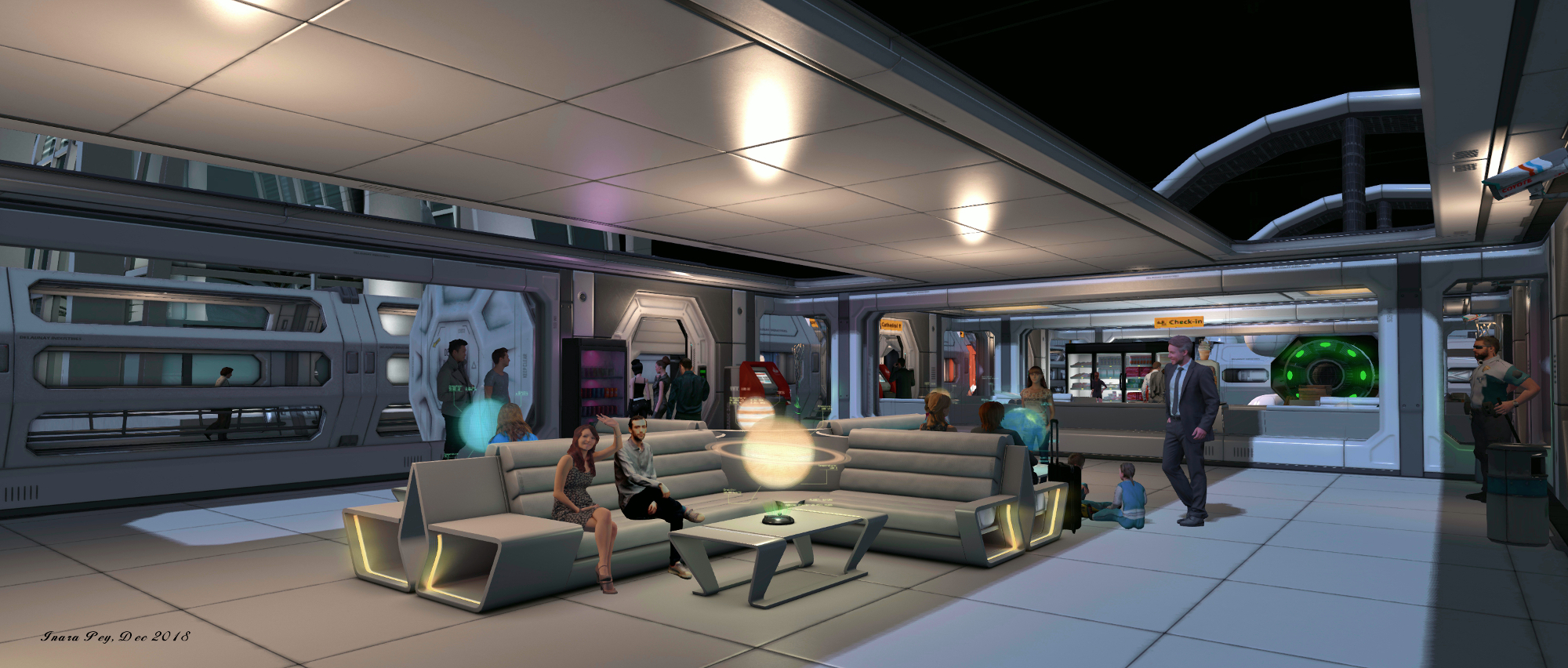
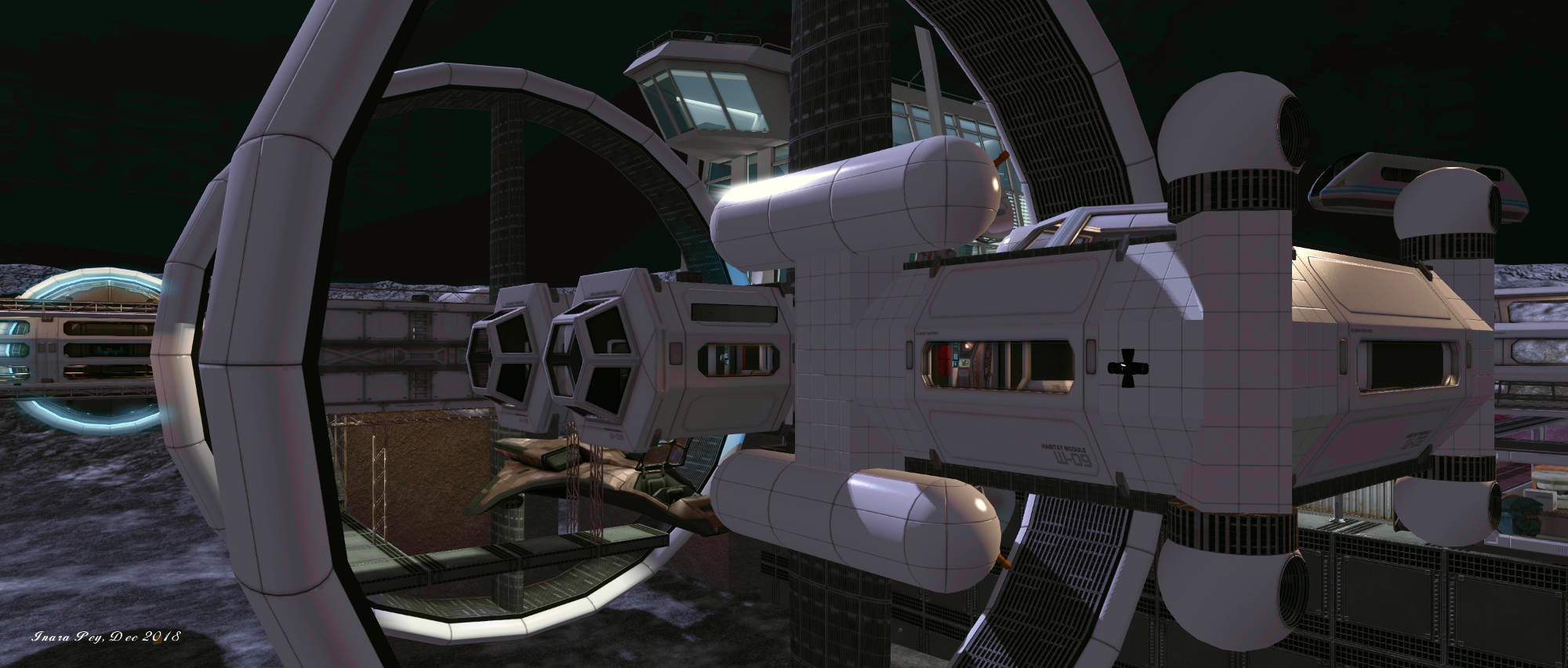
Futuristic in both look and content, this is the gateway to the second half of the region: a large, well-established space port sitting on the surface of the Moon. Four launchpads are presented inside the pyramid, three of them home to individual pods that can carry one passenger at a time up to the Moon. Which you take is entirely up to you, as all three will arrive at different points within the same station, before “return” after you’ve disembarked.
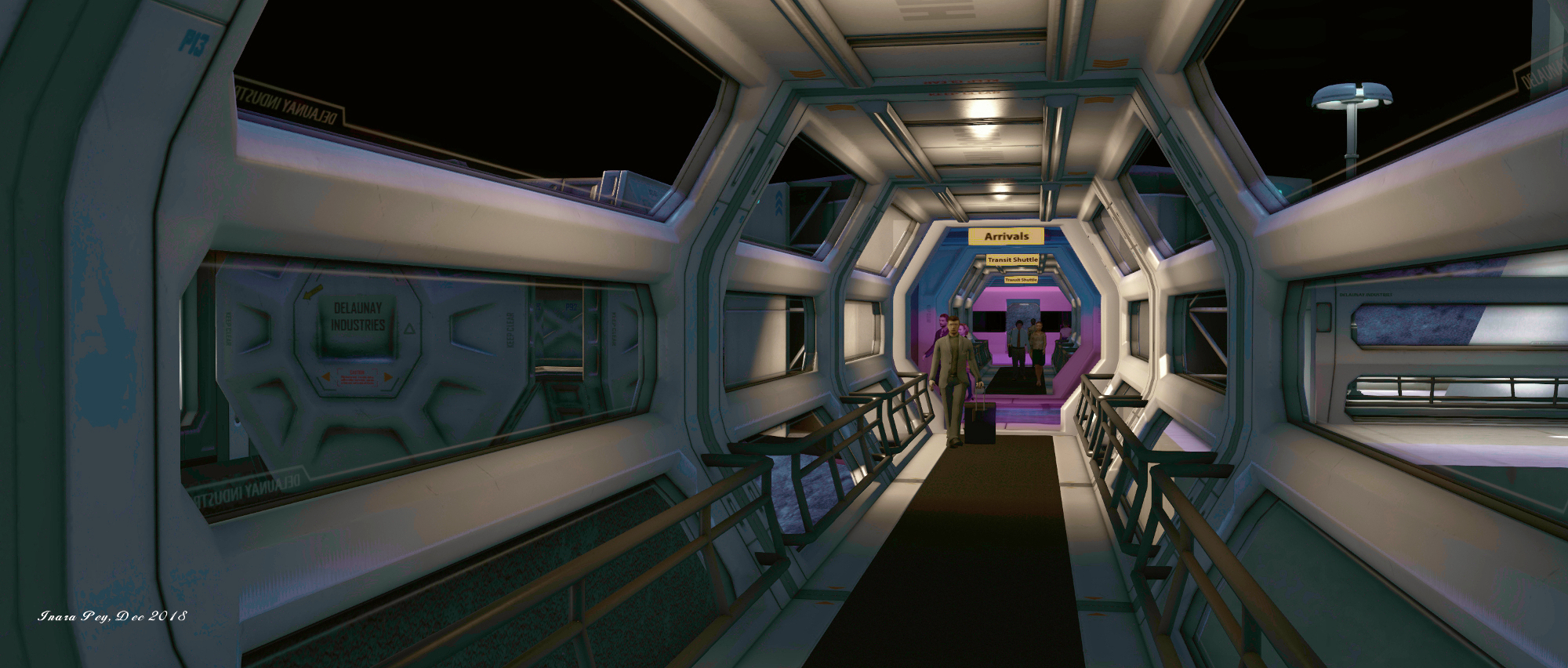
It is to this space port that commerce has clearly moved. In difference to the sleepy setting of the town, the base is a bustling hive of activity. Passengers can be found in the departure lounges doing the things people do before a flight: sitting and waiting, passing the time in conversation, getting food and snacks or anxiously checking-in. Others are to be found hurrying along the enclosed corridors hurrying to / from departure or arrival gates, or waiting for departure aboard their transports, all of them watched over by security guards or flight crew.
A small, two-seat military vessel is also docked in the lower portion of the station, although military uses for the station do not appear to be otherwise much in evidence. Fed Ex, however, do have a large presence, with freighters sit loaded and awaiting departure, ready to carry all measure of goods – and in one case, passengers – elsewhere.
Quite where everyone is going is hard to say, but it would appear the station is very much a gateway to the rest of the solar system. Beyond the passenger hub of the station sits the huge bulk of the Europa Sun, a massive spacer crammed with facilities, including two large hangers. Whether she is still operational or not, is hard to say. She sits on sturdy landing legs, massive engines rotated for lift-off, her flight deck still in place. But the conglomeration of habitation units on her back and research / industrial units under her belly suggests she is perhaps now a permanent part of the base, the hemisphere of her bio dome offering those staying on the base who need it, a reminder of the trees and greenery of Earth.
Facing Europa Sun from across the base is the impressive bulk of a huge structure. It looks a little incongruous in some ways, particularly given appears to the grass and topiary hedgerows found in was should be the airless near-vacuum of space, and alongside a landing pad marked for helicopters (or perhaps the “H” is for “hopper”, as in “Moon hopper”?). What looks to be some kind of control centre sits under this landing pad, but the bulk of the building forms a huge cathedral setting – albeit one with a further pod landing pad vying with the altar for attention. A closer look at the latter will reveal the building’s function: the opportunity to have a real get-away-from-it-all wedding…
A sense of life has been added throughout the station by the inclusion of static characters (I won’t call them NPCs, are they are entirely non-interactive). They are typical of the people you might find in any Earthly airport. All of them bring a certain depth to the setting, as do their compatriots down within the town, even if they are fewer in number.
Zimminyville is, when all is set and done, a quite remarkable location. The town and the lunar base are strikingly different to one another, and each has its own mystery to explore. Time is very much needed to appreciate everything on offer (and to find things like the table games available in both). The attention to detail and the level of care taken in such a complex build is impressive, and there are plenty of opportunities for photography throughout.
Given all that is on offer you might find more than one visit is required to capture all there is to be found, but whether you go once ot twice or any number of times, Zimminyville is not a destination to be missed. Once again, our thanks to Shakespeare for the pointer!
![[Valium]; Inara Pey, December 2018, on Flickr](https://farm5.staticflickr.com/4871/44593723490_6744c350ee_o.jpg)
![[Valium]; Inara Pey, December 2018, on Flickr](https://farm5.staticflickr.com/4818/44593723860_43bd0f5535_o.jpg)
![[Valium]; Inara Pey, December 2018, on Flickr](https://farm5.staticflickr.com/4828/44593724890_e287273cf2_o.jpg)
![[Valium]; Inara Pey, December 2018, on Flickr](https://farm5.staticflickr.com/4820/45498090215_6f05ffe001_o.jpg)
![[Valium]; Inara Pey, December 2018, on Flickr](https://farm5.staticflickr.com/4822/45498089495_045ecb8ecb_o.jpg)
![[Valium]; Inara Pey, December 2018, on Flickr](https://farm5.staticflickr.com/4882/44593724360_0f6cb1ccf0_o.jpg)
![[Valium]; Inara Pey, December 2018, on Flickr](https://farm5.staticflickr.com/4829/45498088645_c725630071_o.jpg)






 Inara Pey: Living in a Modemworld