Rituals, aliens, poems and a rebellious rogue

Seanchai Library

It’s time to highlight another week of storytelling in Voice by the staff and volunteers at the Seanchai Library. As always, all times SLT, and events are held at the Library’s home at Holly Kai Park, unless otherwise indicated.

Sunday, March 31st: 13:30 Tea-Time with Sherlock Holmes’ Greatest Hits

As voted for by Seanchai fans, followers and listeners. This week: The Adventure of the Musgrave Ritual, first published in 1893 in The Strand Magazine, and re-published in 1894 in book format as part of the collection The Memoirs of Sherlock Holmes.

From The Adventure of The Musgrave Ritual, an illustration by Sidney Paget, 1893.

“There are cases enough here, Watson,” said he, looking at me with mischievous eyes. “I think that if you knew all that I had in this box you would ask me to pull some out instead of putting others in.”

“These are the records of your early work, then?” I asked. “I have often wished that I had notes of those cases.”

“Yes, my boy, these were all done prematurely before my biographer had come to glorify me.” He lifted bundle after bundle in a tender, caressing sort of way.

“They are not all successes, Watson,” said he. “But there are some pretty little problems among them. Here’s the record of the Tarleton murders, and the case of Vamberry, the wine merchant, and the adventure of the old Russian woman, and the singular affair of the aluminium crutch, as well as a full account of Ricoletti of the club-foot, and his abominable wife. And here — ah, now, this really is something a little recherche.”

Thus Holmes introduces Watson to one of the cases his took on before the two became friends, one involving an old acquaintance from Holmes’ university days, Reginald Musgrave, a vanished butler and maid and the mysterious Musgrave Ritual. Just the Seanchai Team in the Fireside room to learn more!

Monday, April 1st 19:00: The World Of Ptavvs

Gyro Muggins returns to Larry Niven’s Known Universe to read the first novel Niven ever set within it  – given it was actually he first full-length novel. Within it, he lays many of the seeds, human and alien that would come to define that universe, its characteristics, traits and races.

A reflective statue is found at the bottom of one of Earth’s oceans, having lain there for 1.5 billion years. Humanity’s experiments with time manipulation lead to the conclusion the “statue” is actually an alien caught within a “time slowing” field.

Larry Greenberg, a telepath with highly developed and honed abilities is asked to participate in an attempt to make contact with the alien. This involves Greenberg and the “statue” being places within a single time slowing field, the effect of which is to nullify the one shrouding the alien.

The the new field in operation, Greenberg finds himself in the company of Kzanol, a member of a race called the Thrint. Powerfully telepathic, the Thrint once rules the galaxy pure through their mental powers and the ability to bend the minds of others to their own will. However, in the time that Kzanol has been trapped the result of a malfunction aboard his ship which forced him to abandon it and fall to Earth protected by the stasis field of his space suit, the Thrint were facing a revolt by all the races they had enslaved.

As a result of this, the Thrint had determined to wipe out every race in the galaxy using a thought amplifier. Now, his own mind mixed with that of Kzanol, Greenberg sets out with the alien with the aim of using the weapon to enslave every mind in the solar system…

Tuesday, April 2nd 19:00: The Fairy Tree

An original story written and read by Caledonia Skytower.

Wednesday, April 3rd 19:00: It’s Poetry Month!

Join Aoife Lorefield, Corwyn Allen, Kayden Oconnell, Ktahdn Vesuvino, Caledonia Skytower and possibly more in a celebration of National Poetry Month as they read some of their favourite poems and verses. Have a favourite of your own? Bring it along and one of the team will read it!

Thursday, April 4th

19:00: Rogue One: A Star Wars Story Part 2

With Shandon Loring. (Also in Kitely grid.kitely.com:8002:SEANCHAI).

21:00: Seanchai Late Night

Late night Sci-Fi-Fantasy from some wonderful on-line ‘zines and podcasts, in a relaxed late night atmosphere with Finn Zeddmore.


Moon’s Likelihood of Nearness in Second Life

DiXmiX Gallery: Moon Edenbaum

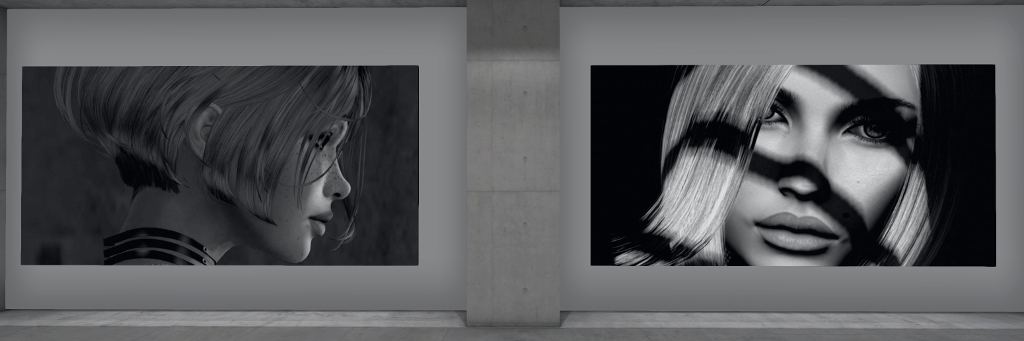
Moon Edenbaum has a talent for taking avatar studies that provide a richness of possible narrative. I first encountered his work in a joint exhibition of art featuring Moon and Hillany Scofield back in 2017 (see Dathúil: Me_You – Moon Edenbaum), and have appreciated his work since then. So it was with a sense of anticipation that I jumped over to DiXmiX Gallery, curated by Dixmix Source, to view a new exhibition of Moon’s work entitled The Likelihood of n e a r e s s.

With its official opening held on Friday, March 29th, 2019, this is a series of some 17 images of Moon’s friends. However, rather than being a set of what might be called “traditional” avatar studies, these are quite marvellous studies taken from some unique perspectives, presented in fitting monochrome finishes.

DiXmiX Gallery: Moon Edenbaum

Each image offers a particular context on the individuals portrayed. They are by turns captures of intimacy, of candidness, of coyness and, throughout all of them, nearness. The suggestion is that the avatars are not so much facing the camera, but are spending time with a friend.

This gives all of them that narrative depth I do enjoy with Moon’s work. Each picture has a story to tell, both about the subject and about their relationship with the camera / the person behind the camera. Take Pai, for example; by avoiding any of her facial features, we are presented with an image of someone who could be shy, or at least self-conscious with the idea of a  camera pointing at her. But this is picture that also reveals she trusts the camera enough for it not to reveal her vulnerability in this regard, while the camera in turn understands her discomfort and respect it by turning its eye away from the potential to embarrass her.

DiXmiX Gallery: Moon Edenbaum

Coyness is perhaps best exemplified through Yul and Mic. Side-by-side, both offer playful views of their subjects that does much to suggest their nature and their relationship with the camera / photographer. Perhaps my favourite among this collection, however, is perhaps Cyn.

Once again a glorious close-up, there is a layered richness to this picture that is attention-holding. It is at once intimate, revealing and allows the imagination to take flight. From the collar around the subject’s through, through to her pose to  the selected angle of the shot itself, the picture offers a story of a woman both aware of – but not bothered by – the presence of the camera, as her attention is held elsewhere, through to a tale of her desires and preferences in relationships. It also raises intriguing questions that give the imagination flight on such matters of her desires and with whom and how they might be met, through to thoughts of exactly who holds her attention, and whether it is in fact the photographer.

DiXmiX Gallery: Moon Edenbaum

It is also, for me, the piece that reflects the title of this most fascinating exhibition, which I have no hesitation in recommending, each picture offering so much to those who view them.

SLurl Details

2019 SL User Groups 13/3: TPV Developer Meeting

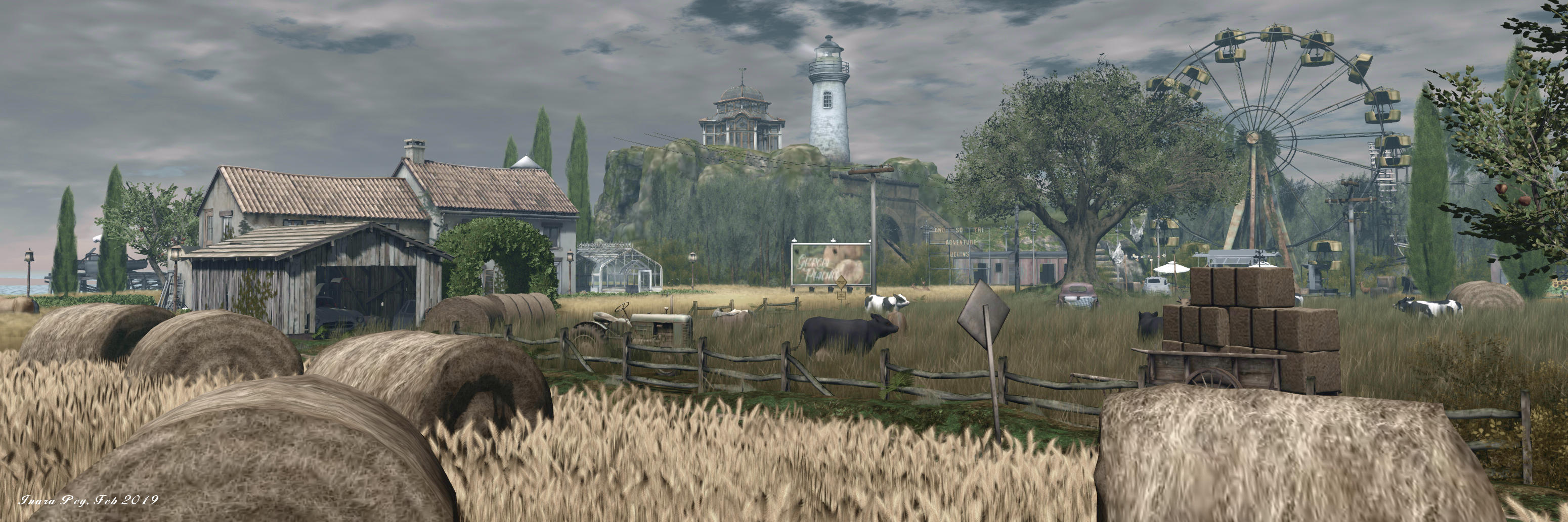
Sol Farm; Inara Pey, February 2019, on FlickrSol Farmblog post

The following notes are taken from the TPV Developer meeting held on Friday, March 29, 2019. A video of the meeting is embedded below, my thanks as always to North for recording and providing it. Time stamps are provided to the major topics of discussion, which will open the video in a new tab for ease of reference.

SL Viewer

There have been no updates to any viewers since my Simulator User Group summary. The viewer pipelines there remain as follows:

  • Current Release version 6.1.0.524670, formerly the BugSplat RC viewer February 13, promoted February 28 No Change.
  • Release channel cohorts (please see my notes on manually installing RC viewer versions if you wish to install any release candidate(s) yourself):
  • Project viewers:
  • Linux Spur viewer, version 5.0.9.329906, dated November 17, 2017 and promoted to release status 29 November – offered pending a Linux version of the Alex Ivy viewer code.
  • Obsolete platform viewer, version 3.7.28.300847, May 8, 2015 – provided for users on Windows XP and OS X versions below 10.7.

[2:22-6:55]

  • The hope is the EEP RC viewer will be eligible for promotion to de facto release status “pretty soon”.  However, as per my CCUG summary, both the EEP viewer and the new-to-RC-status Bakes on Mesh viewer  are awaiting some fixes.
  • The Estate Access Management viewer is good-to-go, but is awaiting some simulator update with a new capability, which is likely to be another couple of weeks, before it can be promoted.
  • All of this means that the next viewer liable to be promoted will be Love Me Render viewer.

EEP Limitations

[7:24-25:00] There are also a couple of user-identified issues with EEP that are being considered:

The first is that EEP doesn’t play well with RLV and RLVa capabilities that use Windlight settings. LL have offered to help see what LSL abilities within EEP might be used to overcome the issues.

The second is potentially more disruptive: the ability to locally change an environment for the purposes of photography is somewhat limited.

Currently, with Windlight, it is possible for a photographer to tweak the local environment in their own viewer (e.g. move the Sun to provide better lighting / shadows, alter the cloud and haze density / colour, etc.).

Within EPP, this ability is limited to only those settings a user has a right to alter, make such minor adjusts potentially impossible to achieve. This is related to the EEP permissions system that has been set to allow EEP assets to be sold by creators.

The only options are either a): completely replace the location environment with one attached to their avatar; or b) trying to build a personal “copy” of the location environment just to adjust the Sun position, etc., or c) trying to employ LSL to make the necessary changes, with b) and c) clearly being hard for most people to achieve.

Whirly Fizzle has raised a feature request (BUG-225921) to bring the matter to LL’s attention, and it is being examined. However, whether or not an alternative means to make such localised (/ personal) tweaks to an environment will make the initial EEP release or be held over to “EEP 2.0” has not been decided.

One suggestion put forward at the meeting allowing such minor tweaks might be to allow make changes without exposing the associated underlying values for the settings (thus avoiding people being able to copy  / rip EEP assets that they would otherwise have to buy), and to have the Save options disabled when doing so. Rider Linden indicated this is one of the approaches he was considering looking at.

Reminder: the EEP simulator code is now grid-wide. This means certain render feature – such as the stars – appear to be “broken” on non-EEP viewers (e.g. black “stars” can appear in daytime skies as square blotches, and at night white stars appear decidedly square. This is because the sky (including the stars) is rendered differently with EEP, but an attempt is made to convert things like stars back to a windlight setting for rendering by non-EEP viewers, which doesn’t entirely work.

This issue will obviously be fixed when the EEP viewer code is available in all viewers.

Simulator Update

[6:56-7:20] Simulator releases have been fairly quiet of late, with some weeks seeing no roles on either the SLS (Main) channel or one or more of the RCs. However, there are a number of simulator projects in flight which mean things are liable to be busy with simulator releasing over the coming weeks.

Teleport Issues

Teleport Disconnects

[25:37-34:01]

  • It’s been widely noted that there has been a sharp up-tick in teleport failures & viewer disconnections (with physical region crossings also causing similar issues).
  • This problem appeared to start with a server deployment, but the root cause(s) is / are proving hard to identify.
  • It took the Lab a while to realise there was a problem, as the tool they use to monitor the success / failure rate of teleports was not showing any significant issues, and Lindens in-world assumed that when they encountered the problem, it was an issue with their own connection.
  • Investigations are now in progress, but identifying a root cause is difficult, as it is proving hard to get a consistent set of circumstances by which the disconnects can be reproduced.
    • If anyone can determine a means to repro the issue, or determine the conditions under which the problem is more / less likely to happen, they are asked to put it in a Jira for the Lab.
  • Some changes have been made to the simulator code in the hope that they might either a) help alleviate the problem, or b) at least provide more data when teleport disconnects do occur, and some of these changes are likely to be deployed in week #14.

Attachment Loss on Teleport

[34:09-36:59]

  • This is another issue that has been of increasing notice for a while now (e.g. inventory being actually detached; attachments being ghosted in your local view whilst others still see them attached; experience-controlled temporary attachments becoming ghosted, etc.).
  • The Lab does not have a solution for the problem as yet. However, via testing, they have found a number of issues that contribute to worn inventory being detached as a result of the teleport (/ region crossing).
  • Fixes for these issues are being developed, and more news on these should be available once the Lab has some definitive testing results.
  • The hope is that the Lab will able to resolve most of the issues  – or at least make things behave more correctly – just through changes on the server-side, rather than the fixes being heavily biased towards the viewer.
    • Any viewer-side changes that might be required will be highlighted at future TPVD meetings do that other viewers can take and merge them as required.

Other Items

Adult Rated In-Viewer Web Searches

[40:45-43:15]

Despite certain pundits claiming otherwise, the Adult rating is not all about “extreme sex and violence” (there are numerous residential, art, photographic, and role-play regions for example, that err on the side of caution and opt for an adult rating). However, a problem that does exist is that the web search in the viewer currently opens on the Events tab, and with the Adult search parameter enabled, this can result in sexually explicit adverts being displayed, which some who might otherwise be using Adult to rating simply to find the type of location noted above to be uncomfortable.

  • Unchecking the Adult search option isn’t a solution, as disables Adult searching in other categories thus preventing the art galleries, etc., mentioned above being listed in results.
  • One way to lessen this impact might be to make the Destinations tab the default tab on opening the web search panel. While this still has Adult destinations in the banner ads, these are more mixed with ads for destinations with other ratings, and potentially less noticeable.
  • Another suggestion offered is to possibly sub-categorise Adult search results between sexual / non-sexual (although this could be hard to achieve in avoiding issues of gaming).
  • The suggestion made for this issue to also be raised at the next Web User Group meeting.


Paola’s Nudes: an homage to Helmut Newton at Nitroglobus

Nitroglobus Gallery: Nudes by Paola Mills

Now open through April and into May at Nitroglobus Roof Gallery, curated by Dido Haas, is Nudes, a themed series of images by Paola Mills, which stands as something of an homage to the late German-Australian photographer Helmut Newton.

For those unfamiliar with Newton, who is perhaps best remembered for his work from the 1970s through mid-1990s, I’ll let Brooke McCord provide an introduction:

Nobody has made quite the lasting impression on fashion imagery as Helmut Newton. Hired by French Vogue in the 1950s before being propelled to fame in the 1970s, Newton came to be renowned for his controversial scenarios, hypersexualised imagery and striking compositions. With elements of his work that linked to the themes of surrealism – an art movement dominant during his youth spent growing up in Berlin – Newton’s unadulterated love of beautiful and strong women saw him create images laden with heavy overtones of voyeurism, sadomasochism and fetishism.

Brooke McCord, Your ultimate guide to Helmut Newton, Dazed, 2016

Nitroglobus Gallery: Paola Mills

In particular, Newton is p[erhaps best known for two classical collections of photography, White Women (1976) and Big Nudes (1981), which together with 1978’s Sleepless Nights, often form a triptych of themes for retrospectives of his unique style of photography.

For Nudes, Paola states she draws inspiration from, and pays something of a tribute to, Big Nudes, although I would perhaps argue that some of the pieces here also reflect (and contrast with) Newton’s White Women as well. As noted, both have come to be regarded as classical works by Newton; White Women due to its mixture of aesthetics, technical perfection and bourgeois decadence laced with dark elegance and eerie abstract s/m trappings to present what was regarded as a pinnacle of erotic photography.

Big Nudes, however, eschewed all of the trappings found within White Women. Instead, for this series of black-and-white photos, produced between 1979 and 1981, Newton took a stylistic change, the elaborate layouts with their tones of decadence discarded in favour of a full-on unambiguously formulated approach that took pride in female nakedness, and its power therein.

Nitroglobus Gallery: Paola Mills

This latter aspect is very much in evidence within Paola’s images, which also offer a contrast to Big Nudes with their use of skin tone and backdrop; they thus present almost an inverse mirror to Newton’s originals. And like Newton’s Big Nudes, Paola’s images speak to both the vulnerability and strength of the female body. But within some of them as well are echoes of White Women: a delicate and nuanced sensuality which, when combined with camera angle and backdrop – the plainness of the latter notwithstanding – offer echo elements of Newton’s 1976 collection. Not that Paola is intending to titillate through these images, a point she makes in the notes accompanying the exhibition, after she gives credit to Newton for his work:

Much more modestly I wanted to represent the nakedness of an avatar in all its erotic charge. I don’t want to tickle the sexual instincts nor excite the minds, but only convey to my avatars the human sensitivity that guides them in the metaverse.

– Paola Mills, describing Nudes

Nitroglobus Gallery: Paola Mills

But just because there is something of a voyeuristic / erotic aspect to some, of the images in Nudes should not be seen in any way as a failure on Paola’s part to achieve her stated goal. Rather, it speaks to the success in presenting the full complexity of human sensitivity – both within the images themselves and our reaction to them.

Nudes officially opens on Sunday, March 31st, 2019 with a party at 12:00 noon SLT, and will run through the month and into May. However, those wishing to see the exhibition ahead of the launch can do so now.

SLurl Details

2019 SL User Groups 13/2: Content Creation summary

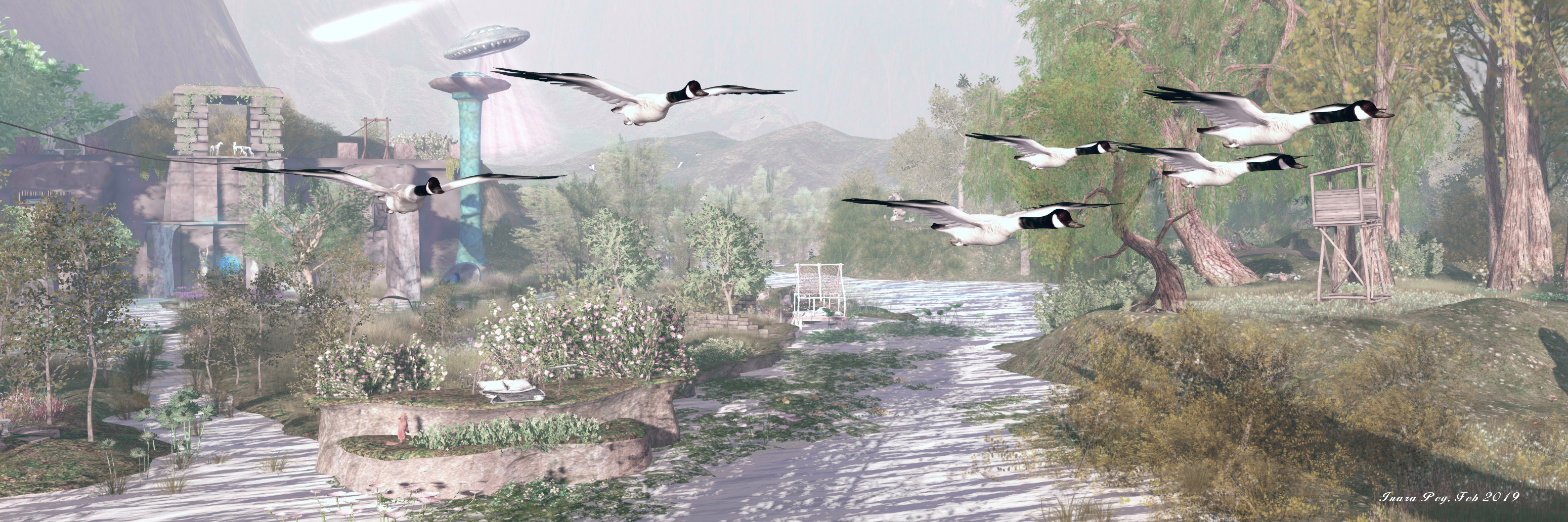
On The Other Side; Inara Pey, February 2019, on FlickrOn The Other Sideblog post

The majority of the following notes are taken from the Content Creation User Group (CCUG) meeting, held on Thursday, March 28th 2019 at 13:00 SLT. These meetings are chaired by Vir Linden, and agenda notes, meeting SLurl, etc, are usually available on the Content Creation User Group wiki page.

Bakes On Mesh

Project Summary

Extending the current avatar baking service to allow wearable textures (skins, tattoos, clothing) to be applied directly to mesh bodies as well as system avatars. This involves viewer and server-side changes, including updating the baking service to support 1024×1024 textures, but does not include normal or specular map support, as these are not part of the existing Bake Service, nor are they recognised as system wearables. Adding materials support may be considered in the future.

Resources

Current Status

  • As noted in my Simulator User Group update, the Bakes on Mesh viewer has reached release candidate status with version 6.1.1.525409.
  • Depending on feedback from QA, this could mean Bakes on Mesh is fairly close to promotion to release status.
  • However, alongside of this work, the Bakes on Mesh reference textures have had to be re-uploaded, and thus have new UUIDs.
    • This means any test content (such as the test Omega system) using these textures will have to be updated in order to work with the RC viewer.
    • The new UUIDs have – at the time of writing – yet to be updated on the Bakes on Mesh wiki pages.
    • There are also LSL constants for the new UUIDs, but LL don’t currently have a simulator update for these yet, so if you try to set LSL to try to set textures to the appropriate channels they won’t currently work as expected.

Environment Enhancement Project

Project Summary

A set of environmental enhancements allowing the environment (sky, sun, moon, clouds, water settings) to be set region or parcel level, with support for up to 7 days per cycle and sky environments set by altitude. It uses a new set of inventory assets (Sky, Water, Day),  and includes the ability to use custom Sun, Moon and cloud textures. The assets can be stored in inventory and traded through the Marketplace / exchanged with others, and can additionally be used in experiences.

Due to performance issues, the initial implementation of EEP will not include certain atmospherics such as crepuscular rays (“God rays”).

Resources

Current Status

  • Work is continuing to resolve some shader issues that see “certain things shading differently”.
  • It has been noticed that EEP can also impact frame rates, and the Lab is trying to quantify these better.
  • A further RC build of the viewer is in the wings, but has some issues with it (e.g. issues with handling projected lights) which need to be addressed. However, it is hoped this will surface in week #14 (commencing Monday, April 1st, 2019).

Reminder: the EEP simulator code is now grid-wide. This means certain render feature – such as the stars – appear to be “broken” on non-EEP viewers (e.g. black “stars” can appear in daytime skies as square blotches, and at night white stars appear decidedly square. This is because the sky (including the stars) is rendered differently with EEP, but an attempt is made to convert things like stars back to a windlight setting for rendering by non-EEP viewers, which doesn’t entirely work.

This issue will obviously be fixed when the EEP viewer code is available in all viewers.

Animesh Follow-On

Vir has commenced work on LSL support for Animesh objects. Right now this involves providing a means to get the number of animated attachment slots, the number of open slots.

Other Items

Animation Optimisations

It’s been noted that .bvh animations go through an optimisation process, but .anim animations do not (a past subject of discussion in CCUG meetings). It would make sense for the optimisations to be applied to both, if they are of benefit, or ignored by both if they are not proving beneficial. It’s been suggested that the optimisations result in .bvh animations being a little less fluid than .anims.

Thus far the Lab hasn’t acted on this, as the general feeling has been that most animators favour one of the formats over the other. Those noticing specific differences in performance between the two are asked to file a Jira and attach test versions of both formats so the Lab can do side-by-side comparisons.

Custom Pivot Points

This was another point of past discussion. Initial work has been done to allow custom pivot points within the viewer, but the current blocker is that it requires simulator support, specifically with the physics shapes that have to be generated. With everything else going on at the moment, there is no time frame as to if / when this work might be carried out.

Date of Next Meeting

Thursday, April 11th, 2019.

Sansar: Questing and Jumping update

The quest portal at the Social Hub in Sansar, which features two quest Agents

On Thursday, March 28th, Linden Lab released the Questing release, described “one of our biggest and best releases yet”. The full release notes are available, and highlights of the release key features might be summarised as:

  • Initial introduction of quests.
  • The ability for avatars to jump.
  • Avatar selection, editing, skin and clothing updates.
  • Content creation updates.
  • Teleporting improvements.

Initial Notes

As with the majority of Sansar deployments, this update requires the automatic download and installation of a client update, particularly as it involves changes affecting the Sansar avatar system.

Quests

The new Quest pop-up

Quests are a part of Sansar’s emerging game building / game play capabilities. Quests are seen as being both a means to help on-board new users to Sansar, by giving them things to do, and as a means of providing a capability that can allow greater gaming and questing in Sansar experiences as a whole, using common root functionality, thus helping to give a feeling of continuity between experiences.

For this initial pass of the system, quests can only be created by Linden Lab. However, over time, the capability will be opened up to experience creators.

The quest system is immediately obvious on logging-in to Sansar, with a Quest pop-up displayed as you arrive in your Home Space. Further, two initial quests are provided at the Social Hub.

The two Social Hub quests are fairly basic. Each offers a modest reward of S$10 for exploring the Social Hub area and either walking over, or touching (left-click in Desktop mode) objects located at various points. Each quest is triggered by touching one of two glowing stands (Agent Animus and Agent Forma) in the centre of the arrival area of the Hub.

Doing so triggers a pop-up describing the quest, which includes options to start the quest or defer it (Maybe Later) – shown below left. Starting the quest then switches the pop-up to display the required objectives and how to complete the “mission” (below right).

A Social Hub Quest – the initial description pop-up (l) and objective pop-up (r)

As objectives are achieved, thy are briefly highlighted, and the grey-out tick mark alongside them is illuminated. Neither of the quests is procedural (so you don’t have to complete the objectives in the listed order), and at walking pace they take about 3-5 minutes to complete.

With all objectives completed, returning to the initiating Agent and touching it will update the quest status and deliver your S$10 reward, together with a link to open the Sansar Store, should you want to buy something.

Currently, there is no limit to how many times you can take each quest, and one user I was with while trying things out claimed to have already gone through both a total of 10 times apiece.

Avatar Related Updates

The Quest and Jump release provides a number of avatar related updates and changes.

  • Jumping: Sansar avatars can now jump. I’ve no idea how this is triggered in VR mode because – at the time of writing this overview – the release notes started with the words “Questing. Jumping. Styling for your custom avatars”, then never actually mentioned how to jump. For those in Desktop mode, it’s a matter of pressing the keyboard space bar. The jump animation is basic, but it works.
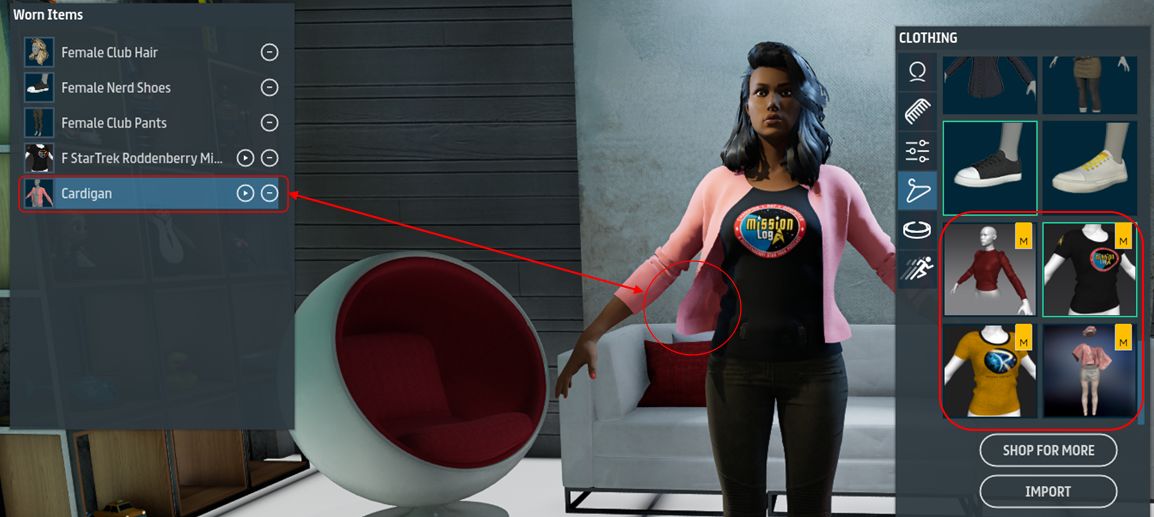
  • Custom Avatar dressing: it is now possible to dress custom avatars from the Look Book – providing they have been built with this in mind.
  • Custom Avatars as starter avatars: new users can now opt to use one of a number of custom avatars (as well as the Sansar default avatars) when starting out.
  • Marvelous Designer library clothing: the Look Book inventory now includes a rang of Marvelous Designer clothing options – look for the yellow “M” tag.
The clothing library now includes adjustable MD clothing options (indicated by a yellow “M” tag). Use the VR controllers or CTRL-left- click and drag for Desktop mode to adjust when the clothing item is selected.
  • Skin colours / tones: more options to colour the skin’s base tone.
  • New functions to enable you to edit your avatar better:
    • Improved save options without being kicked out of the editor.
    • Better reset options to allow you to re-start adjustments from scratch.
    • Easier way of returning to the world and return to your previous position in world before you edited your character. (Saving user position in runtime).

Event Creation Changes

From this release, every event created will be tied to its own experience, based on a scene template, rather than being tied to an existing experience. This means:

  • Events can no longer be joined by finding an experience, it must be done via the event calendar, with the event itself a special copy (not an instance)  of the experience.
  • Active events are listed on a new Featured tab – Client Atlas only.
  • Event creators can change the scene tied to an event, customise the scene like any experience, and delete the experience if it’s no longer needed.

Teleporting Updates

  • When you choose to teleport to your friend, you will now spawn near them, unless the experience creator has opted to disable direct teleport and force you at the arrival point.
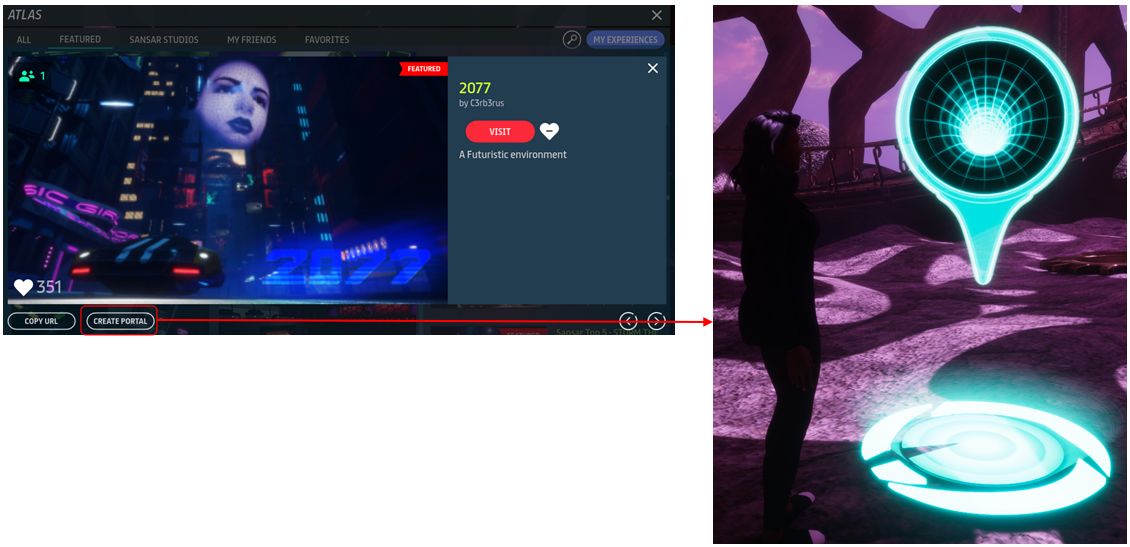
You can now create a portal from the Client Atlas entry for an experience without having to copy the URL; just click the button
  • You can now create Portals more easily with the new “Create Portal” button on the Atlas details page – Client Atlas only.

Creation Updates

  • Object parenting in the scene editor: objects can now have other objects as children. This means:
    • No more folders.  Existing folders are converted into parent objects.
    • Moving/Scaling a parent object will move/scale children along with it.
  • New functions to enable you to create your world better: scaling is no longer restricted to a slider between 0.1x to 10x. You can now use the Properties panel to:
    • Move/rotate/scale a selection of multiple objects at once.
    • Move/rotate a Light component.
  • List<> support in script parameters: allows passing multiple values to a script as a single parameter. This means that creators can now assign multiple values such as a sound, object, a position point to one parameter, eliminating the old behaviour that forces the creator to utilise a parameter per value.
  • Interaction behaviour on a per user basis: creators can now set interactions to update and change behaviour on a per-user basis. This enables creators to disable content once a user interacts with it. For example, a glowing chest in a treasure hunt could stop glowing once the user interacts with it.

Feedback

It will be interesting to see how the quest toolset progresses. They are basic, but functional and were drawing a lot of attention following the release deployment.

The addition of the MD clothing to the library is a welcome update, but while the button for spawning teleport portals is a step forward, Sansar would benefit from a means for users to be able to add experiences to some form of client “favourites” then can quickly access without having to pull up the Atlas, search it, click on an experience description then click on the button to spawn the portal. This is, frankly, as clunky as having to do the same and then click the Copy URL button and paste the URL into chat.

For the list of known issues, please refer to the release notes. For scripting API updates, please refer to the API documentation.