Breath of Nature, September 2019 – click any picture for full size
At the end of August 2019, we dropped into Breath of Nature on the suggestion of Shawn Shakespeare. A homestead region designed by JurisJo, it is a curious region that comes pretty much in two parts.
The western two-thirds of the land present a low-lying pastoral setting, partially split into two smaller islands alongside of the “mainland” area. To the north of the region stands a curtain wall of rock from which waterfalls drop, one set into a pool that feed outwards to the west and south, giving rise to the first of the two smaller islands.
Breath of Nature, September 2019
Home to horses and sheep and offering one of several places to dance, this island is otherwise devoid of major signs of human habitation. However, it sits close to the second small island although the two are not directly connected. Instead, moving between them is by way of two bridges and one of a number of tracks the cross the bulk of the land.
Walking this path presents a picturesque view of the thatched cottage and windmill occupying the second island. Flat except for a single hill on which sits a lone tree, the island presents the cottage and windmill in a picturesque setting as they reside in the long grass. Together, cottage and mill look north over the rest of the land and offer a farm-like feel, and across the water, the open fields and tracks add to this, as do the cattle, sheep, pick-up truck and wagon that can be found there.
Breath of Nature, September 2019
The eastern, and smaller side of the region is far more tropical in looks. Sitting a short distance from the main landing point, it presents a beach setting, complete with tiki huts, a freshwater swimming pool and more places to sit or dance. It is also split into two by a sandy-bottomed stream that flows outwards from the second set of waterfalls that drop from the high curtain wall of cliffs. Crossed by a single wooden bridge, the stream allows the north side of the beach forms a sandy headland running out from the lee of the cliffs and capped by one of the region’s two lighthouses.
This tropical setting is very different to the rest of the region; it is as if by merely stepping through the gap in the cliffs that separate the two, one is striding across the world, for temperate to tropical, the archway standing over the path connecting them being a portal of transfer.
Breath of Nature, September 2019
I admit that the tropical element of the region, with its golden sands, tiki huts and palm trees sat a little oddly to me during our visits. Not that there are any significant issues with the landscaping or design; just that of the two sides of the region, I instinctively felt more at home in the more temperate side, amidst the grasses and tracks, whilst wandering between the stone-built watermill – long since converted into a luxury home – and the cottage and windmills, and following the tracks to see where they might lead.
But whether your presence is for idyllic countryside scenes that might have slipped out of a Constable painting or for the sandy delights of a tropical haven, Breath of Nature offers the chance to enjoy both. And with plenty of places available through to either to sit and relax or enjoy a dance, it has plenty to offer visitors who drop in.
Logos representative only and should not be seen as an endorsement / preference / recommendation
Updates for the week ending Sunday, September 8th
This summary is generally published every Monday, and is a list of SL viewer / client releases (official and TPV) made during the previous week. When reading it, please note:
It is based on my Current Viewer Releases Page, a list of all Second Life viewers and clients that are in popular use (and of which I am aware), and which are recognised as adhering to the TPV Policy. This page includes comprehensive links to download pages, blog notes, release notes, etc., as well as links to any / all reviews of specific viewers / clients made within this blog.
By its nature, this summary presented here will always be in arrears, please refer to the Current Viewer Release Page for more up-to-date information.
Note that for purposes of length, TPV test viewers, preview / beta viewers / nightly builds are generally not recorded in these summaries.
Official LL Viewers
Current Release version 6.3.0.530115, formerly the Bakes on Mesh RC viewer, promoted August 26th – No change.
Release channel cohorts:
Umeshu Maintenance RC viewer updated to version 6.3.1.530559 on September 5th.
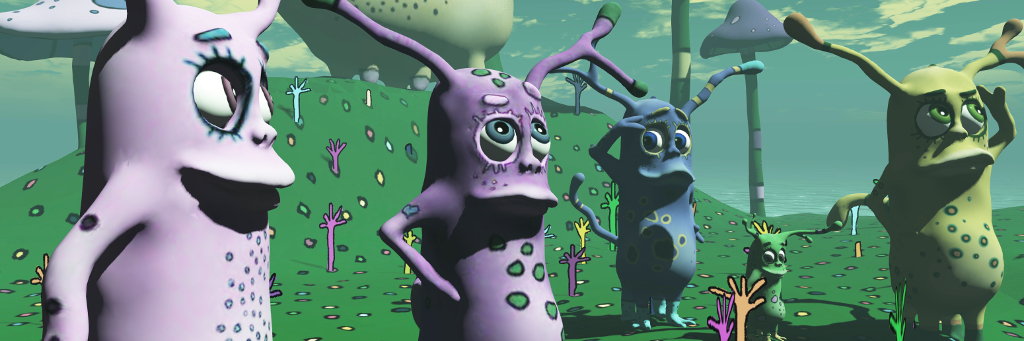
On Sunday, September 8th, Cica Ghost opened the latest in her monthly installations – and it is simply wonderful in its light-heartedness.
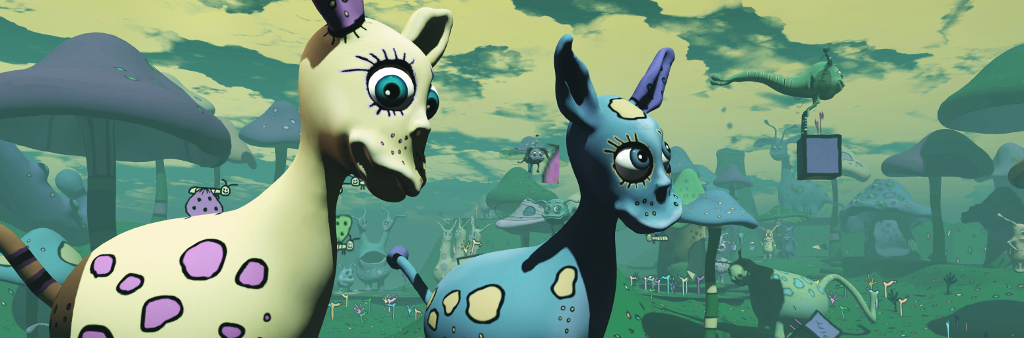
Silly is just that: a marvellous retinue of silly characters in a lush green landscape full of whimsy that would right at home in a children’s story or a scene in The Beatles Yellow Submarine. All of which is wrapped in an About Land joke by Cica:
Q: What is a cat’s favourite colour? A: PURRRR-ple.
Cica Ghost – Silly, September 2019
Across the vivid grass, two-dimensional shoots of many different hues periodically rise in bursts of speed growing, shoots forming as they do so. Except instead of becoming flowers, the buds they sprout become “fingers”, turning the plants into hands that wave in greeting before they descend back into the ground. Fluttering over these are similarly colourful and equally two-dimensional butterflies, their faces lit by happy grins.
There are no trees here; instead huge mushrooms rise over the landscape, casting broad, umbrella-like shadows, while the hump-backed hills are littered with boxes that have their own role to play. It is, in a word, a happy place, rich in humour. but it is not the scenery – whether in two-dimensions or three – that capture and hold the attention; it is the major characters within it.
These are a marvellous mix of the seemingly ordinary – cow-like creatures atop a hill and worm-like characters – to the quite bizarre. Some additionally have more than the usual allocation of heads or expected number of legs, but all of them would be perfectly at home within an animated film – a feeling that has added depth courtesy of the music stream Cica provides for the installation, which should definitely be played during a visit!
Cica Ghost – Silly, September 2019
As with all of Cica’s installations, there are plenty of opportunities to get involved in the setting – places to sit, places to dance, and more. Just mouse-over the boxes scattered around and click when you see the sit icon. Where you end up might surprise you; one box certainly offers a new meaning to the term “in the belly of the beast”, while another might leave you feeling lighter than air! There’s also a free gift you can use to take to the skies and become an airborne participant in things.
Cica’s builds always offer something attractive. Sometimes they come with fun and frivolity, like Silly, others can be more thought-provoking or carry a narrative. It is this constant mixing of ideas and approaches that always made her installations worthy of time and attention. They are also why Cica is one of Second Life’s treasured artists.
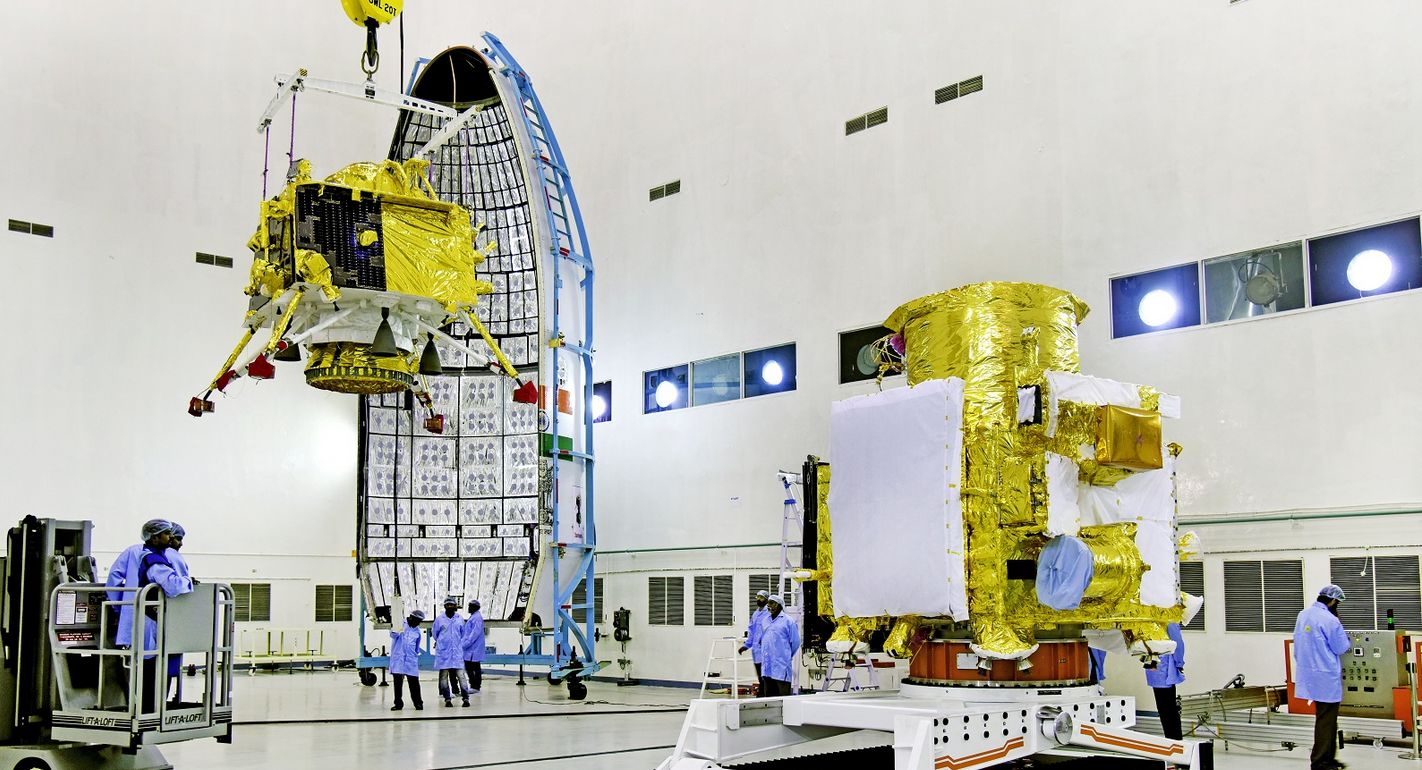
The bulky Vikram lander, with the Pragyan rover”garaged” inside, is hoisted aloft in a clean room, ready to be mated to the “top” of the Chandrayaan-2 orbiter (right). One section of the payload fairing that enclosed the craft during launch is visible in the background. Credit: ISRO
On Friday, September 6th, India was due to become the fourth country to successfully reach the surface of the Moon, with the touch-down of the Vikram lander, part of the Chandrayaan-2 (“moon craft-2” in Hindi) mission.
Launched in late July 2019, Chandrayaan-2 was set to be the latest in a series of high-profile missions undertaken by the Indian Space Research Organisation (ISRO) over the course of the last 11 years, which have included the Chandrayaan-1 lunar orbiter (2008/2009) and the Mangalayaan (“Mars-craft”), launched in 2013 and still operational today.
As I’ve noted in recent Space Sunday articles, Chandrayaan-2 comprises three parts: the orbiter vehicle, the Vikram lander and a small rover called Pragyan (“Wisdom” in Hindi) carried by the lander. Vikram departed the orbiter vehicle on Monday, September 2nd, allowing it to begin a series of manoeuvres in readiness for a final decent and landing, scheduled for Friday, September 6th (western time, the early hours of Saturday, September 7th for India) in the Moon’s South polar region.
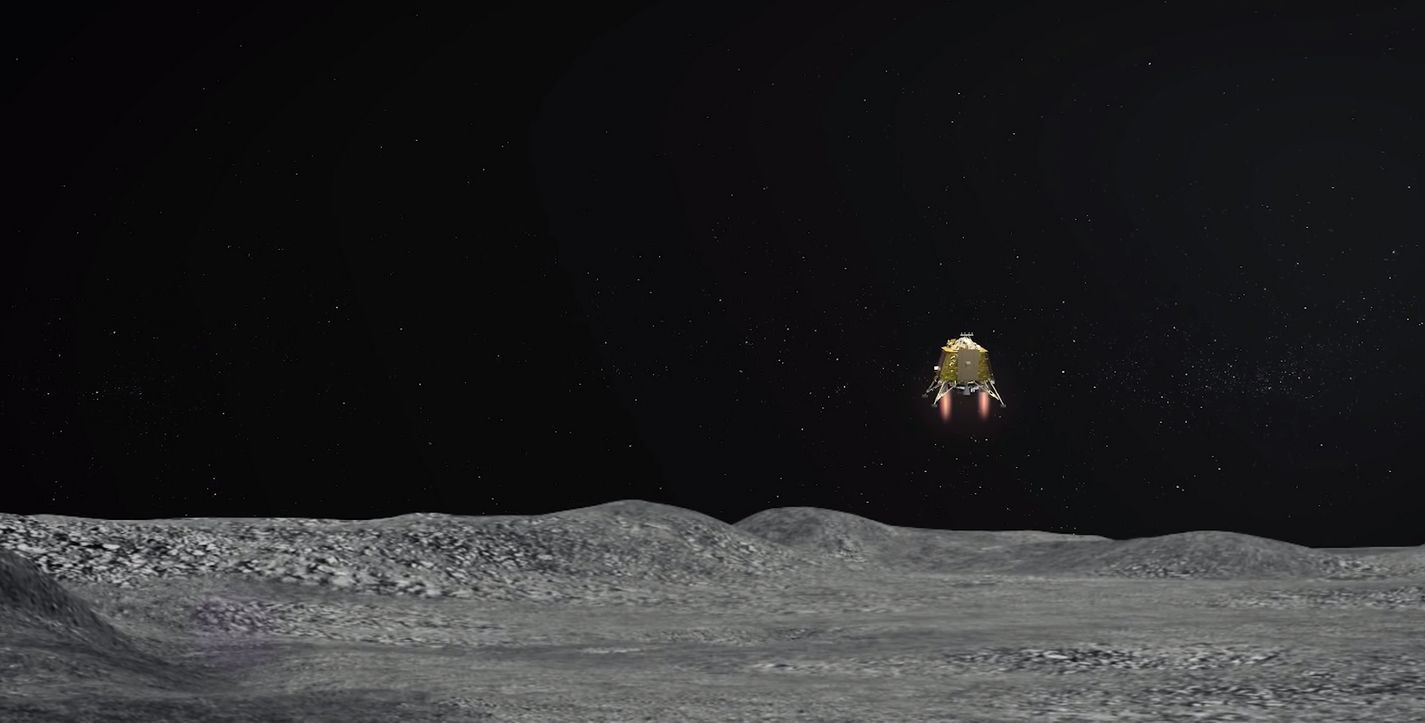
An artist’s impression of the Vikram lander coming in to land in the Moon’s south polar region. Credit: ISRO official video
Initially, that final descent started well enough, with the lander about 550 km (344 mi) from the south pole as it fired its descent motor start the start of its final approach. At an altitude of 6 km (3.75 mi), it started a final sequence of engine burns referred to as the “fine braking phase”. Then all communications ceased.
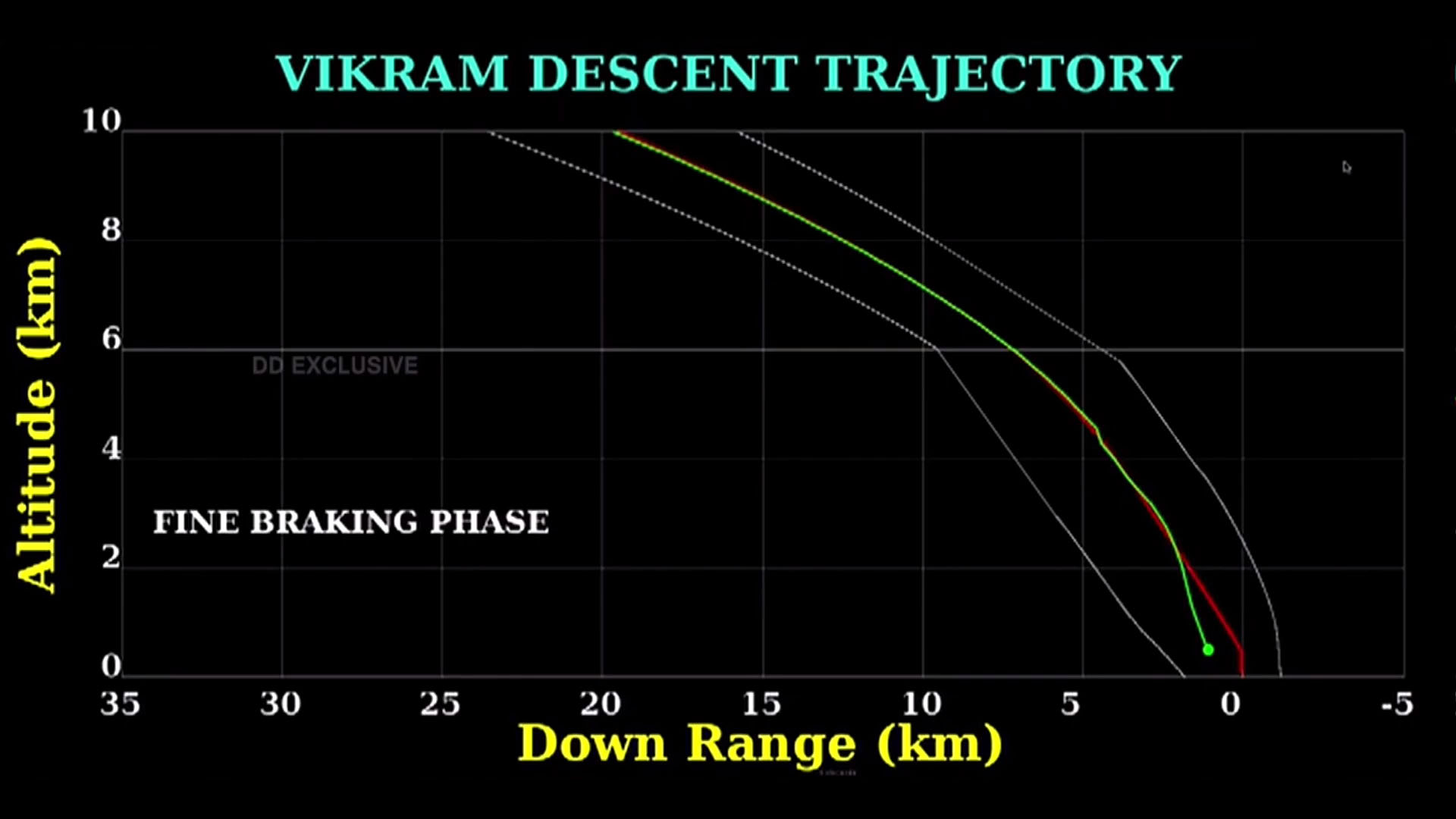
ISRO issued a statement that the vehicle was performing nominally until around 2.1 km above the Moon, when the loss of communications occurred. However, images of the data received from the vehicle and released by ISRO appeared to suggest telemetry was being received when the lander was within 400 m of the lunar surface – and altitude at which it would be fully under its automatic guidance and landing software, and not reliant on commands from Earth. This seemed to suggest Vikram may have made a landing.
ISO stated communications with the Vikram lander were lost some 2.1 km above ground. However, a graphic of the vehicle’s descent towards the Moon (green above), appears to suggest telemetry was lost when the vehicle was between 300-400m above the lunar surface, and that it had drifted perhaps a mile from its planned descent track (red). If accurate, this suggests Vikram was in the fully automated terminal descent phase of its landing. Credit: ISRO
This idea gained ground as this article was being prepared, when an article published by Asia News international suggested Vikram has been spotted on the surface of the Moon, possibly 500m to 1 kilometre from its designated landing point. The article quotes ISRO’s director, Kailasavadivoo Sivan as saying:
We’ve found the location of Vikram Lander on lunar surface & orbiter has clicked a thermal image of Lander. But there is no communication yet. We are trying to have contact. It will be communicated soon.
Since then, the report has been repeated numerous times through various media (including an entirely UNofficial and unverified “ISRO Official Update” Twitter account) without (at the time of publication) official confirmation. This has made it hard to determine the veracity of the ANI report. Hopefully, the situation will become clearer in the coming days. One thing that could help define the lander’s condition would be an image captured by Chandrayaan-2’s main imaging camera. With a resolution of a third of a metre, it is the highest resolution camera in operation around the Moon.
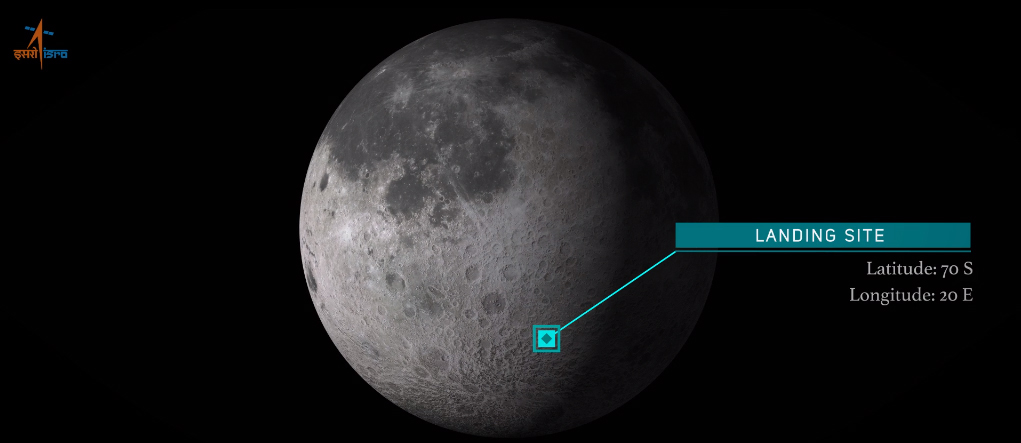
The planned landing site for the Vikram lander. Credit: ISRO
But even though the lander and rover may have been lost, the mission is far from over; the orbiter continues to function perfectly. It also carries the bulk of the mission’s science experiments – eight of the 13 carried by the mission. he data gathered by these systems should enable scientists to compile detailed maps of the lunar surface, revealing key insights about the Moon’s elemental composition, formation and evolution, and potentially help in assessing the moon’s stores of water ice.
In this latter regard, the mission builds on work performed by Chandrayaan-1, which revealed water is present at the lunar poles, with subsequent studies suggesting much of this water is ice on the floors of polar craters, which have been in permanent shadow for billions of years. If this ice is easily accessible, it could be a critical enabling resource for the eventual human settlement of the moon, providing water, oxygen and fuel (hydrogen).
In all, Chandrayaan-2 is expected to operate for some 7 years.
Proxima Centauri: An Angry Star with Bad News for its Planet
In 2016, I wrote about Proixma b, a planet roughly 1.5 times the mass of Earth orbiting our nearest stellar neighbour, Proxima Centauri, 4.25 light years away (see: Exoplanets, dark matter, rovers and recoveries). Since then, and as a result of the planet being within the star’s zone of habitability, there has been a lot of debate about the potential for it to support life.
An artist’s impression of Proxima b with Proxima Centauri low on the horizon. The double star above and to the right of it is Alpha Centauri A and B. Credit: ESO
Numerical models have indicated that Proxima b probably lost a large amount of its water in its early life stages, possibly as much as one of Earth’s oceans. however, those models also suggest liquid water could have survived in warmer regions of the planet – such as on the side of the planet facing its star (Proxima b is potentially tidally locked with its parent star, always keeping the same face towards it). This means other factors that might affect habitability must be examined. Chief among these is the overall activity of the parent star – notably flares, coronal mass ejections and strong UV flux -, all of which can erode a planet’s atmosphere, rendering it uninhabitable in the long term.
That Proxima Centauri is very active with flares has been known for some time, as has been the star’s ability to generate “super-flares”, one of which in 2016 briefly raised the star’s brightness to the point of making it briefly visible to the naked eye from Earth. This activity has suggested that Proxima b is unlikely to support life (see: Curiosity’s 5th, Proxima b and WASP-121b). But the debate has remained.
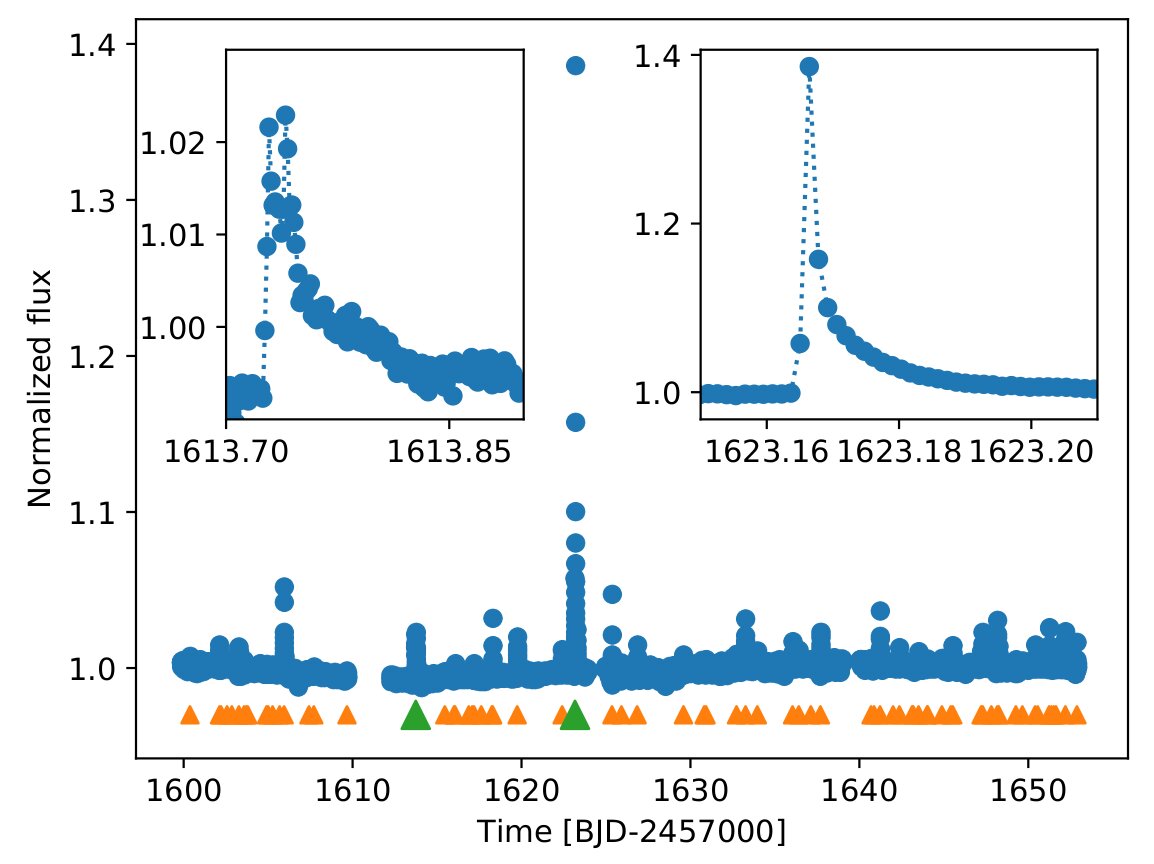
Over the past year, a team of scientists at the Konkoly Observatory in Hungary have been using data from the Transiting Exoplanet Survey Satellite (TESS) to observe Proxima Centauri’s flare activity over a two month period, split between April and June 2019. They found that in the roughly 55-day period, the star pent around 7% of its time violently flaring, with a total of 72 relatively large-scale flares observed. In particular, the energy of the eruptions put them as not far below “super flare” status, suggesting the star could produce a super flare perhaps once every two years.
TESS data on flare activity on Proxima Centauri: yellow triangles indicate flare activity, green triangles show particularly violent flare events. Credit: Krisztián Vida / Konkoly Observatory
Such frequent, high-energy eruptions almost certainly have a severe impact on the atmosphere of Proxima Centauri b, disrupting it to a point where it cannot reach any steady state, leaving it continuously in a state of disruption and alteration, making the potential for the planet to support life even more remote. However, it also raises a curiosity about the star: the underlying magnetic frequency evidenced by Proxima Centaur. Such activity is normally associated with fast-rotating stars with periods of a few days. However, Proxima Centauri has a rotation period of ~80 days; so why it should be so active is now a subject for investigation.
It’s time to highlight another week of storytelling in Voice by the staff and volunteers at the Seanchai Library. As always, all times SLT, and events are held at the Library’s home at Holly Kai Park, unless otherwise indicated.
Sunday, September 8th 13:30: Tea Time with Jeeves
Just for summer, Seanchai Library takes a dive into the world of Reginald Jeeves, a well-educated, intelligent valets of indeterminate age who is employed by the amiable young man-about-town, Bertie Wooster, whom Jeeves routinely has to benignly rescue from the consequences of his idiocy.
Created by author, humorist, and lyricist (working with Guy Bolton and Jerome Kern) Pelham Grenville Wodehouse (October 1881 – February 1975), Jeeves and Wooster are perhaps his most iconic characters, their adventures eventually growing to 35 short stories and 11 novels, the majority of which are first-person narrated from the perspective of Bertie Wooster.
This week comes the fourth part of The Inimitable Jeeves.
A semi-novel published in the UK and the United States in 1923, The Inimitable Jeeves brings together 11 previously published stories structured as “chapters” rather than appearing as individual stories, giving the volume the appearance of being a novel something initially enhanced in early editions, which split the first five and final story into two chapters apiece, giving the impression the book was 18 chapters long (later editions reversed this, each story being just a single chapter for 11 in total).
The stories also add to the novel-like feel, as they each focused variously on a small group of characters throughout including Bertie’s Aunt Agatha, his somewhat inept friend Bingo, and his cousins Claude and Eustace, brought together with Jeeves and Wooster in some familiar Wodehouse themes.
Join Da5id Abbot, Kayden Oconnell, and Caledonia Skytower as they read this delightful series at Ceiliuradh Glen.
Monday, September 9th 19:00: Moonheart
Gyro Muggins reads Charles de Lint’s 1994 novel..
When Sara and Jamie discovered the seemingly ordinary artefacts, they sensed the pull of a dim and distant place. A world of mists and forests, of ancient magic, mythical beings, ageless bards – and restless evil.
Now, with their friends and enemies alike–Blue, the biker; Keiran, the folk musician; the Inspector from the RCMP; and the mysterious Tom Hengyr; Sara and Jamie are drawn into this enchanted land through the portals of Tamson House, that sprawling downtown edifice that straddles two worlds.
Sweeping from ancient Wales to the streets of Ottawa today, Moonheart will entrance you with its tale of this world and the other one at the very edge of sight and the unforgettable people caught up in the affairs of both. A tale of music, and motorcycles, and fey folk beyond the shadows of the moon. A tale of true magic; the tale of Moonheart.
As soon as Anne Shirley arrives at the white farmhouse called Green Gables, she is sure she wants to stay forever. The problem is, the owners of Green Gables, Matthew and Marilla Cuthbert wanted a boy to help Matthew with household chores; so at first it seems as if she will be returned to the orphanage from whence she came.
However, Anne is determined to stay, trying hard not to get into trouble or speaking out of turn, and the Cuthberts come to realise she is someone blessed with an enormous imagination. The latter is especially noticed by the quietly-spoken Matthew, who persuades his sister that young Anne should stay.
Thus we are drawn into Anne’s life and world as she settles into her first real home. Over the course of a five year period from her arrival in Bolingbroke at age 11 through until her move to Queen’s Academy at the age of 16, where she earns a university scholarship, we follow Anne’s adventures and ups and down within the close-knit community, making friends (and sometime enemies whom she is perhaps too stubborn to admit she’s long since forgiven for perceived wrongs) and her domestic trails and tribulations. The later, when tragedy strikes, we follow her back to Bollingbroke, where she indeed becomes Anne of Green Gables, and her story is left open.
Join Faerie Maven-Pralou as she reads L.M. Montgomery’s 1908 classic (and first of a series).
Thursday, September 12th 19:00: Jack Sparrow: The Siren Song, Part 1
Captain Jack Sparrow and his crew have suddenly fallen under a sinister spell. While continuing on their quest for the Sword of Corts, they find themselves entranced by an ethereal song which leads them away from their quarry.
With Shandon Loring, also Also in Kitely – teleport from the main Seanchai World grid.kitely.com:8002:SEANCHAI.
The following notes are taken from the TPV Developer meeting held on September 6th, 2019. A video of the meeting is embedded below, my thanks as always to Pantera for recording and providing it.
This was a meeting with a lot of text chat that didn’t generate a meaningful discussion. Therefore, only key points are recorded below.
Project Muscadine (Animesh follow-on) project viewer, version 6.4.0.530100, August 19.
360 Snapshot project viewer, version 6.2.4.529111, July 16.
Legacy Profiles viewer, version 6.2.3.527749, June 5. Covers the re-integration of Viewer Profiles.
Linux Spur viewer, version 5.0.9.329906, dated November 17, 2017 and promoted to release status 29 November 2017 – offered pending a Linux version of the Alex Ivy viewer code.
Obsolete platform viewer, version 3.7.28.300847, May 8, 2015 – provided for users on Windows XP and OS X versions below 10.7.
Brief Notes on Viewers
The Umeshu RC maintenance viewer will likely be promoted to release status in week #37 (commencing Monday, September 9th).
The voice viewer is still in progress, but has yet to surface as a publicly-available viewer.
Snapshot project viewer:
There are allegedly titling issues when taken very high resolution images with ALM and SSAO enabled.
There are also HUD appearance issues with hi-res snapshot and the option to include HUDs in images enabled, as per BUG-227587.
[3:33-4:30] EEP has further fixes on the rendering front, which are with the Lab’s QA team, so an updated to the RC viewer can be anticipated in the next week or so. This is unlikely to be the last RC update. However, if anyone testing the viewer has issues they are not aware of having been reported, they are asked to ensure they raise a bug report.
An attempt re-evaluate object and avatar rendering costs to make them more reflective of the actual impact of rendering both. The overall aim is to try to correct some inherent negative incentives for creating optimised content (e.g. with regards to generating LOD models with mesh), and to update the calculations to reflect current resource constraints, rather than basing them on outdated constraints (e.g. graphics systems, network capabilities, etc).
Current Status
More focus is being put into this project, but there is still a fair amount of “catch-up” to do.
Current focus remains on data gathering.
It will still be some time before users start to see anything visible surfacing for this work.
In Brief
Group Related
[5:35-7:10] Recent tweaks to improve group chat lag has resulted in some issues for group chat moderation. LL is aware of the problems and a fix is in the works.
In the meantime, LL continue to carry out careful experiments and adjustments to the group chat system to try to make it more responsive.
BUG-10804 – Group Role count inaccuracies: this is a long-running issue with groups with more than 5,000 members, one outcome of which means it’s not always possible to see who is assigned to specialist roles within a group, as they are not listed – and it is impossible to remove roles from users (where they no longer require them) if the user isn’t listed.
BUG-11269 – group profile shows an incorrect membership number.
Part of the comments were around removing inactive accounts – however, the Lab is loathe to do this, due to the number of users who leave SL and return with a request the LL reactivate their account.
Inventory
[7:20-7:55] BUG-227179 – off-line inventory offers from scripted objects are lost. This is awaiting resources to be worked on.







 Inara Pey: Living in a Modemworld