2019 SL User Groups week #38/1: Simulator User Group

Isla de Sol, July 2019 – blog post

Server Deployments

Please refer to the server deployment thread for updates.

  • On Tuesday, September 17th, the SLS (Main) channel was updated with server release 2019-09-06T22:03:53.530715. Originally deployed to the Magnum RC on September 11th, it contains the fix  to address most cases of experience-enabled scripts losing association with their experience – see this blog post.
  • On Wednesday, September 18th, the RC channels are to be updated as follows:
    • BlueSteel and LeTigre should be updated with server release 2019-09-13T19:08:35.530941, comprising:
      • Internal Script Improvements – these should see further improvements in script processing, with the selected regions representing around 15% of the total grid.
      • Fixed “Avatar Sounds” feature fails to disable all scripted sounds.
      • [EEP] Smoothen transition time of llReplaceAgentEnvironment.
      • Updated to include current Second Life Server changes.
    • Magnum should be updated with server release 2019-09-13T20:04:44.530946, comprising minor improvements to starting and stopping regions and EEP updates and fixes.

SL Viewer

On Tuesday, September 17th, 2019 the following viewer updates were made:

  • The Vinsanto Maintenance RC viewer, version 6.3.2.530962.
  • The Legacy Profile project viewer was updated to version 6.3.2.530836.

On Monday, September 16th, the Ordered Shutdown RC viewer, version 6.3.2.530901, was released. This viewer has changes intended to make crashes on shut-down less likely, but does not have any changes to existing features.

At the time of writing, the rest of the current official viewer pipelines remain as follows:

  • Release channel cohorts:
  • Project viewers:
    • Project Muscadine (Animesh follow-on) project viewer, version 6.4.0.530100, August 19th.
    • 360 Snapshot project viewer, version 6.2.4.529111, July 16th.
  • Linux Spur viewer, version 5.0.9.329906, dated November 17, 2017 and promoted to release status 29 November 2017 – offered pending a Linux version of the Alex Ivy viewer code.
  • Obsolete platform viewer, version 3.7.28.300847, May 8, 2015 – provided for users on Windows XP and OS X versions below 10.7.

In Brief

  • The Lab is “very focused” on the problem of avatars teleporting into or out of a region overpowering local performance (scripts, etc.).
    • It’s been widely assumed that the performance is due to things like overall complexity and / or script load, etc.
    • However, while both script load and avatar complexity do have a general impact on performance, LL does not believe they are responsible for the issues seen when avatars enter / leave a region.
    • Data has been gathered on the problem, and Rider Linden indicated that LL feel they have a reasonable handle on the problem and are in a position to start experimenting to verify their findings in the near future.
  • There is period of voice maintenance due on Thursday, September 19th. This involves back-end updates to the voice system.
    • It is not clear if these updates will assist those users who, when activating voice, appear to be in their own channel with just one or two other users and must relog to join the main channel with all the others on voice.
      • This is a problem LL has noted, but Vivox have been unable to determine the cause.
      • There is a voice viewer update in the works that includes additional debugging capabilities that might help with determining the problem.


La Gaspesie – inspired by a corner of Canada

La Gaspesie (Canada) – click on any image for full size

We first visited La Gaspesie (Canada) some time towards the end of July or possibly early August; at that time, the region holders, Tzooki and XavierJacques were still working on the design: the board walks were – for the most part – laid out, but landscaping and the setting out of buildings was still going on. Given the state of play, we got out of the way and headed home – only to almost forget about the region in the intervening weeks. So when it did come back to mind, it seemed only right we hop back and take another look.

The region takes, as its inspiration the Gaspésie Peninsula that runs along the south shore of the Saint Lawrence River to the east of the Matapedia Valley in Quebec, Canada, and which extends into the Gulf of Saint Lawrence.

La Gaspesie (Canada)

Covering an area of some 31,075 sq km (11,998 sq mi), the peninsula’s northern shore is dominated by high sea cliffs, while at its easternmost point, there sits Percé Rock (or Rocher Percé), an island pierced by a natural rock arch. It is this landmark that serves as a focal point for the region’s inspiration, being echoed by the presence of a great rock wall also pierced by a narrow arch, sitting on the region’s eastern side.

Rather than being an island, this great wall of rock sits on a promontory of land, the rest of the region stretching westwards from it, mostly low-lying and cut by water channels that effectively split the landscape up into three large islands – although the number of bridges present can made it feel as if there are far more. Mostly rocky with a scalp of scrub grass, the low-lying lands are home to numerous buildings – huts, small houses, cottages – all of which are open to the public and within fairly easy walking distance of one another, a light scattered of trees adding to the setting.

La Gaspesie (Canada)

Off to the south-west, the height of the eastern cliffs is matched by that of a bulky lighthouse – one of two in the region – sitting atop a hump of rock. A water tower rising from the hill of the south-east headland also tries to vie with it and the cliffs in the height stakes.

Perhaps the most noticeable feature in the region is its board walks. These hug the seaward sides of the region to the west, north and east, only turning inland to the south and south-east where a channel and a bay force them to do so. Broad in width, these walkways are periodically marked by circular sections that from above resemble wooden rosettes that seem to split the board walks into sections.

La Gaspesie (Canada)

Together, these walks offer a means to pretty much circumnavigate the region – although there are plenty of ways to explore the individual major landmasses and find your way between them, as noted above. However, I have to admit I found the board walks perhaps a little too omnipresent. While they are clearly intended to offer a means of exploration (and are amenable to riding the scooters and bikes available from the rezzers near the landing point), I couldn’t help be feel they are also a little intrusive, breaking into the scene in a manner that is at odds with the otherwise very natural landscape and setting.

Now, to be honest, I have no idea if the mainland near Percé Rock is marked by board walks, and this is an attempt to emulate them (although I didn’t notice any to the same degree when looking at photos of Percé village); but it would perhaps have been nice to see come breaks in them in favour of the shingle beaches that seem to be a part of the headland facing Percé Rock. That said, there is more than enough within the region to keep eye and camera occupied without the board walks becoming too oppressive in their presence – and it cannot be denied that the region can be very eye-catching under assorted environment settings.

La Gaspesie (Canada)

Finished with an excellent ambient soundscape and with a variety of things to do from sitting and cuddling to riding bikes and scooters or messing about in bumper boats,  La Gaspesie (Canada)  does make for an engaging visit. For those in particularly need of an unwind from the day’s stresses, a link is provided in the region’s About Land description to some 26+ minutes of “unwindulaxing” music…

SLurl and Links

Team Diabetes of Second Life announces 2019 season

Team Diabetes of Second Life has announced their 2019 fund-raising season. Founded in 2015 by Jessi2009 Warrhol and John Brianna (Johannes1977 Resident), Team Diabetes of Second Life is the official and authorised team of the American Diabetes Association in SL.

Their mission is to raise awareness, tolerance, and funds for diabetes in the virtual world of Second Life. According to the World Health Organisation in 2016 some 422 million adults in the world have diabetes and 1.5 million deaths are directly attributed to diabetes each year.

The 2019 Team Diabetes of Second life season will run from October through to December, with the following events scheduled to take place:

  • October 18th though 26th: Scare Me Silly (off-season event – see below).
  • November 1st through 30th: National Diabetes Month, featuring:
    • November 1st through 30th: The Red Hunt.
    • November 3rd: The Red Ball.
    • November 14th: World Diabetes Day.
  • December 5th to December 14th: Christmas Showcase & Winter Art Show.

Scare Me Silly

Scare Me Silly is an annual event taking place around Halloween. It features live performances. DJ parties, a hunt and a quest, tricks and treats, a haunted mansion, ghostly rides and – of course – shopping!

As noted above, this year the event will take place from Friday, October 18th through Saturday, October 26th inclusive. Registrations for the event from both merchants and artists are now open, and the application form, with guidelines and terms can be found here.

About the American Diabetes Association

 Established in 1940, the American Diabetes Association is working to both prevent and cure diabetes in all it forms, and to help improve the lives of all those affected by diabetes. It does this by providing objective and credible information and resources about diabetes to communities, and funding research into ways and means of both managing and curing the illness. In addition, the Association gives voice to those denied their rights as a consequence of being affected by diabetes.

About Team Diabetes of Second life

Team Diabetes of Second Life is an official and authorised fund-raiser for the American Diabetes Association in Second Life. Established with the aim of raising funds in support of diabetes treatment and to raise awareness of the disease in SL, Team Diabetes of Second Life was founded by Jessi2009 Warrhol and John Brianna (Johannes1977 Resident), who serve on the Advisory Board along with Eleseren Brianna, Veruca Tammas, Rob Fenwitch, and Dawnbeam Dreamscape.

2019 viewer release summaries week #37

Logos representative only and should not be seen as an endorsement / preference / recommendation

Updates for the week ending Sunday, September 15th

This summary is generally published every Monday, and is a list of SL viewer / client releases (official and TPV) made during the previous week. When reading it, please note:

  • It is based on my Current Viewer Releases Page, a list of all Second Life viewers and clients that are in popular use (and of which I am aware), and which are recognised as adhering to the TPV Policy. This page includes comprehensive links to download pages, blog notes, release notes, etc., as well as links to any / all reviews of specific viewers / clients made within this blog.
  • By its nature, this summary presented here will always be in arrears, please refer to the Current Viewer Release Page for more up-to-date information.
  • Note that for purposes of length, TPV test viewers, preview / beta viewers / nightly builds are generally not recorded in these summaries.

Official LL Viewers

  • Current Release version 6.3.1.530559, formerly the Umeshu Maintenance RC viewer, dated, September 5th – NEW.
  • Release channel cohorts:
    • No updates.
  • Project viewers:
    • Project Muscadine (Animesh follow-on) project viewer, version 6.4.0.530473, September 11th.

LL Viewer Resources

Third-party Viewers

V6-style

  • Kokua 64-bit updated to  6.3.1.46169 (non-RLV)  and 6.3.1.46170 (RLV variants) on September 12th (release notes).

V1-style

  • Cool VL viewer update to version 1.26.22.59 (Stable Branch) and version 1.26.23.12 (Experimental Branch) on September 15th (release notes).

Mobile / Other Clients

  • No updates.

Additional TPV Resources

Related Links

First looks: Bellisseria trailer and camper homes

The new Trailer and Camper regions arrive in Bellisseria – but are not currently available to users to claim, as more work in the regions is required

Monday, September 16th, 2019, marked the deployment of the first batch of trailer and camper regions to the Bellisseria, the Linden Homes continent.

First previewed at the SL16B celebrations in June (see: A Look at the Camper and Trailer Homes with Patch Linden), the trailers and campers have long been anticipated, and while the new regions are not quite ready for release to users, their arrival in the live version of Bellisseria means the availability of these new home types has moved a step closer. Further, the regions include a number of new facilities and features for the Bellisseria continent – including the much talked about railway system.

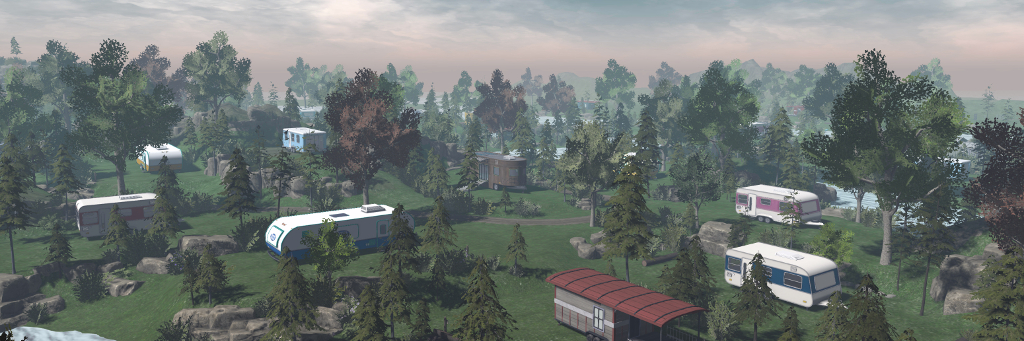
The new Trailers and Campers sit within parkland regions similar to those people may have visited during the SL16B celebrations in June 2019

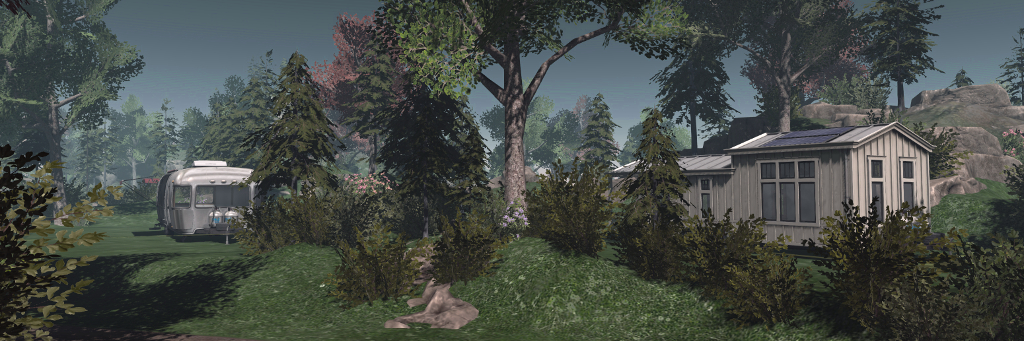
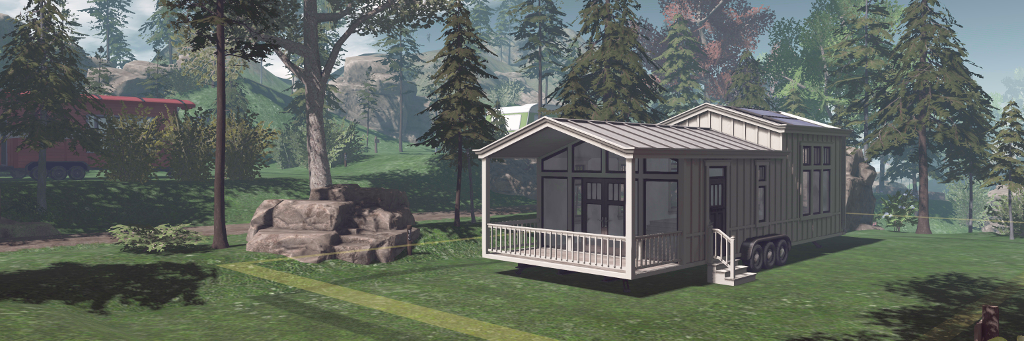
As previously noted, the Campers and Trailers are provided in four styles apiece – the difference being that of size – the trailers are somewhat larger than the campers (or caravans, as we call them in Europe) – although both are being (initially, at least), made available on 512 sq metre parcels.

In keeping with the preview regions as SL16B, the trailers and campers are located in a park / wilderness setting, with plenty of hills, rivers, lakes, waterfalls, a forest and more. trails wind through the region, offering both a means to explore and a way for those who come to occupy the campers and trailers feel as if they are part of a community.

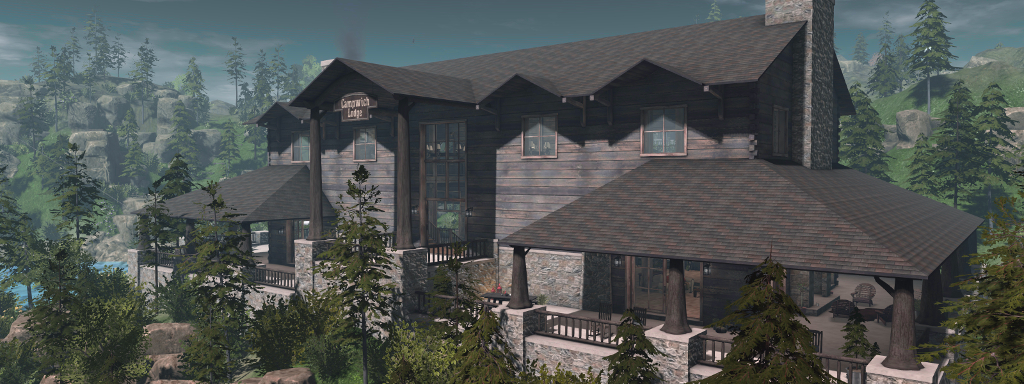
A view of the new lodge, one of the public spaces in the new Trailers and Campers regions for Bellisseria.

One of the new public areas is an impressive parkland lodge. It sits with its back to a sweeping curve of rocky hills down which waters tumble and bubble through a brook. Overlooking a decently-sized lake to the front, it has moorings extending out from one side. These demonstrate a lesson well-learnt from the early days of Bellisseria, as they include rez zones for boats.

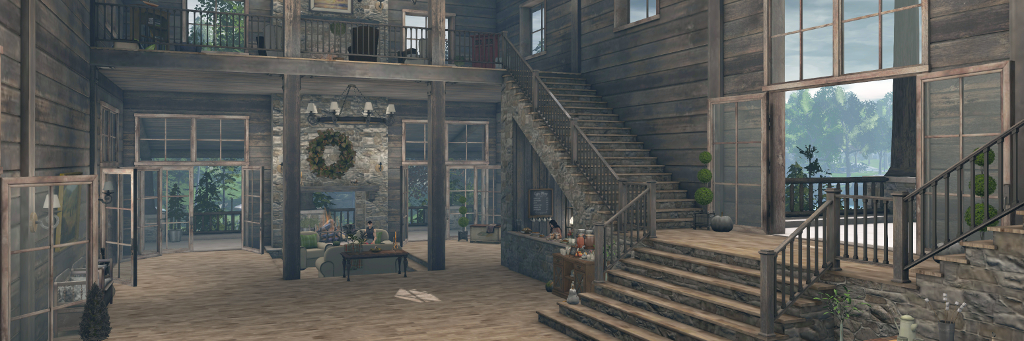
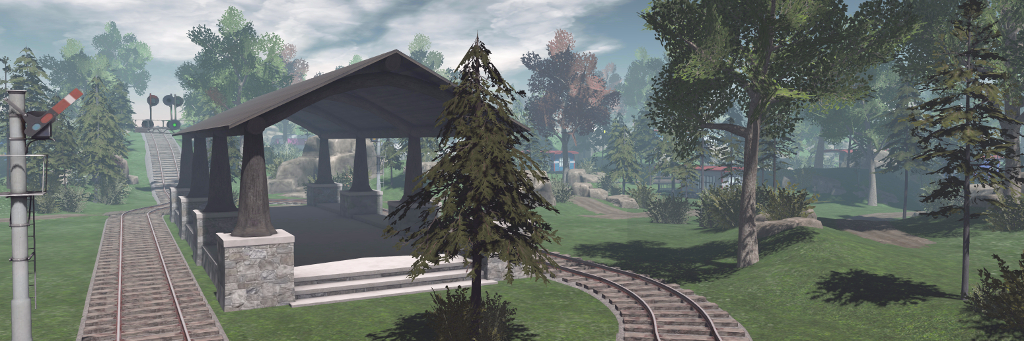
Inside, the lodge offers plenty of interior space on the main floor, complete with a coffee bar. Above this are two galleried sitting spaces, while outside a large deck offers further seating. Behind the lodge, up on a shoulder of one of the hills sits a little railway stop serving the lodge. Those who prefer a more daring means to arrive at the lodge can always try the zipline close by!

Inside the lodge. Patch sits at the far end of the hall with Mystic Mole at the coffee bar on the right, enjoying a little peace and quiet before the inrush of local residents

I can’t see too much about the railway itself – Patch and the Moles were taking questions in the Lodge, but given the volume of people there, I opted to keep away. What I can say is the layout is extensive, forming an open-ended loop around a major part of the new regions that varies between single and double tracks.

The one train I managed to spot on the rails was – unsurprisingly – a steam loco. However, whether it was one of those intended to ply the tracks, or simply there as a test vehicle, I couldn’t honestly say (as I didn’t check ownership!).

One of the new train stations serving the new Bellisseria regions, with trailers visible in the background

It’s important to note that this is only the initial deployment of these regions – as noted above, the Trailers and Campers are not   – as of the time of writing – available to users. As to when the new parcels will be made available, it will be Really Very Soon Now™, with Patch Linden noting to me:

We’re working through all of our final tests, like any of the large scale releases we’ve done, we’re in that state of, it could be in an hour, it could be tomorrow, hard to say if something doesn’t pass, we’re delayed like a shuttle launch trying to lift off. xD

– Patch Linden, Monday, September 16th

As I understand it, the release cycle for these new parcels will be an initial large-scale release, similar to those first seen with the Traditional Homes and Houseboats. After these have occurred, releases for Trailers and Campers will be plugging-in to the Monday, Wednesday, Friday rolling release schedule that w’ve seen since June. All releases will be via the Linden Homes registration page.

Nor is this all – there are to be further types of home made available in the future – with the next promised to be previewed at the RFL Christmas Expo towards the end of the year (see: 2019 SL Christmas Expo registrations open with a special announcement).

With a much smaller footprint that the homes and houseboats so far released, the Trailer and Campers offer more outdoor space for use, even allowing for the 512 sq m size of their parcels

As I’ve previously noted, the Trailer and Campers offer considerably smaller interior living space than the Traditional Homes and Houseboats (hardly surprising, given they are trailers and campers!). However, this is compensated for by the amount of outdoor space available. Even when considering these are 512 sq m plots, it adds up to a far amount of room.

This space, coupled with the overall landscaping of the new regions could actually – and in difference to the doubts I expressed in June – potentially make these new Linden Homes offering potentially attractive (as witnessrd by the (premature) abandonments of homes and houseboats seen ahead of the region deployments).

Related links

Space Sunday: exoplanets, exocomets and Titan’s craters

K2-18b as it might appear in orbit around its red dwarf parent star and with the other known planet in the system – K2-18c – also visible. Credit: ESA/Hubble, M. Kornmesser

I first wrote about K2-18, a red dwarf star some 11 light-years from Earth, and its two companion planets in December 2017. At that time, the outermost of the two planets, called K2-18b or EPIC 201912552 b and discovered in 2015, was the subject of a study to determine its mass in an attempt to better understand the planet’s possible atmospheric properties and bulk composition. This was of particular interest to scientists as K2-18b lay within its parent star’s habitable zone – where liquid water might exist on the planet’s surface.

That study ultimately revealed K2-18b has a mass of around 8 times that of Earth, putting it in the “super-Earth” category of rocky worlds, with a diameter roughly 2.3 times greater than Earth’s (see: Space Sunday: Exoplanets Update). Since then, K2-18b has continued to be the subject of study – and it has now become the first exoplanet thus far discovered confirmed to have water vapour, mostly likely liquid water clouds, within its atmosphere.

The news came via two independent studies that have been carried out using the data gathered by the Hubble Space Telescope (HST). The first study, written by the team who originally gathered the data, appeared on September 10th, 2019 on arXiv.org, but has not been peer-reviewed. The second study – which has been peer-reviewed – appeared in the September 11th edition of Nature Astronomy.

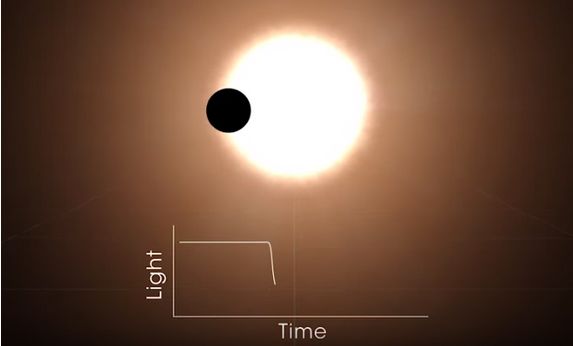
The team responsible for gathering the data – led by Björn Benneke, a professor at the Institute for Research on Exoplanets,  Université de Montréal – did so after applying to use Hubble to observe K2-18b shortly after its discovery. They were ultimately granted telescope time in in 2016 and 2017, using Hubble to gather data in the light from the red dwarf star, and how that light changed under the influence of any atmosphere surrounding K2-18b as it transited in front of the star. Spectrographic analysis of the data confirmed the planet has a fairly dense atmosphere rich in hydrogen and helium – and which also contains the molecular signature of water.

Researchers gathered data on K2-18b’s atmosphere by using the Hubble Space Telescope to observe changes in the light from its parent star as it passed through the planet’s atmosphere during transits. Credit: NASA / ESA simulation

After gathering the data, Benneke’s team wanted time to carry out further observations to both confirm what they had found and make additional discoveries. In the meantime, their findings were available for others to study – which is exactly what a team led by Dr. Angelos Tsiaras based at the University College London (UCL), UK did.

Using independent means of analysing the data, both teams reached the same overall conclusions concerning the major finds within K2-18b’s atmosphere – although they come to different conclusions as to the planet’s likely form. The UCL specify K2-18b as a rocky planet with a dense atmosphere, between 0.01% and 50% of which is water vapour. By comparison, the amount of water vapour in our atmosphere is put at between 0.1% and 4% – so, K2-18b could have anything from a comparable amount of water vapour in its atmosphere to Earth through to being a completely flooded world.

By contrast, Benneke’s team believe the planet is more of a “mini-Neptune”: a planet with a small, solid core surrounded with a thick atmosphere that is predominantly hydrogen / helium in nature, with only trace amounts of water vapour – albeit enough to create liquid water clouds, and possibly even rain. However, the idea that the planet is a mini-Neptune is somewhat at odds with other findings about the planet – such as the December 2017 study.

There is also some tension between the two teams. While Benneke acknowledges his team’s research was open to others to use, he is somewhat aggrieved the UCL team did not bother to contact him or his team concerning their work or their intentions. However, he also sees the results of the UCL’s work as positive in respect to understanding the nature of K2-18b.

The presence of liquid water in the planet’s atmosphere doesn’t automatically mean it is home to life. There are some significant issues around this. For one thing, while the plant is within the habitable zone, the precise surface temperature has yet to be determined, and could range from -73ºC  to +47ºC (-100ºF and +116ºF), meaning it could be colder or hotter than the coldest / hottest places on Earth.

There’s also the fact that the planet is so close to its parent, orbiting once every 33 days, that it is likely tidally-locked with its star. This means one side of the planet will be in perpetual sunlight, and the other in perpetual darkness – something that could well give rise to extreme weather conditions. Finally, there’s the fact that K2-18 is a red dwarf star. These, as I’ve noted before, can be exceptionally violent, and flares and coronal mass ejections from the star are likely to both expose the planet to high levels of radiation and could strip away its atmosphere over time, although it is possible K2-18b’s atmosphere might be dense enough to help it withstand at least some of this stripping away.

Finding water on a potentially habitable world other than Earth is incredibly exciting. K2-18b is not ‘Earth 2.0’ as it is significantly heavier and has a different atmospheric composition. However, it brings us closer to answering the fundamental question: Is the Earth unique?

– Dr. Angelos Tsiaras (UCL Centre for Space Exochemistry Data)
co-author of the UCL study on K2-18b

The next phases in studying K2-18b will likely come in the mid-to-late 2020s. Benneke and his team are already planning to continue their work using NASA’s James Webb telescope, due to be launched in 2021, while Giovanna Tinetti, a member of the UCL team studying K2-18b also happens to be the Principal Investigator for Europe’s Atmospheric Remote-sensing Infra-red Exoplanet Large-survey (ARIEL). She has already indicated the planet will be target for study by that mission when it launches in 2028.

Continue reading “Space Sunday: exoplanets, exocomets and Titan’s craters”