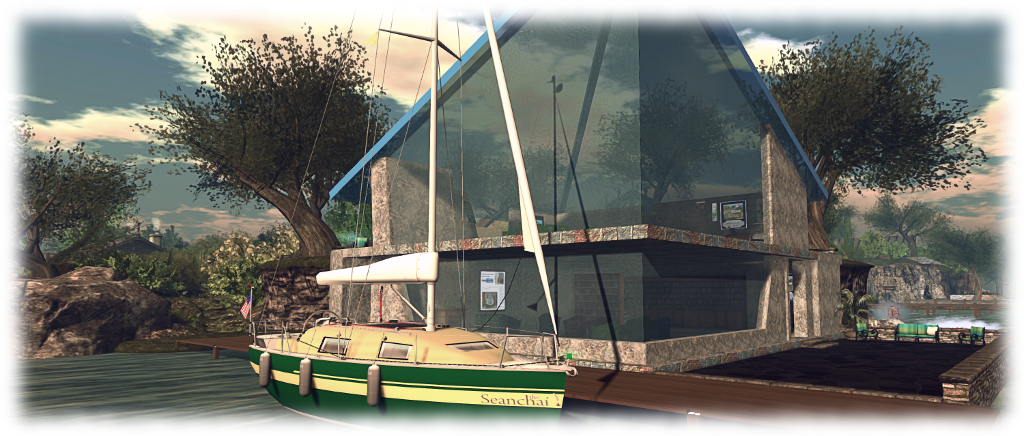
It’s time to highlight another week of storytelling in Voice by the staff and volunteers at the Seanchai Library. As always, all times SLT, and events are held at the Library’s home at Holly Kai Park, unless otherwise indicated.
Monday, September 23rd 19:00: Moonheart
Gyro Muggins reads Charles de Lint’s 1994 novel.
When Sara and Jamie discovered the seemingly ordinary artefacts, they sensed the pull of a dim and distant place. A world of mists and forests, of ancient magic, mythical beings, ageless bards – and restless evil.
Now, with their friends and enemies alike–Blue, the biker; Keiran, the folk musician; the Inspector from the RCMP; and the mysterious Tom Hengyr; Sara and Jamie are drawn into this enchanted land through the portals of Tamson House, that sprawling downtown edifice that straddles two worlds.
Sweeping from ancient Wales to the streets of Ottawa today, Moonheart will entrance you with its tale of this world and the other one at the very edge of sight and the unforgettable people caught up in the affairs of both. A tale of music, and motorcycles, and fey folk beyond the shadows of the moon. A tale of true magic; the tale of Moonheart.
Tuesday, September 24th 19:00: The Spooky Classics
Halloween is approaching and for the next few weeks, Caledonia Skytower will be reading ghostly stories from some of the classics of the genre. Each week features a different author associated with tales of the macabre, Gothic, or just plain spooky. This week: Charles Dickens
Wednesday, September 25th: 19:00 Anne of Green Gables
As soon as Anne Shirley arrives at the white farmhouse called Green Gables, she is sure she wants to stay forever. The problem is, the owners of Green Gables, Matthew and Marilla Cuthbert wanted a boy to help Matthew with household chores; so at first it seems as if she will be returned to the orphanage from whence she came.
However, Anne is determined to stay, trying hard not to get into trouble or speaking out of turn, and the Cuthberts come to realise she is someone blessed with an enormous imagination. The latter is especially noticed by the quietly-spoken Matthew, who persuades his sister that young Anne should stay.
Thus we are drawn into Anne’s life and world as she settles into her first real home. Over the course of a five year period from her arrival in Bolingbroke at age 11 through until her move to Queen’s Academy at the age of 16, where she earns a university scholarship, we follow Anne’s adventures and ups and down within the close-knit community, making friends (and sometime enemies whom she is perhaps too stubborn to admit she’s long since forgiven for perceived wrongs) and her domestic trails and tribulations. The later, when tragedy strikes, we follow her back to Bollingbroke, where she indeed becomes Anne of Green Gables, and her story is left open.
Join Faerie Maven-Pralou as she reads L.M. Montgomery’s 1908 classic (and first of a series).
Thursday, September 26th 19:00 The Dead Travel Fast
“Tonight my bravehearts, we begin our seasonal ventures abroad into exploring the obscure, exhuming Gothic tales, and more seasonal delights!”
With Shandon Loring, also in Kitely – teleport from the main Seanchai World grid.kitely.com:8002:SEANCHAI.
A new study suggests that less that one billion years ago, Venus had liquid water on its surface and atmospheric conditions similar to Earth’s. Credit: NASA
We’re familiar with the idea that Venus is a very hostile place: it has a thick, carbon-dioxide atmosphere mixed with other deadly gases that is so dense, it would instantly crush you were you to step onto the planet’s surface unprotected, and hot enough to boil you in the same moment as well as burn your skin away due to the presence of sulphuric acid. But for a long time, due to its enveloping clouds, it was believed that Venus could be a tropical paradise – a place of warm seas, lakes and rain forests, kept warm by the Sun whilst also protected from the worst of the heat by those thick clouds.
Now, according to a new study presented on September 20th, 2019 at the Joint Meeting of the European Planetary Science Congress (EPSC-DPS),that view of Venus as a warm, wet – and potentially habitable world. What’s more, but for a potentially massive cataclysmic event / chain of events, Venus might have remained that way through to modern times. The study comes from a team at the NASA Goddard Institute for Space Science (GISS), led by Michael Way and Anthony Del Genio.
The studies uses data gathered by two key NASA missions to Venus: the Pioneer Venus orbiter mission (1978-1992), and the Pioneer Venus Multiprobe mission (1978). The latter delivered four probes into the Venusian atmosphere, none of which were expected to survive impact with the planet’s surface, but instead sought to send their findings to Earth as they descended – although as it turned out, one did survive impact and continued to transmit data on surface conditions for more than an hour.
As oceans on Venus might have appeared. Credit: ittiz
That data was coupled with a 3-D general solar circulation model that accounts for the increase in radiation as the Sun has warmed up over its lifetime and models used to define Earth’s early conditions, enabling the GISS time to develop five simulations to try to determine how surface Venus may have developed happened over time – and all five models produced very similar outcomes.
In essence, the models suggest that around 4 billion years ago, and following a period of rapid cooling after its formation, Venus likely had a primordial atmosphere rich in carbon dioxide, and with liquid water present on the surface. Over a period of around 2 billion years, much of the carbon dioxide settled in a similar manner seen on Earth, becoming subsurface carbonate looked in the planet’s crust. In the process, a nitrogen-rich atmosphere would have been left behind, again potentially not that different to Earth’s.
By about 715 million years ago – and allowing for the planet having a sufficient rotation period (16 Earth days or slower) – conditions would have reached a point where a stable temperature regime ranging between 20°C (68 °F) and 50°C (122 °F) could be maintained, with the models indicating that the planet could have oceans and / or seas and / or lakes varying in depth from about 10 m (30 ft) to a maximum of about 310 m (1000 ft), generating sufficient cloud coverage combined with the planet’s rotation to deflect enough sunlight and prevent the atmosphere from overheating. Further, had nothing further happened, these conditions could have more-or-less survived through to current times.
So what happened? That has yet to be fully determined, but the suggestion is that a series of connected global events came together in what might be regarded as a single cataclysmic re-surfacing of the planet. This is somewhat supported by data gathered by the Magellan probe (1988-1994). The GISS team suggest that this caused a massive outflow of the CO2 previously trapped in the subsurface rock that in turn caused a runaway greenhouse effect that resulted in the hothouse we know today, where the average surface temperature is 462°C (864°F).
The surface of Venus called Phoebe Regio, as imaged by the Soviet era Venera 13, 1981-1983
Something happened on Venus where a huge amount of gas was released into the atmosphere and couldn’t be re-absorbed by the rocks. On Earth we have some examples of large-scale outgassing, for instance the creation of the Siberian Traps 500 million years ago which is linked to a mass extinction, but nothing on this scale. It completely transformed Venus.
– Michael Way – GISS Venus study joint lead
There are questions that still need to be answered before the models can be shown to be correct, which the GISS team acknowledge by stating further orbital study of Venus is needed. However, if the study’s findings can be shown to be reasonably correct, it could have relevance in the study of exoplanets.
Until now, it has been believed that planets with an atmosphere occupying a similar orbit around their host star would, like Venus, be subject to tremendous atmospheric heating, preventing liquid water or habitable conditions to exist on their surfaces. However, the GISS models now suggest that subject to certain boxes being ticked, such planets occupying the so-called “Venus zone” around their parent stars could have liquid water present – and might actually be amenable to life.
Artemis and the Moon: Political Football
America is trying to return humans to the Moon by 2024 via a programme called Artemis. It’s an effort that requires funding, clear thinking, co-ordination and agreement. Right now, it would appear as if few of these are proving to be the case.
On the one hand, things do appear to be moving forward. According to a presentation on September 11th, the Lunar Orbital Gateway Platform (LOP-G) is on track. Both the Power and Propulsion Element (PPE -due for launch in 2022) and the Habitation and Logistics Outpost (HALO – due for launched in 2023), as the two core elements of the initial Gateway – remain on track. Even so, doubts have been sewn concerning its relevance, as I’ll come back to in a moment.
An artist’s impression of an unpiloted commercial lander leaving a scaled-back LOP-G for a descent to the surface of the Moon ahead of a 2024 human return to the lunar surface. The LOP-G is the unit on the right, comprising a habitation module and docking ports unit, an on the far right, a power and propulsion unit. In the left foreground is an Orion crewed vehicle. Credit: NASA
Elsewhere, the programme is far from smooth in its progress. On September 11th, the US House of Representative issued a draft continuing resolution (CR) on the 2020 federal budget that provides no additional funding for NASA’s lunar ambitions – a result NASA Administrator Jim Bridenstine stated would be “devastating” to the development of the Artemis lunar lander.
Then at a hearing of the space subcommittee of the U.S. House of Representatives’ Science, Space and Technology Committee on September 18th, NASA’s acting associate administrator for human exploration and operations, Ken Bowersox (himself an ex-astronaut) came under heavy questioning on whether NASA really could achieve a successful human return to the Moon by 2024. His reply wasn’t entirely reassuring, “I wouldn’t bet my oldest child’s upcoming birthday present or anything like that.” He went on:
We’re going to do our best to make it. But, like I said, what’s important is that we launch when we’re ready, that we have a successful mission when it launches.
I’m not going to sit here and tell you that, just arbitrarily, we’re going to make. We have to have a lot of things come together to make it happen. We have to get our funding, we have to balance our resources with our requirements, and then we’ve got to execute it really well. And so, there’s a lot of risk to making the date, but we want to try to do it.
– NASA acting associate administrator for human exploration, Ken Bowersox, September 18th, 2019
In particular, there are concerns surrounding NASA’s new Space Launch System rocket – vital to the effort. This is been plagued by issues to the point where Bridenstine suggested a critical test for the vehicle’s core stage and rocket engines, called the “green run” could be skipped in favour of “other means” of testing – an idea ultimately dropped after considerable push-back from within NASA and safety bodies. As it is, SLS will not be in a position to undertake all of the missions required to return humans to the surface of the Moon – such as delivering hardware to the halo orbit around the Moon that will be used by LOP-G, and so NASA has indicated it would be willing to use commercial vehicles such as the SpaceX Falcon Heavy for a number of cargo flights.
The following notes are taken from the TPV Developer meeting held on September 20th, 2019. A video of the meeting is embedded below, my thanks as always to Pantera for recording and providing it. This was a relatively short meeting, with the majority of topics covered in the first 20 minutes.
SL Viewer News
There have been no further updates to the official SL pipelines since the updates at the start of the week, leaving them as follows:
Current Release version 6.3.1.530559, formerly the Umeshu Maintenance RC viewer, dated September 5th.
Release channel cohorts:
Vinsanto RC viewer, version 6.3.2.530962, September 17th.
Ordered Shutdown RC viewer, version 6.3.2.530901, September 16th. This viewer has changes intended to make crashes on shut-down less likely, but does not have any changes to existing features.
Legacy Profiles viewer, version 6.3.2.530836, September 17th. Covers the re-integration of Viewer Profiles.
Project Muscadine (Animesh follow-on) project viewer, version 6.4.0.530473, September 11th.
360 Snapshot project viewer, version 6.2.4.529111, July 16th.
Linux Spur viewer, version 5.0.9.329906, dated November 17th, 2017 and promoted to release status 29th November 2017 – offered pending a Linux version of the Alex Ivy viewer code.
Obsolete platform viewer, version 3.7.28.300847, May 8th, 2015 – provided for users on Windows XP and OS X versions below 10.7.
Note: Bakes on Mesh introduced an at-login crash that some viewers are experiencing. This has been the subject of a bug report and a fix will be making its way into a maintenance viewer.
Brief Viewer-Related Notes
EEP Viewer
EEP progress has been slowed down for the time being – but for good reasons. The Lab has hired two new rendering system experts, one of whom has already started. They are due to work on EEP related rendering but they will both take time to be introduced to the Lab’s working environment and the EEP project as a whole. This expertise will also be put to work on general rendering work through projects such as the Love Me Render pipeline.
Voice Viewer
The long-awaited Voice viewer update should be appearing in week #39 (commencing Monday, September 23rd), containing assorted fixes for the viewer side of voice.
In particular, it is hoped this update will fix the (predominantly Mac-related) issue of disconnects as a result of a user speaking too softly / having the microphone set too low / pausing for extended period when speaking.
However, there are some issues believed to be server-side that are still being addressed (such as users appearing to be on a separate voice channel to the region of a region, requiring a relog).
It is believed the version of SLvoice.exe in this viewer will function OK with TPVs, although the Lab has obviously not tested this.
Once out, this viewer will likely be pushed through to release status as soon as progress / lack of issues allow.
Viewer Caching / Texture Memory Use
This work is again getting attention, but it will still be a while before it received “substantive” attention once more, in order for a project /RC viewer to make an appearance.
Viewer Build Related Notes
Viewer Build Manifest Updates
From a development perspective, the Voice viewer also includes change to the viewer build manifest, so it accurately reflects viewer build library requirements and correctly reports on missing libraries. Those who self-compile should listen to the video between 10:30 and 14:00.
Viewer Build Tools Project
The work to update the viewer build process to use Visual Studio 2017 and Xcode 10.3 for OS X is still progressing. It is anticipated that results from this work will be visible in the next few weeks.
Mercurial to Github Migration
Bitbucket, used to manage viewer repositories) will be sunsetting support for Mercurial; Linden Lab will therefore be switching to git on bitbucket for their repositories.
Currently, the Lab is experimenting with converting come of their internal repositories from Mercurial to git to see if it is possible to do code merges in both directions via the same tool.
If successful, LL will document the tool and process, then move to try the same procedure against their build repositories, then run things in parallel before finally switching over.
The process is expected to be measured in 2-3 months rather than weeks, and the documentation the Lab produces will be made available to TPVs to allow them to migrate where required, and efforts will be made to keep TPVs informed on overall progress.
Overall, it is anticipated that the overall process will not be quite as “scary” as has been feared.
The Edge, Afflatus, September 2019 – Impossibleisnotfrench
Opening on Saturday, September 21st at THE EDGE Art Gallery, curated by Ladmilla, is a new ensemble exhibition entitle Afflatus (“inspiration”). Running through until Monday, October 21st, 2019, the exhibit features the work of Impossibleisnotfrench, Jessamine2108, Davenwolf Dagger, Loegan Magic, together with gallery “regulars” (residents?) Kapaan, Larisalyn, PartrickofIreland and Trisharose, all rounded-out by a display of art and words by Ladmilla and her SL partner, Eli Medier.
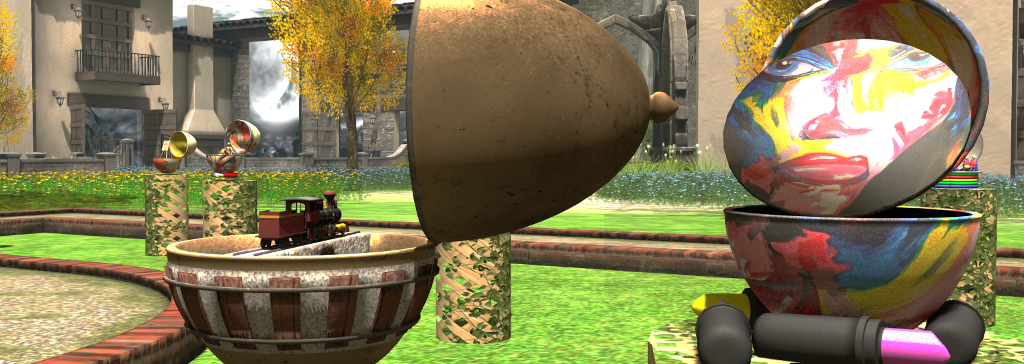
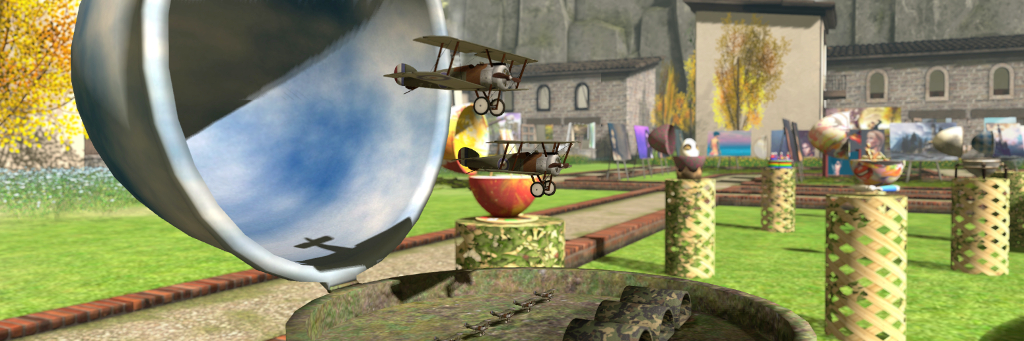
For this exhibition, part of the lawn between the gallery’s indoor exhibition spaces has been turned into a garden display, with paths meandering around work by the quite delightfully name Impossibleisnotfrench (using the Display Name Harry Cover – the name I’m going to go with here, simply for brevity of typing!), and Trisharose. I’m starting here in part because it is the most obvious element in the exhibition, sittig as it does in the midst of the gallery space, but also because Harry’s 3D work is utterly captivating, and it’s the first time I can recall witnessing it in Second Life.
The Edge, Afflatus, September 2019 – Impossibleisnotfrench
For My Third Life Harry present 25 eggs, the majority of which are each slightly larger than an avatar’s neck and head, all of them mindful of Fabergé eggs, but eschewing the gold and bejewelled exteriors in favour of external painting and design in keeping with their contents. Within each (just click the lid on those that might be closed and hiding their interiors) is the most remarkable diorama or model, all of them spanning a broad range of subjects from little World War I Sopwith Camels patrolling the air over their base, to miniature paintings to tiny goldfish swimming in their bowl, with landscapes, figurines and even a couple of cheeky and humorous pieces (think the girl is taking a shower? look more closely!). All are actually drawn from elements of Harry’s life and family, thus offering a “3rd life”, so to speak, reflection of his first life. They are, individually and collectively, an absolutely must-see display that is mesmerizing in its beauty, inspiration and skill of execution.
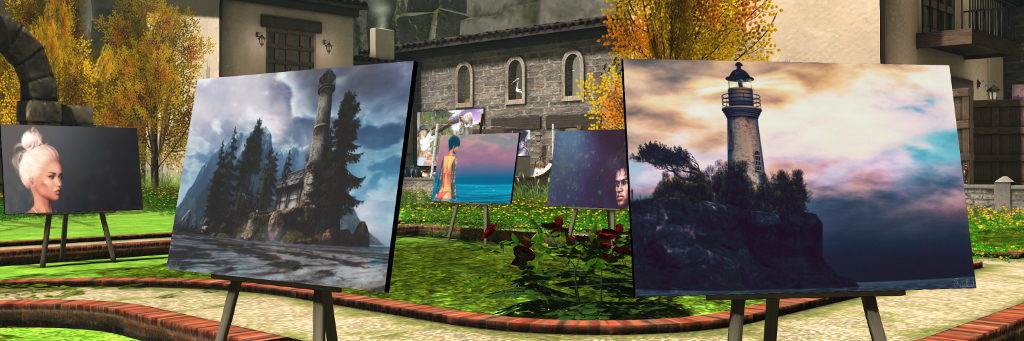
Alongside Harry’s installation, Trisharose presents Be Kind, Laugh and Smile Today, a selection of ten avatar studies and two – for me – quite eye-catching studies of that staple of Second Life landscape, the lighthouse.
The Edge, Afflatus, September 2019 -Trisharose
Within the gallery buildings can be found the installations by the remaining participants in the exhibition, each of whom presents pictures on a theme of their choosing.
Following the order of buildings anti-clockwise from behind the outdoor display, these are Jessamine2108, who offers us a series of Musings, images ranging from studies of avatars in motion (Passion) through to composite pieces (Transcendence) by way of landscape studies to present a set of pieces that do indeed encourage the mind to muse on them. With All Creatures Great and Small, a wonderful selection of landscape and animal images captured around SL, Larisalyn channels the spirit of James Herriot (actually veterinary surgeon Alf Wright), and I challenge anyone not to find a smile at the title piece alongside the entrance to her gallery space.
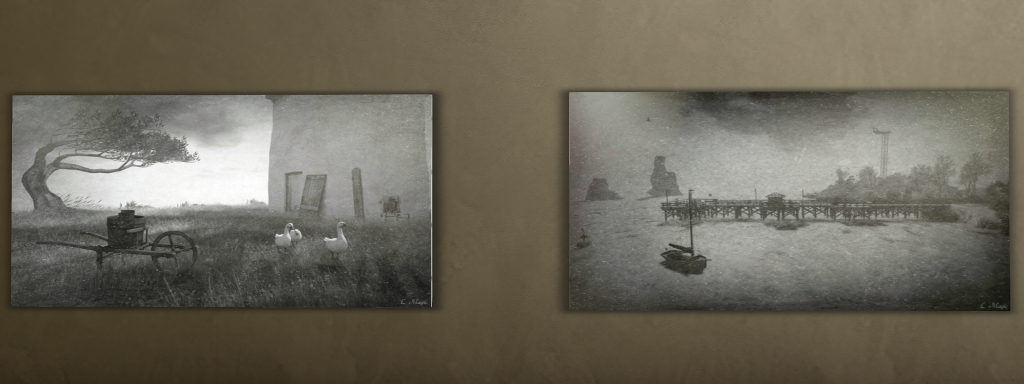
For Vintage Virtual and The Promise Loegan Magic and Kapaan respectively focus on black and white images, albeit it in very different ways. With his images, Loegan presents scenes from Second Life that suggest we are looking back over many decades, to a time before the advent of colour photography; only the appearance of the shells of road vehicles in a couple breaks this illusion. More than that, however, is that in their monochrome rendering, these are images suggestive of a mind in sleep recalling the places it has seen through the medium of dreaming.
The Edge, Afflatus, September 2019 – Loegan Magic
Kapaan’s work, meanwhile is of a darker tone and presents itself as a narrative, each image potential a scene from an unfolding story – a journey undertaken by a lone hero. But to what end? That, perhaps, is for us as the witnesses to decide. Or perhaps the clue lies in the small annex to the main display space.
Davenwolf Dagger is a photographer in the physical world whose work first came to my attention earlier in 2019, and towards which I admits to having something of a fascination. With Industrial Fusion he offers more of his images from the Queen Victoria Museum and Art Gallery, Launceston, Tasmania, and which make up his Blacksmith series. Here they are combined with industrial pieces from SL to provide a unique blending of ideas.
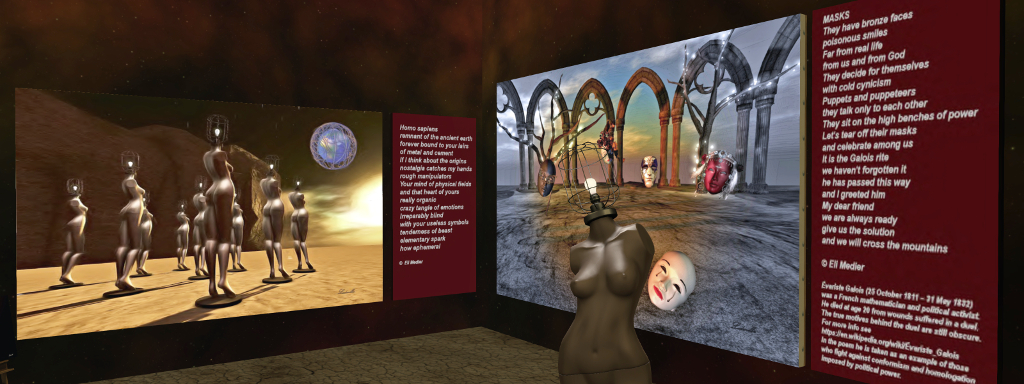
The Edge, Afflatus, September 2019 – Ladmilla and Eli
Puppets presents more of Ladmilla’s always superb and evocative images – here with a slightly surreal slant – coupled with Eli’s masterful use of prose and poem to present a series of pieces encompassing reflections on life, identity, relationships and human nature, all of which meld the physical and the virtual to stir the mind and the eye.
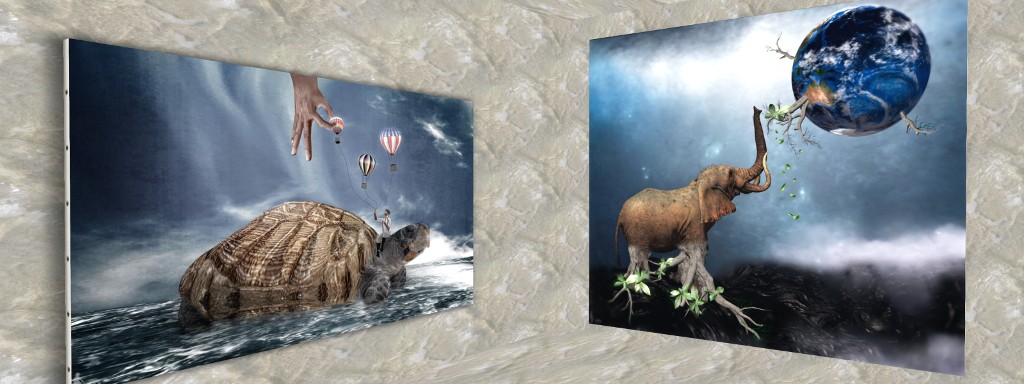
Surrealism is also very much a part of PatrickofIreland’s Four Elements – Essentials of Life. This is something of an immersive installation, commencing within the courtyard of the gallery space. As the name suggests, it offers a celebration of the four essential elements of life – water, air, earth and fire, with each represented through fabulously surreal pieces.
The Edge, Afflatus, September 2019 – PatrickofIreland
Inspired and inspirational, Afflatus and its ensemble exhibitions of at officially opens at 11:00 SLT on Saturday, September 21st, with music by DJ Avalon Boa between 12:00 noon and 14:00 SLT.
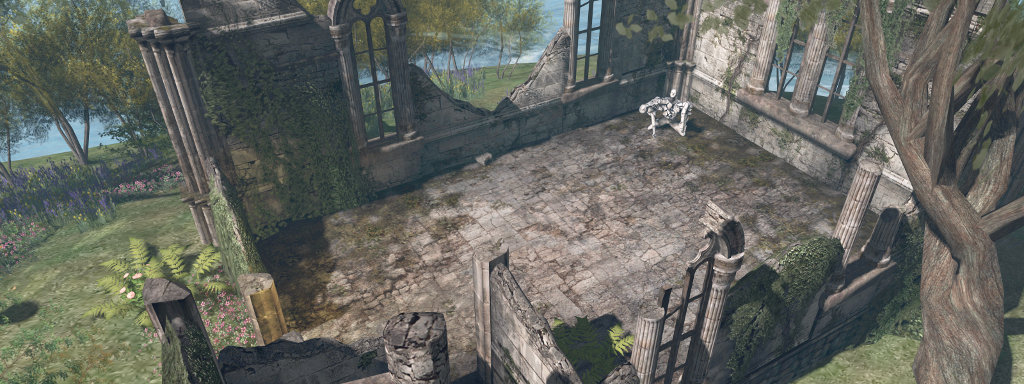
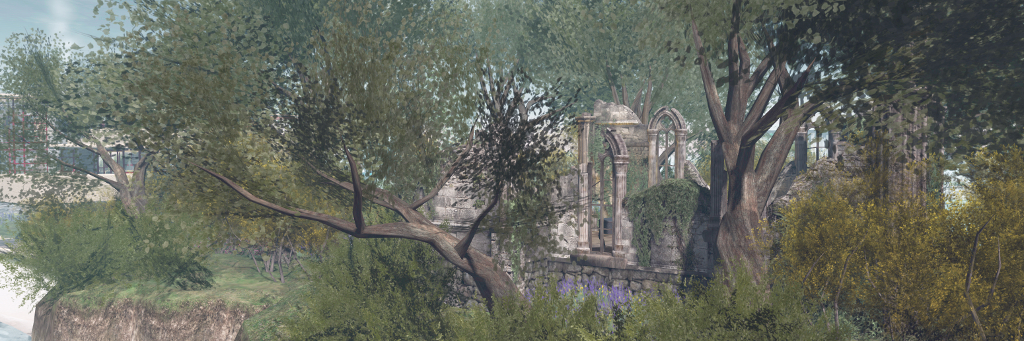
The Chapel Ruins by Marcus Inkpen of The Looking Glass, seated within our “southern island”
It’s been ten months since I bored you with writing about Isla Pey, and at that time I said there probably wouldn’t be any more major changes – and that’s largely been the case. However, over the last couple of months we’ve been re-adding one or two elements of old ruins to the place (a familiar theme with me) – although outside of a couple of walls slipped into the gardens behind the house, nothing really seemed to fit, despite the “south island” screaming to have something placed in it. The towers and walls of previous layouts just didn’t work.
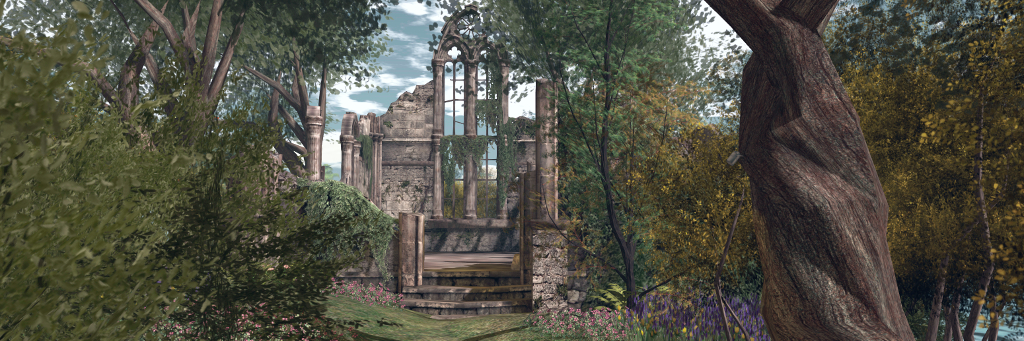
However, a design I’ve admired since it was first released, and which has increasingly been finding its way as a “regular” prop for region designs, is The Looking Glass Chapel Ruins by Marcus Inkpen. Available through The Looking Glass in-world store, this is a truly magnificent piece – and thanks to a combination of size, depth of foundations and luck, it happened to be the *perfect* fit for the land with very little need for anything to be moved or altered – all that was really required was establishing a path to it and around one side of it.
An overhead view of the chapel, with some of my modifications, and a sculpture from Mistero Hifeng
At 66 LI by default, the Chapel Ruins are finely detailed, offering the floor, and broken walls of a single room chapel with the broken square of a tower rising to one side of it, the walls and stairway of which abruptly end just above head height. The windows are without glass, the doors have long gone, and ivy is laying claims to the walls, with fallen stones scattered inside and out. It is, in a word, utterly eye-catching and a worthy centrepiece to any region requiring quality ruins.
Of course, me being who I am, I couldn’t leave it entirely untouched, so a couple of the walls saw some minor alterations (well, one fairly major in that an entire wall section was swapped for another). I also took the opportunity to install some decidedly non-period lighting, together with some additional foliage (pushing the LI to 70) – and then hit a problem.
A view from off-shore
What to do with interior space? Having the ruins really – if I say so myself – set the southern island perfectly; but the rectangle of empty stone floor did look odd – and for over a week nothing came to mind, other than dropping an old piano into it. Which, to be honest, I wanted to shy away from, given such items have also seemed to become de rigueur in a lot of region designs (and I should know- they’ve tended to be de rigueur in my region snapshots of late!).
Fortunately, the answer came in another visit to The Looking Glass. Across the store hall from the vendor for the Chapel Ruins sits a collection called the Our Place To Dream collection, and elements of this collection – notably the wall and the blanket – looked like they might fit with the chapel. And they did.
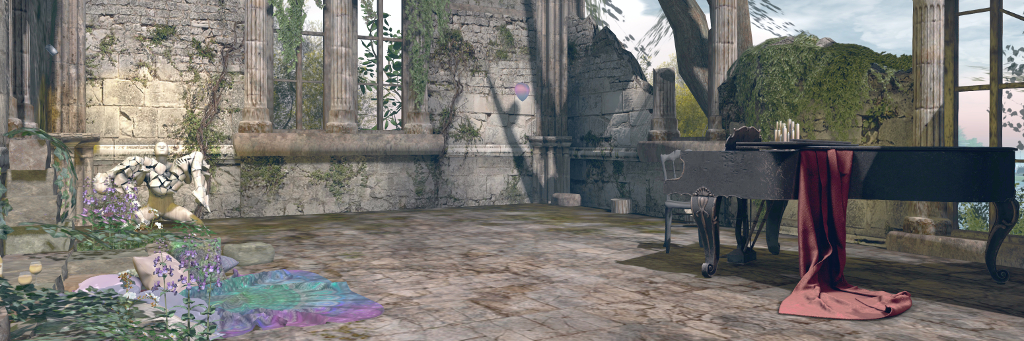
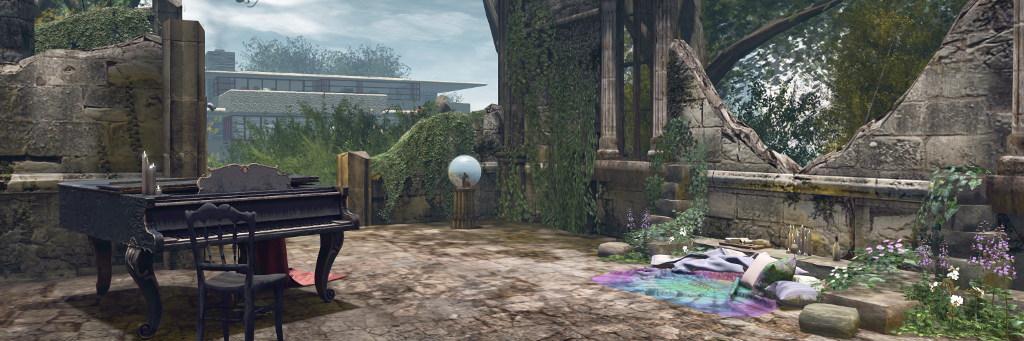
The “finished” space in the Chapel, with the Our Place to Dream Ruined Wall and Blanket (L) and the Nutmeg Distressed Grand Piano.
With a little modification, the wall offered a fitting suggesting of stonework from the broken wall of the chapel gathered together to form a cosy little space for the blanket, particularly when a DIGS cheeseboard together with some candles and wines glasses and bottle from various sources were added to make things even cosier. Which just left the rest of the floor space to deal with. A couple of statues by Mistero Hifeng and Silas Merlin helped; but in the end – well I had to give in to instinct and pick up the Nutmeg Distressed Grand Piano.
So, we now have our own ruined chapel, together with a little cosy spot for dancing, sitting and – with the aid of a picnic set, an outdoor corner to share with friends.
The chapel and the house in the background
The last couple of months have also seen some changes to the house itself – not too much, just some trimming and realignment here and there to give it more of its own look whilst also retaining most of the classic Fallingwater lines. Most of all, it’s given us space for a proper dining area – something I’ve never really seen the point of in SL until I moved into my Linden houseboat 🙂 .
I’m not going to wibble on about the house – but I will say that if you’re looking for a nice-looking, functional (as in animated) kitchen with plenty of options, you might want to take a look at the Olivia Kitchenby: Czikitka.
VUK, September 2019 – click any image for full size
In August we received an invitation from Jacky Macpherson to visit VUK, the Homestead region for the VUK store. Designed by Jacky along with Terry Fotherington and Ines Lauria, the region has been going through a period of development and refinement; on our first visit, there was a small island on its eastern side providing a private space, presumably for region holder and VUK store owner Mr. Vuk. However, on returning in mid-September, this small island had been removed – although it was still showing on the map, suggesting the smaller island has only recently been removed, and ban lines were still in place around the parcel.
The departure of this island (which may only be temporary) means the majority of the region is given over to a single large and rocky island surrounded by a single beach and foreshore. Rising like the shell of a tortoise, the crown of the hill is the location for the VUK store. However, this is no gleaming or fancy store; the location is clearly a former industrial area, and the store sits within the remnants of what looks to have been a factory building. Its roof gone, the walls broken and windows without glass, the building is a place where nature is slowly proclaiming her returning place inside.
VUK, September 2019
Outside of the factory walls is further detritus of human life: the piled ruins of cars and trucks, one of which looks to have become a makeshift shelter for someone. A path winds down the western cliffs from the store to reach what appears to be a once-tidal bay the sea has deserted. The hulk of a fishing boat lies toppled on the grey shore, apparently abandoned well before the sea deserted the shingle, leaving it to become a backdrop for a makeshift bar and DJ area.
More flotsam and jetsam is littered across the bay – a half-buried container, the wreck of an ancient jeep, a shanty hut and makeshift seating area, all watched over by the bulk of a rusting cable car station brooding under the plaintive cry of gulls and assorted critters. However, it’s unlikely the cars that may have once run along the cables to and from the tower ever carried tourists; more likely they carried material for the hilltop factory.
VUK, September 2019
It is this element of careworn age and of life having largely moved on from the setting that gives the region its considerable character – and offers a lot of discover.
From the bay on the west side, it is possible to circumnavigate the lower reach of the island. This will take you past more of the island’s little scenes and points of interest: camps, the wreck of a windmill, and old pier that also appears to have been long deserted by the sea, and which has now become a kind of sun deck and open-air seating area (complete with a neat little working racing car set!).
VUK, September 2019
Up on the hill, the factory is surrounded by trees, grass and more signs of former working spaces. But just beyond them, and accessible from the beach below as well, is the remains of a children’s playground. It sits at odds with the more industrial aspects of the island, but at the same time its aged and rusted condition fits right in with the overall theme.
All of this makes for an engaging visit quite apart from the opportunity to check the VUK brand. For those who like to explore together I recommend heading down to the south side of the island and the deck area mentioned above: there’s a couples walker awaiting you. Also when when visiting, do make sure you have local sounds on so you can appreciate the region’s excellent sound scape.
 Gyro Muggins reads Charles de Lint’s 1994 novel.
 As soon as Anne Shirley arrives at the white farmhouse called Green Gables, she is sure she wants to stay forever. The problem is, the owners of Green Gables, Matthew and Marilla Cuthbert wanted a boy to help Matthew with household chores; so at first it seems as if she will be returned to the orphanage from whence she came.






 Inara Pey: Living in a Modemworld