Space Sunday: home again, a “good night”, and seeking biosigns

Crew Dragon Freedom splashes down off the Florida coast March 18th to conclude the Crew-9 mission. Credit: NASA/Keegan Barber

On Tuesday, March, 18th, 2025, A SpaceX Crew Dragon – mission Crew-9 – made a safe splashdown off the Florida coast prior to being successfully brought aboard the waiting recovery vehicle. This brought to an end what has been perhaps the most mis-reported human space mission thus far.

This is because the vehicle which carried NASA astronauts Barry “Butch” Wilmore and Sunita “Suni” Williams into space back in June 2024 was the much-troubled Boeing CST-100 Starliner. Whilst the vehicle reached orbit successfully, it suffered further problems with it primary propulsion system – located on the vehicle’s expendable service module. As a result, and exercising an understandable over-abundance of caution, NASA opted to leave Wilmore and Williams on the ISS until an alternate means of bringing them home could be scheduled.

However, at no time did this ever mean Williams and Wilmore were “stranded” on the ISS: just because NASA did not want to bring the astronauts back to Earth in an emergency did not ever equate to the agency being unable to do so. This was proven in July 2024 when, following the disintegration of a Russian satellite led to a short-term threat of possible debris impact with the ISS. As a result the station’s crew were ordered by NASA and Roscosmos to “shelter in place” aboard their respective space vehicles – including Wilmore and Williams aboard the CST-100 – in case an emergency departure and return to Earth was required if the debris could showed signs of intersecting the ISS in orbit.
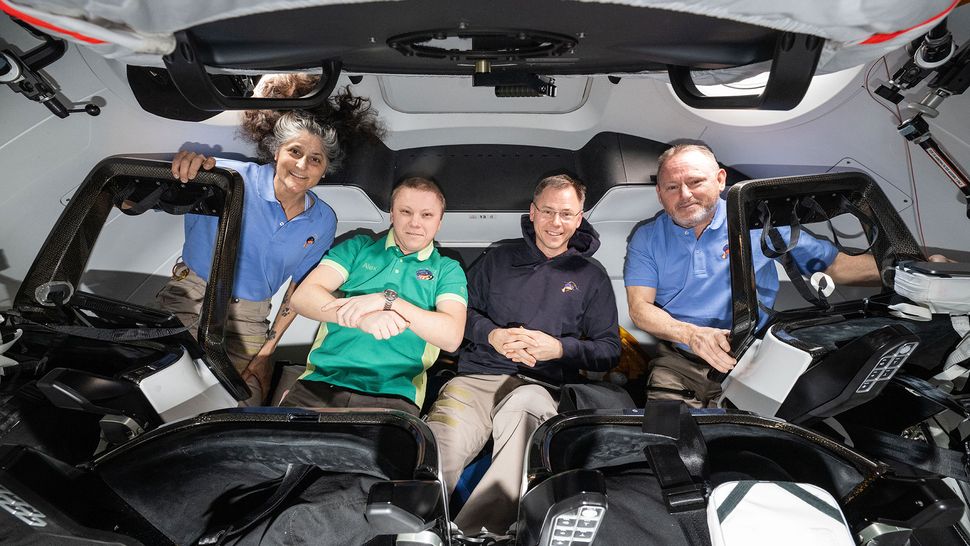
Sunita “Sunni” Williams (l) and Barry “Butch” Wilmore (r), pose aboard the docked Crew Dragon Freedom shortly after it arrived in September 2024, bringing Aleksandr Gorbunov and Nick Hick (sandwiched respectively between Williams and Wilmore) to the ISS. Credit: NASA

In fact, one of the reasons Starliner remained at the ISS even after the decision had been made to return Williams and Wilmore to Earth via other means was as much about providing them with a “lifeboat” return to Earth for as long as possible, as it was about carrying out further tests on the vehicle.

As it was, Starliner did eventually undock from the ISS in September 2024 ahead of the launch of the Crew 9 mission, with the crew capsule Calypso successfully landing on Earth at the end of a fully automated flight and despite two further system hiccups.  Meanwhile, the Crew-9 mission also arrived at the ISS in September 2024 to become NASA Expedition 72, with Williams and Wilmore slotting into the two Expedition 72 crew slots vacated for them, in order to see out the mission’s 170-day rotation on the station.

The rotation came to an end on Tuesday, March 18th, 2025 when Crew 9 – Williams and Wilmore together with mission commander Nick Hague and cosmonaut Aleksandr Gorbunov undocked from the ISS at 0505 UTC, their places having been taken by the Crew 10 / Expedition 73 crew, who arrived at the ISS two days previously.
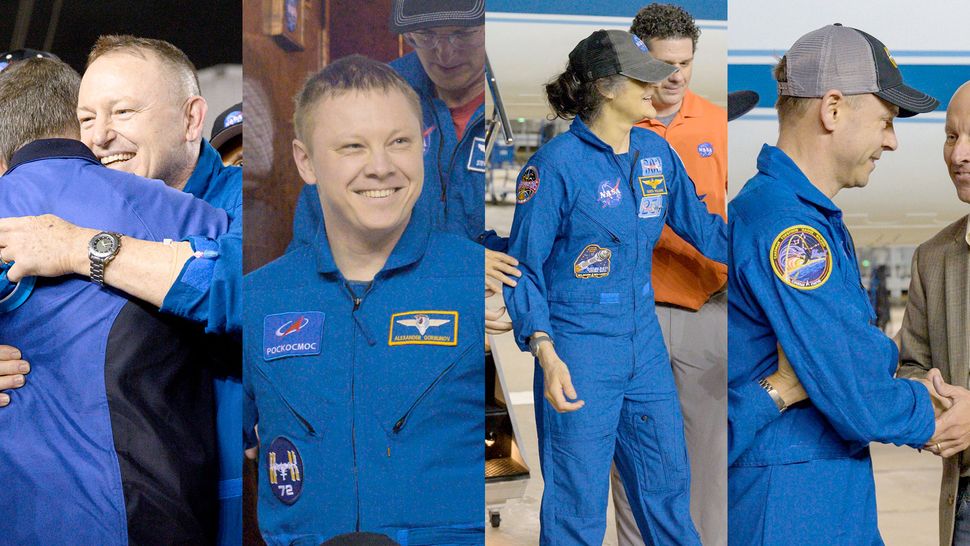
A composite image showing astronauts Butch Wilmore (l) and Suni Williams (second from right), with Aleksandr Gorbunov (second from left) and Nick Hague being greeted by fellow astronauts and family members at Ellington Field, Houston after their flight from Florida. Credit: NASA

And while much has been made of Williams and Wilmore’s extended stay on the ISS, overall, the 286 days they spent on the station is not exactly record-breaking or that unusual. Among NASA’s astronauts, five others have spent longer periods of time on a single ISS crew rotation (even if their time was planned from the outset to be so), whilst four cosmonauts have spent in excess of 330 days each (437 in the case of Valeri Polyakov) on either the Soviet / Russian Mir station or the ISS. That said, Williams has now accumulated the second highest number of continuous days in space by a US astronaut – 608 days – slotting in behind Peggy Whitson who accumulated 675 days in space with NASA and a further 9 days as a private citizen astronaut on the Axiom Ax-2 mission.

What of Starliner?

Whilst Wilmore and Williams may not have been stranded in space, the Starliner programme does have issues, notably with the design of the four propulsion pods – dubbed “doghouses” because of their appearance – mounted on the Starliner’s service module, and which have yet to be fully resolved.

The CST-100 Starliner comprising the capsule Calypso and its service module slowly back away from the ISS following undocking in September 2024. Two of the problematic “doghouse” thruster pods are visible on the cylinder of the service module. Credit: NASA

The pods, each of which mounts five “large” orbital manoeuvring and control (OMAC) thrusters as a “primary” means of propulsion and seven smaller reaction control system (RCS) thrusters used for very precise manoeuvring and control, have been something of a bane to Starliner for the last several years. During preparations for the second uncrewed flight of the CST-100 system (itself the result of an embarrassing cock-up in integrating the timing systems between the launch vehicle and the Starliner craft in the first orbital test flight), it was found that a large number of the values within the thrusters had jammed, delaying the launch by several months, only for a number of the thrusters to have issues during the flight.

During the first Crew Test Flight with Williams and Wilmore, no fewer than five of the RCS thrusters failed during initial docking attempts at the ISS, although four were brought back on-line and the docking completed. This failure, coupled with the discovery that the issue was related to overheating within the “doghouse” units which had not been picked up during the development and testing of the units, then led to something of an embarrassing public spat between Boeing, as the main vehicle contractor, and Aerojet Rocketdyne, makers of the propulsion units, prior to NASA banging some heads together.

Since then, work on rectifying the propulsion unit issues has continued in near-silence. However, the return of the two astronauts to Earth inevitably caused some of the spotlight to swing back towards Boeing and Starliner and if / when / whether it night fly again. There is little doubt that NASA does want Starliner to continue: having all of their eggs in the Crew Dragon / Falcon 9 basket is far from ideal despite that successes of those systems thus far. This was something noted by Steve Stich, NASA’s Commercial Crew Programme Manager, following the Crew 9 splashdown.

We really need to get Boeing into a crewed rotation. Butch and Suni’s return on Dragon, to me, shows how important it is to have two different crew transportation systems, the importance of Starliner and the redundancy that we’re building into human spaceflight for our low Earth orbit economy.

– Steve Stich, NASA Commercial Crew Programme Manager

The Boeing CST-100 Starliner: A: Crew capsule (reusable) 1: Nosecone protecting the docking system during launch (expended) 2: Parachute cover (ejected during landing) 3: Crew access hatch 4: capsule RCS thrusters (x25) 5: Airbags (x6) 6: Heat shield (ejected during landing) 7: NASA Docking System port 8: Parachutes (x3) 9: Window (x3) B: Service module (expended) 10: Power umbilical connecting the command and service modules 11: Radiators (x4) 12: “Doghouse” thruster pods (x4) 13: Propellant tanks 14: Roll control thruster on “Doghouse” 15: Launch abort motors (x4) 16: Solar panels. Credit: NASA

While progress has been made on mitigating the overheating issue by means of changing the operating parameters of the thrusters software system so as to avoid the need for any excessive redesign of the “doghouse” systems, these changes will need to be tested at some point through an actual flight test – and the same is true of the more minor, but still required, alterations to the helium purge systems within the propulsion systems.  This raises another issue: should such a test be carried out via a crewed or uncrewed mission.

The final decision on this lies with NASA, although in their rare comments on the work, Boeing has been somewhat bullish, pushing for the flight to be crewed. For its part, the space agency will not be drawn on what form any additional test flight should take – only that the vehicle used should be “mission ready”, with Boeing in a position to rapidly pivot from completion of a test flight to flying a full crew rotation afterwards.

Even if we were to fly the vehicle without a crew in the return, we want that to be crew-capable. So, we want it to have all the systems in place that that we could fly a crew with. What we’d like to do is that one flight and then get into a crew rotation flight. So, the next flight up would really test all the changes we’re making to the vehicle, and then the next fight beyond that, we really need to get Boeing into a crew rotation. So, that’s the strategy.

– Steve Stich, NASA Commercial Crew Programme Manager

As to when any such flight might take place remains an open-ended question. NASA continues to signal it would like at least the test flight to occur in 2025, but the overall mission schedule for the ISS this year – crew rotation flights, resupply missions (including the demonstration flight of the Dream Chaser resupply vehicle) – mean that docking opportunities for any Starliner test flight are not that numerous in the near-to-medium term.

Blue Ghost says “Night-night” with Stunning Images

In my previous Space Sunday update, I wrote about the private Blue Ghost lander by Firefly Aerospace, which successfully touched-down on the Moon on March 2nd, 2025, marking the company as the first to carry out a “fully successful” (e.g. without rolling or toppling over) commercial lunar landing.

The Earth as captured by Blue Ghost from the surface of the Moon. Credit: Firefly Aerospace / NASA

Over the next lunar daylight period (14 terrestrial days), the vehicle carried out its assigned surface science work, with only the drill system – called LISTER (for Lunar Instrumentation for Subsurface Thermal Exploration with Rapidity rather than having any reference to a character from Red Dwarf) failing to operate as hoped, only reaching a depth of around 1 metre than the hoped-for 3 metres.

However, on Sunday, March 16th, the lander went quiet as the lunar night took hold, denying it the sunlight it needed to convert into electrical power and heat, and temperatures plummeted.

The “diamond ring” is a famous feature of solar eclipses seen from Earth. However, its one is the result of the Earth eclipsing the Sun, as seen from the Moon. Credit: Firefly Aerospace / NASA

While there is a chance residual energy stored in the lander’s batteries might be sufficient to keep its essential electronics functioning, the Firefly team are not expecting to be able to re-establish contact when daylight returns on the vehicle in April.

Rather than simply bid farewell to their plucky little lander, however, on March 18th, Firefly Aerospace, via NASA – the mission being part of NASA’s Commercial Lunar Payload Services (CLPS) programme – released some images captured during the mission to highlight its success. Taken in high definition, they are regarded as some of the best ever taken from the surface of the Moon, and I’ve reproduced some of them here for your appreciation.

As the Sun sets against the lunar horizon, its reflected light turn Earth into another “star” as seen from Blue Ghost, as Venus also appears a bright dot above and to the right of the Sun. Credit: Firefly Aerospace / NASA

Discovering Biosigns on Other Worlds Just Go Easier. Sort-of

So far, we’ve discovered in excess of 4,000 planets orbiting stars beyond our own, and while many are unlikely to support life of any kind, much less life as we know it, there are equally many that just might. The trick is actually recognising the fact they do across the vast interstellar distances involved.

Thus far, the common technique used to try to determine whether or not an exoplanet might harbour life is to look for biosignatures – the by-products of life processes – when analysing the composition of its atmosphere. However, there are a number of problems with this approach, including the fact that many biological interactions can be similarly produced through purely abiotic means such as inorganic chemical reactions, and determining one from the other over interstellar distances in next to impossible.

Might the study of hycean worlds help determine the presence of life beyond our own solar system?

To combat this, researchers from University of California, Riverside, have suggested that astronomers looking for potential signs of life examine the atmospheres of potentially habitable worlds for concentrations of methyl halides. These are gases combining a methyl group with a halogen atom – and they are only produced via organic means by anything from bacteria through to plants. Ergo, if they can be detected in the atmosphere of a planet, they would potentially point to some form of organic process at work on that world.

Clever, right? Well, yes, but there is a hitch. Even here on Earth, atmospheric concentrations of methyl halide are low and prone to being broken-up and “lost” within the general atmospheric “noise”, thus making them hard to detect – and this would likely be true for many potentially life-bearing worlds orbiting other stars. Fortunately, the researchers have an answered for that: look for methyl halides in the atmospheres of hycean worlds.

These are planets which have been shown to have hydrogen-rich atmospheres and are believed to have liquid water surfaces (“hycean” being a portmanteau of “hydrogen” and “ocean”). Generally, speaking, these worlds exist within the “Goldilocks zone” around their parent star: the region wherein all the “right” conditions come together to potentially give life the “kick start” it needs. Further, such are their general atmospheric composition and character, they could support far higher – and more detectable – concentrations of methyl halides.

In this, the researchers are supported by the fact that one biosignature appears to have been detected within the atmosphere of an exoplanet – dimethyl sulphide. This was reported as being discovered within the atmosphere of K2-18b, a hycean world, in 2023. And even while the overall number of hycean worlds thus far discovered is small, finding traces of methyl halides in the atmosphere of just one would be ground-breaking news.

Might the study of the water vapours ejected by Enceladus (seen here in false colour to highlight its surface structure) and Europa reveal the presence of methyl halides?

Another potential area where the detection of methyl halides might work is in the study of the water vapours expelled from the likes of Europa and Enceladus in our own solar system. Both of these moons give off plumes of water vapour through geysers, which in the case of Enceladus, is sufficient to actually help renew the otherwise unstable E- ring around Saturn. Were methyl halides to be found within these vapours (assuming they could survive in the tumult), it could dramatically increase the potential for one of these moons to be harbouring microbial life in its waters.

Scylla’s “Almost” in Second Life

IMAGO Art Galleries, March 2025: Scylla Rhiadra – Almost

Philosophy and art can make for an interesting coupling; on the one hand, philosophy can trigger an artistic response that in turn might serve to illustrate the central thesis being discussed; on the other, art triggered by a philosophical precept can go on to spur thinking and reflection which can reach beyond the original focus of both the art and / or the precept it initially illustrated.

Such is the case with Scylla Rhiadra’s Almost, a compelling series of pieces of art with accompanying textual extracts (often a common element within Scylla’s work), which opened to public display on March 20th, 2025 at Mareea Farrasco’s  IMAGO Art Galleries.

As I’ve noted in covering past exhibitions of her work, Scylla is one of the most gifted communicators in Second Life; her ability to to use art to convey ideas, feelings, realities and truths, and/or to expose concepts and ideas and encourage the grey stuff between the ears to fire on all available cylinders, is second to none. Nor is she unfamiliar with building upon philosophical thinking to explore our notions of what it is to be human, to live, to move through life; in this I would point to Swerve, her exhibition from 2024 which grew out of reflections on atomism as prompted by Titus Lucretius Carus (see Scylla’s Swerve at Nitroglobus in Second Life for more).

IMAGO Art Galleries, March 2025: Scylla Rhiadra – Almost

Within Almost she takes as her seed the work of the ancient Greek philosopher Zeno of Elea – specifically one of his Paradoxes of Motion (which are perhaps the most well-known of his paradoxes), which Scylla refers to as his “Atalanta Paradox”, but which is perhaps better know as the Dichotomy Argument.

In this Zeno asks us to imagine the Greek heroine and athlete running half the distance to a finishing line, and then requires us to notionally half the remaining distance and time again, and again, and again, ad infinitum. The “logical” and mathematically “provable” corollary of this exercise is the realization that the runner will never reach her goal; she will merely get closer and closer, by smaller and smaller spatial and temporal increments.

– Scylla Rhiadra, introducing Almost

IMAGO Art Galleries, March 2025: Scylla Rhiadra – Almost

The Dichotomy Argument, together with Achilles and the Tortoise and Zeno’s Arrow Paradox are regarded as such because between them, they postulate that everything is, to all intents a purposes, motionless. Atalanta can never finish her race; Achilles can never catch the tortoise, that at any given point in its flight, the arrow is in fact standing still. Not only does this mean the races / arrow flight can never be completed – they can never actually commence – which is clearly a logical fallacy, given they can and do. This fallacy offers some interesting lines of thinking, as Scylla goes on to note:

I found the concept an interesting metaphorical approach to understanding what it means to be “human,” existing in real time and space. In some ways, we are always “almost” something or another, in part because we are always in the process of becoming — of “almost” being someone or somewhere else — and because it is a fundamental condition of human existence that we never achieve an ultimate, absolute state.

– Scylla Rhiadra, introducing Almost

Thus, within this series, Scylla presents images which explore the dichotomy created within Zeno’s paradoxes in a highly visual manner.  Each offers a complete story on the human condition within its frame, whilst simultaneously presenting the potential for much broader narratives.

IMAGO Art Galleries, March 2025: Scylla Rhiadra – Almost

In this they are like Atalanta’s race – just as they almost present a “finished” image and idea, so to do they hint at a further measure of consideration, a further line of narrative, drawing the imagination onwards towards a line of “understanding” we never quite reach as we constantly re-evaluate what we are seeing within each image as our view shifts and changes both in light of our emotional state / mental processes and in reaction to reading the text accompanying each piece.

And it is in the textual excerpts that Scylla again teases; whilst they might almost illuminate an image in terms of a single point of understanding, so do they also open doors on to new avenues – or corridors, as Scylla puts it – of thinking and reaction, which can themselves subdivide further than further the more we dwell on what the text might say / mean and what might have motivated its selection.

IMAGO Art Galleries, March 2025: Scylla Rhiadra – Almost

This makes Almost wonderfully subjective – perhaps “personal” might be a better term; there is no single “given” within any single image or its text. Instead there are layers of potential that might be peeled away as each piece and its companion words are examined and considered, very much informed by the feelings and thoughts we bring to them as much as by the scenes they capture. A magnificent and deeply engaging series rich in interpretation from one of Second Life’s most engaging photographic artists.

SLurl Details

2025 week #12: SL CCUG meeting summary: PBR / BOM

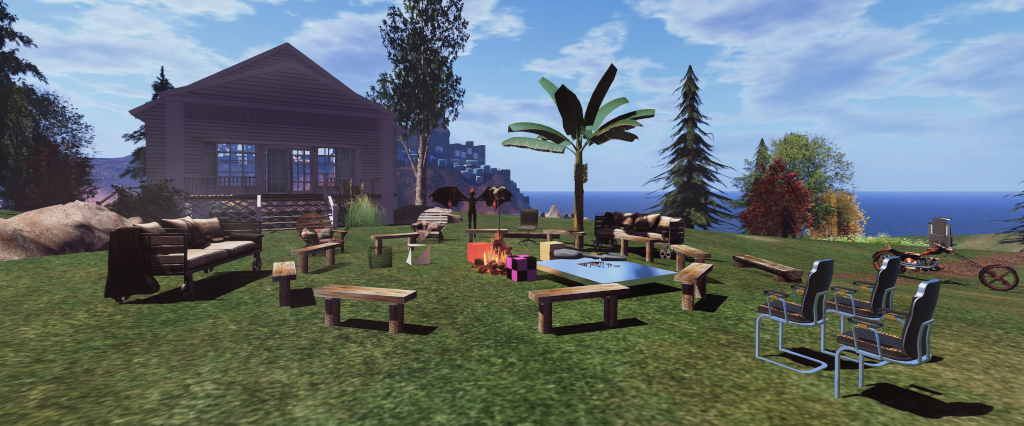
Hippotropolis Campsite: venue for CCUG meetings
The following notes were taken from my audio recording and chat log of the Content Creation User Group (CCUG) meeting of Thursday, March 20th, 2025.Please note that this is not a full transcript, but a summary of key topics .


Table of Contents

Meeting Purpose

  • The CCUG meeting is for discussion of work related to content creation in Second Life, including current and upcoming LL projects, and encompasses requests or comments from the community, together with related viewer development work.
  • This meeting is generally held on alternate Thursdays at Hippotropolis.
  • Dates and times of meetings are recorded in the SL Public Calendar, and they are conducted in a mix of Voice and text chat.

Official Viewer Status and Updates

[Video: 02:07-8:00]

Viewer Status

  • Default viewer: 7.1.12.13550888671, formerly the ForeverFPS, dated March 1, 2025, promoted March 5th – No change.
    • Numerous crash and performance fixes.
    • Water exclusion surfaces.
    • Water improvements.
  • Second Life Release Candidate viewer 2025.03 version 7.1.13.13906285233, March 20th – NEW.
    • New UI element for water exclusion surfaces: Build / Edit floater → Texture Tab → Hide Water checkbox.
    • The maximum amount of Reflection Probes can now be adjusted to better accommodate low VRAM scenarios.
      • Values will be set automatically depending on your chosen graphics quality, OR
      • Use Preferences → Graphics →  Advanced Settings →  Max. Reflection Probes to manually set. Note that lowering the value on this slider can help within environments where a lot of manual Reflection Probes have been placed out.
    • An issue with being unable to see Sky Altitude values in the Region/Estate window has now been resolved.
    • Preferences → Graphics → Max. # of Non-Imposters has been renamed Max. # of Animated Avatars for clarity.
    • Bug and performance fixes and memory optimisations.
Updates to the UI elements in the 2025-03 Release Candidate viewer (click for full size, if required)

Upcoming Viewers

  • The hope is that the 2025.03 RC viewer will progress fairly rapidly through its pre-release iterations and be promoted to de facto viewer status “soon” – most likely early April.
    • Again, this viewer includes many fixes and and work originally scheduled for the 2024 “Maintenance B” RC, which had been held over due to the focus on the performance improvements work.
  • The April release – 2025.04 – is provisionally targeting:
    • The glTF mesh uploader (based on the current .DAE mesh uploader and doing pretty much the same). Again, please note that this is not the full glTF scene importer which has been discussed at previous CCUG meetings; that work is being broken down into smaller, more easily managed projects.
    • Possibly some additional Materials features, although these are currently subject to shifting priorities.
  • Geenz Linden reiterated the idea that the new viewer update process is intended to provide work on a major feature, and also include viewer quality of life improvements – notably requests / fixed file via the Feedback Portal.

Bakes on Mesh Improvements – PBR

[Video: 12:17-24:42]

  • A bump of a feature request to provide the ability to make alphas for AUX BOM layers led Geenz to note that there are internal discussions on Bakes on Mesh and what additional things / features the Lab would like to tackle with regards to it (e.g. blend options, including the ability to blend materials attributes).
  • However, nothing is as yet on the roadmap for implementation.
  • This led to a general request on feedback as to what creators would like to see by way of BOM improvements. Responses included:
    • Full PBR Materials compositing / baking.
    • The mentioned materials blending + Photoshop-like blend modes + the ability to have blends (+ opacity) user-modifiable, even if the assets themselves are not.
    • Provide opacity sliders on the bakes slots, so as to allow things like the creation of a universal tattoo in 100% opacity black, then being able to ‘fade’ it without using more textures with separate opacity settings – see: Introducing Opacity Control for BOM Layers.
    • The ability to drag different BOM layers around when changing layer priorities, rather than having to use the current Up/Down buttons in the appearance floater.
  • Additional requests should be filed via the Feedback Portal.
  • A request for real-time in-viewer painting for alpha layers with a very basic editor was also requested as a part of the above, with Geenz indicating this would be unlikely any time soon.
  • Providing full support for PBR materials within the Bake Service is being actively “thought about” at the Lab, but Geenz noted there are some caveats. For example:
    • There is both a compatibility issue and some degree of “convertibility” between supporting a mix of PBR materials and “legacy” (Blinn-Phong) materials within BOM.
      • The compatibility issue is that both are largely different in how they operate.
      • The “convertibility” aspect lies in the fact that the specularity channel within “legacy” materials was developed with what was at the time (2012) the glTF specularity workflow. This potentially opens the door towards mixing both.
    • However: there are multiple considerations when it comes to possibly supporting both Blinn-Phong and PBR materials in BOM – particularly when it comes to ensuring the end-user understands what is going on, what might happen when editing / combining layers, and the whole question of how the necessary guidelines / caveats / warnings can be meaningfully put before users without causing confusion.
    • These internal discussions are currently on-going.
  • The idea of being able to modify blending when the assets themselves are No Mod was described as “an interesting one”, with Geenz suggesting it is something that should be posted as a request to the Feedback Portal to gain broader feedback from the user / creator community before any specific actions are taken, particularly given changes to the permissions system can lead to debate.
    • This led in part to an additional discussion on the idea of “opening” the permissions system in other areas – such as allowing users the ability to colour tint meshes that are otherwise No Mod, or add glow, if required).
  • During the discussion Geenz noted that in general, PBR is unlikely to be getting displacement mapping “any time soon”.

In Brief

  • [Video: 6:02-7:05 + later in the meeting] glTF mesh uploads:
    • The outline of this work can be found in Add Simple (llmesh) GLTF Model Import.
    • In short: it should be taken that whatever can be done within the existing .DAE uploader will remain so for uploading glTF mesh models at the first pass. Enhancements – including possibly forking the glTF  uploader into its own floater distinct from the .DAE uploader – will come later.
    • Given this, the ability to upload custom skeletons / rigs will not be supported. This does not necessarily mean that custom skeletons / rigs will “never” be supported – rather than it is a more significant project that requires further consideration before a decision can be made.
    • A request was made to be able to select maps / materials for upload in the glTF uploader, e.g. whether it should be a selectable list rather than a drop-down (for materials – which defaults to one or “bulk”) – this also has been included in the Feature Request.
  • [Video: 8:29-11:59] Kyle Linden sought information on why those using vehicles – notably boats / aircraft disable sky rendering (via Advanced → Rendering Types) during normal game play (e.g. not for matters of terraforming, etc.).
    • The majority of feedback within the meeting suggested the core reason to be doing so gives a small FPS boost (and there have been reports filed that sunset / sunrise rendering can impact FPS).
    • Anecdotally, it was suggested that it can improve region crossings, although examples weren’t cited.
    • Some also stated they did it to stop the “frantic” cloud scrolling when moving between different regions with different EPP settings (why not just apply a preferred EEP setting to your avatar to avoid this?). This prompted Geenz Linden to remark that there have been some internal discussions about making the transitions between EEP setting less jarring.
  • [Video: 26:23-27:53] some are reporting increased frequency of texture thrashing on PBR viewers over non-PBR viewers.
    • This is in part why LL has been adding further controls over texture use of VRAM.
    • Manually adjusting VRAM usage may not always resolve all issues of texture blurring (as there can be multiple reasons for it), and tweaking thing like the slider for adjusting the amount of VRAM available for texture loading can make things worse in certain conditions – so keep this in mind.
  • [Video:37:02-38:26] A request was made via chat for the Feedback portal to have a means for people to view all the tickets they have filed. This was seen as something that the Canny developers would need to implement in general, rather than a capability LL could add to the system, and so should perhaps be requested on Canny itself!
  • [Video: 38:51-41:08] It’s been reported that the eye-dropper for tinting PBR surfaces from the colour picker swatch is not working. This extended into comments that copying / pasting materials between surfaces can fail and planar face alignment not working. Fixes for issues such as copying PBR materials are within the 2025.03 RC viewer, together with a fix for PBR materials not always persisting when applied to a mesh face.
  • The last 20 minutes are a general discussion on VR support (not yet, to much work in other areas to complete first); reflection probe fixes (such as better blending) to be looked at; anecdotal comparisons on frame rates being experienced at the meeting (anecdotal as no real indication of overall graphics settings being used, direction people had their camera point & the complexity of their field of view, etc.); general performance and performance tracking.
  • [Video: 58:12-1:00:05] Part of the discussion on frame rates / performance it was noted that turning off the name tag display in the viewer Preferences → General → Name Tags options) can cause an increase in FPS – most likely due to the use of alpha layer in name tags pulling on performance.  This led to request for feedback on whether the default should be left at Name Tags On & left to a person’s individual choice to alter it; or perhaps change it to Show Briefly; or perhaps alter the behaviour so the name tag only renders when the mouse is hovered over an avatar (without necessarily having the hovertips enabled).

Next Meetings

  • Subject to confirmation: Saturday CCUG, Saturday, March 29th, time TBA.
  • 13:00 SLT, Thursday, April 3rd, 2025, at the Hippotropolis Campsite.

Duraya’s I See People in Second Life

Kondor Arts Centre, March 2025: Duraya – I See People

The term “AI art” can tend to be a barbed one. There are understandable – and in my view valid – ethical concerns surrounding AI-generated art, and the fact that many of the models which power the generative tools behind AI art are trained using copyrighted material often without the consent or compensation of the original artists. Indeed, when it comes to matters of copyright, David Holz, creator of Midjourney has shown scant regard for the concept when interviewed – and he is far from alone.

However, the flip side to this – and without wanting to get overly caught within convoluted ethical discussions – there is a case to be made for the fact that when used correctly, AI tools can be a useful means of enhancing an artist’s creativity; the use of algorithms and prompts to manipulate and build on pieces of and artist’s original pieces, enabling them to create something new – and possibly surprising.

Kondor Arts Centre, March 2025: Duraya – I See People

Such considered, curated use can result in extraordinary art; and such is the case with I See People, an exhibition of original art by Duraya, now on display through March / April at the Kondor Art Club, curated by Hermes Kondor and forming part of the Kondor Arts hub.

This is a series of engaging studies of “people”, some drawn / painted by Duraya, others (I believe) photographs of her avatar. All have been subject to AI treatment at Duraya’s command to produce the finished result. All are rich in detail and – perhaps surprisingly to some – rich in emotion / sentiment.

Kondor Arts Centre, March 2025: Duraya – I See People
When I first got in contact with AI I thought ‘huh, everyone can click around a bit to get fantastic results, what a cheat’. It’s true in a way. But if you learn to ‘tame the beast’ and understand how to ride it it’s a fantastic addition to creation like all the post procession devices.
My AI-edited pictures are all based on my own work, playing with prompts, settings and images until I get the result I want, thus accomplishing a mixture of reality and virtuality, sometimes with a little surprising twist.

– Duraya, discussing her AI-assisted art

These are genuinely individual pieces strong in narrative, presenting many aspects of the human condition –  from the trials of life on the personal level: dealing with loneliness, our natural curiosity, the realities of aging, and so on; through to matters that might be seen as more global issues, worries and conditions that challenge us both individually and as a society. Their depth is further enhanced by the styles and approaches Duraya has employed to give them both a sense of of individuality as well as allowing them to be defined – in some cases – thematically as well.

Kondor Arts Centre, March 2025: Duraya – I See People

And in returning to my opening comments, they might well help alter perceptions about the considered and restrained use of AI as a tool for creativity, rather than purely within those terms which leave us unable to see it as anything other than a negative influence.

SLurl Details

Chaos and Calm in Second Life – Part 2: a rich Calm

Chaos and Calm – Calm, March 2025 – click any image for full size

In the first part of this series, I wrote about the return of Chaos Theory, the setting designed by Megan Prumier  which originally sat in the sky above The Butterfly Effect by Vally Lavender. In particular I noted the setting now has a new home, courtesy of Izzy Moondust (iggymurphy), who specifically went out and obtained a Full region just so Chaos Theory and its  residents could once again enjoy it (see: Chaos and Calm in Second Life – Part 1: Chaos Theory).

In that article I noted that as well as presenting Chaos Theory as a public space once more, the ground level of the region it sits within was also being developed by Megan on Izzy’s behalf as a rural space for people to explore and enjoy, and that I’d be covering it closer to completion time. Well, Megan has been working her socks off – and the region’s ground level is now all but done, so here’s the promised piece!

Chaos and Calm – Calm, March 2025

Called Calm, the ground level of the region is a marvellous, largely public setting (Izzy does have her home in the north-west corner of the region, screen away from the rest by trees and sitting on its own hill so please respect her privacy) featuring a lot to see and appreciate throughout. And I do mean a lot; such is Megan’s skill, this is a place that genuinely feels a lot, lot larger than the region in which it sits.

I’m honestly not sure whether words are adequate when it comes to Calm; the setting is so richly informed from its coastal edges to it high cliffs. The Landing Point sits close to the western side of the region,  tucked under the roof of a gazebo sitting between the region two outflowing streams.

Chaos and Calm – Calm, March 2025

These streams flow to the coast from a large lake below the region’s eastern uplands with their high cliffs,  and leave the ground on which the Landing Point sits as a tongue of land lapping at the lake at its bulbous inland end. This headland is split by two small brooks as they depart the lake, forming a Y as they meet to form the southern most of the two streams.

This headland offers an ideal vantage point from which to appreciate the horseshoe of waterfalls tumbling down the cliffs, a path running due east from the Landing Point running almost to the little bridge spanning one of the brooks to reach the headland.

Chaos and Calm – Calm, March 2025

The falls carry the name Snoqualmie Falls, and so appear to honour one of Washington state’s most popular natural attractions. As scenic as they are within Calm, the cliffs from which the water tumbles hide a number of points of interest and secrets which might be easily  be missed by the unwary visitor.

Close by the Landing Point gazebo and on its north side, a wooden bridge spans one of the two streams to lead to a stone-paved footpath. Running eastward towards the falls, this path quickly reaches fields of grass and flowers on the edge of the lake, arched boxwood hedges marking where it continues onward to where it starts winding up through the cliffs, passing by a warehouse converted into a (publicly-accessible) house, complete with a most unique (and historic!) garden ornament located on a flat-topped shoulder of rock.

Chaos and Calm – Calm, March 2025

Beyond the warehouse, the path continues to meander between high bluffs of rock, helping to give the region that sense of being a lot bigger than 256×256 sq metres, prior to reaching a high meadow cut through by some of the water from the upper level of waterfalls. Beyond a bridge spanning this stream, the path plunges into a long, natural tunnel as it passes under the highest waterfalls, offering its own unique beauty prior to emerging on the southern uplands, where a rough trail offers a route back down to the lowlands once more.

However, before being two quick to pass through the cave north-to-south, make sure you look around the field leading into its northern end, as you might find a lookout point of interest. further, mid-way through the tunnel you might noticed a – curtained, shall we say – exit leading to another retreat sitting between the step-like waterfalls to provide a magnificent view out of the region and its many points of interest.

Chaos and Calm – Calm, March 2025

As you descend from the upland along the southern trail and you’ll pass back through some of these further points of interest, including the arboretum, Buckskin peak camp store (which I take to be reference to Mount Buckskin in the Rocky Mountains), outdoor camp sites, what looks to be an art gallery in waiting, a farm shop bakery, places to fish, an old boathouse complete with a dice game sitting neatly on the water, a meadow for horse grazing, a neatly hidden events stage – the Steampunk Corner – and more.

Another event space is to be found on the lake itself. It takes the form of a solidly-built warehouse sitting atop a broad deck extending out over the lake’s shallow northern waters. Called simply Club Calm, it offers bars to either end (one topped by the DJ booth, the mostly open floor in the middle available for dancing.

Chaos and Calm – Calm, March 2025

And all of this still only scratches at the surface of a setting that lives up to is name in every way, and which is rounded-out by a mix of animal / wildlife, a perfect ambient soundscape and plenty of places to sit and pass the time.  Teleport boards are available to help with getting around (and with getting up to Chaos Theory and back!) – but really, Calm should be experienced carefully and on foot – it is a genuine joy to explore.

Do be sure to visit!

Chaos and Calm – Calm, March 2025

SLurl Details

Jhaeros is rated Moderate

Second Life Discord Server open to all & how to join

via Linden Lab

Following the announcement made during the March community Round Table (summarised here with video), the official Second Life Discord server has now been opened up to access by any Second Life users wishing to join it.

Whilst also being YACTF (yet another channel to follow) which comes on top of the blogs, forums, social media feeds etc., that Linden Lab tends to variously (and at times inconsistently) use for communications, the Discord server also presents broader means for SL users to connect with one another, share information, and keep abreast with events and activities (official or otherwise) within Second Life / at Linden Lab.

In particular, the Lab’s official blog post on the opening up of the server gives the following reasons for participating on it:

  • Stay Updated: get the latest news, updates, and announcements directly from Linden Lab.
  • Community Interaction: join discussions, participate in events, and meet other residents from around the virtual world.
  • Exclusive Channels: access dedicated channels for various interests including channels for creators, bloggers, newcomers, and more!
  • Community Support: seek assistance and advice from other Second Life users.

To gain complete access to the server you will need to:

  • Have a Discord account – you can set this up when accessing the Second Life server if you do not already have one.
  • Join the Second Life server.
  • (Optionally) link the Server with your Second Life account for access to all the available channels on the server.

Accessing the Second Life Discord Server

  1. Follow the https://discord.gg/secondlifeofficial link.
  2. If you do have a Discord account, skip to Step 3. Otherwise, follow the steps to create one:
    • Provide a Display Name at the pop-up (user name) and accept the Discord Terms of Service / Privacy Policy (follow the links to read both!).
    • Verify you are not a robot.
    • Provide a birthday.
    • Enter a valid e-mail address and create a password for your account.
    • Respond to the verification e-mail to confirm your e-mail address.
    • If required, get and install the Discord Desktop app (or just access Discord through your browser).
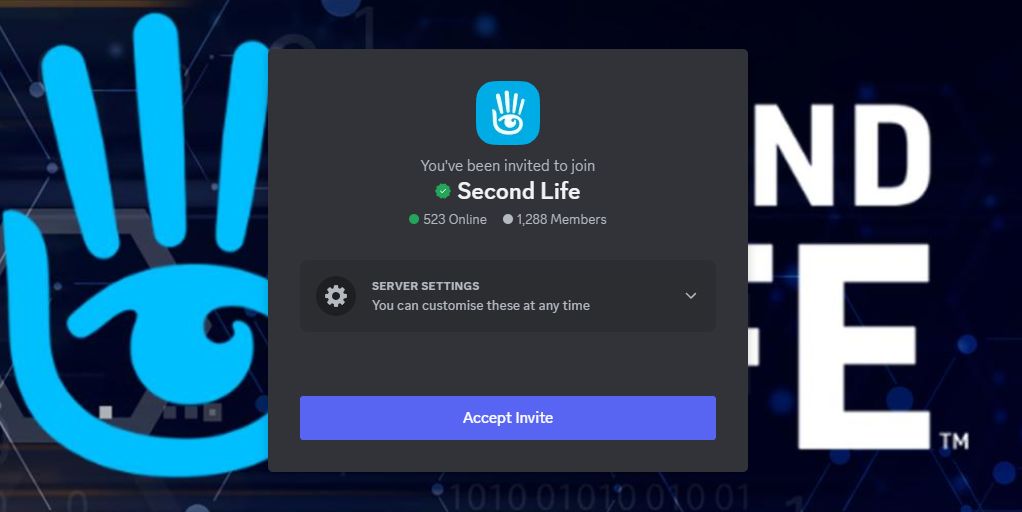
  3. You will be invited to join the Second Life Discord Server.
Accept the invite to join the Second Life Discord Server
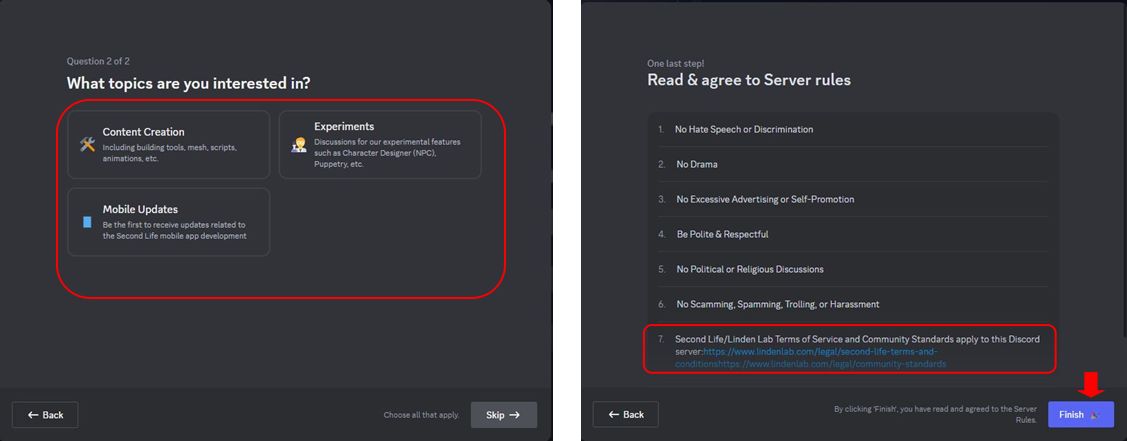
  1. Specify (or skip for now):
    • Your preferred language.
    • Your Second Life interests (you can select some / all of the available options).
Joining the Second Life Discord Server: interest options selection and rules and requirements pop-up
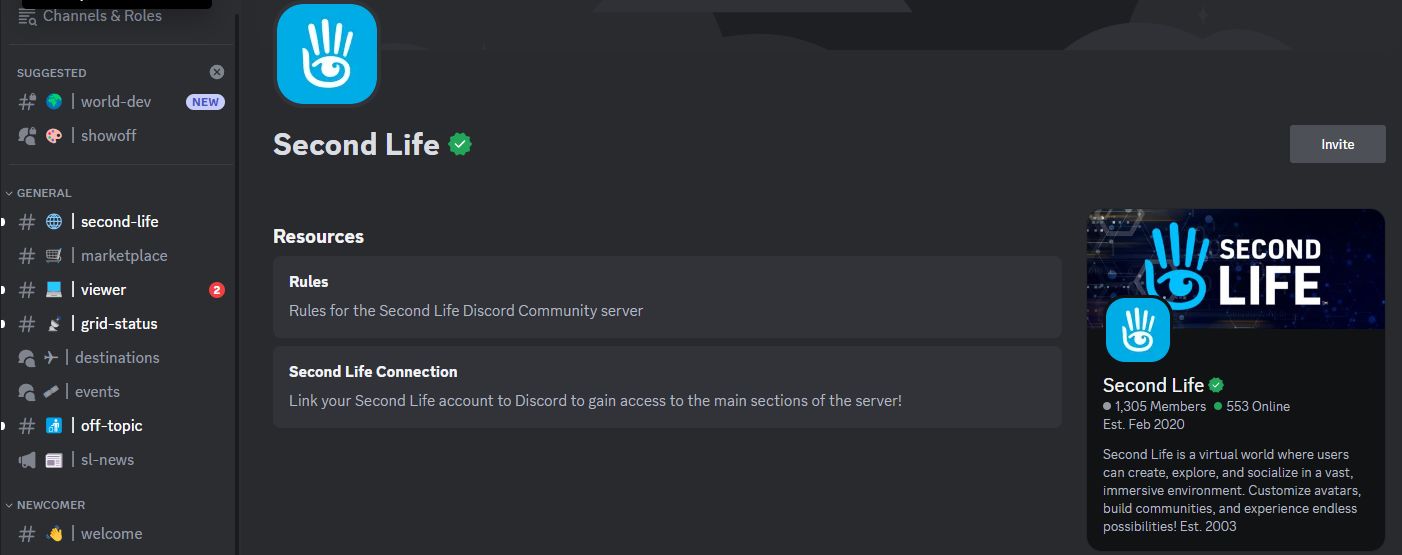
  1. Access the server on clicking Finish.
The Second Life Discord Server

Linking Your Second Life Account with Discord

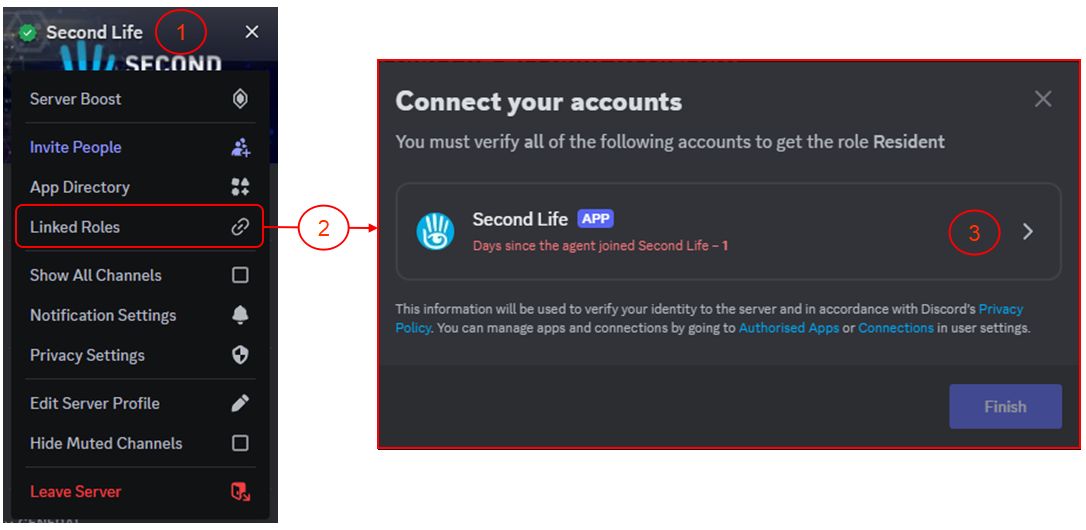
  1. Click on the Second Life Server name in the top left corner of the Discord window to open a drop-down menu.
  2. Click on Linked Roles in the menu to open the Connect Your Accounts pop-up.
Linking your Second Life account to your Discord account (1)
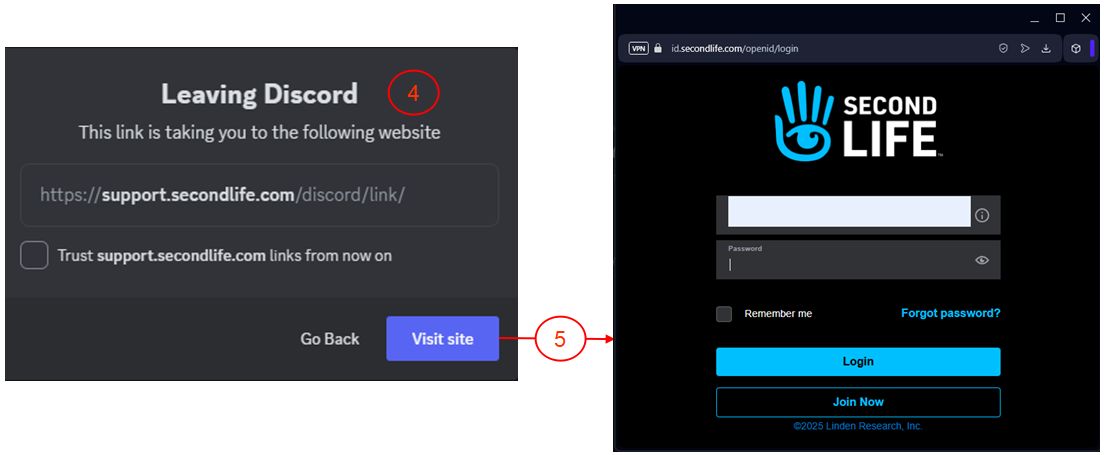
  1. Click on the Second Life APP link.
  2. A pop-up will be displayed indicating you are leaving the Second Life Discord Server using the link support-dot-secondlife-dot-com with the option to trust the link which you can optionally check.
  3. Click on Visit Site to open a pop-up with the Second Life web log-in (and note the URL at the top of the pop-up to ensure it is genuine).
Linking your Second Life account to your Discord account (2)
  1. Enter your Second Life log-in credentials (note: if you use MFA, you might be asked to provide an authenticator  Token).
  2. You will be asked to authorize linking your Discord account with your Second Life account – note you must scroll down the request in order for the Authorise button to activate.
  3. A message is displayed, indicating the link has been successful, and you can close the pop-up.
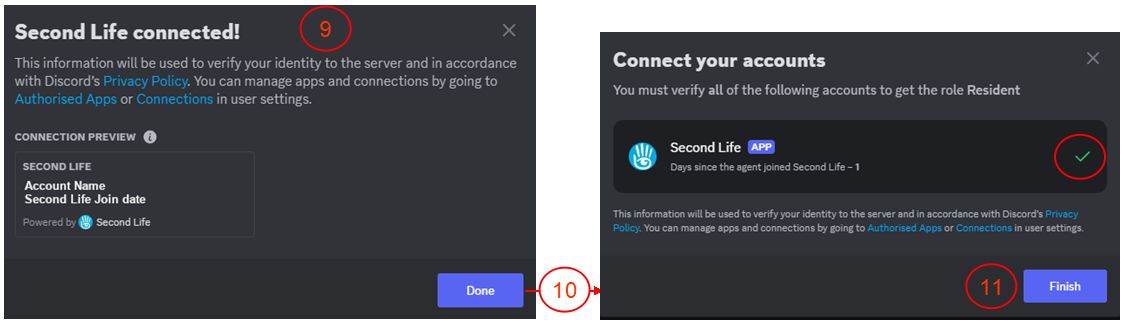
  4. A further pop-up will be displayed, confirming the connection is successful, as well as containing additional useful links.
  5. When you have finished with this pop-up, click Done to be taken back to the Connect Your Accounts pop-up, which has been updated with a tick to indicate the connection.
  6. Click Finish to close the connection.
Linking your Second Life account to your Discord account (3)

Unlinking your Accounts

To Unlink your accounts:

  • Make sure Show All Channels is checked in the Server drop-down menu.
  • Click on sl-connection under the Resources heading in the left side channel list.
  • Scroll to the bottom of the page and the section How to Disconnect Your Second Life Account from Discord.
  • Click on the specified URL to unlink your accounts.
  • The accounts will be unlinked and a message displayed (in a new browser tab if accessing Discord via your browser) indicating your Discord and Second Life accounts have been unlinked.