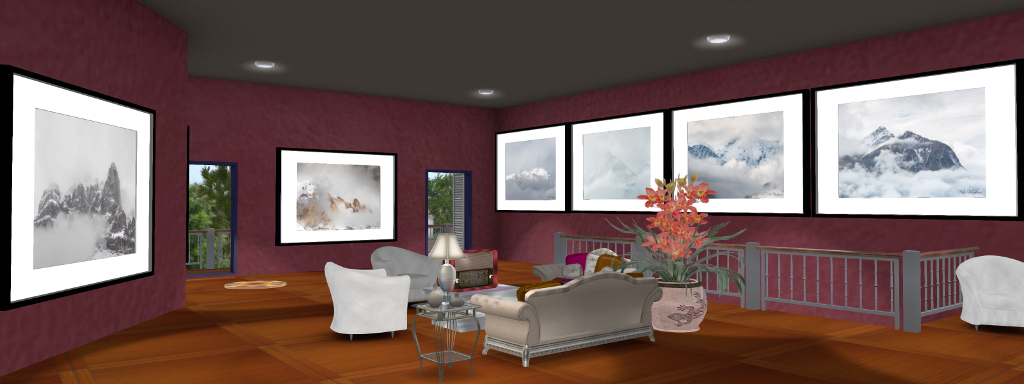
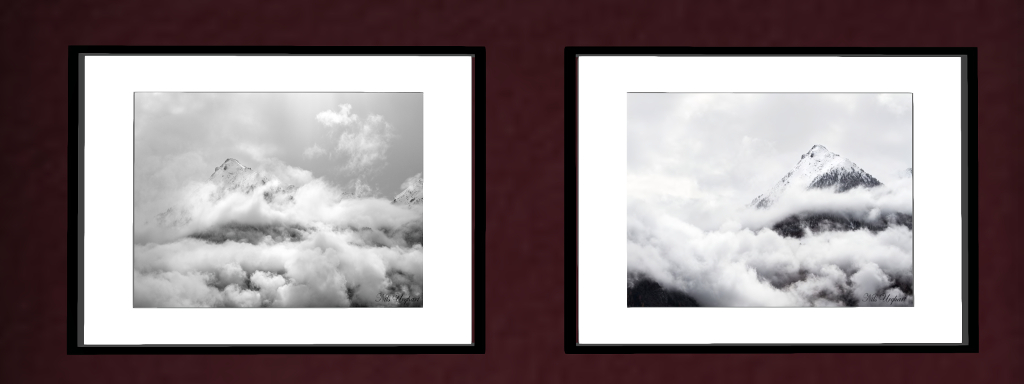
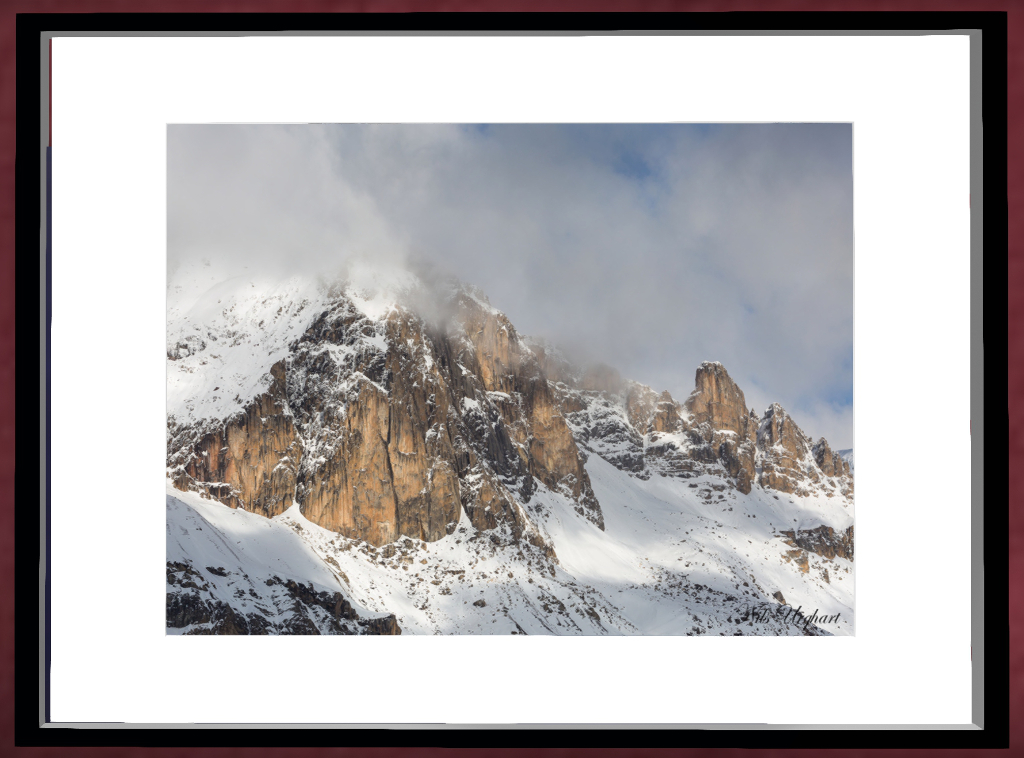
Currently open at his Rill’Arts Gallery is In the Clouds, a series of stunning physical world images by Nils Urqhart of the French Alps either caught within, or against the backdrop of, cloud-laden skies.
Across just shy of thirty images, Nils paints a stunning portrait of the Alps – which forms one of the world’s stunning mountain ranging – that fully captures their intensely rugged, almost romantic, looks, and does so in a completely beguiling manner.
In the Clouds, Nils Urqhart
By presenting the Alps – slopes and peaks, capped by snow or naked – Nils has created a series of images that not only suggest the mountains are almost living, breathing entities, but that they are entirely otherworldly in their nature.
In the Clouds, Nils Urqhart
For example, in some, they seem to float as islands in the sky, breakers of clouds rolling against their flanks as they seem to float on a sea of white and grey. In others we are offered small glimpses of what life among mountains like this – to look out over forest coated rocky slopes whilst also overlooked in turn by the towering, stern presence of these huge rugged faces.
One of the fascinating elements of this exhibition from my perspective is the aforementioned sense of life given to the Alps through the sometimes rolling, roiling set of the clouds around them. In numerous shots, this play of cloud caught on turbulent winds colliding against the sides of the mountains not only looks like that vast ocean breaking upon the flanks of an island, but also the longs exhales of breath from the mountains themselves.
As always with Nils’ photography, this is a marvellous collection of images that are perfectly presented. Those taken by Nils’ work can also find it available for sale in the physical world through American Fine Arts.
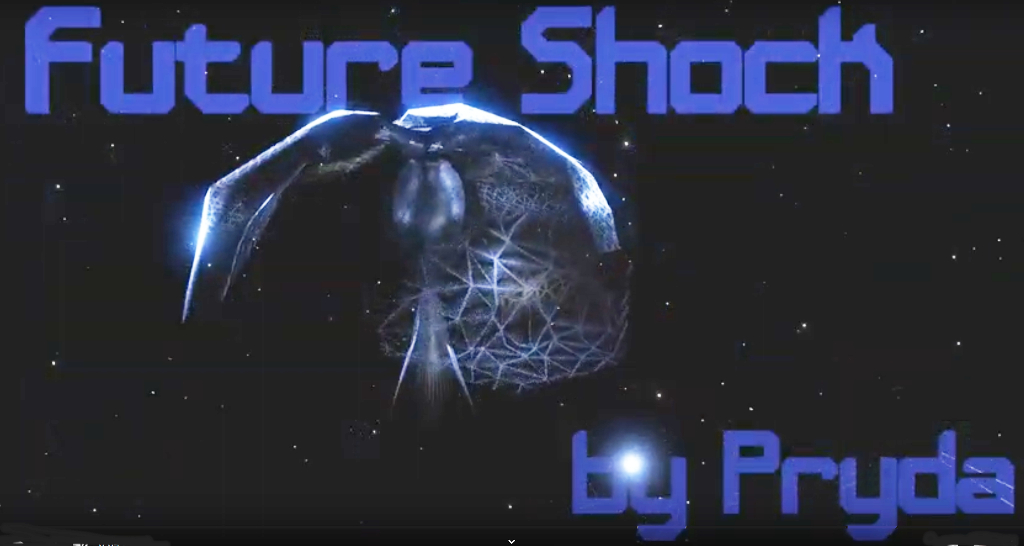
I first wrote aboutFuture Shock, an ambitious Second Life Machinima series produced by Pryda Parx, in September 2016, when the first part in the series was released, and then revisited the project at the start of 2017.
Since then, the series has grown through a second season, and Pryda has edited the episodes on both together into two special Director’s Cut versions, the first running to just over 23 minutes and the second to a touch over 32 minutes (see Future Shock: the machinima continues, for more on both the Director’s Cuts and the second season).
Now, through November and December 2019, the third and final season of the series is being made available for viewing through Pryda’s You Tube channel.
Future Shock is perhaps one of the most ambitious machinima activities to be attempted in Second Life, a 25-episode story arc split across three seasons of episodes (8, 9 and 8 per season). Set at some point in the future, the story presents a somewhat dystopian / semi-cyberpunk world where technology infiltrates every part of people’s lives, a seemingly protective blanket for all whilst also offering the means for personal gratification and escapism through the intertwining of their physical and virtual lives.
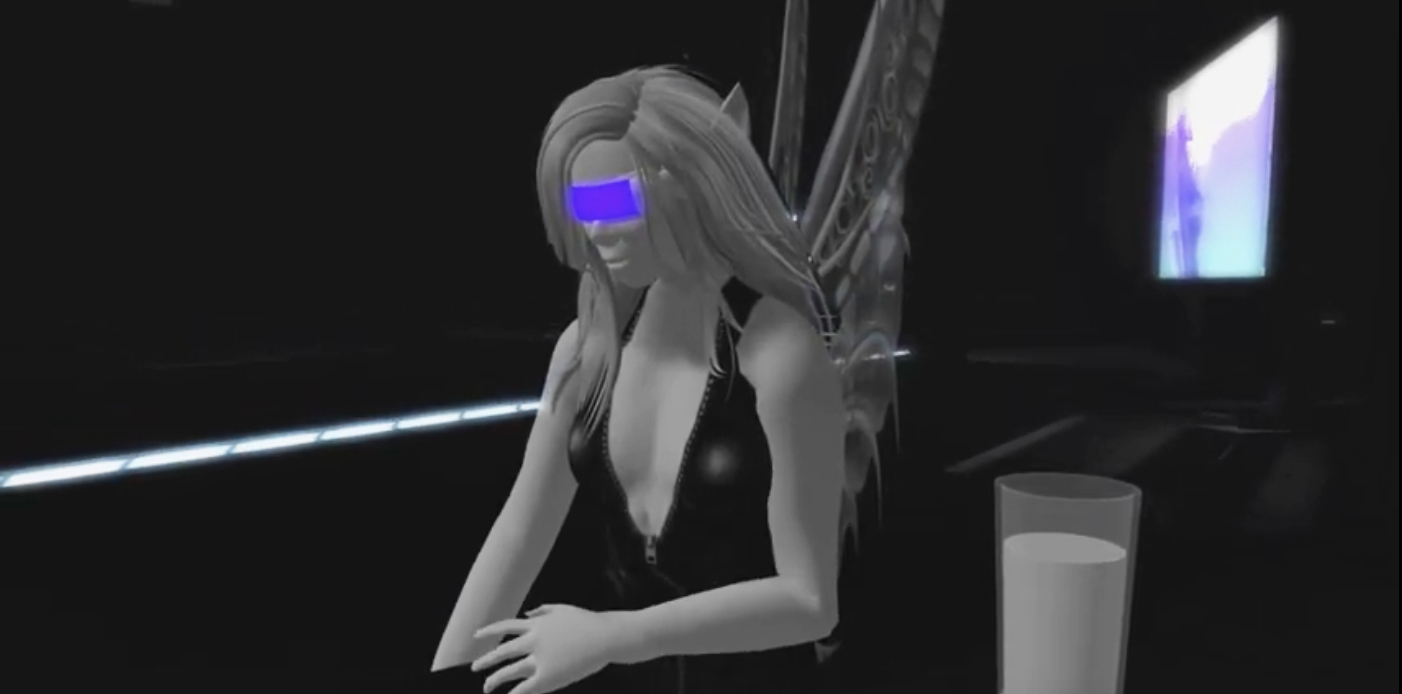
Future Shock protagonist Tracy Grayling
The latter can take the form of immersion into user-defined virtual worlds where dreams and desires are made a reality, and in the physical world, the ability for people to physically augment / redefine / rebuild their own bodies to suit their desires, in a world where everything is defined by a person’s net worth, or IP Credit (draw your own conclusions from the use of “IP”). This IP Credit can be enhanced through a variety of ways – agreeing to complete tasks that are assigned an IP value, for example.
So long as a person’s IP remains positive, then all is well. But should it decline continuously, then things can become hard; and should it zero-out completely, they can find themselves clinically and harshly dealt with. And this latter point is also the case for any who question the apparent benevolence and societal rules of the overseeing technology.
A particular point of uniqueness is the non-linear storytelling technique Pryda has used. The first season, for example, tells the story from the perspective of Tracy Grayling, dropping us into the middle of her life which appears – like the lives of so many – to be self-centred, living in this world of morally questionable ethics, in which people view their time in terms of raising themselves to the next line in a balance sheet, simply to be able to make themselves “better” physically or virtually than their peers. However, is this really so, or is she – wittingly or otherwise – an agent provocateur?
This makes the first season something of a mystery thriller: much is going on, but it’s hard to determine where it is leading. At the same time, we are drawn into the the story via Pryda’s visual technique of contrasting the “real” world, filmed in flat grey and minimal, hard colour (blue, red, white), with the promise of a virtual nirvana rich in colour. In the second season, the events witnessed by Tracy are seen from an entirely different perspective: that of those apparently fighting the controlling technology. This both adds to the depth of the underpinning mystery whilst also given greater context to the first season, making the primary arc of the core storyline clearer.
Tracy Grayling – in avatar form (r) – meets with the leader of the rebels in virtual space
With the third season, the story threads revealed in the first two seasons intertwine and draw us through a further eight episodes to the series climax.
The first part of the third season (and episode 17 overall), Brotherly Assistant is now available on You Tube. While on Thursday, November 14th, there will be a special in-world showing of episode 17 and the premier of episode 18, A Proposition, at the Grand Ballroom, Embrace Aphrodite Island (rated Adult), and the two episodes will be followed by a showing of the Director’s cut of the first season. All who are interested are invited to attend.
I don’t want to say too much about the third season – having been fortunate enough to be offered the chance to view it in advance – simply because I do not want to spoil it for others who have followed the first two seasons, or who wish to catch up with things by watching them now. What I will say is that throughout all three seasons, Pryda has woven a layered story that is worth watching throughout and – considering her own admission that season one was a case of “learn as you go” for her in terms of machinima making – one that demonstrates her growth as filmographer and storyteller.
Should you wish to catch up with the story, please follow the links below.
The SLS (main) channel on Tuesday, November 12th, leaving it on server release 2019-11-01T18:02:37.532376, previously deployed to an RC and comprising: internal script improvements. internal logging changes and improvements to simulator state saves, which should make rolls smoother.
On Wednesday, November 13th, there will be two RC deployments
2019-11-01T18:02:37.532376 – presumably to those RC channel servers that did not receive it in week #45.
Somewhere Else BKLYN, November 2019 – click any image for full size
Somewhere Else BKLYN is a region design that’s be getting a lot of attention of late, offering as it does one of the more unique settings for Second Life photography.
Designed by Littlesquaw and ToXxicShadow, it presents an urban setting (the name suggesting it might be drawn from Brooklyn, New York), looking across a narrow stretch of water (the East River) towards the shining towers and sky scrapers of a city’s beating heart.
Somewhere Else BKLYN, November 2019
The region – a Homestead – offers its own high-rise buildings, but these are dwarves in comparison to those across the water, and they are sa lot shabbier. They form what appears to be little more than a thoroughfare for traffic that is busily trying to get among, or coming from, the gleaming spires of the city. Two busy roads run into the scene from a single bridge that reaches out towards the city’s promise of wealth and (literally) high life, the occupants of the vehicles cramming them perhaps unaware of the place they are attempting to drive through and the fact that it has life of its own.
Perhaps they prefer not to dwell on thoughts of those living in this seedier setting that sits between plush office and outlying suburban home. Which is a shame, as there is the promise of life all around in the side streets and alleys here; even if it does form a mixed bag.
Somewhere Else BKLYN, November 2019
Down one street, for example, sits an oriental market, complete with open air food stands where meat sizzles on hotplates above naked flames and seafood broils in a broth. Elsewhere, a sign sitting atop a building, but at a distant eye-level from the roads here offers the promise of Little Italy, while flashing neon signs entice with offers of food or other distractions.
This is a place where art comes in the form of wall-covering graffiti and where age is always apparent – not just because of the grime and stains of automobile exhausts and decades of wear-and-tear on road surface, sidewalk and building, but also in the way old-style wooden advertising hoarding rub shoulders with their more modern electric counterparts.
Somewhere Else BKLYN, November 2019
It’s clear that this is also a place of commerce – the subway station is proof of that, the maw of its entrance busy with the hustle of people coming and going; but it’s also clear that this is a place past its prime and wanting a little TLC: refuse lays piled here and there, some of the streets are littered and uncared for while poverty is embodied in the lone waterfront sentinel of a bag lady’s shopping cart laden with the bric-a-bric of things she has acquired and which to her offer a meaning for life.
Packed with detail larger and small, and given life through the many characters to be found in its streets, Somewhere Else BKLYN offers an immersive environment (have your local sounds on) environment that is easy to explore and rich in opportunities of Second Life photographers.
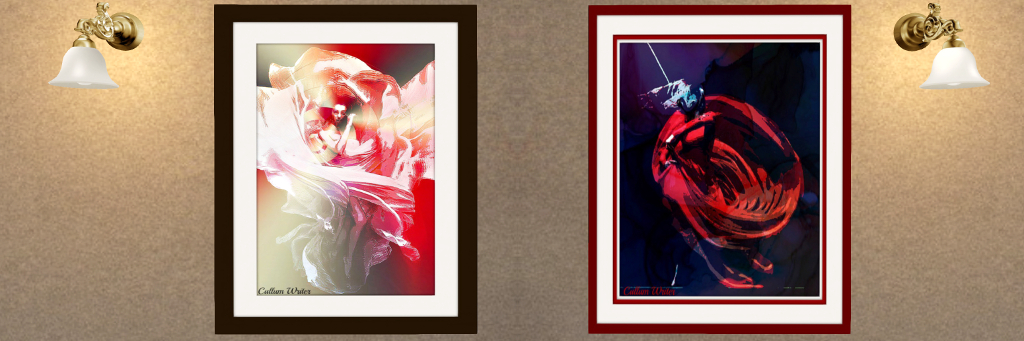
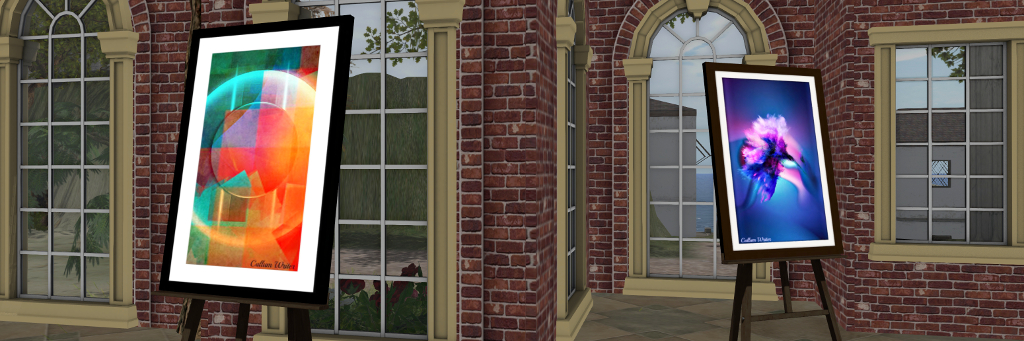
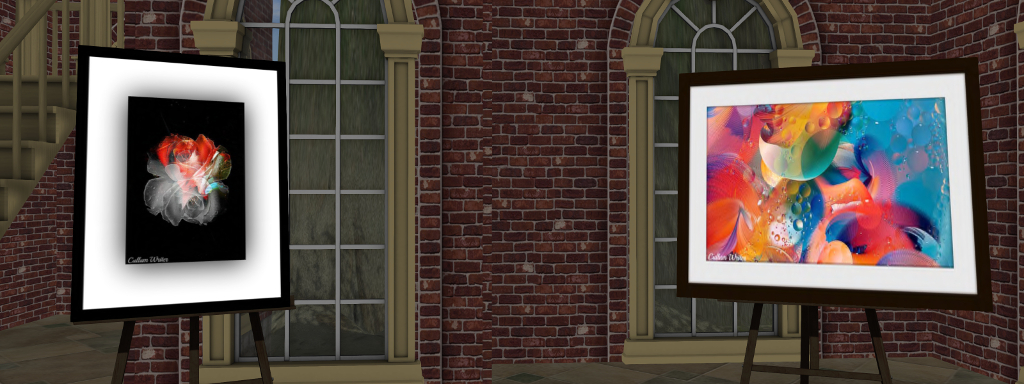
Currently open at the Boston Town Hall is Colors, an exhibition by Callum Writer, an artist I’ve come to admire for the breadth and depth of her work.
Callum found her artistic inspiration through the snapshot capability in the Second Life viewer. From this, she has worked to expand her artistic ability and expression to incorporate techniques such as fractals, collage, abstract, and mixed-media approaches. In all of this, her ability to express emotion, harmony and life through the use of colour is clearly evident, as can very clearly be seen with this exhibition.
Located on the ground floor of the town hall building, the exhibition feature 15 marvellous pieces of Callum’s work. Each and every one of them is stunning in form, colour and expression, starting with Portrait de Femme, to the left of the front entrance to the hall, and proceeding around the space on both the walls and free-standing easels.
The creativity seen in these images is stunning, making any selection of individual pieces meaningless to a degree – although I admit to being drawn in particular She and Dancers 14, alongside the aforementioned Portrait de Femme, because of the manner in which they meld colour, light, movement and life. However, it is impossible not to be taken by each and every piece on display.
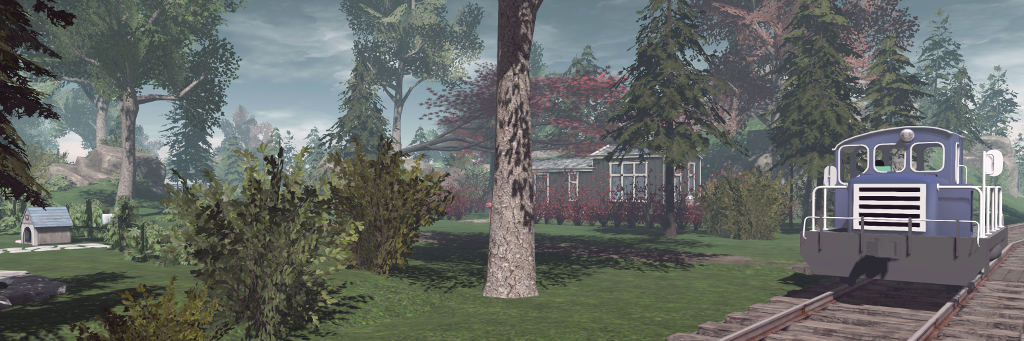
Pootling through some of the new Bellisseria continent regions by rail
It’s been a few months since I last wrote about Bellisseria, the Linden Homes continent. At that time, the trailers and campers selection of homes had just been deployed – and proven as popular as the Traditional homes and Houseboat ranges before them.
Since that time, as has been reported elsewhere, the continent has been expanded with a lot of new regions slotting into the southern side to fill out much of the “missing parts” when compared to the SSPE “test continent” used to initially develop Bellisseria’s layout.
These new regions have dropped into Bellisseria fairly close to where my houseboat is located, and I’ve tended to take the occasional look at them as things have been under development (see A little Culprit Moonwalking in Second Life, for example). However, as this a is quiet Monday, I decided to drop in to the regions at a time when I’m unlikely to get in the way of the Linden Department of Public Works (LPDW) as they continue to build-out the regions with everything from landscaping though flora and infrastructure to the Linden Homes themselves.
The new regions bring together a mix of Houseboats, Traditional houses and Trailers and Campers
The majority of the regions continue with the current themes of Traditional, Houseboat and Trailers and Campers homes. This means – on the surface – that the new regions could be dismissed as “more of the same”, but as my Monday trip through some of them – by rail and horse – shows that while they may contain the same types of houses, they have their own unique character and look.
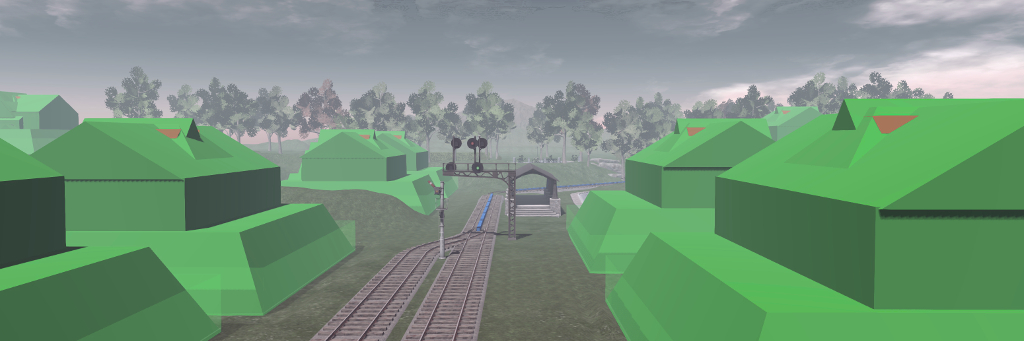
Take, for example, the Bellisseria railway. While this was introduced with the release of the Trailers and Campers, the extension to the continent illustrates it in not to be restricted to regions containing these types of Linden Home – as has been hoped would be the case. Within the new regions, the tracks pass from “camping” regions into Traditional homes regions, and back into “camping” regions once more. Along the way the tracks also branch for what I think is the first time, presenting two potential rail routes through the regions, and one of the new Traditional homes regions has markings for what might be a more substantial station than seen elsewhere (or at least one directly served by road).
The new regions see the Bellisseria rail lines extend into Traditional house regions
Given the continued popularity of the Houseboat styles, it comes as no surprise that the coastal regions offer more moorings for houseboats – some of which have already been populated. But again in what might be an interesting turn where popularity is concerned, the new regions offer an extensive reach of the camping parcels along the coast, presenting people who like the Campers and Trailers with the opportunity to enjoy coastal living, rather than being restricted to just the banks of inland waterways and lakes.
The new regions also offer the first real “blending” of Camper and Trailer regions and Traditional House regions. Until now, the boundaries of the two have tended to be denoted by water. With these new regions, the two types of Linden homes draw together more naturally, sometimes with just low mounds between them, sometimes abutting almost seamlessly.
Trailers and Campers move to being along the coast with the new regions
There are perhaps one or two little things that it would be nice to see. The rail tracks for example run through the regions, passing Campers and Trailer and houses alike running over and under bridges and through deep cuttings; but there are are no tunnels – it would be nice to see one or two in the more hilly areas.
Similarly, while the Traditional house regions and the Trailer and Camper regions do more directly abut one another, the roads of the Traditional house regions and the tracks of the Camper and Trailer regions never actually come together; rather they each end abruptly with a stretch of grass between them, it would be nice to a a more natural joining, asphalt gradually giving way to a narrower, rutted track, for example. Or at least have a fence and (open) gate between them, rather than curbstones, footpath and pristine-looking grass.




 Inara Pey: Living in a Modemworld