The Annex, Nitroglobus Roof Gallery, April 2025: Polly Reina – Just Polly
As I work to catch up on blogging – the last week or so having been focused on building-out an island home for a very dear and close friend – I’ve found I’ve a wealth of exhibitions demanding my attention. As such, I cannot promise to get to them all before they close, but I’m going to start here with a look at a first-time public exhibition for someone who have been involved in Second Life for many years, but who has only now been encouraged to display her avatar-centric photography.
As ever, that encouragement has come from Dido Haas, owner and curator of Nitroglobus Roof Gallery. Dido has a natural talent for – if not discovering, then certainly gently encouraging – artist who have never previously exhibited their work in-world to an audience of strangers to a point where they are comfortable with the idea of doing so.
The Annex, Nitroglobus Roof Gallery, April 2025: Polly Reina – Just Polly
The artist in question here is Polly Reina, at the time of writing a 17+ year veteran of Second Life. Polly has been involved in Flickr since 2010, and her photography, whilst avatar-centric, also folds into landscapes – notably of Tempura Island, where she is also an estate officer -, whilst also flowing from colour to monochrome collections and pieces and back.
With Just Polly, which is being hosted within The Annex at Nitroglobus, we have a thoroughly engaging collection of Polly’s monochrome self-studies, each one genuinely rich in narrative whilst also highly persona, offering a depth of emotions, moods and self-awareness that is utterly captivating. Whilst I could witter on at length and it, I’ll instead allow Polly to describe the collection in her own succinct words:
This exhibition is not just about capturing an image; it’s about feeling it … an intimate journey of self-representation in Second Life, translating emotions, moods, and identity into this space … where each image is a reflection of feeling, movement, and presence, brought to life … This showcase is not just about visual aesthetics but about the silent dialogue between self-perception and my expression. It’s about stepping into different versions of myself, embracing vulnerability, confidence, and the unspoken emotions woven into every image.
– Polly Reina
The Annex, Nitroglobus Roof Gallery, April 2025: Polly Reina – Just Polly
Thus, what we have here is a series of images which reveal so much through the selection of poses, camera angles and focus. Each of them carry a beautiful transposition of the thoughts, the emotions and feeling of the very real person behind the lens of the camera; a person who genuinely sees her avatar not as an expression of whom she might like to be (as can so often be the case in our relationships with our avatars) or a character intended to fulfil a role, but as an extension of who she is within the physical world.
These are piece that will fully and naturally speak to all of us who view our avatars the same way as Polly whilst at the same time offering a masterclass in photographic composition and the power of black-and-white to convey the artist’s thoughts for those who also enjoy photography from a technical as well as artistic perspective.
The Annex, Nitroglobus Roof Gallery, April 2025: Polly Reina – Just Polly
Given this, Just Polly is both personal and highly accessible – and as such, I’ll spare you any further blithering on my part here, and earnestly encourage you to pay Just Polly a visit.
Caer Awen, Cerridwen’s Cauldron, April 2025 – click any image for full size
No-one familiar with fantasy in Second Life can be unaware of Elicio Ember and his magnificent work as both a content creator and as a world-builder – notably at the annual Relay for Life in Second Life Fantasy Faire event. For over seventeen years, through his brand, Cerridwen’s Cauldron, Elicio has redefined fantasy and sci-fi landscapes, architecture, and décor in Second Life. From towering bioluminescent forests to elegant elven spires, through unique science fiction elements to modern décor amenable to any home, as well as avatar wearables, his work is synonymous with fantasy, traditions, beauty and quality.
I’ve actually covered his creations as a part of my coverage of past Fantasy Faire events, and in its own right through his store, Cerridwen’s Cauldron, which has always been an inspirational joy to visit. And it is to the store I returned recently, as Elicio invited me to partake of a new chapter in his creativity, as he prepares to formally open it in a brand new iteration at a new location on April 10th, 2025. As with his past store, it will be part of a wider narrative through the provision of a ground-level realm; however at the time of writing this piece, the latter was still in development – and as such, will be subject to a future article. Together, both store and ground-level setting will form Caer Awen.
Caer Awen, Cerridwen’s Cauldron, April 2025
To appreciate Cerridwen’s Cauldron to the fullest, it is necessary to dip into Celtic – and particularly Middle Welsh – mythology.
Cerridwen (or indeed, Ceridwen), pronounced Ke-RID-wen, not seer-ID-when or any variation thereof, was an enchantress closely tied to the Llyfr Taliesin (Book of Taliesen) and in some tales to the birth of Taliesen himself, and most particularly for giving birth to the beautiful Creirwy, one of the three most beautiful maids of the Isle of Britain, and her hideous brother, Morfan (literally “sea crow”), who is tied to the Arthurian legend. To compensate for her son’s hideous and dark form, Cerridwen sought to imbue him with great wisdom and poetic inspiration, turning to her magic cauldron in order to do so.
Caer Awen, Cerridwen’s Cauldron, April 2025
That cauldron contained Awen, the inspiration; the breath (or muse) gifted to poets, bards, artists and musicians, and itself born of the three elements of rebirth, transformation, and inspiration (which, quite outside the scope of discussion here, ripple out towards ides of the Holy Trinity), and which also marked Cerridwen as the pagan goddess of said elements.
Caer (Kair), meanwhile, also has Old Welsh roots, symbolising a fort of stronghold. It can also be used to indicate a citadel, and it is this connotation that is found within Caer Awen – meaning Citadel of Inspiration – and the name suits the new build perfectly.
Caer Awen, Cerridwen’s Cauldron, April 2025
Like previous Cerridwen’s Cauldron builds, it sits within the sky as a realm unto itself. As a store, it is laid on around the four cardinal points, each corresponding to an element: North = Earth; East = Fire; South = Air and West = Water, and Elicio’s creations are gathered (with some nods towards convenience) in respect of these elements. So, for example, water plants and underwater items can be found within Water, whilst land plants in Earth, and so on. Each section is clearly signed, as are the aisles within it, the entire layout intended to encourage creative thinking as one explores Elicio’s work.
Around the outer extremes of the store areas setting out some of the items for sale as dioramas. These might both further inspire and offer little tales of their own. Footpaths are clearly laid out, whilst individual items for sale are beautifully displayed, rather than just shown as images on a vendor, thus allowing visitors to fully appreciate the and – again – feel the breath of inspiration as to how and where they might be used.
Caer Awen, Cerridwen’s Cauldron, April 2025
Central to all of this is the Citadel itself, comprising a central circular structure rising into the sky and with the Landing Point at its base level. It is surrounded to the North-East, South-East, South-West and Nort-West by four square-based towers. These occupy plazas which in turn sit between two cardinal elements apiece, allowing the themes from the two elemental areas to flow together, watched over by corner-placed spires.
Rising higher than the domes topping the central structure, the four towers each reflect one of the guiding cardinal elements. Nor do they stand alone; they are connected one to the next by graceful skywalks with elegant crystalline forms, with high balconies, while glass-floored walkways connect them to the central tower. Within each of them long stairways gracefully climb their inner walls, passing by their balconies to reach the upper skywalk and thus providing access to the upper reaches of the central tower.
Caer Awen, Cerridwen’s Cauldron, April 2025
It is within this upper level that Cerridwen’s Cauldron will host events – starting with the formal opening party on Sunday, April 13th commencing at 18:00 SLT. Called the Celestial Fae Court, this space is the social beating heart to Caer Awen’s stunning beauty, replete as it is with more of Elicio’s creations.
But in all honesty, words are not enough to describe anything here; the new Cerridwen’s Cauldron store is more than a place to visit (and make purchases!); it is a place to be tasted and savoured first-hand. The build itself is utterly magnificent, with detail throughout that captures the eye and wraps itself around and over areas that might not ordinarily be seen – so free-camming is recommended. It is also a place that, conversely, should be navigated in first person if possible, thus allowing its beauty to unfold and blossom whilst following paths, turning corners and climbing stairways.
Caer Awen, Cerridwen’s Cauldron, April 2025
It is also a place that should be seen using the Shared Environment and with local sounds on for the fullest experience. Sounds change not just in the different elemental areas, but also with a passage of time from day to night. And the arrival or night brings its own beauty as glow and colour spring from plants and garden and crystals, adding further immersion to a setting already so rich and detailed.
As noted, the formal party for the opening is on April 13th, but the store should be available to the public from April 10th. I highly recommend that should you arrive during the region’s daylight hours, you stay until night arrives (the region follows the standard 4-hour day / night cycle, with three hours daylight and one hour of night) – or make a point of returning to see it during the hours of darkness – you will not be disappointed.
Caer Awen, Cerridwen’s Cauldron, April 2025
Do be sure to visit and immerse yourself in Elicio’s creativity and vision, and I’ll be back with more as the ground level setting opens up later in the year.
The following notes were taken from the Tuesday, April 8th, 2025 Simulator User Group (SUG) meeting. They form a summary of the items discussed, and are not intended to be a full transcript, and were taken from my chat log of the meeting and Pantera’s video, embedded at the end of this piece.
Meeting Overview
The Simulator User Group (also referred to by its older name of Server User Group) exists to provide an opportunity for discussion about simulator technology, bugs, and feature ideas.
Meetings are open to anyone with a concern / interest in the above topics, and form one of a series of regular / semi-regular User Group meetings conducted by Linden Lab.
Dates and times of all current meetings can be found on the Second Life Public Calendar, and descriptions of meetings are defined on the SL wiki.
Simulator Deployments
This week will see all channel restarted without and deployments.
Upcoming Deployment
This next simulator update will be called Elderberry. Among other things, this should include:
A new option to llDerezObject – DEREZ_TO_INVENTORY, which returns the targeted object to inventory and saves its current state (e.g. has the same behaviour as Build → Object → Save Back to Object Contents.
llIsLinkGLTFMaterial – which can can determine if a face on a linked prim is PBR.
REZFLAG_DIE_ON_NO_REZZER – which will cause a rezzed prim to die if its rezzer is no longer present in the region.
llSetAlpha will have a caveat: if alpha is set to >0.85, it will switch the overrides to opaque; setting under that value sets them to blend.
This is because there seem to be some serious rendering issues with blend mode and an alpha near 1, per this image. Rider Linden added:
Also. It bears repeating… since I forgot. BP colours (what you set with llSetColor) are in sRGB space. PBR is linear. I’m doing the conversion internally so it should be the same colour in both cases.
SL Viewer Updates
Default viewer: 7.1.12.13550888671, formerly the ForeverFPS, dated March 1, 2025, promoted March 5th – No change – crash and performance fixes; Water exclusion surfaces and water improvements.
Second Life Release Candidate viewer 2025.03 version 7.1.13.14174767759, April 2nd.
New UI element for water exclusion surfaces: Build / Edit floater → Texture Tab → Hide Water checkbox.
The maximum amount of Reflection Probes can now be adjusted to better accommodate low VRAM scenarios.
Values will be set automatically depending on your chosen graphics quality. OR
Use Preferences → Graphics → Advanced Settings → Max. Reflection Probes to manually set.
An issue with being unable to see Sky Altitude values in the Region/Estate window has now been resolved.
Preferences → Graphics → Max. # of Non-Imposters has been renamed Max. # of Animated Avatars for clarity.
Bug and performance fixes and memory optimisations.
Second Life Project Lua Editor Alpha, version 7.1.12.13907344519, April 2nd.
Please refer to the the video for details on the following.
A request was made to have changes to releases on the SLua test regions on Aditi added to the release notes mechanism so that those using the regions can see when / why things are going to change or are going to change.
This is going to be looked into. In the interim, Rider Linden is going to try to to provide notification of updates to the Second Life Discord server.
World → Show → Land Owners has been broken since the release of PBR such that all owners, regardless of type are only shown as red, rather than in different colours based on ownership (see Land owners colour).
A status update was requested for work on providing a means to ease issues of ban line collisions and vehicle loss, and having the simulator provide more timely information on parcel access permissions before a vehicle is on top of a parcel in which access is denied for the avatars riding it.
This is something Rider Linden is hoping to get to in the simulator release after Elderberry).
The discussion broadened through the when and how the simulator should provide parcel information to the viewer – e.g. in general or on demand, and what information could be provided, having a mandated delay on security systems on the Mainland to prevent the enter parcel / immediate teleport / ejection situation.
Still no news on when the Mainland legacy EEP setting (now seen as dim and murky post PBR deployment), although it is believed the Moles are working on Mainland region settings.
† The header images included in these summaries are not intended to represent anything discussed at the meetings; they are simply here to avoid a repeated image of a rooftop of people every week. They are taken from my list of region visits, with a link to the post for those interested.
Logos representative only and should not be seen as an endorsement / preference / recommendation
Updates from the week through to Sunday, April 6th, 2025
This summary is generally published every Monday, and is a list of SL viewer / client releases (official and TPV) made during the previous week. When reading it, please note:
It is based on my Current Viewer Releases Page, a list of all Second Life viewers and clients that are in popular use (and of which I am aware), and which are recognised as adhering to the TPV Policy. This page includes comprehensive links to download pages, blog notes, release notes, etc., as well as links to any / all reviews of specific viewers / clients made within this blog.
By its nature, this summary presented here will always be in arrears, please refer to the Current Viewer Release Page for more up-to-date information.
Note that for purposes of length, TPV test viewers, preview / beta viewers / nightly builds are generally not recorded in these summaries.
Official LL Viewers
Default viewer: 7.1.12.13550888671, formerly the ForeverFPS, dated March 1, 2025, promoted March 5th – No change.
Numerous crash and performance fixes.
Water exclusion surfaces.
Water improvements.
Second Life Release Candidate viewer 2025.03 version 7.1.13.14174767759, April 2nd – NEW.
New UI element for water exclusion surfaces: Build / Edit floater → Texture Tab → Hide Water checkbox.
The maximum amount of Reflection Probes can now be adjusted to better accommodate low VRAM scenarios.
Values will be set automatically depending on your chosen graphics quality. OR
Use Preferences → Graphics → Advanced Settings → Max. Reflection Probes to manually set.
An issue with being unable to see Sky Altitude values in the Region/Estate window has now been resolved.
Preferences → Graphics → Max. # of Non-Imposters has been renamed Max. # of Animated Avatars for clarity.
Bug and performance fixes and memory optimisations.
Second Life Project Lua Editor Alpha, version 7.1.12.14175675593, April 2nd, 2025 – NEW.
TheNest: Sunbird Featherwish, April 2025 – click any image for full size
In May 2024, I visited TheNest: Sunbird, a Full region design leveraging the available Land Capacity bonus, brought together by Second Life partners Adam Cayden and Lya Seerose with the assistance of Tessa (Tessalie). Offering a mix of public spaces and private rental properties, I found the setting photogenic and engaging (see: A Sunbird’s Nest in Second Life).
Since then, a year has come and gone, and Lya and Adam have most recently been engaged in re-working the public spaces within the setting, and they extended an invitation to me to hop back to the region – now called TheNest: Sunbird Featherwish – and have a wander.
TheNest: Sunbird Featherwish, April 2025
Visit our serene town nestled in the mountains. Enjoy the peaceful streets and their enchanting views, explore our cosy rentals, and marvel at the natural beauty surrounding you, from the smallest blossom to the tallest tree. Come immerse yourself to the tranquillity of a rural paradise, where every corner is alive with the vibrant colours and scents of spring.
– Adam Cayden writing about TheNest : Sunbird Featherwish About Land
The broad design of the region remains as it was during my May 204 visit: the lowland areas open to the public, gradually climbing back to the highlands where the private rentals sit, all nice and clearly separated from the public areas to help avoid accidental trespass.
TheNest: Sunbird Featherwish, April 2025
Within this design, the township presented at the time of my previous visit has been beautifully supplanted by a location rolling multiple ideas and themes together to present a genuinely delightful sense of small village /town intimacy which could so easily be found almost anywhere in Europe.
As with the previous iteration of the setting, the village / town is pedestrianised – but that’s as far as the similarities go. Now split between elevations linked by broad cobbled footpaths and sweeping steps and stairways, the town presents at its lower extremities access to a cosy beach with the local tram station sitting alongside it. From here, the steps rise under the arches of a high bridge buttressed at either end by hexagonal towers topped by small formal garden / sitting spaces.
TheNest: Sunbird Featherwish, April 2025
Continuing up the steps and under the bridge brings visitors to a local ice cream parlour and its outdoor seating overlooking the tramway below, as the tracks departs the station to pass overland along the edge of of the region before vanishing into a tunnel. Also across from the ice cream parlour sits a little bakery offering treats and its own outdoor seating area, this overlooking small gorge fed by tumbling falls with open meadowlands beyond.
Between ice cream parlour and bakery, the path rises and sweeps past the local tea house, then rises again to arrive at the village / town square – or rather, circle! Here there is so much to see – as there is on the way up (including the local feline welcome committee tucked away and keeping an eye on things), so time dallying and exploring is recommended.
TheNest: Sunbird Featherwish, April 2025
From the town it is possible to join the country walk as it arcs around the woodlands directly below the private rentals sitting up on their clifftop perches offering grand views of all that les below. This path eventually descends down to the meadowlands mentioned above, and which themselves can be reached from one end of the bridge also previously mentioned.
However, my descriptions of the setting are beside the point: such is the love and care that has been poured into the region, a visit is mandatory by anyone appreciating SL region designs. The detail is simply exquisite throughout – from the cats watching over things and all the easily-missed details tucked into some of the public buildings and in the little alleys and gaps between some of them, to the details scatter along the countryside pathways and trails parks and walks. Throughout everything, there are multiple paces to sit and pass the time and several romantic little points for people to enjoy.
TheNest: Sunbird Featherwish, April 2025
Perhaps the best way to appreciate the setting is to click the Scenic Route sign at the Landing Point and take the teleport down to the tram station. From here, you can work your way up through the town much as I have described – but with the option of turning left on climbing the steps up from the ice cream parlour, then following the signed path around to one of the hexagonal towers and then over the bridge. Just be sure that, whichever route you choose – up through the town or over the bridge to the meadowlands, take your time and keep your eyes open lest you miss something along the way!
A genuine delight to visit – and if you’re looking for a home it SL, it might just be the place to tickle your fancy. either way, why not take a look for yourself?
Crew Dragon Resilience splashes down of the coast of California at the end of the 4-day FRAM2 mission. Credit: SpaceX
Previewed in my previous Space Sunday update, the FRAM2 mission lifted-off almost precisely on time from Kennedy Space Centre’s Launch Complex 39A at 01:46:50 UTC on April 1st, carrying the first humans to ever orbit the Earth in a low-Earth polar orbit.
The ascent to orbit, travelling south from the space centre, proceeded smoothly, the SpaceX Crew Dragon capsule and service module (“Trunk” in SpaceX parlance) entering a low Earth orbit with an apogee of 413 km and a perigee of 202 km some eight minutes after launch. The orbit, referred to as a polar retrograde, due to the fact the vehicle travelled first over the South Pole then around and over the North Pole, lay at an inclination of 90.01°, breaking the previous high inclination orbit record for a crewed space vehicle set by Vostok 6 in 1963.
Aboard the vehicle were Chinese-born, but Maltese citizen and crypto currency entrepreneur Chung Wang, who will be the mission’s commander and is a co-bankroller of the flight; Jannicke Mikkelsen, a Scottish-born Norwegian cinematographer and a pioneer of VR cinematography, 3D animation and augmented reality, who is the other co-bankroller for the flight; Eric Philips, a 62-year-old noted Australian polar explorer, who will be the first “fully” Australian national to fly in space, and Rabea Rogge, a German electrical engineer and robotic expert.
The 4-day mission comprised an extensive science programme, focusing on human health in space, growing food supplements on-orbit (oyster mushrooms) and investigating the Phenomena known as STEVE (see my last Space Sunday update) from orbit. The mission also included educational broadcasts to schools and a lot of social media-posted videos.
A video of Antarctica recorded by the FRAM2 crew. Seen in the footage is videographer Jannicke Mikkelsen, and the voice-over is from Eric Philips
To assist in observations and measurements, Resilience was fitted with the transparent Copula to replace the outer airlock hatch and docking mechanism within the forward end of the capsule, affording the crew near-360º views of Earth once the vehicle’s protective nose cone had been opened.
The launch itself required a complete update of the Crew Dragon navigation software, originally written for lower 51º inclination orbits. This included a complete overhaul of the launch abort software for both capsule and launch vehicle. The latter was made necessary by the fact the ascent to orbit carried the vehicle over parts of South America, so any abort situation had to ensure that both booster and capsule would not return to Earth over land, and the capsule would be able to splashdown safely with the crew.
What really marked this mission, however, was the sheer transparency of operations; nothing in the video logs was pre-scripted or rehearsed; camera were rolling with conversations going on in the background – including conversations between crew members and SpaceX mission control about “known issue” with the space vehicle (not sure how significant – but being told that there is a “known issue” with a vehicle when you’re sitting in it in space might not be the most comforting thing to hear!), informal chit-chat during observations and an introduction to the fifth “crew member”, Tyler.
A compilation video of the mission, including shot through the inner hatch of the airlock showing Earth beyond the Copula. Note the inner hatch could also be opened to allow crew to enter the forward are and look out of the Cupola
While the mission had a lot of science goals – including testing a portable MRI unit, carrying out x-rays of the human body, studies into blood and bone health and glucose regulation in the body in micro-gravity – it has not stopped criticism being levelled at it, with some scientists stating the period spent in space being too short to yield practical results in some areas, and other aspects of the mission being labelled “a notch above a gimmick”.
For Chung, Mikkelsen and Philips in particular, however, the mission was as much personal as scientific: they have spent fair portions of their adult lives exploring the Polar regions, carrying out studies and research (the four all actually met during an expedition to Svalbard (leading them to nickname the mission “Svalbard 1”).
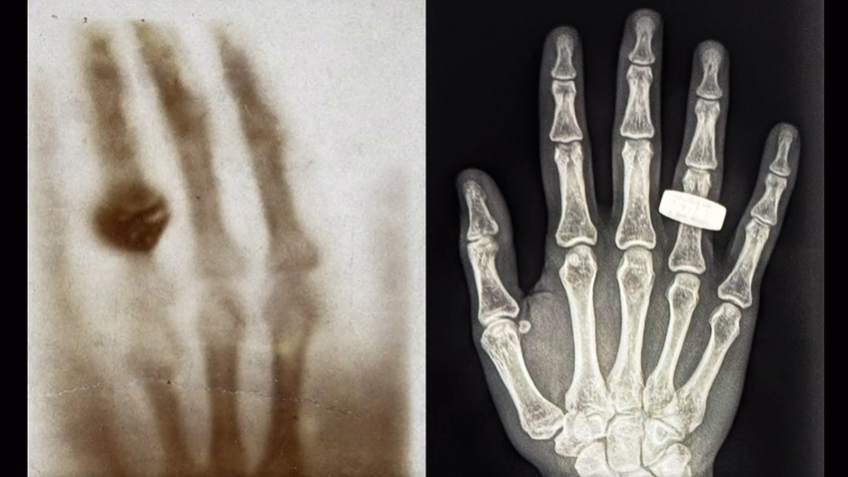
The first ever x-ray of a human hand taken in space (right) during tests of a small x-ray unit aboard the FRAM2 mission. The hand (with ring) was used in homage to the first ever x-ray of a human, captured by Wilhelm Conrad Röntgen (of his wife’s hand) in 1895 (l). Credits: Wilhelm Conrad Röntgen; FRAM2 / SpaceX
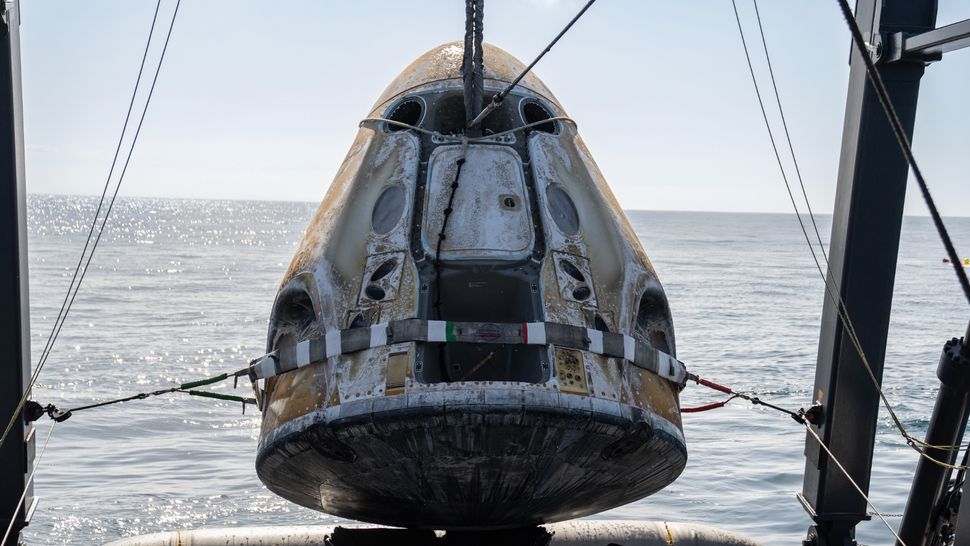
FRAM2 came to an end on April 4th, 2025, when, following an extended de-orbit, the combined vehicle re-entered the atmosphere and headed for a splashdown off the California coast where the SpaceX recovery ship was waiting for the vehicle. This marked the first splashdown for Crew Dragon off the west coast of the USA – although more will be following.
SpaceX has been criticised for the fact that during several missions returning crews from the International Space Station, the “Trunk” service module has in part survived re-entry, with elements coming down very close to populated areas. To avoid this, the company is moving crewed splashdowns to the west coast of the USA in order to ensure that should any parts of the Trunk survive re-entry they will splashdown in the Pacific Ocean.
As a test of this, the module used by Resilience remained attached to the vehicle for longer during the initial re-entry operations, in order to ensure that if any part of it did survive the heat of re-entry, the debris would fall to Earth over Point Nemo – the remotest part of the Pacific Ocean relative to human habitation, and referred to as the “spacecraft graveyard”.
A re-entry seared Resilience is lifted aboard the SpaceX recovery vessel in preparation for crew egress. Credit: SpaceX
Splashdown occurred at 19:28 UTC on April 4th, with the capsule and crew safely recovered to the SpaceX recovery vehicle for transport to the port of Los Angeles.
NASA Opens-Out Requirements for Private Missions to the ISS
NASA has announced it is seeking proposal for two further private astronaut missions (PAMs) to be conducted to the ISS – and for the first time, the requirement that such missions must be commanded by former NASA astronaut has been removed.
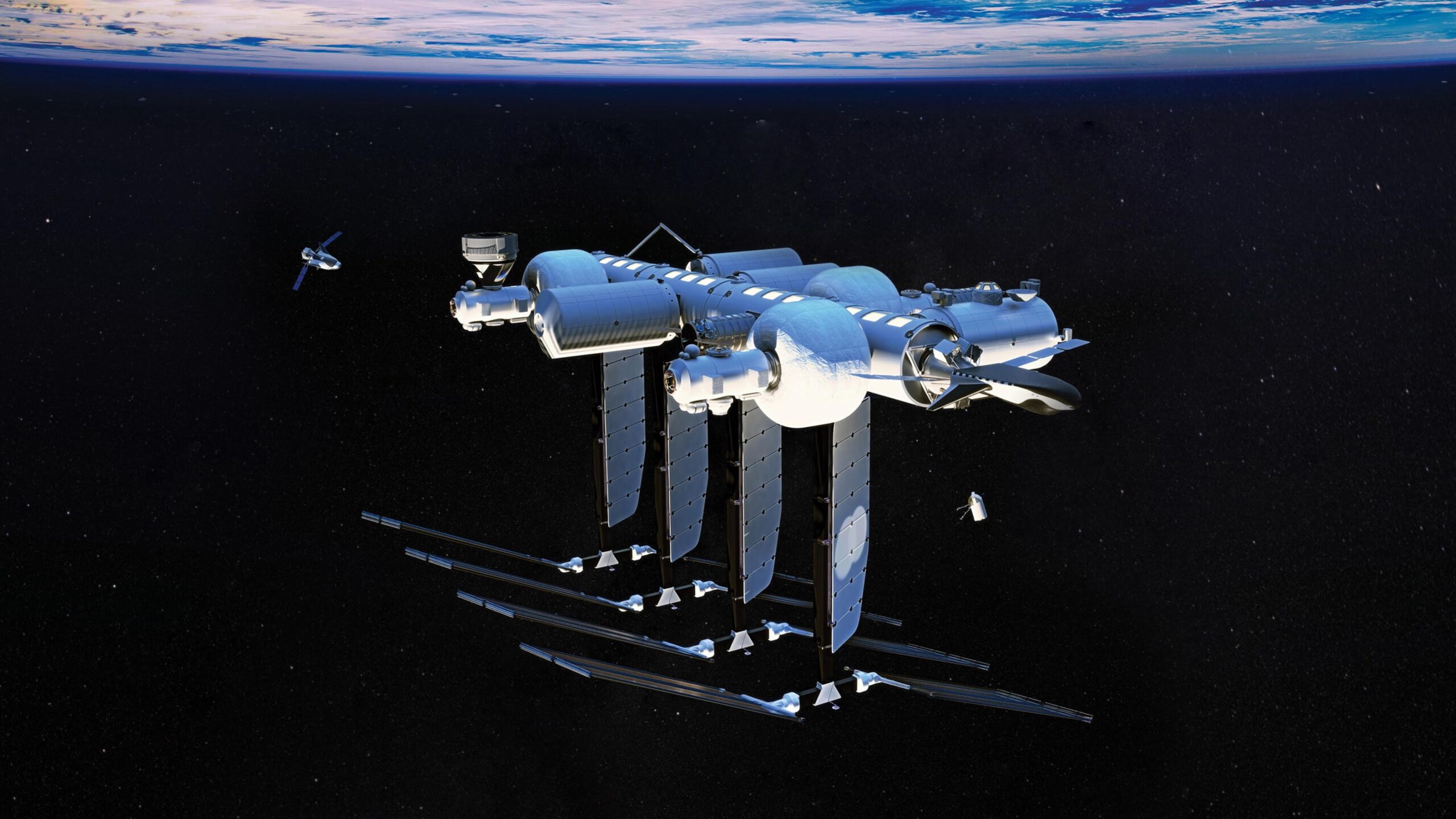
The agency is planning to pivot away from the International Space Station (ISS) operations as it nears its end-of-life (some of the Russian elements of the station are already well outside their “warranty” – that is, their intended lifespan), with the hope that the private sector will take over low-Earth orbit research and station operations. Currently, there are a number of proposals for doing so – perhaps most notably Axiom Space and the orbital Reef consortium led by Blue Origin and Sierra Space.
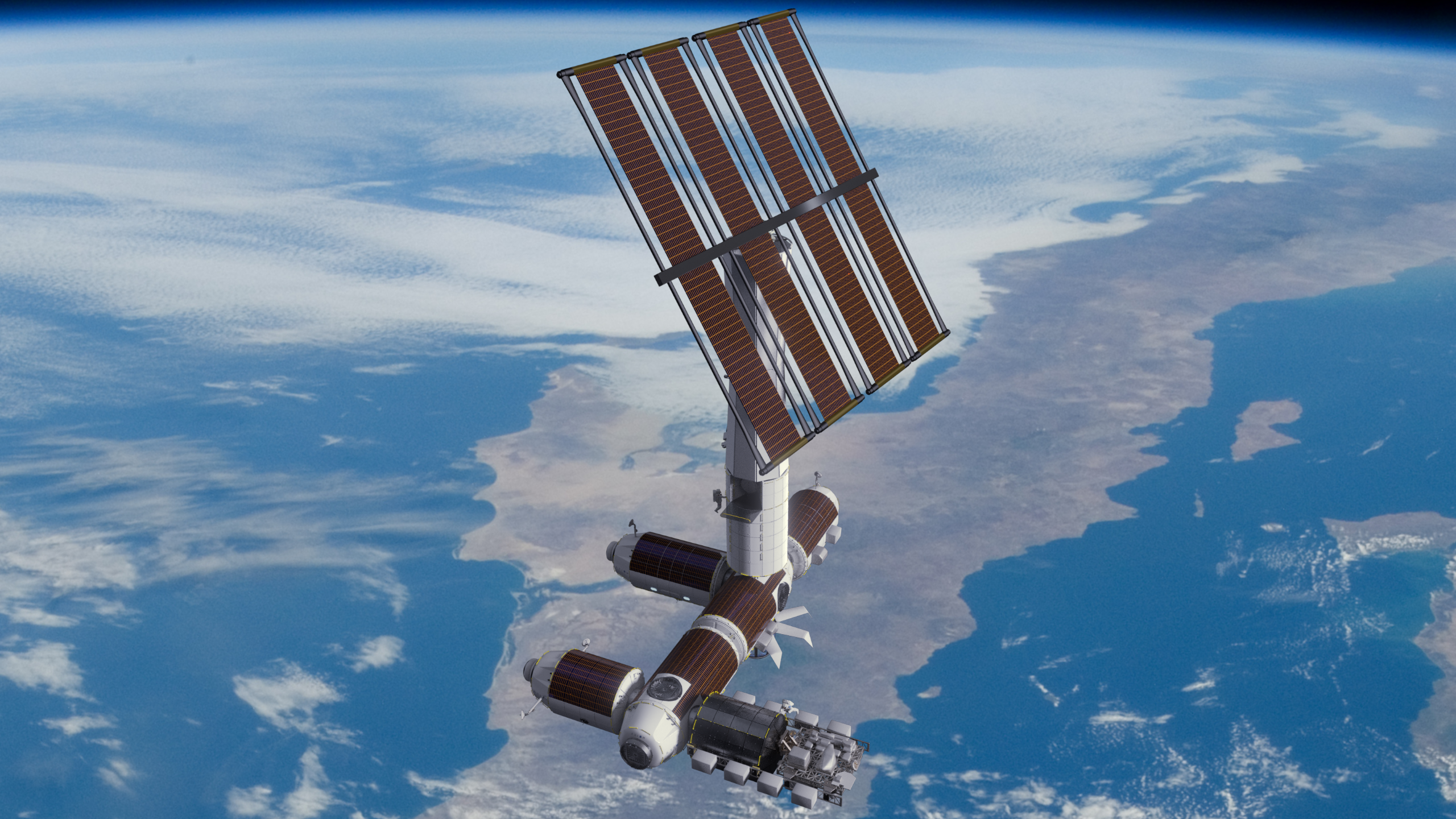
Axiom Space already has a contract with NASA to add its own modules to the ISS, starting in 2027 with the launch of the PPTM – Power, Propulsion and Transfer Module. This will then be joined by at least a second module, Hab-1, prior to the decommissioning of the ISS. These modules will then be detached from the ISS to become a free-floating hub to which Axiom will add further modules.
An artist’s impression of the Axiom space station as it will look when completed and free-flying. Credit: Axiom Space
To prepare for this, Axiom signed an agreement with NASA to fly four missions to the ISS between 2022 and 2025, with the option on a fifth. Three of these form the only fully private missions yet flown to the ISS, and all have been commanded by former NASA astronauts – Michael López-Alegría (Axiom AX-1 and Ax-3) and Peggy Whitson (Ax-2), with Whitson also set to command AX-4, currently targeting a May 2025 launch.
Under the new NASA PAM requirements, private missions are now required to be commanded by any astronaut who has served as a long-duration ISS crewmember (defined as 30 days or more in the ISS) and who has been involved in ISS operations in the last five years or else shows evidence of “current, active participation in similar, relevant spaceflight operations”. This therefore opens the door for missions to be commanded by Canadian, French, German, English, Japanese, etc., astronauts meeting the requirements to command missions by commercial providers.
The move to relax the requirements is to help remove the reliance on purely NASA-based experience to lead private sector missions into orbit and allow companies like Axiom, Blue Origin and – most notably, perhaps – Vast Space, who have a MOU with SpaceX to fly two PAM missions to the ISS but have yet to meet NASA’s requirements to do so, to start formulating their own requirements, gain expertise and build partnership and processes to assist in their efforts to establish on-orbit facilities.
The Blue Origin / Sierra Space-led Orbital Reef space station design, which will utilise the Boeing CST-100 Starliner for crew transfers, and the Sierra Space Dreamer Chaser spaceplane for cargo transfers. Credit: Blue Origin / Sierra Space / Boeing
The announcement by NASA is of potential import to the UK: Axiom have an agreement in place with SpaceX to fly a total of five Ax missions to the ISS. However, the fifth – provisionally aiming for 2026 – has yet to be crewed, and there have been discussion between Axiom and UK officials about the mission being an “all British” crew, comprising Tim Peake as mission commander, who flew the Expedition 46/47 rotations on the ISS, together with fellow UK European Astronaut Corps members Meganne Christian, Rosemary Coogan and Paralympic sprinter (and surgeon) John McFall.
New Glenn Mishap Investigation Completed
The Federal Aviation Administration announced March 31st, 2025 that it has accepted the findings of an investigation led by Blue Origin following the loss of the first stage of the company’s New Glenn heavy lift launch vehicle during its maiden flight on January 16th, 2025 (see: Space Sunday: NG-1 and IFT-7).
While the overall goals of that mission were met, a secondary goal – recovering the rocket’s large first stage by landing it at sea board a landing vessel – failed, the booster stage falling back into the Atlantic Ocean. Whilst no debris was strewn across flight corridors or fell on populated areas (unlike recent SpaceX Starship launch attempts), the failure of the planned booster recovery, whilst always rated by Blue Origin as having a minimal chance of success on the very first flight of the rocket, meant the vehicle’s launch license was correctly suspended by the Federal Aviation Authority (FAA) until a full Mishap Investigation into the cause of the loss had been carried out by Blue Origin and the FAA had accepted the findings and remedial actions taken.
The investigation report was duly supplied in March 2025, and identified the booster’s inability to re-ignite its motors during descent as the cause of the loss. Whilst no precise cause(s) for this failure have been openly published, Blue Origin has indicated seven areas where remedial work has been undertaken on the vehicle’s flight systems, and the FAA now consider the investigation closed. As a result – subject to a final inspection of the changes made – the license suspension should be lifted before the end of April. In the meantime, Blue Origin has been given the all-clear to resume preparations for the next New Glenn launch.
The maiden flight of Blue Origin’s New Glenn rocket lifts-off from Launch Complex 36 at Cape Canaveral Space Force Station on January 16th, 2025. Credit: Blue Origin / USSF
All of this is in stark contrast to the handling of the last two SpaceX Starship launches (IFT-7 and IFT-8). Both resulted in the complete loss of the Starship upper stages well within Earth’s atmosphere, resulting in debris falling over the Greater Antilles (and some of it striking close to populated areas on the Turks and Caicos islands) together with a degree of disruption to commercial flights in the region. However, in the case of IFT-7, the FAA cleared the launch of IFT-8 before the Mishap Investigation was closed, and appears to be on course to do so in the case of IFT-8, with SpaceX already ramping-up for the next test article flight.
In the meantime, assuming the New Glenn license is renewed in April, the next launch for the vehicle could come as soon as “late spring 2025” (end of May). However, no payload for the flight has been specified, only that it will include a further attempt to return the first stage to an at-sea landing aboard Landing Platform Vessel 1 Jacklyn.
Some reports had suggested this next launch could comprise the Blue Moon Mark 1 lander – an automated vehicle capable of delivering up to 3 tonnes of payload to the surface of the Moon and intended to demonstrate / test technologies to be used in the company’s much larger Blue Moon Mark 2 lander, designed to deliver crews to the surface of the Moon. However, in discussing the launch path for New Glenn, Blue Origin CEO David Limp indicated that a launch of Blue Moon Mark 1 is unlikely to occur before late summer 2025 at the earliest.
2024 YR4 Seen At Last
As I noted in February 2025, 2024 YR4 is an Earth-crossing Apollo-type asteroid discovered on December 27th, 2024. It caused a bit of stir at the time, as there was a non-zero chance that as it pursued its own orbit around the Sun, in 2032 it could end up trying to occupy the space volume of space as taken-up by or own planet, with potentially disastrous and deadly results for anyone and anything caught directly under / within the air blast that would likely result from its destruction as it tore into our atmosphere.
Fortunately, continued observations of the asteroid – which passes across Earth’s orbit roughly once every 4 years – have shown the threat of any impact in 2032 are now very close to zero (although it does still exist on the tiniest of scales, together with a smaller chance of it hitting the Moon).
At the time of its discovery, 2024 YR4 was classified as a stony S-type or L-type asteroid, somewhere in the region of 50-60 metres across (roughly the same size as the fragment which caused the 1908 Tunguska event). That size estimate has now been confirmed, and what’s more, we now have our first (and admittedly fuzzy) images of the fragment, courtesy of the James Webb Space Telescope (JWST), and they reveal it to be a strange little bugger.
2024 YR4 imaged by JWST’s NIRCam on 8 March 2025. Credit: NASA/ESA
Imaged and scanned by the US Near-InfraRed Camera (NIRCam) and British-led European Mid-InfraRed Instrument (MIRI), 2024 YR4 is indeed some 60 metres across at its widest. It is also somewhat unlike similar asteroids in its spectral type, in that it has a high spin rate as it tumbles around the Sun and appears to be more a conglomeration rocks banded together, rather than a single chunk of rock.
Observations are continuing to ensure the 2032 rick of impact is completely eliminated and also to provide data to calculate impact risks beyond 2032, whilst the data obtained by JWST – which mark 2024 YR4 as the smallest object the observatory has every imaged from its L2 HALO orbit – are being used to help scientists to better characterise NEOs of a similar size and spectral type and more fully understand how they might react were one to strike our atmosphere.







 Inara Pey: Living in a Modemworld