In May 2022, Terrygold opened I Would, a further installation of art exploring personal themes of, life, love, and the passage of time. It is something of a third chapter in a series that started with Empty Chairs (see: Terrygold’s Empty Chairs: remembrance in Second Life) and then continued with Rain (see Terrygold’s Rain in Second Life), which – at the time of writing this article, at lease – is still open to visitors at Terrygold’s gallery, alongside I Would.
As with its predecessors, I Would takes visitor on a journey of two parts; one reflecting on childhood and the innocence carried within it; the other the increasingly harsh realities of life within a society which appears to be growing ever more isolationist, intolerant and selfish. These two parts are mirrored one to the other, but they are not reflections of one another; rather they are windows into different states of mind, linked by the presence of Terry, an adult woman who is both guide and voice of the artist’s – and our own – thoughts.
Terrygold: I Would
In the first part of the installation, we travel with Terry from her house and through a park; a place which, in childhood was never short of magical and where excitement and fun and release always awaited and where something might always be found to delight. A place where any little girl could be a princess and dream dreams of a future bright within happiness and light, and within which the realities of human nature were hidden – as least until seen through the weary eyes of adulthood.
In the second, we also start within Terry’s house, but on exiting, we pass onto a street of a modern town; a place dark, dreary and where anger gnashes teeth, and everything appears to be in a state of decay and uncaring selfishness. This is a street where anger is quick to boil over, and where those that have care little for the hardship of those who do not have, whilst being without is grounds to exude the right to threaten and to take.
All of this is evidenced in the words spoken in local chat by Terry as you come across her at various points in both scenes, and also through the words of other characters that might also be found, whilst mood is set by the framing of the scenes and the vignettes waiting within them.
Terrygold: I Would
Within the park, for example, we travel from Terry’s house through the bright colours and magical mysteries imagined by childhood eyes, to arrive back at Terry’s house as it sits in the harshness of winter – symbolic of the passage of time as we grow from the gaiety of childhood to the coldness of adult life. Meanwhile, in the street scene we find a subtle amplification between those who have, and those who do not: in a garden protected by a high fence, a little girl plays happily, utterly oblivious of the little girl down the street cut off from her enjoyment of the local swings thanks to the vandalism of others and the force erection of another, and altogether different, high fence.
Throughout both scenes the words of the character of Terry give us pause for thought and to question. Why is life like this? Why do we so readily give up on the magic and promise of childhood to settle so readily into the cynicism and cruelty of adult life? What is it about our natures and our societies that make it “easier” to live in anger, resentment, selfishness and disregard, rather than allowing ourselves a more positive and accepting outlook? We obviously cannot remain as innocent as when young – but can we not hold onto the dreams we have, share them, and made the world a better, brighter place by doing so?
Terrygold: I Would
Within each half of the installation are 2D images by Terrygold that offer further reflection and visual tapping of the words offered through the character of Terry. These images add a further layer to our interpretation of I Would as it offers a thought-provoking window into life and the questions we can silently ask of it, and consider the wishes we all have at some point whispered within the stillness of our own thoughts.
On arrival at the gallery landing point, use the teleport disk to visit I Would and the other installations.
An artist’s impression of H260655b and H260655c orbiting their parent star. Credit: SciNews.
Two new “super Earth” exoplanets have been confirmed as orbiting a star just 33 light-years (10 parsecs) from our own, making them two of the closest rocky exoplanets to Earth to be thus far be located.
Such is their proximity, the planets – HD260655b and HD260655c – offer new opportunities for exoplanet and comparative planetology studies. They both orbit an M-type red dwarf star, the most common – and one of the oldest – types of star within our galaxy; these stars are both smaller and a lot cooler than main sequence stars like own own, but can also be quite violent in terms of their stellar activity. HD260655 is unusual amongst its brethren as it is somewhat brighter then most other M-type stars, given its comparatively small size. From Earth, it appears to reside within the constellation of Gemini, and is also known by a number of different catalogue designations, including Gliese 239 and Wolf 287.
HD260655b, the innermost of the two planets, zips around its parent at a giddying 2.8 terrestrial days; it is some 1.24 times the size of Earth and has 2.14 times the mass. HD260655c is much more “sedate” in its orbit, taking an entire 5.7 days to go around its parent; it is 1.53 times the size of Earth with around 3.1 times the mass.
The to planets are so close to their parent they are liable to be tidally locked, keeping the same side pointing towards the star all the time, and their estimated temperatures mean they are unlikely to support life: “b” has a temperature of around 435ºC, and likely has no atmosphere (although this is by no means certain), and “c” has an temperature averaging 284ºC – but may have a hydrogen-deficient atmosphere (so no water).
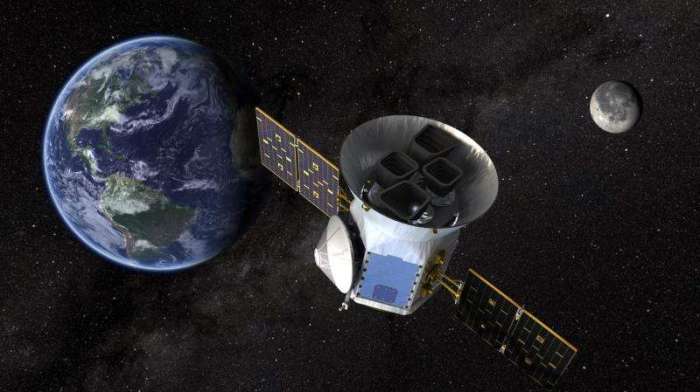
Artist’s impression of TESS in its “P/2” orbit. Credit: NASA
The planets were discovered in a 2021 review of data gathered by the NASA / MIT Transiting Exoplanet Survey Satellite (TESS) mission. Normally the confirmation process for such transiting planets – those that pass between their parent star and the point of observation to produce regular dips in the brightness of their star – can take a lot of additional work, including looking at other data about the star, repeating observations, confirming there has been no instrument error, etc. However, with HD260655, the process was accelerated because it had been tagged as having a possible planetary system in 1998 following observations using the HIRISE (now ANDES) instrument on the Keck telescope, and in 2016 following observations by the CARMENES instrument at the Calar Alto Observatory in Spain, and the data from these instrument-based observations did much to confirm the presence of both planets.
What is particularly exciting about these two worlds is the combination of their proximity to their star, its brightness and its proximity to our own solar system, all of which makes them ideal for study by the James Webb Space Telescope (JWST).
Among other things, JWST should be able to confirm whether or not either planet has an atmosphere and the composition of that atmosphere. Should it turn out that “b” has no atmosphere but “c” does, it allows for direct observation of the role of their star in characterising each planet over time, and the manner in which M-type stars influence atmospheric loss among their worlds; this in turn allows astronomers to gain a better understanding of the nature of exoplanets orbiting other M-Type stars. Finally, study of HD260655b and HD260655c and comparisons with the rocky planets of our own system could further add to our understanding of how planetary systems in general form.
Starship Update
On June 13th, the Federal Aviation Administration (FAA) issued its long-awaited Programmatic Environmental Assessment (PEA) concerning the SpaceX Starbase facilities at Boca Chica – and the summary is, neither the FAA nor the other government agencies that were involved in the study have come up with any significant environmental issues that would prevent SpaceX continuing with its current plans with the site.
The report doesn’t, however give SpaceX any immediate clearance to launch their first starship / super heavy orbital attempt. That requires a launch licence, which the FAA has yet to grant – and as a part of that process is that SpaceX demonstrate compliance with 75 action points raised by the PEA. Further, some of the action points will be subject to on-going review and could impact the company’s ability to secure launch licenses beyond the first. Further, the company may yet have to face direct action on the part of environmental groups in light of the fact that activities within the Boca Chica area – also a wildlife refuge – has already impacted some of the rare species living there.
Even so, it currently seems probable the SpaceX could be in a position to make their initial orbital launch attempt with a starship / super heavy combination in August 2022. As it is, the super heavy earmarked for the attempt – Booster 7 – has been equipped with its full complement of 33 Raptor engines, whilst its companion starship, Ship 24, is in the process of being fitted with its engines.
The massive “mechazilla” lifting mechanism on the launch support tower at the Starbase orbital facility, Boca Chica, was put through its paces again in mid-June, in readiness for lifting Booster 7 onto the launch table, and later stacking Ship 24 atop of it (seen bellow and to the left of the mechanism’s massive arms. Credit: BocaChicaGal / NASASpaceflight.comIn the next few weeks, we’re liable to see both Booster 7 and Ship 24 return to the launch area, with Booster 7 going through a range of static fire tests on the launch table before being mated with ship 24.
Meanwhile, at Kennedy Space, NASA has finally signalled growing (and, frankly, belated) concern about the SpaceX plans with the Pad 39A facility.
As I’ve previously reported, SpaceX resumed building a second super heavy / starship launch facility within the Pad 39A facilities the company leases from NASA. Of particular concern to NASA is the fact that SpaceX is locating the new launch platform so close to the existing Falcon 9 facilities, that the shockwave from a super heavy launch could conceivably damage the Falcon 9 pad and thus impact NASA’s ability to send crews to the International Space Station.
Pad 39A, Kennedy Space Centre, June 2022. To the left is the current Falcon 9 launch platform, sitting on top of the Apollo / Shuttle launch ramp. To the far right is the first section of the launch support tower for starship / supper heavy launches, showing the relative proximity of the two. Centre is a crane and a green structure, thought to be the start of work to install large water tanks between the two in order to deflect soundwaves from a super heavy launch away from the Falcon pad. Credit: @FarryFaz, Twitter
SpaceX appears to be trying to assuage NASA’s fears in part by installing what appears to be massive water tanks between the new launch facility and Pad 39A, possibly with the intent that the structure deflects sound away from Pad 39A. However, there is a greater threat involved in operating starship / super heavy which has not (in public, at least) been raised by NASA. To understand this threat, we need to go back to July 3rd, 1969.
That was the date on which the Soviet Union attempted to launch the second of its answer to America’s Saturn V, the N1 rocket, from the Baikonur Cosmodrome, Kazakhstan. However, seconds after lift-off the vehicle suffered a major malfunction, crashing back onto the launch pad. On impact, around 15% of the 2,400 tonnes of vehicle propellants detonated in a blast measuring 1 kiloton, obliterating the launch pad and scattering debris up to 10 km away. Fortunately, as the propellants were spread amongst 8 individual fuel tanks across the four stages of the vehicle, 85% did not detonate, but were burned in the ensuing deflagration; had they detonated, the estimated blast yield would have been closer to 7 kilotons – almost half the blast force of the first war time use of an atomic weapon (15 kilotons).
Super heavy doesn’t use multiple tanks. It effectively has two massive tanks that share a common dome (that is, the top end of one tank is the bottom of the other). This means that in the event of a catastrophic failure, it is exceptionally likely that any detonation will involve the entire 3,600 tones of propellants on super heavy alone, again yielding a blast in excess of 7 kilotons. Such a detonation on the ground or shortly after lift-off would not only level Pad 39A, it could cause at least moderate damage to the launch infrastructure shared by pads 39A and 39B.
Imagining Exoplanets Using the Sun’s Gravity
When it comes to astronomy, gravity can be a very useful tool thanks to the way it can affect light. Back in April, for example, I wrote about the use of gravitational lensing – the bending of light from an object far, far, away by the gravity of an object much closer – to give us our first glimpse of the most distant star from our own to have yet been captured.
The star, now called Eärendel, the Old English term for “morning star” – was imaged by the Hubble Space Telescope using the gravitational lensing effect of an intervening galactic cluster. However, a team led by Slava Turyshev, a physicist at NASA’s Jet Propulsion Laboratory, California, want to take the idea of gravitational lensing to a new level, using our own Sun to image distant worlds.
In this image from the Hubble Space Telescope, a luminous red galaxy (LRG) is surrounded by the Einstein Ring artefact created by the light from a much more distant blue galaxy being distorted by the LRG’s gravity. Credit: ESA / NASA
Turyshev and his team propose the use of a network of small satellites, preferably using solar sails, that could be deployed so as to image exoplanets using a 40 cm telescope in what they call the Solar Gravity Lens (SGL).
The idea has been in development for the last three years, and Turyshev’s team have determined how to resolved many of the idea’s specific problems. One of this is that while the Sun makes an excellent gravity lens, the corona is so bright it actually blots out the Einstein Ring – the circle of light created by the more distant object – such that it cannot be resolved. To fix this, the team determined that a satellite could, within a solar sail of the right size, use it as both a means of propulsion and effectively cover the Sun and this corona, revealing the Einstein Ring to the telescope. Determining the best size of the solar sail then allowed the team to calculate the mass and size of a satellite – thus allowing them to arrive at the optimal size for the telescope.
From that, the team have been able to work on a series of simulations based on the likely pixel size Earth-sized (or larger) would be produced at various distance up to 100 years years away, which in turn allowed them to simulate how such world would appear after processing their Einstein Ring and then deconvoluting the resultant image.
A simulation showing how Earth would look in a 128×128 resolution image captured by a 40-cm 30 parsecs away and using gravitational lensing similar to that produced by the Sun:. Left: the original 128×128 image; (c) as the image would look were it to be captured using SGL and then extracted from it Einstein Ring artefact; (r) as it would look after full deconvolution. Credit: Turyshev et al.
Further work is required to define the overall carrier spacecraft, but as Turyshev notes, SGL could provide us with insights into worlds beyond our solar system which might otherwise take years or even decades to accumulate.
The following notes were taken from my audio recording and chat log of the Content Creation User Group (CCUG) meeting held on Thursday, June 16th 2022 at 13:00 SLT. These meetings are chaired by Vir Linden, and their dates and times can be obtained from the SL Public Calendar.
This is a summary of the key topics discussed in the meeting and is not intended to be a full transcript.
Official Viewers Update
No changes to the list of official viewer through until Thursday, June 16th, leaving them as:
Release viewer: version 6.6.0.571939 – formerly the Performance Improvements viewer, dated May 25th – no change.
Nomayo Maintenance RC (Maintenance N) viewer, version 6.6.1.572179, June 1.
Makgeolli Maintenance RC viewer (Maintenance M) viewer, version 6.5.6.571575, May 12.
Project viewers:
Performance Floater project viewer, version 6.5.4.571296, May 10.
Mesh Optimizer project viewer, version 6.5.2.566858, dated January 5, issued after January 10.
Legacy Profiles viewer, version 6.4.11.550519, dated October 26, 2020.
Copy / Paste viewer, version 6.3.5.533365, dated December 9, 2019.
General Viewer Status
Bugs are still being ironed-out of the release version of the Performance Improvements viewer.
It is hoped the Legacy Profiles project viewer will start to move forwards once more.
There’s a further dedicated graphics project viewer in the wings, which may be appearing in the near future.
Materials and PBR Work
Please also see previous CCUG meeting summaries for further background on this work, with notes specific to the reflection probe work available in my week #22 and week #20 meeting summaries.
Outline of Work
Work on an implementation of reflection probes which can be used both with PDR shading and with legacy content.
The overall aim of this work is to provide a means to support more physically accurate reflections in SL than can be currently generated (seen as a requirement for PBR support).
It applies to both PBR generated content, once available, and to legacy content.
Creating a materials type with an associated inventory asset. This will initially comprise the ability to copy a texture entry (with its specific parameters) to inventory, to be followed by initial work to work implement a PBR graphics pipe in the viewer.
Reflection Probes Progress
Simulator-side support for reflection probes has been on test using an experimental view and simulator-side updates available on Aditi through the DRTSIM542 channel (Materials 1, Rumpus Room, Rumpus Room 2, and Materials Adult).
Materials Progress
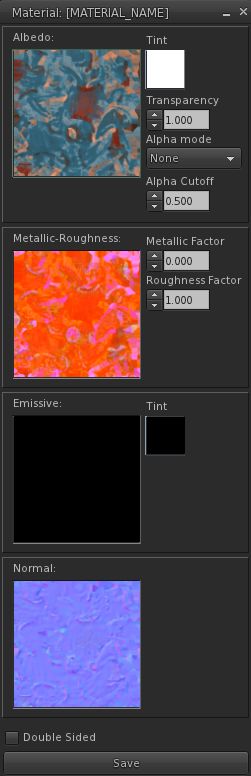
Prototype Materials editor
Work is continuing on glTF materials import, and the hope is to have something that is functional within “the next week or two”. This uses the same unpacking mechanism as Unreal 4.
Materials will be uploaded with an additional editor (shown right), which will allow some manipulation and delivery the materials as an inventory item when uploaded.
Supported textures / capabilities:
RGB albedo + transparency.
RGB Occlusion/Roughness/Metalness: R = occlusion, G = roughness; Blue = metalness.
RGB emissive.
RGB normal (- alpha).
Double-sized supported (disables backface calling before issuing the draw call).
Two-sided lighting (so if the back of a triangle is visible, it flips the normal around).
Functionality not initially supported will be the ability to change the UVU wrapping Mode (so everything will sill be repeat); no ability to change the metification / magnification filter per texture;
The process separates the materials from the mesh, so the materials can’t know if things like tangents are present.
Texture will initially have to be packed by a creator’s preferred toolset; once the project gets to a state of polishing, the importer should re-pack the textures itself, unless importing from a non-glTF source, in which case self-packing will still be required.
Normals will likely be MikkTSpace, as per the glTF specification, but work needs to be done to see if supporting this could lead to clashes with the current normal maps rendering. This does mean that current Normal maps will not work on PBR materials.
Uploads will be L$10 per texture, so L$40 if all four used.
Brad Linden is working on getting the import into inventory working.
ALM Proposal / Work
At the #week #23 TPVD Developer Meeting (notes here), it was indicated that LL are “leaning” towards removal of the non-Advanced Lighting Model (ALM) (aka “forward rendering”) rendering path from the viewer, leaving just ALM rendering (aka deferred rendering”).
This was triggered as a result of a bug report which initially appeared to suggest the Performance Improvements viewer unintentionally alters the render order of object faces. While it later proved that the issue was more an edge-case in the way a piece of content had been created, efforts to try to correct it and to ensure it rendered as desired in both ALM and non-ALM rendering, raised the question as to whether it would simply be easier to remove the non-ALM path.
Were non-ALM rendering to be removed from the viewer, it would:
Only be done if it can be shown that this does not adversely impact performance (e.g. ALM runs roughly as well as non-ALM for those using the latter) on the broad cross-section of hardware most commonly operated by SL users.
Include a slider to manage the number of rendered local lights, as these are unlimited under ALM but can cause performance issues on low-end systems; thus a slider will help those on lower spec hardware to determine how many local lights they wish to have rendered.
Likely include a “data saving mode” that will prevent the download of materials for those on metered connections (to reduce the amount of data crossing their connection) and / or help those who find that materials loading can impact performance. This will have a UI warning that when employed, some objects may not look the way they are supposed to look.
In terms of the last point above and “data saving mode” the focus is currently on how many users would need it *if* the Lab goes forward with the idea. This will help determine how much the mode is needed and how best to approach it.
Given the ongoing work to support PBR and a more rounded set of materials, moving to deferred (ALM) rendering without fallbacks to non-ALM rendering – providing, again, the caveats noted above can be met / implemented – will help ensure a more reliable / consistent viewing experience.
Rigged Attachment Render Order
In terms of render order of object faces on rigged meshes, LL are considering adding a “render order number” that can be used by creators to ensure the orderly rendering of faces for transparent rigged attachments (thus allowing pre-loading of textures on “invisible” faces, etc.).
This would hopefully overcome issues of implicit render ordering (which may change due to other viewer dependencies), and of interpretations of the rendering order by creators that can lead to the kind of issue noted in the ALM discussion above.
There are complications in attempting this -e.g. render order is not per object, but per mesh, and is part of an overall schema for rigged attachments (attach order, linkset order, face index order); questions around overall outfit changes, where multiple attachments are being made, etc.
Providing such an approach does not break masses of existing content, it would allow creators to continue to use the implicit ordering (and risk odd behaviours should LL make changes in the future that affect the order), or use the ordering system to explicitly set the order, no matter what changes might occur down the line.
None of this work should impact the attachment order, but could significantly reduce the number of avatar draw calls.
The Shambles, June 2022 – click any image for full size
Update, July 20236th, 2022: The Shambles has relocated.
The Shambles is the name Tolia Crisp has settled upon for the latest of her Homestead regions designs which she broadly offered to visitors under her Frogmore Land Management group / brand. And for those familiar with the likes of Frogmore and Mousehole, there are elements here that place The Shambles within the same realm of those settings, with much to set it apart and offer a sense of mystery and surprise.
The first of the former of these is that the location is described as being “up the River Foss”; this is likely a reference to the river of that name that flows through North Yorkshire, England, rising close to Oulston Reservoir and meandering roughly south for about 30 kilometres to join the River Ouse in York. This puts The Shambles squarely into Tolia’s theme of English settings, albeit within a location pretty much diagonally at the other end of the country compared to Frogmore and Mousehole with their Cornish locales.
The Shambles, June 2022
However, where Frogmore and Mousehole have their feet pretty much rooted in reality, The Shambles stands well to one side, a veritable potpourri of themes and ideas brought together in a surprising whole that delights the eyes. This is something that is immediately obvious on arrival: sitting behind the landing point platform and hovering over a broad channel that sits between village and an oddly denuded hump of an island, is a strange windmill, held aloft by downward-pointing rotors spinning away beneath it and the metal deck before it. In fact, with its larger sail turning slowly behind it, it looks not so much like a floating windmill as it does a fanciful flying house.
The landing point occupies a tiny islet connected to the village by a metal bridge around which tentacles rise from the coastal waters, adding a touch of Innsmouth to the setting.
The Shambles, June 2022
On the little waterfront across the bridge are hints which, together with the hovering house / windmill, help the setting lean towards the suggestion that is it steampunk themed. Cogs turn slowly on the wall of a cottage as a kind of mobile décor; a great gas boiler pumps heat into the cottage’s interior and, further along the waterfront, what looks to be the face of an old copper clock has been fashioned into a table where refreshments might be taken, watched over by a mechanical messenger owl.
However, it doesn’t take much to realise that the themes here run much broader than steampunk alone; close to the table mentioned above, for example, a poster hangs from the doorway of a magic shop proclaiming Harry Potter is Undesirable No 1, while the waterfront itself is probably awash with the engine noise from the Star Wars-esque flying vehicle which appears to have just passed overhead, zipping between rooftops and the bulbous bulk of a balloon moored by the landing point.
The Shambles, June 2022
Enter the main street of the village, and more of this blending of ideas unfolds before your eyes in ways that are genuinely captivating. A dieselpunk tricycle, driven by a great chugging internal combustion engine turning a pusher propeller awaits a driver; futuristic lasers zap between buildings; a steampunk style airship appears to have wedged itself into the cul-de-sac of the street, neon signs and LCD panels hang from walls…
This is a place where nothing is as it seems and unique elements are waiting to be found everywhere the camera turns. Take, for example, Cordelia Curiosus and the boulangerie adjoining it. Leaving the Buffy the Vampire Slayer reference in the name of the former, these initially appear to be ordinary places of business. But look again: the windows of Cordelia’s are aquariums, home to fish and corals, the water held in by a combination of window frames and – magic? Similarly the wall between the two shops is a shimmering face of water held back by something, the boulangerie a further haven for fish, turtles and aquatic plants.
The Shambles, June 2022
More touches can be found across the street, where a host of incongruities are gathering into a little vignette that offers so much. There’s a Victorian-era Bobby standing with his back to a pub cheekily calling itself the Scotland Yard, the walls of will are posted with a reward poster typical of those times and the front page of a newspaper offering the latest on the Whitechapel Murders – and the involvement of one S. Holmes, Esq.
The Bobby himself stands between a set of very futuristic packing cases before which floats a glowing umbrella projected by an equally glowing wand, none of which seems to fluster our good constable in the slightest – and nor does the London Police telephone box very definitely from the 1960s – so very definitely in fact, that one might be tempted to ask if it really is a police telephone box – and thus the entire vignette allows the imagination to take flight.
The Shambles, June 2022
Thus, wherever you roam, down through the village with its little stream and cornucopia of buildings, businesses and photo opportunities, or up on and between the rooftops, there is a lot to appreciate within The Shambles – far more than mentioned here. Yes, it is a little texture-heavy when loading; but it is nevertheless highly photogenic and offers more than a few places to sit down and pass the time. Those in the Frogmore group also get rezzing rights when visiting – but do please clean-up when done!
Update: the issues described blow have also been noted on Nvidia drivers 512.95 and 515.48. If you encounter similar issues please check for driver version (go to Help → About in the viewer and then look for the line “OpenGL Version: X.X.X NVIDIA YYY.YY”, where Nvidia YYY.YY is your installed driver); if you note a different driver to 51.6.40, please consider adding a note to the two official Jira linked to below, and in a comment on Beq’s NvidIa forum report, so other can see potentially affected drivers. Thanks.
It is being reported that the latest Nvidia driver version 516.40, issued on June 15th, 2022, is causing issues for Second Life Users running either Windows or Linux who have updated to use it. As a result, the general advice is not to update to this driver for the time being.
In summary:
The issues are apparent when running the viewer with Advanced Lighting Model (ALM) enabled.
They can cause objects to flash or blink in and out, or can display rings or lines across in-world objects (as shown in the image below).
Image showing some of the artefacts created during scene rendering following an update to the Nivida 516.40 driver. Image courtesy of ermanart / BUG-232264
The following bug reports provide further information on the problems reported thus far:
For those who have updated to driver 516.40, two courses of action are currently available to try to correct:
Minimum: disable ALM (Preferences → Graphics → uncheck Advanced Lighting Model. Note that this may not work when under Linden Water in Second Life, per BUG-232268 (above).
Recommended: revert to an earlier driver version or use the Nvidia Studio Drivers instead.
Again, please note that the issues are driver-related, and so not something either Linden Lab nor TPVs can address themselves.
I have been fortunate to follow a large part of Milena Carbone’s artistic journey in Second Life. Since her first major exhibition of work I visited (Agape, February 2020), Milena has repeatedly demonstrated the inherent power of art to challenge, to question, to offer statements on life, politics religion and self, to engage and to provoke.
Her work has tackled subjects as diverse as the nature of reality, self-perception and the realities (or otherwise) of “god”; it has plumbed the depths of our humanity (and inhumanity), of identify and self, and even navigated the waters of quantum field theory and the Casmir effect.
Kondor Art Square: Milena Carbone – Introspective
Thus, whilst offering a retrospective of her work after just three years of exhibiting it in Second Life might be seen as something of an exercise in ego, it is not (for one thing, I know Milena is far too self-aware to allow her ego to get in the way of things). Rather, it is a chance for those who have not had the ability to observe the evolution of her work and explore her ideas and thoughts on life, human nature, reality and self, to do so by acquainting themselves with piece from her catalogue of work to date, and to consider the paradigms she explores and presents. Equally, for Milena, it is an opportunity to revisit her work from earlier times and consider it under the light of her current thinking and world-view.Hence why, in receiving the invitation from Hermes Kondor to mount a retrospective of her work within the Art Square of his arts hub, Milena opted to title the exhibition Introspective, and frame it around a central commentary and three questions. The latter initially appear to be offered as a means to help frame her continued presence within SL; however, they actually reach much further than this.
Kondor Art Square: Milena Carbone – Introspective
Within all three resides both a cry oft heard down the ages, and also a challenge to us all in the here and now: why, really, are we here; what purpose do we serve? When are we finally going to put pettiness and anger and hate behind us and truly learn acceptance of one another and embrace love for one another? When will we, quite frankly, cease the shouting din of childish behaviours and grow up as a species?
Around the introductory boards (which on their reverse sides offer copies of the books Milena has produced in reference to some of her exhibitions, thus offering further insight and means of retrospection) and against the edges of the square are pieces taken from Milena’s exhibitions. These start in the north-east corner of the square and proceed south and then around to the north-west corner, arranged in chronological order. Each is presented with text either from the exhibition itself, or designed to offer a framing for it – text which also, for those willing to read, muse and reflect, offering further reverberations of the core questions Milena asks.
Kondor Art Square: Milena Carbone – Introspective
These images, in and of themselves, also allow us to travel through Milena’s growth in both experimentation and in confidence with her ability to use the tools at her disposal to represent her art and her thoughts and in allowing her inner voices to speak in unison and / or equally.
Introspective is an exhibition that can be appreciated purely visually; however, its full richness comes in taking the artist’s hand and walking through her words and thoughts in reflection of the images and the introduction.






 Inara Pey: Living in a Modemworld