Space Sunday: collisions, storms, aspirations and servicing

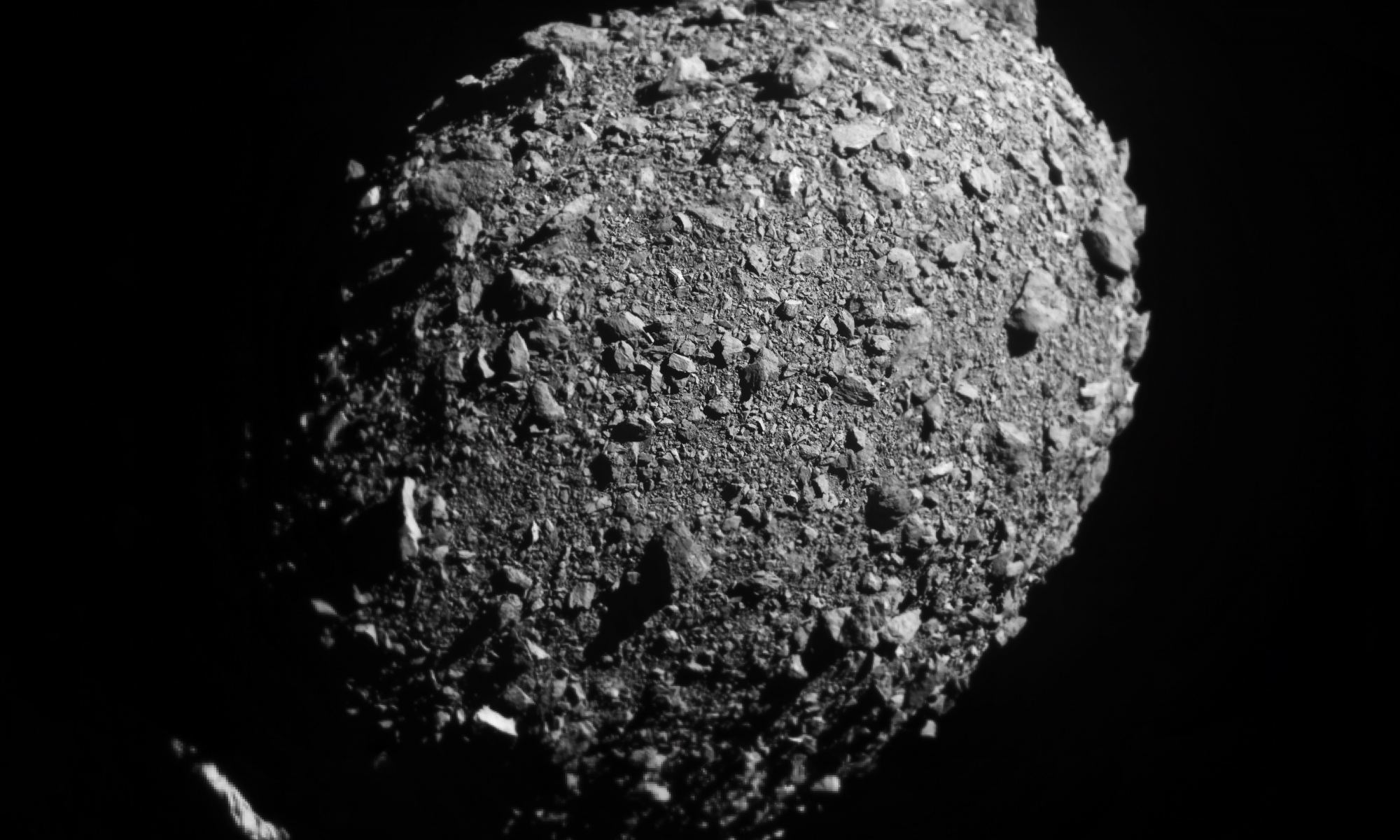
A high resolution image of Dimorphos made by stacking the last images received from DART. Credit: Eydeet on Imgur.

On Monday, September 26th 2022, NASA’s DART (Double Asteroid Redirection Test) spacecraft, massing 570 kg slammed into the 160-m  diameter, roughly 5 million tonne asteroid Dimorphos as the latter orbited its parent asteroid, Didymos.

As I outlined in my previous Space Sunday update, the aim of the mission was to test the ability of a vehicle launched from Earth to alter the orbit of a near-Earth object (NEO) purely through the transfer of kinetic energy, in order to prevent a collision between planet and NEO.

Didymos / Dimorphos are NEOs. They orbit the Sun every 2.11 years, hopping across the orbit of Earth in the process and swinging out as far as the orbit of Mars before heading back towards the Sun, Didymos and Dimorphos are ideal subjects for such tests because the former’s orbit around the Sun can be accurately tracked, as can the latter’s near-circular 11.9 hour equatorial orbit around Didymos.
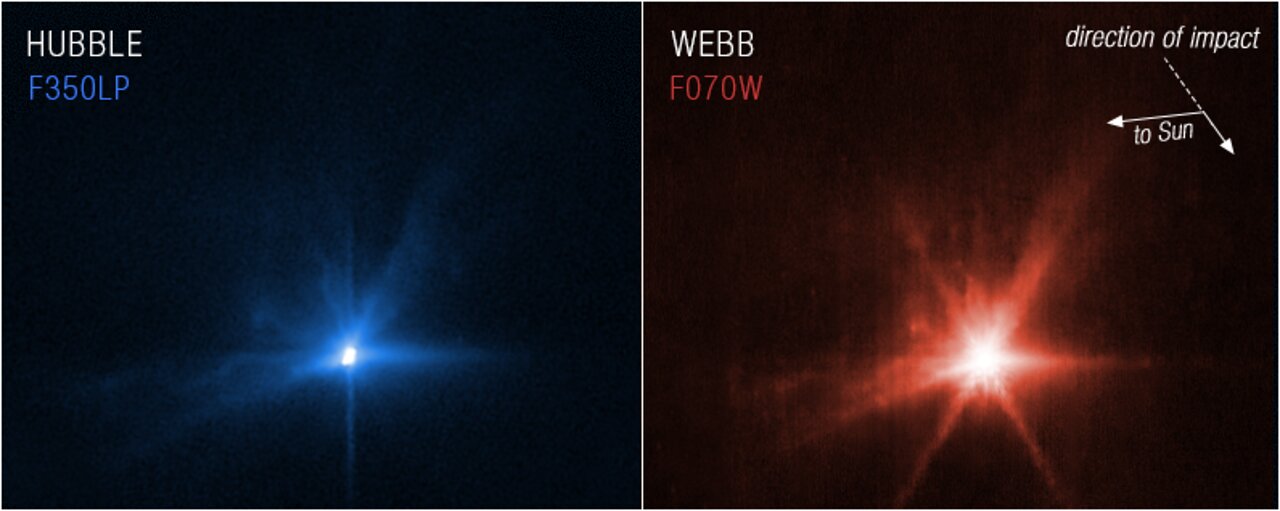
Images of Dimorphos captured simultaneously by the Hubble (l) and James Webb (r) Space Telescopes several hours after DART struck the asteroid. These images mark the first time the two observatories have taken simultaneous images of the same target. and show the spread of material ejected materials  Credit NASA, ESA, CSA, and STScI

At the time of impact, DART was travelling at around 22,530 kmh, and its impact with the asteroid was described as the equivalent of “a golf cart ramming into the Great Pyramid of Giza”.

Prior to the impact, NASA indicated they expected the head-on collision between spacecraft and asteroid should slow the latter’s orbital velocity around Didymos by around 1% – or 10 minutes. This might not sound a lot, but it should result is a clearly observable change in Dimorphos’ orbit.

The impact was observed from a number of vantage points – including aboard DART itself, thanks to DRACO, the Didymos Reconnaissance and Asteroid Camera for Optical navigation, which recorded the spacecraft’s approach all the way up to impact (and loss of signal), a host of ground-based telescopes and both the Hubble and James Web space telescopes.  In addition, a fly-by cubesat called Light Italian CubeSat for Imaging of Asteroids (LICIACube) built by the Italian Space Agency and released by DART roughly two weeks prior to the impact, should be returning post-impact images of Dimorphos in the next few days.
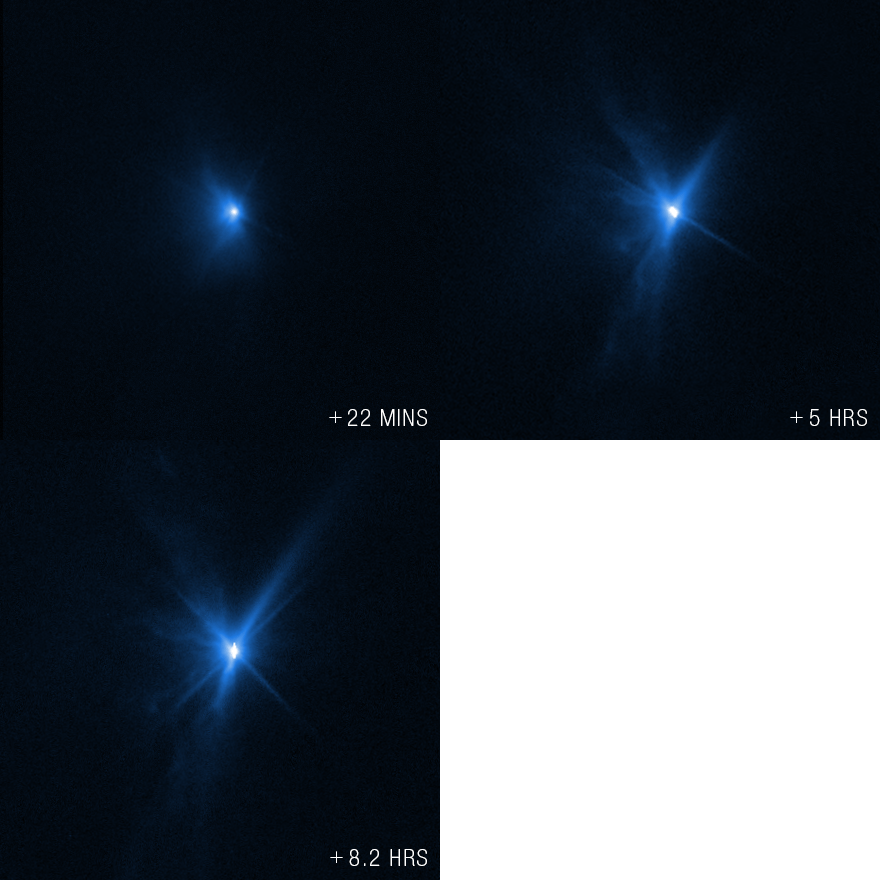
An animation of images captured by the Hubble Space Telescope following the DART impact with Dimorphos, showing the spread of ejecta following the strike. Credit: NASA, ESA, CSA, and STScI

While scientists know a reasonably amount of the orbits of Dimorphos and Didymos, there is far more that is not known about either – such as their overall composition. As such, what would happen as a result of the impact was also unknown – and as seen from the likes of Hubble and James Webb and telescopes on Earth, the impact appeared much brighter than had been expected.

In particular, Hubble and JWST were both able to monitor and image the ejecta generated by the impact. Being able to do this is an added science goal for the mission, as analysis of the streaks of ejecta captured in both visible and infra-red wavelengths will help determine the asteroid’s likely composition and structure.

However, it is still going to be a while for the overall results of impact to be fully calculated, although initial estimates of the change in Dimorphos’ orbit might be known within a week or two following the collision.

China’s International Aspirations

China is looking to build partnerships for its upcoming missions to the moon and deep ventures into the solar system, while omitting mention of (current?) main partner Russia.

Speaking at the International Astronautical Congress (IAC) in Paris on September 21st, 2022, Wang Qiong of the Lunar Exploration and Space Engineering Centre under the China National Space Administration (CNSA) stated that China was open to proposals for science payloads aboard its Chang’e-7 lunar south pole orbiter / lander mission, and the Chang’e-8 in-situ resource utilization test mission, as well as already having the participation of Sweden, Pakistan, the UAE (in the form of a small rover) and the European Space Agency (ESA) for the 2024’s Chang’e-6 mission.

In addition, China is working on a number of deep space missions for which international co-operation is welcomed in the form of:

  • Tianwen-2 (2025), a near-Earth asteroid sampling mission which will also visit a main belt comet.
  • Tianwen-3, a Mars sample return mission.
  • Tianwen-4 (2029) a mission to Jupiter (with a fly-by Uranus).

Finally, China is looking for further partners in the International Lunar Research Station (ILRS) programme to establish a permanent robotic and later human-occupied moon base in the 2030s.

However, the presentation avoided mention of China’s current partner in ILRS: Russia. Per an agreement signed in June 2021, China and Russia are nominally equal partners in the project, and up to Russia’s invasion of Ukraine, ILRS was referred to as a joint China-Russia programme (Russia was not represented at the IAC due to their on-going aggression in Ukraine).

It’s not clear if the conspicuous absence of Russia from China’s presentations signifies sensitivity to the situation in Ukraine and Russia’s isolation, or a change in Chinese thinking towards their engagement with Russia – although there is speculation the latter is the case.

Be it in space or elsewhere, China has a very realistic view of Russia and partnering with Moscow has never been Beijing’s most preferred outcome, for the two countries are not natural partners. This uneasiness is well reflected in their joint ILRS, which still remains little more than a coordination mechanism rather than a bold undertaking sharing a common goal. In moving forward, however, Beijing now seems to be increasingly confronted with a difficult dilemma: turn the relationship into a real partnership or drop it altogether.

– Marco Aliberti, European Space Policy Institute (ESPI)

Thus, given Russia’s current standing in the world, a partnership with Moscow could limit China’s ability to attract new, potentially more auspicious, international partner.

In Brief

Artemis 1

It now appears that the first launch of NASA’s new Space launch System rocket in the Artemis 1mission is unlikely to occur prior to November 2022 – although speculatively, the mid-to-end of October launch window remains possible.

Thanks to the arrival of hurricane Ian, NASA was forced to roll the massive rocket and its launch platform back the Vehicle Assembly Building (VAB) at Kennedy Space Centre overnight on Monday, 26th, / Tuesday, 27th September 2022 in what was (literally, given roll-back commenced at 23:00 local time on the 26th) a 11th hour decision.

As a result of the roll-back, NASA has opted to replace the batteries on the vehicle’s flight termination system (FTS) – the package which destructs the rocket should it veer off-course during its ascent through the atmosphere.

A dramatic shot of Artemis 1 arriving at the Vehicle Assembly Building shortly after 7:00am local time in Florida on Tuesday, September 27th, 2022, even as the weather front of Hurricane Ian moves in. Credit: Greg Scott

This is a non-trivial task, and given the technicalities involved, NASA managers have indicated getting the work completed and returning the rocket to the pad before the end of October could be difficult.  Should the launch slip into November, opportunities for that month exist from November 12th through 27th.

Crew 5

Hurricane Ian has also impacted the NASA / SpaceX Crew 5 ferry mission to the International Space Station (ISS). The 4-person crew – comprising NASA astronauts Nicole Mann and Josh Cassada together with Japanese astronaut Koichi Wakata and Russian cosmonaut Anna Kikina – had been scheduled for October 3rd, but has been pushed back to October 5th as a result of the storm.
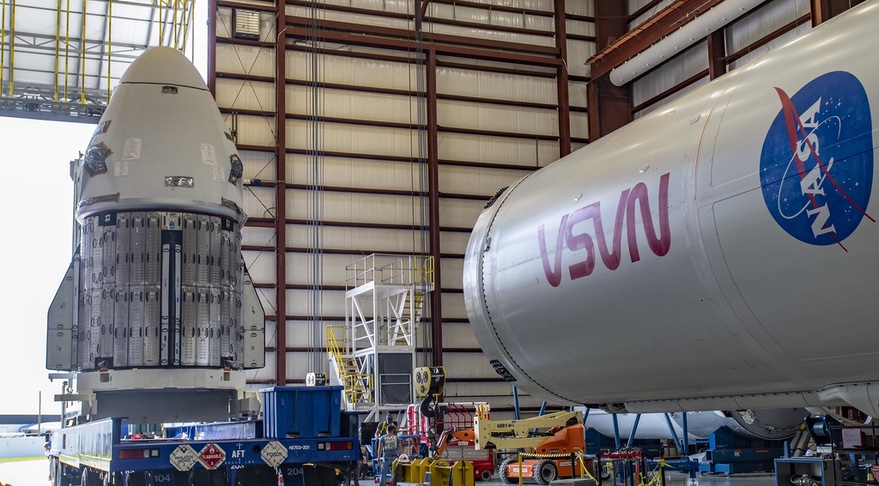
The Crew 5 Dragon vehicle and its Falcon 9 booster being prepared at the SpaceX facilities, Pad 39A, Kennedy Space Centre. Credit: SpaceX

This is something of a historic mission – Mann will be the first woman to reach space, and Kikina will be the first cosmonaut to fly to the orbiting lab with SpaceX.

Hubble: NASA and SpaceX Consider Dragon Servicing Mission

NASA and SpaceX are carrying out a study to see if it would be possible to use the latter’s Dragon vehicle to reach the Hubble Space Telescope (HST) and boost its orbit – and, if Crew Dragon is used, deliver a crew to HST to carry out basic, but essential servicing.

From its launch in 1990 through until 2011, HST had to be routinely visited by the space shuttle to allow astronauts carry out essential servicing and the replacement of aging parts, as well as use the shuttle’s reaction control system to periodically raise Hubble’s orbit around the Earth.
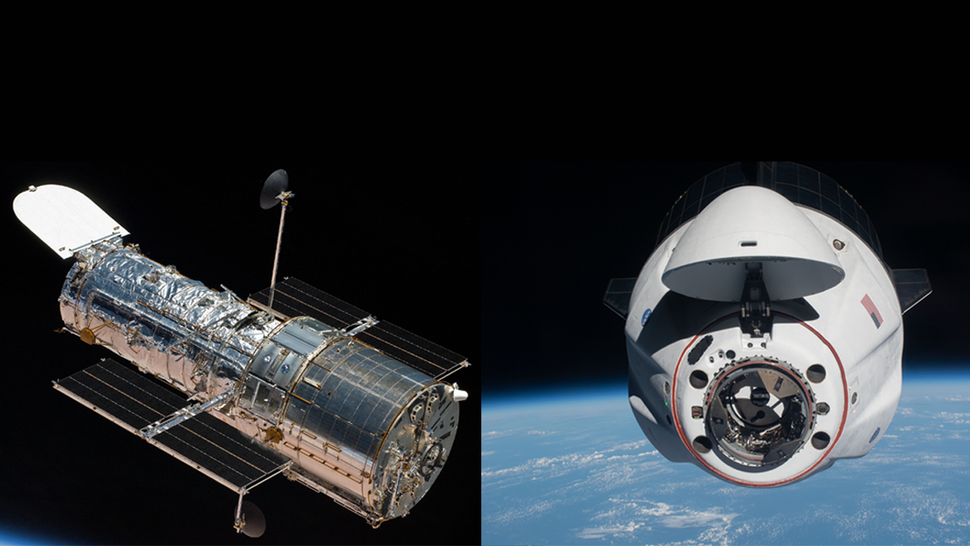
NASA and SpaceX are studying the feasibility of using the latter’s Dragon vehicle to boost the Hubble Space Telescope’s orbital altitude, and possibly deliver a crew to Hubble to carry out servicing operations. Credit: NASA

However, in 2011, the shuttle was retired, leaving NASA without a vehicle capable of servicing the observatory, was has lowered its orbit by some 60km compared to when it was launched as a result of atmospheric drag. Unless countered, this drag will continue until HST will tumble uncontrolled into the denser atmosphere and break-up in the mid-2030s. To avoid this, NASA is planning a controlled de-orbit mission to HST using an automated vehicle in 2029/30, ensuring it burns-up safely and any surviving debris falls into the Pacific Ocean. By contrast, should a servicing / orbital boost be possible with Dragon, then Hubble’s operational life could be extended by up to 20 years.

Even so, such a mission by Dragon – crewed or otherwise – will not be easy; as noted, HST is specifically designed to be services by the space shuttle, and while a capture mechanism was installed during the very last shuttle servicing mission to Hubble, it is intended to be used as a part of the de-orbit mission mentioned above. But should the study show a Dragon-based boost / service mission is feasible, it could come at little to no cost to NASA.

This is because billionaire Jared Isaacman, who has already financed and commanded the Inspiration4 mission and who is financing a series of further crew flights on Crew Dragon under the Polaris project, has indicated he believes a mission to Hubble would be a worth goal for Polaris – and he is actively involved in the study.

2022 week #39: CCUG & TPVD meetings – PBR and LOD

Sweetwater Valley, August 2022 – blog post

The following notes were taken from:

  • My audio recording and chat log of the Content Creation User Group (CCUG) meeting held on Thursday, September 29th 2022 at 13:00 SLT.
  • My notes and the video from the Third-Party Viewer Developer (TPVD) meeting held on Friday, September 30th, 2022 at 13:00 SLT. The video is provided by Pantera – my thanks to her for recording it, and it can be found at the end of this article. Times stamps to the video are included where relevant in the following notes.

Both meetings are chaired by Vir Linden, and their dates and times can be obtained from the SL Public Calendar.

This is a summary of the key topics discussed in the meeting and is not intended to be a full transcript.

Official Viewers Status

[TPVD Video: 0:00-1:00]

No changes through the week, leaving the current crop of official viewers as:

  • Release viewer: version 6.6.4.575022 – hotfix for Crash at ~LLModalDialog() – promoted September 15 – no change.
  • Release channel cohorts (please see my notes on manually installing RC viewer versions if you wish to install any release candidate(s) yourself).
    • Maintenance 3 RC viewer, version 6.6.5.575257, September 23.
    • Maintenance P (Preferences, Position and Paste) RC viewer version 6.6.5.575055 September 19.
  • Project viewers:
    • Puppetry project viewer, version 6.6.3.574545,  issued on August 30.
    • Love Me Render (LMR) 6 graphics improvements project viewer 6.6.2.573263, July 21.
    • Performance Floater project viewer, version 6.5.4.571296, May 10.

General Viewer Notes

  • The next likely promotion to de facto release status will be the Maintenance 3 RC viewer.
  • The Performance Floater project viewer (which includes UI updates and the Lab’s new Auto-FPS feature) has been undergoing a lot of work to reconcile the Lab’s auto-FPS work with that of Firestorm (by Beq Janus and released in Firestorm 6.5.3, March 2022), and so an updated version should be appearing Soon™, possibly in week #40.
  • [Video: 28:10-32:35] The move to use Visual Studio 2022 in the Windows builds of the official viewer is moving ahead. Licenses are now in place, and an internal viewer (DRTVWR-568) built using VS2022 is being tested, and a project viewer may appear off the back of this.
    • In addition to this work, and as part of the migration to github, the third-party libraries used by the build process will be updated. This work will not include Clang.

Autobuild

[TPVD Video: 4:43-8:30]

  • A new version of Autobuild has been released with some features TPV developers may be interested in:
    • zstandard, xz, gzip compression of package archives.
    • blake2b hash support.
    • Support for downloading packages from restricted sources such as private GitHub Releases and GitLab packages.
    • CPU count exported as AUTOBUILD_CPU_COUNT for build scripts.
  • Signal Linden would like to hear from developers using a forked version of Autobuild could let him know what they need to be able to use the upstream version of Autobuild so that is is “simple to use” and has all the features TPV devs need to build their viewers.
  • This discussion  included a conversation on using WSL in place of cygwin and on setting credentials to protect build packages that are not supposed to be redistributed.

PBR: Materials and Reflections

  • Please also see previous CCUG meeting summaries for further background on this project.
  • Test viewers continued to be made available to those on the Content Creation Discord channel, with work now focused on brining the viewer more into line with the release viewer so that it can move forward to a project viewer status for wider distribution.
    • Requests to join that channel should be made in person at CCUG meetings. I am no longer able (at LL’s request) to furnish such information.
  • It currently looks as though the route to be taken in aligning the PBR / Materials viewer to the current viewers code is that users will not be able to disable PBR rendering, but will be able to turn off the new reflections  capabilities. This means that:
    • Objects with PBR materials on their faces will continue to show those materials, they just will not respond to reflection probes when the reflections capability is disabled.
    • Legacy materials (those we currently have today) should continue to look pretty much as they do at the moment.
  • A major change between the PBR / Materials viewer and the current viewer is the former performs the majority of alpha blending rendering in linear colour space.
    • This can cause some different results to be displayed with alpha blending and the haze in some EEP settings.  However, the majority of colours should render the same as, or close to, how they appear now.
    • However, the benefit is it reduces the amount of work the GPU / CPU has to do in converting between different colour spaces (e.g. linear and RGB).
  • Linden Water still has to be incorporated into the new render pipe (notably the the reflection and refraction paths, which currently require the forward rendering ((i.e. non-ALM) path – a path being disabled in the viewer as a part of this work.
  • [TPVD video: 1:34-3:15] texture overrides are likely to be handled via specifying a glTF complaint JSON blob per texture entry – although which fields will be supported is still TBA. It’s hoped that this approach will allow for rapid front-end / back-end support of features.
  • Reflections: the blending between reflection probes is still “not great” so this may cause some issues with presenting reflections across large surfaces (such as the face of a large skyscraper or glass building), with the suggestion being to manually place additional probes.

LSL Support

  • New PBR / Materials related LSL functions are to be introduced to allow for setting PBR materials on prim / object faces.
  • These functions currently comprise:
    • llGetRenderMaterial(sideNum) –  Returns materialNameOrID
    • llSetRenderMaterial(materialNameOrID, sideNum)
    • llSetLinkRenderMaterial(linkNum, materialNameOrID, sideNum)
    • llGetPrimitiveParams([PRIM_RENDER_MATERIAL, sideNum]) – Returns [ materialNameOrID
    • ]llGetLinkPrimitiveParams(linkNum, [PRIM_RENDER_MATERIAL]) – Returns [ materialNameOrID, … ]
    • llSetLinkPrimitiveParamsFast(linkNum, [PRIM_RENDER_MATERIAL, sideNum, materialNameOrID])
  • The standalone functions are seen as being in line with llSetTexture, and to be less verbose when typing, compared to typing a list as with Set /GetlinkPrimitiveParams.
  • All of these functions work similarly to the functions for setting textures on the faces of prims (ex: llSetTexture), but instead of referencing an image asset, they reference a material, such as can be created with the Material Editor.
  • materialNameOrID can be the material UUID string, or the name of a material item in the prim’s inventory.
  • These functions are currently deployed on the Aditi PBR test regions (Rumpus Room and Materials Sandbox regions) for testing.

Land Impact / LOD Clamping

[TPVD video 39:15-meeting end + CCUG Meeting]

The core of both the CCUG and TPVD meetings was the issue of the user experience, in-world mesh LODs, Land Impact, and what might be done to improve things.

Side note: it was acknowledged that many of the issues raised also apply to mesh avatar clothing and avatar accessories, but due to the manner in which avatars are handled in general, this is seen as a separate issue, deserving of its own discussion and potential routes to improve.

The Problem

  • Around 30% of SL users – and a lot who are entering SL for the first time – are on systems that require a reasonable LOD factor (e.g. no more than 2) in order to have a reasonable frame rate. Unfortunately, this leaves them with a “broken” view of the world, as a result of a lot of in-world mesh items being built so they need to be seen at higher LOD setting at even reasonable camera distances.
  • This is the result of a combination of issues, including (but not necessarily limited to):
    • The Land Capacity / Land Impact (LI) system, and the need to manage the impact (LI) in-world builds builds have.
    • The failure / unwillingness of some creators to properly optimised the Level of Detail (LOD) generation of their models, despite knowing they should, and using the lowest LOD options they can in order to minimise LI (and thus have their models decimate  – fall apart – even when see from relatively close distances).
    • The ability to force the viewer to fully render any LOD model of an in-world object, no matter how poorly optimised, in full detail via the unsupported RenderVolumeLODFactor setting, with creators then telling customer to set their viewer to high LOD factor (sometimes double figures) – something which can severely impact frame rates.
      • “Unsupported” is here a deliberate choice of words. As Runitai Linden noted at both meetings, debug settings, whether exposed as a UI element by TPVs or not, are not regarded as being a core, supported part of the viewer and thus are subject to change / removal by the Lab.
    • Issues within the mesh uploader cost calculations which appear to penalise properly modelled LODs by increasing the cost of a model with “decent” LODs to upload.
  • It is an issue that is seen as needing to be addressed, simply because new users are seen as coming into SL on lower-performing systems and having a bad visual experience. The question is how best to address it.

Possible Routes to Help Alleviate

  • Enforced clamping of the RenderVolumeLODFactor debug setting to no more than 4.00 for all viewers. This has been the case for some time in the official viewer (with the Graphics Preferences slide clamped to a maximum of 2.00), a practice also employed by some TPVs.
    • There was a general level of support for such a move, the view being it would force those creators who persist in trying to circumvent LOD modelling in favour of gaining a lower LI on their items to no longer do so, and encourage those coming into SL mesh content creation to properly model LODs.
  • Overhauling the LOD calculations for how objects are seen and rendered by the viewer, so that instead of only looking at the number of degrees on-screen the bounding sphere of an object takes up, the viewer scales its calculations in accordance with screen resolution.
    • This is seen by the Lab as a potentially good idea.

Other Points Raised in the Discussions

  • [TPVD Video 51:41-53:26] – Proper LODs appear to be penalised with higher LI values. This is likely to be down to how LI is calculated across a regions as explained by Runitai, and the math involved is unlikely to be changed.
  • [TPVD Video:  55:21-56:51] – Issues of render cost vs. download costs (getting all the asset data to the viewer for rendering) and what is seen as an imbalance between the two when rendering multiple copies of the same object. however, for the reasons given in the video, this is also unlikely to change.
  • [TPVD Video: 57:25-58:38] – RenderDynamicLOD is a debug setting (again, unsupported), that, when set to FALSE, forces the viewer to select a LOD model for an in-world object, based on its size, and always renders that LOD model, irrespective of camera distance.
    • As such, it cannot be gamed to avoid LODs per se.
    • It can, in some circumstances, result in an improvement (perhaps only slight) in FPS. As such, it is possible this setting might be presented as an option in the Advanced Graphics Preferences at some point (thus making it a supported feature).
  • [TPVD Video: 58:59-59:46] – In response to a suggestion made in chat that LL provide some form of “mesh inspection” service to ensure mesh items are decently optimised / modelled.
    • This was seen as antithetical to SL being a platform for content creation, as it would bottleneck the creative process and potentially deter creators.
    • It would also raise the question of how to review and “accept / refuse” all existing content within SL.
    • Instead, the preferable route is seen as trying to provide a means for creators to use them platform whilst ensuring that are encouraged to produce good looking, performant, content.
  • [TVPD Video 59:49-60:43] – However, it was observed that at the end of the day, if content creators are unable / unwilling to adhere to some building principles which allow the world to scale well be providing properly optimised LODs, there is always the option of replacing all creator-generated LODs with auto-generated LODs.
    • This is something which may (please note the emphasis!) be done in the case of avatar clothing and accessories.
    • It  is also seen as something which might help enable SL to run graphically on mobile devices.

CCUG In Brief

  • There was some confusion over LL providing “instanced” regions,  with some at the meeting being convinced it was a product offering indicated as “coming” or “premium”.
    • Currently, there are no clear plans for this to happen – the nearest to “instancing” the Lab offers is the cloning of event regions.
    • Instancing and on-demand products have been discussed at the Lab, but as pointed out in the meeting, providing them is not a certainty at present, and there are questions about what might happen WRT AWS fees, etc., should LL start to offer such a product (they may not actually go down as a result of unpredictability of use).
  • Alpha masks for the additional AUX wearable channels – a feature request has been received and accepted for these to be implemented, but no time frame on possible delivery, due the the need for both viewer and simulator updates as part of the implementation.
  • The question was asked of those attending the meeting as to which they would prefer to see: improvements to the in-world building tools or improving inter-operability with 3D tools.
    • This was something of a loaded question, inasmuch as those attending the CCUG are, for the most part, commercial content creators – people focused on generating income from their work. As such – and as demonstrated by the responses to the question (which included a call of in-world builders “leaching” off of others – hardly a fair categorisation) – inter-operability proved to be the more popular.
    • It was, however, acknowledged by Lab staff at the meeting that there are other creators in Second Life who are not necessarily driven by commercial aims but who can still contribute to the wider community and multiple ways and who still utilise the in-world tools, and as such, their feedback should also be sought.

TPVD In Brief

  • [Video: 8:51-9:51] Multi-Factor Authentication: there is an upcoming update which will see MFA enforced viewer-side. When implemented, it will mean users who have opted-in to MFA will only be able to log-in to SL on viewers with MFA support; they will no longer be able to switch between viewers with / without MFA support.
  • [Video: 9:59-11:00] Inventory Updates: discussed in previous meetings, it has been confirmed that as part of this work the AIS2 API will be deprecated and will “go away at some point”, and the viewer fully transitioned to AIS3 only.
    • This means that any new inventory fields added as a part of any forthcoming inventory project will only be accessible via AIS3.
  • [Video: 12:11-17:05] Legacy Profiles:
    • It has been noted that the URL  Profile field is now completely missing from the legacy Profiles viewer code  from the Lab.  A Jira for this has been requested.
    • Viewer with the Legacy Profile code now also incorrectly report an avatar’s rezday (listing it one day early). This is a known issue and will be addressed, but requires a back-end update.
  • [Video 32:51-39:14] A discussion on viewer code signing (e.g. for recognition of executables being from a trusted source) – please refer to the video.

Next Meetings

  • CCUG: Thursday, October 6th, 2022.
  • TPVD: Friday, October 28th, 2022.

More about a Green Story in Second Life

Green Story, September 2022 – click any image for full size

I hadn’t realised that it’s been four years since my first visit to Green Story, the Homestead region held and designed by Dior Canis. Indeed, it might have been even longer before I hopped back to have another look, but for a poke from Shawn Shakespeare; admittedly, that poke was given to me at the end of June 2022, so even now I’m being a little tardy in just getting around to a visit and an article, given October is now peeking over the horizon at us!

At the time of my previous visit, which I wrote about in Stories and memories in Green Second Life, the region was very much a place of two halves, one in the sky and one on the ground, and both equally attractive, and which offered a continuity of theme and expression, one to the other.

Green Story, September 2022: “catch a falling star”

So far as I can tell now, Green Story exists in its current iteration as a ground-level build only; I certainly didn’t note any suggestion of a teleport to a sky platform – so if I did miss it, my apologies.  Both the 2018 iteration of Green Story and this are joined, however, by the fact that whilst each has its own landscape, neither is what might be said to be  contiguous location; rather, each exists to offer a series of locations – or vignettes, depending on how they are being utilised – scattered within a landscape which helps to link them as places to be found and appreciated.

In its form at the time of writing this piece for example, the landing point sits on a winding track running towards (or away from, depending on your point-of view), a little railway stations which has perhaps seen better days. Rain falls from a star-filled sky cut through with the ribbon of the Milky Way, and the shadowed forms of the station buildings, their mix of warm yellow lights and bright white platform illumination reflecting of banks of mist, beckon the new arrival with the promise of a warm reprieve from the downpour.

Green Story, September 2022: “the inner light”

This station is a strange hodgepodge of buildings platforms, music store, café, waiting room, and so on, which look as though they have all come together to huddle against the rain rather than being built with intent, a single rail car hunched at the end of one of the lines and suffering the rain in silence. The very oddness of the station buildings – which includes a very cosy artist’s studio floating above the rest as if daring gravity to say something – givens them a unique attractiveness which further draws visitors to them.

Travelling the other way along the track from the station takes the visitor past a little telephone booth before the trail peters on on a shoulder of the hills descending from the south and west to meet the north-facing coast, the course of the trail marked only by the march of a line of street lamps beyond where the trail’s guiding fences end.

Green Story, September 2022: “catspaw”

Further travel from here is either a case of climbing the rough slope of the hill or descending it towards the waiting shore. The way upwards can lead one to where the skeletal form of a cabin occupies an out-thrust of rock. Looking to be only partially complete (and a neat combining of builds by Wendy Keno and Cory Edo), the cabin is nevertheless cosily furnished and offers a comfortable retreat from the weather with an uninterrupted sea view. The path down, meanwhile, offers the way to where a deck sits over the water. Reached via stepping stone, it offers a view to the brilliant arc of the Milky Way as it rises from the north-east to arch over the region in a swathe of starry colour. Also visible from this deck is a little boat sitting far out on the water and laden with pillows and blankets as a further retreat  for visitors to partake.

And therein lines the raison d’être for this design: not s much as a place to be explored in the traditional sense, but as a place where people can come, relax, share (intimately, if they wish, given much of the furniture scattered around includes cuddles / adult poses), take photos of themselves within the various vignettes – art studio, cabin, deck, telephone booth and so on (several more await discovery as one wanders) – or simply remember or lose oneself in thought.

Green Story, September 2022

In this latter point, it doesn’t matter that the art studio floats over the back of the station buildings or a single window frame is suspended alone on a hill slope; what matters is how the mind, the eye and / or the camera opt to use the locations within this region, be it for expression or escape.

SLurl Details

Fading Melu: unique expression in Second Life

Melusina Parkin: Fading Melu

Almost two years ago, Melusina Parkin presented her first collection of avatar-centric images.  Just Melusina was very much an experimental collection; as Melu noted herself at the time, portraiture and taking images of her avatar were entirely outside of her focus (no pun intended), her work to that point being largely directed towards landscapes, architecture and design.

However, Melu is a uniquely gifted artist; she has the ability to identify angle, eye line, subject and focus to present intriguing picture in which it is possible to define a single line of narrative or dialogue that naturally leads one to perceive a story far broader than the canvas, and which at the same time can draw us along subtle lines of thinking. In bringing these techniques and approach to portraiture, Melu presented series of self-studies which, while obviously set and posed, were nonetheless utterly natural in style and tone, and completely captivating in their potential to tell stories – as I wrote at the time.

Now, two years on, Melusina has returned to the subject of self studies with Fading Melu, a collection of images centred on her avatar and with the same rich potential for weaving stories – but which are very different in tone and approach; something she set out intentionally achieve, as she noted to me as we discussed the collection just ahead of its September 10th, 2022 opening.

Melusina Parkin: Fading Melu

Comprising some 23 pieces Fading Melu offers portraits which are linked by three major elements: they are mostly set against a dark background; they carry a sense of being over-exposed; they utilise a depth of field that ensures both subject and backdrop (where visible) are intentionally out-of-focus.

This latter point might sound counter-intuitive; sure, depth-of-field can be used in many ways – most obviously by “fading out” a backdrop / the “less important” and either focusing the eye on the foreground subject or the specific element within an image that caught the photographer’s eye; but to blur the entire image, subject and all? After all, and as I noted in writing about Just Melusina:

“Traditional” portraits tend to be exercises in power and / or ego, however subliminal. The subject and their pose is what counts, the clothes they wear, the backdrop to their sitting, etc., are all merely accoutrements to the central theme of look at ME. Even self-portraiture can follow a similar route [so] the end result tends to be the same: to push their audience into a single track of emotional response. 
Melusina Parkin: Fading Melu

Thus, in blurring each image within Fading Melu, Melusina is literally blurring how these portraits might be perceived, and so potentially making their narrative harder to define.

But in doing so, Fading Melu – to me – achieves two goals. First, because subject and background are both equally out-of-focus, we cannot so easily discern what may have driven the thinking behind each one’s composition and presentation. Thus interpreting them becomes much deeper and more personal, our reactions formed more by our own outlook and perception rather than any subtle hints in direction presented by the artist.

Second, Fading Melu might be said to offer a commentary on the human / avatar relationship. Our involvement in Second Life brings with it a certain investment in our avatars; for some, this can be superficial in terms of how our “real lives” permeate our avatar in terms of looks, behaviour, etc; for others the investment can run very deep. Either way, the fact remains that no matter how we try, we can never fully inhabit our avatars; there is always something of a divide between avatar and self. Thus, through their intentional out-of-focus finish, these are pieces that might be seen as offering a subtle underlining of this entire “me / not me” dichotomy.

Melusina Parkin: Fading Melu

Thus, within Fading Melu we have another multi-faceted collection of images capable of stirring the grey matter, and which serve as a superb expansion and enhancing of ideas first seen within 2020’s Just Melusina.

SLurl Details

2022 SUG meetings week #39 summary

Rosehaven Seafolk Sanctuary, August 2022 – blog post

The following notes were taken from the Tuesday, September 20th, 2022 Simulator User Group (SUG) meeting. They form a summary of the items discussed and is not intended to be a full transcript. A video of the entire meeting is embedded at the end of the article for those wishing to review the meeting in full – my thanks to Pantera for recording it.

Server Deployments

At  the time of writing, there was no published deployment plan for the week.

  • On Tuesday, September 27th, the simhosts on the Main SLS channel were restarted with no deployment, leaving them on simulator release 574921,  comprising the fixes from release 574611 + BUG-232593 “Mesh physics shapes changing unexpectedly when rezzed on a 574611 sim”, introduced with that update.
  • On Wednesday, September 28th, the simhosts on the RC channels should receive an update containing two new functions llGetObjectLinkKey (specified under llGetLinkKey) and llSHA256String.

Available Official Viewers

No changes to mark the start of the week, leaving the official viewer pipelines as:

  • Release viewer: version 6.6.4.575022 – hotfix for Crash at ~LLModalDialog() – promoted September 15 – NEW.
  • Release channel cohorts:
    • Maintenance 3 RC viewer, version 6.6.5.575257, September 23.
    • Maintenance P (Preferences, Position and Paste) RC viewer version 6.6.5.575055 September 19.
  • Project viewers:
    • Puppetry project viewer, version 6.6.3.574545,  issued on August 30.
    • Love Me Render (LMR) 6 graphics improvements project viewer 6.6.2.573263, July 21.
    • Performance Floater project viewer, version 6.5.4.571296, May 10.

In Brief

  • Bugger all of note discussed as this was a “solstice party” and it was bloody hard enough just confirming RC server deployment details.

A little Regency in Second Life

Vue Sur Mer, September 2022 – click any image for full size

Pleasure Ò Raigàin (vVEdanaVv) is one of the creative minds (and chief builder) behind Carrowmere, a Homestead region I visited with great delight back at the start of 2022 (see: A trip to an Irish corner of Second Life). Whilst that region is still active in Second Life, Pleasure has turned her mind to other projects as well, and recently invited me to pay a visit to Vue Sur Mer, a new parcel build she has opened to the public.

Occupying just 4096 square metres, this is one of those landscaping designs I tend to like because it demonstrates the fact that people don’t actually need a full-sized region (Homestead or otherwise) to create something special for themselves or which can be shared with others as a public space. Sitting within the north-east corner of its parent region (hence the reason for the parcel’s name), this is a parcel with a very distinct and cosily engaging theme, offering as it does a slice of Regency England in reflection of the US TV series Bridgerton.

Vue Sur Mer, September 2022

I confess to knowing next to nothing about the television series – I’m actually not a great fan of period dramas for assorted reasons; but that hardly matters here. Whether or not you are familiar with the show – or indeed Regency England – Vue Sur Mer offers an enticing and romantic corner of Second Life that is highly photogenic and easy to appreciate.

Whilst formally regarded at the period 1811 to 1820, when by Act of Parliament, George, Prince of Wales became Prince Regent as a result of his father’s (George III) worsening mental health and ending when the Prince ascended to the throne as George IV, the Regency period can more broadly be regarded as the final third of the Georgian era, spanning the years 1795 through 1837. It was a time of sharp social divide within the United Kingdom between the haves and the have nots, with the former enjoying a period of cultural and social growth (aided by Romanticism straddling the era and the early Victorian period), and seemingly oblivious (or uncaring) about the hardship faced by the labourers of the country.

Vue Sur Mer, September 2022

In its celebration of the period as seen through the likes of Bridgerton, Vue Sur Mer quite marvellously captures the grace and beauty that lay within the houses and gardens of the well-off. This is a setting where, to draw further on the period) Mr. Darcy and Elizabeth Bennet would find little amiss.

Presented as semi-formal garden environment in which is located a small summer house and even smaller pavilion, both constructed of neatly cut and squared white stone, it is not hard to imagine Vue Sur Mer as a places tucked away within the wildlings beyond the more formal gardens of a grand estate, a place where the romantically-inclined can slip away to for courtship conversations, unobtrusively observed by footmen; or which the estate owners might host a young artist or musician or poet, thus earning themselves further social kudos.

Vue Sur Mer, September 2022

Behind the summer house sits a shaded pond where courting couples might sit or a poet seek his (or her!) muse under the natural arch of two bent trees, this time watched over by Andromeda and Perseus. To the side of the house tea might be taken under a beflowered gazebo set over a carpet of pale blooms, the discussion perhaps revolving around Ms. Austen’s writings, given the books perched on the table. Nearby, the pavilion sits purely as a retreat for the menfolk, being set out with a range of brandy and whiskey bottles which share their table with a box of cigars.

Between pavilion and gazebo lie stone steps rising under a stone arch to reach a wildling garden protected by a snowy owl; a place where a budding painter might decide to set their easel should they tire of the confines within the little greenhouse on the far side of the little beach, converted as it is as a tiny art studio.

Vue Sur Mer, September 2022

Compact yet packed with detail (I’ve not really mentioned the care with with Pleasure has set the décor and furnishings within the house), and finished with a gentle soundscape, Vue Sur Mer is a veritable painting in its own right. And I leave it to you to decide whether or not to do so in period attire!

SLurl Details