The following notes were taken from the Tuesday, July 11th Simulator User Group (SUG) meeting. They form a summary of the items discussed and is not intended to be a full transcript. A video of the entire meeting is embedded at the end of the article for those wishing to review the meeting in full – my thanks to Pantera for recording it.
Meeting Overview
The Simulator User Group (also referred to by its older name of Server User Group) exists to provide an opportunity for discussion about simulator technology, bugs, and feature ideas.
They are open to anyone with a concern / interest in the above topics, and form one of a series of regular / semi-regular User Group meetings conducted by Linden Lab.
Dates and times of all current meetings can be found on the Second Life Public Calendar, and descriptions of meetings are defined on the SL wiki.
Server Deployments
No deployments are planned for the week, but all simhost channels will be restated on the Tuesday and Wednesday slots.
Upcoming Updates
One (or more) upcoming simulator code updates will include:
A fix for the bug on the simulators running the recent LSD additions (llLinksetDataCountFound() & llLinksetDataDeleteFound()) being unable to save scripts.
The changes to UUID generation on certain items (e.g. textures, notecards, materials (particularly the upcoming PBR Materials)) to reduce the amount of duplication. These changes will not impact UUIDs for objects rezzed in-world or made by the viewer. for further background, see my week 26 SUG meeting summary.
Viewer Updates
On Monday, July 10th, the Maintenance T RC viewer updated to version 6.6.13.580918.
The rest of the official viewer currently in the pipeline remains as:
Release viewer version 6.6.13.580794, formerly the Windows 32 + macOS pre-10.13 RC and dated June 30th and promoted on July 5.
glTF / PBR Materials viewer, version 7.0.0.580782, June 30.
Project viewers:
Second Life Project Inventory Extensions viewer, version 6.6.13.580808, July 6.
Emoji project viewer, version 6.6.13.580279, May 30.
Puppetry project viewer, version 6.6.12.579958, May 11.
PBR Materials
There continue to be a lot of questions as to when PBR will be deployed across the entire grid. In response to such questions at the SUG meeting, the following observations were made:
The server has to go through the full RC process still, once it is deemed ready for that. the messaging formats and api interfaces are expected to be stable, but if a showstopper bug is found that can change if needed to fix it.
– Brad Linden
I am about 80% confident the interface is complete and also about 80% confident that we have some server side changes to behaviour within the confines of the existing spec (things like: what can you do with reflection probes). Internally we’re answering questions like “can you kick a reflection probe like a soccer ball? Can you put a reflection probe as the root of your physical vehicle?”
– Maxidox Linden
It almost goes without saying that there are a lot of significant changes in the glTF server & viewer. It’s a case where it is much better to be safe than sorry.
– Rider Linden
In Brief
The Asset store is now standing at 2 petabytes.
BUG-233853 “Scripts failing to receive rapid touch_start events under LL viewer” had had been seen as fixed in The Maintenance T RC viewer. however, it has been reported the issue has still present, so the bug report has been re-opened.
Refer to the latter part of the video for:
A general discussion on bots.
A discussion on using estate_environment command to update EEP settings across an entire estate / the issues around updating Mainland on a continent-wide basis to overcome the current somewhat darker (than private regions) default environment (short form: it is hoped PBR with its updated environment settings will help matters).
† The header images included in these summaries are not intended to represent anything discussed at the meetings; they are simply here to avoid a repeated image of a rooftop of people every week. They are taken from my list of region visits, with a link to the post for those interested.
NovaOwl, July 2023: Ninae Trallis – Do You Believe?
Recently opened within the main gallery at NovaOwl Community Centre & Gallery operated by ULi Jansma, Ceakay Ballyhoo & Owl Dragonash, is what might be called a 3-part exhibition of avatar studies by photographer-artist Ninae Trallis. I say three parts, because there are three elements of equal import within Do You Believe? – the images themselves (together with their supporting 3D elements), the selection of music offered with each picture, and how both resonate individually and jointly with our emotions / imaginations.
Unlike most exhibitions I’ve visited within the main gallery at NovaOwl, Do You Believe occupies both the 3-room gallery space and the adjoining space which had, during part visits, been generally given over to a café / lounge space – and rightly so, as these are genuinely captivating images. Ninae is one of the few artists in SL who focuses on avatar studies whilst largely eschewing the use of post-processing to enhance her images. Instead, she uses framing, composition, environment and the viewer – Black Dragon in this case – for her work, relegating tools such as Photoshop to the role of small-scale touching-up.
NovaOwl, July 2023: Ninae Trallis – Do You Believe?
This gives her images a crisp richness and depth which is immediately engaging. Her use of lighting ensures most colours are softened to natural pastels, while her use of black and white gives a further sense of authenticity of live and vitality. Each image sits as a single-frame story, expanded upon through the use of the 3D elements placed before and around the images. What that story might be folds another of the three elements into the exhibition: our imagination.
Through the title we are offered a challenge – to believe in … something. Through the images we are offered hints of ideas, some obvious, some more subtle: to believe in love, fantasy, the existence of fae and / or faerie tales, our own ability to create, to trust in another – be it with secrets, or hearts or even our submission to them – and not to fear rejection; to believe in the power of nature and in things unseen.
NovaOwl, July 2023: Ninae Trallis – Do You Believe?
How we might opt to interpret individual images is given a further little tilt in that each image is accompanied by a piece of music (click the music notes found to the lower left or right of each picture – under under the middle of a couple! – to be offered a You Tube URL to the music in question. As Ninae notes, these pieces, which range from classical pieces through soundtracks through to rock and pop ballads, might be completely unrelated to the image in question – like many of us (myself included), Ninae listens to music whilst the creative juices flow – but then again, they might not (as hinted by her use of “sometimes” in the notes accompanying the exhibition).
Which of these might be the case is left open to personal interpretation – and while some might appear “obvious” in their influence on the production of the image they accompany, the lyrics, when listened to in full, might actually suggest otherwise. But discerning whether or not the choice of music for any given piece is intentional or simply the result of it being a piece Ninae likes independently of the image is actually irrelevant here. Each piece, whether Chopin, Lewis Capaldi, Hans Zimmer, original composition or cover version, echoes that challenge of the exhibit’s title, the music mixing with the images to set our imagination free to reflect, to travel where emotions might lead, to conjure feelings and ideas in which might believe, however transitory their existence in our minds and imaginings.
NovaOwl, July 2023: Ninae Trallis – Do You Believe?
Rich and eye-catching – and potentially containing a little in the way of personal revelation through the selection of music as much as the images themselves (which adds to its beauty and mystique, Do You Believe? is an engaging, gently layered exhibition.
Logos representative only and should not be seen as an endorsement / preference / recommendation
Updates from the week through to Sunday, July 9th, 2023
This summary is generally published every Monday, and is a list of SL viewer / client releases (official and TPV) made during the previous week. When reading it, please note:
It is based on my Current Viewer Releases Page, a list of all Second Life viewers and clients that are in popular use (and of which I am aware), and which are recognised as adhering to the TPV Policy. This page includes comprehensive links to download pages, blog notes, release notes, etc., as well as links to any / all reviews of specific viewers / clients made within this blog.
By its nature, this summary presented here will always be in arrears, please refer to the Current Viewer Release Page for more up-to-date information.
Note that for purposes of length, TPV test viewers, preview / beta viewers / nightly builds are generally not recorded in these summaries.
Official LL Viewers
Release viewer, version 6.6.13.580794, formerly the Windows 32 + macOS pre-10.13 RC, issued June 30, promoted July 5th.
V-261: the final launch of Ariane 5, July 5th, 2023, as it lifts two communications satellites to orbit from Europe’s Spaceport, Kourou in French Guiana. Credit: Arianespace.
It is perhaps the unsung hero of space launch capabilities. Whilst the media focuses on its darling Falcon 9 – a vehicle which, to be sure, is innovative, successful and highly flexible -, or reflects on Russia’s veritable (if sometimes troublesome) Soyuz family, Europe’s Ariane 5 has quietly gone about the business of lifting payloads to various orbits and a deep space missions for 28 years, barely coming to prominence in the news, unless in exceptional circumstances. Such as on the occasion of its final flight, as has been the case this past week. This is a shame, because the Ariane 5 project has been remarkably successful.
First flown in 1996 as the latest iteration of the Ariane family, the rocket’s history goes back to the 1970s, when an Anglo-French-German project was established to develop a new commercial launch vehicle for Western Europe. Christened “Ariane” – the French spelling of the mythological character Ariadne – the project became largely French-driven but within the auspices of the European Space Agency (ESA). The latter charged Airbus Defence and Space with the development of all Ariane vehicles and all related testing facilities, whilst CNES, the French national space agency, spun-up a commercial operation called Arianespace – in which they retain around a 32.5% stake – to handle production, operations, marketing and launches of the Ariane family, the latter being made out of Europe’s Spaceport, aka the Guiana Space Centre at Kourou in French Guiana.
Arianespace was the world’s first commercial launch provider, initially offering customer launches atop the evolving family of Ariane vehicles, commencing with Ariane 1 in 1979. Then, from 2003 through 2019, then partnership with Russia to provide medium-lift launch capabilities utilising the Soyuz-ST payload carrier under the Arianespace Soyuz programme, becoming the only facility to operate Soyuz vehicles outside of Russia (until the latter’s invasion of Ukraine brought the partnership to an end). In 2012, Arianespace further supplement its range of capabilities by adding the Italian-led Vega small payloads vehicle to their launch vehicle catalogue.
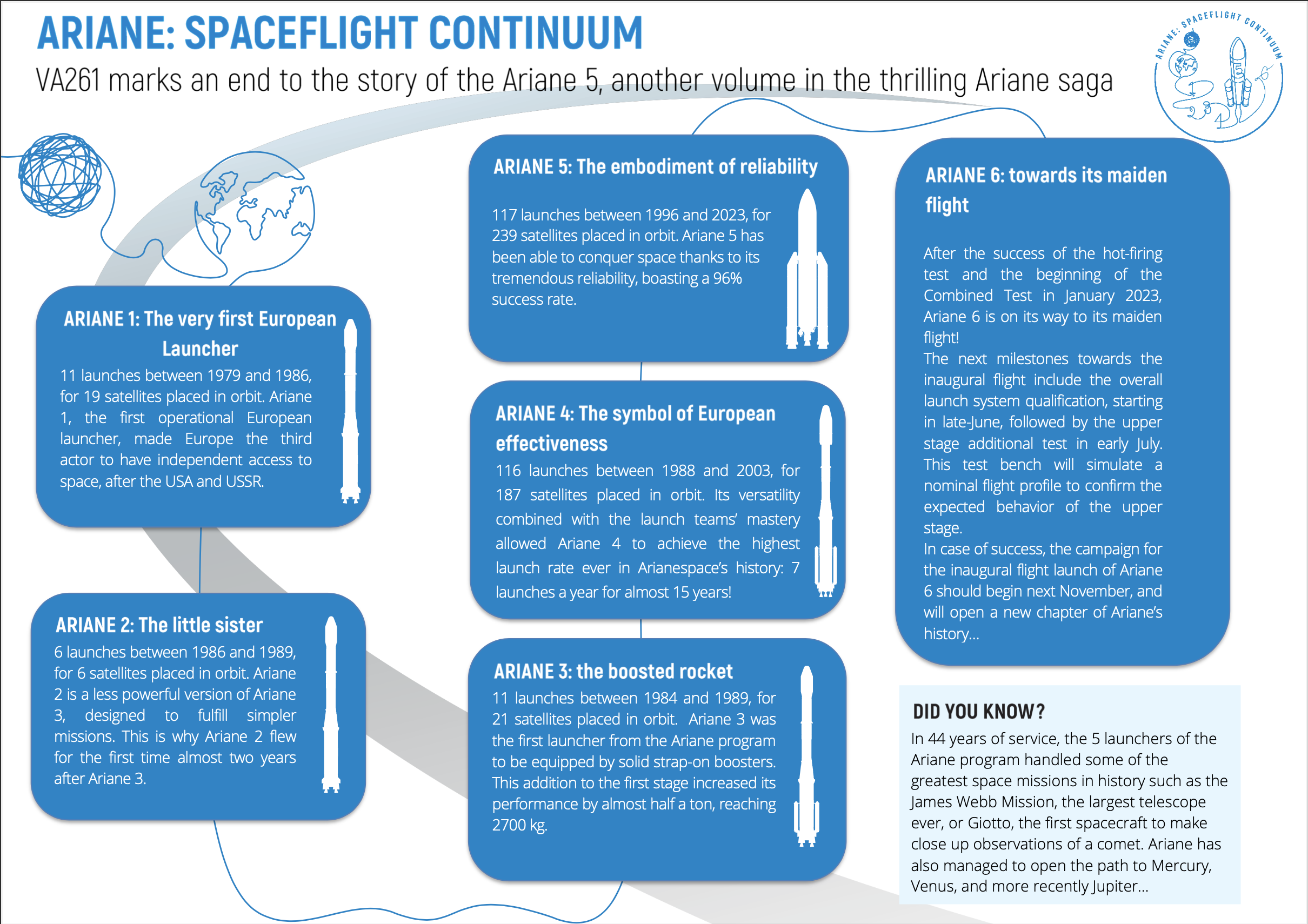
The Ariane launch vehicle family – an infographic released be Arianespace to mark the final launch of an Ariane 5. Credit: Arianespace
Ariane 5 was first launched in June 1996 in what was called the G(eneric) variant, capable of lifting 16 tonnes to low Earth orbit (LEO) or up to 6.95 tonnes to geosynchronous transfer orbit (GTO). Over the coming years, it iterated through four evolutions – G+, GS, ECA, and ES – each bringing about a range of performance and other improvements which raised the vehicle’s maximum lift capabilities to 21 tonnes of payload to LEO and 10.86 tonnes to GTO whilst also allowing Arianespace to lower launch fees to customers. In addition – and while it was never used in such a capacity – Ariane 5 is the only member of the Ariane family to be designed for crewed launches, in part being designed to carry the Hermes space plane to orbit (of which more below).
In all, Ariane 5 flew a total of 117 launches from 1996 onwards, suffering three partial and two complete failures to deliver payloads as intended, with an maximum launch cadence of 7 per year. Notable among these launches are:
December 10th, 1999: the X-ray Multi-Mirror Mission(XMM-Newton). Itself an oft-overlooked mission when compared to NASA’s Great Observatories programme, XMM-Newton was one of the four “cornerstone” missions of the Horizon 2000 chapter of ESA’s science missions.
Named for English physicist and astronomer Sir Isaac Newton, the spacecraft comprises 3 X-ray telescopes feeding a range of science instruments and imaging systems. Its primary mission is the study of interstellar X-ray sources in both narrow- and broad-range spectroscopy, and performing the first simultaneous imaging of objects in both X-ray and optical (visible + ultraviolet) wavelengths. The programme was initially funded for two years, but its most recent mission extension will see it funded through until the end of 2026 – with the potential (vehicle conditions allowing) – for it to be extended up to the launch of its “replacement” mission, the Advanced Telescope for High Energy Astrophysics (ATHENA), due to commence operations in 2035/6. As of May 2018, XMM had generated more than 5,600 research papers.
March 2nd 2004: Rosetta. Another Horizon 2000 “cornerstone” mission, Rosetta spent 10 years using the inner solar system to allow it to rendezvous with the nucleus of comet 67P/Churyumov–Gerasimenko – the first space vehicle to enter orbit around a comet following its arrival on August 6th, 2014.
For two years, the vehicle revealed an enormous amount about the comet, although it was perhaps overshadowed in the public consciousness by the adventures of the little Philae lander Rosetta dispatched to the surface of the comet, and which captured hearts and minds with its struggles.
November 12th, 2009, ESA’s Rosetta, launched via Ariane 5, approaches Earth for a final flyby before heading out into deep space for its rendezvous with comet. P67//Churyumov–Gerasimenko. Credit: ESA
May 14th, 2009: Herschel Space Observatory and Planck Observatory. These two ground-breaking missions were delivered to the Erath-Sun Lagrange L2 position (yes, the one also used by the James Webb Space Telescope – JWST -, and the one the Euclid mission will utilise where it arrives in an extended halo orbit around it in August 2023). Whilst separate missions, both spacecraft were launched on the same Ariane 5 booster and each utilised a service module built to a common design.
Initially planned for a 15-month primary mission, Planck – named for German physicist Max Planck – ran for just under 4.5 years, concluding in 2013 after on-board supplies of liquid helium were exhausted, and the primary instruments could longer be cooled to their required operating temperatures. As fuel remained for the craft’s manoeuvring thrusters, Planck was ordered to move away from the L2 position and into a heliocentric orbit, where its systems were decommissioned and the vehicle shut down.
The Herschel Space Observatory, meanwhile, operated for just over 4 years, and was the largest infrared telescope ever launched until the James Webb Space Telescope. It was yet another “cornerstone” mission for Horizon 2000, and was named for Sir William Herschel, the discoverer of the infrared spectrum. Its primary objectives comprised investigating clues for the formation of galaxies in the early universe, the nature of molecular chemistry across the universe, the interaction of star formation with the interstellar medium and, closer to home, the chemical composition of atmospheres and surfaces of planets, moons and comets within our solar system. In this regard, the observatory amassed more the 25,000 hours of science data used by 600 different science programmes.
October 20th, 2018: BepiColumbo. Undertaken by ESA and the Japan Aerospace Exploration Agency (JAXA), BepiColumbo is the overall mission title given to two vehicles and their transfer bus, all launched as a “stack” via Ariane 5, in a mission to carry out a comprehensive study Mercury, the innermost planet of the solar system. It is named after Italian scientist and mathematician Giuseppe “Bepi” Colombo.
Despite its orbit being relative close to Earth (when compared to the outer planets of the solar system that is), Mercury’s is one of the most technically complex to reach. “Bepi” Columbo calculated a vehicle could use a solar orbit and multiple fly-bys of the inner planets to reach Mercury in an energy-efficient manner – and it is this style of approach the mission is using to reach its destination. It has already completed five gravity assist manoeuvres (1 around Earth in 2020, two around Venus in 2020 and 2021 and 2 around Mercury in 2021 and 2022). A further fiver fly-bys of Mercury will occur in 2024/25 to bring the mission to its primary science orbit around the planet at the end of 2025.
An image captured by BepiColumbo on June 23rd, 2022 as the spacecraft flew past Mercury at a distance of 1,406km on its second major flyby of the mission. Between early 2024 and late 2025, the vehicle will use several more flybys to bounce itself int an extended orbit around Mercury and then into its primary science orbit. Credit: ESA / JAXA
At that time the vehicles will separate, the transfer bus, called the Mercury Transfer Module being discarded to allow the 1.1 tonne ESA-built Mercury Planetary Orbited (MPO) to commence what is expected to be at least one terrestrial year of operations studying the planet. During the initial phase of this mission, MPO will in turn deploy the Japanese-built Mio vehicle into its own orbit around Mercury, where it is also expected to operate for at least a terrestrial year.
[REN] May, 2023 – blog postThe following notes were taken from my audio recording and chat log transcript of the Content Creation User Group (CCUG) meeting held on Thursday, July 6th, and the Third Party Viewer Developer (TPVD) meeting held on Friday, July 7th, 2023.
Meetings
The CCUG meeting is for discussion of work related to content creation in Second Life, including current work, upcoming work, and requests or comments from the community, together with viewer development work.
The TPV Developer meeting provides an opportunity for discussion about the development of, and features for, the Second Life viewer, and for Linden Lab viewer developers and third-party viewer (TPV) / open-source code contributors developers to discuss general viewer development.
As a rule, both meetings are:
Held in-world and chaired by Vir Linden.
Conducted in a mix of voice and text.
Held at 13:00 SLT on their respective days.
Are subject to the schedule set within the SL Public Calendar, which includes locations for both meetings (also included at the end of these reports).
Open to all with an interest in content creation / viewer development.
As these meetings occasionally fall “back-to-back” on certain weeks, and often cover some of the same ground, their summaries are sometime combined into a single report (as is the case here). They are drawn from a mix of my own audio recordings of the meeting + chat log (CCUG), and from the video of the TPVD meeting produced by Pantera Północy (which is embedded at the end of the summaries for reference) + chat log. Not that they are summaries, and not intended to be transcripts of everything said during either meeting.
Viewer News
The Windows 32 + macOS pre-10.13 RC, version 6.6.13.580794 was rapidly promoted to de facto release status on July 6.
The Second Life Project Inventory Extensions viewer updated to version 6.6.13.580656, on July 6.
glTF / PBR Materials viewer, version 7.0.0.580782, June 30.
Maintenance T RC viewer, version 6.6.13.580700, June 28.
Project viewers:
Emoji project viewer, version 6.6.13.580279, May 30.
Puppetry project viewer, version 6.6.12.579958, May 11.
General Viewer Notes:
The Windows 32 + macOS pre-10.13 viewer is the last official viewer supporting either the Win 32-bit version or Mac OS versions prior to version 11. As viewers for 64-bit only and MacOS 11+ become the defacto releases, this viewer (as it is and without further update) will be moved to a side cohort, and used when someone running a pre-11 MacOS release or a Windows viewer incapable of running the 64-bit version of the viewer will receive this version instead.
Maintenance T has returned to being the most likely RC viewer due for promotion to de facto release status, now that its high crash rate has (hopefully) been brought under control.
The Emoji project viewer is liable to see further improvements to the Emoji picker in the UI.
glTF Materials and Reflection Probes
Project Summary
To provide support for PBR materials using the core glTF 2.0 specification Section 3.9 and using mikkTSpace tangents, including the ability to have PBR Materials assets which can be applied to surfaces and also traded / sold.
Substance Painter is also used as a guiding principal for how PBR materials should look in Second Life.
Up to four texture maps are supported for PBR Materials: the base colour (which includes the alpha); normal; metallic / roughness; and emissive, each with independent scaling.
Given the additional texture load, work has been put into improving texture handling within the PBR viewer.
In the near-term, glTF materials assets are materials scenes that don’t have any nodes / geometry, they only have the materials array, and there is only one material in that array.
As a part of this work, PBR Materials will see the introduction of reflection probes which can be used to generate reflections (via cubemaps) on in-world surfaces. These will be a mix of automatically-place and manually place probes (with the ability to move either).
The overall goal is to provide as much support for the glTF 2.0 specification as possible.
Bug-fixing within the simulator code is also on-going, so those testing PBR materials where the support is available should take note of this.
Obviously, to take advantage of these regions (both to upload PBR Materials and to see the new PBR environment lighting + the demonstration objects provided within some the regions, you must be running the PBR Materials RC viewer.
The cost of upload for Materials without any textures is free; however, the L$10 texture upload fee is charged on a per texture basis for any included within a PBR material surface (up to four can be included).
Any PBR materials content created within these environments which is later rezzed in any region that is not Materials-enabled, will become “material-less” in a non-recoverable way, and will need to be recreated.
Because of the above point, until PBR support is fully gird-wide, any attempts to put PBR-enabled goods on the Marketplace will be sanctioned.
General bug fixing on the viewer is also continuing, and the spread PBR across the grid is largely down to a mix of bug fixing and getting everything stable, and seeing if any particularly nasty blockers or bug rear up.
As an aside, the additional texture overhead for PBR Materials has been one of the drivers behind increasing the amount of VRAM the viewer can use for textures, as also now found within the PBR Materials viewer.
PBR Mirrors
This is a follow-on project to the PBR Materials, intended to provide a controlled method to enable planar mirrors in SL (i.e. flat surface mirrors which can reflect what is immediately around them, including avatars).
The approach Geenz Linden is taking towards enabling mirrors is to use a “hero probe” concept. In short:
With PBR, reflections are generated using reflection probes, per the notes above. These are capped at a maximum resolution of 128×128 per object face; hero probes will be capped at 512×512 per object face, providing a mush higher resolution of reflection.
Hero probes are an automated selection process. “Standard” probes cannot be converted to hero probes by manual intervention, nor can they be created.
A hero probe is selected on the basis of the “mirror” surface / probe and the proximity of the viewing avatar / camera to it.
Thus, if there are 5 mirrors place in a room, only the mirror closest to any given avatar / avatar camera will be used as a hero probe within that avatar’s viewer; the other four will remain “standard” probes, until such time as the avatar / camera moves closer to one of them, at which point it will become the hero probe, and the former hero will revert to a standard probe.
The primary use case for this work is mirrors, but it is possible, depending on performance impact, etc., that in the future, one additional hero probe might be allowed per scene, and the use case broadened (e.g. the water reflections).
In Brief
Via the TPVD meeting
Simulator updates: two simulator RC are currently with QA:
One includes updates to the avatar arrival code (i.e. handling avatars being received into the region via TP) which should help reduce the “viewer freeze” / frame rate drop others in the region can experience.
The other includes bug fixes and additional LSL functions.
General discussions on:
Anecdotal spotting of increased teleport failures, but lacking specifics on location, repro, etc. LL’s gridwide stats on TPs is not reflecting any noticeable uptick in failures. Therefore, those who do encounter them frequently are asked to:
Log where / when / how such failure occur.
If a pattern emerges (e.g. failures consistently occur when teleporting after doing X, or, say, in the first TP are logging-in, or anything else which suggests a possible underlying pattern), to file a Jira bug report, providing as much of the info they’ve gathered as possible.
A similar anecdotal report on people seeing themselves (or others as clouds for extended periods with in increased frequency. Again, where this is seen to happen consistently, a bug report is requested.
The official viewer CHUI + lack of chat bar (which also leans into what appears to be a lack of awareness that the Chat Console is not a “Firestorm feature”, but something generally available to people – although new users may need their attention directed to (and how to open chat from it), as the fade-out can case thigs to be missed and the click-to-open chat is not obvious.
On options available if TPVs that are not available in the official viewer (or possibly, with some, just not exposed through the UI), but which possibly should be.
Please refer to the TPVD meeting video below for further details on the above discussions.
† The header images included in these summaries are not intended to represent anything discussed at the meetings; they are simply here to avoid a repeated image of a gathering of people every week. They are taken from my list of region visits, with a link to the post for those interested.
Viper Heaven, July 2023 – click any image to view on Flickr
Cube Republic (of landscaping fame) poked me recently concerning Viper Heaven, a skyborne installation built by Markarius Viper high over one of the regions of Viper Estate, which Markarius runs along with JimSqu Sunbelter. An artist, builder and regions designer, Markarius’s name is not new to me, although I had to go all the way back to 2016 to find the last design I’d blogged about in which he played a role in designing (Osprey Ridge, which he designed with Flo (SweetFloXO), a place now gone from SL and the region repurposed as a marina). Given this and – most importantly – Cube’s recommendation – I stepped on the pad, figuratively speaking and ordered “energise.”
And am I ever glad I did; Viper Heaven is one of the most visually engaging, photogenic, imaginative, potentially romantic and mysterious designs it has been my pleasure to visit. Built high over a Full region utilising the Land Capacity bonus, Viper Heaven seamlessly brings together elements of fantasy, mythology, ancient civilisations, art, lighting, and a light smattering of religious iconography in a genuinely captivating setting which is an utterly Must See destination.
However, before getting into specifics – no easy task in itself, given the visual richness of the setting – there are a number of points worth keeping in mind ahead of any visit. The first is that everything within the setting has been carefully orchestrated – including the environment settings. It’s therefore vital it ensure your viewer is set to Use Shared Environment (World → Environment menu) prior to visiting. Alongside of this is the fact that Viper Heaven uses a localised Experience to handle seamless transitioning between the different environment settings as visitors move between locations and levels. This Experience also allows for automated teleports when the setting’s various portals are encountered, therefore, it is essential you join the Experience when the pop-up dialogue is displayed by your viewer.
Finally, and while Shadows do not need to be enabled during a visit (in fact, because of the surrounding shell of the “sky”, I would suggest leaving shadows off, even if you do normally explore with them enabled), due to the use of projectors, it is vital you make sure Advanced Lighting Model is enabled in your viewer (Preferences → Graphics → check Advanced Lighting Model if not already checked – and am I ever glad the occasions when I’ll have to give that reminder will start to draw to a close in the future!).
Viper Heaven, July 2023
To describe Viper Heaven is something of an exercise in futility; the simple truth is that this is a genuinely rich and immersive setting folding so much into it, and to appreciate it properly, it has to be seen first-hand. That said, and just to whet appetites, visitors will, within the three primary levels of of installation, find touches of ancient Egyptian and Grecian religion and mythology. For example Isis, Anubis, Bastet and Sobek occupy a setting that might easily suggest a location on the banks of the Nile at Thebes or perhaps Memphis; elsewhere, there is a ruined temple of an Oracle – still visited, it would seem, given the fresh fruits laid out before her statue in the hope of receiving divination by those leaving the gifts. Then, perhaps most noticeable of all – there are the three mighty Titans holding aloft the upper level, as if in honour of Atlas as he held aloft the celestial spheres, whilst Ganesha / Ganesh sits on a stone plaza, offering another touch of religious mythology.
And that’s just to start; also awaiting discovery are touches of Elven and Fae fantasy – particularly in the form of plants and structure by the Master Elf himself, Elicio Ember, whilst one corner of the setting carries a strong hint of Fritz Lang, another carries a Lovecraftian air, and still another a suggestion that dwarfish tools have been at work in hidden caverns. As all this is just for openers. From the landing point on the uppermost level paths wind around the main island as it is held aloft by the Titans, bridges reaching out to islands floating close to hand, stairs rising to different levels and exotic plants floating among the trees to cast a further air of alien fantasy into the mix.
Viper Heaven, July 2023
As mentioned, portals link the various levels, and these take various forms. Some are animated and rather indicative of their purpose. Others many appear as doors partially opened or tight shut. Still others might appear to be just a blank face of rock or wood into which the path seems to collide. No clue is given as to where they might lie or where they might lead – so if you want to discover all of Viper Heaven’s myriad secrets and appreciate its beauty and design to the fullest – walk is the order of the day!
Nor is Viper Heaven alone within the estate; also awaiting discovery is Viper Hell, as well are several other public locations. These are separate to Viper Heaven – giving me an excuse for return visits in the future! – but Markarius has developed a HUD to help people get around, which will hopefully soon be generally available at landing points, etc. But in the meantime, if you do pay a visit and catch Markarius on radar or in person, he’ll be happy to provide you with a copy of the HUD on request.
And all that said, I’ll leave you with my impressions of the setting on video – the first I’ve been able to produce of any reasonable length in a good few years thanks to ne hardware. I’m not sure how many videos I’ll produce going forward (I have some outstanding obligations to fulfil now I have everything sorted once more!), but frankly, Viper Heaven was simply too beautiful not to attempt to film it.
My thanks to Cube for the pointer, and to Markarius for taking the time to chat with me.






 Inara Pey: Living in a Modemworld