Space Sunday: flying on Titan; bringing home samples from Mars

A 2021 rendering of NASA’s Dragonfly octocopter vehicle, now set to head to Titan in 2028. Credit: NASA / JHU/APL

NASA’s ambitious plan to fly a robotic vehicle on a moon of another world is to go ahead after receiving official confirmation in April 2024. With its cost now set at some US $3.35 billion, double its initial price estimates – largely the result of the COVID pandemic derailing the vehicle development process in 2020/21 -, the vehicle – called Dragonfly (as is the overall mission) is intended to have a 10-year primary lifespan, with 3.3 years of that time spent flying around and studying Saturn’s largest moon, Titan.

Dragonfly is a spectacular science mission with broad community interest, and we are excited to take the next steps on this mission. Exploring Titan will push the boundaries of what we can do with rotorcraft outside of Earth.

– Nicky Fox, NASA associate administrator, Science Mission Directorate, Washington D.C.

Titan is a unique target for extended study for a number of reasons. Most notably, and as confirmed by ESA’s Huygens lander and NASA’s Cassini mission, it has an abundant, complex, and diverse carbon-rich chemistry, while its surface includes liquid hydrocarbon lakes and “seas”, together with (admittedly transient) liquid water and water ice, and likely has an interior liquid water ocean. All of this means it is an ideal focus for astrobiology and origin of life studies – the lakes of water / hydrocarbons potentially forming a prebiotic primordial soup similar to that which may have helped kick-start life here on Earth.

Using a vehicle that is in situ on the surface of Titan is vital, because the moon’s dense atmosphere obscures its surface across many wavelengths, making it exceptionally hard to definitively identify the specific combinations of hydrocarbon materials present across the moon’s surface without getting very up close and personal. To do this, Dragonfly will be a unique rotary vehicle, one a good deal heavier and more complex / capable than the Ingenuity drone flown on Mars (which was an extraordinary flying vehicle – and now static weather station – on Mars).

The brainchild of Jason W. Barnes (University of Idaho) and  Ralph Lorenz (Johns Hopkins University Applied Physics Laboratory – or JHU/APL), Dragonfly is being developed for NASA by JHU/APL, with Elizabeth “Zibi” Turtle, a planetary scientist at JHU /APL serving as the mission’s principal investigator.

The craft is designed as an octocopter – an aerial vehicle with four pairs of contra-rotating rotor blades. Each pair of rotors will be powered by its own electric motor, and the craft has been design to withstand either the loss of a single rotor blade or the completely failure of and one motor powering a pair of blades. It will have an on-the-ground mass of around 450 kg (compared to Ingenuity’s 1.8 kg), and will use a mix of nuclear and battery power.

A large lithium-ion battery will provide direct power to the vehicles flight and navigation systems and to this science suite. It will provide sufficient power for the craft to travel up to 16 km on a single charge at speeds of up to 36 km/h, with a maximum airborne time of around 30 minutes per flight, and an estimated maximum altitude of 4 km – although generally the craft will fly much lower than this. The battery will be supported / recharged by a Multi-Mission Radioisotope Thermoelectric Generator (MMRTG), which will also be used to provide heat to the vehicle, particularly during Titan’s night periods when it is behind Saturn relative to the Sun, and which lasts for 8 terrestrial days. The MMRTG will additionally provide power to the vehicle’s science instruments during the night periods, allowing them to work whilst the vehicle waits out the night in order to resume flying in daylight..

Dragonfly’s remarkable flight capabilities – speed, altitude, single flight distance – are made possible by Titan’s environment: the moon’s low gravity (around 13.8% that of Earth and dense atmosphere (around 1.45 times that of Earth’s) mean that the flight power for a given mass operating on Titan is around 40 times lower than on Earth, so the vehicle can have a fairly significant mass which can be lifted by relatively low-mass, low-power motors.

A Dragonfly testbed article undergoing flight trials

The vehicle will fly a primary science suite of four packages, comprising:

  • DraGNS (Dragonfly Gamma-Ray and NeutronSpectrometer): comprising  a deuterium-tritium Pulsed Neutron Generator and a pairing of a gamma-ray spectrometer and neutron spectrometer to identify the surface composition under the vehicle.
  • DraGMet (Dragonfly Geophysicsand Meteorology Package): a suite of meteorological sensors including a seismometer.
  • DraMS (Dragonfly Mass Spectrometer): a mass spectrometer to identify chemical components, especially those relevant to biological processes, in surface and atmospheric samples.
  • DragonCam (Dragonfly Camera Suite) is a set of microscopic and panoramic cameras to image Titan’s terrain and scout for scientifically interesting landing sites.

Samples of surface material for examination by the science packages will be obtained using two coring drills and hoses mounted within Dragonfly’s skid, per the video below.

Further, the vehicle will be equipped with a fully autonomous flight and navigation system capable of flying it along a selected flight path, making its own adjustments to account for local conditions whilst in flight, and with sensors capable of record potential points of scientific interest along or to either side of its flight path, so the information can be relayed to Earth and factored into planning for future excursions. Flights over new terrain will likely be of an “out and back” scouting nature, the craft returning to its point of origin, allowing controllers on Earth to plan follow-up flights to locations along the flight track, taking into account any points of interest noted by the vehicle.

Currently, Dragonfly is targeting a July 2028 launch, although the launch vehicle itself has yet to be announced. It will take seven years to reach Titan, mostly likely using several gravity-assist manoeuvres around Earth to slingshot itself on its way. In this, it will be the first dedicated mission to the outer solar system not to flyby / utilise Jupiter whilst en route, as the planet will not be within the mission flight path.

On arrival at Titan, and following separation from the cruise stage that would keep it both powered and warm during the trip from Earth, Dragonfly will enter the moon’s atmosphere atop a 3.7 metre diameter heat shield, and under a protective back shell. Once in the atmosphere, a single drogue and single large main parachute will be deployed to slow the vehicle’s descent until it reaches an altitude at which the parachute is released and Dragonfly can drop clear of the back shell, enabling it to start its motors and make a first landing on Titan.

A 2017 rendering of Dragonfly’s arrival on Titan. Credit: NASA / JHU/APL

In this, the landing site for the mission has already been selected: the edge of a prominent and dark region of Titan called Shangri-La, thought to be an immense sand sea of dark, carbon-rich material.

Specifically, Dragonfly will touch down in a dune field close to the relatively young Selk impact crater, which will be the vehicles first science study location, as it contains strong indications that it was once home to deposits of liquid water (and is now surrounded by ejecta that includes water ice) and contains tholin organic compounds. After this, Dragonfly will move on into the Shangri-La, carrying out exploratory flights of up to 8 km at a time and gathering samples for analysis from diverse locations.

NASA Re-Re-Rethinks Mars Sample Return Mission

NASA is now officially seeking both internal outside support for its much-troubled Mars Sample Return (MSR) mission.

The goal of returning samples of surface and sub-surface material from Mars to Earth, where it can be subjected to much more intensive and multi-disciplinary study than can be achieved via in-situ robotic explorations, has long be sought. For NASA, the last 20 years have seen numerous ideas put forward for gathering and returning such samples from Mars, all of which have ended up being cut down in their prime due to matters of cost and stringent curbs on the US space agency’s budget – sending a vehicle to Mars with the express intent of obtaining, storing and then returning samples to Earth not being the easiest of mission profiles to plan, let alone achieve.

However, in the lead-up to the Mars 2020 mission, featuring the rover Perseverance, NASA and the European Space Agency (ESA) signed a letter of intent to jointly develop a sample return mission based around the concept of the actual sample gathering being carried out by Perseverance and deposited on the surface of Mars for collection “at a future date”. The operation to start depositing groups of these samples actually started on December 21st, 2022, with a total of 10 sample tubes being deposited relatively close together on Mars by Perseverance.
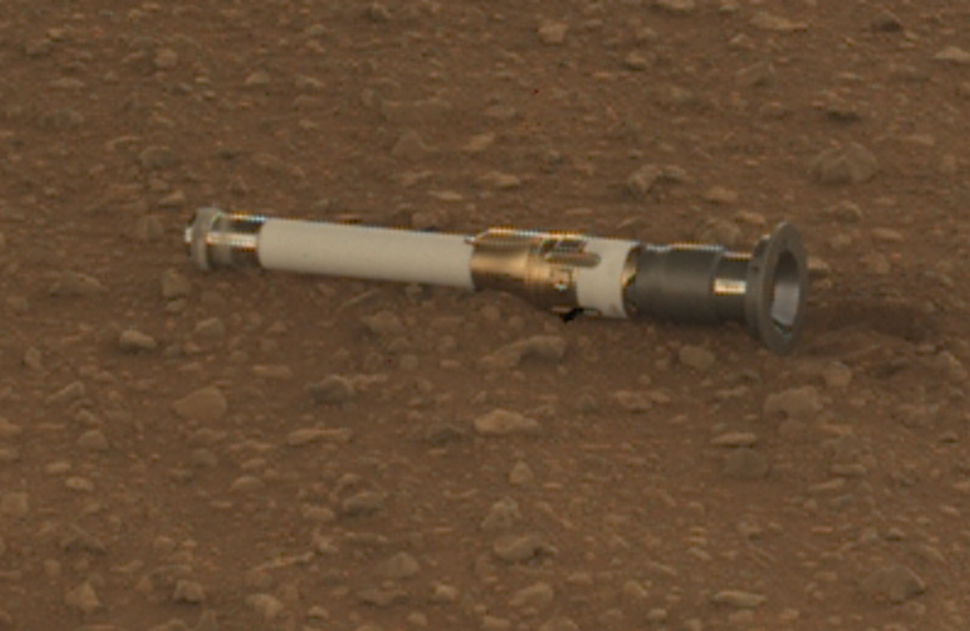
Resembling a Star Wars light sabre in an image obtained by the WATSON imager on Perseverance’s robot arm, this was the first of the sample tubes to be “dropped off” by the Mars 2020 rover (December 21st, 2022), marking the start of an initial operation to place 10 such sample tubes in a cache for collection by some future Mars Sample Return mission. Credit: NASA

Whilst this approach negated the need for the MSR to actually collect and store samples itself – in theory simplifying the mission parameters – actually settling on a final design for the mission proved difficult. By 2021, the “optimal” approach was seen as being a mission involving four unique vehicles in addition to the Mars 2020 rover. These were:

  • A NASA- built Mars lander / launch platform.
  • A NASA-built Mars Ascent Vehicle (MAV) with a specialised sample containment unit, and carried within the lander.
  • A European-built “fetch” rover with its own dedicated lander, designed to land ahead of the NASA lander and go find the sample tubes deposited by Perseverance, bring them to the NASA lander and transfer them into the sample containment unit in the MAV.
  • A European-built Earth Return Vehicle (ERV) designed to arrive in Mars orbit and await the arrival of the NASA-built MAV from the surface of Mars. This would then capture the sample unit (about the size of the basketball) after the latter had been released by the MAV, secure it and the samples inside itself and then make the return trip to Earth.

So, yeah; “simples” – not. The mission included, as identified by independent review board (IRB) charged with reviewing the mission for its overall cost-effectiveness and feasibility, no fewer than eight “break the chain” (and cause the mission to fail) first-time challenges, including the fully robotic collection and transfer of samples, the first automated launch of a vehicle from the surface of another planetary body, the first fully autonomous orbital rendezvous between two vehicles (the MAV and the ERV), and the first “pitch and catch” transfer of a sample package. However, despite this and concerns over the estimated mission cost rising to around US $4 billion, the IRB green lit the mission.

The MSR mission concept as envisioned in 2021 / early 2022 and featuring the ESA-built “fetch” rover (minus its lander).  Credit: NASA / ESA

 By July 2022, the complexities of the mission had been more fully realised, so efforts were made to “simplify” it. Specifically, the ESA “fetch” rover was eliminated from the mission – but was supplanted by the use of two Ingenuity class Mars helicopters. Fitted with wheels, these would also be delivered to Mars by the NASA lander carrying the MAV, and once there, they would fly and land in close proximity to sample tubes deposited by Perseverance, then drive up to them, pick them up and fly them back to the lander for transfer to the MAV, with the rest of the mission remaining the same.
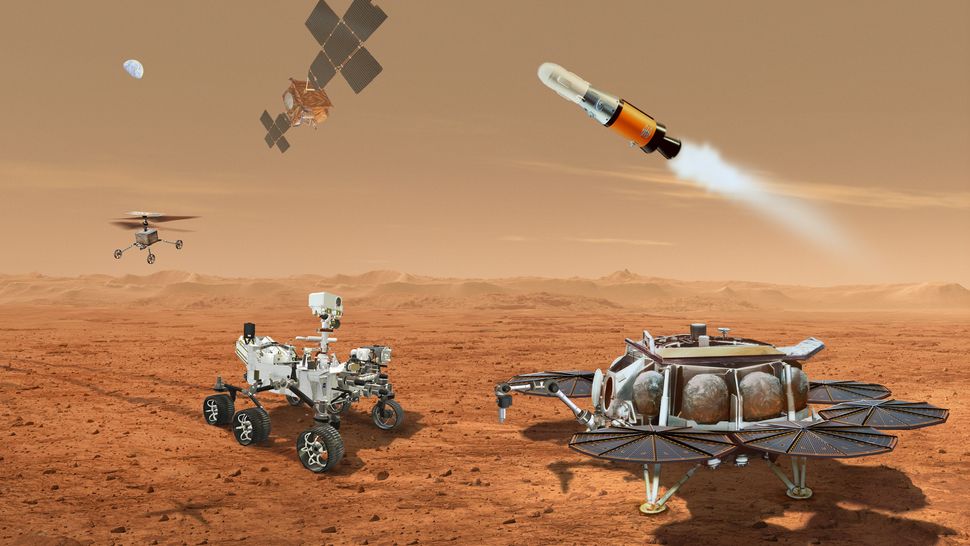
The 2022 MSR update, with the ESA “fetch” rover removed from the mission, and replaced by two Ingenuity-class  helicopters (only one shown), which would be delivered to Mars by the NASA MSR lander and tasked with recovering sample tubes deposited by the Mars 2020 Perseverance rover. Credit: NASA / ESA

However, while this removed the need for an entire rover and lander, and meant that effectively, NASA would have two further helicopters on Mars with which they could carrying out other missions once the sample tubes had been delivered to the MAV, it didn’t actually do much to reduce complexity or mission cost – which threatened to rise to around US $8 billion.

To offset this, the planned mission time frame was revised from around 2030-31 to the mid-to-late 2030s, allowing the mission cost to be spread across a greater number of NASA fiscal years. However, by mid-2023, it was widely recognised that the mission would probably exceed the US $8 billion estimate and peak at perhaps as much as US $11 billion – gaining the mission a lot of opposition on Capitol Hill. Suggestions were made to push the mission time-fame out further, with the lander / MAV / helicopter element not launching until the early 2040s.

By mid-2023, the mission had been further revised in order to try to reduce complexity and costs. Under the new proposal, none of the sample tubes thus far used and deposited on Mars for collection by Perseverance would actually be recovered (about 24 of the 43 total). Instead, all of the remaining tubes (16 of which have yet to be used, as of the time of writing) would be retained on the rover. Then, on the arrival of the MSR lander / MAV combination, Perseverance would rendezvous with them and load its supply of sample tubes directly into the MAV’s sample capsule for onward transfer to the ERV and a return to Earth. Whilst this would limit the selection of samples compared to gathering them from the various caches the rover had made on the surface of Mars, it did both simplify the mission – NASA only having to fly the MAV-carrying lander – whilst ensuring ESA’s involvement was not wasted, as they would still supply the Earth Return Vehicle.

The 2023 MSR update, with Ingenuity class helicopters removed and showing the Perseverance rover directly transferring sample tube to the sample capsule of the MAV, eliminating the need for intermediary vehicles. Credit: NASA / ESA

Despite this, over mission complexities and the need for the development of two entirely new classes of robotic spacecraft (the MSR lander-come-launcher for the MAV, and the MAV itself, complete with its sample storage / containment system) meant NASA would still be looking at around a minimum US $8 billion cost – and if the timeframe for the mission were to be extended into the early 2040s, inflation would likely push the final price back up towards the US $11 billion figure.

As a result, and with NASA’s budget already being severely stressed for the 2024/25 period, the agency finally admitted defeat with its more grandiose MSR plans, and on April 15th, 2024, the US space agency issued a statement indicating it is now looking “outside the box” for the means to carry out a Mars sample return mission in a cost-effective manner and within a reasonable time-frame (i.e. before the end of the 2030s). To this end, the statement calls on all NASA centres involved in Mars exploration to work together in order to develop such a mission, whilst also indicating the agency will seek proposals for potential mission architecture from the private sector.

Currently, NASA itself has admitted it does not have firm ideas on how mission costs can be reduced, but is determined to see the sample return mission take place, viewing it as a vital precursor to any attempt at a human mission to Mars. Thus, the process for redeveloping plans and ideas is expected to run through until the latter part of autumn 2024.

2024 week #16: SL CCUG summary

Selen’s Gallery, April 2024: Gem Preiz – Do You Like Gold? blog post †

The following notes were taken from my audio recording and chat log transcript of the Content Creation User Group (CCUG) meeting held on Thursday,  April 18th, 2024.

Meeting Purpose

  • The CCUG meeting is for discussion of work related to content creation in Second Life, including current and upcoming LL projects, and encompasses requests or comments from the community, together with related viewer development work. This meeting is held on alternate Thursdays at Hippotropolis.
  • In regards to meetings:
    • Dates and times are recorded in the SL Public Calendar.
    • Commence at 13:00 SLT on their respective dates.
    • Are conducted in a mix of Voice and text chat.
    • Are open to all with an interest in content creation.
  • The notes herein are a summary of topics discussed and are not intended to be a full transcript of the meeting.

Official Viewers Status

  • On Friday, April 19th, the Maintenance YZ RC ( My Outfits folder improvements; ability to remove entries from landmark history updated to version 7.1.6.8745209917.
  • On Wednesday, April 17th, Maintenance X RC viewer (usability improvements) updated to version 7.1.6.8709279750.

The rest of the official viewers remain as:

  • Release viewer: version7.1.5.8443591509, formerly the Maintenance-W RC (bug and crash fixes), version and issued March 29th, promoted April 9th –
  • Release channel cohorts:
  • Project viewers:

It is possible the glTF Maintenance-2 RC viewer might be promoted to de facto release status early in week ’13 (commencing Monday, March 25th, 2024).

Graphics / glTF

  • Work continues on the GLTF Featurettes viewer + support.
    • The viewer is in RC with on-going bug fixes.
    • The simulator support is now on a Preflight channel on Agni (the Main grid), which includes the regions Rumpus Room 2048; Rumpus Room 2049; Rumpus Room 2050 and Rumpus Room 2051.
  • 2K Textures:
    • Are not currently supported for upload onto the Main grid.
    • The fees for 2K textures have been set as follows:
      • Basic / Plus account: L$50 per texture.
      • Premium account: L$40 per texture.
      • Premium Plus: L$10 per texture.
    • 2K textures for Bakes on Mesh requires a substantial update to the Bake service (as is frequently mentioned at CCUG meetings), and currently this does not appear to be in the works.
  • Mirrors:
    • Now leverage the Dynamic flag. When set, this tells the mirror to reflect everything in the rendering pipeline including avatars and particles). if the flag is not set, avatars are particles are not rendered, just the environment (e.g. for a reflective floor which reflects the room, but rendering the avatars would cause a massive performance hit).
    • Mirror probes can now be set using LSL.
    • The updated UX for Mirrors is still not done, and it is acknowledged that setting up a mirror is far from intuitive. A good 10+ minutes of the meeting was devoted to “how to make a mirror” – rather proving the point!
  • Work has started on prototyping glTF scene handling (as part of the overall glTF scene import work). Initial work is to enable the showing of a scene locally within the viewer using a debug setting. More on this as the option becomes available in a viewer. But in short:
    • Once imported, glTF scenes will be an inventory asset type.
    • Each scene with by associated with an in-world object (e.g. a prim), which becomes its “handle”.

In Brief

  • Custom skeletons: this is an ongoing debate within LL. glTF allows for custom skeletons and animations. Second Life has a defined avatar skeleton and recognised animation formats for use against it.
    • As such, there is a disparity between SL and glTF, as in theory, adherence to the glTF specification means recognising the use of custom skeletons with their own animations – which would then be incompatible with the existing SL format(s), and lead to potential confusion  / clashes between established avatar types using the SL skeleton and custom skeletons.
    • Thus, some navigation is required to determine if / how custom skeletons might be handled without confusing the existing consumer market in SL in terms of what accessories work with which type of avatar.
  • Emissive strength is seen as “feeble” by some, so a request was made for a numeric box in which a desired emissive strength might be entered. As the glTF specification allows for this, it is something that could be added to a future viewer iteration (but not necessarily would be – Feature Request?).
  • Much of the meeting was about what extensions LL might consider, how things like emissive maps and lighting might be handled in the future, IOR, transmission and the potential to add iridescence – some of which are being worked on (IOR and transmission) and will be reported on in summaries as they come along, others are seen as possibly / maybe.

Next Meeting

† The header images included in these summaries are not intended to represent anything discussed at the meetings; they are simply here to avoid a repeated image of a gathering of people every week. They are taken from my list of region visits, with a link to the post for those interested.

Lab Gab April 2024 Update: Mobile, Mirrors, Policies – summary

via Linden Lab

On Friday, April 19th, Linden Lab issued a pre-recorded segment of Lab Gab, intended to provide updates on various technical projects currently in progress – notably the SL Mobile app – and to provide a modest degree of update on policy matters in the wake of allegations levelled publicly and pseudonymously against the company and some of its employees and contractors, during the month of February 2024.

The video itself – which is embedded at the end of this article – is extensively indexed within its You Tube page. The following is a brief summary of the major (in my eyes) points raised in the segment, and offered as a quick reference summary for those interested.

SL Mobile – Status

[Video: 1:20-12:00]

  • Currently remains in Premium Plus closed alpha testing (Premium Plus members can sign-up for access to this alpha testing phase).
  • Work is in progress to expand access to Premium subscribers. However, this requires moving the app from the iOS (Test Flight) and Google Android testing infrastructure (where users have to be manually added to the test environments) to an environment where granting access can be handled on a more automated / streamlined basis, and this will take time to complete.
  • An update highlighting some of the more recent Mobile app features was issued on April 5th, 2024, and the week commence April 15th, 2024, saw an updated version of the app made available to those in the alpha test programme, which includes further bug fixes and updates – including the addition of deformer support, so quadruped / non-biped avatars render correctly in the app.

How Development of the Mobile App is Approached

[Video: 4:06-6:45]

  • SL Mobile development is being looked at in terms of what residents may want to do and the features required to achieve that.
  • Currently the focus is on users staying connected through notifications, being able to converse, etc., and the receipt (and response to) off-line IMs (which is said to have implications for Second Life in general, not just with regards to Mobile, with future updates on what is being done being promised.
  • Related to this is work on actually being able to do things – visit places, change outfits / looks / accessories, etc., and interact with objects.
  • In addition to providing features and capabilities for active users, Mobile is being thought of in terms of how to get “lapsed” users to re-engage with the platform. This work particularly requires the building-out of a set of capabilities to help such users re-engage with the platform and friends as smoothly as possible.

Mobile Q&A

[Video: 10:14-12:00]

(taken from questions submitted in advance, following the announcement of a Mobile update segment of Lab Gab originally scheduled for March 2024, but subsequently postponed.)

  • Will SL Mobile support HUDS – yes.
  • Create and build on Mobile? – longer-term it might be possible to provide a feature that allows some form of content creation on Mobile, but it will be limited. For “serious” content creation capabilities, the desktop viewer will still be required.
  • Voice support on Mobile – yes
  • Estate Management – maybe.
  • Mobile-specific capabilities (webcam, GPS, etc) – maybe.
  • Keyboard & mouse support – definite maybe.
  • Will Mobile be free or pay-to-access  – currently, there are no plans to charge for Mobile use, but ideas for making current subscription plans ore meaningful for those only accessing SL via the app are being considered.

glTF / PBR

[Video: 12:53-20:05]

Mirrors

  • A glTF “featurette” capability, providing real-time mirrors in Second Life (including avatar reflections).
  • Currently available for testing on Aditi (the Beta grid), but simulator support due to start limited deployment on Agni (the Main grid) during week#17 (commencing Monday, April 22nd), with viewer support (at the time of writing) available via the glTF Featurettes RC viewer.
  • In keeping with the new glTF features, leverage both reflection probes and the upcoming 2K texture support.
Signal Linden demonstrates the glTF mirror capability, which is about to become fully available in Second Life

2K Textures – including Fees

  • Full support for 2048×2048 textures.
  • To ensure there is no undue impact on performance given 2K textures have 4 time the area of current 1K textures, work has been put into streaming optimisation to ensure only the require MIP map is used with a textures (e.g. if the texture is 2K, but the surface it is being displayed on only requires 512K – then the 512K MIP map will be used, NOT the 2K MIP.
  • Fees for 2K texture uploads:
    • Basic / Plus account: L$50 per texture.
    • Premium account: L$40 per texture.
    • Premium Plus: L$10 per texture.
  • Viewer support will be provided separately to the Mirrors / PBR Terrain work, “soon”.

PBR Terrain

  • Provides support for PBR materials on SL terrain (including specular and normal map support).
  • Includes the use of 2K textures.
Materials applied to Second Life terrains. Credit: Linden Lab
  • Not only improves the texel density (resolution) for terrain, but also provides better blending between textures as terrain elevation changes.

General

  • Those wishing to see glTF mirrors and terrain support can do so by requesting access to Aditi (the beta grid) and visiting one of the following regions: Rumpus Room 2048; Rumpus Room 2049; Rumpus Room 2050 and Rumpus Room 2051.
  • However, (initially limited) deployment of back-end support for Mirrors and PBR Terrain on Agni (the Main grid) commenced on Wednesday, April 17th, using the Featurettes RC viewer available via the Alternate Viewers page. The supported regions have the same Rumpus Room names as given above, and I will be updating on this as a part of my SUG meeting summaries.
  • All of the glTF work is discussed at the Content Creation User Group – see the SL Public Calendar for the meeting dates – and I summarise meetings here.

Policy Updates with Keira Linden

[Video: 21:14-24:12]

Note: this section is in keeping with the statement by Linden Lab owner and Executive Chair, Brad Oberwager in light of allegations made with a pseudonymous article which appeared on a social journalise website in February 2024 (further commentary on this can be found here).

  • A reminder of the age requirements for Second Life:
    • Second Life is generally for adults (18 years or older).
    • 16-17 years are allowed, but only within General rated regions.
    • Second Life is not intended for anyone under the age of 16, except for students in the 13-15 year age range, who are restricted to regions operated by recognised / sponsoring educational organisations, and provided with access through a special registration process.
  • LL is keenly aware of the need not to expose minors to inappropriate content. As such, the age verification process for users entering second Life is to be strengthened, and further details on this will be made available soon.
  • Use of child avatars:
    • Linden Lab recognises that adults do role-play and present as child avatars in ways that are entirely without any form of sexualisation or in any way ageplay related, and the company has no intention to limit or prevent this kind of engagement.
    • However:
      • Child avatars should not be used to access or be near regions which have (or also have) adult-rated content / activities.
      • Consenting adults engaging in adult-oriented role-play with / using avatars presenting as children (aka “ageplay”) is not allowed – and will never be allowed – in Second Life, and the policy on this is strictly enforced.
    • In light of the recent allegations, the Lab is in the process of strengthening the child avatar policy, and the updated version will be rolled out soon. The intent of these changes is to ensure an even greater separation between the use of child avatars and adult-rated content in Second Life.
  • As well as the above, LL is looking to improve policies relating to conduct both within the broader Second Life community of users and within the company as well (e.g. how staff interact with the wider community, and policies relating to potential conflicts of interest / the perception of favouritism,  in the case of the latter).
  • A cross-department project is also underway to help with content moderation, both in-world and on the Marketplace.

Community Round Table

[Video: 24:14-25:17]

  • A new channel of communication to launch in May 2024.
  • Being seen as a more “general purpose” user group meeting type of forum where users can put forward their ideas on how to improve Second Life to executive members of Linden Lab’s leadership.
  • Details to be forthcoming soon.


2024 SL SUG meetings week #16 summary

Grauland – Last Trees, April 2024 – blog post †

The following notes were taken from the Tuesday, April 16th, 2024 Simulator User Group (SUG) meeting. They form a summary of the items discussed, and are not intended to be a full transcript, and were taken from my chat log and the video by Pantera – my thanks to her as always for providing it.

Meeting Overview

  • The Simulator User Group (also referred to by its older name of Server User Group) exists to provide an opportunity for discussion about simulator technology, bugs, and feature ideas.
  • These meetings are conducted (as a rule):
  • They are open to anyone with a concern / interest in the above topics, and form one of a series of regular / semi-regular User Group meetings conducted by Linden Lab.
  • Dates and times of all current meetings can be found on the Second Life Public Calendar, and descriptions of meetings are defined on the SL wiki.

Simulator Deployments

  • The Main and the majority of RC channels will all be restarted this week (Tuesday / Wednesday) with no updates deployed.
  • The exception to this is the Preflight RC channel which will be updated on Wednesday, April 17th, with the back-end support for the the glTF updates available in the Graphics Featurettes viewer (e.g. PBR terrain textures and mirrors.
    • Note that this deployment is for testing only.
    • Support for 2K texture will not be enabled simulator-side as a part of the initial deployment, as these are awaiting a couple of fixes to clear QA. Ergo, support for 2K textures within the preflight channel will be enabled later.

Upcoming Deployments

  • Back-end support for WebRTC Voice will be next to be deployed, and this will likely go to a Snack RC channel.  See my Week #12 summary for an outline of WebRTC voice.
  • The upcoming Spring Break RC release (yet to go to RC) will have a fix for the hovering-at-login issue.

SL Viewer Updates

No updates to the official viewers currently in the pipeline, leaving them as:

  • Release viewer: version7.1.5.8443591509, formerly the Maintenance-W RC (bug and crash fixes), version and issued March 29th, promoted April 9th.
  • Release channel cohorts (please see my notes on manually installing RC viewer versions if you wish to install any release candidate(s) yourself).
    • Maintenance Y/Z RC ( My Outfits folder improvements; ability to remove entries from landmark history), version 7.1.6.8632452945, April 12.
    • Materials Featurettes RC viewer, version 7.1.5.8472515256, April 3
    • Maintenance X RC (usability improvements), version 7.1.5.8443777128, April 2.
  • Project viewers:

In Brief

  • Teleports / region crossings: the question was asked as to which would have the greater performance impact: a avatar with 10 attachments, each of a single linked part in each, or an avatar with 1 attachments of 10 linked parts.
    • The reply from Monty Linden was that – outside of script considerations – the difference is liable to be negligible (scripts being the major performance hit in terms of region crossings / teleports).
  • A discussion on attachment point in general, including:
    • An increase to the maximum allowed attachments (38), primarily to help deal with issues as specified in this Feature Request, if providing a function as outlined in the Feature Request was not on the cards. However, it was felt by some that attachment counts should not be increased until the maximums for allowed worn prims / scripts are brought down to realistic figures and enforced.
    • A suggestion that a couple of attachment points by reserved specifically for Experiences.
    • A request for updates to the particle system to work with rigged attachments (removing the need unrigged particle prims). However, as the simulator does not track attachment points (which would be required for this to work), it was seen as not doable.
  • A request was made for LL to offer an LSL function so creators could clamp raycasts to the region edge in order to stop the end-points going off-region (/simulator) and causing errors.
    • Whilst seen as doable, it was felt that as raycasting should not have end points beyond a region’s boundaries, a better solution might be to identify and fix the underpinning bug that is allowing it.
    • Fixing the issue might also allow LL to implement the idea outlined in llVisualizeRay – A way to see Raycasts, but using llCastRay rather than adding a new LSL function.
  • Please refer to the video for:
    • A discussion on HTTP request throttling.
    • A discussion om script modules / libraries.
    • General thoughts on region crossings.

† The header images included in these summaries are not intended to represent anything discussed at the meetings; they are simply here to avoid a repeated image of a rooftop of people every week. They are taken from my list of region visits, with a link to the post for those interested.

2024 SL viewer release summaries week #15

Logos representative only and should not be seen as an endorsement / preference / recommendation

Updates from the week through to Sunday, April 14th, 2024

This summary is generally published every Monday, and is a list of SL viewer / client releases (official and TPV) made during the previous week. When reading it, please note:

  • It is based on my Current Viewer Releases Page, a list of all Second Life viewers and clients that are in popular use (and of which I am aware), and which are recognised as adhering to the TPV Policy. This page includes comprehensive links to download pages, blog notes, release notes, etc., as well as links to any / all reviews of specific viewers / clients made within this blog.
  • By its nature, this summary presented here will always be in arrears, please refer to the Current Viewer Release Page for more up-to-date information.
  • Note that for purposes of length, TPV test viewers, preview / beta viewers / nightly builds are generally not recorded in these summaries.

Official LL Viewers

  • Release viewer: version7.1.5.8443591509, formerly the Maintenance-W RC (bug and crash fixes), version and issued March 29th, promoted April 9th – NEW.
  • Release channel cohorts (please see my notes on manually installing RC viewer versions if you wish to install any release candidate(s) yourself).
    • Maintenance Y/Z RC ( My Outfits folder improvements; ability to remove entries from landmark history), version 7.1.6.8632452945, April 12.
  • Project viewers:
    • No updates.

LL Viewer Resources

Third-party Viewers

V6-style

  • Alchemy updated to version 7.1.4.2442 (Beta PBR build) April 12 – release notes

V1-style

  • No updates.

Mobile / Other Clients

  • No updates.

Additional TPV Resources

Related Links

Grauland’s Last Trees in Second Life

Grauland – Last Trees, April 2024 – click any image for full size

Jim Garand never fails to intrigue / please with his periodic re-designs of Grauland, his Homestead region. Since 2019 he has consistently offered environments for people to visit which have mixed themes and ideas in multiple ways – landscapes, art, architecture, history, mystery, science fiction, and so on.

As such, it is always a pleasure to drop in and witness what he has most recently created for people to enjoy. And for me, this is particularly true of the April 2024 edition of the region, which he has called Grauland – Last Trees, as it reminds me of one of my favourite – and potentially one of the most underrated classics of of the genre – science-fiction film, Silent Running.

Grauland – Last Trees, April 2024

The region does this in two ways. The first is that – like the film – it appears to offer a commentary on the environment and the damage being done to it by the human species. In this, the setting also perhaps echoes Waterworld, given it appears to be a lone outpost rising from an unending sea; but I’m sticking with Silent Running simply because of the two great biodomes sitting to the north and south of the outpost. If you’re familiar with the film, then it’s hard not to see these two massive geodesic structures of glass and steel and not think of Valley Forge and the precious cargo she and her sister ships carried in the home of one day replanting Earth.

Here, however, the domes do not protect woodlands or the fields of plants and all the insects and smaller animals vital to a healthy biosphere as seen in the film. Instead, each dome is home to a single giant oak rising from a sea of grass and spreading their boughs in defiance of the glowering sky outside of the gentle lights (and warmth, perhaps?) of the domes. But as with Silent Running, it would appear that this outpost, anchored to the bed of the shallow surrounding sea, is dedicated to the preservation of these two great trees and also to the renewal of plant-life to some degree, given the hydroponics farm located in the lower level of one of the great domes.

Grauland – Last Trees, April 2024

Whilst not out in the void of space near Saturn, Grauland’s outpost is crewed by people clearly trying to make the best of things – as were the crew of the Valley Forge. Part of the station is devoted to living quarters offering creature comforts and sitting over floating docks where jet skis and RHIBs are available for recreational enjoyment on the water (and yes, you can ride the jet skis), while lidos and floats bob on the water, suggesting swimming is also to be had. In this, the jet skis – for me – offered a further indirect link to the film, standing-in for the four-wheeled buggies Freeman Lowell and his colleagues used to let off steam as they raced around their cargo ship.

Sadly, Huey, Dewey and Louie are absent from Jim’s design – probably because the similarity to Silent Running is entirely of my own making -, but there are three android-like heads and upper bodies awaiting discovery instead. Quite what their purpose might be is for anyone visiting to guess. Perhaps, within their I, Robot-ish looks, they are the brains monitoring the station. You decide.

Grauland – Last Trees, April 2024

A series of landing pads, four of them occupied by hopper shuttles, suggest that flight is required to get to the station from elsewhere (wherever that might be), with two of the craft apparently for rescue / evacuation use. However, given a wheeled amphibious truck is hauling itself out of the water onto an elevator platform, there is also the suggestion that land of some kind might not actually be too far away.

If land is relatively close by, then the question must be asked what has happened to require a station such as this, dedicated as it seems to be, to the preservation of the two great oak trees and the growing of new plants (or trees)? Indeed, is this base actually on Earth at all – or are we perhaps somewhere else in the cosmos, a place sufficiently like Earth so as to support Earth-based animal (i.e. human) and plant life? In all of this Jim offers no clues, instead leaving the door of the imagination wide open to allow us to formulate our own ideas and stories about this place.

Grauland – Last Trees, April 2024

What is clear is that while the waters here might be shallow, they would appear to be wracked at times by storms of a sufficient enough violence to warrant sitting the majority of the base atop massive girder-like legs, presumably to lift the buildings, landing pads and so out wall out of the reach of ravaging waves and spray. It’s also clear that there is much to explore here as well – stairwells climb between levels, catwalks, ramps and gantries connect different areas, elevators offer ease of access to the water up to higher sections of the outpost for those who don’t fancy counting steps, and the crew quarters offer their own curiosities.

All told, another expressive and imaginative build by Jim, and one well worth visiting and exploring.

Grauland – Last Trees, April 2024

SLurl Details