Logos representative only and should not be seen as an endorsement / preference / recommendation
Updates from the week through to Sunday, August 11th, 2024
This summary is generally published every Monday, and is a list of SL viewer / client releases (official and TPV) made during the previous week. When reading it, please note:
It is based on my Current Viewer Releases Page, a list of all Second Life viewers and clients that are in popular use (and of which I am aware), and which are recognised as adhering to the TPV Policy. This page includes comprehensive links to download pages, blog notes, release notes, etc., as well as links to any / all reviews of specific viewers / clients made within this blog.
By its nature, this summary presented here will always be in arrears, please refer to the Current Viewer Release Page for more up-to-date information.
Note that for purposes of length, TPV test viewers, preview / beta viewers / nightly builds are generally not recorded in these summaries.
Official LL Viewers
Release viewer: version 7.1.8.9375512768, formerly the Graphics Featurettes RC viewer dated June 5 and promoted June 10th.
Release channel cohorts:
Atlasaurus RC (object take options; improved MOAP URL handling), updated to version 7.1.9.10220184061, August 7.
Akijima August 2024: Eta Mae: t’s All Blinn-Phong to Me!It’s All Blinn-Phong to Me! is a new and relatively light-hearted art exhibition by EtaMae (Etamae) and being hosted at Akiko Kinoshi (A Kiko) at her Akijima arts region with her Akipelago chain of Islands.
For those who may not be familiar with the term, Blinn-Phong is a reflection / shading model which, in terms of Second Life has been the mechanism by which materials and their reflectivity worked exclusively prior to the arrival of glTF / PBR in SL (and indeed, still work – they haven’t gone away with the arrival of PBR).
Akijima August 2024: Eta Mae: t’s All Blinn-Phong to Me!
While Blinn-Phong is the correct name for this type of shading / reflection model, the fact is that for many, it is another odd term being ushered in alongside a tonne of others as glTF makes its presence felt in Second Life. There’s glTF and PBR themselves, together with metallic roughness, base colour, emissive, transmission, index of reflection, and so on. All of which can start to sound like a foreign language and seem quite frightening when really all they signify is an effort to bring SL graphically and technologically in line with modern rendering engines and the toolsets and standards used in content creation.
And that’s something of the “message” behind this art exhibition: don’t worry about all the terms; they are either just new ways of expressing what you’ve been doing all this time, or indicating there are new ways of doing things you’re always done, whilst offering new little tweaks you can make to things.
Akijima August 2024: Eta Mae: t’s All Blinn-Phong to Me!
On offer are a series of beautifully abstract pieces by Eta, 15 in a larger format, created using Blinn-Phong materials and seven smaller pieces (including the one at one of the entrances to the gallery space) created using PBR materials. Each set incorporates subtle animations, and both look very similar – emphasising the fact that whether you call them Blinn-Phong, PBR or just “materials”, nothing has changed in terms of what the finished results can be – or might be; we can still build and create and display – and have a few new treats to boot, such as the mirror elements Eta has added to her PBR art (and which could have been as easily built using Blinn-Phong materials).
It’s an elegant, simple statement; as Eta notes: it’s not profound, it’s not deep – but it it is illustrative. Just because the terms are new and the technology is changing, there’s no need to be frightened or object to what’s going on. SL is still a place where we can express ourselves (physically and artfully). So just chill, have fun – and enjoy!
Akijima August 2024: Eta Mae: t’s All Blinn-Phong to Me!
A rendering of the Marine Spaceport (MS) Voyager launching a Space Perspective capsule at the start of a 6-hour journey under a balloon to carry passengers to an altitude of 32 km and then bringing them back to a safe splashdown and recovery. Credit: Space Perspective
At a time when Blue Origin are lobbing place to the edge of space in ballistic capsules and Virgin Galactic has been (although currently on hiatus) chucking them not-quite-so-high on rocket planes, Space Perspective came up with an altogether more sedate – and longer duration approach to giving people a taste of space: send them up in a balloon.
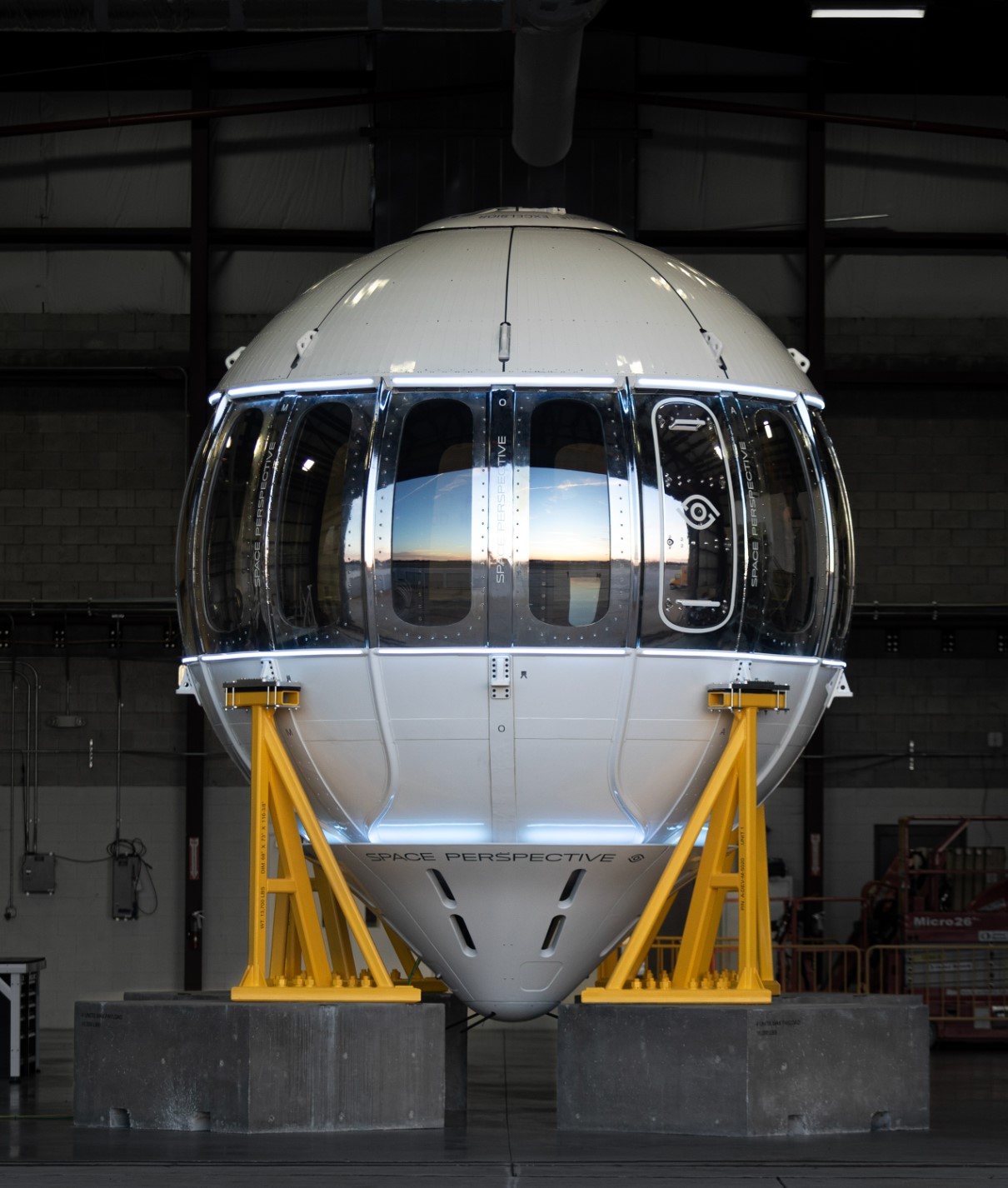
Space Perspective’s Neptune capsule test article at their hanger in Titusville, Florida. Credit: Space Perspective
When I first wrote about the endeavour, Space Perspective planned to offer flights for up to 8 passengers and 2 crew starting on land, using a purpose-built balloon with a luxury capsule slung beneath it to carry them up to around 30-32 km altitude (not high enough to qualify for astronaut wings but more than enough to witness the curvature of the Earth and see it passing below as the 6-hour flight heads out to sea) before descending to a splashdown and a return to dry land aboard a luxury boat.
Since then things have changed somewhat. Whilst the overall goal remains the same – and the prototype capsule for the flights, called Neptune, has made a number of demonstration flights, once the system is approved and operational, the entire flight will commence and end at sea, launched and recovered via a purpose-equipped vessel.
MS Voyager undergoing sea trails following her refit and renaming. Credit: Guice Offshore / Space Perspective
The MS (Marine Spaceport) Voyager, as the vessel is known, is a former 3,100 tonne displacement oil platform support vessel (OSV) measuring 90 metres in length, 61 metres of which is a flat working deck which has been specifically outfitted for the launch and recovery of the company’s balloons and capsules. The term “Marine Spaceport” replaces the more usual usage of MS (“Motor Vessel”) to indicate the ship is intended to be a fully ocean-going launch and recovery vessel. Initially it will operate of the United States Space Coast, Florida, but Space Perspective is already eyeing the potential to offer flights out of the Caribbean and other wealthy tourist retreats, thus bringing the thrill of edge-of-space flight to the potential travellers, rather than making them travel to the launch pad.
The name Voyager was chosen in direct reference to NASA’s Voyager mission programme, and specifically Voyager 1. Billed as the “first” in its class and operated by specialist marine and aerospace recovery company Guice Offshore on behalf of Space Perspective, both companies have hinted further vessels (Voyager 2?) might be made available in the future.
A rendering of the inside the Neptune Capsule with an added backdrop of the Earth visible through the windows. The cabin sits 10 – 8 passengers + 2 crew and features a “space spa” (washroom) and drinks and snacks. Credit: Space PerspectiveThe ship was officially unveiled in January 2024 following a 2-year refit and upgrade. This includes outfitting her for balloon and capsule transport, balloon inflation, capsule launch system, capsule recovery system (following splashdown, rather than trying to recover the capsule directly on the deck) and more. In addition, the vessel has been equipped with luxury staterooms for capsule passengers, a passenger lounge and a fully equipped hospital. Since its official unveiling in its finished looks (the company did reveal snippets of it during the acquisition and conversion process), Voyager has been undergoing final re-certification and licensing trials prior to moving to ita new berth at Port Canaveral, its base of operations.
The capability to launch and retrieve the Neptune capsule at sea creates worldwide scalability along with an unprecedented closure of the routine operations safety case. We are proud to bring a new spaceflight capability to Port Canaveral and the Space Coast.
– Taber MacCallum, founder and co-CEO of Space Perspective
Whilst no dates have been given, Space Perspective has indicated the next phase of work is to test launch and recovery operations using the Neptune capsule. After these, the company expects to move towards obtaining a commercial license for passenger operations and then to offering flights.
Tickets for the latter have already been offered by the company at US $125,000 per head – far less than either Virgin Galactic or Blue Origin, although both of the latter do offer periods in microgravity, which Space Perspectives cannot provide. The company has not revealed how many tickets it has sold in advance of commencing operations.
The Great Lake of Mars
Mars is a small world when compared to Earth, but it likes to do things big. There’s Olympus Mons, the massive shield volcano , rising almost 22km above the Mars datum (compared to Mauna Loa and Mauna Kea rising some 9-10km above the sea floor on Earth), and covering an area as much as 300,000 sq km in size (compared to the10,430 sq km of the Island of Hawaii). Or there’s the 4,000+ km length of the Vallis Marineris, in places 7 km deep and more than capable of regarding the 447 km long and 1.6 km deep Grand Canyon as a mere tributary.
Both of these feature are very well known to people even with just a passing interest in Mars. But there is another remarkable – if less obvious – feature on Mars which has been the subject of extended study by Europe’s 20-year Mars orbiting veteran, Mars Express.
Located in the planet’s southern hemisphere, and badly scarred and weathered by impact craters and the passage of time, are the remnants of a vast lake – or perhaps sea might be a better description – that at some point in the ancient Martian past may have been up to 1 km deep, a depth similar to the extent of the southern end of the Caspian Sea, Earth’s largest inland sea. However, where the latter covers an area of some 386,400 sq km, Eridania Lake on Mars once covered an area of some 1.1 million square km – big enough to hold three times the volume of water by volume than the Caspian Sea. And if you’re wondering about how this compares to the Great Lakes in North America, the largest bodies of freshwater on Earth, they “merely” cover an area of some 244,100 sq km with a maximum depth of around 406 metres.
However, like the Great Lakes, Lake Eridana consists of several interconnected basins, all of which likely held water as a common lake between 4.1 and 3 billion years ago. These basins are still visible on the surface of Mars today and, and are now officially called the Ariadnes Colles (“hills”), Coralis Chaos, Atlantis Chaos, Simois Colles, and Gorgonum Chaos.
What is particularly interesting about this region is not the fact it was once a vast lake, but that it is exceptionally mineral and clay rich (the clay deposits being up to 2 km thick), with many of the detected minerals showing clear signs of volcanic origins. This means that the lake bed could once have been home to hydrothermal vents; thus Eridana potentially offered everything life needed to bring itself into being back in the Martian pre-history: the right chemicals and minerals, a source of water, and a source of heat / energy.
An illustration of how volcanic activity may have caused the deposition of minerals on the floor of Lake Eridania and chlorides along the shoreline as a result of evaporation. Credit: J Secosky via wikimedia
The clearest evidence for the region being subject to the effects of volcanism is not so much in the presences of ancient volcanic peaks, but from the presence of significant fault lines collectively called the Sirenum Fossae. Over 2,700 km in length, these fault lines sit either side of a trough of land which dropped below the mean surface level to form a graben as the land either side of the faults was pulled apart. It’s believed this occurred when the crust of the planet was under enormous strain as the massive Tharsis bulge with its three huge volcanoes was forcing itself upwards half a world away, allowing liquid magma to channel its way up to the heat the lake bed, giving rise in turn to the hydrothermal venting.
The hills of Ariadnes and Simois Colles are thought to have been mounds of material deposited within the lake during the early-to-mid Noachain period, when Mars is thought to have been most abundant in liquid water. As the water began to recede in the latter part of the Noachian period (round 3.8 to 3.7 billion years ago), material was exposed to the Martian weather and subject to sculpting into mounds.
An annotated image of four of the principle parts of Eridania Lake, showing the likely water depths during the time the lake was at its greatest. Credit: J Secosky via wikimedia
Then, in the Hesperian period (3.7 to around 3.0 billion years ago), the region of the lake were subject to perhaps multiple periods of flood and clearing (along with other parts of the planet) as volcanism took more widespread hold on the planet and the likes of Olympus Mons formed, whilst the volcanoes of Tharsis and Elysium added their voices to the choir of eruptions and disruptions. This ebb and flow of water further shaped the vast fields of mounds before they were again exposed to the (much calmer by this time) Martian winds, which have been shaping them ever since.
Such is the wealth of potential science there that the region was proposed as a possible landing zone for NASA’s Mars 2020 rover Perseverance.
Despite the fact that Eridania floor has been mapped as a volcanic ridged plain, several sedimentary mineralogies have been recognised there corroborating i) a low-energy and long-lasting (Late Noachian to Early Hesperian) depositional environment characterised by the presence of ponding water, and ii) a warm Martian paleoclimate with a stable highland water table more than ∼3.5 billion years ago.
For all the above reasons, the Eridania surface provides great potential to search for prebiotic chemistry and past exobiological life: thus we are proposing this region as the Mars 2020 landing site.
– Pajola et al, 2016: Eridania Basin: An ancient paleolake floor as the next landing site for the Mars 2020 rover
Ultimately, and for a variety of reasons, the region was passed over in favour of other locations and, eventually, Jezero Crater was selected as the landing zone for Perseverance. However, the continuing study of Eridania is again awakening calls for a robotic mission there – if a suitable landing zone can be located. Not only does the region offer a fascinating mineralogical history of Mars and the potential for studies into both prebiotic chemistry and potential past biological activity, the richness of the minerals and compounds identified within the clays of the region could potentially preserve the characteristics of the ancient atmosphere and climate. Thus studying them even in the absence of any evidence for organic activities within the clays of the region could do much to further unlock the ancient history of Mars.
Starliner to Remain, Crew-9 Delayed and Embarrassment Rises
So the Starliner saga continues. As noted last time out, the decision on when (and how) to return Boeing’s CST-100 Starliner to Earth was awaiting further review of data on the end-of-July “hot fire” tests of the vehicle’s thrusters systems both on Earth and on the International Space Station (ISS).
At the time of that update, things looked good from both a Boeing and a NASA perspective, but NASA delayed detailed commentary on the results for a week to allow further reviews of the data. These have been carried out, and appear to show there are still issues which may or may not be related to the overheating problem. As the precise cause of the additional issues cannot be determined, NASA announced on August 7th that the Starliner vehicle, comprising the reusable capsule Calypso and its non-reusable service module, will remain at the ISS until mid-August at least.
This announcement came a day after NASA indicated that the Crew 9 mission due to launch to the ISS on August 18th would be delayed until no earlier than September 24th (something I indicated might be the case in my last update). However, during the August 7thbriefing, NASA did make the admission they are now looking at alternate ways to potentially bring the Starliner’s crew of Barry “Butch” Wilmore and Sunita “Suni” Williams home, if necessary.
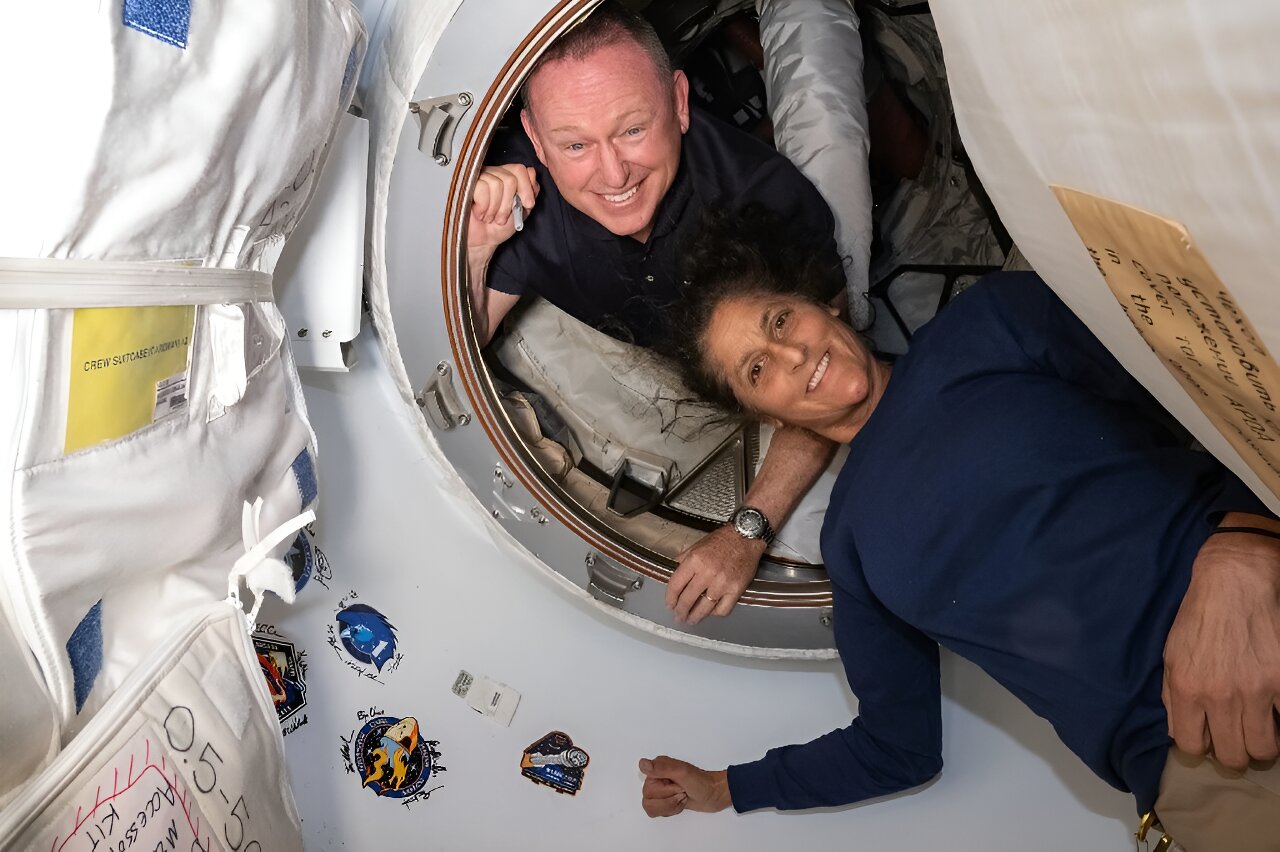
“Butch” Wilmore and “Suni” Williams slightly ironically imaged within the ISS airlock and the hatchway of the Crew Dragon vehicle docked at the space station, as engineers at NASA and Boeing continue to seek answers to issues with the Boeing Starliner propulsion systems. Credit: NASA
The most likely scenario for this would launching the Crew 9 mission with only two people on board – most likely Commander Zena Cardman and Pilot Nick Hague, leaving 2 seats free for Williams and Wilmore (although their space suits are different to those used by SpaceX, so this would have to be worked through). Wilmore and Williams would then remain aboard the ISS as a part of the Crew 9 rotation (Expedition 72), returning to Earth with Cardman and Hague in March 2025. As veterans of previous ISS crews (Wilmore as a part of the Expedition 41 rotation in 2014 and Williams as part of both the 2006/7 Expedition 14 and Expedition 32 rotations in 2012), they are more than qualified for such an extended stay.
If the case, this would not be the first time a crew has faced an extended stay on the ISS – as many commentators seem to have forgotten.
In September 2022 cosmonauts Sergey Prokopyev, Dmitry Petelin and NASA astronaut Frank Rubio arrived aboard the ISS for a 6-month rotation. Three months into their stay, their space vehicle, Soyuz MS-22 suffered a major coolant leak, rendering it unfit for crewed flight. Instead, in February 2023, Russia launched Soyuz MS-23 to the space station without its crew of three. Rubio, Petelin and Prokopyev then remained on the ISS through the end of September 2023, carrying the work planned for the original MS-23 crew.
However, this would then require the Starliner to make an automated return to Earth. In theory, Starliner is fully capable of doing this (unlike SpaceX Dragon), having a fully automated flight control software suite. This was demonstrated in May 2022 with the unscrewed Orbital flight Test 2 in May 2022. The problem here being that Calypso was launched without some (or all) of the necessary software (notably, the software required for the vehicle to automated undock and move away from the ISS).
Starliner capsule S2 with the hatch for its docking adaptor open, approaches the ISS in May 2022 using its automated flight software to conduct a fully automatic rendezvous and docking with the station. However, some (or all) of this software is not currently available to the Calypso, and would have to be uploaded to the vehicle and configured if the craft is to make an uncrewed return to Earth. Credit: NASA
While this is partially understandable – this flight was, after all, intended to test the vehicle under human control – it is nevertheless highly embarrassing that neither Boeing nor NASA sought to ensure the automated flight software was available on Calypso just in case it was needed. Instead, the software would have to be uploaded, configured and tested – a process that could take up to 4 weeks to complete.
This lead to something of a public tiff between company and agency, Boeing aggressively stating the craft is fully capable of a crewed return to Earth. NASA, however, isn’t (rightly) open to taking chances with its personnel – so for now the saga will continue.
Xanadu, August 2024 – click any image for full size
Following the lead of Susann DeCuir, I dropped into Xanadu, a quarter Full region held and designed by Xan Dark (Xan Darkheart) and presenting a (primarily, but not exclusively) Sino-Japanese fusion of ideas wrapped within an Adult-rated environment in which adult / sexual activities are allowed; as such, I’ll say up front that the setting may not appeal to everyone in terms of its function, but it is nevertheless visually engaging and photogenic – and during the time of my visit, it was quiet and friendly.
The landing point sits within a Zen garden located more-or-less in the middle of the setting and to which it might said – that in the manner of ancient Rome – all roads (or in this case, paths) lead; or at least depart, given it is the landing point. Watched over by a Zen master, the garden offers visitors a choice of routes to take.
Xanadu, August 2024
To the north, the path crosses a zig-zagging walkway of modern design as it passes over an oval body of water served by waterfalls, to reach a coastal pavilion; south to where a stone bridge guarded by a Torii gate and a pair of Kirin crosses another body of water before the path climbs up to a temple in which Buddha listens to the prayers and chants of monks; west to pass a bamboo garden with it bed-enclosing tea house and onwards to where a Tibetan structure sits as a bathhouse come personal retreat.
Off to the east, the path skirts the waters crossed by the stone bridge to where a hollowed tree trunk provides the way up to another little house for adult pastimes, and then on to where a sauna hides amidst an enchanted wood before reaching ruins that would not look out of place in Medieval Europe.
Xanadu, August 2024
And that’s just the start of things. There are in fact two pavilions looing out over the waters to the north and west of the region and the off-region mountains guarding the waters. Both provide a view across the turquoise waters to where a giant octopus ravages the wreck of a sailing ship. Or, if you turn to the right on crossing the zig-zag bridge, the trail will lead you to a wooden bridge as it reaches out to a boat-like island in the middle of the lake. Here, slung below the bough of a Sakura tree is a swing, with other places to sit and cuddle along the bank of the lake nearby. Whilst sitting at any of these, you might get a sense of being watched. If so, look up at the waterfalls that feed the lake here and you might find the reason 🙂 – and another place to have a little fun.
Then there is the lake between the landing point and the temple. Not only is it home to Koi carp and swans and herons and more, it is home to a floating deck reached by crossing a stone dragon bridge. And still this is only scratching the surface of all that might be found within Xanadu. There are dozen of little touches to be found, from the little playground for pandas to the more obvious table-top games – and I couldn’t help but smile at the sight of a ninja-like figure clearly up to nefarious mischief. There’s also the hidden theatre awaiting discovery and the hot tub deck, both of which add their own modern twists to what might otherwise be a ageless setting.
Xanadu, August 2024
Nor – outside of the Kirin – had I mentioned the fantasy touches apparent throughout. Fairies await visitors wander the paths, a goblin keeps watch, whilst a wall of giant basalt columns separate the setting from the neighbouring parcels like a rocky version of G.R.R. Martin’s Wall separating Westeros from the North. Not – I hasten to add, having recently been chastised for offering personal impressions in describing another region, that this setting in anyway contains anything to do with Martin’s mythology; it’s simply what comes to mind when exploring.
As might be gathered from all of the above, Xanadu packs a lot into a quarter region – and quite beautifully so; the flora is rich and verdant, the paths set out in such a way as to give the impression one is wandering a location far larger than its 14,368 sq metres. Thus, throughout all of it there is never a sense of being overcrowded, just of being in another land where inspiration come from many sources, those from Asia reaching beyond Japan and China, and the fantasy elements offering a nice twist.
Xanadu, August 2024
Yes, sexual activities, D/s and BDSM do form part and parcel of the overall setting, so discretion is advised for those not into these particular activities as noted; but also as noted, I didn’t encounter anything off-putting during my visit and found a delight in the overall design and my explorations.
Kudos to Xan for such a richly diverse and detailed location, and my thanks to Susann for the pointer!
Nitroglobus Roof Gallery, August 2024: Scylla Rhiadra – Swerve
August 5th, 2024, saw the opening of Swerve, a themed exhibition by Scylla Rhiadra, hosted by Dido Haas at her Nitroglobus Roof Gallery.
Scylla is, quite frankly one of the most gifted communicators in Second Life; her ability to to use art to convey ideas, feelings, realities and truths, and/or to expose concepts and ideas and encourage the grey stuff between the ears to start firing on all available cylinders, is second to none. This is especially true with Swerve, which takes as its subject matter, a visualisation of the essence of De rerumnatura, (“On the nature of things”), a six-part (and potentially unfinished) poem by the 1first century BCE Roman poet and Epicurean philosopher, Titus Lucretius Carus.
It is also, again quite frankly, an exhibition I’ve found exceptionally difficult to write about. This is partially due to the fact that Scylla lays out out the inspiration and ideas for the exhibition quite wonderfully through both a poster on the wall close the gallery’s main landing point and through the notecard that can be obtained by touching said poster. As such, anything I might further say on in this regard is rendered somewhat superfluous.
Nitroglobus Roof Gallery, August 2024: Scylla Rhiadra – Swerve
“Swerve” is the most usual translation of the Latin term clinamen, a key word and concept in De Rerum Natura, a 1st-century BCE philosophical poem by Titus Lucretius Carus. Lucretius was the great populariser of Epicureanism, and his poem is a long and detailed explication of the ancient understanding of atomism, and of its implications for human life. It is also, in an important sense, the inspiration for this exhibition.
Lucretius tells us that nothing that is not “matter,” composed of atomic particles, exists in the universe. We swim through a torrential downpour of plummeting atoms that crowd the void of space, and these fall naturally in a straight line. Vitally, however, they also sometimes swerve from their straight, downward course and, colliding with others, cohere into new clumps of matter or ricochet off each other in unpredictable ways. “Swerve” is thus the foundation of all existing things, and, as importantly, of all change. The idiosyncratic motion of these swerving atoms is also, Lucretius asserts, the origin of human free will, for we too “swerve” from our natural course according to the dictates of our appetites and passions.
Scylla Rhiadra, introducing Swerve
There’s also the fact that by pure happenstance, I’ve not long since finished reading Greenblatt’s The Swerve: How the World Became Modern, the story of how the last known remaining copy of De rerum natura was rescued from certain loss in the early 15th century, helping to kick-start our modern understanding of modern physics an physical sciences.
While there is much that is perhaps questionable within The Swerve (particularly around Greenblatt’s propensity to interject his own view on religion together with a blurring of historical lines), I have nevertheless found it hard to divorce my thoughts on the fundamental story of the rescuing of the poem and how it potentially influenced modern thinking as outlined in Greenblatt’s book, from Scylla’s far more focused and elegant examination of her opening question posed when introducing her exhibition:
What does it mean to live in a godless, materialist universe ruled by the laws of physics and propelled by the endless fall and collision of atoms in apparently chaotic order?
Scylla Rhiadra, introducing Swerve
This is not in any way to fault Scylla; the fault is mine alone; I have lacked the mental discipline to keep my mind focused purely on Scylla’s work.
However, in trying to keep that focus, what I can say is this. The images Scylla present within Swerve are – as always – of a nature that allows each of them to stand on its own as an engaging piece of art while also offering a depth of reflection and / or enunciation of ideas either posited by Lucretius or to which we might be led in considering of his explanations of life, the nature of the mind and the soul, the driving forces behind our own actions and reactions to the cosmos – and others – around is, and most particularly by our own inner passions and desires, which can both aid and foil us.
Nitroglobus Roof Gallery, August 2024: Scylla Rhiadra – Swerve
In this there is much subtext to be found within many of these pieces – be it the placement of an icon on the wall or the juxtaposition of a woman’s body behind the bloom of a flower. Some of this again stand quite independently of Lucretius’ writing – but at the same time, understanding his outlook and the Epicurean view of the cosmos and humanity greatly enhances how these pictures might be viewed – an they, aided by Scylla’s words, tickle the desire to know more about this almost-lost didactic poem.
There are perhaps small aspects of Scylla commentary that might give cause for disagreement. Her use of the word godless might be seen as inaccurate, as neither Epicurus nor Lucretius posited a universe without deities; rather they held that such was the natural, elemental nature of an atomic universe, ordered by simple rules and interactions (such as clinamen), there was simply no need for any gods to involve themselves in the affairs of mortals; they could simply get on with enjoying absolute peace for all eternity. However, I would respond by saying that in a wider context – that of the “modern” world – Scylla’s use of godless is well-founded; while we have no evidence throughout De rerum natura that Lucretius was an atheist, in its denial of divine intervention and its repudiation of the immortal soul, the poem was (and sometimes still is) seen as “anti-Christian” and “dangerous”.
Nitroglobus Roof Gallery, August 2024: Scylla Rhiadra – Swerve
There is so much more I could say – but (thankfully for you) I won’t, other than do go as see this exhibition – read Scylla notes and then view her work; allow it to inhabit your thoughts and whisper to you with the voice of history.
The following notes were taken from the Tuesday, August 6th, 2024 Simulator User Group (SUG) meeting. They form a summary of the items discussed, and are not intended to be a full transcript, and were taken from my chat log. Pantera videoed the meeting, and the recording is embedded at the end of this piece – my thanks, as always, for her work.
Meeting Overview
The Simulator User Group (also referred to by its older name of Server User Group) exists to provide an opportunity for discussion about simulator technology, bugs, and feature ideas.
Meetings are open to anyone with a concern / interest in the above topics, and form one of a series of regular / semi-regular User Group meetings conducted by Linden Lab.
Dates and times of all current meetings can be found on the Second Life Public Calendar, and descriptions of meetings are defined on the SL wiki.
Simulator Deployments
The SLS Main channel was restarted on Tuesday, August 6th 2024.
On Wednesday, August 7th:
The BlueSteel RC is to be restarted.
The remaining RC channels should receive the Summer Fun simulator update, which includes the initial Combat 2 updates from Rider Linden.
Upcoming Releases
The is an internal discussion going on at the Lab as to the next simulator update. This may either be Picnic or the back-end WebRTC updates – with the most likely order being Picnic first, then WebRTC.
SL Viewer Updates
Release viewer: version 7.1.8.9375512768, formerly the Graphics Featurettes RC viewer dated June 5 and promoted June 10th.
Atlasaurus RC (object take options; improved MOAP URL handling), version 7.1.9.9981869229, July 22.
Maintenance B RC (usability updates / imposter changes) 7.1.9.9555137545, June 21.
Maintenance C RC (reset skeleton in all viewers), version 7.1.9.9469671545, June 14.
Game Controller
As a reminder – Summer Fun includes the Game Controller updates from Leviathan Linden, but these have yet to reach a former viewer release.
Also, and just as a FYI for those trying the pre-release game control viewer:
If the viewer is used on a simulator without the back-end support (e.g. any simulator on the SLS Main channel after toWednesday, August 7th, and Tuesday, August, 13th), the viewer will be logged out in what might look like a crash.
This generally only happens the the GameControl option is enabled, but has also been reported on occasion even with the option disabled.
In Brief
A general and (theoretical) means of cleaning-up the viewer codebase, and the potential risks in doing so (e.g. apparently “unused” code removed or capabilities thought as no longer relevant resulting in content breakage.
The above extended into the use of APIs in the viewer as well, with encouragement for those with ideas for APIs to file them as feature requests (such as this feature request).
Rider confirmed that the promised facelift for the LL combat regions will focus on Concord, Lexington and No Man’s Land.
It’s been noted that outdated map tiles are still appearing on the World Map despite recent updates – apparently, the final updates to the map server have yet to be deployed, hence the delays in updates some might witness.
Please refer to the video below for further details.
† The header images included in these summaries are not intended to represent anything discussed at the meetings; they are simply here to avoid a repeated image of a rooftop of people every week. They are taken from my list of region visits, with a link to the post for those interested.







 Inara Pey: Living in a Modemworld