Space Sunday: Water in Mars, and a Juice-y flyby

An artist’s illustration of NASA’s INterior Exploration Using Seismic Investigations, Geodesy and Heat Transport (InSight) lander on Mars (active: 2018-2022), which attempted to give the planet its first thorough check up since it formed 4.5 billion years ago. In particular, the mission sought to understand the planet’s interior composition and monitor things like tectonic activity (marsquakes), meteorite impacts, study how much heat is still flowing through the planet, and track Mars’ wobble as it orbits the Sun. Credit: NASA/JPL

The subject of water on Mars has been a topic of scientific debate and speculation for well over 100 years. Since the earliest reliable observations of Mars via telescope, it had been thought that water ice and water vapour existed on the planet and in its atmosphere as a result of the seeing the polar ice caps (although we now know the major stakeholder in these is carbon dioxide) and cloud formations.

However, the idea that Mars was still subject to liquid water flowing across its surface in our modern era became popularised in the late 1800s. In  1877, respective Italian Astronomer  Giovanni  Schiaparelli – already noted for his observations of Mars in which he correctly identified and named multiple visible surface features – used the Great Opposition of 1877 (when Mars and Earth were both on the same side of the Sun relative to one another and Earth was effectively “overtaking” Mars in their respective orbits, thus bringing the two into “close” proximity to one another) to carry out further observations. During these he noted the presence of multiple canali  on Mars.
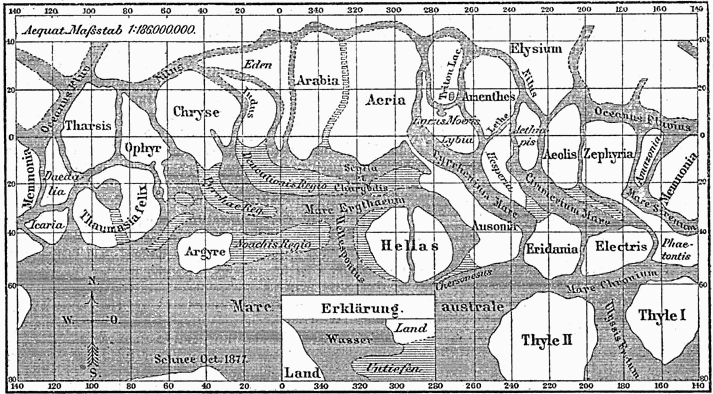
One of Schiaparelli’s 1877 surface maps of Mars. Note the looping canali (“channels”) he thought he observed in the northern hemisphere of the planet, and which he saw as entirely natural phenomena, although most were later shown to be optical illusions / the misidentification of other features. Credit: Public domain

Canali is an innocent term, meaning “channel”, and Schiaparelli simply used this term to differentiate what he thought is saw from other features he observed. But in English-speaking newspapers it was later translated as canals, evocative of artificial and intelligent construction. This resulted in wealthy Bostonian businessman Percival Lowell, following his return to the United States in the early 1890s to establish an observatory in Flagstaff, Arizona, specifically (initially at least) so he could observe these “canals” for himself.

Over the course of 15 years (1893-1908), Lowell saw his canals, which grew into a globe-spanning network and led to the publication of three books (Mars (1895), Mars and Its Canals (1906), and Mars As the Abode of Life (1908 – an original copy of which I actually own!) in which he expounded his theory that Mars had a network of canals built by an ancient civilisation in a last-ditch effort to carry liquid water from the planet’s poles to their equatorial and temperature cities as the planet increasingly became more desert-like.

A manuscript globe of Mars made by Danish amateur astronomer, Emmy Ingeborg Brun, presenting an image of Lowell’s network of Martian “canals” (together with the names he assigned individual “canals”), and made by combining sketches of his observations and which were published in Mars and Its Canals (1906), and Mars As the Abode of Life (1908). Credit: Royal Greenwich Observatory

Lowell stuck to this belief throughout his observations in spite of increasing scientific evidence that Mars was likely incapable of supporting liquid water on its surface and observations from other observatories with larger telescopes than his which could not find any evidence of “canals”, and that at least some of what he was seeing was actually (as Schiaparelli had believed) lines of demarcation between different elevations / terrains.

As a result of this belief, Lowell has become regarded as a bit of a crackpot  – which is a same, as he led a remarkable life with multiple achievements as a traveller, diplomat, writer and armchair scientist, and did gain recognition in his lifetime for his work – He was elected a Fellow of the American Academy of Arts and Sciences in 1892 and then to the American Philosophical Society in 1897, whilst the volume of work he carried out as an astronomer outside of his theories about Mars saw him receive the Prix Jules Janssen, the highest award of the Société Astronomique de France, in 1904.
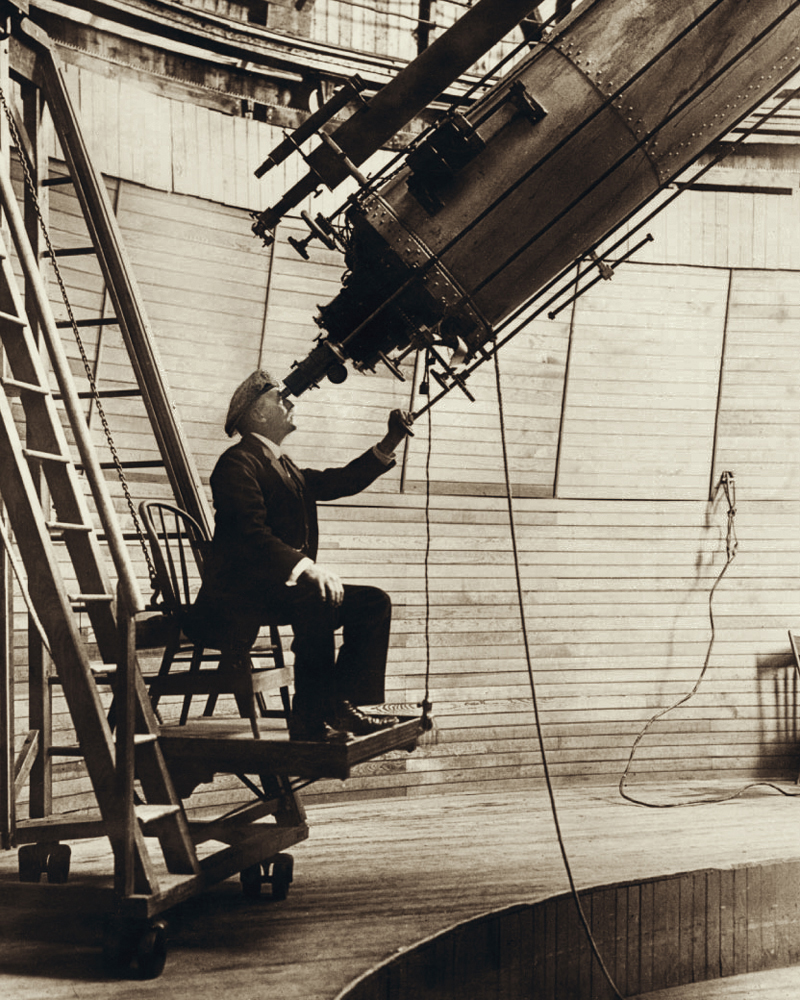
Lowell pictured in 1914 seated at the 61-cm (24-in) Alvan Clark & Sons refracting telescope at the Lowell Observatory, Flagstaff, Arizona, as he observes Venus. Credit: Unknown and reconstructed

This volume of work include daytime studies of Venus and the search for “planet X”, a planetary body believed (and still believed by some) to be orbiting the Sun far out beyond the orbit of Neptune. In fact, the Lowell Observatory became a centre for this work, for which it was rewarded in 1930 when Clyde Tombaugh located Pluto using the observatory’s telescopes and equipment.

Of course, whilst liquid water does not exist on the surface of Mars today and hasn’t for billions of years, we have found plenty of evidence for its past presence on the planet’s surface.

In my previous Space Sunday article, for example, I wrote about the Great Lake of Mars, Lake Eridania, whilst both the Mars Science Laboratory Curiosity and Mars 2020 rover Perseverance have literally been following the evidence for free flowing water in both of the locations on Mars they are exploring. Prior to them, the Mars Exploration Rovers Spirit and Opportunity both uncovered evidence of past liquid water on Mars, as have orbital vehicles from NASA, Europe and other nations. But the two big questions have always been – where did it go, and where did it come from?

In terms of where it went, the most common theories are that the water either evaporated and was lost to space along with Mars’ vanishing atmosphere relatively early in the planet’s life or retreated down into the Martian crust where it froze out into icy “reservoirs”. The first is likely for a certain volume of water, whilst subterranean tracts of water ice have been located not too far under the surface of Mars. However, the latter cannot possibly account for the amount of water believed to have existed on the surface of Mars in its early history, not could simple evaporation account for the disappearance of to greater majority of it. So where did the rest go? And where did it come from originally?

Well, in a new report published this month a team of scientists believe they have the answer, and it lay within data obtained by NASA’s InSight (INterior exploration using Seismic Investigations, Geodesy and Heat Transport) lander.

This ambitious craft landed on Mars in 2018, with the mission running from November of that year through until the end of December 2022. In particular, the lander carried with it two unique instruments it deployed onto the Martian surface using a robot arm. One of these was the French-lead Seismic Experiment for Interior Structure (SEIS), designed to measure marsquakes and other internal activity on Mars and things like the response to meteorite impacts, in order to better understand the planet’s internal structure. The data continues to be studied, and has revealed much about the planet’s internal structure and its history.

Most recently, a US team from the Scripps Institution of Oceanography at the University of California, San Diego and the University of California, Berkeley, have been reviewing the SEIS findings specifically to try to answer the question of where the water went. In particular, they have been using mathematical models employed here on Earth to locate aquifers and oil and gas fields deep underground. By adjusting the models so they provided results consistent what is largely known about the Martian crust down to a depth of several kilometres below the surface, they ran a series of passes on data gathered from deeper and deep within the planet’s crust, In particular, the came across two interesting results. The first indicated that while deposits of water ice do exist below the surface of Mars, and less than 5 km from the surface, they are likely to be far less commonplace than had been thought. The second result they took note of was consistent with those indicative of layers of water-saturated igneous rock deep within the Earth’s crust.

Most interestingly, the results of the SEIS data modelled suggest this deep layer of rock and water – laying some 11.5 to 20 km below the surface of Mars could be widespread across the planet to the extent that it could contain more water than would have been required to fill the oceans and seas of ancient Mars.

Taken together, these result indicate that while the theories about water on Mars being lost to space or frozen into subsurface ice are still valid, the vast majority of the water most likely retreated deep down into the planet, possibly returning to the reserves from which it might have originally burst forth to flood parts of Mars during the planet’s late Noachain / early Hesperian period of extreme volcanic activity.
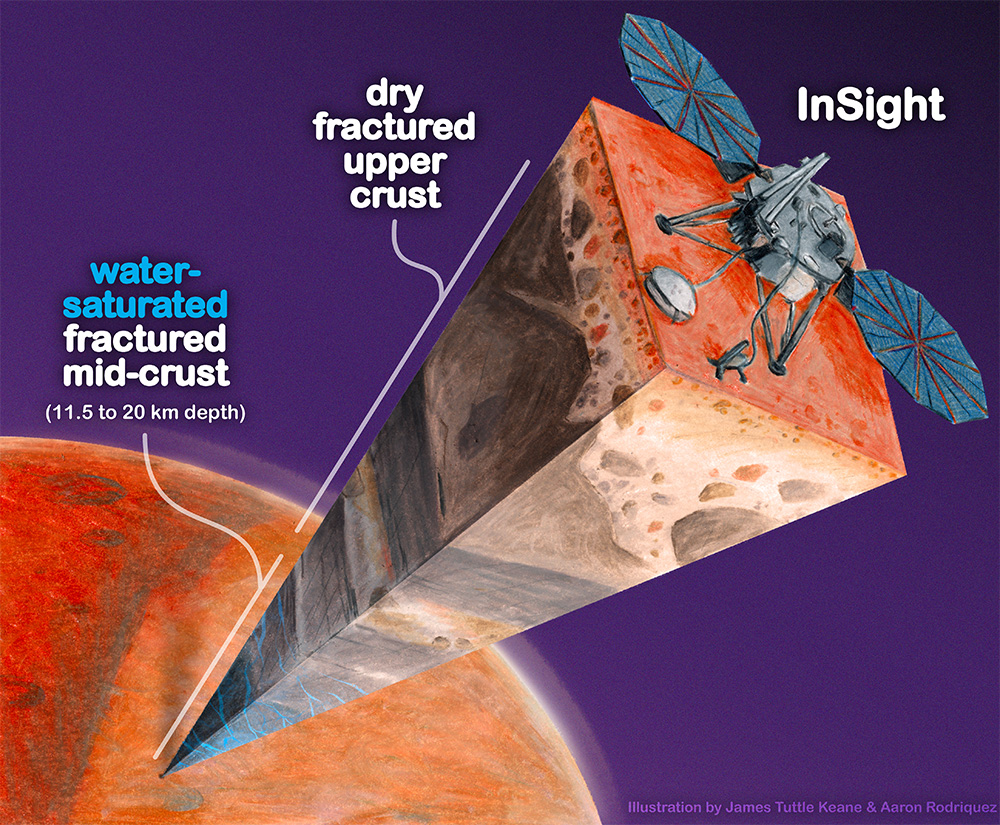
A “core sample” of the Martian interior beneath NASA’s InSight lander from the Scripps / UC Berkeley study. The top 5km of the crust appear to be dry, with limited large-scale deposits of water ice, while a water-saturated zone of fractured rock lies some 11.5 to 20 km below the surface. This is believed to by a widespread layer within the crust, potentially containing more liquid water than the volume believed to have been present in ancient Martian oceans. Credit: J Tuttle; Keane and Aaron Rodriquez, via Scripps Institution of Oceanography

One intriguing question that arises from this work is related to the potential for Mars to have harboured life, and what happened to it as the water vanished. if the modelling in the study is correct, and the water did retreat deep under the surface of Mars and form aquifers and pools with the rocks there, did any ancient microbial life gone with it, and if so – might it have survived? The pressure and temperatures at the depth which the water appears to reside would keep it both liquid and warm and provide energy, as would mineral deposited within the rock; so the question is not without merit.

Establishing that there is a big reservoir of liquid water provides some window into what the climate was like or could be like. And water is necessary for life as we know it. I don’t see why [the underground reservoir] is not a habitable environment. It’s certainly true on Earth — deep, deep mines host life, the bottom of the ocean hosts life. We haven’t found any evidence for life on Mars, but at least we have identified a place that should, in principle, be able to sustain life.

– Michael Manga, Professor of Earth and Planetary Science, UC Berkeley

But the is a question that’s unlikely be to answered any time soon. Determining if the environment is at the very least amenable to life, much less actually finding evidence for life within it – or even simply reaching any of the water deposits –is going to be pretty much impossible for a good while yet. Current deep drilling techniques here on Earth for extracting oil and gas only go down to around 2 km; getting that sort of equipment to Mars and enabling it to dill down at least 11-12 km will pretty much remain the stuff of dreams for a good while to come.

 JUICE to Swing by the Moon and Earth

The European Jupiter Icy Moons Explorer (JUICE) mission will be making a first-of-its kind fly-by of the Moon and Earth this week, the first in more than 5 gravity assist manoeuvres the vehicle will make (excluding those made while orbiting Jupiter) during its mission to study the icy moons on the Jovian system.

An artist’s impression of ESA’s Juice mission approaching the Jovian system in 2031. Credit: ESA

Such manoeuvres are often used with space missions and for a variety of reasons. With JUICE, it means the craft could be flown into space using a medium-lift launch vehicle and make (and albeit relatively sedate) flight to Jupiter, involving a total of three fly-bys of Earth and one of Venus to accelerate it to a peak velocity of 2.7 km per second using the minimum of fuel and then slingshot it out to a point in space where it will intercept the Jovian system, and they use further flybys of the planet and its Moons to both slow itself down into orbit around them and then adjust its course so it can study the icy moons of Jupiter – GanymedeCallisto, and Europa.

This first fly-by comes 16 months since the launch of the vehicle, and will be the very first Earth gravity assist which also employs the Moon as a critical component. On August 19th, Juice will as around the Moon at a distance of just 700 km (reaching the altitude at 21:16 UTC), using the Moon’s gravity to swung it onto a trajectory that will see it pass by Earth just over 24 hours later, passing over north-eastern Asia and the Pacific at an altitude of just 6,807 km on the morning of August 20th (local time) before heading back out to loop around the Sun. After this it will get a further gravity assist from Venus in August 2025 and then two more from Earth (without the Moon helping) in 2026 and 2029, that latter of which will  slingshot the vehicle on it way to rendezvous with Jupiter and its moons.
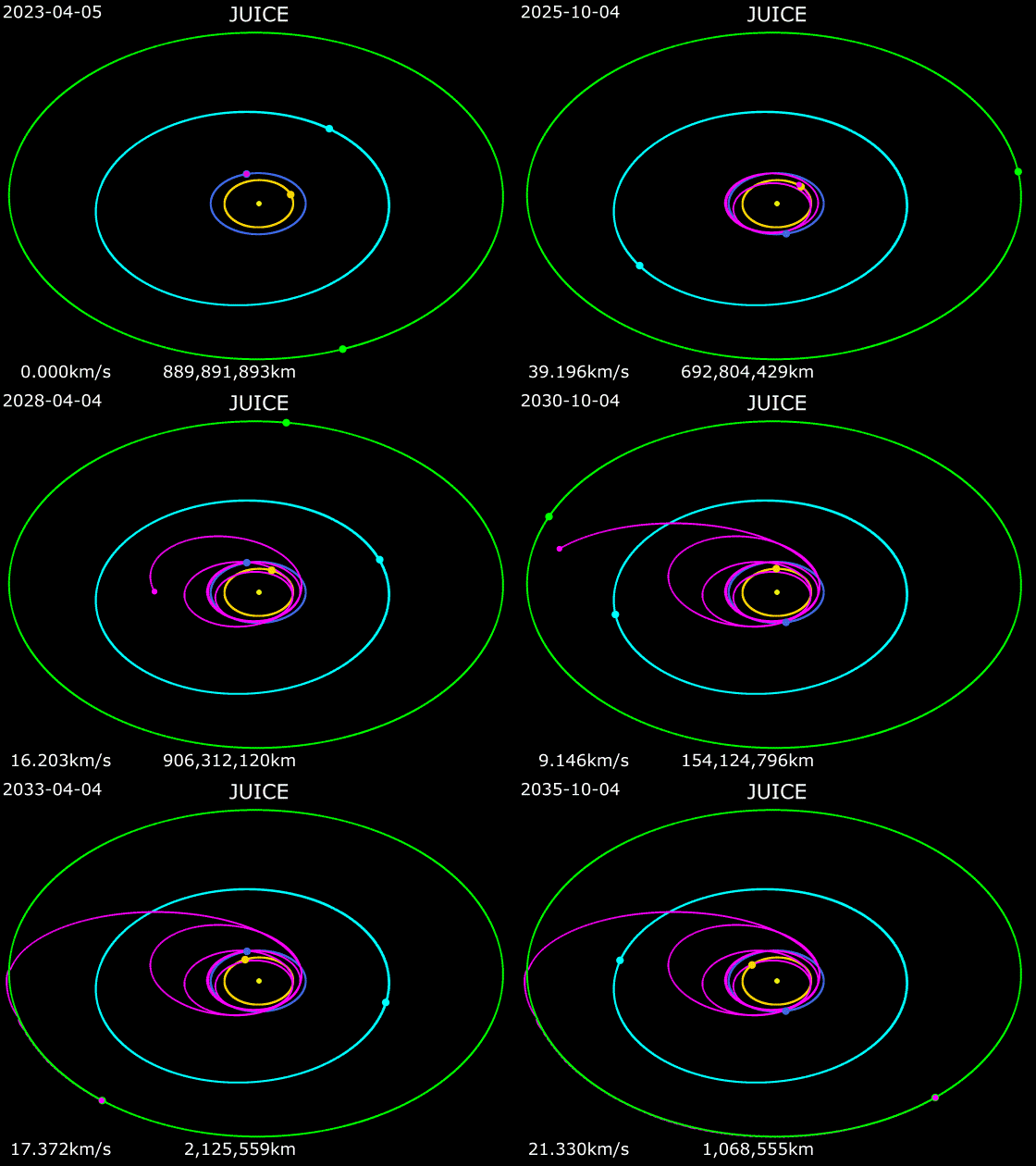
An animated GIF showing Juice’s flightpath as it loops around the inner solar system (2023-2029 – Yellow= Venus; blue = Earth) prior to gain the velocity required to slingshot out to intercept Jupiter, passing by way of asteroid 223 Rosa (teal). Credit: Phoenix777, using NASA HORIZONS system data, via Wikipedia

On August 15th, Juice briefly caused a stir when it was mistaken as a near-Earth object (NEO) on a potential collision course with Earth. At 27 metres across, most of which is some 85 square metres of solar arrays, Juice is a strong reflector of sunlight, and this briefly confused systems at the ATLAS Sky Survey, Hawai’i, which attempts to locate, identify and track potentially threatening NEOs. However, the system’s confusion was quickly identified as actually being the Juice spacecraft and the alert corrected.

This was actually the second time an ESA deep-space vehicle has been mistaken as a hazardous NEO; in November 2007, and as it approached Earth for a flyby, Europe’s Rosettta mission spacecraft  – also with a large span of solar arrays – was also briefly mis-identified as a NEO on a possible collision course with Earth. On that occasion, it was mis-identified by a human observer, and further manual checking was required before it was confirmed the object being tracked was actually the Rosetta spacecraft and not of any threat to Earth.

Following its arrival at the Jovian system, Juice will spend 1259 days orbiting the system, the majority of which will be in Jupiter-centric orbits that will allow it to study Ganymede, Callisto and Europa, with numerous gravity-assists of both Ganymede and Callisto used to alter its trajectory and velocity, allowing it to study them from different orbital inclinations and also to dip down into the inner Jovian system to study Europa.

However, the final 284 days of the time (from early 2035) will be spent in a dedicated orbit around Ganymede, allowing the spacecraft to complete some 6 months of dedicated studies of the moon once it has settled into a 500 km circular orbit around Ganymede. By the end of 2035, the spacecraft is expected to have expended the last of its 3 tonnes of manoeuvring propellants, bringing the mission to an end. without the ability to manoeuvre, Juice is expected to quickly fall victim to further Jupiter gravitational perturbations and crash into Ganymede within weeks of running out of propellants.

Anais Nin – Feelings, Love, Passion, Life in Second Life

Kondor Art Club, August 2024: Bee – Anais Nin – Feelings, Love, Passion, Life

Currently on display at the Kondor Art Club is a richly engaging exhibition of images captured by Bee (Filipa Emor) paired with words (mostly) written by Anaïs Nin. Entitled Anaïs Nin – Feelings, Love, Passion, Life, it’s both a highly personal exhibition, forming a tribute to Anaïs and her writings from someone who admires her work, and t the same time an approachable and artistic means of introducing those less familiar with her life, her writing and her influence to all three.

Born in France in early 1903 to Cuban parents, Anaïs Nin is hailed by many as one of the finest writers of female erotica. She was one of the first women known to explore fully the realm of erotic writing, and certainly the first prominent woman in the modern West known to write erotica. Her work in this regard is both rich and deeply complex; she first became aware of erotica literature in the 1920s or 1930s, after she, her first husband, Hugh Parker Guiler and her family moved to Paris in 1924, and her fascination with it grew from there via interests in psychoanalysis, her own emerging sexuality and her explorations of self.

Kondor Art Club, August 2024: Bee – Anais Nin – Feelings, Love, Passion, Life
One by one, I read these books, which were completely new to me. I had never read erotic literature in America… They overwhelmed me. I was innocent before I read them, but by the time I had read them all, there was nothing I did not know about sexual exploits… I had my degree in erotic lore.

The Diary of Anaïs Nin, Volume 1 (1931-1934)

In truth, Nin’s life was complex – she never divorced her first husband, but this did not stop her from marrying again in 1955, this time to actor Rupert Pole (later annulled in 1966 as a result of – essentially – tax complications!), and throughout her life she had multiple affairs and relationships.

Of the latter, the one that influenced her life to the greatest was with American novelist, short story writer and essayist Henry Miller. What started as a friendship grew into a deeply passionate and complex relationship which influenced both Nin’s sexuality and her writing. Nin was also an avid diarist throughout her life, recording her thoughts and feelings daily, reflecting on her growth as a woman, on her sexuality, on her loves and desires.

Kondor Art Club, August 2024: Bee – Anais Nin – Feelings, Love, Passion, Life

This desire to give expression spilled over into her relationship with Miller, the two of them sharing intimate thoughts in prose as well as engaging on a heated affair whilst Miller’s wife June (to whom Nin had initially been drawn) was away. Within Anaïs Nin – Feelings, Love, Passion, Life, Bee offers a series of black and white images encapsulating a sense of erotica whilst also offering to illustration Nin’s thoughts, feelings and – as one travels on through the exhibition – her desires for Miller.

Presented with a passage from one of the volumes of Nin’s collected journals or later publications which drew together her writings that focused on Miller and his wife), the images are a marvellous reflection of Nin’s thoughts and emotions, her feelings towards Miller (and also his towards her).

In this, the exhibition appears to be progressive in nature, with the images and texts starting on the left side of entrance to the hall and then proceeding around the inner and outer walls, gradually progressing from Nin’s inner thoughts through to her thoughts on, and exchanges with, Miller (with the images also shifting from singular pieces to those involving couples). Thus Bee weaves a visual journal, if you will reflecting Nin’s thoughts in an intimate and engaging manner.

Kondor Art Club, August 2024: Bee – Anais Nin – Feelings, Love, Passion, Life

All told, an emotive, poignant and visually captivating exhibition.

SLurl Details

2024 week #33: SL CCUG summary

Grauland / Corsair Island, July 2024 – blog post

The following notes were taken from my audio recording and chat log transcript of the Content Creation User Group (CCUG) meeting held on Thursday, August 15th, 2024.

Meeting Purpose

  • The CCUG meeting is for discussion of work related to content creation in Second Life, including current and upcoming LL projects, and encompasses requests or comments from the community, together with related viewer development work. This meeting is held on alternate Thursdays at Hippotropolis.
  • Meeting dates and times are recorded in the SL Public Calendar, and they re conducted in a mix of Voice and text chat.
  • The notes herein are a summary of topics discussed and are not intended to be a full transcript of the meeting.

Official Viewers Status

The Atlasaurus RC (object take options; improved MOAP URL handling) updated to version 7.1.9.10326512121,  on August 14th.

The other viewers in the pipeline remain as:

  • Release viewer: version 7.1.8.9375512768, formerly the Graphics Featurettes RC viewer dated June 5 and promoted June 10th.
  • Release channel cohorts:

Upcoming Releases – Change In Priority

As a result of PBR-related issues (see the section Performance Issues, below), the priority of upcoming viewer releases has changed.

  • The next planned viewer promotion was to have been the dedicated WebRTC Voice viewer.
  • The plan now is to prioritise a “more ambitious” viewer which will include the WebRTC updates and a number of high-level bug fixes related to performance (e.g.  a major vertex buffer fix, which although specifically targeted at Mac users, could help others on systems with integrated graphics).

Graphics / glTF

PBR Terrain Painting – Cosmic Linden

Summary
  • An in-development project. Current intent:
    • Provide a means to support the four PBR materials currently used in SL for “terrain painting”.
    • Will allow materials to be defined in their X,Y co-ordinates within a region by using a paint map, rather than having them defined by elevation defined in a height map. This will allow where grass or rock or stones or dirt, etc., appear within the region. providing much more flexibility in how terrain appears / changes.
    • Terrain painting will use the same permissions as terrain texturing (so if you have terraforming permissions, then tertian paining is possible; if you have the appropriate region permissions, you can define the PBR materials for the region.
    • Region owners / estate managers will have the ability to select whether the texture / heightmap is available in a region or whether the region uses terrain painting via a toggle switch in the Region floater. If Terrain painting is enabled at the region level, parcel holders (if I am understanding correctly) will be able to opt out / in.
  • Other points of note:
    • LL prefer to limit terrain painting to the four available slots at region revel, rather than allowing fully customisable swatches / slots at parcel level, as the latter presents “non-trivial issues” for terrain texture handling /loading.
    • Terrain painting will require a new entity to be introduced. Exactly what form this will take is still being discussed internally; it is unlikely to be a new asset type.
  • Much longer term options being considered for this capability might be to:
    • Allow prims to act as part of the terrain, inheriting the materials of the terrain, whilst still allowing the prim to be sized and shaped.
    • Perhaps allow the terrain within a region to be replaced by “something” else created externally to SL and then imported.
    • Neither of these ideas are currently being pursued beyond possible ideas / options.
Status
  • Cosmic believe she is getting close – perhaps another couple of weeks – to having an initial viewer build with the capability.
  • This initial build will allow terrain painting purely on the viewer-side; there will be no support for saving changes on the simulator; this will come as the work continues to be developed.

Transmission / IOR – Geenz Linden

  • Transmission and Index of Reflection (IOR)  will provide:
    • Both refraction and “blurry” refraction suitable for things like frosted glass surfaces.
    • Dispersion, allowing chromatic aberration, allowing the RGB channels to “separate out” based on a certain factor.
    • Volume, allowing an object surface to be tinted at different surface thicknesses .
    • Geenz is currently wrapping this work to get it into the Develop branch of the viewer following an internal demonstration at the Lab.

General Discussion

Performance Issues

  • It’s been confirmed that the potential for performance drops was missed within the code Firestorm took to integrate into their PBR viewer offering, and given they have the largest share of users (particularly those on low-to-mid range systems – e.g. those with 16Gb of RAM or less, and mid-to-low spec GPUs or with integrated graphics), their users have been the hardest hit with performance issues.
    • As a result, Linden Lab is now working with Firestorm to resolve the current issues.
    • As noted above, Linden Lab is now working to prioritise the release of a viewer with a number of fixes and updates aimed at improving / restoring viewer performance.
    • In the interim, the recommendation is for anyone experiencing severe performance issues to roll back to a pre-PBR viewer release.
    • Further, given that fixes beyond those currently being prioritised by LL will take time to surface, and the fact that there will continue to be systems that struggle with PBR, Firestorm has stated that version 6.6.17 of their viewer (the last pre-PBR release) will not be blocked per standard policy, but will remain available on as “as is” basis (e.g. not subject to bug maintenance or update with new features).
  • Fixes LL are looking to get out after the “prioritised” viewer has been released include:
    • Addressing  issues with the texture pipeline.
    • Fixing an issue whereby viewers on systems without dedicated video memory continually allocating available system memory to textures until all available system memory is consumed and the system suffers “performance death” until restarted.
    • A fix from the Alchemy team for an issue wherein if Mirrors are disabled in a viewer session, they continue using system resources until the viewer is restarted.
  • There will be “some form of communications coming out soon” to help inform people who are having a negative experience with PBR about what is going on to help alleviate issues.

In Brief

  • As far as enhancing rendering / shaders is concerned, the focus currently is on getting a working glTF scene implementation first, then working out what to backport to materials in inventory for applying to prims / non-glTF meshes. The will provide a good frame of reference when backporting materials to legacy objects and help maintain a consistency of appearance.
  • The meeting was overtaking by an extended discussion / diagnosis of a issue with hair which is becoming increasingly notices (hair appearing to “clump” or get blurred which does not appear to be directly related to colour alpha blending).
    • The problem is in part exacerbated by the fact the most SL hair is No Mod; so issues cannot be easily user-addressed.
    • No clear solution to this was presented, and the conversation is liable to continue, so will update if / when a way forward becomes clearer.
    • One idea floated, but will require a lot more internal investigation before LL move one way or the other, is to potentially add flags that will allow certain parameters within No Mod objects to be modified where it makes sense for them to be modifiable.
    • Expect further discussion on this.

Next Meetings

† The header images included in these summaries are not intended to represent anything discussed at the meetings; they are simply here to avoid a repeated image of a gathering of people every week. They are taken from my list of region visits, with a link to the post for those interested.

Got Blog! – Inara Pey: Living in a Modemworld

Isla Myvatn, August 2024

This is going to be an oddity for me; at the weekend I received a number of tags from bloggers asking me to participate in a blogger challenge created by Sassy Scarborough and Gorgeous Aurelia.

I actually wasn’t sure about participating, mainly because, as the introduction to the challenge states it is primarily aimed towards fashion and décor bloggers – of which I’m neither – and some of the questions are certainly tilted in this direction. However, as a couple of those tagging me outright mentioned me as a source of influence to their own blogging and the organisers of the challenge also state it is open to other bloggers,, I decided to give it a go and answer some of the questions that more directly apply to my style of blogging.

When did you start your Second Life Blog?

Originally, in early 2007 and not long after my return to SL. At that time I was using the Blogspot platform. At the start of 2009, I switched to using WordPress, where for a short time, I ran two blogs.

Why did you start Blogging in Second Life?

Frankly? A combination of ego and brashness.

Ego, because I’d previously written (and been published) on the nature and psychology of D/s relationships, and after being somewhat surprised at how the subject tended to be handled in SL, I believed I could offer better insight into it through articles drawn from my previous writing. Brashness, because I also started offering thoughts and opinions about Second Life when I actually didn’t understand all of the complexities involved in running and maintaining a platform like SL as well as I perhaps should, making some of my own critiques either questionable or hypocritical. So I opted to educate myself and try to right about the platform from a position of knowledge or understanding, and thus my blogging journey really began.

Cloud Edge 2, July 2024 – blog post
Do you feel the Blogging community in Second Life has changed since you started Blogging, and if so, in what ways?

Certainly the tools available to bloggers have massively improved, as has their ease of use. This has helped bloggers produce far more informative and professional sites. At the same time, may people blogging SL today are far more aware of the platform and its capabilities – and its sheer bloody complexity – than might have been the case a decade or so ago. Thus, there are far more blogs that can deal knowledgably about the specifics of the platform and provide a lasting and valuable service.

Angel of Pain, July 2024 – blog post
Do you think that Bloggers have a positive impact on Second Life culture and community, and if so, do you have any stories about that?

For the most part, yes, and for the reasons noted above. Users with a passion for a specific aspect of SL, who delve into the intricacies of this or that, really are very well placed to communicate and reach an audience. Those who take the time to develop information, present useable tutorials, blogs and summaries, who see their work as a means to help and support their fellow platform users provide an invaluable service which massively benefits the platform in ways that  – in all honesty – LL on their own and can have a very valuable impact on SL culture and communities (emphasis on plural intentional).

Are you approachable as a Blogger by content creators that may have interest in you as a Blogger for their Brand/Store?

As noted above, I’m not actually a content blogger per se; the reviews I provide are large on items I’ve purchased and have especially appreciated having. My forte leans more into blogging region and parcel designs (and occasionally video them!), and review art exhibitions and galleries. Those with ideas for this type of coverage are welcome to contact me.

The ever magnificent Memento Mori, part of the magic Chouchou estate

Have you yourself ever benefited from another Blogger’s post, such as learning a new skill for Blogging, or Second Life functions that you may not have known about?

If I’m honest, I genuinely don’t have the time the peruse many blogs; I have too much going on in-world and elsewhere. That said, I do try to dip into the blogs on my blogroll whenever possible, and there are three past bloggers of SL I would mention, because without them, this blog would never have grown. They are: Tateru Nino – whose encouragement / mentorship did so much to increase my understanding of SL as a platform and as diverse set of communities and technologies; Honour McMillan – through whom I discovered the joys of exploring Second Life and who, along with Ziki Questi, led me to discovering the world of art in SL.

Do you have any advice that you can give other Bloggers that may be new to the experience, or even advice/wisdom that you want to share with the Blogging community as a whole, new or old?

Blog about what you enjoy. Don’t feel a need to do things a specific way – as with all things Second Life, the choice is yours in what you write about, how you opt to write, how frequently you write, etc. Don’t feel you must conform to this or that world-view or subject matter; be yourself – and be opening to learning as you go.

Nong Han Kumphawapi, June 2024 – blog post
Do you have suggestions for which Blogging Platform to use, and why you chose it over others? – WordPress, Blogspot, Wix, Tumblr, etc.

To be honest, no; the platforms we use is very much a matter of choice, as is the approach taken. I simply don’t know enough about what is out there to say whether X is better than Y or if A gives more options than B. The important thing is for people to poke around, investigate, find what might benefit them within the platforms out there, and which fit things like their pocket in terms of any costs involved, and basics like ease-of-use, data exportability (in case a move elsewhere is required), etc.

Do you use Social Media, and/or other platforms outside of your Blog/Website to promote the content you have shared?

In decreasing order of engagement: PrimfeedTwitter – BlueSky – MastodonPlurk. And for photos / video: FlickrYouTube.

What do you enjoy and are most passionate about when it comes to Blogging?

Discovery. I love discovering regions and parcels people have poured themselves into in order to create environments and settings for others to enjoy. Their generosity in time, effort and love never ceases to amaze, together with their sheer passion for the platform. Big hat tip here as well to all the landscaping and building creators like Cube Republic, Alex Bader, Kristali Rabeni, Cory Edo, Marcthur Gossoon and so many more) who do so much to facilitate this kind of creativity and who too often get overlooked by bloggers (myself included!).

Art. The levels of artistic expression in SL and the platform’s ability to platform so much art is simply amazing – and again, special recognition to all those who work so hard to bring us art and who promote it and provide the venues in which it can be presented.

2024 SL SUG meetings week #33 summary

Cloud Edge II, July 2024 – blog post

The following notes were taken from the Tuesday,  August 13th, 2024 Simulator User Group (SUG) meeting. They form a summary of the items discussed, and are not intended to be a full transcript, and were taken from my chat log. Pantera videoed the meeting, and the recording is embedded at the end of this piece – my thanks, as always, for her work.

Meeting Overview

  • The Simulator User Group (also referred to by its older name of Server User Group) exists to provide an opportunity for discussion about simulator technology, bugs, and feature ideas.
  • These meetings are conducted (as a rule):
  • Meetings are open to anyone with a concern / interest in the above topics, and form one of a series of regular / semi-regular User Group meetings conducted by Linden Lab.
  • Dates and times of all current meetings can be found on the Second Life Public Calendar, and descriptions of meetings are defined on the SL wiki.

Simulator Deployments

  • There will be no planned deployments for the week, but the channels will be restarted. LL have decided to hold-off deploying the Summer Fun / Combat 2 update to further channels for another week. Rider Linden described the reason thus:
As we rolled out further we encountered a product that had a scripting bug that caused it to misbehave on the new servers. We reached out to the creator and he’s fixed the issue and is issuing updates. We wanted to give him a chance to get those out all across the grid.

SL Viewer Updates

On Tuesday, August 13th, the WebRTC RC viewer updated to version 7.1.9.10325451220.

The rest of the current crop of viewers remains as:

  • Release viewer: version 7.1.8.9375512768, formerly the Graphics Featurettes RC viewer dated June 5 and promoted June 10th.
  • Release channel cohorts:
    • Atlasaurus RC (object take options; improved MOAP URL handling), version 7.1.9.10220184061, August 7.
    • Maintenance B RC (usability updates / imposter changes) 7.1.9.9555137545, June 21.
    • Maintenance C RC (reset skeleton in all viewers), version 7.1.9.9469671545, June 14.

In Brief

Combat Partnership Reminder

  • With Combat 2.0 becoming available, Linden Lab has announced the Combat 2.0 Promotion Partnership Programme has been launched.
    • The intention behind the Promotion Partnership Programme this is to give those actively involved in combat activities in Second Life the “opportunity to help us spread the word across the grid about Combat 2.0 in Second Life”.
    • In particular, this will see some of the LL combat regions (e.g. Concord and Lexington) a facelift and use them to showcase Combat 2.0, with participants in the Programme asked to donate free-to-use combat items for use in the regions.
    • In addition, participants will have their regions / communities included in a Combat section of the Destination Guide. There may be other benefits for participants as well.
    • Those interested can sign-up via this Google form.

General

  • Recent bugs / requests under review / potentially to be pulled into upcoming simulator updates (e.g. BBG, which will follow Picnic):
  • Weird region crossing behaviour:
    • Various reports of a rare and intermittent vehicle region crossing oddity, in which the crossing goes wrong, unseating the rider- but rezzing a grey prim in the rider’s place as a par to of the vehicle’s linkset “created” by the rider. When unlinked, the prim slides around on the ground but has a rotation lock property on it that keeps it upright.
    • Some think this might be a very old bug that can replace the vehicle rider with an agent-sized cube, per [#BUG-3547] Sim Crossing Rezzes Objects Surrounding Individuals.
    •  It is unclear if any report has been filed recently against the problem, so if anyone encounters it, they are asked to raise a bug report with as much details as possible.
    • Leviathan Linden noted:
Avatars ARE prims, but with some meta data and a session that makes them special. The prim should have been deleted when the session was cleaned up or failed…. which suggests the session itself failed to be created on the far side of the region crossing.
  • There was a discussion on regex functions, based off of llRegex* functions, of which Rider Liden said:
I’ve just not had time to get to it yet. I think I have the code organized to a point right now where they wouldn’t be too much work to implement.
  • Please refer to the video below for further details of the meeting.

† The header images included in these summaries are not intended to represent anything discussed at the meetings; they are simply here to avoid a repeated image of a rooftop of people every week. They are taken from my list of region visits, with a link to the post for those interested.

Winchester Harbor’s autumnal delight in Second Life

Winchester Harbor, August 2024 – click any image for full size

Winchester Harbor is a magnificent Full region design by Lilly Blackwood with the support of her SL and RL partner William Winchester, who performs the role the region’s Harbour Master. I was fortunate to come across it recently after poking the Destination Guide, and the description there immediately piqued my curiosity.

Winchester Harbour is a mysterious abandoned fishing outpost in the North Atlantic Sea, suspended in time, and cloaked in eternal Autumn. It’s home to lush forests, waterfalls, a river, grass fields, and several haunted places. Enjoy a brew at the Harbour Bar, or sit atop the lighthouse and enjoy the views! There is much to see for those who love to explore.

– Winchester Harbor’s Destination Guide entry

Winchester Harbor, August 2024

I say “magnificent” as Winchester Harbor is a genuine feast for the eyes and camera; the care and love with which it has been put together has to be witnessed first-hand to be fully appreciated. The landscape is marvellous, the detailing both indoors and out sublime, and the blending of elements exquisite, all neatly wrapped within a sense of mystery edged with the occult and presented in (at the time of my visit at least – I’ve honestly no idea if it changes with the seasons) the perfect autumnal feel.

While the Destination Guide description indicates the setting is “in” the North Atlantic, suggesting a group of islands (something perhaps supported by the lack of region surround), to me the Winchester Harbor evoked thoughts of a coastal location, perhaps along the New England coast of the United States – and not because of any thoughts of Winchester, New Hampshire – or across the border in New Brunswick or Nova Scotia. Of  course, it could be anywhere, either side of the Atlantic, but it was thought of New England that tickled my imagination at times when I was wandering around and taking-in all that the setting has to offer.

Winchester Harbor, August 2024

The bulk of the region forms an extensive land mass richly wooded throughout, with four smaller islands bracketing it from three corners (one with a further little island tucked away out-of-sight behind it, and counted separately for reasons I’ll come to in a moment). In fact, given the stream running through the main landmass from from south-west to north-east, connects to open waters at either end, effectively splitting the north-west side of the land (albeit narrowly) from the rest, some might consider this an additional island in is own right.

The landing point sits on a pier jutting out into the waters to the south of the land and within a bay overlooked by two of the smaller islands. It is on one of these islands that the first hints of mystery might be found by those camming. An old church and graveyard are perched on the island’s shoulder, aged and blackened and with a fire burning within the abandoned church. The trees here add their own brooding presence with their darkened trunks as skulls stare at visitors, a cauldron bubbles and strange child-like figures dance spookily among the tombstones.

Winchester Harbor, August 2024

Also overlooking the landing point from a vantage point on a rocky island is one of the region’s lighthouses. This is open to the public – although to reach it you’ll need a boat, so keep an eye open for the rezzers (not that they are hard to find 🙂 ), and is nicely decorated for the onset of autumn and the coming of Halloween – the latter just adding a touch to the mysterious / ghostly goings-on hereabouts. It is behind this island that the little hideaway island I mentioned earlier might be found, neatly out of sight from the rest of the setting – and with good reason: it is a private home, so if you do pottle across to the lighthouse by boat, please keep that in mind and don’t be tempted to go and have a pike in person.

On the landward side of the landing point the path is marked by a signpost indicating the major points of interest to visit. Chief among these is the harbour itself, located on the east side of the region and watched over by the second the the setting’s lighthouses. The piers along the waterfront offer a variety of places to sit and pass the time – although the apparent imminent arrival of a kraken might give some pause for thought before hanging around! 🙂 .

Winchester Harbor, August 2024

It is from one of these piers that boats can be rezzed for pootling around on the water. However, they are not the only options for locomotion outside of pure shank’s pony; the harbour bar pier offers both bicycles and Segways for rezzing / riding. A further touch of the occult can also be found here in the form of the fortune teller’s shack, whilst the apothecary adds its air to the place by being the largest building on the harbour front.

Beyond the harbour, the path following the waterfront on to reach the bridge giving  access to the two north-eastern islands (one of which is home to the lighthouse mentioned above, reached by way of the chapel-like witch’s cottage occupying the other little island in the pair. Beyond this, the path curves to to one of my favourite parts of the region – the old ruins.

Winchester Harbor, August 2024

Making excellent use of the Ruined Walls kits from Marcthur Gossoon (which I’ve used myself on my island home, together with his superb No Cottage Bizar build). Here, Lily has used the kit elements to create a lovely little ruined retreat that is utterly welcoming and cosy, and a sheer delight to spend time within.

And still there is more to explore – be it the little swamp with its slightly run-down cabin or Mystery Mansion atop the north-western hills with its well-appointed décor and ghostly hostess on the veranda. There’s also the local camp sites and the gazebo hidden in the woods, and the high waterfalls. Paths are clear and easy to follow, with lanterns thoughtfully placed to alert travellers at night as to where routes divide.

Winchester Harbor, August 2024

Rounded-out with places to dance for those of a romantic disposition, a fitting soundscape and ideal EEP setting, Winchester Harbor makes for an engaging, enjoyable visit.

SLurl Details