The following summary notes were taken from the Tuesday, February 22nd, 2022 Simulator User Group (SUG) meeting. It forms a summary of the items discussed, and a video of the entire meeting is embedded at the end of the article – my thanks to Pantera for recording it.
Server Deployments
The week #7 Main channel restart and RC channels deployment were described as “bumpy”, prompting the Lab to dig into things. It is believed the cause of the problems has been identified (the failure of one of the tools used by the Lab) and a fix put in place. To this end:
There was no deployment / restart of the Main channel on Tuesday, February 22nd.
Wednesday, February 23rd will likely see a limited restart “on just one or two small RC channels.”
Available Official Viewers
The J&K Maintenance viewer updated to version 6.5.3.568554 on Tuesday, February 22nd.
This list reflects the rest of the official viewers currently available.
Release viewer: version version 6.5.2.567427 – Mac Voice hotfix viewer, January 13 – no change.
The Tracy Integration RC viewer version 6.4.23.563771 (dated Friday, November 5) issued Tuesday, November 9.
Project viewers:
Performance Improvements project viewer version 6.6.0.567604, dated January 24.
Mesh Optimizer project viewer, version 6.5.2.566858, dated January 5, issued after January 10.
Performance Floater project viewer, version 6.4.23.562625, issued September 2.
Legacy Profiles viewer, version 6.4.11.550519, dated October 26, 2020.
Copy / Paste viewer, version 6.3.5.533365, dated December 9, 2019.
In Brief
At the week #7 meeting, a suggestion put forward (by a user) was to have a vehicle given the lowest access permissions among those avatars seated on it. That way, if any agent attached to an object cannot enter a parcel, the vehicle would treat that parcel as a solid obstruction – see feature request BUG-231802. At this meeting,
Rider Linden indicated the Lab is considering ending the ban line info for an entire region to the viewer earlier as part of the parcel flag info.
The request is listed as Awaiting Review, but Rider intimated to could well enter the queue of work for the Lab.
A request was made for the ability to put objects inside the contents of child links (such as animations) and be able to read it and play that animation stored in the child link (see BUG-231848). Rider Linden noted that “it is an interesting idea but it is going to take some thought.”
A request was made for the ability to pitch shift sounds (similar to SVC-4373). This would have multiple potential benefits from avoiding the need to upload multiple sound in order to create a meaningful pitch change through to enabling a grater range of musical instruments in SL. As SVC Jiras are no longer active, a request was made for a new feature request on the idea.
There was a lot of general discussion on WIMNIs for SL and what might be done by way of improvements to things like region crossings, etc., but nothing that is currently being actioned as a project, so please refer to the video below for these items.
My audio recording and chat log of the Content Creation User Group (CCUG) meeting held on Thursday, February 17th 2022 at 13:00 SLT. These meetings are chaired by Vir Linden, and meeting dates can be obtained from the SL Public Calendar.
My audio recording and the Video recording by Pantera (embedded at the end of this piece) from the Third-Party Viewer Developer (TPVD) meeting on Friday, February 18th, 2022 at 12:00 noon SLT.
It is a summary of the key topics discussed, and in the case of the TPVD meeting, timestamps to the relevant point of the video are included.
This list reflects the currently available official Second Life viewers.
Release viewer: version version 6.5.2.567427 – Mac Voice hotfix viewer, January 13 – no change.
Release channel cohorts:
Maintenance J&K RC viewer, version 6.5.3.567451, issued on January 20th.
The Tracy Integration RC viewer version 6.4.23.563771 (dated Friday, November 5) issued Tuesday, November 9.
Project viewers:
Performance Improvements project viewer version 6.6.0.567604, dated January 24.
Mesh Optimizer project viewer, version 6.5.2.566858, dated January 5, issued after January 10.
Performance Floater project viewer, version 6.4.23.562625, issued September 2.
Legacy Profiles viewer, version 6.4.11.550519, dated October 26, 2020.
Copy / Paste viewer, version 6.3.5.533365, dated December 9, 2019.
General Viewer Notes
The Maintenance J&K RC viewer is still the next in line for promotion to de facto release status.
Progress of this viewer had been delayed due to the viewer updater needing to be updated from Python 2 to Python 3.
This change has now been made, and the viewer is ready to be issued as an updated RC viewer.
Work continues on the Performance Improvements project viewer to lift that to RC status.
It was found that bump (normal) maps were being processed on the main viewer thread, causing the viewer to exceed 60 fps with Vsync enabled (which should hold it to 60fps), causing frame jitter. Bump map processing has therefore been moved to a separate thread.
There has been a pass to improve hardware compatibility with AMD GPUs.
An issue with rigged meshes failing to render in the thumbnail panels when editing an avatar’s shape has been addressed,
This could be the first in a series of viewers produced under the Performance Improvements banner, with the Lab already discussing additional improvements that could be made in future versions.
The Performance Floater viewer is being updated with further options to manually adjust viewer settings to help maintain frame rates.
As noted in the week #5 summary, multi-factor authentication (MFA) is coming to the viewer.
The viewer-side code is complete, and had been awaiting the implementation of server-side support.
The latter has now been deployed to the Main grid, so it is anticipated that an RC version of the official viewer will be available in the very near future.
It is recognised that TPVs will need time to integrate the necessary viewer-side code into their offerings, therefore:
As MFA is implemented in the official viewer, there will be a “grace” period to allow TPV adopt the viewer code.
During this period, users will be able to access SL on TPVs as they currently do now, regardless of whether or not they have opted-in to MFA.
After this “grace” period, all users who have opted in to MFA will be required to authenticate themselves when using the viewer to log-in to Second Life (with the use 30-day period of valid authentication, as per secondlife.com MFA).
Please refer to my week #5 summary for the full list of notes on MFA in the viewer.
In Brief
Content Creation Meeting
Honouring joint rotation at mesh upload:
There are a number of long-standing bugs and requests concerning support (or lack that of) for maintaining mesh joint rotations at upload – currently, overrides are only provided for position and scaling.
The Collada .DAE file format does allow for rotation to be maintained through a number of ways, but currently SL doesn’t support all of them – hence when joint rotations tend to be ignored.
The general discussion leaned towards having the ability to override join rotation at upload would be a nice to have, with the view from LL that if done, it would be a check box at upload, so it would only apply to new content being uploaded, and not affect existing content.
Preference over the above was expressed for the ability to scale bones via animations.
This could allow for things like animals to increase in size as they grow from kitten / cub / pup, etc., to adulthood; possible improvements to clothing; enabling more complex avatar animations etc.
One potential issue with this is that scaling by animation might / will conflict with the skeletal sliders.
Providing animation scaling adds a further point of complexity, presenting 3 points at which scale is being impacted: within the mesh (from values at upload), trough the application of animations and via the shape sliders. Ergo, some form of ordering hierarchy is potentially required to avoid conflicts between the three.
No conclusions were drawn on this in terms of possible implementation or further investigation of options.
Sparked an extended conversation on physics shapes and LI – not all of which, I confess, I could not entirely follow in listening back through the audio, as some of it depended on some in-world testing – and I was absent from my screen through the majority of the meeting, so did not get to see the in-world examples being manipulated.
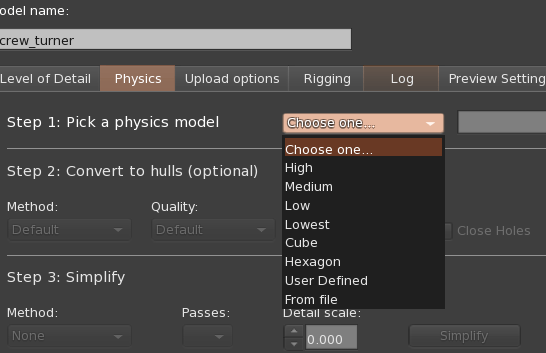
Essentially, the feature request calls for the provision of simpler physics shapes to be available for use when uploading a mesh than are currently available – the simplest being a “cube” mesh physics asset. This is something Firestorm already provides:
Physics models offer through the Firestorm mesh uploader – the shapes being continued within the viewer for application. Credit: Beq Janus
The conversation also folded into it requests to have direct access to Havok (the physics engine) primitive physics shapes (sphere, cube, cylinder, etc., and the ability to upload them.
For now, a contribution of the code used by Firestorm has been offered / requested.
This is turn lead to a discussion on, if implemented by LL, whether the default upload physics shape (Convex Hull) should be changed to “Cube” – with the preference being to leave it as is, although it was noted that with PBR set for future implementation, the upload mesh form may at some point need to be changed.
Given the confusion evident within the discussion, this also perhaps points to the need for the uploader to have a link to relevant and maintained documentation on best practices for mesh uploads, physics, etc.
The end of the meeting featured a further request for materials support for Bakes on Mesh (BoM)
This is something which, as noted in the past, would require a not insignificant extension to how bakes are handled, together with and expansion of the Bake Service itself – particularly if it was expected that individual layers would have an associated normal and specular channel associated with them.
A suggested alternative would be to have a single normal and single specular channel then is applied to the entire bake. While this might work for specularity, it’s not clear how this would work with a normal maps and be effective when trying to define different fabrics through the use of normals.
Currently, LL have no direct plans to implement materials for BoM.
TPV Developer Meeting
BUG-225696 “All offline inventory offers from scripted objects are lost” is to be the subject of a simulator-side project that is now “gearing up” to fix it “once and for all”, which is “coming for a near value of ‘Soon™’.
There are a lot of “new initiatives” in the pipeline with LL beyond those outlined in things like the 2021 year-end review, but nothing that has reached a point where it can be discussed in detail at TPVD (or other) meetings.
The following summary notes were taken from the Tuesday, February 15th, 2022 Simulator User Group (SUG) meeting. It forms a summary of the items discussed, and a video of the entire meeting is embedded at the end of the article – my thanks to Pantera for recording it.
Server Deployments
There was no deployment to the SLS Main channel on Tuesday, February 15th, 2022, but the simhosts were restarted.
Wednesday, February 16th should see the RC channels updated with simulator release 568051, postponed from week #6, and which includes a series of bug fixes (including one for BUG-230771 “llRequestUsername returns invalid data when invalid key is provided”) and adds a feature to LSL: OBJECT_ACCOUNT_LEVEL flag to llGetObjectDetails(): when called on an agent in the region, returns the agent’s premium status.
Available Official Viewers
This list reflects those viewers available via the first four links in the LL Viewer Resources section, below.
Release viewer: version version 6.5.2.567427 – Mac Voice hotfix viewer, January 13 – no change.
Maintenance RC viewer, version 6.5.3.567451, issued on January 20th, combining the Jenever and Koaliang Maintenance viewers.
The Tracy Integration RC viewer version 6.4.23.563771 (dated Friday, November 5) issued Tuesday, November 9.
Project viewers:
Performance Improvements project viewer version 6.6.0.567604, dated January 24.
Mesh Optimizer project viewer, version 6.5.2.566858, dated January 5, issued after January 10.
Performance Floater project viewer, version 6.4.23.562625, issued September 2.
Legacy Profiles viewer, version 6.4.11.550519, dated October 26, 2020.
Copy / Paste viewer, version 6.3.5.533365, dated December 9, 2019.
In Brief
A request was (again) made to have simulator behaviour change such that vehicles hitting a parcel ban / ban lines are “bounced” (much like they do on reaching an edge of the grid) rather than avatars being unseated / dumped and the vehicle returned to the owner’s Lost and Found.
This has been requested before, but rejected.
During the meeting, the idea was referred to as something that “might be possible”, although it would require protocol changes, if tackled.
An alternative suggestion put forward (by a user) was to have a vehicle given the lowest access permissions among those avatars seated on it. That way, if any agent attached to an object cannot enter a parcel, the vehicle would treat that parcel as a solid obstruction. This was seen as potentially more “doable” idea, and a formal Jira Feature Request was asked for – see BUG-231802.
A request was made for a grid-wide KVP (or KVP-style) database (as is available to Premium members under the Experience Keys system) to be made available that could be used as a permanent data store (see BUG-231801) available to all who need it.
Some of the ideas put forward around this at the meeting included updating the script engine so that scripts can dynamically write data to note cards – something as seen as problematic by the LL or have the viewer use local storage for data generated for use by the avatar (e.g. from a HUD) – something that could be an issue if data is stored on one machine is needed when on another device.
Cost of storage was noted as a possible issue, with the suggestion that perhaps (and whilst not permanent) KVP-like storage could be made available along the lines of Local Textures: the data is available for use for as long as a person is logged-in, after which the storage used would be cleared.
A further alternative suggestion made by LL – again, note the word suggestion – was the provision of a LSL API that could be used to access AWS services like Dynamo – that is, LL supply API and data movement, users wanting to use the capability supply the account and credentials. This was suggested with an idea of soliciting feedback on the idea.
A suggestion was also put forward for a new asset type specifically designed for read / write data storage, but capped at (say) 64 KB.
Again, this was a discussion – there are currently no plans to implement any of the above.
An issue with uniformly applying EEP settings across multiple regions in an estate via scripted means and smoothly applying it to avatars into and through the estate. A specific bug requiring rectification via the use of fast timers has been identified, together with a possible improvement to handling EEP settings via script. A bug report (BUG-231806) and a couple of feature requests (BUG-231807 and BUG-231808) have been filed on the matters – please refer to them and the video for more.
There was a lot of text chat around Avatar Expressiveness – however, as most of this was was subjective and the Lab is not yet in a position to provide further information on the capability, I’ll leave it to the video, below.
The following summary notes were taken from the Tuesday, February 8th, 2022 Simulator User Group (SUG) meeting. It forms a summary of the items discussed, and a video of the entire meeting is embedded at the end of the article – my thanks to Pantera for recording it.
Server Deployments
There was no deployment to the SLS Main channel on Tuesday, February 8th, 2022, but the simhosts were restarted.
Wednesday, February 9th should see the RC channels updated with simulator release 568051, which includes a series of bug fixes (including one for BUG-230771 “llRequestUsername returns invalid data when invalid key is provided”) and adds a feature to LSL: OBJECT_ACCOUNT_LEVEL flag to llGetObjectDetails(): when called on an agent in the region, returns the agent’s premium status.
Maintenance RC viewer, version 6.5.3.567451, issued on January 20th, combining the Jenever and Koaliang Maintenance viewers.
The Tracy Integration RC viewer version 6.4.23.563771 (dated Friday, November 5) issued Tuesday, November 9.
Project viewers:
Performance Improvements project viewer version 6.6.0.567604, dated January 24.
Mesh Optimizer project viewer, version 6.5.2.566858, dated January 5, issued after January 10.
Performance Floater project viewer, version 6.4.23.562625, issued September 2.
Legacy Profiles viewer, version 6.4.11.550519, dated October 26, 2020.
Copy / Paste viewer, version 6.3.5.533365, dated December 9, 2019.
Multi-Factor Authentication
Following the announcement that LL are developing viewer-side multi-factor authentication (MFA) – see my week #5 TPV Developer meeting summary – there have been renewed calls for LL to broaden the means by which MFA can be used beyond the need for a phone phone an authenticator app.
These requests are for e-mail support as a bare minimum.
However, and to point out yet again:
MFA with SL is opt-in, rather than opt-out.
For those who wish to use it, the Lab have provided a bare-bones means for users to use MFA using a unique key reference available via their account dashboard at secondlife.com. See: Second Life Multi-Factor Authentication: the What and How.
In Brief
There was further discussion on region crossings and future work. A lot of this centred on corner crossings.
In short, SL doesn’t really support corner crossings (avatars / vehicle must first pass from the “departing” region to one sitting to one of the cardinal points, and then from that region to the “destination” region).
This can result in a lot of timing issues and data hand-off, etc.
LL acknowledge more work needs to be done in terms of better handling, data checking, etc., between the involved simulators and the viewer.
Currently, no significant project in planned for region crossing work – which does not men it will not be looked at.
My audio recording and chat log of the Content Creation User Group (CCUG) meeting held on Thursday, February 3rd 2022 at 13:00 SLT. These meetings are chaired by Vir Linden, and meeting dates can be obtained from the SL Public Calendar.
My audio recording and the Video recording by Pantera (embedded at the end of this piece) from the Third-Party Viewer Developer (TPVD) meeting on Friday, February 4th, 2022.
So this document forms a summary of the key topics discussed, and in the case of the TPVD meeting, timestamps to the relevant point of the video are included.
Maintenance RC viewer, version 6.5.3.567451, issued on January 20th, combining the Jenever and Koaliang Maintenance viewers.
The Tracy Integration RC viewer version 6.4.23.563771 (dated Friday, November 5) issued Tuesday, November 9.
Project viewers:
Performance Improvements project viewer version 6.6.0.567604, dated January 24.
Mesh Optimizer project viewer, version 6.5.2.566858, dated January 5, issued after January 10.
Performance Floater project viewer, version 6.4.23.562625, issued September 2.
Legacy Profiles viewer, version 6.4.11.550519, dated October 26, 2020.
Copy / Paste viewer, version 6.3.5.533365, dated December 9, 2019.
General Viewer Notes
The Maintenance J&K RC viewer is likely the next viewer to gain promotion as the de facto release viewer.
The Performance Improvements viewer is close to being ready for promotion to RC status, and is just pending some remaining bug fixes.
This viewer did have changes to alpha sorting for rigged attachment, but following reports of content breakage as a result of this change, which was more a technical change than a performance enhancement, it has now been reverted to expected alpha sorting behaviour to avoid the breakage issue. Instead, possible alternative approaches will be looked at in the future.
A future version of this viewer is to include a new UI element intended to help make adjustments to some of the high-impact graphics settings to help improve frame rates,
LL is also completing work to switch the viewer over to using Python 3.
In September 2021, Linden Lab introduced multi-factor authentication (MFA) utilising either a QA code + mobile device or a key number, for those pages of the SL website that provide access to users’ account information (see: Second Life Multi-Factor Authentication: the what and how, September 2021).
When introduced, it was indicated that over time, the use of MFA would be expanded and improved, and would eventually include the viewer as well.
Brad Linden is now working on implementing MFA for the viewer.
What This Means
The work has reached a point where LL is close to having a viewer with MFA support ready for initial testing (as defined by see: SL Wiki: Login MFA), together with updates to the back-end log-in service to support it.
Viewer MFA will be based on users opting in to the capability via the secondlife.com dashboard, as described in the blog posted linked to above.
It is recognised that TPVs will need time to integrate the necessary viewer-side code into their offerings, therefore:
There will be a grace period between the initial introduction of the code in the official viewer and a time when all viewers / clients access Second Life will be required to support MFA to allow users who have opted-in to MFA to continue logging-in to SL.
During this grace period, all users on a TPV will be able to access Second Life, regardless of whether or not they have opted into MFA.
After the grace period has expired, all TPVs will be expected to support MFA, and those users on them who have opted in to MFA will be required to authenticate themselves when using the viewer to log-in to Second Life (with the use 30-day period of valid authentication, as per secondlife.com MFA).
During the grace period, users on TPVs that switch to support MFA will likewise need to start authenticating themselves when logging-in to SL.
Again, this will only affect users who have opted into MFA (unless LL at some point decides all user must use MFA to access SL).
MFA on the viewer will be a blanket action – there will be no additional MFA authentication for actions such as buying Linden Dollars through the viewer.
Using MFA when logging-in to the viewer will not automatically also authenticate you on secondlife.com or vice-versa.
There was a broader discussion on providing alternative mechanisms by which users can opt-in and use MFA – such as e-mail – rather than relating on a mobile device and authenticator software. Such decisions fall outside the realm of the viewer development team, and so could not be answered directly (however LL have stated additional / alternate methods of authentication will be added to the system at some point in the future).
In Brief
Content Creation Meeting
BUG-231731 “Script text quality and performance” prompted questions on how it might be implemented given it has been accepted. Vir pointed out that “Accepted” does not necessarily mean it a Feature Request will be implemented forthwith, and as such, it will be raised for discussion once it has reached a point where LL is considering working on it.
BUG-229205 “Re-enable PRIM_CAST_SHADOWS” came up for discussion, it is believed that the viewer-side code for it has been deprecated / removed, and the server also no longer recognises the function.
Runitai Linden suggested it is something that should be re-enabled on the grounds that it is “something that most graphics engines let you do.”
However, any final decision will be subject to further internal discussions within LL.
Request: allow seated avatars to temporarily have a physics shape of none if explicitly set by script (potential use-case: an in-world game uses tiny vehicles in a scaled environment to simulate a larger playing field, but as the drivers are normal-sized avatars, they cause collisions between one another, impairing gameplay; disabling the avatar physics would in theory prevent this, although it is not clear if such a change would be recognised by the simulator, where it is believed the expectation of avatar physics is assumed throughout the code).
The discussion encapsulated requests such as BUG-5538, the need for an overhaul of the camera control system & better LSL access to same; better joystick control options, and better support for alternative input types.
The latter point in turn led to a discussion on wider HID support and even the potential for MIDI (Musical Instrument Digital Interface) support (having been a means to provide remote control and synchronisation prior to HID design becoming the “standard”) as a means to transport and synchronise joystick inputs from the viewer to the simulator in a generic, open manner.
All of this was spitballing, rather than the formulation of an actual project.
Essentially what is being sought is a solution similar to the Firestorm AO (but without the apparent overheads) that effectively allows viewer-side replacement of animation states sent by the server with local animations, avoiding the need for scripted HUDS / attachments.
Much of the discussion at this meeting is clarifying the original request for Vir Linden’s benefit, although the consensus is that official a cap replacement for llSetAnimationOverride and allowing TPVs to implement their own viewer-side AO UI elements would be a good start.
Once this has been done, then discussion can turn to the more complex issue of adding further animation states.
A Cap and viewer-side controls will not fully eliminate scripted AOs (particularly in the case of non-human AO walks, sits stands, for example), but this shouldn’t negate the provisioning of a Cap.
Please refer to the video for the discussion – much of which is in text chat.
The following notes cover the key points from the Web User Group (WUG) meeting, held on Wednesday, February 2nd, 2022.
These meetings are generally held on the first Wednesday of the month, with dates and venue details available via the SL public calendar. A video of the meeting, courtesy of Pantera, can be found embedded at the end of this article (my thanks to her as always!). Again, the following is a summary of key topics / discussions, not a full transcript of everything mentioned.
A face-lift for the look of the Destination Guide.
Back-end infrastructure work on the DG to make it “easier and more effective” for the Lab to maintain, and to lay the foundations to build now functionality going forward (e.g. improved support for TPVs); restructuring of widgets; improvements to place rankings.
These updates should be deployed during February.
Marketplace variants (e.g. different colour variants for an item in a single listing):
Infrastructure work is now in progress.
Work has also started on designs for how listings will work.
No date / time-frame for when this will be delivered – but possibly Q2 2022.
Part of January’s work has been focused on OS and code updates to keep everything up-to-date.
Search Improvements Project Update
The third-party team who will be supporting the work to overhaul Search is now on-board with the Lab.
This means the project to overhaul Search has now started, and is liable to run for the next 6 months or so.
As previously noted, the aim of the work is to make Search functionality / results more meaningful / relevant.
The idea for this is to have an Amazon-style Q&A section on Marketplace listings similar to that seen on Amazon, where questions on a product can be asked and answered either by the creator (or their store managers) or by those who have actually purchased the item.
Views against this included:
Some Content creators have external social media groups or in-world groups to address questions, etc., so a Q&A section just adds to these channels.
Some creators feel they are dealing with enough “spam” and “crap” (words used), and a Q&A section just adds to it.
Some creators use alt accounts for different brands they run, and don’t keep their alts active beyond creating listings, so they “are not going to see Q&As”.
A suggested alternative was to have amore of a “live chat” feature or a link to contact the creator so that people can talk directly to a creator / store manager.
This would appear to suffer many of the “cons” noted above: what about stores run by alts that are not logged-in? A “live chat” capability forms yet another channel of communication; it requires always being logged-in to the MP, etc.
It could also potentially be an abuse vector.
It misses the potential for a Q&A section to double as a form of FAQ – common questions asked are right their in front of customer’s eyes (if they choose to read them).
One creator at the meeting did point out it could be very helpful to newer users, in allowing them to ask questions without the need to try and find whatever alternative channel – in-world group, Discord channel, etc. – that might be available for questions.
It was pointed out that the facility could be made optional: if a creator doesn’t want to have a Q&A section included in a listing (or even an entire store) they could opt to do so.
Given the number of unfavourable responses voiced at the meeting, the idea is being taken “back to the drawing board”.
Rather than having to use alts to manage listings for their different brands, allowing creators on the Marketplace to have additional stores linked to a “primary” brand name, allowing them to manage all their brands from one account.
This would be a much larger project to implement, requiring some substantial infrastructure changes (e.g. the MP is built on the assumption there is one one store per MP account). As such, requests for such a capability have previously been turned down.
There was some confusion in the meeting as to what the difference would be between “store” and “sub-brand” and how they might be used.
There were also what amounted to two different use-cases:
Some would like the capability to run multiple individual stores from just the one account, rather than having to run different store through alt accounts (e.g. a store for their horse-related goods, a store for their motorcycle products, etc), with the option to link between stores if they wanted, and with ease-of-access to the stores from one Marketplace account dashboard.
Others expressed more of a “department store” style approach with a “flagship” brand, and then sub-brands for products below it (equating to the different departments in a store), allowing them to “break up” their existing store without the risk of losing existing reviews and feedback.
A further suggestion what to provide a means for creators to link their alt store accounts to a “main” account, if they so wish – although this does not solve for those wishing to split their existing stores..
Both of these approaches were seen as valid, but left the question on how best to approach them. As such, Reed Linden requested time to take the ideas back to the Lab for internal brainstorming + further discussions at future WUG meetings.
In Brief
[41:36-42:35] LL are targeting 2022 Q2 (April-June) for the deployment of Premium Plus. Content, cost, etc., will be announced at the time of launch.
[48:02-48:50] Despite fees on Event listings, there are still what amounts to adverts appearing within the events listing. Currently, Events are not subject to any work, and so this is still something to be dealt with. However, events are due to be overhauled “in the near future”.
It was re-iterated that LL have largely stopped supporting the SL wiki, other than core pages of information relating to things like LSL functions, policy, etc., and there are no plans to move it to HTTPS.