William Weaver’s Phototools: create glorious shots with Firestorm

Update: Phototools is fully integrated into Firestorm.

Not long after joining Second Life, William Weaver, known in-world as Paperwork Resident, became interested in both SL photography and machinima. While he quickly realised the viewer has a huge capability for making both, he found that even in a TPV like Firestorm, many of the controls remain spread across multiple floaters and tabs and buried within the debug settings, making it hard to use the viewer to its fullest potential for in-world picture production without a lot of frustrating shuffling of floaters and tabs.

His solution was to develop Phototools, a menu system for Firestorm that pulls together all the various settings and options within the viewer that a photographer or machinima maker is liable to need during a shoot. With Phototools, it is possible to quickly and relatively easily set-up the viewer to produce stunning visual images in a one-stop pass using a dedicated floater; allowing some stunning results to be had without the need for any post-processing through Photoshop or similar tools.

“Discover” by William Weaver – an image produced in Firestorm using the options made available through Phototools and with no external post-processing

Phototools has been around now for a while, available from Williams, blog, Paperwork Shows, and has been gaining popularity among Firestorm users. However, William has been working on preparing it for full integration into the viewer, and as a part of this work, he has made a number of changes to it which have just been released as version 0.94.

Essentially, Phototools replaces several of Firestorm’s default floaters with updated versions. In the original release, these included a replacement camera floater, which presented a wealth of additional camera and mouse / joystick options. However, as it was also relatively large and cumbersome, William has reverted to using the original camera floater in the new release, with the additional controls incorporated into the main Phototools floater. For those who have been using the earlier version of Phototools, the new release includes an .XML file for the original Firestorm default camera floater.

The Phototools Floater

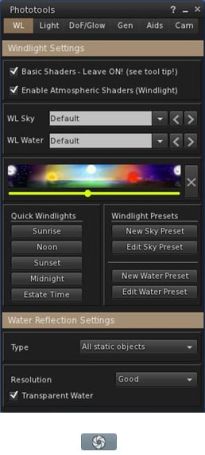
The main floater replaced by Phototools is the Firestorm Quick Preferences floater. For those who find this a very handy tool to have at your fingertips, it is not entirely lost: most of the options it contains are still available in its replacement, which I like to call the Phototools floater. This comprises six tabs: WL – for Windlight settings Light – for lighting and shadows; DoF/Glow – for depth of field and glow effects; Gen – for setting Draw Distance, terrain detail, avatar counts, etc; and Cam – for camera and mouse options.

Three of the Phototools floater tabs (click to enlarge)

Anyone familiar with Firestorm’s Preferences tabs will immediately recognise many of the options presented within the Phototools floater; others may not be so instantly recognisable, as they’ve been pulled from the debug settings. This is where the power of Phototools lay: not in providing new options or functions, but in making those already present in the viewer a lot easier to access and use from a single reference-point with the minimum of fuss and without taking up huge amounts of screen space (and having a heavy impact on frame rates).

The first tab in the floater is for Windlight settings and this includes options to open the Windlight water and sky presets floaters (which can also still be accessed via World-> Environment Editor ->Sky Presets / Water Presets). Both of these floaters have been extensively re-worked to make them much more compact and screen-friendly when compared to the default versions found in most viewers.

Windlight Water Presets: the default floater (l) and the Phototools updated floater (r) both to scale (click to enlarge)

Taken together, the Phototools floater and revised sky and water presets floaters present all the options needed to manipulate the environment, as seen through your viewer, in three panels which are compact enough not to overwhelm the screen; a major benefit when trying to set-up lighting, etc., for a specific shoot or film sequence and you need to see the impact of changes on your world-view as you adjust lighting and other effects to achieve a specific result.

Another of William Weaver’s images created entirely using the viewer options presented through Phototools

How it all Came About

I recently caught up with William with a view to finding out more about Phototools and the future holds for them. I started by asking him how he got started on the road of developing them.

“When I first started in SL I was using it to write,” he explained. “I would role-play and write chapters in a story from the events of the role-play. While doing this, I started taking some pictures and I noticed SL has a great deal of potential for very good image making.”

He also noticed that a lot of people relied on external post-processing to achieve their finished results, “While I appreciate people who are good with Photoshop and after effects, I enjoy working with the limits of the viewer.” This started him thinking about how the capabilities within the viewer could be presented in a more user-friendly and accessible manner. At the same time, and while also involved in the role-play, William got to make his first SL machinima, which brought him up against additional problems.

Continue reading “William Weaver’s Phototools: create glorious shots with Firestorm”

Viewer release summary 2012: week 35

This summary is published every Monday and is a list of SL viewer / client releases (official and TPV) made during the previous week. When reading it, please note:

  • It is based on my Viewer Round-up Page, a list of  all Second Life viewers and clients that are in popular use (and of which I am aware) and which are recognised as being in adherence with the TPV Policy
  • By its nature, this summary will always be in arrears
  • The Viewer Round-up Page is updated as soon as I’m aware of any releases / changes to viewers & clients, and should be referred to for more up-to-date information as the week progresses
  • The Viewer Round-up Page also includes comprehensive links to download pages, blog notes, release notes, etc., as well as links to any / all reviews of specific viewers / clients made within this blog.  

Updates for the week ending: 2 September, 2012

  • SL Viewer updates:
    • Beta version rolled to 3.4.0.264194 on August 30 – release notes
    • Development: rolled to 3.4.1.264186 on August 30
    • Mesh Deformer updated to: 3.4.1.264215 on  August 31
  • Firestorm released version 4.2.1 on August 27, before withdrawing it and rolling to 4.2.2.29837 on August 28 – core updates: pathfiinding, Flickr snapshots upload, mute Group Chat, RLVa 1.4.7, client AO improvements, OpenSim improvements – release notes – my 4.2.2 review here
  • Kokua made pre-release 3.3.4.23783 available on August 30 – core updates: media fixes
  • Zen Viewer rolled to Zen version 3.4.1.0 on August 28 – core updates: sound explorer added; LSL fix for (llTargetOmega() (spinning / rotating objects); angular velocity for vehicles fixed; updated HyperGrid support
  • Cool Viewer:
    • Stable branch rolled to 1.26.4.28, on September 1- core updates: improved mesh uploader with male / female shapes radio button; numerous 3.4.1 backports and updates (incl llTargetOmega() for spinning / rotating objects); added work-around for disappearing / non-rezzing attachments following log-in / TP;
    • Experimental release rolled  to 1.26.5.7 also on September 1 – core updates as per 1.26.4.28 plus fixes
    • Release notes for both
  • GroupTools rolled to installer release 2.2.10.0 on September 2

Related Links

HTTP and Group Services updates

There are a number of projects underway at the moment to improve various aspects of Second Life performance. Some of these have been reported on as a part of the Shining Project, others are being dealt with elsewhere are reported on through the likes of the SL Scripting User Group and the fortnightly TPV/Developer meetings.

The following is by way of a brief update on the ongoing HTTP Library and Group Management projects with information taken from the most recent TPV/Developer meeting (recording link).

HTTP Library

The focus of this aspect of the Shining Project is to improve the underpinning HTTP messaging that is crucial to simulator / simulator and simulator / viewer communications, and it is under the management of Monty Linden.

Discussion on progress with the project commences at 36:36 into the recording.

The project code (textures only) is with the Linden Lab QA team and is expected to be in the 3.4.1 viewer once it has been released by QA. In the meantime, the HTTP project viewer was updated at the end of July. Many people are noticing improvements in viewer performance that go beyond initial texture loading, although there have been reports of other aspects of the viewer which use HTTP apparently being “slower” to use. This latter issue is most likely a false impression, with Monty commenting at the August 24th meeting that, “Most parts shouldn’t be affected. It’s competitive, when you’re doing both texture downloading and some of that work … but other things aren’t being cheated if you’re not downloading textures at the time.”

An issue has been noted in older Macbook Pro systems (late 2007 into 2008 dual-core systems, although the span of the problem isn’t clear) using nVidia drivers, wherein the expected speed-up with cached data which can be seen on other systems isn’t occurring. Monty is still investigating this. Overall, however, feedback on this project has been positive.

Group Management Functions

Large group loading: a familiar problem

Baker Linden has been working to resolve this problem, and his plan is also to go the HTTP route, which will require changes on both the server and the viewer sides of the equation. His comments on progress start at 42:53 into the TPV/Developer meeting recording.

The server-side code for an initial implementation of the solution has been passed to LL’s QA and is expected to be rolled to selected regions on the Beta (Aditi) grid soon.

In terms of the viewer, the plan is to develop a Project Viewer, which will be made available in the near future for people to use with the Aditi test regions. How soon this viewer is likely to appear is open to question – the code will initially need to be passed by LL’s QA (who may have received it on the 24th August) prior to the viewer being built. Once in the project viewer repository, the code will also be available for TPVs to produce test viewers of their own.

How long the testing period will last is also open to question and dependent upon feedback / issues arising. However, the plan will be to follow the usual pattern for roll-outs in that once the code has been tested on Aditi and necessary updates made, it will be rolled to a main grid RC for more more involved testing. This is important, as there is a significant different in the number and sizes of groups operating on the two grids. For example, the largest group on Aditi numbers some 40,000 members; on the main grid the largest group is about 112K, and there are many more groups with between 40K and 112K members.

One thing that has been made clear is that there will be no attempt at backward compatibility with V1-based viewers on the Lab’s part; the new code will be aimed solely at the V3 code base. However, V1-based viewers will still be able to use the UDP protocols for group management, although the LL servers will limit UDP access to groups with 10K members or fewer, so V1-viewers will have some more code backporting on their hands.

There will also initially be some issues around the new HTTP protocol. For example, in the first implementation, the data will be uncompressed. This means that a 40K member group is around 5Mb in size, which can take up to a few minutes to download, depending on someone’s connection speed, so some frustrations are liable to continue. While data compression will eventually be used, this is not planned for the initial implementation.

The discussion involved providing an option to routinely clear-down group lists based on people’s last log-in date, or who have not logged in for a (group owner specified) number of days. However, LL are not going to implement such a feature on the grounds that it could lead to mistakes being made, and people being accidentally removed from a group.

Time Scale and Implementation

As mentioned above, there is no definitive time scale for this work to be completed. Testing is liable to take several weeks at the very least, so it is unlikely the new group management capabilities will be rolled-out on a widespread basis for at least another month, or possibly longer.

However, and like the upcoming new avatar bake service, once the server code is available on the grid, the switch-over will be transparent. If a viewer has the code to use the new group management HTTP service, it will do so, if it has not been updated, it will continue to use the UDP service (with the aforementioned 10K “cap”) until such time as that capability is “retired” from the grid.

Firestorm 4.2.2.29837: pathfinding, Flickr and more

Monday 27th saw Firestorm 4.2.1.29803 released. Unfortunately, this included a visual bug being inadvertently introduced into the release which made moving items such as doors and wheels appear to be “broken”. While this was only a visual impact rather than a code breakage, the decision was taken to withdraw 4.2.1 and replace it with 4.2.2 once the problem had been fixed.

As a result, and in case the release of version 4.2.2 included additional updates necessary as a result of fixing the issue, I opted to hold-off on my review of 4.2.1, and wait until I’d been able to look at 4.2.2 before Pressing a review.

So here it is, a look at Firestorm 4.2.2, featuring some of the key changes and updates which include an initial implementation of pathfinding. Alongside this, the release sees includes Katharine Berry’s snapshots-to-Flickr option, temporary uploads from the snapshot floater, new toolbar buttons and more.

A Note on OpenSim

This release does not include any fork between Second Life and OpenSim. That will be coming in a future release, which, as Jessica reports in her blog post on this release, might be a while in coming as the team have a lot of work on their collective plate.

Installation

The windows installer is some 33.7Mb in size – so par for the course with Firestorm. If you’ve previously installed version 4.2.1.29803 then a clean install is not required. However, if you’re upgrading from 4.1.1.28744 or earlier, a clean install is required / recommended.

Pathfinding Tools

As mentioned above, and with the exception of navmesh visualisation, all the main pathfinding tools are present in this release, complete with the expected Firestorm finesse when it comes to Rebake Region.

The Linksets and Characters floaters can be accessed using both the context and the pie menu when right-clicking on an object or character. The Build and Object Profile panels also have their pathfinding information panels added.

The Firestorm team have implemented the Rebake Region functionality somewhat differently to Linden Lab. Rather than incorporating a button displayed at the bottom of the viewer window when a rebake is required, the team have combined the rebake function with the pathfinding icon displayed in the Menu Bar / Navigation Bar (if displayed). Thus, when the icon is displayed (either with or without the initial warning pop-up, as shown in the image below), clicking on the icon will display a dialogue allowing a rebake to be initiated.

Region rebaking in Firestorm: The Menu Bar icon is used to trigger a rebake, rather than a button displayed within the viewer window. The default warning of the need for a rebake (top) may also be displayed, depending upon whether you have left the option enabled or not after its first appearance.

Combined with disabling the initial pop-up (by checking Do not show this again),  this option makes the need for rebakes less intrusive when using Firestorm.

New Buttons

There are three new toolbar buttons in the 4.2.0 release: Asset Blacklist and Sound Explorer, both of which toggle open / close the Asset Blacklist floater or the Sound Explorer floater respectively (each otherwise accessible via the World menu), and Ground Sit – which is pretty self-explanatory.

Snapshots: Flickr, Temp Upload and More

Flickr option on Snapshots floater

Flickr is a popular medium for SL photographers, so having an option to save pictures directly to it is likely to be a benefit to many. With this release, Firestorm obtains Katharine Berry’s code to enable snapshots to be uploaded directly from the viewer to a Flickr account.

In order to work, this functionality requires Firestorm is authorised to access a Flickr account. Therefore, the first time the Flickr tab on the snapshot floater is clicked, a pop-up is displayed, both explaining the need for authentication and what will happen. Clicking on NO on the pop-up will stop the process, and you can use another option on your snapshot floater for saving the image.

Clicking on YES will take you to the Flickr authorisation page, which will outline the possible risks of connecting Firestorm to Flickr (a standard alert page, common when using inter-application authorisation). Read the warning carefully, and if happy, confirm you wish to proceed (refusing cancels the link and denies Firestorm the ability to upload to Flickr).

Confirming that you’re happy to proceed will display a code number on the Flickr web-page. Type this into the authorisation pop-up displayed in Firestorm to complete the authorisation process. Once done, you’ll be able to upload pictures to your Flickr account without further hindrance.

This release of the snapshot floater also includes an option to temporarily upload a snapshot to your inventory. Temporary snapshots are saved to your Photo Album, where they will be available for personal use (e.g. non-transferrable, etc) until your next re-log. Finally for the snapshot floater, all settings changes are saved between sessions.

Use the page numbers below left to continue reading

Viewer release summary 2012: week 34

The following is summary of changes to SL viewers / clients (official and TPV) which have taken place in the past week. It is based on my Viewer Round-up Page, which provides a list of  all Second Life viewers and clients that are in popular use (and of which I am aware) and which are recognised as being in adherence with the TPV Policy.

This summary is published every Monday, and by its nature will always be in arrears. Therefore, for the most up-to-date information on viewers and clients, please see my Viewer Round-up Page, which is updated as soon as I’m aware of any changes, and which includes comprehensive links to download pages, blog notes, release notes, etc., for Viewers and clients as well as links to any / all reviews of specific viewers / clients made within this blog.  

Updates for the week ending: 26 August, 2012

  • SL Viewer updates:
    • Beta version rolled to 3.4.0.263727 on August 20 – release notes
    • Development: rolled to 3.4.1.263920 on August 16
    • Mesh Deformer updated to 3.3.1.264008 on August 24
  • Cool Viewer: Stable branch rolled to 1.26.4.27  and Experimental to 1.26.5.6, both on August 26 – release notes for both
  • Singularity release version 1.7.1.2888 on August 22 – release notes
  • Lumiya updated to 2.2.2 on August 20 – release notes

Related Links

Helping the community: the Phoenix Firestorm Support region

Update Aug 25th: The region is now open. See the link at the end of this article to visit.

This weekend, the Firestorm team will be launching a new in-world venture: the Phoenix Firestom Support island.

The region is designed to serve two purposes. One is to provide help and support for users of any calibre, via the use of in-world tutorials supported by real life help in the case of users new to SL, and via the provisioning of an area more focused on providing real life help for users more familiar with SL and the viewer. The second is to provide an in-world base of operations to support Firestorm users in particular.

Firestorm’s new support island

The region is somewhat mindful of the old SL Orientation Islands where new users to SL learned about the basics of the viewer and how to do things – so much so, in fact, that I was half-expecting to find a beach ball and table during my preview explorations :). While neither turned up, I did smile on coming across a large and talkative phoenix, itself a reminder of the OI parrot…

However, this is not to say that the region has been deliberately modelled on the old Orientation Islands. As Jessica Lyon, the Phoenix / Firestorm project lead pointed out to me as we discussed the island and the ideas behind it, it’s a matter of form following function. A relaxed and visually pleasing tutorial path with few distractions naturally lends itself to this kind of open-air approach.

The main element of the region is a path which leads people around the island from the arrival point, taking them past various lessons in gaining familiarity with Second Life and the viewer. These are very much focused on “learn by doing” – such as jumping over a fence to understand walk / jump – and are very clearly and cleanly presented, and obviously intended for the more novice user.

Arrival point

The signs are clear and concise, and while based on Firestorm running in a default mode (i.e. with the pie menu active), they easily translate to other viewers, whether they are using pie or context menus.

Within this sits a central area where questions about Second Life and viewer use that go beyond those that tend to be asked by “new” users can be addressed. This can be reached via a bridge from the outer area of the island or via a teleporter located at the arrivals point.

The central area, where the more experience user can seek focused assistance from staff and mentors

A key aspect of the region is that is designed to be staffed. Although it had originally been hoped that in-situ help relatively small, things haven’t quite work out as originally envisioned. “Our original plan,” Jessica told me, “Was to have a first entry to SL region for zero – 30 day accounts only, and would staff it with our own support staff and a careful selection of mentors/helpers. We have a RegAPI from LL [which would allow Firestorm to run a sign-up page and deliver new users directly to the region]. Unfortunately, it doesn’t work with “Resident” last names, so we had to switch to plan B. Plan B is to open the region to the public, and heavily staff it with mentors and helpers to ensure new and old residents alike get real help from real humans.”

As a result of the switch to “Plan B”, and to ensure the island is properly staffed, invitations to participate have been sent to the RHN, White Tiger Mentors, Mental Mentors and other groups. One potential benefit of this is it will help ensure there’s a much more diverse wealth of experience on-hand to deal with viewer-centric questions than might otherwise be the case were the island solely staffed by Firestorm-focused volunteers.

Continue reading “Helping the community: the Phoenix Firestorm Support region”