A Viper Heaven in Second Life

Viper Heaven, July 2023 – click any image to view on Flickr

Cube Republic (of landscaping fame) poked me recently concerning Viper Heaven, a skyborne installation built by Markarius Viper high over one of the regions of Viper Estate, which Markarius runs along with JimSqu Sunbelter. An artist, builder and regions designer, Markarius’s name is not new to me, although I had to go all the way back to 2016 to find the last design I’d blogged about in which he played a role in designing (Osprey Ridge, which he designed with Flo (SweetFloXO), a place now gone from SL and the region repurposed as a marina). Given this and – most importantly – Cube’s recommendation – I stepped on the pad, figuratively speaking and ordered “energise.”

And am I ever glad I did; Viper Heaven is one of the most visually engaging, photogenic, imaginative, potentially romantic and mysterious designs it has been my pleasure to visit. Built high over a Full region utilising the Land Capacity bonus, Viper Heaven seamlessly brings together elements of fantasy, mythology, ancient civilisations, art, lighting, and a light smattering of religious iconography in a genuinely captivating setting which is an utterly Must See destination.

However, before getting into specifics – no easy task in itself, given the visual richness of the setting – there are a number of points worth keeping in mind ahead of any visit. The first is that everything within the setting has been carefully orchestrated – including the environment settings. It’s therefore vital it ensure your viewer is set to Use Shared Environment (World → Environment menu) prior to visiting. Alongside of this is the fact that Viper Heaven uses a localised Experience to handle seamless transitioning between the different environment settings as visitors move between locations and levels. This Experience also allows for automated teleports when the setting’s various portals are encountered, therefore, it is essential you join the Experience when the pop-up dialogue is displayed by your viewer.

Finally, and while Shadows do not need to be enabled during a visit (in fact, because of the surrounding shell of the “sky”, I would suggest leaving shadows off, even if you do normally explore with them enabled), due to the use of projectors, it is vital you make sure Advanced Lighting Model is enabled in your viewer (Preferences → Graphics → check Advanced Lighting Model if not already checked – and am I ever glad the occasions when I’ll have to give that reminder will start to draw to a close in the future!).

Viper Heaven, July 2023

To describe Viper Heaven is something of an exercise in futility; the simple truth is that this is a genuinely rich and immersive setting folding so much into it, and to appreciate it properly, it has to be seen first-hand. That said, and just to whet appetites, visitors will, within the three primary levels of of installation, find touches of ancient Egyptian and Grecian religion and mythology. For example Isis, Anubis, Bastet and Sobek occupy a setting that might easily suggest a location on the banks of the Nile at Thebes or perhaps Memphis; elsewhere, there is a ruined temple of an Oracle – still visited, it would seem, given the fresh fruits laid out before her statue in the hope of receiving divination by those leaving the gifts. Then, perhaps most noticeable of all – there are the three mighty Titans holding aloft the upper level, as if in honour of Atlas as he held aloft the celestial spheres, whilst  Ganesha / Ganesh sits on a stone plaza, offering another touch of religious mythology.

And that’s just to start; also awaiting discovery are touches of Elven and Fae fantasy – particularly in the form of plants and structure by the Master Elf himself, Elicio Ember, whilst one corner of the setting carries a strong hint of Fritz Lang, another carries a Lovecraftian air, and still another a suggestion that dwarfish tools have been at work in hidden caverns. As all this is just for openers. From the landing point on the uppermost level paths wind around the main island as it is held aloft by the Titans, bridges reaching out to islands floating close to hand, stairs rising to different levels and exotic plants floating among the trees to cast a further air of alien fantasy into the mix.

Viper Heaven, July 2023

As mentioned, portals link the various levels, and these take various forms. Some are animated and rather indicative of their purpose. Others many appear as doors partially opened or tight shut. Still others might appear to be just a blank face of rock or wood into which the path seems to collide. No clue is given as to where they might lie or where they might lead – so if you want to discover all of Viper Heaven’s myriad secrets and appreciate its beauty and design to the fullest – walk is the order of the day!

Nor is Viper Heaven alone within the estate; also awaiting discovery is Viper Hell, as well are several other public locations. These are separate to Viper Heaven – giving me an excuse for return visits in the future! – but Markarius has developed a HUD to help people get around, which will hopefully soon be generally available at landing points, etc. But in the meantime, if you do pay a visit and catch Markarius on radar or in person, he’ll be happy to provide you with a copy of the HUD on request.

And all that said, I’ll leave you with my impressions of the setting on video – the first I’ve been able to produce of any reasonable length in a good few years thanks to ne hardware. I’m not sure how many videos I’ll produce going forward (I have some outstanding obligations to fulfil now I have everything sorted once more!), but frankly, Viper Heaven was simply too beautiful not to attempt to film it.

My thanks to Cube for the pointer, and to Markarius for taking the time to chat with me.

SLurl Details

A touch of Iceland in Second Life

Grauvik, July 2023 – click any image for full size

It was off to JimGarand’s Homestead region for me recently, after several people poked me about Jim having both joined Emm Evergarden’s The Nature Collective and opened a new setting within his region, temporarily abandoning his normal name for his settings – Grauland – in favour of Grauvik, a name suggestive of  Scandinavian / Norse roots. There’s no accident in this as Grauvik offers a fictional island apparently sitting off the coast of Iceland.

As a fan of Jim’s work, I always enjoy seeing what he has produced, but learning he’d settled on an Icelandic theme I was almost immediately off to take a look: Iceland is one of the many places around the world I’ve been fortunate enough to visit, spending time in the south-west and travelling extensively around the north of Iceland (it’s no accident my primary home in Second Life is dubbed Isla Myvatn – I spent part of a very happy vacation close to the lake and the impressive lava fields of  Krafla  🙂 .

Grauvik, July 2023

I’ve no idea if Jim has based his build on a specific location in Iceland; “Grauvik” appears to be a concatenation of “Grauland” and “Viking”, rather than the name of an actual place (although “vik” itself is a common place ending in Icelandic – e.g. Keflavik, Reykjavik -, which is said to mean “bay” or “inlet” or a derivative of the old Norse for “harbour”. However, I have seen mention that the little fishing village of Grenivik, nestled on the eastern side of the fjord Eyjafjordur may have served as inspiration.

I’ve no idea if this is correct, not having been able to talk to Jim directly. However, Grenivik does sit on the east side of the impressive fjord (which offers a spectacular descent down into the local airport at Akureyri, the airliner flying down and below the mountain peaks on either side of the fjord, including the 1,100 metre tall Kaldbakur beneath which Grenivik nestles), and with the island of Hrísey sitting within the fjord’s waters, I wouldn’t at all be surprised if it did play a role in helping for some of the ideas for Grauvik in Jim’s imagination.

Grauvik, July 2023

The setting certainly contains elements which are not uncommon to Iceland as a whole: the volcanic “sand” of the beach areas, the brightly-painted, wood-built houses, its rugged, flat nature (several of Iceland’s islands tend to be relatively flat, or flat-topped – with Flatey (literally “flat island”) being the obvious example); while the wooden boardwalks are mindful of those which can be found extending over various hot springs and also located in places like Thingvellir National Park – of which some parts of the walkways in Grauvik reminded me). Also like Iceland are standing stones and outbursts of modern art, short, hardy grass and heathers growing from the soil, etc.

Having mentioned Flatey Island, I’ll admit that from some angles when camming, Grauvik put me in mind of photos of various parts of that island I’ve seen (I confess I’ve not as yet visited it, although it is one of the places I would like to see whenever I make a further trip to Iceland, partly because friends have told me it’s a lovely place to visit and partly because of its connection with the Flateyjarbók, the largest medieval Icelandic manuscript and noted for bringing together the histories of notable Norse settlements.

Grauvik, July 2023

Jim’s work often includes interior designs – he’s as skilled in this area as much as he is in creating landscapes – and this is again on display within Grauvik, the little cabins carrying the look and feel of having been fitted-out as a holiday retreats, utilising the clean lines of décor and furnishing frequently found in such houses and in hotel rooms in Iceland.

This is an easygoing place to explore, again mindful of some of the nature walks common to some of the islands of Iceland as well as within the inland parks. In fact, rather than “explore” I’d suggest Grauvik is a place to meander through, perhaps reflective of the easy-going nature of many Icelanders. Touches of Norse history are awaiting discovery along the modern art, notable outside the large café / landing point building, and again over at the operating boat builder’s shed sitting on the top of what appears to be a very modern quayside which itself extends down to what might be the remnants of an older set of wooden wharves.

Grauvik, July 2023

All told, another engaging build from Jim, and a fitting addition to The Nature Collective.

SLurl Details

  • Grauvik (Liberia Isle, rated Adult)

Through the fourth wall at Nitroglobus in Second Life

Nitroglobus Roof Gallery, July 2023: Kitten – Fourth Wall

July 2023’s exhibition at Nitroglobus Roof Gallery, operated and curated by Dido Haas, sees the return of Kitten (Joaannna), who this time brings her engaging monochrome photography, complete with a considered touch of depth of field to the gallery’s main hall, having previously appeared within the Annex (see: A Kitten’s Noir world in Second Life)

Fourth Wall is a considered study on the nuances of this artificial construct of the stage (and which might be seen to extend into the world of photography in a considered manner), and how that wall might be broken.

Within stagecraft, the term fourth wall refers to the convention by which actors focus their attention primarily on the dramatic world they inhabit, regardless of the presence of the audience (in what  Konstantin Stanislavski called “public solitude”), as if an imaginary wall lies between the, preventing the audience from being seen. At the same time, that wall can be breached in both a subtle manner and also very directly.

Nitroglobus Roof Gallery, July 2023: Kitten – Fourth Wall

In modern times, the latter is most obviously seen where a performer clearly and directly addresses their audience. however, the more subtle breaching has always been present on within stage performances: whilst the physical presence of the audience might well be ignored, their energy and reaction to what they are seeing is not; instead, that energy and response is used by those on stage to inform and modulate their performance, even though they might never directly break the fourth wall.

With Fourth Wall, Kitten takes as her foundation the idea of a photoshoot. This style of photography folds within it a kind of fourth wall of its own; the models and set exist very separately to the viewing audience, yet they are connected by the presence of the camera itself. Thus, that imaginary wall can be breached both through subtleness and by direct engagement: the former by the fact the mere presence of the camera represents a pseudo-audience, one the models can use to imagine the responsive energy of any actual audience to their time and effort, using it to further inform and modulate their performance. At the same time, they can opt to directly breach the divide, simply be looking the camera in the lens and / or adopting a pose suggesting they are directly addressing who might be on the other side of the image.

Nitroglobus Roof Gallery, July 2023: Kitten – Fourth Wall

By mixing the poses and the “between takes” images, Kitten blends both ways in which the fourth wall is broken – but in doing so, she also leaves us with a conundrum to explore: how much of the breaching is intentional and how much of it is “accidental” (to use Kitten’s term) – the more subtle playing of (and with) the observer’s unseen presence and how it might be influence the model’s behaviour?

However, as Kitten notes herself, there is also a wider context and questioning here, one directed towards Second Life as a whole. As she notes, SL is, when all is said and done, an artificial environment. Yes, it is immersive and allows us to adopt role / personas. But it also allows us to breach the separating wall of the screen if we so wish – but how much more might we reveal more subtly? And what does this say about our relationship / understanding of this environment?

Nitroglobus Roof Gallery, July 2023: Kitten – Fourth Wall

Rounded out by a new lighting set by Adwehe, Fourth Wall is rich in visual content and in the expression of ideas and questions.

SLurl Details

Of art and auguries in Second Life

Kondor Art Centre: Janus Falls – Auguries of Innocence

Having opened on June 29th, 2023 at the main gallery area of the Kondor Art Centre operated and curated by Hermes Kondor, is an evocative and provocative exhibition by UK-based Janus Fall.

Combining classical poetry, digital images, global current affairs, the increasing dichotomies of society, and reflections on human nature, Auguries of Innocence is a visual essay of juxtapositions and contrasts offered as commentary on the current downward spiral of intolerant, insensitive, judgemental otherism (of others) and denial (of others and also of things like our impact on matter of climate change, etc.) which is too quickly becoming the accepted state of being within large portions of modern societies (particularly those known for their previously more liberal lean), when we really should by now know better.

Kondor Art Centre: Janus Falls – Auguries of Innocence

The exhibition takes its title from the 132-line, single stanza poem of the same name by William Blake. Like much of Blake’s work, the poem did not gain recognition until well after his death in 1827; in fact, despite being written in the early 1800s and going to be frequently quoted (particularly the opening four lines), it didn’t actually see the light of publication until the late 1860s.

In content, the poem might be seen as a plea by the poet for humanity to do better, lest we lose all we have been given under the judgement of God. In this it contrasts the cycle of nature, wherein the world is constant reborn and remade, all the time growing in both nurturing innocence and experience / interconnectedness, with the cycle of humanity, in which we are born into that same innocence of nature, only to push it aside as we grow into adulthood, replacing it with self-serving corruption and inhumanity towards others and nature.

However, the poem is not only notable for its content, but also in its structure, which is as intentionally complex as the subject matter it contains. Throughout its length, Blake frequently switches both rhyming schemes (e.g. alternative rhyme to rhyming couplets) whilst mixing different forms of meter (e.g. trochee and anapest) with the predominant iambic meter, whilst also using a range of literally tools such as alliteration, repetition, metaphor and – most notably – juxtaposition and paradox.

Kondor Art Centre: Janus Falls – Auguries of Innocence

Within this structure, the opening four lines act as both an overall introduction to the poem’s concepts and also offer guidance on how the imagery within the rest of the poem should be interpreted. Within Janus’ exhibition, those four lines perform something of the same purpose; working with a diary extract written by a 16-year-old girl seeking to escape the war engulfing her country, they offer both an introduction to the images presented within this exhibition and give context in how they should be viewed both cognitively and physically. In terms of the physical, they – and the extract from the diary – are to be found on the left front wall of the gallery as you enter it, to form a potential starting point for viewing the mages, encouraging visitors to progress from there  and around the lower floor to the stairs and the upper level, thence back down to complete the circuit and finishing at the artist’s final notes and Memorial to a Woman in a Field.

The images are striking, Janus reflecting the diversity of styles and techniques Blake uses within his poem within each of her images. Where he uses metaphor, alliteration and simile, she uses technical and artistic approaches such as motion blur, superimposition and Chiaroscuro. However, most strikingly, Janus matches Blake’s use of juxtaposition within her images, most notably through the placement of the natural beauty of the women in her images against their backdrop. Whether drawn from images initially captured in Second Life or the result of digital manipulation of images produced outside of SL (and possibly using AI toolsets?) matters not.

Kondor Art Centre: Janus Falls – Auguries of Innocence

There is so much to unpack in these pieces, that it is possible to end up writing a treatise. The aforementioned Memorial to a Woman in a Field for example, offers so much to consider, from the manner in which it presents what should be harmony between people and humanity and nature, through to the way it offers a subtle reflection of Blake’s deeply held Christian beliefs whilst rejecting the constructs of organised religion for the manner in which it encourages the corruption of self  through the promotion of judgemental intolerance and denial of anyone who can be branded as “others” – something which we can still see only too well within modern society.

However, rather than ramble on, I think Janus herself does more than enough to present her work as it should be seen and understood. Certainly, Auguries of Innocence does much to offer a questioning challenge to us, one with which Blake himself would doubtless agree: given it is now over 200 years since he wrote the opening lines of his poem, isn’t it about time we finally started putting aside self-centred and social indifference / cruelty to one another and tried to be better, both for the benefit of others and the world as a whole?

SLurl Details

A visit to an exoplanet in Second Life

Natthimmel, July 2023 – click any image for full size

It was back to the Homestead region of Natthimmel, held by Saskia Rieko to witness the latest design by her SL partner Konrad (Kaiju Kohime) after seeing a tweet by Laskya Claren (who also assisted with the notecard introduction to the build). To be honest, it’s a setting that would have attracted my interest, but Laskya’s tweet helped me to note it sooner rather than later, given it is by Konrad and Saskia – who are establishing a solid reputation for region designs representative of physical world locations (for example, see: A Night Sky with a touch of history in Second Life) – and the fact that for this particular build they mix three of my non-SL interests: astronomy, theoretical space science and science-fiction as the springboard for the imagination. However, Laskya’s tweet was timely in that it pushed me towards visiting sooner rather than later.

The astronomy comes from the use of the Gliese 581 system as a inspiration for the build and its associated story. This is a dwarf star (M spectral type) located some 20.5 light-years from our own solar system, and which in 2005 was discovered to have one of the smallest extrasolar planets ever found orbiting it. Called Gliese 581b (the “b” indicating it to be the first planet known to be orbiting the star, whilst “Gliese” referencing the 1957 catalogue in which the star was record – even though it has been observed well before that year). It is actually one of three planets currently known to be orbiting the tiny star, with three other potential planets – Gliese 581d, Gliese 581f and Gliese 581g – thought to have been discovered later proving to be the result of stellar upsets within the star affecting the instruments on Earth attempting to locate exoplanets around it.

Natthimmel, July 2023

From these fact, the region spins off a story of the future discovery of artefacts on the outermost of the three Gliese 581 planets, Gliese 581e (as all the planets in the system are tidally locked with their parent star, always keep the same face towards it, the observed artefacts could not be surface features moving as a result of Gliese 581e’s axial rotation). This discovery leads to a crewed mission to the system aboard the UESS Rocinante, thus bringing in the first sci-fi reference, the Rocinante being the hero ship from The Expanse series of novels and stories by “James S. A. Corey” and the associated TV series (as well as also being a classic literary reference to adventures, Rocinante also being the name of Don Quixote’s horse).

A second sci-fi reference also lies in the text with the reference to ansible communications – a term first coined (and subsequently built upon) by Ursula le Guin, and used by many sci-fi authors, including Orson Scott Card. It is also in the notecard that the reference to theoretical space science appears, the Rocinante using an Alcubierre Drive for interstellar propulsion.

Natthimmel, July 2023

This introductory notecard actually serves as a mini short story in is own right, rather than just and introduction to the setting. In doing so, it sets up the imagination, offering a framework by which we might – if we so choose – explore the setting: what actually happened aboard the Rocinante? Were the note affects on the crew the result of the indicated damage to the drive system or something else? What caused the vessel to crash on the planet? Systems failure? Human error? Deliberate malfeasance by a member of the crew? Were the logged reports of alien creatures the result of genuine sightings or further hallucinations?

Thus, visitors can opt to put themselves in the role of the recommended salvage / rescue mission; or, if preferred, as members of the Rocinante’s crew encountering this strange world on which they have been cast – be it Gliese 581e or somewhere deep within a rip in the fabric of space/time brought about by the failure in their drive system. Or, if preferred, visitors can simply use the eerie, other-worldly environment for photography; there are no rules here in that respect. However, one thing I would recommend is to visit using the local environment settings (World → Environment → Use Shared Environment) and with the viewer’s Advanced Lighting Model enabled (Preferences → Graphics → make sure Advanced Lighting Model is checked – no need to enable shadows).

Natthimmel, July 2023

A different but engaging location which, whilst entirely imaginary, nevertheless folds into it some nice touches of science fact and theory wrapped into an engaging visit.

SLurl Details

Of art, embryos and the Solstice in Second Life

PsyGallery, June 2023: TerraMerhyem – Embryos

It was back to Psygallery, operated and curated by Twister Grut in mid-June for me, this time to view another pairing of exhibitions within the gallery spaces by two very different artists. While each is entirely independent of the other, they nevertheless might be seen as being linked by a thread of – well, life (or at least, within the context of celebrating life).

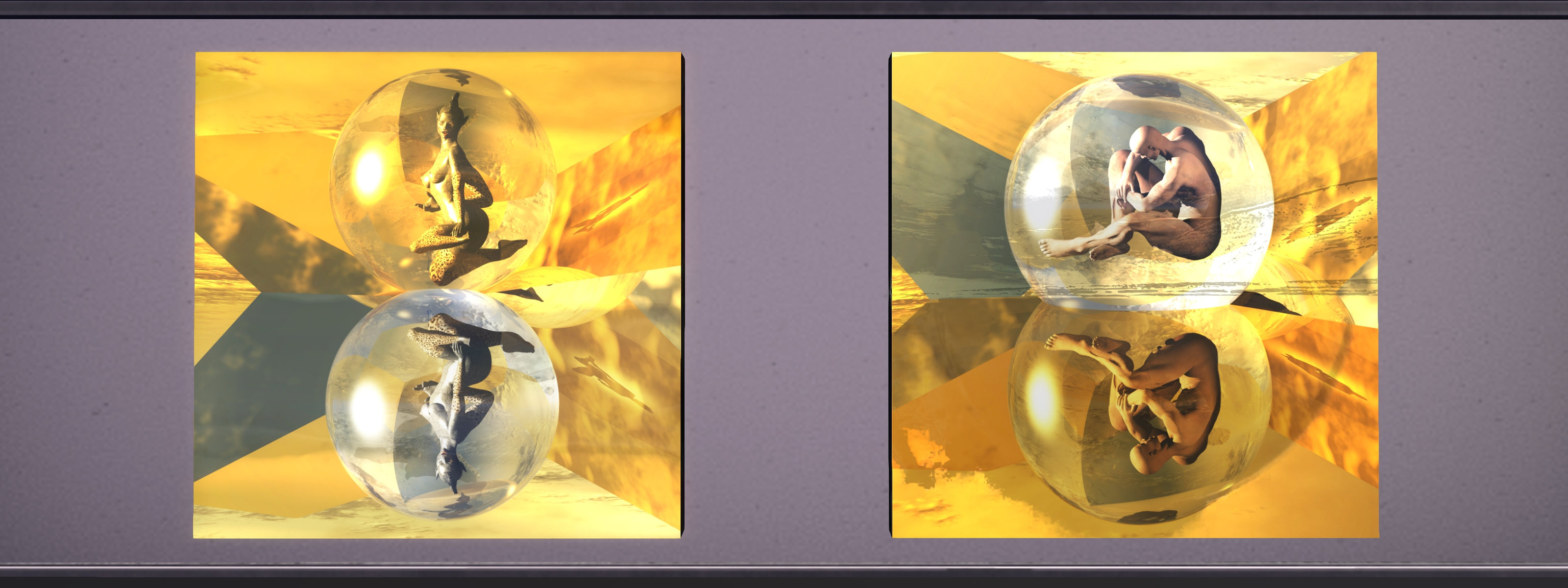
Within the two-level main hall of PsyGallery sits Embryos by TerraMerhyem. No liner notes are provided for this selection of work, spanning as it does both static and animated pieces. However, given it is by Terra, you can expect it to be nothing short of expressive, and each of the pieces visually engaging. The one set of notes that are provided come in the form of reminders on the floor of each level within the gallery that Advanced Lighting Model should be enabled (Preferences → Graphics → make sure the option is checked) in order to see the works at their best.

PsyGallery, June 2023: TerraMerhyem – Embryos

For most of us, the term embryo most likely brings to mind the stage of human life following fertilisation through until the  ninth week after conception, with mental images of of the growing embryo lying within the womb as it commences its journey towards / into life. Some of this is perhaps evident in the static pieces presented here by Terra, showing as they do male and female human forms contained within protective spheres, like embryos within the womb. However, give that the figures in their spheres are fully-formed adults means this is not an artistic treatise on life per se; rather it is perhaps more of a comment on the fact that from beginning to end, life is a continuous process of growth, maturation, change and – for all of its gregarious opportunities – ultimately isolated and individual.

That no influence is exerted by the artist on how we opt to interpret these pieces, thus leaving us free to interpret them as some form of commentary – per the above – or purely as purely visually engaging, highly creative and imaginative pieces of art similarly enhances the appeal of the 2D pieces; allowing each to be taken as a whole unto itself, or – in the case of four of the pieces – artistic pairings.

Similarly, how we interpret the animated pieces, which mix 2D and 3D creations, is left to out own processes of thought and reaction to art and design. Utilising geometry, images and colour to rich effect, these are pieces literally pulsating – one might say beating with the rhythm of a healthy heart – in a manner which is strikingly beautiful whilst still carrying that suggestion of life and change we might opt to see as a possible message within the static pieces, through both the regularity of their pulsations and their gently repeating motions.

PsyGallery, June 2023: Canaris Restless – Summer Solstice

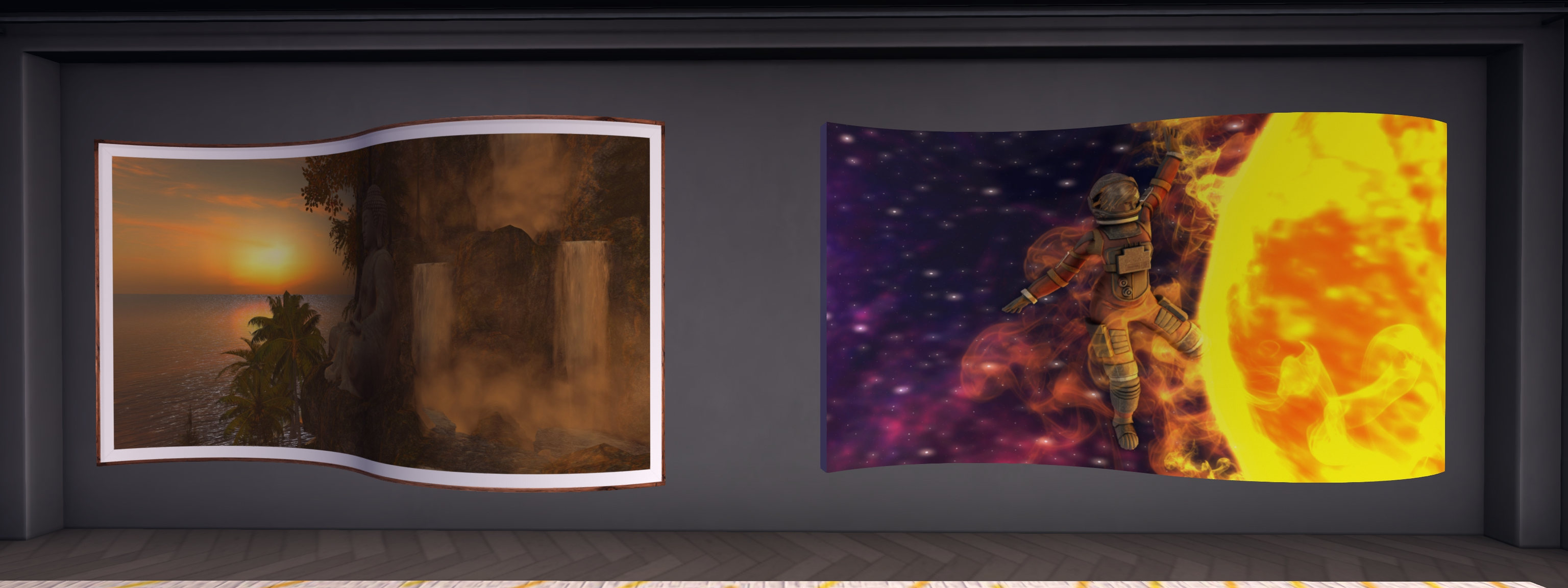
On the uppermost level of the gallery, and reached via the teleport board is Summer Solstice, a series of images by Canaris Restless offered as a visual essay on the subject of the titular event and how it is viewed by different cultures, past and present.

As Canaris notes, the Summer Solstice has been, and remains for many, a time of new beginnings, and / or renewal of life and growth; a time when all that is good about life is celebrated as the cycle of life moves ever forward; and within this might be ween the thread linking both of these exhibitions into something of a themed whole, if one chooses to do so.

The smaller of the two installations, Summer Solstice is marked by Canaris’ elegant photography captured within Second Life and by free-standing displays of (literally) heliocentric art reminding us of the reality that the Sun – whilst perhaps not worshipped as once it was – truly remains the most prominent giver of life for our world.

PsyGallery, June 2023: Canaris Restless – Summer Solstice

Two very visually engaging exhibitions by two very different artists they many, but Embryos and Summer Solstice do compliment one another in terms of potential themes and ideas, so do be sure to see both when visiting.

SLurl Details