Wandering With Love In Her Heart

Salt Water; Inara Pey, December 2014, on FlickrWith Love in Her Heart, Sounds of Silence (Flickr)

My previous travelogue featured TreMeldazis’ Salt Water, which at the time I mentioned was one of three regions in his care, the others being  Isle of Grace, which is restricted access and appears to be Tre’s home, and Sounds of Silence, a homestead region designed by Sunshine Zhangsun, which is open to the public.

Given the regions do go together somewhat, you can see one for the shores of the others and cross between Salt Water and Sounds of Silence, I thought it only fair that I also write about the latter as well.

Sunshine has called the region With Love In Her Heart, and it lies to the east of Salt Water, separated from it by a narrow channel of sea water. Rated Moderate, the region shares much in common, terrain-wise with Salt Water: beaches form much of the coastline, with low-ling grasslands just inland in places, while rocky hills make up the rest of the landscape.

Salt Water; Inara Pey, December 2014, on FlickrWith Love in Her Heart, Sounds of Silence (Flickr)

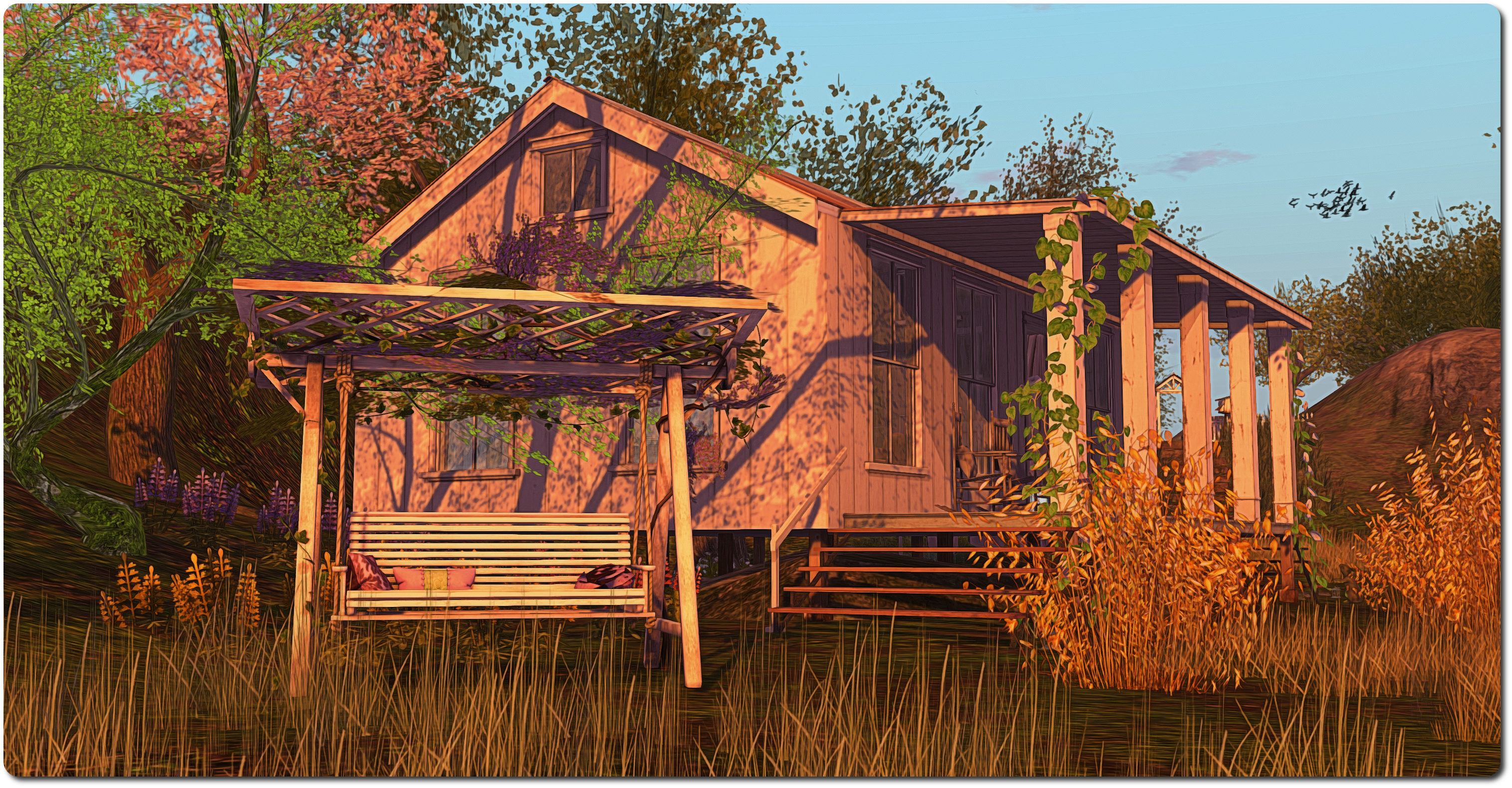
However, move inland, and things have an altogether more pastoral theme. Goats wander the hillsides, sheep and cattle graze on the higher grasslands and horse roam the lower grassy reaches closer to the sea. There is a farm here, which – possibly due to the influence of the documentaries I’ve been watching of late – put me in mind of the Australian outback.  The two houses are open to visitors and furnished, one having the appearance of a family home, the other a working studio.

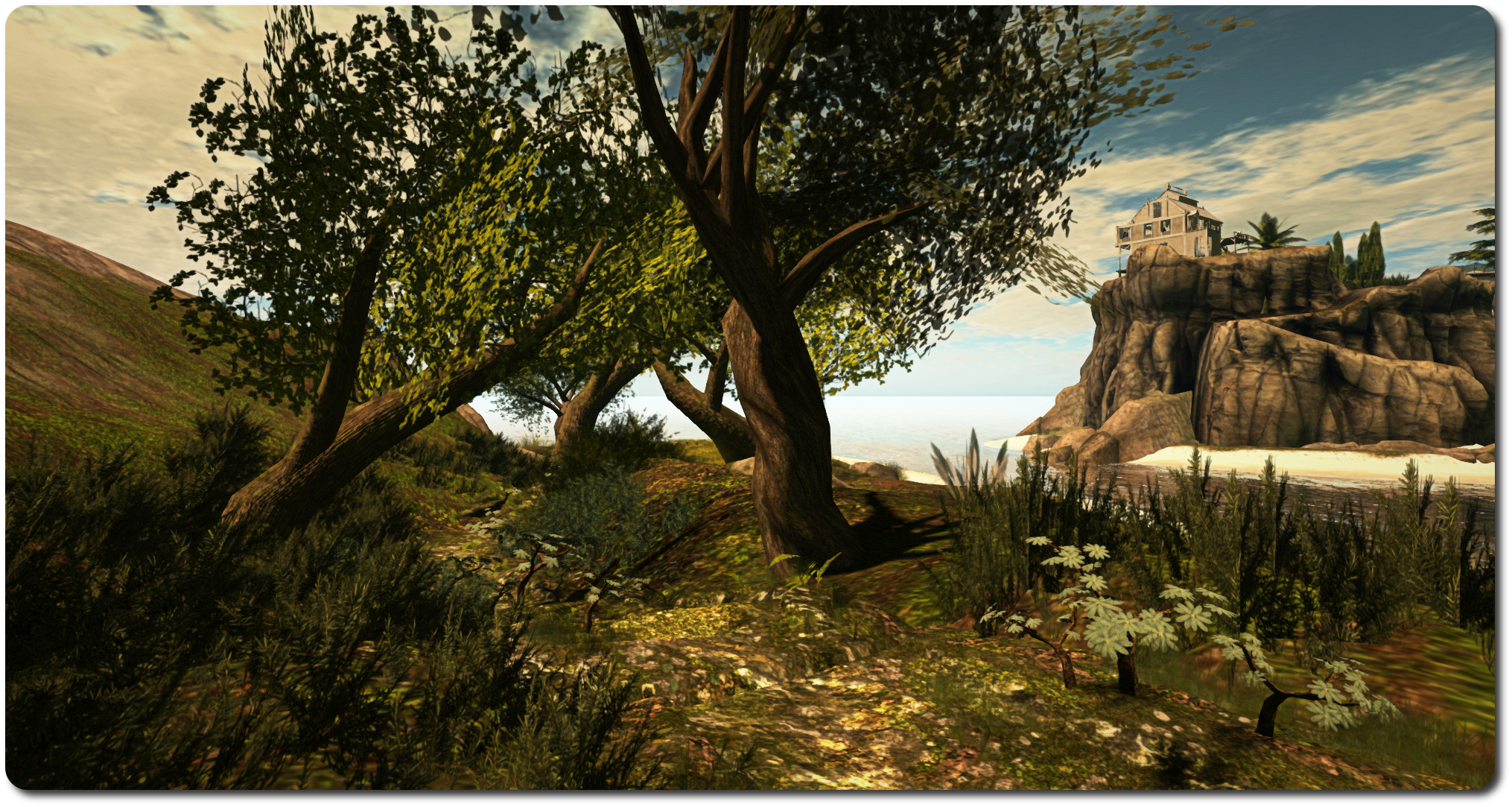
Up the hill from these, lying in a shallow grass bowl with bare-topped hills surrounding it, sits a barn with cattle and sheep roaming nearby. The feeling of homestead is enhanced here by the small burial plot sitting in the shadow of a tall tree.
Salt Water; Inara Pey, December 2014, on FlickrWith Love in Her Heart, Sounds of Silence (Flickr)

From the barn, one can wander on over the hills to the east to to the beach, or turn more southwards and follow one of two paths which cut through the hills. The first of these leads back to the arrival point; so if you teleported into the region, it might be the route you followed to reach the barn and livestock. The second path leads down to a circular cove nestled between the hills and rocky cliffs, where two secluded stretches of sand can be found facing one another across the calm waters, linked by a path over the rocks to one side of the cove.

Here you’ll find places to sit, both on the sands and on the water, offering spots for quiet contemplation or a little time with a close friend / loved one. Explore the island, and you’ll find other such places and little social spots – towels spread on the beach here, a little boat sitting just off the coast there, a small camp and fire pit towards one headland, a makeshift tent of blankets and cushions looking out to the north, and so on.
Salt Water; Inara Pey, December 2014, on FlickrWith Love in Her Heart, Sounds of Silence (Flickr)

All told, With Love In Her Heart offers something of a tranquil setting; the landscape sits easy on the eye, there are places to wander and to sit, and like Salt Water, plenty of opportunities for photography (rezzing is open, but do remember to pick things up after!). As I mentioned with Salt Water, taken together, both regions are worth a joint visit.

Related Links

LEA announce AIR 8 selection

LEA_square_logo_60On Tuesday, December 16th, 2014 the Linden Endowment for the Arts announced the successful applicants for the 8th round of the LEA’s Artist-in-Residence (AIR) programme.

They are: Solkide Auer, Art Blue, Giovanna Cerise, Asmita Duranjaya and Sable, Mario2 Helstein, Mistero Hifeng,  NaTaS Janus, Gracie Kendal, frankx lefavre,  FreeWee Ling, mediciprincess, Whiskey Monday, Haveit Neox, Lemonodo Oh, Krystali Rabeni, Searby, Sniper Siemens , Misprint Thursday, Lorin Tone and Mary Wickentower.

Qualia: The Sentience of Being - frankx lefavre, December 2014
Qualia: The Sentience of Being – Frankx Lefavre, December 2014

The LEA received over 40 applications, and those selected were viewed as presenting “truly outstanding proposals that represent a diverse range of virtual art.”

The successful applicants will each be allocated a full region within the LEA for a 6-month period. They have up to four months to prepare their projects, which range from full-sim immersions, to innovative builds geared specifically for multimedia works such as sound and machinima. Each installation must be open for a minimum of two months of the 6-month allocation, and it is expected that some will be open in advance of the four-month build deadline. All exhibits must be open to the public by the end of April 2015 at the latest.

Chaos, Kosmos - Giovanna Cerise, December 2014
Chaos, Kosmos – Giovanna Cerise, November 2014

All openings will be announced in the LEA blog.

The Drax Files Radio Hour: taking flight with an aeronautical legend

radio-hourI’ve not covered recent Drax Files Radio hour shows, primarily due to time constraints. However, show #49 features a special guest whose work has brought fun to a lot of people’s lives in SL (including my own), Steve “Cubey Terra” Cavers. Given his work has had such an influence in various aspects of my SL life, I couldn’t pass-up writing about this show.

The interview kicks-off after the usual preamble,  at the 21:35 minute mark. Cubey Terra may be a name unfamiliar to those who have come to SL in recent years, particularly as he decided to take a break from the platform for a couple of years. But to many in the SL aviation community and who have been around for a while, his name is instantly familiar, and often linked to the nickname “the grandfather of SL aviation”, a term he’s personally uncomfortable with, for reasons which are explored as his conversation with Drax unfolds.

As well as being active in SL from the earliest days (that is, from just after it opens its doors to the public in June 2013), Cubey also spent time working for the Lab as a part-time support volunteer. As such, he is ideally placed to discuss Second Life from several perspectives: content creation, the very early days of the platform and the users it attracted, and that of providing user-focused support and assistance back when the platform was just starting to grow.

Cubey Terra
Cubey Terra

However, before all of that is reached, the conversation kicks-off with an interesting exchange on the subject of alt accounts and our level of comfort with them, but from the perspective of using them ourselves, and the reactions from friends and those around on on discovering we have alt accounts.

What is interesting here is the somewhat divergent views Cubey and Drax, as individuals who don’t use their avatars as characters, but rather fully invest their personality into their avatar, have about their alt accounts. On the one hand, Drax finds it constraining, and consciously feels more of a puppeteer with his alts, while Cubey perhaps find his alts somewhat more liberating when used. These reactions aren’t uncommon; I’ve particularly identified more with Drax’s perspective in the past, although my view has perhaps started to lean towards Cubey’s more recently and in certain situations.

While he worked for the Lab “only” for a year, Cubey provides some fascinating insights into what it is like to be involved in user support back when Second Life was a lot smaller than it is today, and matters could more easily be handled in more of an on-going, hands-on and proactive manner:

Right from the beginning of Second Life, Linden Lab decided that it would be a good idea to have staff in-world, standing around in welcome areas or going around from sim to sim, making sure that things are running correctly, problem-solving, putting out fires – literally, because people would rez fires and worse. And so it was more a personalised experience than what you get now … so that’s basically what I would do.

As a personalised experience, it was, inevitably, something that couldn’t easily scale given the sudden and missive influx of users Second Life gained during the 2005-2007 period. This is something Cubey notes in the interview, explaining how the influx resulted in the support staff logging-in to the support service outside of their assigned hours in order to to try to ensure problems could be dealt with. Such was the situation, that even as early as 2005, those working in support were openly voicing opinions that the approach simply wouldn’t scale to meet the constantly rising demands for assistance – something which helps put the pivoting of support and assistance towards other means and channels into better perspective.

This part of the conversation also touches on broader aspects of governance and on the needs for some structure and rules, and Cubey offers-up so sage observations on matters of finding a a balance between creative freedom and a balance, open social environment.

One of the reasons Cubey may be averse to his title of "the father of SL aviation" is that he took his inspiration from those at the Kazenojin aviation group and Andrew Linden
One of the reasons Cubey may be averse to his title of “the father of SL aviation” is that he took his inspiration from those at the Kazenojin aviation group and Andrew Linden

Around half-way through the interview, matters turn more to Cubey’s involvement in the Second Life aviation community. In particular, Cubey touches upon how he got started in aviation via the Kazenojin aviation group, and Andrew Linden’s first aeroplane script. It is because his work was pre-dated by Kazenojin and Andrew Linden that he feels uncomfortable with titles such as “grandfather” of SL aviation.

Even so, for many of us who came into SL around 2006/7, his name is pretty synonymous with flying and aeronautical matters in Second Life. To use myself as an example; long before I started flying aeroplanes in SL, I was deeply into SL skydiving as a direct result of discovering the Terra range of parachutes, which in turn led my to joining a skydiving club  / group in SL (and I still use the TerraSport III Pro ‘chute in-world to this day). And when I did start flying in earnest, it was the Terra Stingray I turned to to get started (and I still fly that today as well!).

The Cubey Terra Stingray was one of my first real forays into flying in SL - a great aircraft (which also doubles as a speed boat and submarine!)
The Cubey Terra Stingray was one of my first real forays into flying in SL – a great aircraft (which also doubles as a speed boat and submarine!)

The end of the interview turns its attention to what draw Cubey back to SL after his break, and start creating once more. The answer is given pretty much in one word: mesh. Through it, Cubey now has the opportunity to learn new content creation techniques and develop the kinds of aircraft he’s always wanted to create, but has been unable to do so due to previous constraints within the platform.

All told, another fascinating interview (and one deserving of a full hour, frankly), providing a lot of insight into times past in SL, and not a few thoughts on times present and times yet to be.

Cubey marked his return to SL with the release of the Terra Xplorer "hover disk"
Cubey marked his return to SL with the release of the Terra Xplorer “hover disk”, a fun way to travel around

Summer can still be found in Second Life

Salt Water; Inara Pey, December 2014, on FlickrSalt Water (Flickr)

Winter has drawn a snowy cloak over much of Second Life. However, for those seeking sunshine, sand and a little warmth, it can still be found.

One place were the sun does still shine is Salt Water. Once the home of Baja Norte (which relocated to a region of its own a while ago), the region is still a place of verdant green and yellow sand, albeit bathed in the light of a forever setting sun (causing me to fiddled windlight to an earlier time of day when making my visit).

Now an Adult rated region, Salt Water is maintained by TreMeldazis, and forms one of three regions in his care. The other two are Isle of Grace, which is restricted access and appears to be Tre’s home, and Sounds of Silence, a homestead region designed by Sunshine Zhangsun (who also worked on Salt Water) for the purposes of photography, and now kept open through Tre’s generosity.

Salt Water; Inara Pey, December 2014, on FlickrSalt Water (Flickr)

There’s no actual description with Salt Water, but given it is Adult, and cuddle spots are scattered right across the region (as are dance systems), don’t be surprised if you do come across a spot of canoodling going on should you decide to wander the beaches or explore inland.

The island has an eye-catching design, with beaches forming most of the perimeter, together with low grasslands no the north side. The interior of the island is largely given over to tall rocky outcrops and plateaus, paths winding up their sides and stone bridges spanning the gaps between them. A channel of water curls inland from the beach on the west side of the island, into which fresh water tumbles from rocky cliffs rising above it.

Salt Water; Inara Pey, December 2014, on FlickrSalt Water (Flickr)

Atop the tallest of the plateaus can be found a studio house, open to the public, its woodwork bleached and worm from exposure to the sun and the salt of the air around the island. The remaining plateaus all have their own features to be enjoyed by couples and groups, with places to sit and chat or cuddle or places to dance through the evening light. For those who enjoy the beach, there are sun loungers to be found, while a further wooden house has been built out over the water at Mermaid Cove, partially protected from the tide by a breakwater of rocks.

Needless to say, the opportunities for photography within the island are myriad, the landscape offering a rich diversity of backgrounds. Rezzing is open for those who need props for their photos – but do please be sure to clean-up behind you. With both Isle of Grace and Sounds of Silence visible from Salt Water, some great backdrops can be had for the photographically gifted.

Salt Water; Inara Pey, December 2014, on FlickrSalt Water (Flickr)

For those wishing to extend their explorations, Sounds of Silence is a simple hop away, and offers a charm of its own. However, I’ll be saving that for another article on another day!

Related Links

Transcending Borders (2): celebrating the machinima makers

On Sunday, December 14th, 2014, the Grand Finale of the University Of Western Australia’s (UWA) Transcending Borders was held at the impressive UWA-BOSL Grand Amphitheatre. During the event, over L$1,000,000 was awarded in prizes to artists, machinima makers and those who took part in the audience participation competition. With some last-minute additions to the prize pools, and some additional special awards, the event was a very special celebration of artistic expression in Second Life.

Transcending Borders challenged entrants to interpret the title of the competition in any fashion they deem applicable, and produce a 3D artwork (in no more than 150 prims) or short film based on their interpretation, be it on transcending borders of space and time, love and loss, nationally or culture or language, or the real and the virtual, and so on. The result was a glittering array of 67 artworks and 38 machinima, representing a broad diversity of interpretations of the theme.

The Grand Finale was hosted by the UWA’s Jayjay Zifanwe, with the UWA’s art curator, FreeWee Ling also on hand to announce the special Curator’s awards in both the art and machinima categories.

In the first part of this report, I covered the awards for the Transcending Borders 3D Art Challenge. Here, I review the winners in the the MachinimUWA VII Transcending Borders Challenge, in which machinima makers could submit as many films on the them as they wish, as long as each entry had been specifically filmed for the Challenge, and should preferably run for around 4 minutes 30 seconds (although this latter point was not a “hard” rule.

Audience Participation Prizes

Alongside the “main” challenges focused on artists and machinima makers, Transcending Borders included two audience participation competitions. Anyone who was not on the official judging panel was invited to provide what they thought the top 10 would be as decided by the actual panel, and those with lists which most closely matched the final list of prize winners as determined by the judges, would receive a special prize.

And the winners were:

  • 5th place winner (L$5,000): Elle Thorkveld
  • 4th place winner (L$7,500): Chic Aeon
  • 3rd place winner (L$10,000): Karima Hosian
  • 2nd place winner (L$15,000): Lalie Sorbet
  • 1st place winner (L$20,000): Dyzo.

Commenting on the machinima audience participation competition, Jayjay said, “No tall order to attempt to participate in this challenge, as one had to watch all the machinima [38 entries].
Quite amazing, as all the top 3 correctly predicted 8 of the top 10 [as determined by the judge’s votes].” He went on to note that of these five individuals, three had been in the top five of the last art Grand Challenge, perhaps showing that there was something of a science in how the winners make their selections.

For Chic Aeon, the audience participation prize was the start of a remarkable part of the evening, something she shared with Haveit Neox.

Machinima Prizes

Note that SLurls are given with the titles of all winning pieces, and all the entries into the MachinimUMA VII Transcending Borders challenge can be seen on the SL Artist website.

The 10th through 6th places winners, who each received L$25,000 are:

As there was a tie for 4th place, there was no individual 5th place prize winner. Instead, the top four prizes in the MachinimUWA VII Transcending Borders challenge were awarded as follows:

Jayjay had contacted Tutsy ahead of the event to inform him he had won a prize, but due to Internet issues, Tutsy could not remain connected to Second Life for the event. Instead, a short speech he had prepared ahead of time was read out by his friend, Yoon.

I would like to express a warm welcome to all participants and visitors for attending this grand finale. Also I would like to express a big thank you to UWA, Jayjay and all the organizers of this contest for offering the opportunity to many people, to discover or establish themselves as creators in 3D or Machinimas. 

Transcending borders in and with a movie is less tough than transcending the borders of a contest itself.  A work of NicoleX was refused because it conflicted with the UWA borders. I do regret the work has been refused, it shows the limits we have to deal with sometimes.
Yet we also cannot be deaf and blind for using our freedom of expression with a sense of awareness for the consequences. When input and output become disproportionate, other
solutions are needed.

Therefore again, many thanks to both UWA and all people that participated with their movies and opinions. And I am secretly proud as well a tiny little bit, thank you all!

 Special Awards

In addition to the top ten awards, the Grand Finale included a number of special awards, both from the MachinimaUWA VII Transcending Borders challenge and also from the 2014 Project SciFi, which the UWA partners.

MachinimUWA VII Transcending Borders Special Prizes

  • Honourable Mention Prize for message within a film (L$15,000): Unseen Transcended Borders, by Eric Takkar & Arcane Marenwolf (USA  and Australia)
  • Honourable Mention Prize for artistry within a film (L$15,000): The Embryo, by Ultraviolet Alter (France)
  • UWA Special Prize (L$25,000), awarded by the UWA representatives on the judging panel to the film that interweaves a number of locations from the UWA campus in it: The Ghost in the Machine, by Chic Aeon (USA) – Chic’s third win of the evening, and the second for her entry
  • Curators Choice Award (L$25,000) for the film, selected by UWA’s curator FreeWee Ling, that weaves one or few of the artworks in the challenge into it: Reading Primchords, by Haveit Neox (USA) –  Haveit’s third individual win in the Finale with both the film and Primchords, the artwork which inspired it. Haveit also shared a prize with Lilia Artia and Mouehane for Sharing Unknown Roads

Commenting on her choice, FreeWee said:

For the machinima curator’s prize there were several entries that included artwork from current or past UWA shows. Some were focused specifically on a single piece or two, some incorporated art as a background to their narratives, and some had only a brief sighting of a work. I was looking for machinimas that most effectively used the artwork to tell the story of the film. The films that did that best seemed to be those by the 3D artists themselves. Among those, there was one film I thought was most engaging with the 3D art being essential in telling a story.

Project Sci-Fi Awards

Mention was also made of the two SL-based machinima which had also received prizes inthe 2014 Project Sci-Fi competition. This event was judged by a jury entirely separate to that of Transcending Borders.

  • 2014 Project SciFi Challenge Honourable Mention (AU$200): About Face, by Avajean Westland (USA)
  • 2014 Project SciFi Challenge winner (AU$300) Metaphore by Tutsy Navrathna (India).

Congratulations to all the winners.

As with the first part of this report, I would again like to extend my personal thanks to both Jayjay and FreeWee for the incredible amount of work they do in the promotion of virtual world art and the potential of virtual worlds. Transcending Borders is not only a fitting theme for a UWA Grand Challenge, reminds us that both Jayjay and FreeWee help artists, educators, students and virtual worlds enthusiasts transcend the borders between the virtual and the physical each and every day.

Related Links

Transcending Borders (1): celebrating the artists

The UWA-BOSL Ampitheatre: scene of the Transcending Borders Grand Finale

On Sunday, December 14th, 2014, the Grand Finale of the University Of Western Australia’s (UWA) Transcending Borders was held at the impressive UWA-BOSL Grand Amphitheatre. During the event, over L$1,000,000 was awarded in prizes to artists, machinima makers and those who took part in the audience participation competitions. With some last-minute additions to the prize pools, and some additional special awards, the event was a very special celebration of artistic expression in Second Life.

Transcending Borders challenged entrants to interpret the title of the competition in any fashion they deem applicable, and produce a 3D artwork (in no more than 150 prims) or short film based on their interpretation, be it on transcending borders of space and time, love and loss, nationally or culture or language, or the real and the virtual, and so on. The result was a glittering array of 67 artworks and 38 machinima, representing a broad diversity of interpretations of the theme.

The Grand Finale was hosted by the UWA’s Jayjay Zifanwe, with the UWA’s art curator, FreeWee Ling also on hand to announce the special Curator’s awards in both the art and machinima categories.

JayJay Zifanwe
JayJay Zifanwe

Opening the event, Jayjay said:

It’s been an absolute pleasure for me to work with all of you over the course of these challenges, and especially to those who went above and beyond the call of duty to make all of this a success. Thank you FreeWee Ling, curator of art at UWA & RL Honorary Fellow at UWA. Thank you LaPiscean Liberty, co-host for MachinimUWA VII, champion of machinima of Second Life. Also much thanks to those who have provided support and sponsorship which sees the overall prize pool standing at more than L$1,000,000 across both art and machinima. Special mention needs to be made of all who have been such strong supporters.

These challenges are sponsored by Tom Papas and SciFi Film Festival, LaPiscean Liberty and SL Artist, AviewTV, Arrehn Oberlander and MetaHarpers, Kip Yellowjacket and Virtlantis, Taralyn Gravois and Arts Castle Gallery, TheDoveRhode and Peace is a Choice and S&S Gallery of Fine SL Art, Barbie Alchemi of Creations for Parkinsons, Jon Stubbs and UWA Student Services, as well as The UWA Virtual Worlds Project.

I want to thank all of you for being here today, bringing the world together. The UWA Art, Architectural & Machinima Challenges, the teaching & research have seen people from all corners of the globe involved with students, artists, builders and machinimatographers hailing from Lithuania, Singapore, Costa Rica, the Philippines, Finland, Greece, India, Colombia, Poland, Norway, South Africa, Sweden, Ukraine, Taiwan, Hungary, Latvia, Russia, Venezuela, Belgium, Mexico, Wales, Canada, the USA, the UK, Uruguay, Scotland, England, Spain, Switzerland, Italy, France, the French Caribbean, Brazil, Argentina, Chile, Denmark, Holland, Ireland, Northern Ireland, Portugal, Austria, Cuba, Serbia, Tunisia, Germany, Japan, New Zealand, Australia and parts unknown. More than 45 nations with 6 of the 7 continents of the world represented.

The following is a run-down of the winners of the 3D Art challenge. The MachinimUWA VII: Transcending Borders awards are presented in a further article in these pages.

Audience Participation Prizes

Alongside the “main” challenges focused on artists and machinima makers, Transcending Borders included two audience participation competitions. Anyone who was not on the official judging panel was invited to provide what they thought the top 10 would be as decided by the actual panel, and those with lists which most closely matched the final list of prize winners as determined by the judges, would receive a special prize.

In all, there were two groups of audience participation prizes for the 3D art challenge. As an entire art degree class from York University entered the competition, and the overall prize pool had been increased from L$57,500 to L$62,500, the audience participation prizes were altered, with 3 awards specifically for York University students, and four for members of the public. These prizes were awarded as follows:

  • Joint second in the York University student prize: Vickar Tran and Stefano Onorati (L$2,500 each)
  • Overall winner, York University student prize: Abisola Okiwole (L$5,000)
  • 4th place, audience participation: Rosie Dimanovic (L$7,500)
  • 3rd place, audience participation: Sheba Blitz (L$10,000)
  • 2nd place, audience participation: Sueworthy (L$15,000)
  • Overall winner, audience participation: Temi Sirbu (L$20,000 and a place on the official jury for the next grand art challenge

All of the winners will additionally receive a physical prize from the UWA.

Art Awards

Note that SLurls are given with the titles of all winning pieces, and all the entries into the Transcending Borders 3D art challenge can still be viewed at the UWA art gallery.

In an unprecedented result, there were no fewer than five 10th places winners, all tied on a total of 21 points from the judge’s selections. The five winners each receive a L$5,000 prize and are:

Pixel Sideways "Transcending Borderz" - joint 10th place winner
Transcending Borderz, by Pixel Sideways – one of the five joint 10th place winners

Continue reading “Transcending Borders (1): celebrating the artists” →