2014: A look back – part 1

Isle of Mousai, January 2014Isle of Mousai, Ancient Alexandria, one of my first ports of call in 2014 for my Exploring Second Life series

Christmas is upon us, and following not far behind, the year’s end, which is often a time of reflection as we look back over the old before pausing to await the arrival of the new. It’s become something of a tradition in these pages to look back over the virtual year’s events as I’ve seen and reported them, and offer a chance to revisit the ups and downs and the good and the bad the last twelve months have brought us.

Once again, this has been an incredibly busy year for me, blog-wise – over 950 articles published so far (and counting!) since the start of the year. So I hope you’ll forgive that as I look back over the year as I’ve managed to report it through this blog, I’ve broken it down into three parts, which I’ll be publishing between now and the end of the year. Not everything that happened through the year may be here; there are some aspects of  SL in which I’m not active, and so may have missed some headlines. Nevertheless, I hope this review sparks a few memories and provides some interesting holiday reading.  Just to (hopefully) make the reading a little more interesting, I’ve tried to avoid just breaking things down entirely by month, in favour of offering what I hope is more of a narrative flow. Part two and part three are also available.

The Lab

The year gets off to something of a quiet start – literally. With communications from the Lab slowly drying-up throughout the period 2010-2013, There is an announcement (absent from any of the SL channels, due to the Lab’s approach of “siloing” what communications were forthcoming), that the still pre-release Patterns sandbox game / creation tool for Mac and PCs had been updated with materials processing and more, some of which gets a further tweak during the month. An update on the required documentation being sought from users meeting certain transaction thresholds is given, but doesn’t entirely enlighten, prompting me to seek further clarification from the Lab. Given the confusion evident, the Lab does issue a tax and account info FAQ to help people.

Rod Humble, with a little reminder from his past, becomes an CEO of the past at Linden Lab

However, the biggest news to start the year comes  via Facebook messages, Tweets and tech media reports, as it emerges that, after three years at the Lab, Rod Humble had departed for pastures new around the end of 2013.

As a result, I look back over his tenure, and decide that, allowing for the warts it brought with it (breakdown of communications, the ToS changes, etc), in terms of the technical aspects of SL, it wasn’t that bad. It wasn’t a popular view.

However, the lack of anything from the Lab one the matter wasn’t encouraging at the time.

The first real confirmation of Mr. Humble’s departure from the Lab came with the announcement that Ebbe Altberg had been hired, and would join the company officially in February. This was met with statements of “Who he?” from many, so I dug around and put together a brief profile, which in turn prompted the man himself to drop by the blog – which is always welcome! Although admittedly, I couldn’t resist dropping him a letter on the subject of communications – not that I needed to have worried, as it turned out.

One of the first things undertaken as a result of Ebbe’s appointment is a review of the Lab’s attempts at diversification.This results in Creatorverse, dio and Versu being  axed, and I’m left wondering if Versu doesn’t deserve a future, particularly given a new title, Blood & Laurels, appeared ready to be launched; I’m not alone in this view. However, the Lab initially refuses the idea.

In the meantime, Patterns, having escaped the chopping block (or at least getting a stay of execution), gets its new UI. Positive moves continue elsewhere in the Lab as the door to improved communications is further pushed open, including a promise to re-open the SL JIRA  to public viewing and a promise to revisit the August 2013 changes to the Lab’s Terms of Service. The latter is made during an open Q&A session Ebbe takes  at the 2014 VWBPE; unfortunately, when it arrives, the update doesn’t, in the eyes of many (myself included), really seem to actually clarify anything – but more of that anon.

New man at the top, Ebbe Altberg (l), who quickly sets about reversing the Lab's policy on communications, opening things out and taking time to attend events such as the Virtual Worlds Best Practice in Education, where he appear via his alt-ego Ebbe Linden (r - image by Strawberry Singh)
New man at the top, Ebbe Altberg (l), who quickly sets about reversing the Lab’s policy on communications, opening things out and taking time to attend events such as the Virtual Worlds Best Practice in Education, where he appeared via his alter-ego Ebbe Linden (r – image by Strawberry Singh)

The re-engagement with the education sector continues later in the year with Ebbe meeting with representatives in-world, as he did with a number of other user communities, building bridges and seeking to understand needs and wants within SL as a whole – for which he should actually be congratulated. Also on the education front, the Lab  helps to promote education projects, such as the MOOC course for Spanish educators, which was to be repeated later in the year as well.

In April, the Heartbleed situation rears its head across the Internet, and the Lab offers advice to users, while I pick-up on a Tweet from Strawberry Singh concerning promotional videos and SL.

Second Life

The start of the year brings word from Tyche Shepherd’s Grid Survey that while region losses continued through 2013, the total loss is some 40% less than that experienced in 2013, although it still represents an 8.2% reduction in the overall number of regions. This does cause renewed demands for tier cuts from some quarters (although tier cuts are as best a very short-term answer, and could actually do more harm than good, as I explained back in January 2013).

Monty Linden: starts the year as he means to go on: overhauling the Lab's use of HTTP
Monty Linden: starts the year as he means to go on: overhauling the Lab’s use of HTTP

For me, my SL January starts with a number of questions from other users on the status of direct messaging on the SL feeds. Passing the enquiry on to the Lab, I receive confirmation that the option had been turned off, which surprises and disappoints some.

2014’s impressive list of updates and improvements to the platform takes off with the arrival of Monty Linden’s much anticipated HTTP project viewer, which he subsequently blogged about. As well as banging on all things HTTP, Monty also sets about cleaning-up the various third-party libraries used in the viewer build process, the first part of an on-going overhaul of that process that would continue through the year.

January also sees Andrew Linden’s last project for SL (completed prior to him departing for High Fidelity in December 2013), a capability to allow for the uniform scaling of linksets, arrive on the grid. Then, the end of January brings with it a surprise when there’s a change to the land bot policy, causing a few eyebrows to rise.

Among the Lab’s major projects, fitted mesh is impacted by AMD driver issues, one of several  AMD-related problems which will occur through the year, although they don’t prevent fitted mesh being officially launched in early February.

February also sees the first big step in the Lab’s AIS v3 project to improve inventory handling between the viewer and the simulators, with the release of the SSA / AIS v3 project viewer,

Photography in SL takes a couple of hits early in the year. January sees the issues that prevent snapshots being uploaded to the SL feeds continue, while in March, photo uploads to Facebook are disabled due to them violating FB’s policies by including SLurls.  This is finally rectified in April, with the formal release of SL Share 2, which allows photos (and messages) to be shared with Twitter and Flickr, and includes post-processing filter capabilities. I’m able to preview the capabilities ahead of the official announcement, which comes with a welcome video for Torley.
Continue reading “2014: A look back – part 1” →

A winter’s scribbled heart

Scribbled Hearts; Inara Pey, August 2013, on FlickrScribbled Hearts (Flickr)

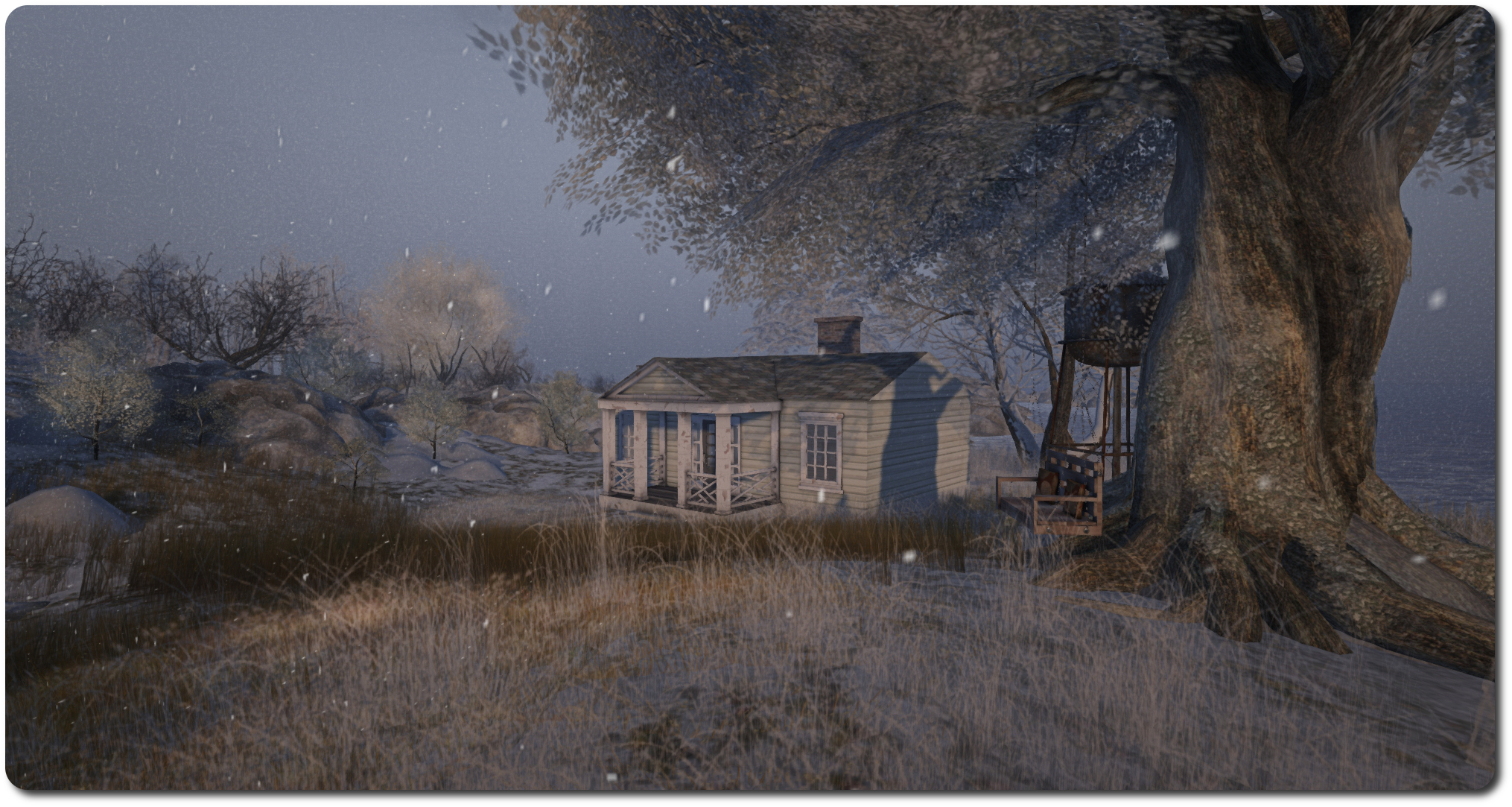
Looking through my travelogue entries for SL, I was surprised to realise I hadn’t paid a visit to Scribbled Hearts in over a year.

Much has changed since I last visited. *. emm [shop] and Little Closet have both now gone, replaced by Alessandra Ambrosio’s Tarte and Plethora Plentiful’s Plethora. However, much of the “old” look and feel of the region is still retained, with landscaping by Elvira Kytori and  Alessandra Ambrosio. Water still very much forms a central feature and the overall appearance is very rural and open.

Scribbled Hearts; Inara Pey, August 2013, on FlickrScribbled Hearts (Flickr)

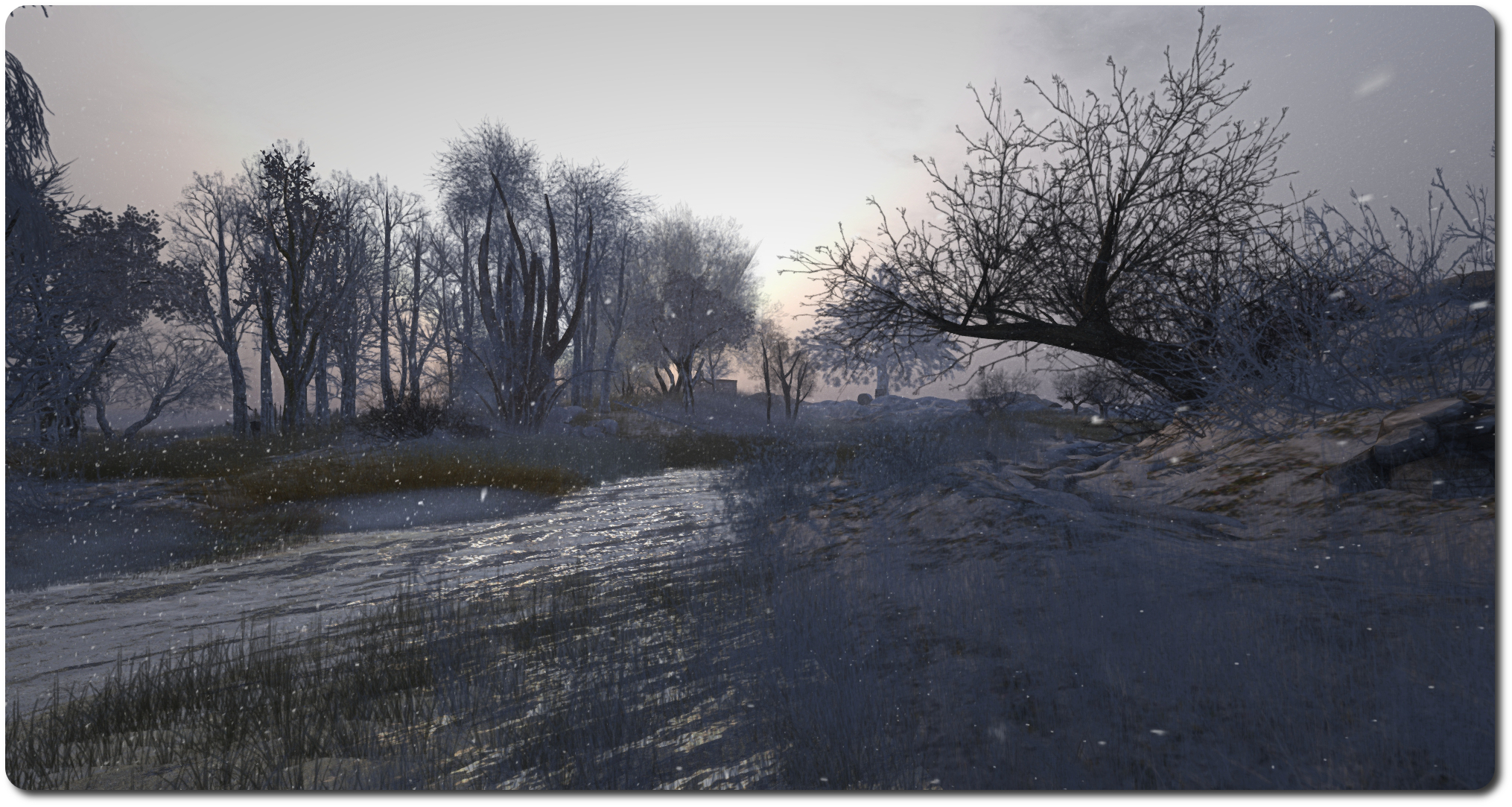
As one might expect given the time of year in the northern hemisphere, the region is in the grip of winter; snow is beginning to lay on the ground – and has drifted in places as it falls steadily from the sky, misting the horizon. Most of the region is open to explore, although a parcel on the north side is restricted access at ground level, so watch out for bouncing off of ban lines if you decide to flip around by air.

Alongside of the stores, the region has a couple of small homes and a strange little hutch-like cabin scattered across it, with a rutted track leading visitors around them and it little touches of interest – a camp fire and chairs here, a swing hung from the tree there, and so on. None of the houses are occupied, so there is no risk of invasion of privacy, and one of them offers a little backyard jetty where you can sit and strum a guitar. Rezzing has been turned off, so the place isn’t quite and amenable to photographs as it once was, but it still offers some good opportunities for seasonal photos and well as a wander through the stores.

Scribbled Hearts; Inara Pey, August 2013, on FlickrScribbled Hearts (Flickr)

All told, still a pleasing corner of SL to visit.

Related Links

The Drax Files Radio Hour: DMCA explored

radio-hourThe December 19th Drax Files Radio Hour podcast tackles something of a difficult (and emotive) subject: the Digital Millennium Copyright Act (DMCA), and its potential for good and bay in environments such as Second Life.

The DMCA, which is somewhat matched by the European Union’s Directive 2001/29/EC, is intended to protect the rights of copyright holders and to prevent copyright infringement, whilst simultaneously providing ISPs and other intermediaries with exemption from direct and indirect liability in situations where infringement is alleged to have taken place (what is referred to as their “safe harbour” status).

While it is a shame there was no qualified legal voice on the show, it does feature two extremely competent and level-headed commentators in the form of Tracy Redangel, co-owner of {NanTra} Poses, and Kitty O’toole of Kittywitch fame. Drax also chats with former IMVU content creator Fatima Mekkaoui (Imokon Neox in SL), and she also profiles excellent insight into matters and a balanced view of things.

The show was prompted by the  recent Belleza DMCA situation, which although now resolved, has been the latest in an increasing new of cases where the DMCA process appears to be employed as a means of harassment or in anti-competitive behaviour.

How the DMCA process works on the web (click for full size) – an infographic provided by web hosting company Nexcess

This is because of the manner in which the DMCA operates. In essence: if party A believes (emphasis intentional) that party B is using material that infringes upon their copyright, they issue a DMCA notification to party B’s service provider.

The service provider must then act “expeditiously to remove, or disable access to, the material that is claimed to be infringing or to be the subject of infringing activity”, and then notify party B that the content has been removed to comply with a DMCA notification.

Party B can challenge the claim by filing a counter-notification, which is passed to party A (at which point the original notification is passed to party B).

Party A then has 10-14 business days in which to indicate they have filed a claim with the court. If no indication is forthcoming, then the content must be restored by the service provider within 14 business days of the counter-notification being received.

The bias here is clear: a claimant only needs to indicate they are acting in a good faith belief that their copyright is being infringed to warrant content removal. No actual proof is required.

Thus, the door is open to potential misuse of the process. Google, for example, has indicated that around 37% of DMCA notifications it receives “are not valid copyright claims” (as opposed to incorrectly filed claims, which account for just under 10% of all notices filed in the USA). The Electronic Frontier Foundation’s Hall of Shame further demonstrates how the process is frequently used for questionable reasons by corporations and businesses.

In terms of misuse of the process, the Belleza situation is particularly interesting / worrying, as it appears to be rooted in harassment. Not only did the DMCA notification come at a time when the brand was facing significant issues in-world, up to and including the crashing of their store region, it now appears that the DMCA itself had been filed entirely fraudulently, using the details of someone not even involved in using Second Life. In other words, it was a deliberately fraudulent document aimed at disrupting Belleza’s business.

Continue reading “The Drax Files Radio Hour: DMCA explored” →

The algorithms of art

Art and Algorithms Digital Arts Festival
Art and Algorithms Digital Arts Festival – Jo Ellsmere: Biomechanical (click any image for full size to see the details)

The Art and Algorithms Digital Arts Festival, currently located on LEA8, will be closing at the end of December 2014, and if you haven’t already paid it a visit, I would recommend that you do. It is a continuation of the Second Life element of the art festival of the same name, which was held in Titusville, Florida, between October 3rd and 12th, 2014.

Arranged around a central landing point area are eight individual exhibition spaces offering one or more pieces by well-known SL artists. Each exhibit is highly individual in terms of subject matter, and despite the fact they are all packed into a single region, they each offer an individual environment, complete with custom media streaming and parcel windlight presets.

The landing area, designed by Pixel Sideways, initially served as a tutorial area for people entering SL for the first time from the Titusville festival; as such, it may not appear to hold much of interest to the established SL user. However, I’d suggest having a little look around, as there are several points of interest to be found, including a teleport to Pixels’ own display area located high over the region. The music stream provided in the arrival area might also be of interest as well, given it is being driven by solar radiation levels being recorded by NASA’s Lunar Reconnaissance Orbiter as it orbits the Moon!

Art and Algorithms Digital Arts Festival
Art and Algorithms Digital Arts Festival – Ub Yifu: The Tree People, “an absorbing immersive environment, which is at the same time a tribute to Nature and its many gifts, the mysterious duality of life, and the creative people who explore virtual worlds in search of their holy grail”

The first of the installations on display to capture my attention when visiting was Jo Ellsmere’s Biomechanical, picture at the top of this article. A homage to V. Meyerhold’s biomechanics system developed to help train actors, it was first seen as a part of the digital element of The Golden Age of the Russian Avant Garde, by Peter Greenaway (UK) and Saskia Boddeke (Holland) which I wrote about in May 2014, and makes a welcome return here. The piece features five avatars beautifully scripted to move through as series of synchronised actions, both as a single unit and as five unique elements within that unit, a slight syncopation to their movements giving them a time-lapsed grace.

Jo also shares the stage with Pyewacket Kazyanenko for Interstellar Princess, which they disarmingly refer to as simply, “a complete understanding of the universe, why it is as it is and why it exists at all”! Featuring a small army of bots named for the phonetic alphabet, and a similar number of televisions (make sure you run media in the parcel), it’s a curious piece.

Art and Algorithms Digital Arts Festival
Art and Algorithms Digital Arts Festival – Lollito Larkham: Petit-Gris (Little Gray), the Plutoian who passes the days listlessly, moving about his home, reading about alleged “humans” and tale of the wonderful planet Earth, his mood swinging between hope and despair that he’ll ever be able to see it for himself

The origins of ALEA FUKUSHIMA apparently lie in a dream artist Artistide Despres had, in which he imagined a scientist-musician who was able to neutralize the radioactivity at the Fukushima nuclear power plant by transforming the energy into music. This is an interactive piece, musical instruments in the “reactor building” responding directly to avatars.

In another of the overhead domes, Feathers Boa offers visitors Painting in Three Dimensions,  retrospective of her work from the period of 2007-2010. All of the pieces here also respond to the presence of an avatar, changing as you approach them and then step away from them.

Art and Algorithms Digital Arts Festival
Art and Algorithms Digital Arts Festival – in A Comfortable Skin, Gracie Kendal continues her exploration of society’s obsession with appearance, identity, and acceptance, using both physical and virtual avatars. Don one of the paint-splattered skins she offers, jump into the images of physical world locations and similarly-attired “avatars” and take a picture of yourself. Are you comfortable in the skin you’re in?

Glyph Graves presents three pieces for the price of one: Ghost Flora, Breeze, and Forest of Water. The latter two pieces are presented in one of ground-level exhibition spaces, while Ghost Flora can be seen in the waters surrounding the central landing / tutorial area.

Together, these works make up an interesting exhibition, each of them showing various facets of artistic expression and the versatility available within virtual environments like Second Life for immersive art.

Related Links


Never Ending surprises

Never Ending
Never Ending

Never Ending, in its winter guise, is perhaps one of the most surprising regions I’ve visited in a while. The work of しゅにん (Syunin Arida), いお (iorri), and TefTef Violet, it not only carries a seasonal theme right now, it does so in a quite remarkable manner, one which may at first deceive the casual eye.

On arriving, you standing close to a little village deep in snow and surrounded by  snow-covered hills of almost cartoonish undulations. Bare trees are strung with lights, while bears are sprawled on and against logs and tree stumps in one corner of the village, looking well and truly worn-out by all the exertions of Christmas shopping – or perhaps by trying to catch the raccoon who is keeping an eye on them from the upstairs window of the tower behind them…

Never Ending
Never Ending

Theses are not the only furry inhabitants of the village. Just over the garden fence, Grandpa Raccoon  stands on his porch, puffing his pipe, while across the snow-blanketed village green a young raccoon reads outside the local bookshop, Mama bear sitting close at hand, baby bear in her lap. Meanwhile, and next door to the bookshop, Mrs. Raccoon is arriving home with the groceries…

If all this sounds a little twee, don’t be fooled. The little village, with its Christmas tree bearing fairy lights and candles and presents spread under its boughs, is both charming  and avoids a feeling of looking just a little too sweet. It offers a lot to see, with seats and cuddle spots inviting visitors to stay a while; but it’s not all there is to see or explore, so don’t be fooled into just taking a cursory look around and skipping elsewhere.

Never Ending
Never Ending

Just outside the village sits a Flea Circus, and wander a little further or cam around and you’ll note there are other places to explore: a frozen lake, a couple of hidden valleys and little nooks shielded from the rest of the region by the steep hills. There even a wooden lodge sitting atop a steep hill awaiting your visit. But unless you’re ready to do some serious climbing (or cheat and fly), how are all of them reached?

The answer lies in a series of teleports which have been scattered around the region awaiting discovery. Some take the form of double doors, other are anywhere doors and still others are photos mounted on display boards. Herein lies another surprise: not all the destinations on offer are at ground level; several are hidden up in the sky, and are themselves a delight to discover and explore. What’s more, quite where you’ll be taken next isn’t always clear when first exploring, which further add to the mystery and charm of the region.

NE-10_001
Never Ending

Never Ending is a true delight, with surprises at every turn;, and a visit I’d suggest you not pass on the opportunity to make. Do be prepared to click on things as well; there are several quite charming poses to be found (look for the umbrellas in particular), and a couple of gift boxes on offer from the designers.

Related Links

Art in ice

Olympes Rhodes, Paris Metro Art Gallery

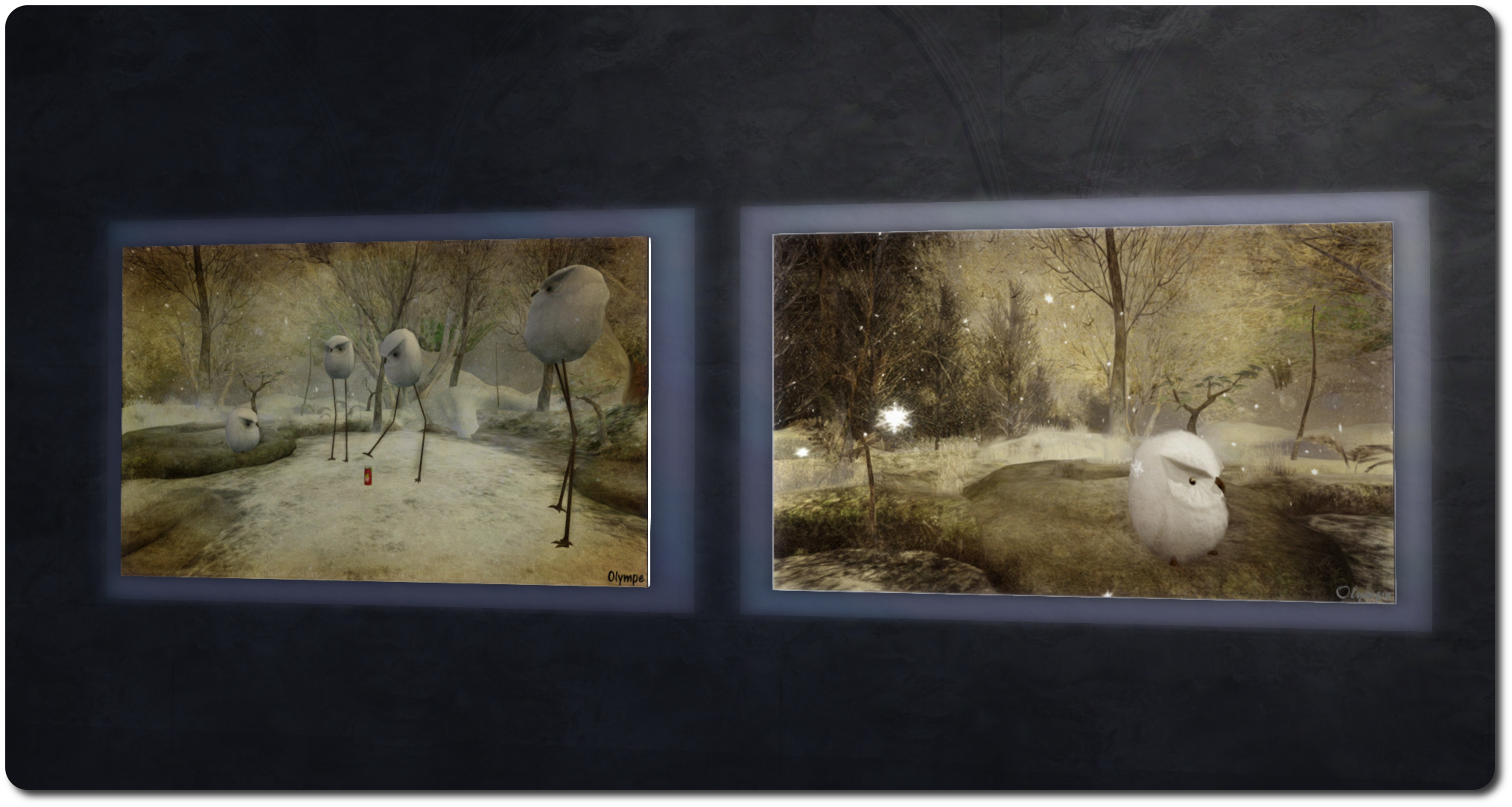
Running through until January 2015 at the Paris Metro Art Gallery is an exhibition of SL landscapes by Olympes Rhodes, featuring a collection of pictures captured from around Second Life which reflect the theme of winter in one way or another.

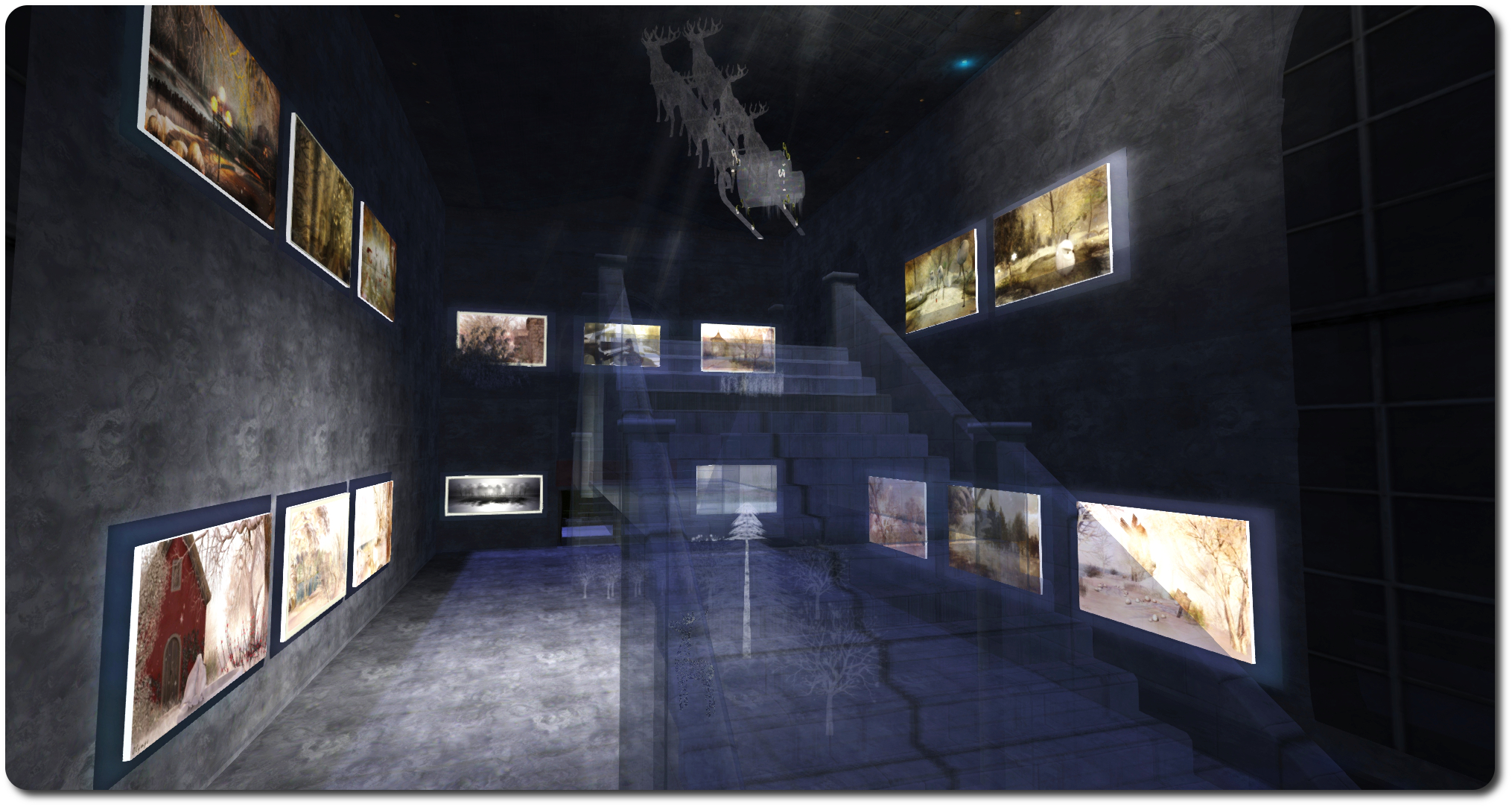
Some twenty-one pictures are on display, arranged on two levels within the gallery space, which has been transformed into something of an ice palace for the exhibition; the floor and walls covered in panelling covered in a ice-like effect and which are semi-transparent, so the world outside can just bee seen through the gallery’s actual windows, while the mezzanine floor of the upper level and the grand staircase leading up to it have a ghostly, translucent finish to them suggestive of them having been cut from ice.

Olympes Rhodes, Paris Metro Art Gallery

“My job was to create an environment in the gallery that supports the works,” curator Quan Lavender says of the interior design, “And fits to the wonderful Winter scene with ice pond in front of the building.” I’d say she’s succeeded, the interior fittings rounded-off with a series of ice carvings and other accessories Quan found at the Xmas Expo, and which fit the theme perfectly.

Not all of the pictures on display may appear to be winter scenes; they don’t all have snow and frost featured within them, for example. But the theme is there to be found in each and every one, even if the presentation is subtle – such as with the pictures taken at Chouchou, which suggest feelings of winter and ice through the backdrop of the Memento Mori cathedral. In another, a little group of penguins standing on the beach provide the necessary connection.

Olympes Rhodes, Paris Metro Art Gallery

All of the pieces have their own beauty and delicacy about them, and each one offers a unique interpretation of some very famous regions in Second Life. Their names are not given, which encourages the visitor to spend time examining each picture in greater detail to see if the location can be identified. Or at least, that was the case with this visitor!

When visiting, and if you are so minded, don’t forget that gallery owner Rose (rfb Morpork) has created a gown to match the theme of the exhibition, which can be obtained from the gift giver outside the gallery.

Related Links