To visit a Misty Isle

Tuck's Misty Isle, Devonair; Inara Pey, February 2015, on FlickrTuck’s Misty Isle (Flickr) – click any image for full size

I was led to Tuck’s Misty Isle by Hans Inshan, who posted some gorgeous photos she’d taken on the Bitacora Vajera blog. While I can’t hope to match Hans’ photographic skills, I nevertheless wanted to hop over and see the island for myself.

The Tuck in question is Little Tuck, aka Pete Applemoor – a fact which came as something of a surprise to me as Pete, IIRC, visited my Fallingwater inspired build a number of times while it still existed in Second Life. As such, it became a delight to explore his region.
Tuck's Misty Isle, Devonair; Inara Pey, February 2015, on FlickrTuck’s Misty Isle (Flickr) – click any image for full size

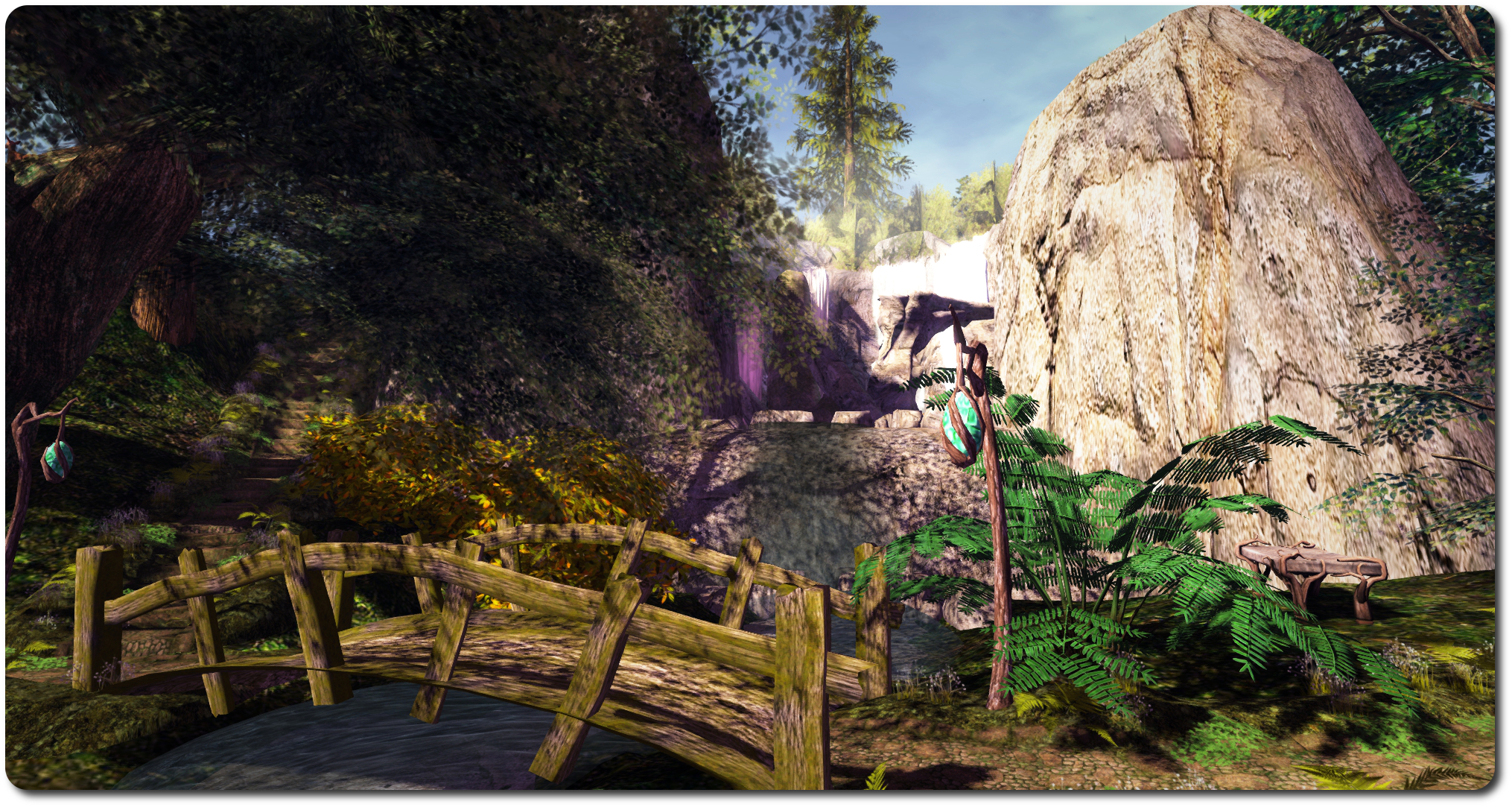
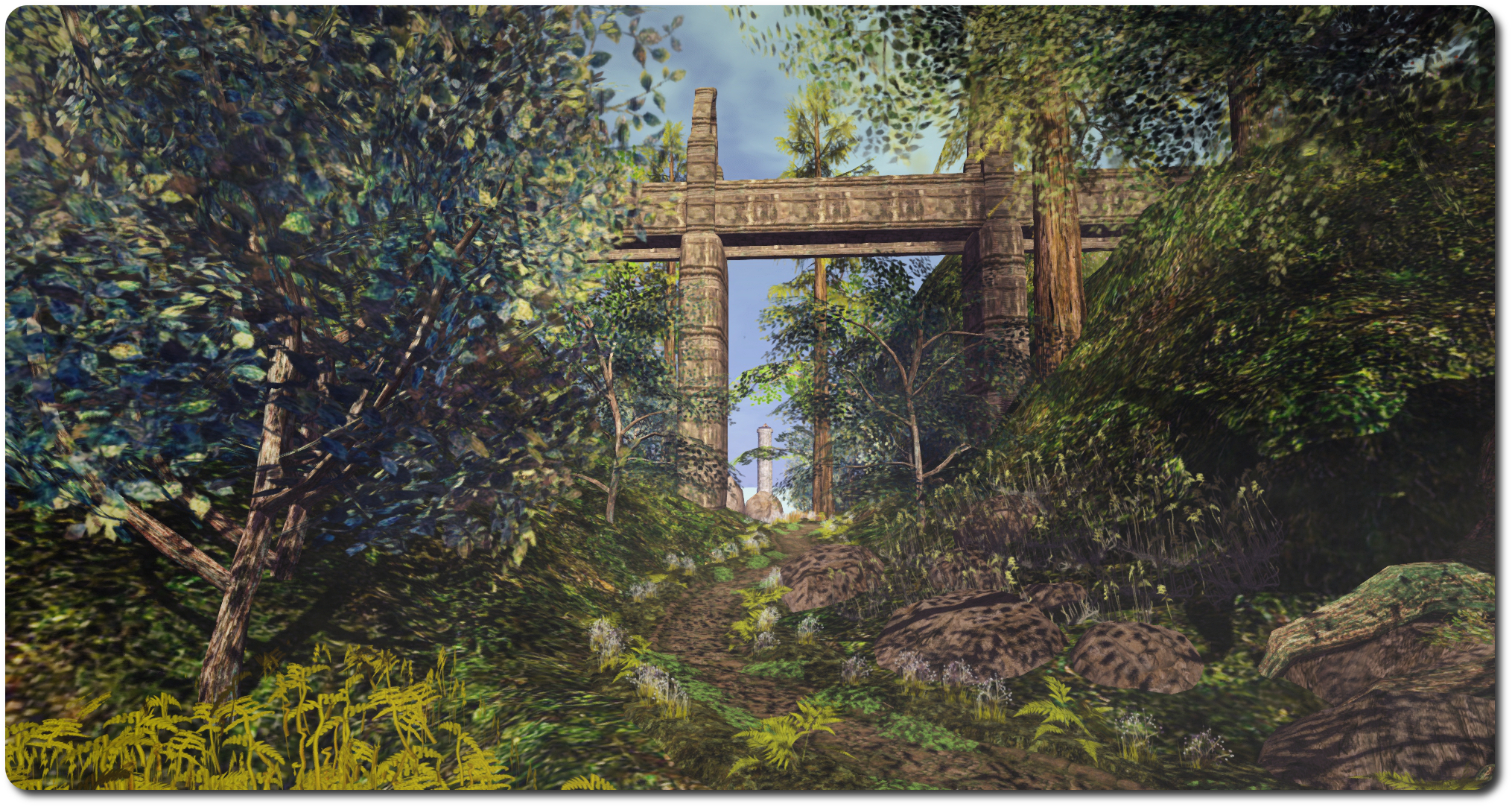
This is a rugged, wooded isle with fortress-like high cliffs guarding the majority of its shoreline, the landscape within split by a deep river gorge that curls its way from a set of high falls  through the heart of the island to arrive at the sea. Those reading the region’s description will learn the Misty Isle was once the domain of an ancient civilisation, the ruins of which can be found throughout, and is now the home to fae, pixies, elves, merfolk, nymphs and more.

Evidence that the place is still occupied can be found in the well-worn trails and tracks that lead the visitor inland for the landing point, and up into the hills: torches burn brightly along the edge of the paths, and all the bridges are in good repair. So someone must be around to keep the former lit and the latter safe for others to cross.

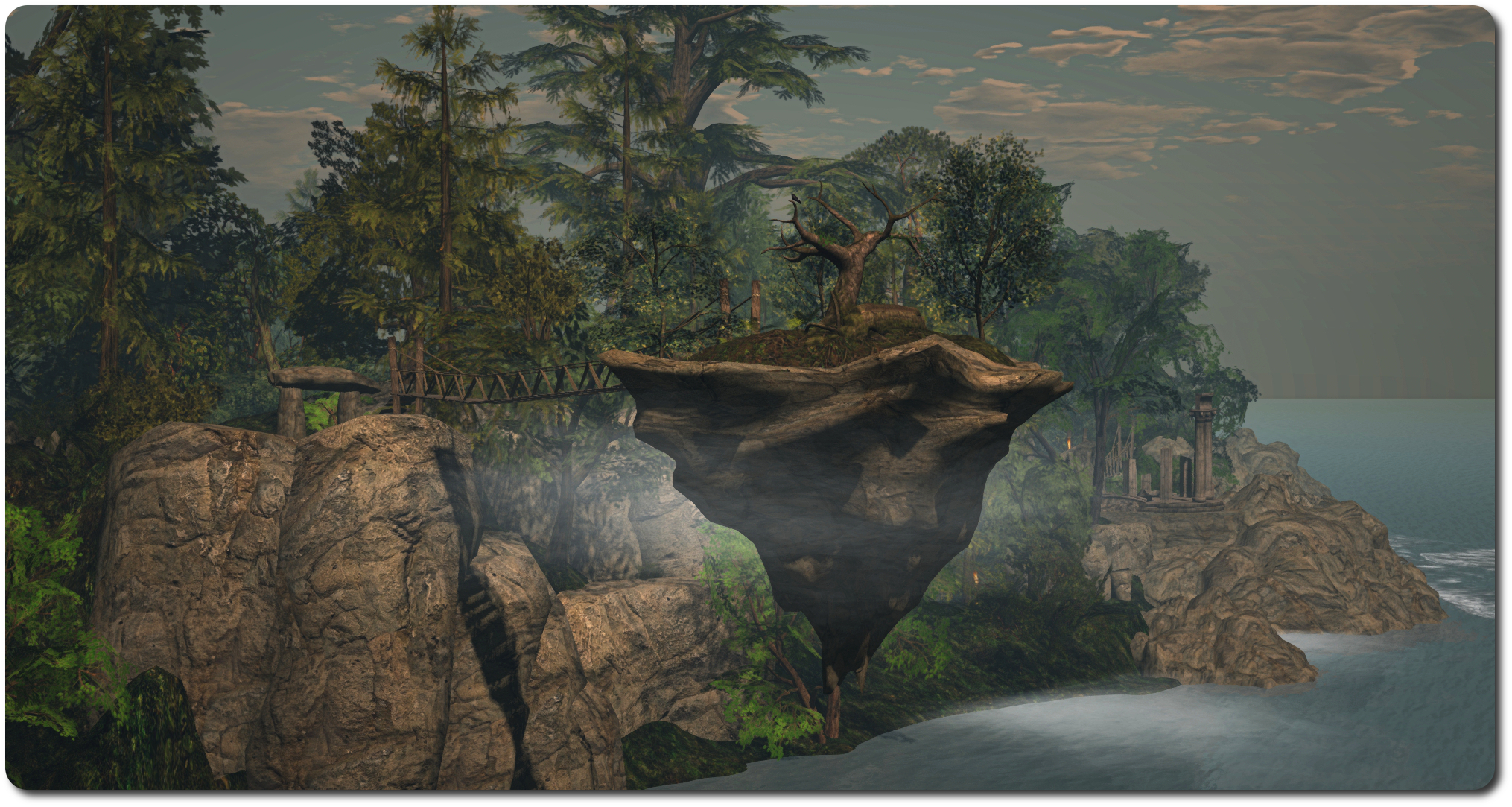
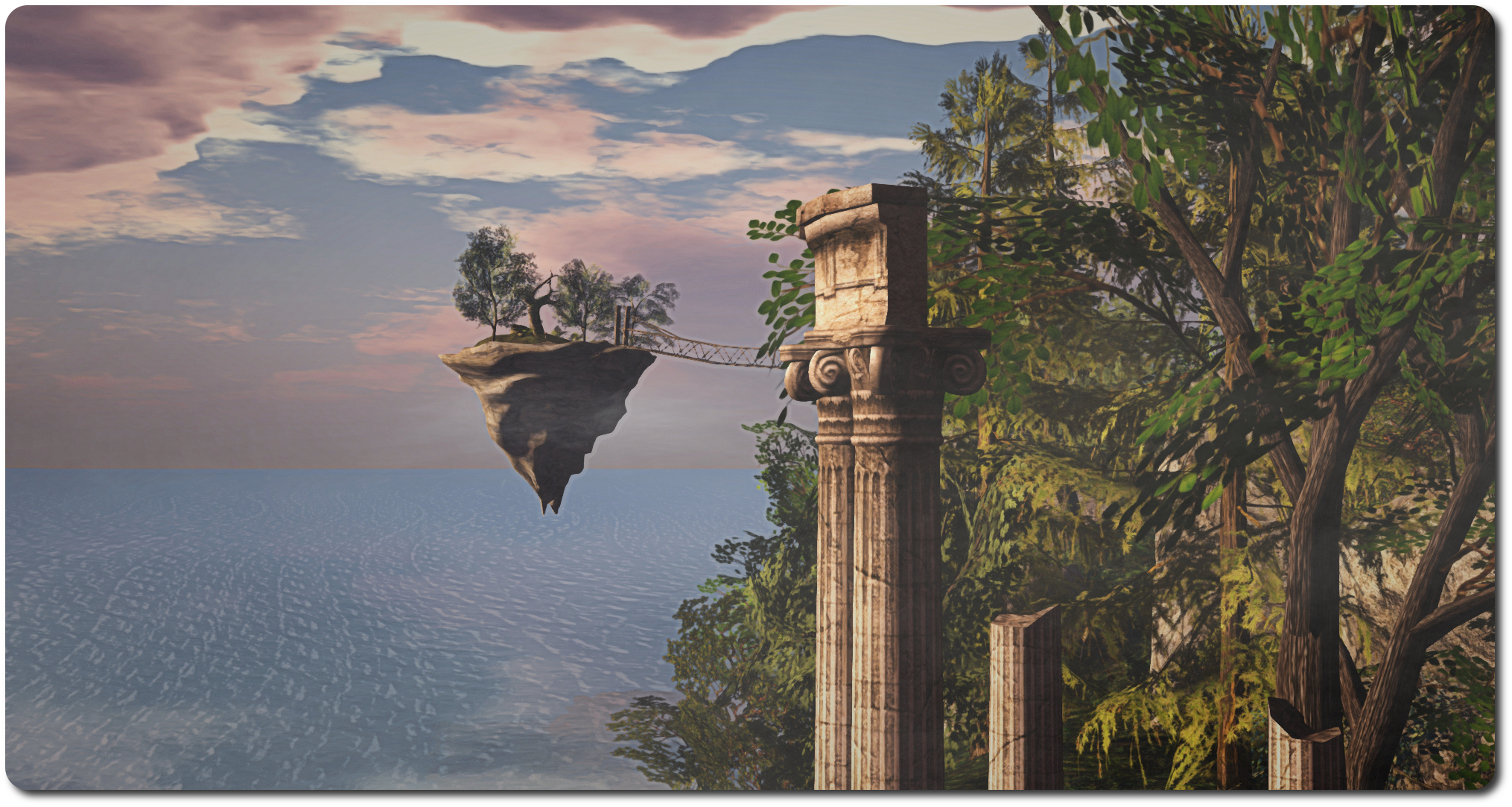
There is also a sense that some of the ruins still see use, and the small island floating serenely in the air just off the coast, reached by one of the aforementioned bridges, speaks of a powerful magic still very much at work here. In fact, keep your eyes open as you explore, and you’ll find places where you can experience the power of the magic yourself as you float over the water at the foot of the falls or above the the island’s single wooden village.
Tuck's Misty Isle, Devonair; Inara Pey, February 2015, on FlickrTuck’s Misty Isle (Flickr) – click any image for full size

Wildlife can be found throughout the island – foxes, bears, deer, pelicans and more, and along with them can be found places to sit or dance or simply enjoy the view. After all, as the description tells us, this is a place for contemplation and for enjoying the company of those close to us.

Tuck’s Misty Isle does exactly what it says on the tin: offers a place to relax in, explore and enjoy, whether on your own or with a friend or two. Rezzing is open if you want to have a prop or two when taking photographs, but do please pick things up behind you. And do consider showing your appreciation for any visit you make through one of the numerous donation points scattered across the island – it all goes towards keeping it open for all to enjoy.
Tuck's Misty Isle, Devonair; Inara Pey, February 2015, on FlickrTuck’s Misty Isle (Flickr) – click any image for full size

Related Links


Previewing a walk through SL’s history

The Greatest Story Ever Told - LEA17
The Greatest Story Ever Told – LEA17

During the Round 6 of the Artist In Residence (AIR) series at the Linden Endowment for the Arts (LEA), Sniper Siemens produced a wonderful retrospective on Second Life, looking back over the platform’s history from 2001 through until 2014, with a small peep at what might be coming.

At the time of that exhibition, Sniper had just two weeks to get everything together and create the installation. as a result, as delightful as it was, much was left unsaid.

Now, as a pert of the AIR Round 8 submissions, Sniper has returned to the LEA to present a re-worked and expanded look at SL’s long and tangled history with The Greatest Story Ever Told, which officially opens to the public at 15:00 SLT on Saturday, February 7th, 2015. Having been given the opportunity to have a preview walk through the installation, I can say that it is, quite simply, superb.

As with the original, the visitor is taken on a chronological walk through SL’s vast and tangled history, only here the journey starts in 1999, and instead of walking through a watery domain, one is lead through a wooded landscape along a series of paved footpaths which allow the platform’s history to unfold as one progresses along them.

The Greatest Story Ever Told - LEA17
The Greatest Story Ever Told – LEA17

And history is quite literally everywhere, right down to the names of the paths themselves, which start off evocatively enough: Battery Street (complete with a model of the Lab’s offices there), which is followed by Da Boom, Natoma, Ritch, Zoe – all the names of some of the original 16 regions which comprised Second Life at its “birth”, and which were themselves drawn from the names of streets around the Lab’s original base of operations in Linden Street, San Francisco (and the fact that several of them are all the locations of eateries / hostelries was, I’m sure, entirely coincidental 🙂 ).

The paths lead the visitor chronologically through SL’s history, with information boards, images and interactive elements, together with a small army of little residents and Lindens, encompassing key events and changes. The information provided is drawn from a number of sources, including the Second Life wiki and the wiki’s History of Second Life pages. Several of the boards make for interesting reading, as they present information written at the time some events were unfolding, thus given them an added sense of presence.

The Greatest Story Ever Told - LEA17: recalling the days of the paid teleport hubs
The Greatest Story Ever Told – LEA17: recalling the days of the paid teleport hubs …

As with the original presentation, both technical and social changes are documented, with many of the “blanks” in the original now completed. As a result, a much richer picture of Second Life is painted, the good and the bad, the ups and the downs, and some events are put into their proper perspective – such as the FBI’s 2007 look into certain activities in SL. Nowadays, this is often seen causing the Lab to later ban gambling on the platform. However, as the information provided in The Greatest Story Ever Told reveals, this really is a case of post hoc, ergo propter hoc., and the circumstances of both the investigation and the reasons for banning gambling on the platform are quite different.

The path eventually leads the visitor to 2015, and a brief look at what the Lab’s next generation platform might hold for us. It is followed by a little Linden and resident holding a sign: This is not the end – a clever play on the fact that this isn’t the end of the installation, as the path leads on to a retrospective of the Burning Life (now BURN2) event in SL, and in a more subtle touch, to the fact that the new platform doesn’t mean Second life is coming to an end.

The Greatest Story Ever Told - LEA17: ... and correcting the misconceptions around the FBI's 2007 investigation of certain activities in SL ...
The Greatest Story Ever Told – LEA17: … and correcting the misconceptions around the FBI’s 2007 investigation of certain activities in SL …

There is a lot to take in with this installation; not only through the information boards and images and little vignettes one passes, but also in the overall way in  which everything is presented. Take, for example, use of high walls along two sides of the installation which, while preventing any overlap between it and the neighbouring installations, combines with the setting of The Greatest Story to remind us of something of SL’s “walled garden” reputation. Then there is the way in which many technical elements intrinsic to SL’s development are also presented: windlight, projected lighting, mesh, materials.

All told, this quite simply a brilliant expansion of the original concept, and I’m really pleased that Sniper has been given the opportunity to revisit the subject, expand upon it, and in doing so, has retained the same touch of humour in many of the individual pieces presented within it. The Greatest Story Ever Told is a genuine delight, something everyone should find the time to visit and walk through.

Given the nature of the installation, I’ll leave the final words here to Sniper:

The History of Second Life is the story of all us.

Every single person who has decided to be part of it must to thank a small group of peoples  that one day they saw  a vision. If today you can rez a prim, drive a car or dance in a disco, it is possible  thanks to  this small group of people. Many others have continued to maintain it and develop it, even without a remuneration. So, learn to respect those who allowed this and enjoyed  the best Second life.

The Greatest Story Ever Told - LEA17
The Greatest Story Ever Told – LEA17

As a reminder: the Greatest Story Ever Told – SL History 1999-2015 opens to the public at 15:00 SLT on on Saturday, February 7th. Note that teleports may not work until then.

OnLive open SL Go Island

SL Go user? Now you can get help and personal assistance through the SL Go Island - and it's a good place for escaping the worlds, as well!
SL Go user? Now you can get help and personal assistance at the SL Go Island – and it’s a good place for escaping the worlds, as well!

Important note: The SL Go service is to be shut down on April 30th, 2015. For more information, please read this report.

On Wednesday, February 4th, Dennis Harper, OnLive’s Product Manager for SL Go kindly invited me to preview the new SL Go island in Second Life, which is designed to offer users of the the SL Go service a in-world place they can visit should they need assistance.

SL Go Island officially opens its doors for business at 10:00 SLT on Thursday, February 5th, 2015, and is modelled along similar lines to the Firestorm Support Island, which originally opened in August 2012 (see my review on it).

The idea for such a in-world venue was originally suggested during the special Firestorm Q&A meeting, alongside the idea for the SL Go support group, which launched in January 2015.

The landing point offers information and clickable signs for obtaining assistance - and more
SL Go Island: the landing point offers information and clickable signs for obtaining assistance – and more, with the SL Go greeter bot standing alongside

SL Go island offers a rural environment, with the landing area acting as the support hub. Here information boards and signage provides initial assistance.

A main board offers basic information, while thee signs hanging from it will take visitors to the OnLive Support web page, the support forum, and – for those who have yet to try it, a link to the SL Go sign-up page. A further sign allows SL Go users who have not already done so to join the in-world SL Go support group.

However, it doesn’t end there. On the table under the main noticeboard sit s small silver bell. If a member of the SL Go support team isn’t already on the island (they all tend to spend a fair amount of time there) or near the landing point, ring it, and personal help should be forthcoming.

SL Go support staff can frequently be found at the beach bar ....
SL Go Island: support staff can frequently be found at the beach bar ….

The rest of the island, all of which has been designed by  OnLive web engineer and Second life resident Jersey Silent, is given over to walks among the trees and down to the beach. Here sits a bar (providing support is thirty work!), and if folk aren’t around the landing point, they can generally be found here. There are also a number of spots scattered around the island, make it a welcoming place for those who wish to sit and relax.

SL Go Product Manager, Dennis Harper, in-world

“I really like it here,” Dennis said to me as he and Jersey showed me around. “If you want to find me, I’m usually at the beach bar, it’s a great place to relax, although there’s a cool swamp on the other side, which is also nice to visit after a day at the beach. But we’ve tried not to make it anything fancy – just a place to hang out.”

“But don’t forget, for the fastest and most timely support for SL Go, visit us on SL Go Island!” He added.

Wandering the island with Dennis and Jersey, I  couldn’t help but notice the care take to keep things open, relaxed, and as welcoming as possible. Jersey’s Landscape blends content from a number of designers who are bound to be familiar to many visitors, and she’s taken a huge amount of care to provide open spaces and quiet little spots for visitors to enjoy.

So – if you’re an SL Go user and need help, or if your curious about SL Go, or if you just want somewhere new to wander and spend time in, SL Go island may offer the perfect solution!

The Drax Files Radio Hour: listening to the words of an Angel

radio-hourThe opening of 53rd episode of The Drax Files Radio Hour may have the feeling of being a slightly rushed production; there’s not casual introduction by the featured guest or other notable mentioned later in the show. Instead we launch straight into the Draxtor Theme.

However, any feeling the recording’s opening may have in being pushed through quickly is understandable: this segment of the show comes right off the back of a gruelling week for Drax cutting and finalising the 26th instalment of his World Makers series, which I looked at following its release.

More to the point, it offers plenty of time for an extended interview with Second Life architect Kaya Angel, the man behind the stunning Angel Manor, and who has been responsible for a number of unique and beautiful builds across Second Life over the years, as well as running his own business selling high-quality prefab houses. And if that isn’t enough, Kaya is also a great patron of the arts, providing both the Rose Theatre Ballroom and the Rose Theatre Gallery for a wide range of events and art exhibitions.

The interview with Kaya kicks-off at 14:11, following the musical interlude, starting with mention of Kaya beautiful 6-minute video Second Life: A different perception, which I make no apologies for embedding here once again, even though I featured it in these pages just over a week ago.

The interview starts with Kaya relating his own initial involvement in Second Life. While acknowledging himself to have been a gamer with a specific interest in on-line games, he was actually drawn to SL from something of a philosophical bent, created as a result of a question Philip Rosedale asked back in the very early days of the platform’s public existence: if you were given the tools to re-create society and reality, what would you create?  Would you create something new, or repeat what we can see around us?

From here the discussions focuses on the issue of engagement in SL. All too often when this is discussed, the focus tends to immediately narrow to matters of technology – such as the “steep learning curve” inherent within the viewer. While the viewer is complex and does take time to master, I do tend to feel that it and the technology are looked to as being the bugaboos preventing SL’s wider adoption because they are far more tangible an issue than the more fundamental (and oft acknowledged by seldom addressed) reason that the sheer lack of any direction given to people in terms of what they “should” be doing or achieving or seeking or fighting or building or destroying (insert you own term here) leads to confusion and departure a lot quicker than any really deep-seated problems within the viewer.

As Kaya states, “How do you get people to stay in a virtual world when they are so use to having specific things that they told that they should do or can do?”

It’s a question that has long plagued user and the Lab themselves; we’re all familiar with how hard it is to define SL – although Kaya goes on to express a few ideas of his own. However, I would just not that in terms of the initial discussion and ideas put forward, I would disagree with Drax on the idea that directed experiences, when used as gateways into the platform might further reduce people’s ability to see the wider potential of the platform.

If anything, I’d suggest the reverse is true; providing such “gateway experiences” offer some form of informative portal to the broader potentials of SL / a UGC driven environment, they are more likely to engage with an audience (those interested in the experience) and bring them into it and encourage those among them who are so minded to explore SL further far more effectively than simply dropping them in-world in a manner that is almost entirely random in nature and lacking any structure at all.

Angle Manor, January 2015
Angel Manor, January 2015

As a content creator, it comes as no surprise that Kaya sees one of the major means of engagement with the platform as being the ability to build and create. In itself, this is not a new idea – we’ve all pointed to much the same when discussing getting people more involved in SL; however, this doesn’t make what Kaya says any less valid. Rather, his comments give pause for thought on just how much harder it is for people coming into SL today to discover the expressive power and joy of content creation for themselves.

This isn’t so much because emphasis has shifted over the last few years from the humble prim and in-world building to mesh and external tools (although this does get touched upon during the discussion). nor does it really have anything to do (to a great degree at least) with the provision of Linden Homes or the inclusion of starter avatars in the viewer, both of which are also referenced.

Continue reading “The Drax Files Radio Hour: listening to the words of an Angel” →

The photographic eye of Slatan Dryke

Scenes - Slatan Dryke
Scenes – Slatan Dryke

Opening at 12:30 on Sunday, February 1st at the Seaside Gallery, which is owned an operated by JMB Balogh is the debut public exhibition of work by SL photographer Slatan Dryke.

As its name suggests, Scenes features images captured from around Second Life which each create a vignette of their own, each with a little story to tell. Most of the images (if not all) have been taken at well-known locations in Second Life, but such is the angle and nature of each picture, the locations aren’t always easy to identify.

Scenes - Slatan Dryke
Scenes – Slatan Dryke

A considered use of colour and lighting is evident in the images, affording them a unique look and feel. Slatan states that he rarely uses post-processing to enhance his images, relying purely on his eye and SL’s windlight capabilities. This has given rise to some very striking pictures, some of which are included in this exhibition, such as Jaundiced Sepia (seen at the top of this article, on the left). There is such a beautiful quality about this one piece that were it not for the recognisable form of the little café, the eye could be so easily fooled into believing it to be a picture taken in the physical world;  the bicycle in particular looking as if it is simply awaiting a delivery boy to jump onto the saddle and pedal off on his rounds. Slatan himself poses  in a couple of the images, and with Muse Amplitude (directly above on the left) in particular, this again gives the piece an added depth.

With 18 pieces on display, this is not a large exhibition, although a number of Slatan’s animated sculptures are also on display as well, and available for purchase alongside the pictures. I’d perhaps like to have seen the images themselves a little smaller in size, if only to see one or two more included. But this isn’t a complaint; rather an admission that I found myself rather attracted to some of the pieces presented – I mentioned two above – and would like to see others the artist has which encompass  a similar theme and / or approach.

Scenes - Slatan Dryke
Scenes – Slatan Dryke

A a debut exhibition, scenes serves as an excellent introduction to Slatan’s work for those unfamiliar with it, and I look forward to see his work displayed in other galleries in SL.

Related Links

Timeless peace in The Outer Garden

The Outer Garden, Calm Beach; Inara Pey, January 2015, on FlickrThe Outer Garden, Calm Beach (Flickr) – click any image for full size

The Outer Garden, floating high over a quarter of a full sim region, is a true delight. Designed by Bisou Dexler, it is a tour de force demonstration that less is very often more as it presents visitors, and especially photographers, with an absolute treasure of a place to visit.

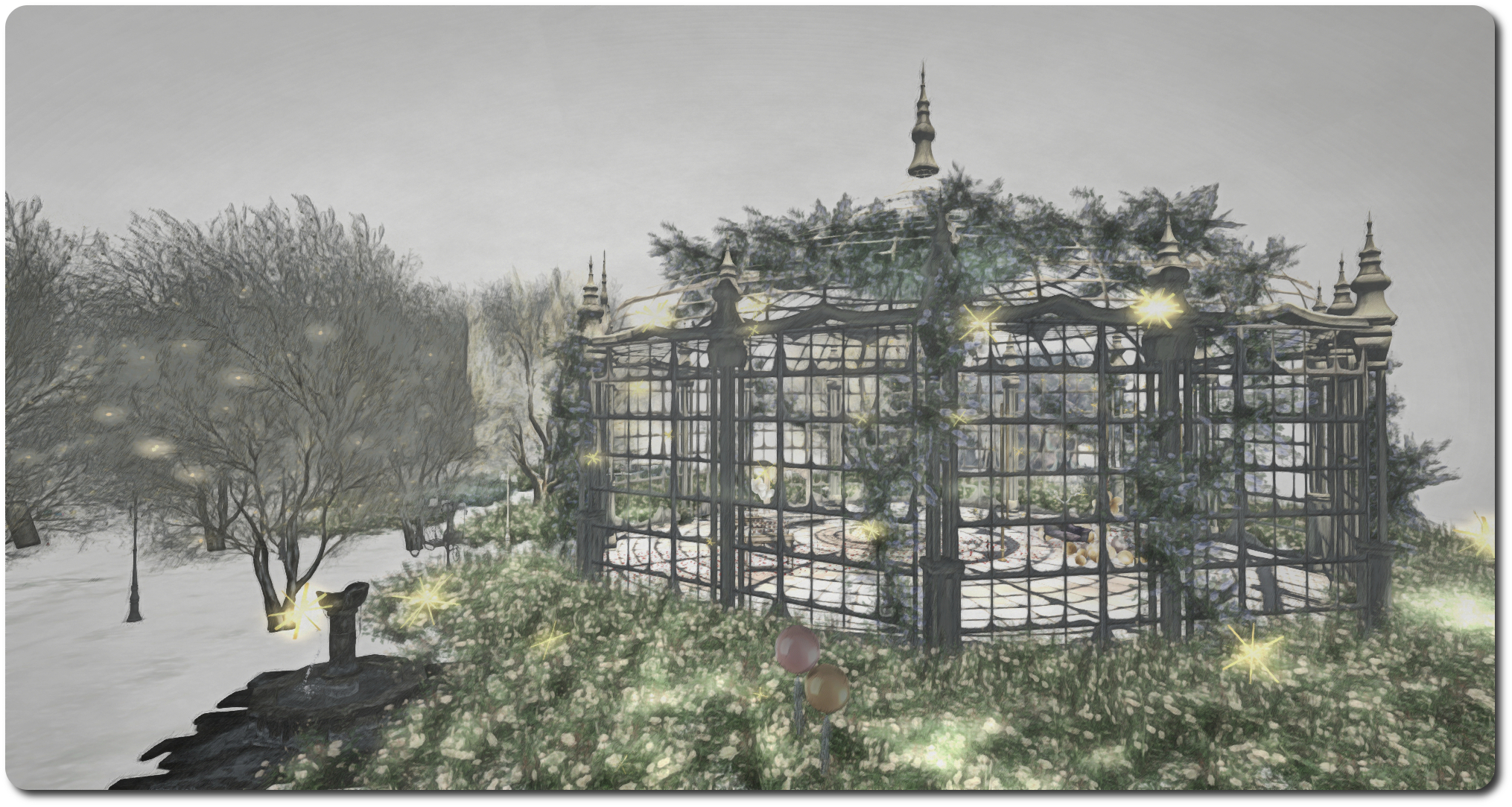
Central to the design is a huge pavilion of glass what I take to be wrought iron, a structure evocative of Victorian beauty, hung with climbing roses and surrounded by a lake of bright rose bushes set against the snowy white ground. Around this can be found a series of little scenes which can either been seen as a part of the whole, or form self-contained elements of their own, while inside the pavilion lies a romantic heart.

The Outer Garden, Calm Beach; Inara Pey, January 2015, on FlickrThe Outer Garden, Calm Beach (Flickr) – click any image for full size

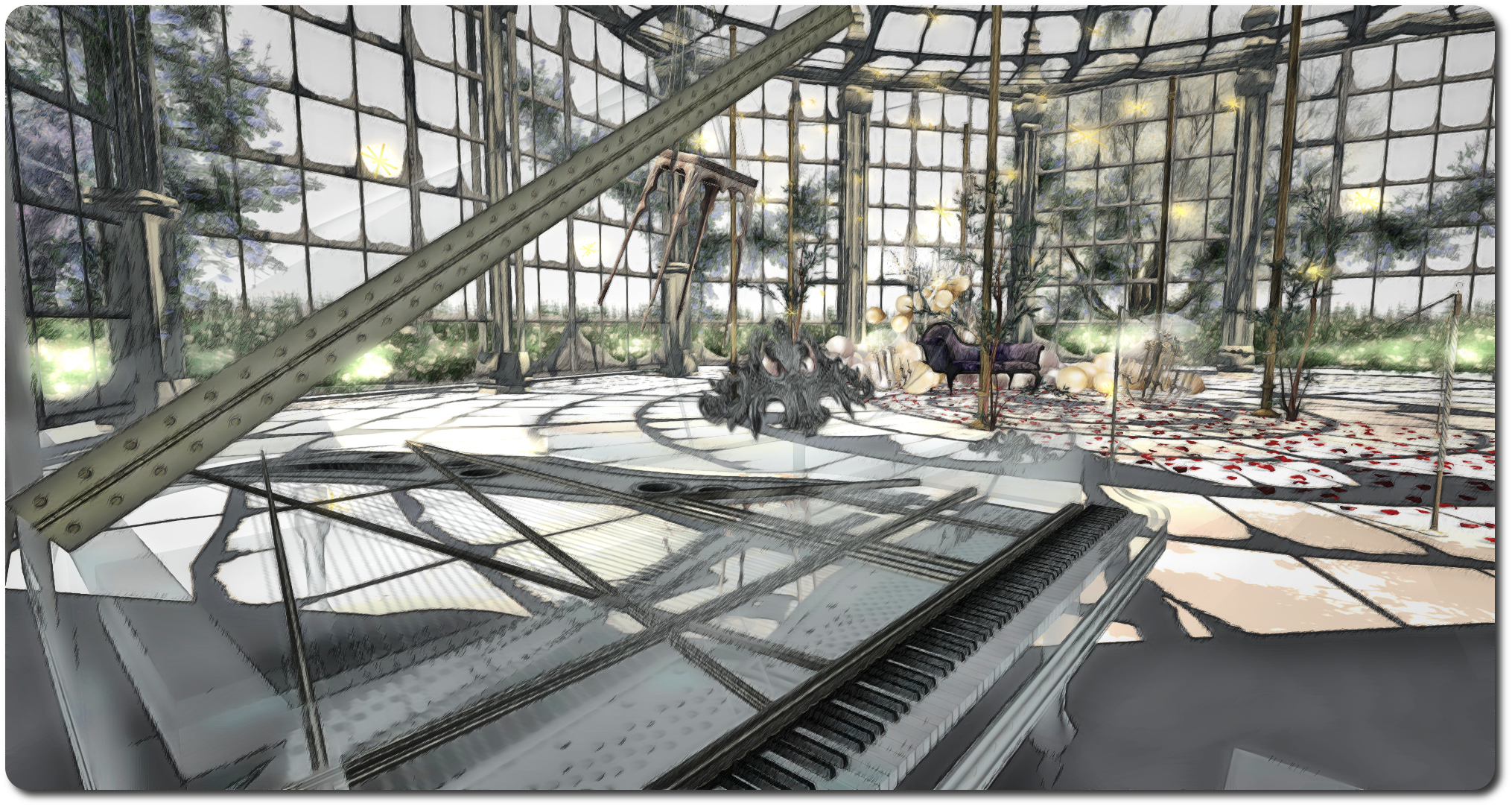
Here one finds an aisle leading from the great doors to a single chaise lounge, the red petals of roses forming a soft carpet on the white floor. Close by, the ghostly form of a glass piano sits, waiting to be played or to play for visitors. Candles light the space on an evening, together with a sprinkling of  golden stars floating in the air under the high dome, while balloons are gathered near the piano and the seat, like clouds hovering at the horizon.

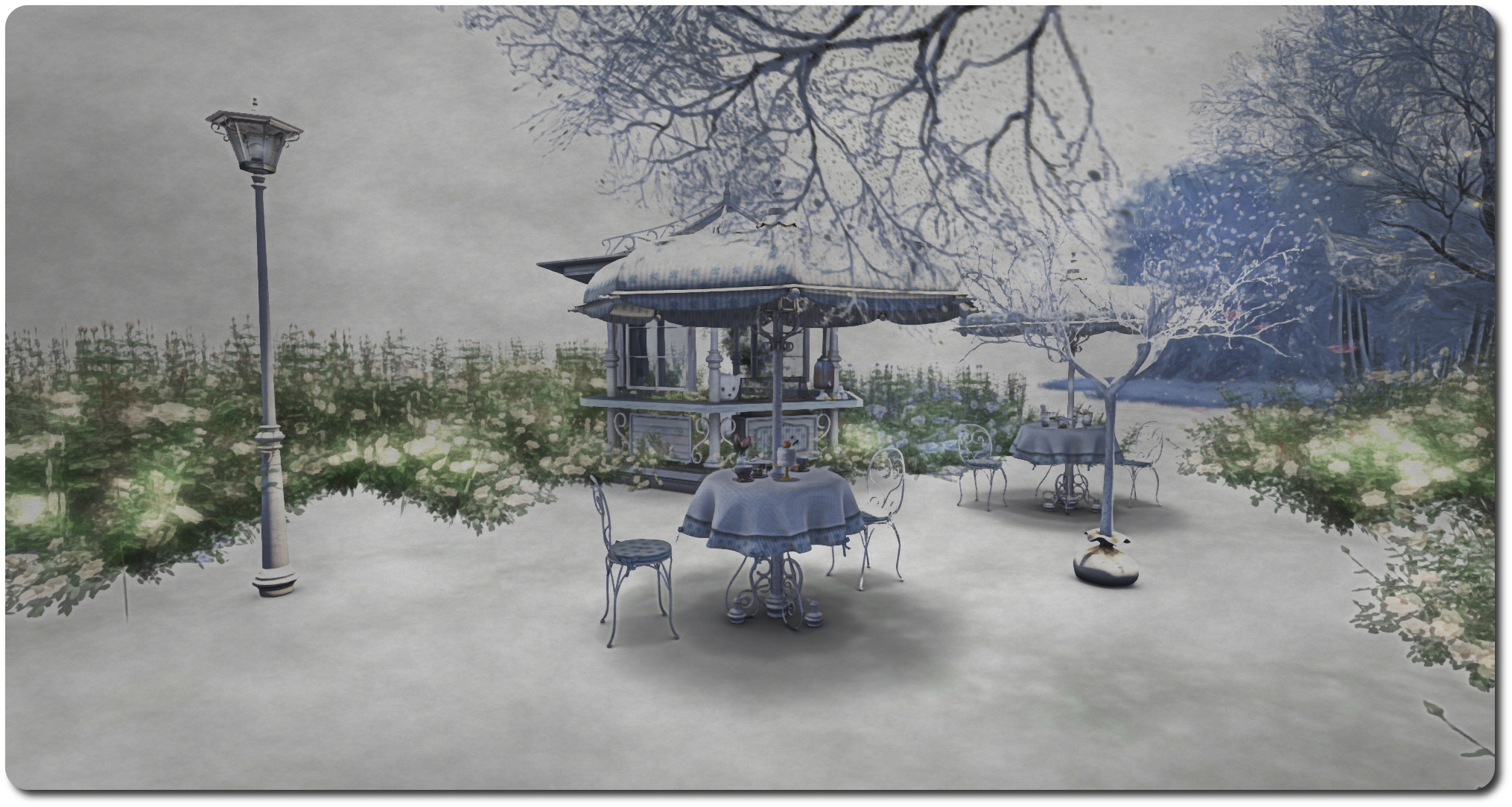
Outside, ices and cakes can be found not little tables next to an ice cream gazebo staffed by a a little white teddy bear, the translucent forms of butterflies hovering wisp-like between the tables. A little further away sits a little copse, a little hideaway nestling inside.

The Outer Garden, Calm Beach; Inara Pey, January 2015, on FlickrThe Outer Garden, Calm Beach (Flickr) – click any image for full size

There is a beautiful ethereal quality to The Outer Garden, partially due to the use of light (especially a subtle use of glow); this gives the entire scene a soft look that might be described as “timeless” or “other-worldly”, and which leads to opportunities for some clever photographic effects when mixing the right appearance with the surroundings. Just watch, for example, as someone can seemingly disappear into the rose bushes surrounding the pavilion as they walk away from you, their form gradually softening and fading the further they get from your camera.

The Outer Garden is an absolute treasure; if you’ve not already been there, it is a place I thoroughly recommend you add to your list of places to visit.

The Outer Garden, Calm Beach; Inara Pey, January 2015, on FlickrThe Outer Garden, Calm Beach (Flickr) – click any image for full size

Related Links