TerpsiCorps: five artists

TerpsiCorps gallery: Luly Boop (Lulyboop)

Currently on display at the TerpsiCorps ARTWerks gallery is an ensemble exhibition featuring the art of Luly Boop (Lulyboop), Bamboo Barnes, Isadora Alaya (Otcoc), Sabbian Paine and Myra Wildmist. Located in the former Dionysus Workshop Pavilion area, which has been converted into five individual exhibition spaces very much in keeping with the rest of the TerpsiCorps environment.

“My biggest passion in Second Life is photography,” Luly states of her work. “For the last two years, the photography has allowed me to communicate my thoughts, my emotions, to tell histories. SL gives me the ideal setting to do all this.” This is certainly true of the pieces she offers here. Self studies, each has its own story to tell, with three in particular depicting Luly’s relationship with her art.

TerpsiCorps gallery: Luly Boop (Lulyboop)

“In the last year Photoshop has allowed me to expand my ability to express myself through pictures,” she continues, “I intend to learn more about this tool because it allows me to capture SL not always as it is, but use virtual world to give space to my imagination.” Thus, My Thoughts…, My Goal… and My Dreams… – while perhaps NSFW – are beautifully rendered and processed through Photoshop to reflect the beauty of Luly’s relationship with her art – a woman and her camera.

Bamboo Barnes is a self-taught artist who first started capturing images in 2012. “Very soon Second Life art installations became my biggest favourite theme, and they are a reason I continue to log-in to Second Life. I don’t deal with change well in the real world, but with my art, I don’t like to express myself the same way for too long; that is boring.”

TerpsiCorps gallery: Bamboo Barnes

Again, the seven images she offers at TerpsiCorps richly reflect this drive to see her work change – to evolve. Focusing on the art installations of others, each piece is richly evocative and richly presented. Each is very different from the last – although something of an abstract theme is present in several of them.

Sabbian Paine has been capturing the world of Second Life through his lens since early 2009 when he was introduced to the world of Second Life photography. What started out as a hobby quickly became a passion, offering him a freedom to create images of depth and beauty, reflections of an environment he sees as a immersive 3D world filled with art. The seven images Sabbian presents here stand as a magnificent testimony to both his work and viewpoint.

With four pieces offered in monochrome and three in soft tones, there really are marvellous images, each one deeply evocative and rich in narrative.

TerpsiCorps gallery: Sabbian Paine

Isadora Alaya (Otcoc) is a name from SL photography I had not been familiar with prior to visiting TerpsiCorps gallery, where she is exhibiting the largest number of pieces among the first four artists, with nine pictures on display. seven of these are essentially black and white / monochrome studies covering a range of subjects, with two richly coloured and in strong contrast to the others. all are beautifully executed pieces, which comprise pictures of locations within Second Life and studies of art displays  – notably by Haveit Neox – which present a diverse series of statements on our virtual world, each one fully capable of capturing and holding the eye.

The last exhibit on offer is a small installation by Myra Wildmist entitled Your Vagina is Art, a seemingly self-explanatory title, although the installation is far more subtle than the name implies. With images, quotes, observations and new items, complete with an interactive element, this appears to be an installation designed to combine art and a degree of social / sexual commentary. I leave it to you, should you visit, to determine whether it speaks to you or not.

TerpsiCorp gallery: Isadora Alaya (Otcoc)

All five exhibitions have been available at TerpsiCorps for the last couple of months. As such, and while I’m not clear on when they might close / be changed, I do suggest that if you plan visiting, you do so sooner rather than later, just in case.

SLurl Details

Tralala’s Diner in Second Life

Tralala’s Diner – click any image for full size

We first came across Tralala’s Diner courtesy of (who else?) Shakespeare and Max, who forwarded the landmark back in September 2017, although time didn’t permit us a visit until November (partly because I misfiled the LM in inventory). The description for the region – designed by tralala Loordes – did pique my curiosity in part: “Hong Kong Rooftop Slums” – not that I managed to find anything that remotely put me in mind of that wonderful city. The rest of the description, however, suits this full region right down to the T: it really is post-apocalyptic setting, with lots going on.

In fact, so much is going on visually, that the region is perhaps lifted above other regions offering similar settings; there is a quirkiness about Tralala’s Diner which makes it a little more than “just” your typical post-apocalyptic setting. Yes, there are the fires, the ruined buildings, the areas being reclaimed by nature, the attempts to organise life after the fall as witnessed through the presence of wind turbines, and what appears to be – at least going on the number of antennae, aerials and satellite dishes vying for rooftop space – attempts to make contact with other group who may have survived whatever disaster has befallen this world.

Tralala’s Diner

A visit starts at the landing point, slight off-centre to the middle of the region, in a shack at the end of an old street. An overpass rises just outside the shack, broken and bearing the wrecks of vehicles rusting in the elements. Signs beneath the elevated road warn of bio hazards ahead, perhaps encouraging those stepping out under a grubby sky to turn and follow the old road pointing away from the dire warnings. This road has long since been overtaken by nature, grass and bushes laying claim to its one pristine tarmac, the ageing and decrepit buildings on either side of it seeming to have faired better under nature’s attempts at reclamation.

Where you go from here is a matter of pointing your feet; it actually doesn’t matter where you go, as you’re bound to come across something extraordinary in whichever direction you opt to strike out. Daring the warning signs, for example, will bring you to a shanty town built within and on the roofs of old industrial units, and huddled around the square of a market offering a Sino-Japanese fusion of looks. Southwards, and the southern aspect of the region is given over to the ruins of city tower blocks standing as if blasted by one ore more explosions. Then there are the more eclectic structures to be found that together add a strange whimsy to the place; like the sliced hull of a submarine converted into a dormitory or barracks or the improbable sight of the home built of shipping containers held aloft by a propeller lazily turning beneath them, the owner’s bicycle neatly propped outside the vault-like door.

Tralala’s Diner

And that’s just the start. Everywhere are buildings old and older, whole and broken, some sheltering homes or market stalls or shops or other signs of commerce, others harking back to a bygone era when machines turned within them, people pulled off the roads to spend a night in their bedrooms and money was the oil that kept life moving. Now, among the hodgepodge of homes and places of commerce, the broken road and the decaying vehicles, the only things moving seem to the birds and the wind turbines. The latter are scattered across the landscape, standing alone or in regimented rows of three, as if waiting for some latter-day Don Quixote to come tilting at them, perhaps on a bizarre steed of human design.

What makes Tralala’s Diner particularly fascinating is the detail poured into it. Everywhere you wander there is something to see, be it large or small. The marketplace, for example is chock full of human bric-a-brac and the needs of life, while many of the buildings have interior fittings and furnishing, however shabby they might be. There is some cost for this however, particularly if you run the viewer with shadows enabled: with all the textures, the rainfall, etc., I found my FPS collapsing into single digits while exploring, and did struggle in a couple of places with rendering / movement.

Tralala’s Diner

Nevertheless, for those who like dystopian environments and places offering a post-apocalyptic outlook, Tralala’s Diner should not be missed. It is photogenically captivating, and those taking pictures are encouraged to post them to the region’s Flickr group.

SLurl Details

A photogenic twirl in Second Life

La virevolte; Inara Pey, December 2017, on FlickrLa virevolte – click on any image for full size

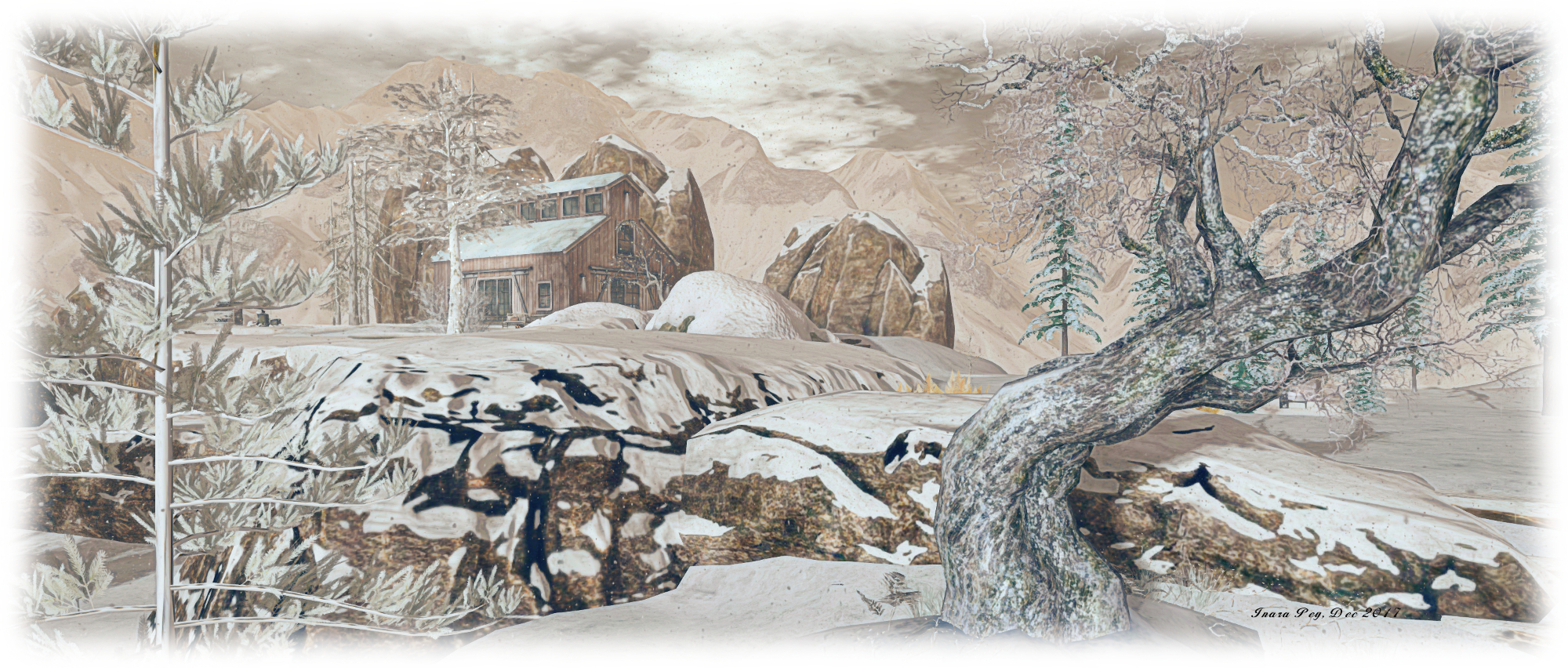
La virevolte (The Twirl) is a gorgeous Homestead region designed by Iska (sablina). Caught in a winter setting, this is a rugged region is a rugged setting, running from lowland areas in the west to highland regions to the east, surrounded by snow-capped mountains.

Where this might be is open to question – there are few clues in the form of architecture and wildlife, although the vehicles in the region are of European origin. But where this might be really doesn’t matter; what is important is the sheer beauty of the region’s composition, which uses muted tones and colours to considerable effect, both outdoors and inside the buildings scattered across the region.

La virevolte; Inara Pey, December 2017, on FlickrLa virevolte

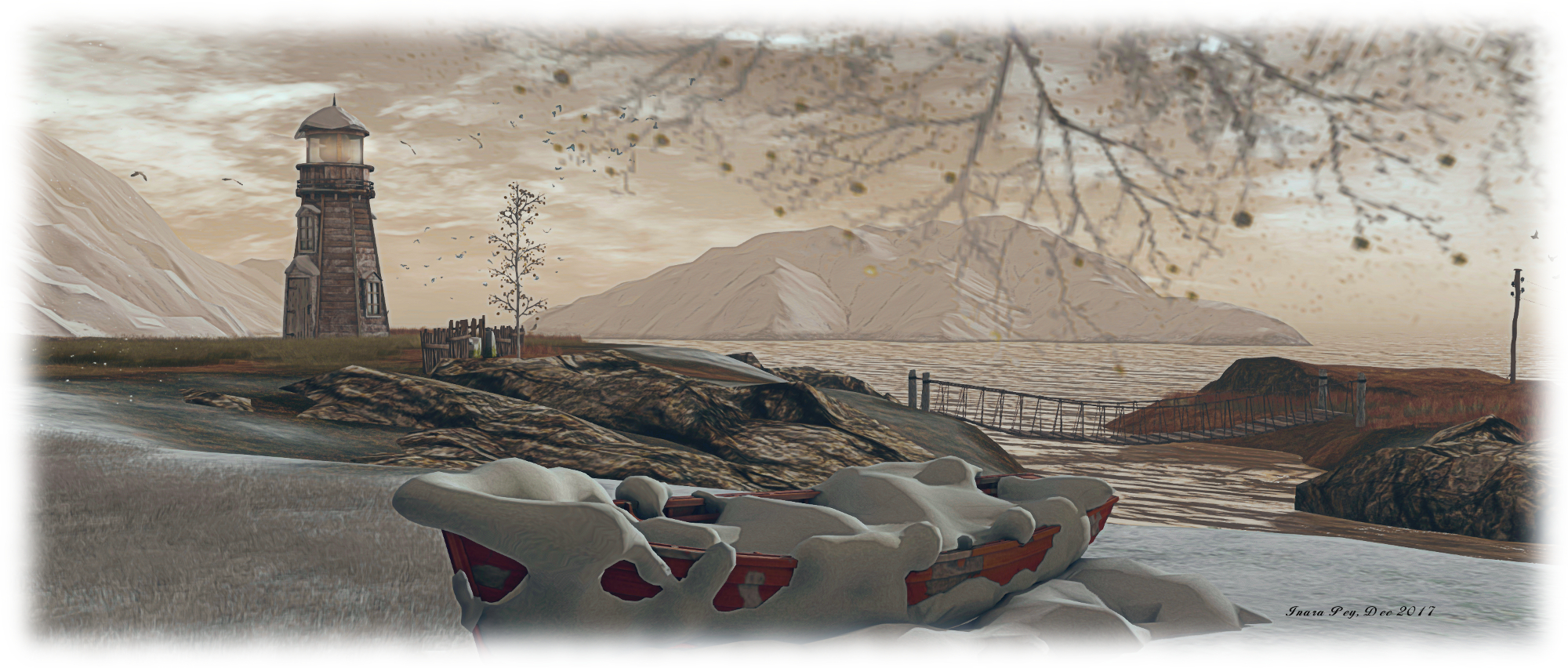
The landing point lies in the middle of the region,  close to a snowy track that winds from a headland on the west side, where an old lighthouse sits, then passes a log cabin sitting within its own fenced-off grounds before arriving at the foot of the eastern uplands.  A narrow channel cuts into the land near the lighthouse, forming a small, oval bay spanned by an ageing bridge. On the south side of this channel lies an old stone-walled barn, a Citroen van parked close by.

This western side of the landscape is largely snow free – although as one travels eastwards, the snow makes its presence felt, both on the ground and as it falls from a sky filled with scurrying clouds that scrape their way over the tall surrounding mountains. This gives the perfect impression of a wintry cold front moving across the land, depositing snow as it passes, gradually hiding the tough grass of the region under a white blanket.

La virevolte; Inara Pey, December 2017, on FlickrLa virevolte

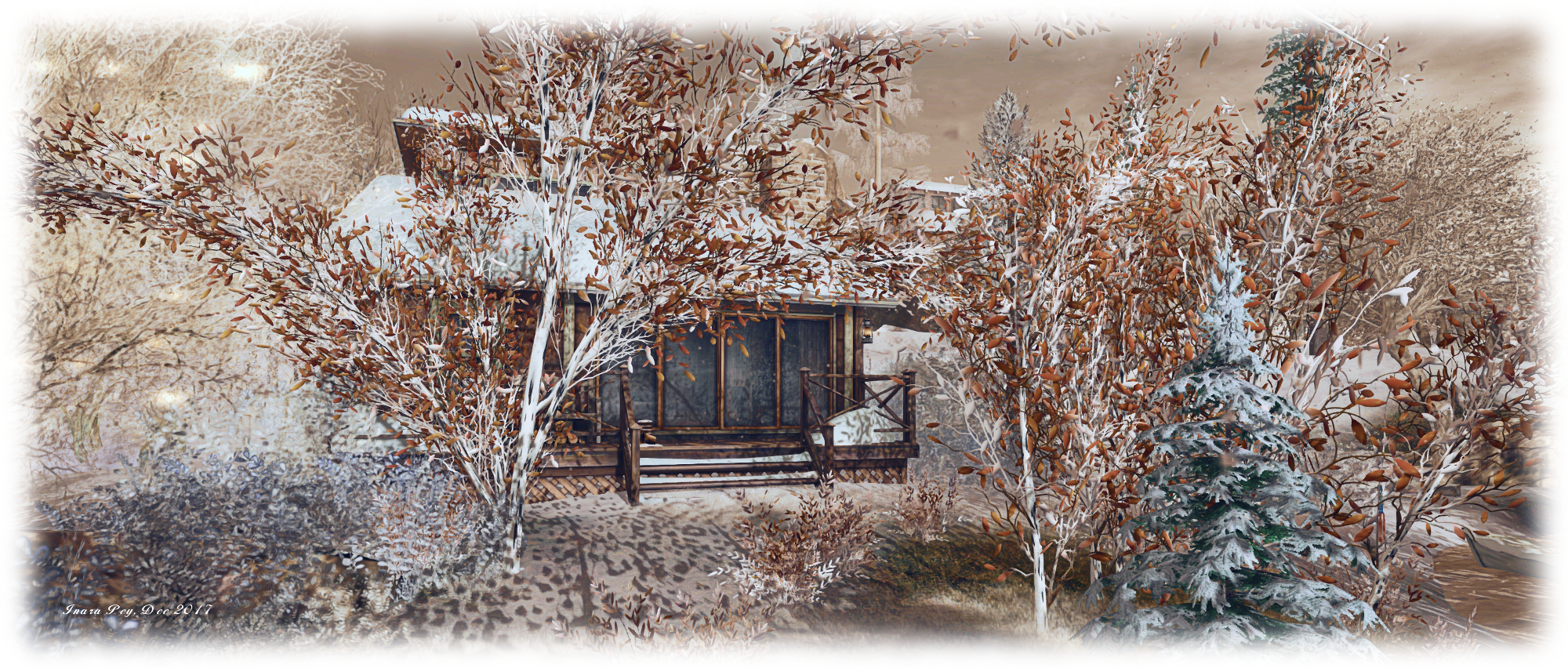
Within the deeper snows of this eastern side of the region, sits a cosy wooden cabin overlooking waters that cut into the landscape from the north to form a small bay and finger of water that cuts a small slice of land off from the rest to form a little island. This brackets the western headland, connected to it by a rope-and-wood bridge. Old ruins sit on this crooked silver of land, sharing it with a curtain of silver birch which line the banks of the water channel.

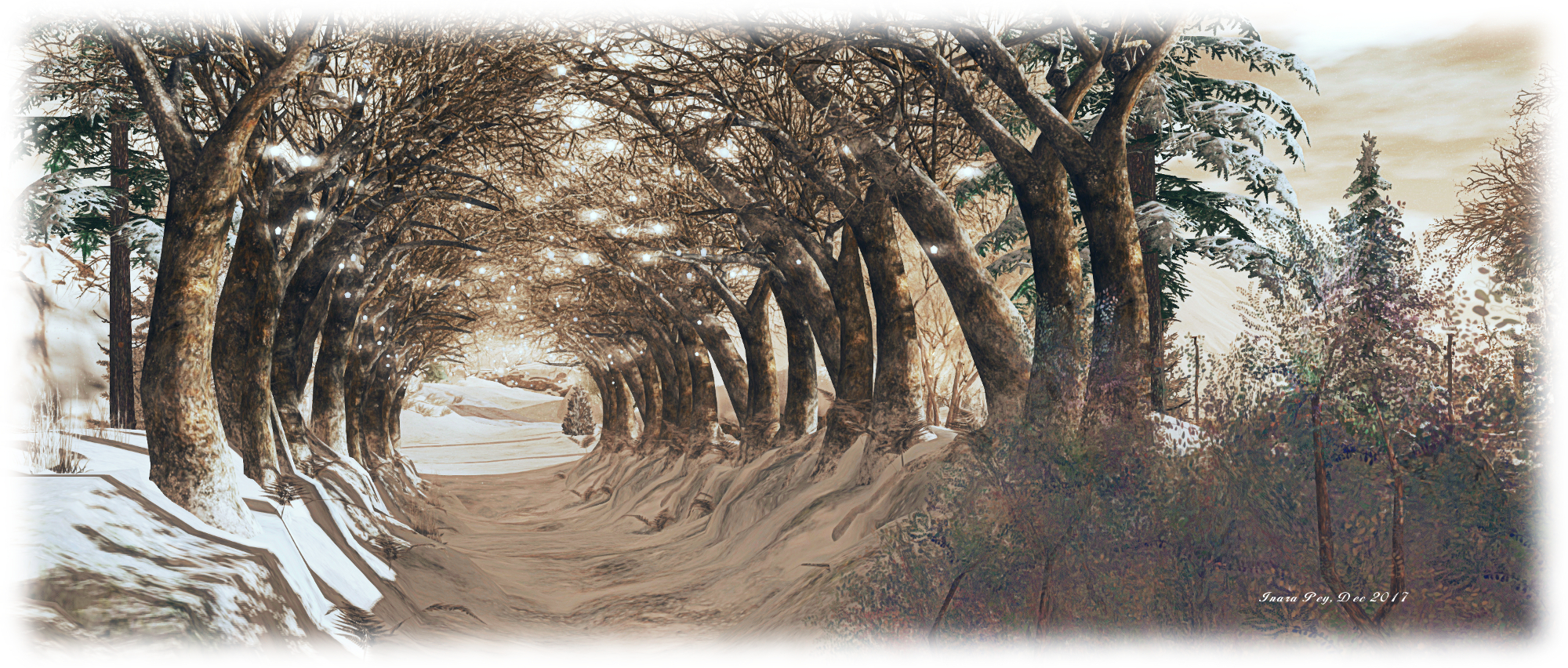
Behind the cabin, the rocky shoulders of a plateau rise in steps to where a barn has been converted into something of a club house or social space, with comfortable sofas and chairs, a pool table and general bric-a-brac. This is reached by way of stone steps cut into the rock, and which rise from the western end of the rutted track mentioned above. An avenue of small trees, their trunks bent into a series of arches, also runs from close by the cabin to the foot of the steps.

La virevolte; Inara Pey, December 2017, on FlickrLa virevolte

Rocks also rise in the south-east corner of the region, offer a small shelf where another, unfurnished, cabin sits. This can be reached by following the curve of a second track that branches from the first to swing around a low table of rock to provide access to a little depression in the land, where sits a well and a pair from benches – and stone steps offer the way up to the cabin.

There are one or two areas where the grasses to the east and north need to be set to phantom, but La virevolte is wonderfully wild, windswept and marvellous photogenic. It makes for a picturesque visit – and our thanks, once again, to Shakespeare and Max for pointing it out to us!

La virevolte; Inara Pey, December 2017, on FlickrLa virevolte

SLurl Details

Return to ISM in Second Life

International Space Museum

It’s been over five years since I wrote about the International Spaceflight Museum (ISM) in Second Life.  At that time, this two-region facility, offering something of a history of space exploration, had just come through something of a financial crisis (see here and here).  Prior to that, my last visit was far back in 2012 – so I thought I’d hop back over for an update.

Comprising Spaceport Alpha and Spaceport Beta, and entirely funded by donations and sponsorship as a 501(c)3 non-profit, ISM is a large-scale undertaking, providing a good introduction to the history of space flight, charting many of the key events and the systems they used. It provides insight into international space operations covering – America, the Soviet Union/Russia, Europe, Japan, China, India – together with something of a look at commercial activities.

International Space Station: Rocket Ring

A visit starts at the main landing point / information hub. This features a citation to a letter from Konstantin Eduardovich Tsiolkovsky, the Soviet Russian rocket scientist regarded as the “grandfather” of modern rocketry. Given as Earth is the cradle of humanity, but one cannot live in a cradle forever, the quote is from a phrase Tsiolkovsky wrote in 1911, which transliterates as Planyeta yest’ kolybyel razuma, no nyelzya vietchno zhit’ v kolybyeli – “a planet is the cradle of mind, but one cannot live in a cradle forever”. However, both this literal translation and the more popular quote point to the same ideal: that to grow as a species, humanity must as some point reach beyond the planet of our birth.

A path leads away from the landing hub towards ISM’s most impressive feature: the Rocket Ring. This provides models of some of the major launch systems used by countries around the world. This includes vehicles such as the V2 rocket – which both Russia and America utilised in their early post-war experiments; launch systems developed from ballistic missile systems – such as America’s Titan and Atlas; through to more familiar launchers such as the Soviet / Russian Soyuz and Proton families, and a look at some of the more recent vehicles to enter the market: SpaceX’s Falcon 9 and Falcon Heavy.

International Space Museum: SpaceShipOne

The ring is far from complete – systems such as Blue Origin’s New Shephard and New Glenn are lacking, NASA’s Space Launch System is missing (although the cancelled Ares launchers from the US Constellation programme are present, dominating the ring alongside Russia’s massive N1 lunar booster). However, space is limited, and what is presented is still a rich array of launch vehicles which, for those interested in the less well advertised space programmes – such as Japan’s, India’s or China’s, provides some excellent models of their current fleets.

Beneath the Rocket ring are further exhibits, including models of the Apollo Command and Service Module (CSM) and Lunar Excursion Module (LEM), the Gemini capsule, and a look at the lives of  Tsiolkovsky and Robert Hutchings Goddard, regarded as the “father” of modern rockery. NASA’s Orion Multi-Purpose Crew Vehicle (MPCV) in both its original form, with rounded solar arrays and a more recent design, featuring twin rectangular solar arrays. Orion will use a Service Module based on the European Automated Transfer Vehicle (ATV), which used to haul up to 5 tonnes of supplies and equipment to the space station, and include the ATV’s unique arrangement of four solar arrays.

International Spaceflight Museum: an historical look at the ISS with the shuttle docked, and a European ATV resupply vehicle arriving. Also docked is a combination of Soyuz+Progress vehicles

Further out from these are further displays, including the Apollo Saturn 1B rocket, information centres and more. These also include interactive elements, such as a Gemini V / Atlas II rocket, which offers a ride up to one of the sky exhibits – that of the International Space Station (which can also be reached from the ground-level sit-on teleport kiosks). Also in the sky and reached from the ISS display, are models of the solar system.

Spaceport Bravo, reached via a runway-like bridge over which the first sub-orbital flight of SpaceShipOne is recorded, sits a reproduction of NASA’s Vehicle (or Vertical, as it was originally known) Assembly Building (the VAB). This is where the Apollo rockets and space shuttle systems were “stacked” and readied for launch, and where the SLS rocket will be assembled ready for flight. One of the bays in the VAB feature the space shuttle Atlantis, which has just been mated with its External Tank / Solid Rocket Booster units; the other features a Saturn V leaving the bay atop its crawler-transporter. Alongside of this is an Orbiter Processing Facility (OPF), the interior of which is somewhat sparse, but does offer models of NASA’s lunar rover vehicle and the  Lunniy Korabl (LK) lander vehicle which formed part of the Soviet Union’s manned lunar programme aspirations.

International Space Station: Mercury recalled

Visually, ISM offers a lot to see, not all of which is expressed here – and at one time hosted a range of events (it’s unclear whether this is still the case). However, there are some disappointments. An attempt has been made to link exhibits to a wiki, but the majority of pages have yet to be populated, for example. Several areas appear a little sparse – such as the OPF building, as noted; all of which gives a feeling the ISM is caught in time – as if in the midst of a still-to-be completed update, including elements which might be relatively easily seen to. Take the photo map of the Florida space coast, for example. This shows the facilities at both Kennedy Space Centre and Cape Canaveral Air Force Station, but has yet to be updated to reflect SpaceX’s use of Kennedy’s Pad-39A and Canaveral’s SLc-40 and SLC-13.

Even so, for those who want to dip their toes a little more deeply into the world of space flight, ISM retains a lot to offer, while across the water NASA’s Explorer Island offers an interesting looking back in history to the US space agency’s involvement in Second Life.

SLurl Details

International Spaceflight Museum (Spaceport Alpha, rated; General)

Steampunk Moods in Second Life

Steampunk Modes: Gem Preiz

Now open at Galerie des Machines, Paris Couture and curated by Olympe (OLYMPES Rhode), is Steampunk Moods, a celebration of steampunk and Victorian technology, with a touch of ecological commentary. The exhibition features art by Gem Preiz, Melusina Parkin, Haveit Neox and Bénédicte Petiet.

“Straddling the reincarnation of the past and a certain idea of ​​the future, Steampunk is primarily an aesthetic current of literary origin before developing on a multitude of other media,” Olympe states in the introduction to the exhibition. “A temporal paradox, it mixes centuries of fiction, Jules Verne, [Herbert] George Wells, popular culture, films, comics and other video games.” The art presented within the gallery’s halls reflects this in a most eclectic mix of 2D art spanning the virtual and the physical, and which mixes what might be termed “traditional” steampunk imagery with more familiar Victoriana and interpretations of the future.

Steampunk Modes: Melusina Parkin

The ground floor of the gallery features a selection of Gem Preiz’s stunning fractal art, and the first glimpse into the future. It’s well established that I’m a major admirer of Gem’s work, and the pieces selected for this exhibit reflect why. Gem’s fractal art is hugely evocative in painting visions of the future; they encompass everything from cosmology through issues of ecology and human development,  touching – richly so – on concepts of architecture,  design and culture.

Several of these factors are touched upon within the thirteen images presented here – but so to is a sense of mechanisation. Several of the pieces have the look and feel of great engines – or parts of engines; others seem to suggest great cogs and wheels. There are also other reflections of steampunk: hints of lenses, twists of grill work and plating that are almost decorative in look and feel – the finery that can so often be found in more delicate pieces from the era. Each image is uniquely beautiful and  – literally – multi-faceted, demonstrating Gem’s multi-panel approach to his art that allow him to offer marvellously high-resolution pieces of his original art.

Steampunk Moods: Haveit Neox

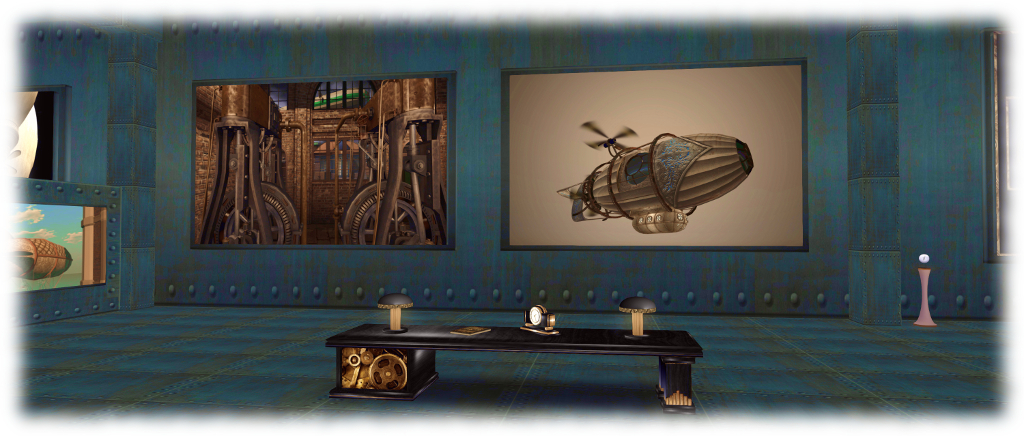
On the floor above Gem’s exhibit is an extensive display of in-world photography by Melusina Parkin, featuring steampunk elements found throughout Second Life, both large and small and presented in a suitably metal-walled environment. Many of the images present objects and scenes in Melu’s familiar close-up style, focusing our attention on specifics, rather than a broader scene, while still conveying an entire story to a piece. Several of them present familiar steampunk themes – powered airships: both dirigible and boat-hulled. Propellers also feature, while there are hints of Verne and Wells to be found.The models of Battersea Power Station, dating from the 1930s, might seem a little incongruous. But given it is an iconic emblem to industrial power, it is somehow fitting.

Passing through the display of Melusina’s art brings visitors to a second hall, where Haveit Neox’s contribution can be found. This takes the form of an iteration of his installation, The Miniature Goal, first seen in 2014.  Within it, Haveit asks, “What if our physical world shrunk in proportion to the resources we drain from it?” As I wrote back in 2014, this is a fascinating piece; here it perhaps offers a slightly different look at steampunk. The technology of the latter is somewhat based on the consumption of fossil fuels and other natural resources, consideration of the consequences are perhaps not so at odds with the core theme.

Steampunk Modes: Bénédicte Petiet

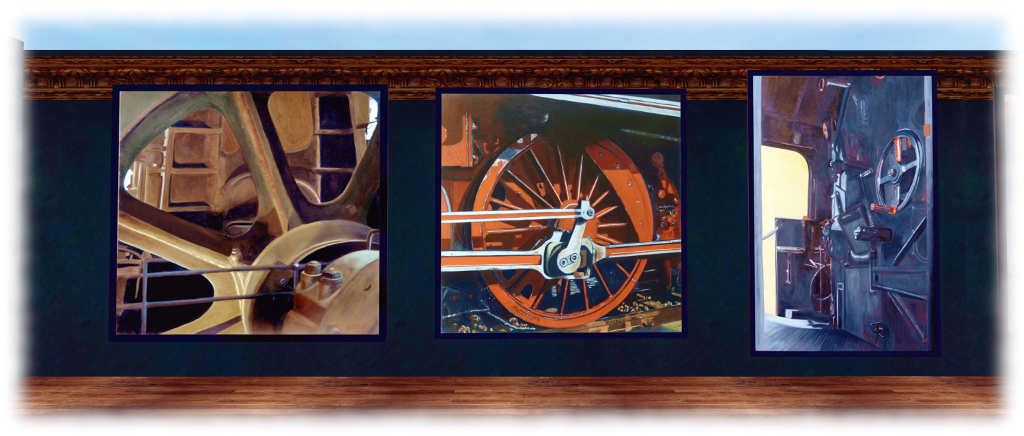
Above the floor featuring the physical world art of   Bénédicte Petiet. Again, the canvas here is broader than what might be regarded as “traditional” steampunk. Like Melu, Bénédicte presents the most of his images in close-up: machines, wheels, pistons, gears, relays … all are presented here. So to are what might be considered elements from outside the realm of steampunk itself: cars from the recent past, and even street scenes. With the exception of the latter – which appear to be a mini-exhibit in their own right – the rest of the images suggest something almost “retro-futuristic”: the past we can recognise presented through a digital medium of their future.

All told, a multi-faceted exhibition, well worth exploring.

SLurl Details

Tarrying at Tramore Bay in Second Life

Tranmore Bay; Inara Pey, December 2017, on FlickrTramore Bay – click on any image for full size

Tramore Bay, the work of Pernilla (PernillaOhl) and Amelie Tautou (Amilee34) is once again evidence that you don’t need at entire region – Full or Homestead – to make a lasting impression in Second Life. Occupying the south-east corner of a Full region, Tranmore Bay is a compacts design, making full used of the space available to presents a highly photogenic and quite delightful cove-like environment in which to spend time.

That said, a visit begins, not within the cove itself, but high overhead, at the industrial / brewery chic Tramore Bar, where music can be enjoyed with a drink and game of darts or while cosying close to the fireplace.  Six teleport options are available on the wall next to the landing point (and a TP station in on the floor, the twin of several at ground level), each of which delivers visitors to an area of the cove at ground level. As all are within easy walking distance of one another, which you take to the ground isn’t that important – although the café is perhaps the most central.

Tranmore Bay; Inara Pey, December 2017, on FlickrTramore Bay – click on any image for full size

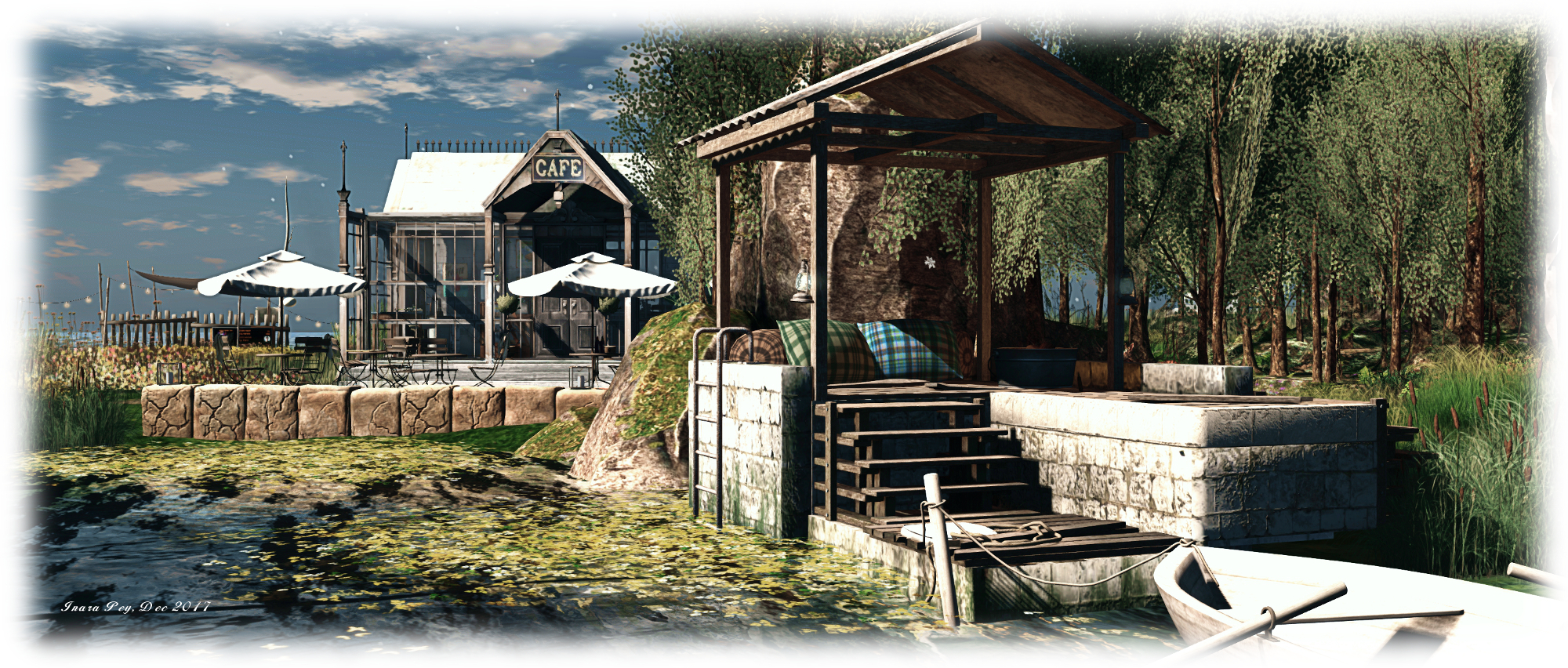
The default windlight at ground level is a deep sunset, but this is a place where a rich variety of environmental settings can be used to create the ambience required of your pictures. As Caitlyn and I both felt we needed a break from winter’s snow and hints of winter, I selected a more late summer setting for the pictures here to add some further sensations of warmth.  The café is an old wooden structure, looking equally out to sea and inland. It’s and the rest of the cove lay protected by high rocky walls on three sides, with a view out over beach and sea to the south.

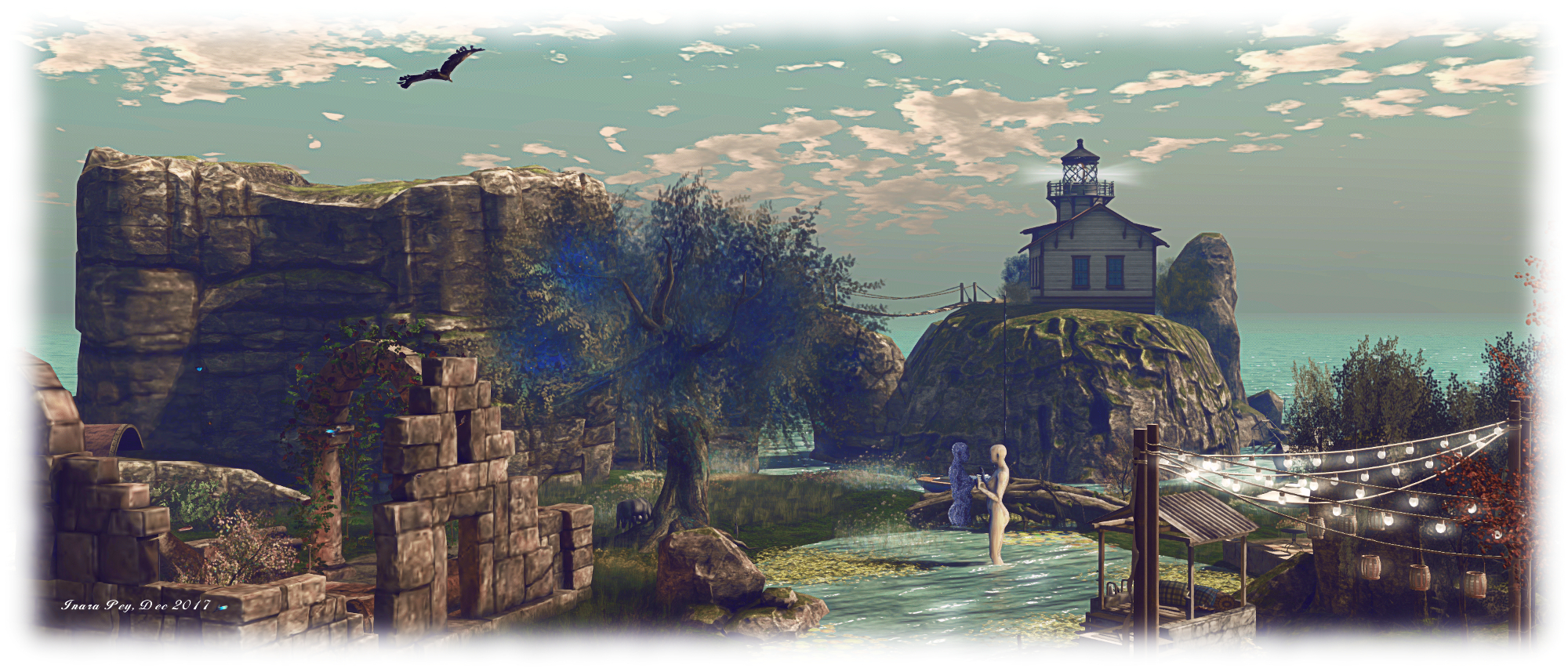
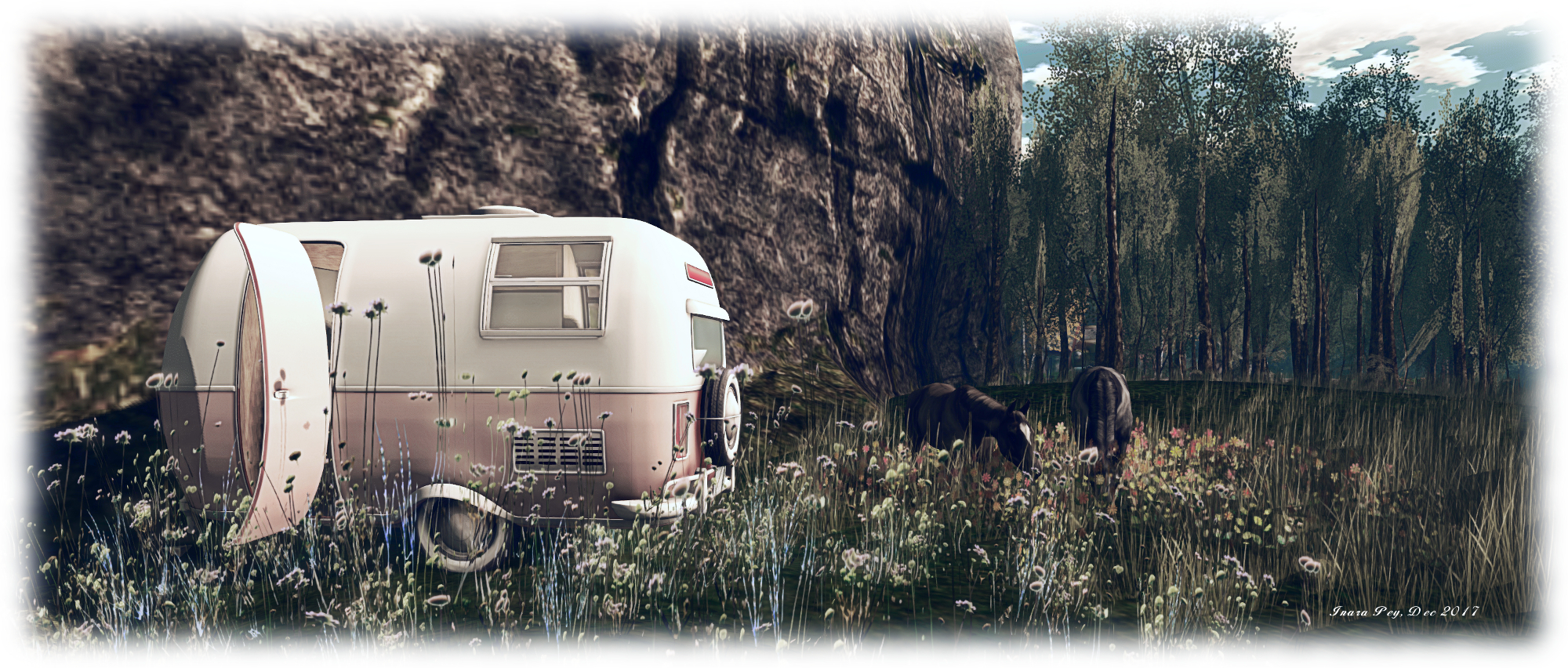
Woodlands border one side of the café , sitting in the lee of the cliffs and offering paths to wander and deer and horses to watch. Inland from the café is a music stage, with a path lurking in the shadows, offering a winding path up into the west cliffs. It is this path, and the one to the east of the land, which add further depth to the setting, allowing visitors to climb up between rocky shoulders to the flat cliff tops, then roam along the grass-covered rock to a camp site on the west cliffs or, by way of wooden bridge, to the chapel-like lighthouse keeping a watchful eye on things from a rocky island in the very south-east corner of the region.

Tranmore Bay; Inara Pey, December 2017, on FlickrTramore Bay – click on any image for full size

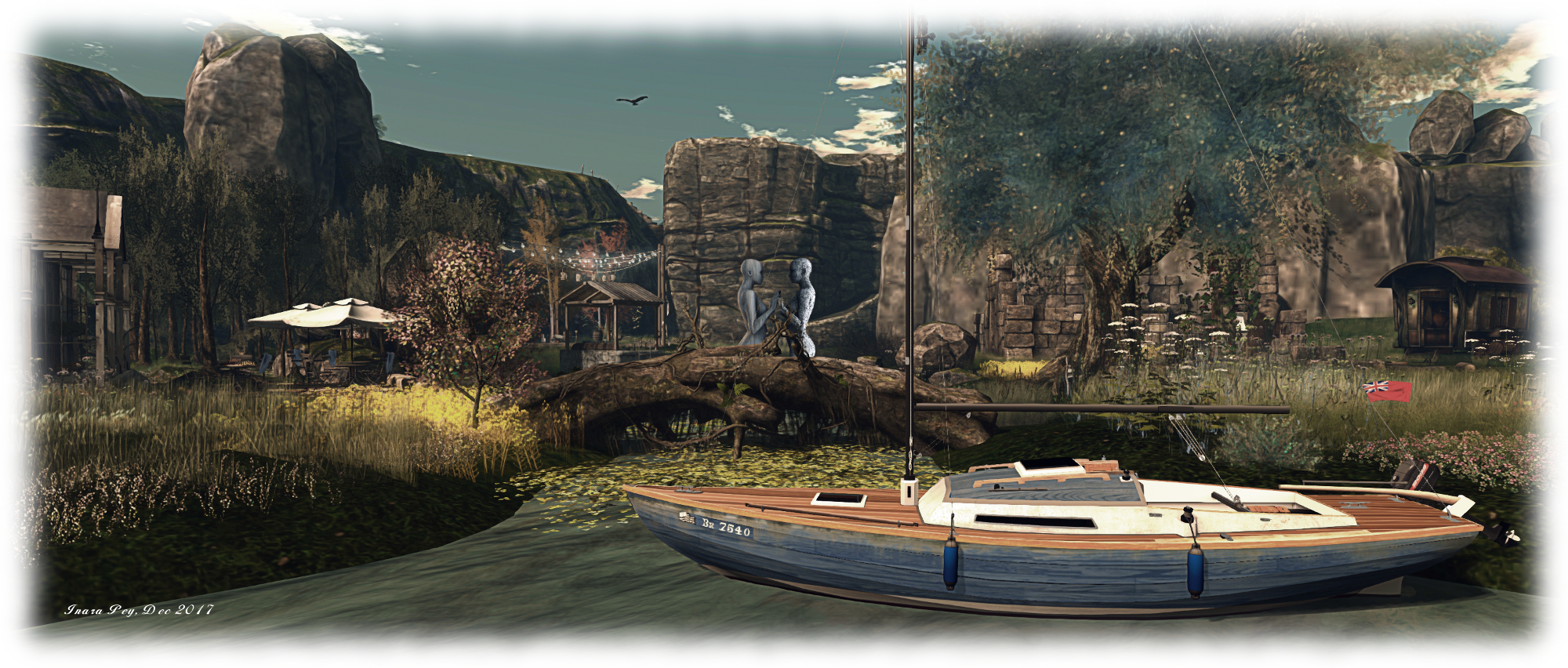
The path to the lighthouse lies across a narrow body of water from the café , spanned by a rough bridge formed by the fallen trunks of trees. The path to it, like the one to the camp site, offers superb views over the land, particularly from the great rocky arch spanning the water to the lighthouse’s little perch. Also to be found on this side of the water, tucked under the cliffs, is an old ruin, the setting for outdoor dining, a little Romany camp close by.

Throughout all of this, there are charming little touches: the wild flowers; the snuggle posts on the beach and around camp fires; a scatter of art by Mistero Hifeng which add a unique feel to the setting; the sailing boat (privately owned) moored in the lee of cliffs and lighthouse island – and more besides. There are a couple of little rough spots in the landscaping where plants perhaps need to be phantom, or path sections don’t quite align, but these are more than compensated for by the sheer beauty of Tranmore Bay.

Tranmore Bay; Inara Pey, December 2017, on FlickrTramore Bay – click on any image for full size

All told, this is a really delightful place to visit. Those interested in learning about music events at Tramore Bay can join the local group, photographers can enjoy the setting for their work, and explorers will find plenty to see and appreciate – and to offer reasons to tarry a while. Should you enjoy your visit, do please consider making a donation towards the enjoyment of Tranmore Bay by others via the tip jar up at the bar.

Tranmore Bay; Inara Pey, December 2017, on FlickrTramore Bay – click on any image for full size

SLurl Details