No Life Without Art in Second Life

No Life Without Art: Kandinsky

“My passion for art has been part of my virtual life from the start, and in RL began many years ago,” Alo (Aloisio Congrejo) says of himself. “As an artistic ‘consumer’ there have been many artists both great and lesser known that I have followed and admired, but what is most important to me is to see the work of anyone who can craft various media in such a way as to express their feelings.”

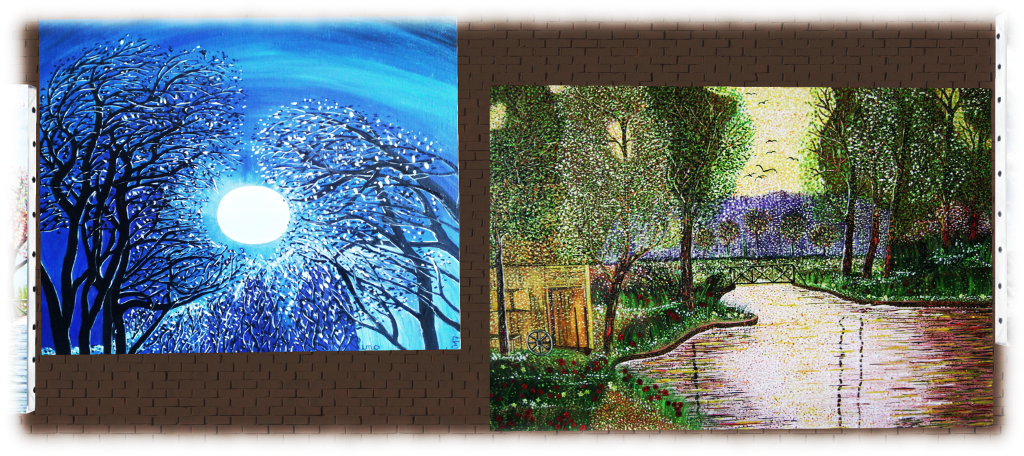
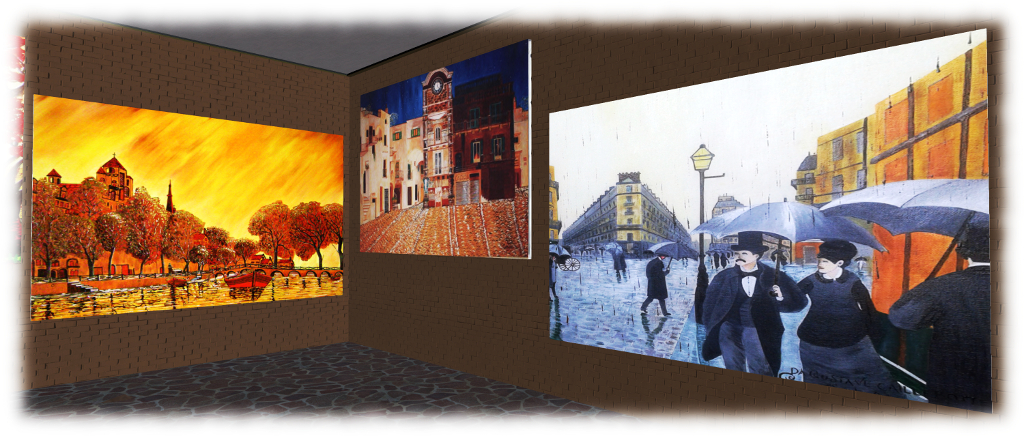
Thus it is that for his latest exhibition, No Life Without Art, he uses his own artistic expressionism to celebrate some of the most influential artists of the early 20th century – Wassily Kandinsky, credited with painting one of the first recognised purely abstract works; Paul Klee, whose unique approach to art drew upon abstraction, cubism, expressionism and surrealism and surrealists Joan Miró, René Magritte and Giorgio de Chirico.

No Life Without Art: Giorgio de Chirico

A visit to the installation begins on a platform overlooking a 3D tribute to Kandinsky with a piece that – for me at least – echoes his Small World pieces, produced in the 1920s when teaching at the Bauhaus in Berlin. This part of the installation is perhaps best viewed from above and by camming, although there is a walkway leading down to it for those who wish to explore more closely.

Beneath this, and reached via teleport board at the landing point sit the tributes to Giorgio de Chirico and René Magritte. In the early years of the 20th century, de Chirico founded the scuola metafisica metaphysical art movement, which profoundly influenced the surrealists. Featuring dream-like scenes offering strong contrasts in light and shadow and often with an undertone of mystery or threat, the movement flourished through the second decade of the 20th Century and is notable commemorated in this installation through the inclusion of a representation of The Disquieting Muses (circa 1917) and what might be a play on The Seer (circa 1914/15), together with architecture and backgrounds reflecting those seen in many of de Chirico’s works from this period.

No Life Without Art: René Magritte

Set across three platforms linked by walkways, the de Chirico pieces overlook a wall of identical pieces which offer a play on Magritte’s 1964 composition The Son Of Man and which also might be said it echo his 1966 piece, The Pilgrim. These form a link with the lowest level, where the artists is again celebrated, with another image of a faceless man, together with that of an apple, which for Magritte symbolised the tension between the hidden and visible.  Both of these images are also symbolic for the artist’s influence on the pop, minimalist and conceptual art movements, whilst also offering a tip of the hat towards his own playful use of art.

This level also celebrates Joan Miró and Paul Klee, with the latter’s highly individualistic style very well represented through a reproduction of his 1922 composition, Red Balloon, and a 3D representation of Flagged Pavilion (1927), while Miro is represented by his 1925 work, The Garden.

No Life Without Art: Paul Klee

All five artists are well represented, and Alo also provides biographical note cards on each, allowing visitors to gain a greater understanding of their lives and works. In introducing himself, Alo notes that he appreciates those who can express their feelings through their art. In No Life Without Art, he clearly reveals his own depth of feeling for, and admiration of, these five influential and provocative artists.

SLurl Details

Yamagata in Second Life

Yamagata; Inara Pey, August 2017, on Flickr Yamagata – click any image for full size

“I have wanted an oriental themed sim for the longest time,” Ayla Zhoy (AylaJ) says of her homestead region design Yamagata, “and here it is! I’ve spent some time slowly working on this and I hope you enjoy your visit.”

Regular readers to these pages will know that I’m immediately drawn to anything with an oriental flavour. This being the case, Caitlyn and I hopped over to take a look around as soon as the opportunity arose – and we weren’t at all disappointed.

Yamagata; Inara Pey, August 2017, on Flickr Yamagata

As with many oriental regions in Second Life, Yamagata draws strongly on Sino-Japanese influences, blending the two together to create an environment which is eye-catching, relaxing, fun to explore (although do take note, it is a constant work-in-progess, and so is changing on a fluid basis) and with plenty of opportunities for photography.

The land is in fact split into a number of small islands – although such is the design, this may not immediately be obvious when exploring. The landing point sits to the north-west of the region, on an elongated islet it shares with a modest traditional Japanese style house and garden. A walk inland from the house will bring you to a stone arch, water tumbling from it as it links the island with one on which a bamboo of Pandas reside. A short distance away, and running through the trees occupying the eastern end of the island, a path provides access to the first of several bridges spanning the channels which divide up the land.

Yamagata; Inara Pey, August 2017, on Flickr Yamagata

However, before you leave the landing point, make sure you accept the offered note card, it has details of a number of points of interest worth visiting when exploring. These include tea houses, onsens, houses and ruins. They can be explored in any order, and each offers a setting very much worth seeing. Paths and grassy trails run across all of the islands, linking bridges and points of interest to one another, while stone steps provide access to the region’s elevated areas.

One of the more intriguing places to visit is the stone tower rising on the west side of one of the larger islands. This sits in two parts, one preciously balanced atop the other by a mix of what appears to be a narrow neck of stone blocks, an iron ladder and gravity’s attention being otherwise occupied elsewhere! The ladders offer a way up (right-click and sit), and the tower itself is a good vantage point from which to see the rest of the region.

Yamagata; Inara Pey, August 2017, on Flickr Yamagata

But really, the best way to see everything is obviously on foot, following the paths, discovering all the different locations and places to sit and contemplate or cuddle or bathe along the way. The pandas offer a cute distraction (the stone arch can be climbed over to reach them if you want – although it is not strictly speaking a bridge). There are a couple of boats in the region, but these don’t appear to be set to allow passengers to sit at present – or at least at the time of our visit; which is a pity as the one near the stone water arch makes for a nice spot from which to observe the pandas.

Yamagata really is a lovely setting, well suited to a variety of windlight settings and offering a lot for people to enjoy. The Sino-Japanese theme works well, and is complemented by a soft ambient sound scape entirely in keeping with the region.

Yamagata; Inara Pey, August 2017, on Flickr Yamagata

SLurl Details

Art in the wild in Second Life

Aly's Fine Art Gallery and Jungle; Inara Pey, August 2017, on Flickr Aly’s Fine Art Gallery and Jungle – click any image for full size

In May 2017, Caitlyn and I visited Aly’s Fine Art Gallery and Jungle, designed by Hepburn (Hepburn30) and Pross (Prosperine2) for region holder Aly (Alysheea). The region is a home for Aly to display her 2D and 3D art –  and also provide visitors with a place to explore. As such, it presents an interesting mix of place to visit and explore, and gallery to appreciate the art on exhibition.

The gallery space is located in the south-west corner of the region, and is formed by three tiki huts located around a small lake surrounded by sandy banks. Aly’s art, which is an intriguing mix of “traditional” photography, abstract images based on photos, and images which appear to have been captured in-world. These are displayed alongside and around 3D sculptures and mobiles.

Aly's Fine Art Gallery and Jungle; Inara Pey, August 2017, on Flickr Aly’s Fine Art Gallery and Jungle

Across the water, elephants graze on the long grass growing around a tall watchtower. Of African origin, the elephants are perhaps a little at odds with the rest of the setting, which – for myself at least – has a far more Asian look and feel to it than it does African. Nevertheless, the offer plenty of opportunities for photos and are quite magnificent.

Beyond this, the region is a mix of tropical rain forest and rugged uplands, and offers much that requires careful exploration.  The rain forest has a number of trails running through it, one of which leads to a wooden summer-house offering a place for couples to enjoy a cuddle or two alongside a series of waterfalls. Another of the paths leads to steps cut into the side of the plateau which rises from the north and east sides of the region. This is an area requiring careful exploration, as not everything to be found here is necessarily above ground: there are caverns awaiting discovery. For those who prefer staying out of tunnels and caves, there are platforms along the side of the cliffs offering seating areas, while others provide ways to explore some of the lower-lying rocks.

Aly's Fine Art Gallery and Jungle; Inara Pey, August 2017, on Flickr Aly’s Fine Art Gallery and Jungle

Throughout the entire region are many Asian influences: a statue of Buddha, ruins which wouldn’t go amiss in the jungles of Burma, Tai Chai exercise areas, and more. These are mixed with places to sit and cuddle in camp sites and elsewhere, and which include a platform beneath a hot air balloon. For the observant – again – a hidden opportunity to play the Moonphase Piano.

As noted, this is an intriguing region. The art exhibition is modest, but well worth a visit, while the rest of the region offers a chance for exploration and photography – and has over the months been captivate by talents far greater than my own.  That said, and being honest, I do have one or two quibbles with some parts of the build – the plateau and rugged areas are a trifle ragged in places, and could perhaps benefit from some gentle clean-up and tidying. But again, this doesn’t detract from photographic opportunities, either under the default windlight or similar soft lighting.

Aly's Fine Art Gallery and Jungle; Inara Pey, August 2017, on Flickr Aly’s Fine Art Gallery and Jungle

SLurl Details

A cyberpunk Cocoon in Second Life

Cocoon, Japan Rose; Inara Pey, August 2017, on Flickr Cocoon – click any image for full size

Note: Cocoon has relocated and updated. The SLurls in this post have therefore been updated to reflect the new region. Please also refer to for a review of the new Cocoon.

Cocoon is the name of a cyberpunk role-play region designed by Ellie (Mii1a), and it offers an atmospheric environment with a rich back-story.

It is the year 2487. The Earth surface has become virtually uninhabitable as consequence of wars and environmental neglect. Most of humanity has fled the surface in the hopes of building a new future.

Cities slowly float around three thousand meters high above the surface, to escape the corroding effects of the pollution and radiation on the city’s hull over time.

The cities are connected by dense air-traffic and there is a booming economy for all types of goods. The cities are controlled by many different rival mega-concerns in the science and weapon industry, yet most parts of the population don’t care about the large-scale politics and established connections on many levels between the cities. There exists a thriving black market for weapons, drugs, software, food, cybernetics and other technology which remains nearly uncontrollable by the big businesses.

Cocoon, Japan Rose; Inara Pey, August 2017, on Flickr Cocoon

The name Cocoon is that of a “an unimportant artificial asteroid” first developed by the Cocoon Corporation some 40 years prior to the current period. Over the years it has grown to a centre of commerce sitting between floating cities of Earth and the colonies on the Moon and Mars – and a convenient place where those wishing to avoid being noticed could also find a place to hide – providing they don’t do anything to bring themselves to the attention of the security services.

The city is divided into four sectors – an automatic industrial area with docking facilities for shuttles operating between Earth, the Moon and Mars; a residential sector located along a narrow street with a mall and a black market location; the entertainment sector (also the oldest area of the facility) and sector four – the secretive area run by Cocooncorp itself and which “very few people have been able to enter that building or tell what is inside.” Finding your way around can be a tad confusing, as it’s not entirely clear whether the sectors are all on the same level or defined by height – so keep an eye on the signage.

Cocoon, Japan Rose; Inara Pey, August 2017, on Flickr Cocoon

The confusion induced by the design actually adds to the build, rather than detracting from it; after all, who immediately knows their way around a city on a first visit? As it is, the design encourages exploration and increases the chances of bumping into / jumping in-progress role-play. The latter appears to be entirely free-form, and includes combat via the Sosumi combat System, which can be obtained by group members via kiosks located throughout the build.

The overall design carries a look that is – as with most cyberpunk / sci-fi dystopian build – a hint of Blade Runner about it. This is not to say it is in any way derivative; rather it offers setting which may be comfortably familiar enough to encourage role-players to get involved. There are a number of ways to get around as well: on foot, via the numerous elevators and – for those who join the RP group – bikes can also be obtained for use on the multi-level roads. RP locations can be found outdoors and in. Role-play can additionally be enhanced by the media boards scattered through the city. Operated by ONN – Orbital New Network – these offer “news updates” on events which could act as springboards for further role-play.

Cocoon, Japan Rose; Inara Pey, August 2017, on Flickr Cocoon

Unlike many RP environments in Second Life, Cocoon appears to be a vibrant community; during our visit there were over half-a-dozen players actively participating in role-play. A comprehensive website provides those wishing to get involved all they need to know in order to join in: back story, allowed factions, rules and guidelines and an application form – group membership is via application / invitation. What is particularly interesting with the website, is the fact that is active among members: character biographies have been written, the forums look to be active, as does the photo gallery. Members are even encouraged – and do – write their own blogs.

For those looking for cyberpunk / dystopian role-play (complete with the ruins of Earth at ground level), Cocoon could be just the ticket. Those looking for futuristic setting for photography may also find the region an interesting visit (just be aware it is a role-play environment and try to dress appropriately).

Cocoon, Japan Rose; Inara Pey, August 2017, on Flickr Cocoon

With thanks to Shakespeare and Max for the tip.

SLurl Details

  • Cocoon (Japan Rose, rated: Moderate)

A Split Screen double in Second Life

EveryWhere and NoWhere – JadeYu Fhang

EveryWhere and NoWhere, by JadeYu, forms a ground level installation, and is the more extensive of the two. It offers a complex environment of scenes and platforms, forming a unique world of geometric shapes and inhabited by strange, female forms.

In the first – which acts as the landing point – the figures are enmeshed in a delicate framework somewhat resembling a bird’s nest. Ladders rise from the platform at various angles, each offering a number of poses for visitors. Beyond this lie processions of doorway-like boxes march and undulate through the sky, or rise vertically upwards, apparently tended by beings with dragonfly like wings as streams of light pulse and roll around them. Two structures sit within the rising tower of squares, each a miniature tableau in its own right.

EveryWhere and NoWhere – JadeYu Fhang

Other platforms float close by, occupied by more beings, while the ground below flows in curlicues, some of which rise to surround two central figures. Further away, on two sides of the region, the land rises, patterned geometry tattooing its surface. More shapes, almost origami-like in form, hover delicate in the sky over the slopes of the landscape.

An intricate landscape, the setting is a reflection of its title. Fascinating, complex, with a range of facets and potential interpretations,  EveryWhere and NoWhere should be visited with local sounds enabled in order to hear the accompanying sound scape. This, with its metronomic chimes and plaintive voice, gives the entire space added depth.

Games We Play – Krystali Rabeni

The Games We Play offers visitors a games of chess of a most unusual kind. Far from being the traditional chequered board, this playing surface is uneven, individual squares set at different levels relative to their neighbours – and then extend up the walls surround the space before closing overhead. Pieces in gold and silver are ranged across the horizontal area of play, and occupy the some of the wall spaces as well.

The pieces themselves further reveal the unusual nature of this game – or games: the gold pieces comprise more than the normal single queen or pair of knights, for example. Meanwhile, winged pawns fly overhead, imbued with a power not to be found in a normal game of chess. It’s a complex setting the nature of the game suggesting that – like life – there is more to this game than meets the eye.

Games We Play – Krystali Rabeni

Neither artist offers an explanation for their respective works, preferring to leave interpretations to visitors. However, each piece offers enough clues – including their titles, for opinions, ideas and narratives to be formed. As such, both offer an intriguing and interesting visit, and will remain in place until the end of September 2017.

SLurl Details

An August return to Yasminia in Second Life

Yasminia, Yasminia; Inara Pey, August 2017, on Flickr Yasminia – click any image for full size

It’s been almost a year since Caitlyn and I first visited Yasminia, the homestead region designed by Busta (BadboyHi). At the time, he’d opened the region to the public for a limited time and was planning to close it once more. However, such has been the response from visitors, he decided to leave it available to public access and continue to offer people a chance to visit – and I’m happy to report it remains open to all.

Beack then Yasminia was a very pastoral setting with open fields and horses grazing, offering visitors a photogenic delight. Today’s Yasminia is very different look – albeit one no less photogenic. The largely pastoral setting has given way to one that is more mixed – still rural, but with the corner of a small town poking into it, suggesting a place where the countryside meets a more urban setting.

Yasminia, Yasminia; Inara Pey, August 2017, on Flickr Yasminia

Where you begin a visit is entirely up to you, as no landing point is set. Opting for the default central arrival point on the region will deliver you to the edge of the little town. Rather than use that, however, the SLurl I’m using here will drop you off towards the north-west corner of the region, on a track running southwards above a ribbon of beach.  This can be reached via a set of stone steps descending the slope between track and sand, while across the track sit houses and outbuildings arranged around a courtyard and fronted by a paved garden with fountain and water feature. The courtyard, with its outdoor table set out with soup pots, wine and bread, makes for the ideal place to return to following a walk through the rest of the region.

The track winds its way down through the timberline towards the little town, running south and then west, offering a relaxing walk down to where the paved road running through this corner of civilisation starts. Those wishing a shorter route can walk through the gardens fronting the houses,  then take another set of stairs down to the north-eastern edge of the town, where just a few steps will bring you to the road and its companion footpath.

Yasminia, Yasminia; Inara Pey, August 2017, on Flickr Yasminia

Careworn buildings line either side of the road – this is perhaps not the most prosperous place nestled within the surrounding peaks. A small chapel sits alongside the road, the tall tower of what might be a granary rising beyond it and standing sentinel between two small bays which cut their way into the land. One of these, overlooked by a broad, paved terrace set as an outdoor café, offers mooring for boats and a scenic look out over the broader bay separating Yasminia from the surrounding mountains.

The buildings backing onto the cafe terrace may all once have been thriving businesses; now however, they are run-down, deserted and empty, their windows shuttered or with blinds drawn, life having apparently moved on. Only the gas station / auto shop appears to still be doing business, perhaps the last hanger-on, even as the dirt of the tracks either end of the street encroach on its paved surface.

Yasminia, Yasminia; Inara Pey, August 2017, on Flickr Yasminia

If the apparent desertion of the town is a little too much, follow the road and track north and then east as it curls around the base of the uplands on which the houses sit. It will lead you back to the beach. Here can be found signs of life aplenty: surfboards upended in the sand, chairs and seating ranged under canvas awnings, a beach side disco with dancing on the sand, fire pits, and sun loungers pairing their way down the longer ribbon of west-facing beach, presenting couples with plenty of room to relax under the sun.

Today, as noted, Yasminia presents a very different face to the world than a year ago – but one which has its own unique beauty, with places to relax and that three-sided courtyard ready to greet visitors with wine and food and the chance for friendly conversation.

Yasminia, Yasminia; Inara Pey, August 2017, on Flickr Yasminia

SLurl Details