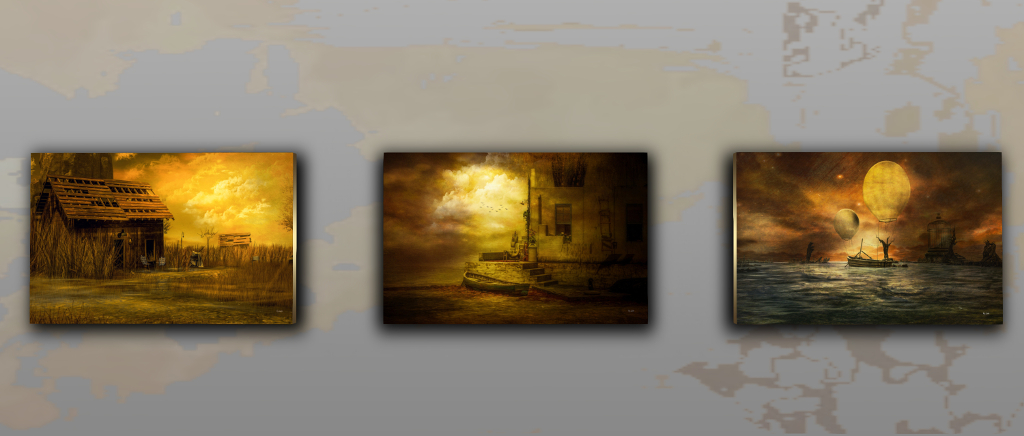
The mandalas and art of Sheba Blitz in Second Life

InterstallART: Simply Spiritual

Mandalas, whether presented as art or an expression of spirituality or as a symbol of the universe or as a result of geometric teasings of fractals, have long fascinated me. The name literally means “circle” in Sanskrit, and within Buddhism and Hinduism the mandala is a spiritual and ritual symbol representative of the cosmos around us.

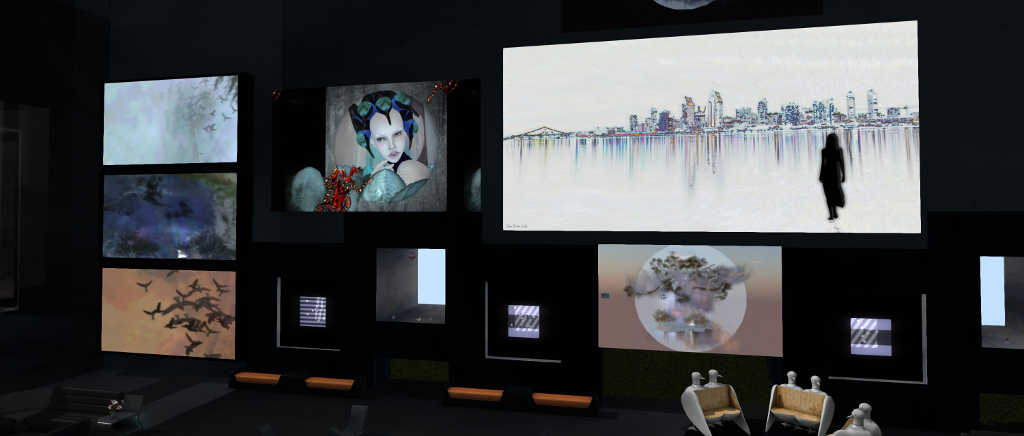
Within Second Life, an artist who captures everything of the rich context, ritual form, balance and harmony of the mandala in her art is Sheba Blitz, and she is currently the Artist in Residence for August at  InterstellART, where she is presenting Simply Spiritual, featuring several of her mandalas, and more besides.

Sheba draws on numerous sources as inspiration for her mandalas. Some of these may be close to the spiritual origins of the form – Buddhism and Hinduism -, others might be as diverse as western astrology or tarot cards. Whatever the source, she produces these marvellous pieces using gouache, acrylics or metallic paints on either canvas or paper, and the uploaded images offered for display within Second Life lose nothing of the intricate beauty of their production.

InterstallART: Simply Spiritual

One of the most fascinating forms of the mandala is created by Tibetan Buddhists. Called dul-tson-kyil-khor (mandala of coloured powders”), or sandpainting, it is a most intricate ritual that sees the production of the most stunning mandala art that has to be seen to be truly appreciated. None of the pieces produced – generally over the course of several days – survives long after its completion; instead, it is destroyed and the sands used taken to a body of water where they are given up as an offering. The entire process serves as both a metaphor for the “impermanence” of the physical world, and also as a means to reconsecrate the earth and its inhabitants.

In many respects, through their survival beyond the creative process, Sheba’s mandalas also offer a metaphor. However, rather than being representative of the impermanent nature of the physical world, their continuance serves as a reminder of the enduring beauty of the universe in which we reside.

InterstallART: Simply Spiritual

Sheba notes that she didn’t originally come to Second Life to display her work. However, after joining, she found herself drawn to the world of art in Second Life, attending exhibitions, seeking other artists, buying pieces by others, and immersing herself in the means to experience art in a new way. Fortunately, she was asked to start exhibiting her own work, and Second Life has been the richer for it.

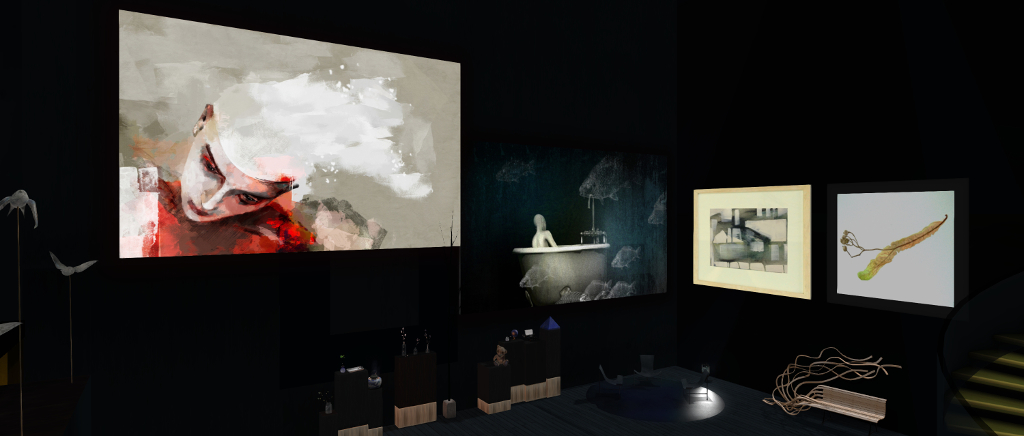
More recently, the rich diversity of artistic opportunities she’s experienced in SL has led Sheba into new avenues of expression, notably in-world photography and 3D art and sculpture. Simply Spiritual also presents some of the fruits of these broader endeavours, with a number of Sheba’s paintings, photographs and 3D art also on display within the gallery space.

InterstallART: Simply Spiritual

An engaging visit, Simply Spiritual will run through until the end of August, 2018.

SLurl Details

Meditations on a Black Kite in Second Life

Black Kite; Inara Pey, August 2018, on FlickrBlack Kite – click any image for full size

In writing about the closure of Namaste and Kamigama recently (see here for more), I made mention of the fact that with all the “new” regions and ever-changing region designs in Second Life, it is sometimes easy to forget the more long-lived locations in-world that are open to public visit.

Those comments put me in mind of a region I first visited nigh-on six years ago, and to which I haven’t written about in the last four. So, I decided to heed my own suggestion and hop over to it and spend a little time there.

Black Kite; Inara Pey, August 2018, on FlickrBlack Kite

Black Kite is the home of Cloudy (Theblackcloud Oh), and it has been open to the public for as long as I can remember it being in Second Life. Over the years it has undergone changes here and there, but by-and-large it has always remained a tranquil, water-focused setting, and this remains true today.

This is a place where azure waters gently flow under a matching sky broken by lazily drifting clouds of white. The ankle-deep water is dotted with wooden decks and board walks, some connected one to another, others sitting as isolated islands to be reached by gentle wading, short steps offering a way up onto them.

Black Kite; Inara Pey, August 2018, on FlickrBlack Kite

The decks are home to assorted points of interest – a couple are the location of the 8f8 store, another offers the chance to rest alongside the Moon, a third features a little open-air café (one of the elements of Black Kite that tends to remain as other elements come and go), while others offer places to simply sit and while away the time.

Watching over this is the region’s signature kite, caught on a mystical wind and aided in its oversight by the strange bobble-topped trees that rise from the waters alongside platforms and around the landing point. Throughout all of this are invitations to throw aside worries and care and just be: “Do what you want”, Celebrate”, “Nothing really matters”, “Dream” … Even “Go fly a kite”, painted on the water beneath the floating kite, reads more as an invitation than it’s more usual sentiment.

Black Kite; Inara Pey, August 2018, on FlickrBlack Kite

For those who have previously visited, the 8f8 store, the kite, the trees, the café and the water tower will all be reminders of Black Kite’s endurance in Second Life. So to are the bottles and jars scattered around, offering those who want to meditate in peace and quiet – and behind glass – the ability to do so. But so too are the subtle changes to be found on repeat visits spaced a little time apart from one another.

In my case, and on this trip, these changes took the form of a tower of shipping containers I can’t recall having seen before, and the arrival of assorted “cuteness” around the region – the “ice cream bunnies” at the café, for example, or the plushie birds. Small changes, perhaps, but enough to keep the camera and eyes roving, and the feet wandering through the region to discover what else might be.

Black Kite; Inara Pey, August 2018, on FlickrBlack Kite

Cloudy does still keep a private residence in the north-east corner of the region, and this is barred to public entry – but the rest of the region remains as open and as free to wander as ever. In fact, one of the joys of Black Kite always has been the fact it is uncluttered. Board walk, decks, platforms – all are scattered across the region with sufficient water between them as to engender among those using them a sense of being apart from others, free to relax in your own little space on one of the decks even when others may be a-visiting or enjoying a break for themselves.

Given that so many places occupying private islands come and go with (sometimes alarming) frequency, that Black Kite remains in-world, open to the public and asking so little in return, for more than six years now, having originally been claimed in March 2012, and remains under its original “ownership” is pretty remarkable. As such, I’m glad I’ve made the time to not only revisit for the first time in several years, but also to write about it once more.  And as with my two previous posts, I’ll again suggest that if you’ve never visited Black Kite before, and wish to see somewhere just that little bit different, you jump over and take a look for yourselves.

Black Kite; Inara Pey, August 2018, on FlickrBlack Kite

SLurl Details

Black Kite (Black Kite, rated: Moderate)
Carolyn Phoenix at Club LA and Gallery

Club LA and Gallery: Carolyn Phoenix

“There’s a crack in everything. That’s how the light gets in” are the words printed on the invitation to see an exhibition of photographic art by Carolyn Phoenix that recently opened at the Club LA and Gallery, curated by Fuyuko ‘冬子’ Amano (Wintergeist). Whether this is the title of the exhibition or a byline for it, I’m unsure. But I can say that the pieces on offer are hauntingly beautiful in their composition and presentation.

The mezzanine level of the gallery, where the exhibition is being hosted, has been converted into a dark, enclosed space in keeping with the title / byline. On display within it are 20 images by Carolyn, sharing the space with torso mannequins equipped with angel wings that add to the dream-like feel of the environment.

Club LA and Gallery: Carolyn Phoenix

The images themselves are mostly dark in tone and subject – so much so that specific details can be hard to make out beyond the shard or pools of washes of light each image contains. These bursts and flickers and beams of light reflect the title  / byline: they have seemingly entered the worlds of these pictures through cracks or holes or as a result of sunlight breaking through clouds or a lone bulb hanging from a ceiling or a reflection from somewhere, to revel things that might otherwise remain unseen.

What these casts of light reveal various from image to image.  Some are mindful of dreams or secret thoughts, often dark in tone – the kind of imaginings we’d rather not shed public light upon, but that nevertheless draw us to them. Others are lighter in nature, simply exulting in the play of light and shadow or the beauty of an artist’s expression of their work; there’s even a hint of playfulness about one.

Club LA and Gallery: Carolyn Phoenix

Some of the images seem to call into focus ideas of identity and of judgement. Teller (seen on the left of the banner image for this review) for example, with its reclined figure looking at a list of eyes from eyeless sockets, tends to suggest the idea of how we present ourselves to the world. The eyes, after all, are the windows of the soul; so how better to project who we might want to appear to be than by selecting our eyes, and only revealing what we want to be seen of ourselves? At the same time there is another potential interpretation: if the eyes are the windows into the soul and thus to who we really are, then how better to remove the potential for the light of understanding to penetrate our inner self than by expunging our eyes altogether, lest we be judged for what lies within.

Judgement is a theme brought into focus by a piece called Verdict (on the left of the image directly above these two paragraphs). But Again the meaning seems to be twofold. On the one hand, the tall figures surrounding the smaller one suggest a fear of judgement; of being looked down upon by others. But closer examination of the smaller subject, catsuited and hooded, perhaps suggests something else: a desire to be judged, to be found wanting and perhaps “punished”. Thus the light haloing the scene perhaps reveals kink-edged secret she at the centre of the image would rather remain hidden to all but a few – or even takes a guilty pleasure in having it so revealed…

Club LA and Gallery: Carolyn Phoenix

Nuanced throughout, a captivating display of photographic art well worth visiting. And while doingso, why not avail yourself of the exhibitions by tralala Loordes and Sighvatr (worthaboutapig), both of which can be seen or accessed on the ground floor of the gallery.

SLurl Details

A Concrete Diorama in Second Life

Concrete Diorama – G.B.T.H Project

The G.B.T.H. (Grab By The Horns) Project, curated by Megan Prumier and Marina Münter, and described as being “focused on the extension of creative processes, 3D environments and art related subjects”, opened its August 2018 exhibition at the start of the month.

Concrete Diorama features the work of sculptor Mistero Hifeng, presented in a strange, semi-dark environment where the contrasts of dark  – black and grey – spaces with the bursts of brilliant white within some chambers is as much a part of the exhibition as Mistero’s pieces.

Concrete Diorama – G.B.T.H Project

From the landing point, visitors travel along a semi-dark hallway, lined by port holes lit by spotlights. Each portal looks out over individual scenes of couples caught in acts of tenderness, suggesting a theme of love (and perhaps loss or regret). A second darkened hallway follows, windows on either side looking out onto scenes of figures floating in bubbles. Further along, two large proportioned figures stand beside cracked models of the moon, ramps to either side of them leading up to the first of the white chambers. Here, figures lie in a circle, prostrated under fine mess nettings, all facing a central lone tree.

In further chambers dancers perform ballet as couples lie in shallow troughs in the floor, whilst a grand diorama focused on a piece called Bruciando Ricordi (Burning Memories) awaits in the uppermost chamber of the exhibition space.

It’s a haunting, evocative setting, rich in mood and emotion. The expressions of love and loss, coupled with pleading, desire, and regret are all present throughout – most clearly through the crowning piece that features Bruciando Ricordi, which joined by the likes of La Magia di Quell’incanto (The Magic of That Enchantment) and Su Questo Silenzio…Balla (On This Silence … Dance). But the nuances and measure are broader than may first appear.

Concrete Diorama – G.B.T.H Project

The couples in their troughs beneath a transparent floor, for example, perhaps carry with them the idea of loss through death, and a desire never to be parted. Meanwhile, the figures prostrated around the tree under their fine netting, appear to be in a different kind of mourning. Are they perhaps a reference to the way we humans can be indifferent to the plight of nature at our hands – at least until it is too late, as signified by the denuded and barren tree sitting at the centre of their circle and the apparent focus of their grief? And what of the large women beside their broken moons? Are they attempting to hide their heads in shame, the result of seeing the slender figures before them, and the  knowledge that society encourages us to embrace the slim as figures of beauty and reject the over-sized?

I’ve long appreciated and enjoyed Mistero’s sculptures, but this is perhaps the first time I’ve seen them brought together in a way that suggests a layered, nuanced narrative; one that resides not only in the individual pieces or in the way some have been brought together to form a diorama, but also right throughout the different levels and chambers within the installation as a whole. It’s an approach that, despite some of the darker tones (literal and metaphorical) apparent in the exhibit, is both effective and captivating.

Concrete Diorama – G.B.T.H Project

SLurl Details

A Farewell to a Pandora Box of magical Dreams

Pandora Resort; Inara Pey, October 2017, on FlickrNamaste – click any image for full size

I’ve written about the region designs of Lokhe Angel Verlack (Jackson Verlack) since April 2015, when I first discovered one of his first iterations of Pandora Box of Dreams – the name he has largely used to denote the regions he has designed and run with his SL partner, Miza Cupcake Verlack (Mizaki).

Over the years, these designs have grown in complexity and vision, he and Miza have also moved from the Pandora Box of Dreams approach to design role-play regions inspired by the World of Darkness universe (see here and here) before returning once more to the Pandora Box of Dreams “brand” with region designs that have mixed rental accommodation with stunning places for visit and spend time, such as the former Pandora Resort, and more recently Namaste and Kamigami, both of which I visited in 2017 (see here and here).

Pandora Resort; Inara Pey, October 2017, on FlickrNamaste

Sadly, word came from Miza that Namaste and Kamigami will be closing on August 1st, 2018. In fact, Jackson has already started dismantling Kamigami. What’s more, it’s likely to be the last public region design we might be seeing from Jackson for a while.

The reason for the closure isn’t the hoary old devil of tier per-se – whilst offering rentals for people, Jackson and Miza have largely covered the cost of the region out of their own pocket. Rather, its a lack of footfall through the region. Despite frequent events, the opportunity to enjoy two very well-designed and captivating locales, the region has seen a steady decline in traffic which, sadly, has reached a point where Jackson and Miza feel they’d rather focus on more personal projects and things that give them enjoyment.

Pandora Resort; Inara Pey, October 2017, on FlickrNamaste

In this, they are far from alone: the truth is that such is the vastness of Second life and the constant popping-up of new regions and new places to visit, those places that offer a sense of longevity and comforting familiarity, unless located on the mainland, do become harder and harder to maintain when it comes to drawing a steady flow of traffic. Even with things like tier reduction (and depending on how that is passed on through land companies when it comes to rented regions), a point can so easily be reached  where the effort in trying to maintain that flow and meeting the cost of keeping a region has to be put into perspective and a decision sometimes made.

I admit, I feel a little guilt here; as a Second Life travel blogger, I’m all too keen to hop to the “new” places and write about them, or hop back to those that are given a make-over every few months. It becomes all too easy to forget about those that are there, month-on-month and never overly changing, but offering a consistent beauty for all to enjoy. Perhaps this is something all of us who write about Second Life need to keep in mind, and consider looking back at some of the regions we’ve visited in the previous year that might not have changed in the intervening time, and just dropping a “reminder” note about them for readers who may not have had the chance to visit, or might be unaware of their presence.

Kamigami, Pandora Resort Town; Inara Pey, February 2018, on Flickr Kamigami, Pandora Resort

In the meantime, the gradually disappearing Kamigami notwithstanding, there is still a little time before the region closes on August 1st, 2018, to visit Namaste and say farewell, and perhaps drop a note of thanks via IM or notecard to Lokhe and Miza for sharing their vision with us.

For my part, I hope this is not the last we’ve seen of Lokhe’s designs; he has amazing vision in creating special places, and my thanks to him and Miza for allowing us to share in them.

Pandora Resort; Inara Pey, October 2017, on FlickrNamaste

SLurl Details

Ponto Cabana, Lemon Beach, in Second Life

Ponto Cabana; Inara Pey, July 2018, on FlickrPonto Cabana – click any image for full size

Lemon Beach is a place we’ve frequently visited in Second Life. From at least 2015 through until early 2017, it was held by Silvermoon Fairey under the name It’s A New Dawn (see here and here for more). More recently, it has been held by Iska (sablina), who initially gave it the name La Virevolte (The Twirl), occasioning us to visit on two occasions in the winter of 2017 and the spring of 2018.

Iska, working with working with Chimkama, and Toxx Genest (ToXxicShadow). has now give Lemon Beach a further makeover, and a new name, Ponto Cabana, presenting a reason to make a further visit as July drew to a close.

Ponto Cabana; Inara Pey, July 2018, on FlickrPonto Cabana

In its new guise, the region offers a curious mix of settings. On the one hand, there is a feeling that perhaps this is in part an old Spanish colonial plantation somewhere in the tropics. A grand house sits on the highest point on an island, steps descending down through what might have once been cultivated terraces to where the old road runs past the foot of the hill before snaking its way up to the house. In doing so, the road turns sharply past the single remaining wall of an old chapel. This may have once been a part of the estate, but time has not been kind, the lone wall with its forlorn bell sitting above the sea.

Some of the terraces below the house are still being cultivated, although these now appear to be more for personal use than for growing produce destined for market or export. The rest, sitting before the house and cut by both winding road and grassy footpath, are given over to an informal garden. Meanwhile, the house with its white, adobe-like finish cracked and broken in places and clearly roughly patched in others, has a sense of stately age about it, perhaps just a little at odds with the furnishings within and around it, which suggest the current occupants lean towards a more bohemian lifestyle than one focused on the cultivation of local plants and fruits.

Ponto Cabana; Inara Pey, July 2018, on FlickrPonto Cabana

Across the water, on another rocky-sided island, there is a slightly different look and feel. The structures here are mostly more modern in style – if a lot more run-down than the adobe fronted house. A paved road, leading to and from nowhere, arcs past a large house – or about what’s left of it, given its broken form is now subject to nature’s claim. Across the short sweep of road sits an old swimming pool, a pelican perched on the rusting frame of a diving board perhaps wondering just what happened to the water.

Up on a headland, beyond the ruin of an old fort, sit a raised wooden hut with evidence of some occupancy scattered about it, but on the whole the feeling here is of a place now deserted; or at least in the process of being deserted. A car piled high with luggage sitting incongruously on the road outside of the ruined house as if ready to forever depart, a stubborn donkey standing before it, determined to stare it down. The road itself ends just behind the donkey, a set of steps leading down to another pat of the setting that again has a feeling of age about its occupancy in the form of the ruins of a stone chapel.

Ponto Cabana; Inara Pey, July 2018, on FlickrPonto Cabana

Of grander stature than the lone, bell-carrying wall near the old plantation house, this ruin speaks of a once proud centre of worship with something of a medieval bent in its design. The way to it has long since been flooded, but stepping-stones offer a way across the water to the foot of the steps leading up to its stone flagged floors even as a wooden bridge offers access to the lands around it. Flamingos wade through the water, while humming birds flitter busily around the flowers growing from it and – in another incongruous, but oddly acceptable touch – two little hippos stand knee-deep in the water.

All-in-all, Ponto Cabana is a strange and eclectic mix. However, it is an eclectic mix that works, and works delightfully well. With places to sit and relax – notably around the old plantation house, surrounded by off-sim islands heightening the tropical feel for the setting, and even a couple of off-shore perches to enjoy, Ponto Cabana makes for an ideal and photogenic visit.

Ponto Cabana; Inara Pey, July 2018, on FlickrPonto Cabana

SLurl Details