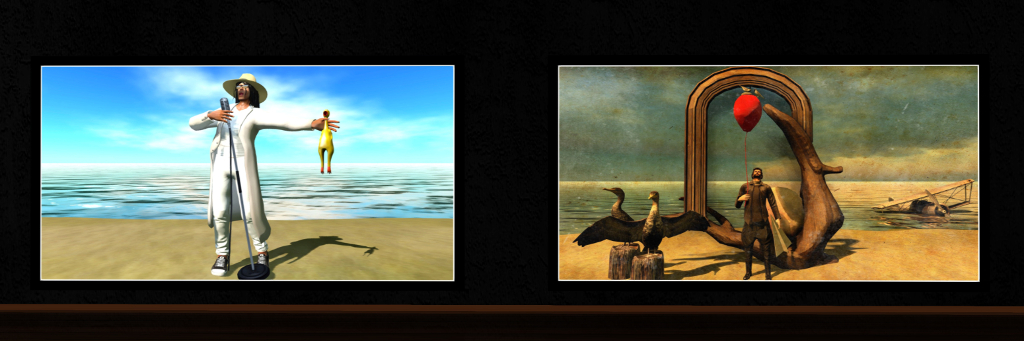
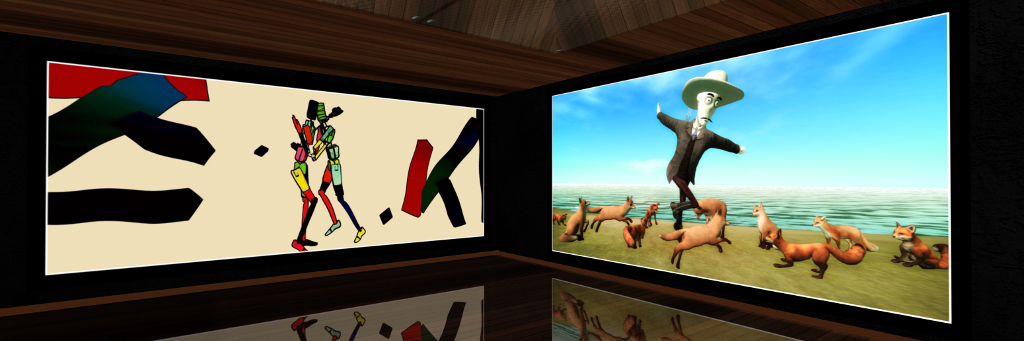
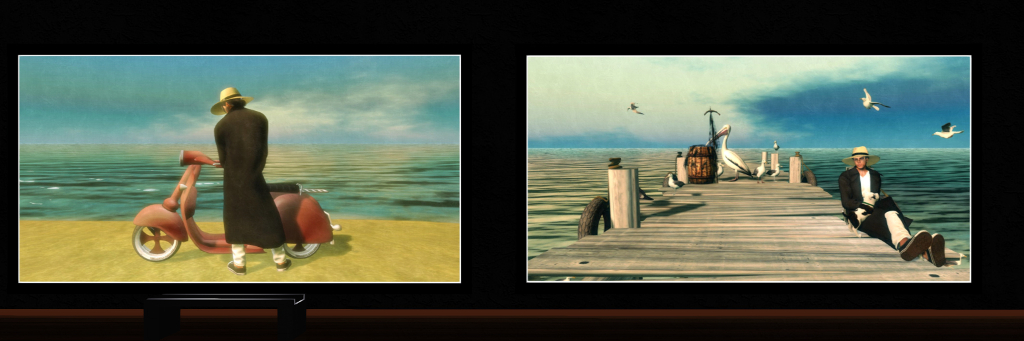
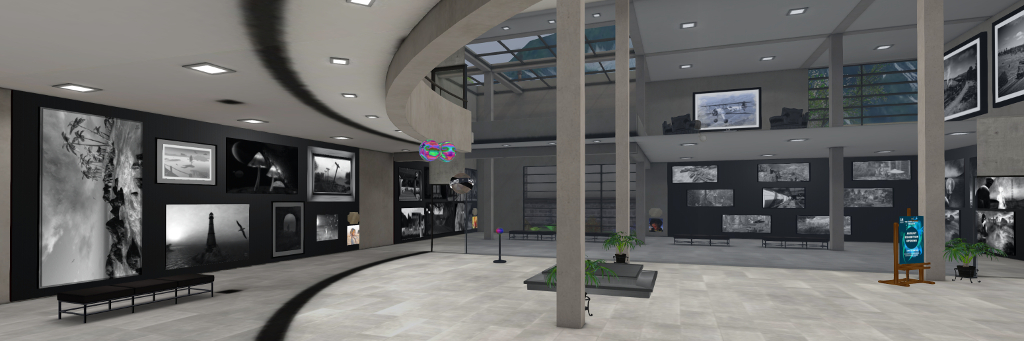
Currently on display at Diotima Art Gallery curated by Redi (Red Bikcin), is Hot Summer, an exhibition of art by Kimeu Korg. As the title suggests, it features images – fifteen in total – depicting summertime scenes; or which are for the most part summertime scenes!
I admit to being something of a fan of Kimeu’s art, as he has a wonderful sense of whimsy and also an eye for creating thought-provoking images that can draw upon the abstract and / or the absurd or comical to pull the observer into them. Some of this talent is on display within the pieces presented here, although most are perhaps more “traditional” in nature – albeit with various motifs that also make Kimeu’s work so attractive.
Diotima Art Gallery – Kimeu Korg
The more comical can be seen in the likes of (13), located on the the right of the entry hall of the gallery. It features Kimeu standing on a beach in white, singing lustfully, a microphone in one hand and a rubber chicken held outstretched in the other, it’s beak agape as if singing in accompaniment. Set against a calm sea and sandy foreground – two of the aforementioned motifs that can be found as a theme to many of the pieces here – it cannot fail to raise a smile.
Whimsy is evident front-and centre in some of these pieces – notably in the likes of (8), found in the far corner (relative to the entrance) of the L-shaped gallery, but also far more gently, such as with (4), which at a first casual glance might appear to be an ordinary image of a man standing on that sandy shoreline and looking out over sunny waters to where Orca-like fins rise above the waves, a dog and puppy – until you take a second look, and realise the “dog” and “puppy” are in fact a seal and her pup.
Diotima Art Gallery – Kimeu Korg
Finished as paintings – both oil and watercolour in looks – and also as coloured drawings, Kimeu’s pictures always have a life of their own that is unique within Second Life, something that also increases the appeal of seeing them exhibited, and this collection is no exception. It will remain open through to the end of Thursday, September 5th, and a visit is strongly recommended.
{PAPPADO}. August 2019 – click on any image for full size
Shawn Shakespeare suggested we drop into {PAPPADO}, a 1/4 Full region parcel offering a waterfront design suggestive of somewhere along one of Europe’s Mediterranean coastlines.
Unlike most 1/4 region parcels, which tend to make up a square within a region, this one looks to be two 1/8th parcels that have been joined end-to-end to present a ribbon-like setting that runs entirely across the north side of the host region, east to west ,that in turn makes for an ideal coastal build.
{PAPPADO}, August 2019
On arrival, I was somewhat put in mind of two places we’ve vitised in the last year in SL – Little Havana, which we dropped into in December 2018, and Keleland, which we last visited a year ago, in August 2018. The resemblance to either is somewhat superficial – {PAPPADO} has a personality all its own – but in the case of Kekeland, it is perhaps understandable given the parcel’s principal designer is Terry Fotherington, who designed Kekeland alongside of Bridget Genna.
The landing point sits at the eastern end of the parcel, on an aged stone terrace bookended by the sea to one side and an old chapel-like building on the other. Both terrace and chapel share their stonework with an arched gateway that backs the terrace, all three suggesting that are all that remains of a large structure that once stood here – although the walls running from either side of the gateway are of a much more recent design, and the gates themselves suggest they are perhaps not the originals.
{PAPPADO}, August 2019
Beyond the gates is an old slipway; what it may have been used for is unclear, but the hulk of an fishing boat lies canted over on the sands close by, and another, seaworthy trawler sits just off-shore – the first hints that this is as much a working destination s vacation spot.
Running westwards away from the landing point is the broad ruler of a road sitting between sandy beach and seafront properties that would appear to cater to those on vacation – there’s a motel, a cinema, a little ice cream parlour and a cake shop. Arches and alleyway provide access to a cobbled street paralleling the beach-front road and which offers a mix of possible residential houses and smaller commercial units.
{PAPPADO}, August 2019
Mid-way down the road sits a further set of arched gates that slice across it and standing in defiance of any four-wheeled motor vehicles that might happen down the street. While the road does continue beyond the wrought-iron gates, the surroundings take on a far more businesslike look. The beach is replaced by wharves, the sand by rocks and shingle. Signs indicate this is a place were fishing is the order of the day – although given the rocks in the sea, I would not like to try to bring a fishing boat alongside the wharves!
The buildings here also appear a lot more careworn than those to the east, again perhaps an indication that enticing tourists or holidaymakers is not their primary goal. Beyond them, where the road meets its end, a path and little bridge cross a busy brook to provide access to another small beach area backed by a modern-style house (apparently open to the public), offering little spots on the sand for folks to enjoy at this end of the parcel.
{PAPPADO}, August 2019
Quite where in the world this might be is anyone’s guess. The gay colours of the buildings at the eastern end of the setting put one in mind of places like Havana, but the preponderance of Vespa scooters suggest somewhere on the Italian coast. However, and wherever you chose to see it, {PAPPADO} offers a pleasing diversion (although one or two of the props could perhaps benefit from some adjustment – a corner café has a few floating chairs, as does the beach!).
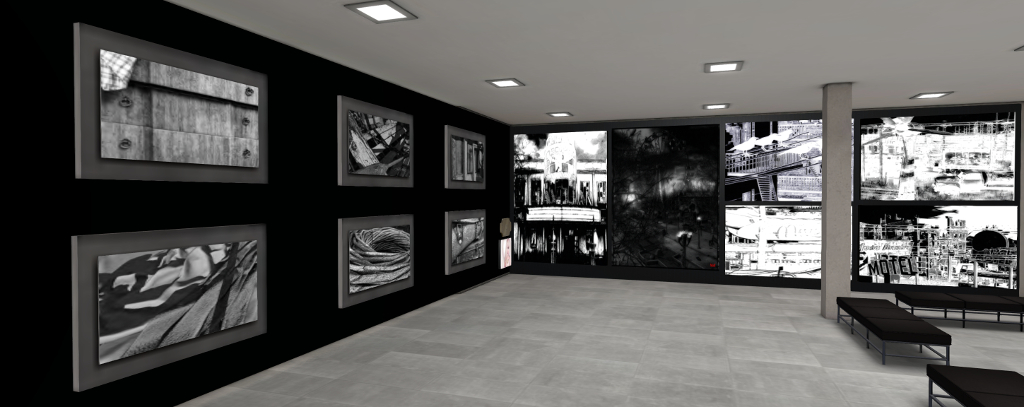
Now open at Kultivate Magazine’s The Edge Gallery is the August-September exhibition of black-and-white / monochrome art and photography.
The featured artists for the exhibition are Tatjab, MTH63, Wintergeist, Chic Aeon, Belua Broadfoot, Illrya Chardin, Sophie Congrego, Roxaane Fyanucci, Euridice Qork, and someone called Inara Pey, who is really just along for the ride. The artists offer a rich mix of portraiture and landscape images in their selections, as well as a mix of styles that make for an engaging exhibition.
Kultivate The Edge, August 2019 – Tatjab
While the range of images is both deep and broad, I admit to finding myself repeatedly gravitating towards two of the artists in particular. The first is Tatjab – also known as tattoo artist (hence his SL and Twitter handle of “Tatjab”), painter, and pencil portrait artist, Jesse Boren. Located on the upper mezzanine level of the gallery and facing the entrance, he presents fourteen pencil portraits taken from the physical world that are utterly stunning.
Ranging from fantasy pieces (such as portraits of Cthulhu) through personal pieces (Blaze, Leland and Pam’s Grandpa, for example) to those of famous individuals such as Barrack Obama, Sir Anthony Hopkins (as Hannibal Lecter) and Clint Eastwood (as Josey Wales), these are truly marvellous pieces, one and all; the manner in which the very essence and life force of Hopkins, Eastwood (a picture I could barely take my eyes off of!) and guitarist Justin Furstienfled has been captured is just amazing – as is true of all the other pieces Tatjab offers here.
The Edge, August 2019 – Euridice Qork
Just to the left of Tatjab’s area in the gallery are nine pieces by Euridice Qork. All are avatar portraits and studies, but again I found myself repeatedly drawn to them because each and every one is powerfully evocative in its own very individual way. Within them all, one can find a sense of the subject’s self or can feel an emotional response or been drawn to thinking about a certain era – or perhaps all three, and more.
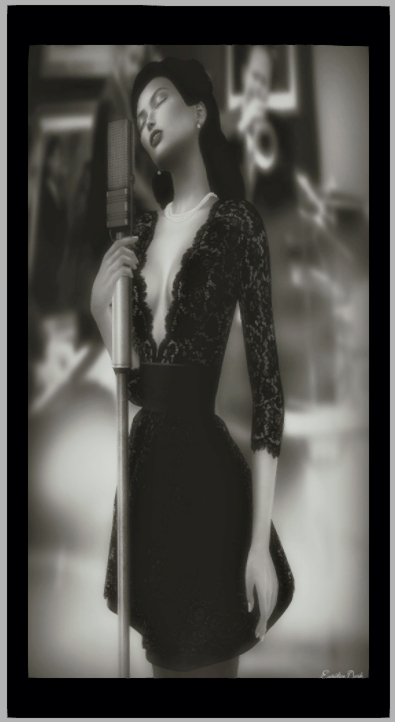
Take, for example the rightmost image of the woman at the microphone. While her style of dress might be a little more risqué than would likely have been the case at the time, the pose, the soft-focus background, the poise of the fingers of her left hand – all evoke a sense of 1940-1950s America, and a time when both jazz groups and big bands fronted by a vocalist where the means of a Saturday evening’s entertainment. Indeed, each time I look at this particular image, I cannot help but hear the words of Blue Moon, accompanied by a lone trumpet playing in the background.
Two other artists exhibiting here to and to whom I was drawn are Chic Aeon and MTH63 each of whom can be found on the lower floor of the gallery.
Chic opts for a series of close-up images of items in-world. In this, I found the images to carry an echo of a technique that has become a signature of Melusina Parkin, and which I find particularly engaging: close-ups that suggest they are part of a large scene or story. In their presentation, be they focused on suitcases stacked one upon another or an oar in an aged and damaged rowing boat or the partially open drawers of a dresser, they drawer us to them, encouraging us into them in an attempt to peek beyond their borders, so to speak, and discern the wider story that may be just out of sight.
MTH63 offers a series of images of locations within Second Life, but rather than present them as “simple” monochrome pieces, he offers all but one of them as “negatives”, or perhaps reverse processed images (as used in the motion picture industry). Thus we’re presented with five unique views of settings within Second Life, with the one “positive” image sitting within them as the focal “glue” to MTH63’s “album”.
Kultivate The Edge, August 2019 – Chic Aeon (l) and MTH63
Truth be told, all of the artists featured in this exhibition offer a unique perspective on SL photography, be their work focused on avatars or landscapes or a mix of the two. The only potential exception is yours truly – and I say this not out of any sense of false modesty or to seek praise, but simply because I do not consider myself an artist. My images are purely intended for illustrative purposes within this blog; they are not posed, nor do they share depth of creative nuance evident in the other images, be it with framing, lighting, post-processing, and so on. As such, I count myself fortunate to be included in an exhibition where there are some genuinely breath-taking pieces.
Broken, August 2019 – click on any image to enlarge
We first visited Broken, the homestead region designed and held by Natalia Corvale, at the start of 2019. At that time, it offered a winter’s setting: a place lightly dusted in snow (see The beauty of Broken in Second Life for more). Now, eight months later, things have moved on and in keeping with the northern hemisphere seasons, Broken presents a landscape caught in the bloom of summer and caught under twilight’s full gleaming.
The land lies split into a number of islands, some connected by bridges, others perhaps best visited by the little swan boats that can be found a short walk to the north from the landing point. The latter sits within the largest island in the group, a low-lying, grassy location marked by the presence of a barn and several horses that stand idly around.
Broken, August 2019
Examination of the horses will reveal they are in fact Water Horse Animesh animals available for visitors to ride; just click a horse to mount it (you’ll be offered a riding HUD – not a vital requirement – and removable stirrups). Use the Arrow or WASD keys for movement, with a double tap of W or Up to cycle through the walk, trot, canter and gallop options (and a quick tap on the D or Down arrow to cycle back down).
The HUD, for those who want to try it offers an option to dismount and lead the horse around, whilst standing from it de-rez the horse – don’t forget to remove the stirrups from your feet! (you can also find out more about the horses in my review The Animesh Water Horse in Second Life). I should also note using the horses can make it easier to cross to those islands in the group that are not linked by bridges to their neighbours.
Broken, August 2019
When writing about Broken in January, I noted that the region has the feel of being a personal design for Natalia. This still feels the case now; the dedication offered in the About Land description – “for anyone who’s ever lost someone” – remains the same, and it continues to resonate with aspects of Natalia’s profile information. Further the very setting, with the twilight sky under its painter’s clouds, invites a mood of remembrance and / or contemplation.
Also as I noted in January, “lost” doesn’t necessarily refer to having suffered the passing of someone close. Rather, it encompasses the separation born of a relationship – be it as lovers or friends – that has run its course and which now lies behind us. Thus Broken perhaps offers a place where memories can be recalled, although this doesn’t necessarily make it a place purely for the melancholy of heart. Far from it; there are plenty of places where couples can spend time to be found scattered across the island, both indoors and out.
Broken, August 2019
These, and the very nature and placement of the islands one to the next, mean Broken ripe for exploration and photography. Some of the locations to be enjoyed are easy to find – such as the Hideaway cabin tucked away to the south and west of the region and that offers a cosy little place to share and o perhaps ruminate. Others are a little harder to find, and often pop out at you unexpectedly, presenting a smile of delight on being discovered.
Large among the latter is the hilltop open-air theatre; more subtle are the swings beneath stout boughs or the raft floating quietly in the shadow of shoreline bushes. Travel east and you might unexpectedly come across a little fish’n’chips bar; go north beyond the camper trailer visible from the landing point, and over the low hills beyond it, and you’ll come across another cabin, this one squatting above the open sea, its exterior careworn by the elements, its interior a cosy little retreat.
Broken, August 2019
All of this is just scratching the surface of Broken’s delight, much of which extends into the very landscaping of the region, particularly in the use of grasses and flowers across the ground. There is a natural beauty that shines throughout the region from grass to flowers to trees and buildings and individual locations, that make it instantly attractive, and that encourages the visitor to stay.
With thanks to all who suggested a re-visit to Broken: Max, Miro, Morgana and Shawn!
Clifton Forge, August 2019 – click any image for full size
Clifton Forge is a half Full region offering “modern supernatural para role-playing,” featuring humans, witches, vampires, and werewolves.
Supported by its own website, the setting is distinctly urban, representing a small city nestled within a mountain environment. It is intended to offer a place where, “blissful everyday living masks a darker and more turbulent truth”, the website setting-up a place where normalcy forms a blanket over a range of strange activities which those interested in role-playing within the environment can then take-up:
All manner of depravity conceals itself behind a flawless veneer here; the Hotel’s façade is cracked by stories of staff suicides, the Church here asks for alms – but whether it intends to divert these funds to charitable causes or fill its own coffers is unknown. A harried city cop turns Sheriff in what some might see as a peaceful retirement plan, while others wonder why she has escaped to a more pastoral clime. Everyone has a secret – what is yours?
Clifton Forge, August 2019
Like many RP environments in Second Life, the official landing point sits in the sky over the parcel in the sumptuous setting of a grand hall. Here visitors can contact the Clifton Forge administrators, and follow browser links to the RP back-story, rules and apply to join the group to participate in local role-play. Those arriving at the landing point will also be asked to join the local Out Of Character (OCC) group prior to making a visit down to the city proper. The group is free to join and helps mark visitors as non-playing characters during a visit, and you can always leave it following a visit if you have no interest in remaining a member.
Taking the main teleport to group level will deliver visitors to the east side of the parcel, and a further teleport board ready to take people onwards to some of the principal points of interest in the city which might conceivably be leaping-off points for role-play opportunities. These include some typical locations for any city setting: the local church, the hotel, the medical centre, the police station, places to sit and eat or find entertainment, and so on. However, the setting is far better seen by exploring on foot or by using the local bicycles available from the rezzer located close by.
Clifton forge, august 2019
The town is split into two, with the portion that contains the landing point also offering the main square, the city hall, the emergency facilities, various businesses and paths to some of the local residencies (note that some or all of the latter are available for rent, so do be aware of the potential to trespass into someone’s home when exploring). The second of the city’s districts – reached via a single tunnel – is home to the church and the hotel, together with further local businesses, before giving way to a more rural setting, of rocky bluffs and woodlands in which sit shacks and cabins.
Given the city only occupies a half region, attempts have been made to make use of elevation in places – notably the woodland area mentioned above, and with some of the rental properties and the church. This, together with at least one underground parking area both adds literal depth to the setting as well as making role-play more interesting by providing a sense of greater space than had things been kept more-or-less on the one level across the parcel.
Clifton Forge, August 2019
When exploring, notes that there are NPCs dotted around. some of these – such as the bouncer outside of the Castle House – will provide note cards when touched, and these cards contain game play information and local rules (e.g. such as player being frisked and fully disarmed before entering an establishment).
One or two aspects of the setting look like they might still be under development – I noted a couple of floating pieces of vegetation in the sky above the town, and the ground around Castle House looks like it might be awaiting further landscaping. However, the setting is, overall, as it is presented in the description: an urban environment representative of a small city; one that is awaiting a cast of role-players. If you’re into the supernatural and are looking for a role-play environment that offers in in a modern setting, might be interested in taking a look – just note that for the purposes of this article, I did adjust my windlight settings away from the local default.
Vibes Gallery, curated by Eviana Robbiani, is currently home to an untitled exhibition featuring Sunset Theas, Paola Mills, Lyack Glenwalker, Megan Prumier, and Aurora Donner. Given some of the images involve nudity, it should perhaps be considered an exhibition that is NSFW.
Immediately inside the entrance to the gallery is a quartet of images by Sunset Theas that follow a theme of their own, perhaps best described as condensing the seven stages of life into four evocative monochrome images, entitled, Embryonic, Birth, Life and Death. As the titles imply, each captures a moment in time and life.
Vibes Gallery: Sunset Theas
The use of monochrome, soft focus and life and shadow serve to make each of these pieces an intriguing study that fully captures the essence of their titles. Take Embryonic, for example. The use of depth of field and the off-centre capture are so suggestive of an ultrasound scan, with just enough form and substance for us to understand what we are seeing.
And so the images progress: Birth using light and shadow and a huddled form that offers the idea of a babe is dark swaddling; Life offers a image of the full vitality of a person in their prime, the use of a mask preventing us from being drawn into studying the model, but considering that broader idea of life. Then depth, with it simple setting, soft focus and back view of a naked body without adornment of clothing or within the setting is simply glorious – if such a term can be used – in its presentation of the body’s emptiness in death.
Vibes Gallery: Megan Prumier
At the far end of the gallery space are four images by Megan Prumier that again offer a theme; this one using reflections in the form of overlaid images of the female body. Each displays a considered use of technique that makes the nudity within the images secondary to their narrative. Take Warm Shivers, for example; the marvellous placement of the image, one copy superimposed over the other wonderfully suggests both someone feeling the cold in their nudity whilst at the same time presenting the idea of receiving warm comfort from someone close.
Between these two groups lie another set of four images by Paola Mills, and two pairs of images by Lyack Glenwalker and Aurora Donner. I admit to being unfamiliar with the latter two, but again, on the strength of the two images presented here, Lyack has a talent for producing images rich in narrative. Certainly, his images reflect the stories inherent in the four pieces offered by Paola, while Aurora’s pair of studies round-out the exhibition nicely.