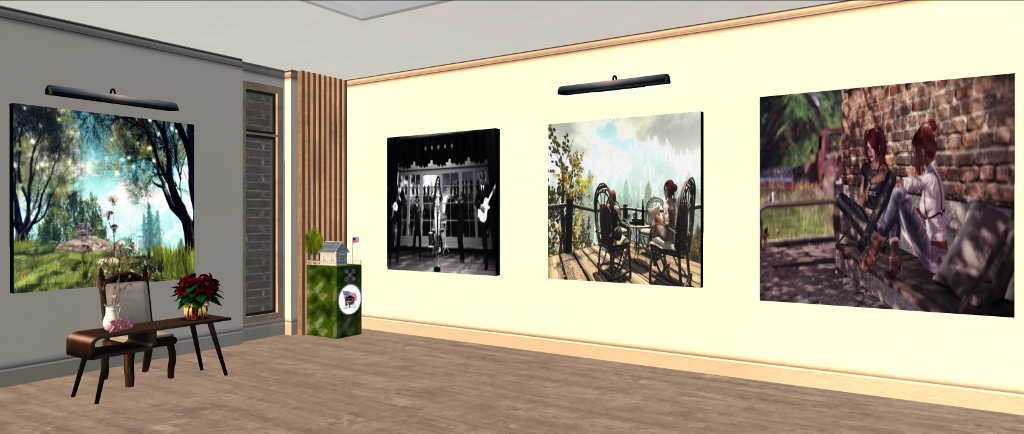
Calling Out For You is the title of Edie Horngold’s exhibition at DiXmiX gallery. Located on the gallery’s White hall mezzanine and running through until early February 2020, this is an intriguing series of avatar studies, each of which is intended to frame a story, rather than representing an avatar through portrait or action.
Quite what the story might be is entirely down to those who visit – hence the title for the exhibition – as each image in this selection is highly personal in interpretation. All but one of the images deliberately avoid including the full face of their subject (Edie herself), a move that helps to settle those viewing them into a wider consideration of the narrative framed within each image, rather than being focused purely on looks and expression.
A further aspect to the story elements of the pieces comes through the use of colour, with most of the pieces offered as monochrome pieces. Where colour is used, it is generally not only minimalised, it is often offered through softer tones, allowing it to form a part of the overall narrative without distracting from it by causing the eye to unduly focus on individual parts of the image.
DiXmiX Gallery: Edie Horngold
Take Hisssteria, for example. Here the broader monochrome aspect of the piece is “broken” through the reflective sheen afforded the leather suit, while the use of a flesh tone of the arm blends, rather than clashes, with the more alabaster tone to the exposed flesh elsewhere whilst also offering a suggestion of sinuosity in keeping with with the snake (also offered in softer tones), thus helping the eye and mind to focus more on the relationship between figure and reptile.
A contrast to this approach is Hand With Cigarette. Here the use of colour is richer – the green of the dress deliberately contrasting with the paler flesh and the black background. This helps draw the eye to the red nails, the tempting partial exposure of nipples and the languid hand with the cigarette between relaxed fingers. All combine to imply seduction, the dress and poised hand at the side enhancing the potential for story through the suggestion of a femme fatale.
DiXmiX Gallery: Edie Horngold
It is these hints and echoes that make many of the pieces so intriguing. They draw one into each picture, teasing the imagination, presenting both evocative and provocative lines of narrative; mysteries, if you will, in which the solution is unique to each of us.
Substance abuse – be it “hard” or “soft” drugs, misuse of prescription drugs or over-indulgence in alcohol, to name but some of its forms – can be a difficult subject to represent. It can come about due to a variety of means and reasons, often with the person or persons caught in the cycle either trying to hide their dependency or deny it. Circumstance often plays a role in misuse, and that circumstance can vary widely.
With her latest installation, Carla, Walk in the Darkness, Terrygold attempts to weave a story of how substance abuse can grow out of the simplest of situations: peer pressure coupled with parental pressure.
Terrygold – Carla: Walk in the Darkness
Though a series of written chapters presented in text, interlinked by a series of 3D vignettes and photographs, the installation traces the story of Carla, a young teenage girl who is apparently content with her lot: school and studying to be a dancer – until she runs into some of her peers into smoking some cannabis.
From this seemingly innocent start, Carla’s life spirals – kicking back and just enjoying the heightened mood associated with cannabis, then skipping dance lessons and rebelling against her family’s concern / pressure that gives her a need to seek “freedom”, which itself is a further opening of the Pandora’s box of needing to recapture the comfort and escape of that first high through every more damaging ways – damaging to both herself and members of her family.
The story is set out in a series of descending rooms, starting from the uppermost, where a general introduction to the installation can be found, together with information on how best to view the installation. Spiralling downwards, each room offers a piece of the story, the physical descent from room to room clearly a metaphor for the descent into the darkness of substance abuse / dependency. Following the path down can be a little difficult in places, – so just cam around if you feel your are stuck; there are clues in places – green triangles on the floor or roses spread across them.
It is ultimately a dark tale that does not end happily – as one might expect – and the ending is made that much starker because after it, we get to see what might have happened if, instead of succumbing to a need to be accepted by peers, Carla had uttered a simple word.
Overall, the story is well told; the words of the story have in places obviously been carefully chosen to have maximum impact, and the individual vignettes (some of which may have interactive elements, so be sure to mouse around them rather than simply passing through) emphasise the key points of the tale. That said, there is a risk some might find the story a little too artificial in structure (long has been the debate around whether medicinal use of some drugs can lead to a need / dependency on them or carry a person into the realm “hard” drug abuse). However, as I’ve noted, this isn’t a subject that is easy to represent or broach; as such some license in the structure and outcome should be allowed.
Terrygold – Carla: Walk in the Darkness
Carla: Walk in the Darkness officially opens at 13:00 SLT on Saturday, January 4th, 2020.
Aradia’s Winter, January 2020 – click any image for full size
Update, January 12th: Aradia has now been re-dressed for spring.
Aradia is a Homestead region designed by LadyOnia that offers a mix of public spaces and rentals for those seeking a home. We first visited in November 2019, not long after the the region had opened, and when it was dressed for autumn. I jumped back with the start of the new year to take a look at it under winter’s blanket.
The landing point sits to the west of the region, above a broad spread of beach – although given the snow and the winds, it might take a very brave soul to take a dip in the waters or attempt any sunbathing on the sands! The rest of this predominantly low-lying region spreads out eastwards, cut by channels of water that serve to break it up such that exploration is a case of findings ways across the water (and even then, once or twice a little wading might be required!).
Aradia’s Winter, January 2020
I say “predominantly low-lying”, because the north-eastern corner of the region is raised slightly above the rest to form a circular table of land on which the rental properties are located. This looks across the region to where the land unmistakable bulks up in a rocky hill to the south-west.
The rentals are clearly separated from the “public” parts of the region, with just a single point of access by foot to their round plateau. Five cottages and a lighthouse form a ring around the outer extent of their rocky table, the centre of which forms an open space marked by ancient stonework built around a water feature.
Aradia’s Winter, January 2020
Rental information on the properties is available at the information board located on the steps that form the access point for the rentals, spaning the channel separating them from the rest of the region. However, I understand from LadyOnia that she is currently using two of the properties, leaving just four with rental options. Wildlife is very much a feature of the region: herons and egrets keep an eye on the waterways, doubtless watching for unwary fish, although they may face some competition for fishy meals from the otters floating on the water or playing nearby.
Away from the waters, peacocks strut around the territories they’ve claimed for themselves, while rabbits and deer take a more relaxed view of things, content to hop through the snow or graze on the grasses poking up through its blanket. Weasels are also to be found as they scurry through the snow, while sheep and goats can be found at various points, with the sheep laying claim to the ring of standing stones to the north-west.
Aradia’s Winter, January 2020
For those fancying a bit of a climb, the south-eastern hill can be reached via log bridges and a rocky arch, the climb made easier by the stone steps winding up its flanks. The hill’s lower shoulder is broad enough to be home to a large frozen pond, a little café raised to one side of it. The latter offers a place to sit and rest and perhaps enjoy a hot cocoa before carrying on up to the peak, while a sign at the edge of the pond will deliver skates for anyone wanting to make use of the ice as a rink.
The central and eastern lowlands offer open spaces and various features of their own – some of which may be changing a the next few weeks as they are decidedly Christmas oriented, and LadyOnia noted to me that she’s looking to introduce a spring setting to the region in the not-too-distant future. Much of these lower areas are marked by trees with trunks bent so they stand as if crouched against an unrelenting wind. Places to sit and cuddle can be found under some of them, with more places of to to be found scattered around, from simple benches to a giant stone-carved hand to winter’s crescent Moon swing.
Aradia’s Winter, January 2020
One of the pleasing aspects of this region – for me, at least – is that the volume of snow didn’t impact my system’s performance as much as it has elsewhere. However, it does combine well with the region’s windlight to add a natural softening to the landscape as one looks across the region, just as now does in the natural world.
Currently open – for a while longer at least, given it commenced at the end of October 2019! – at La Galerie D’angle, curated by Mary Zimmer, is an exhibition by JanitaEduarda Arado.
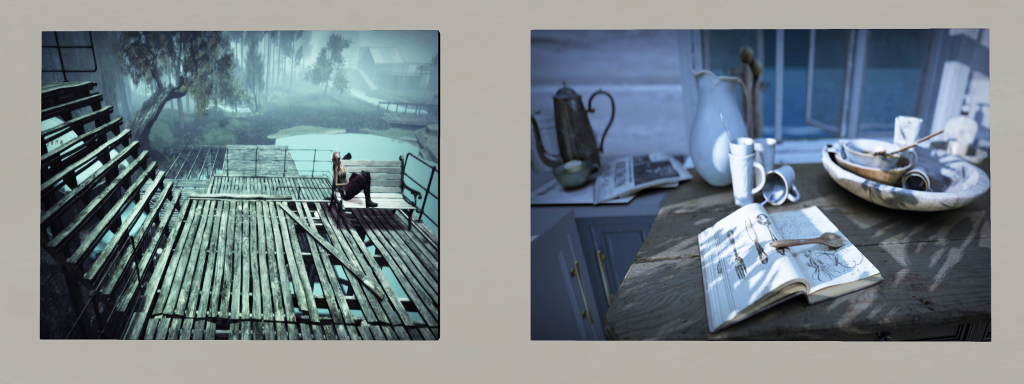
I confess that I’m not aware of being that familiar with JanitaEduarda’s work, but will say that this exhibition is a superb introduction. Comprising some 40 images, the pieces presented in it cover landscape, avatar and self-studies that are diverse and eye-catching. Throughout all of them as a rich understanding of colour, tone, depth of field / focus and – as is always important for me – narrative.
La Galerie D’angle: JanitaEduarda Arado
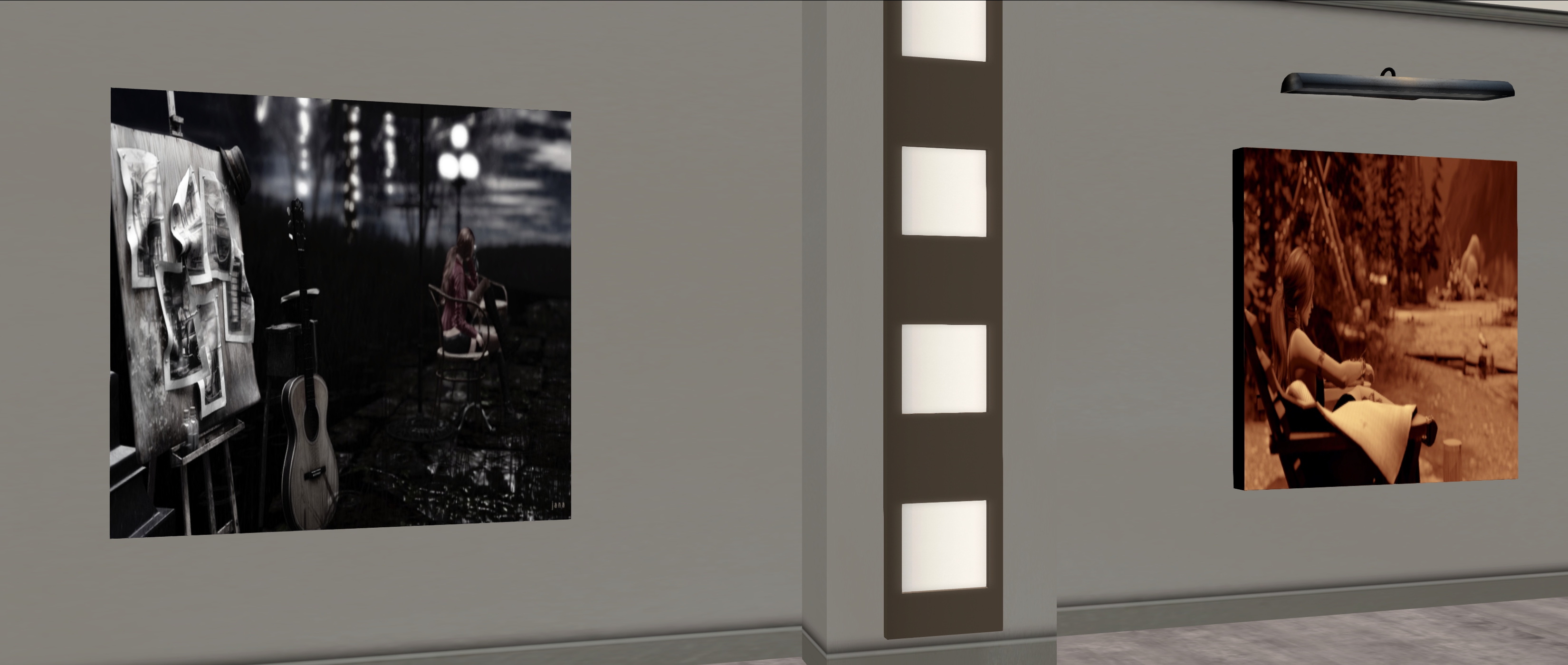
The latter are particularly strong in the self-studies spaced throughout the exhibition, where the suggestion of a broader story – or a layering of stories is offered. Take When the Last Sound has Faded, for example. This predominantly monochrome piece has several tales to tell, from a suggestion of a love of music, through the emotional power of music to the tale of a love now past and the loneliness / regret that follows – or, conversely, in the peace and solitude that a release from a relationship brings.
Sometimes the stories are more indirect. Take Stillness of the Mind. Here the idea of piece may initially be suggested through the use of soft focus that rendered the figure in the background as blurred, suggestive of someone lost in thought. However, the same depth of field brings the milk urn on the kitchen table into sharp focus, and with it the idea of liquid at rest, undisturbed, still – and so we have a metaphor for a mind at rest.
La Galerie D’angle: JanitaEduarda Arado
Once again, this is a superb exhibition for this gallery, featuring an artist whose pieces invite the imagination to take flight. Not to be missed before it closes.
Catena et Cavea, January 2020 – click any image for full size
Catena et Cavea (literally “chain and coop”, but better translated as “chain and cage”), is a Full region utilising the additional 10K land capacity to present a setting of multiple elements, some of which may not suit all tastes given their adult leanings. Held by Ororeia, who designed it with Kyra Nachtigal, the region is described by them both as:
Our home, and at the same time a big playground for everyone. It’s adult, so please no under-age avatars … Feel free to explore everywhere, but please be respectful if we are at home. If a door opens on touch, you are welcome to enter.
Catena et Cavea, January 2020
In this instance, “adult” refers to BDSM activities (as some may well guess from the English version of the region’s name). However, the greater portion of this aspect to the region is located underground, and so while there are more visible elements scattered around, they do not interfere with more general exploration / photography. In fact, I’d say viewer / system performance might be a greater cause of issues than anything BDSM related: this is a region with so much packed into it I had to disable shadows, drop draw distance, etc., in order to be able to move comfortably, my viewer was working so hard.
The best way to describe Catena et Cavea’s layout is to note it can be split into some readily-identifiable areas. The south-east corner, for example, comprises a coastal fun fair with some of the rides in a warehouse. Bounded to the east be a ribbon of sand and on the west by a small, rectangular harbour, it almost forms a little headland raised above the sea.
Catena et Cavea, January 2020
A paved road / path runs up towards the beach from the harbour, separating a second warehouse from the rest of the fun fair. The road forms the landing point for the region (where an information board is available for those wishing to learn more about it – just click for a note card), while the second warehouse has been been converted into a beach house.
North of here sits a terraced vineyard stepping its way up to a shoulder of the island’s rugged centre. Topped by a cemetery and a summer house and garden space. North of this, the land slopes gently back down towards the coast and a circle of standing stones watched over by further ruins inland. A slender finger of rock also extends outwards from the high parts of the region, pointing out to the north-east and distinguished by a rocky arch under which the beach passes, while the flat top of the rock has been pierced by the tip of a giant sword that stands over the arch as if guarding it.
Catena et Cavea, January 2020
The sword is one of several artistic statements scattered throughout the region. These include the sculpture of a giant hand sitting close to the sword, and which converted into a seat, and smaller statues marking the footpaths running around the west side of the island.
This side of the region takes the form of an almost region-long plateau running south-to-north, home to a large house that may be a private residence when Ororeia and Kyra are present, so again some caution in exploring might be advised when approaching it. The house shares the space with a summer house at the southern end of the plateau and a large circular arboretum, which together with the gardens and paths, appear to be open to the public.
Catena et Cavea, January 2020
More houses sit below the plateau to the south. These do not appear to be rentals, but rather available to those wishing to have a little indoor privacy. However, I’m not entirely sure on this, so they are perhaps approached with caution out of respect to how they are being used, if occupied. They are connected to the plateau by a set of steel stairways that ascend the cliffs, passing the entrance to a bar cut back into the upper reach of the cliffs as they do so. This is very much more BDSM-oriented than the visible spaces on the region, and forms the entrance to underground play areas for those interested.
The north side of the uplands running eastwards from the large house, offer a small bar / play area backed by fenced fields for cattle and sheep. Behind this, the region climbs to a peak and a large pavilion area, the path to which lies on the south side of the island, switch backing its way up from the little residential area or via the shoulder with the cemetery. It’s a path that has a secret of its own – the BDSM tunnels are not the only underground element to the region, as the introductory note card indicates. I’m not going to give the secrets away; suffice it to say not all cliff face rock is necessarily just cliff face rock, and you might need to follow the clues in the introductory note card to find your way to the teleport that accesses the caves.
Catena et Cavea, January 2020
As noted, there is a huge amount going on in the region, rendering wise, and this can really hit performance; with shadows enable I was lucky to get much above 6-8 fps), and even with shadows disabled, there were a number of places in the region were my system was still struggling on single digits. If similarly hit, people might find the region an issue, however, given the photogenic edge to the setting, making allowances for the region’s load might be worthwhile.
Operated by Lee1 Olsen, the Lundy Art Gallery is a must-visit destination for all who appreciate Second Life art, offering as it does a broad cross-section of pieces by 2D and 3D artists.
At the time of my visit, the main hall of the gallery presented something of a historic look at Second Life, featuring artists who have joined the platform relatively recently, and those whose names are very much a part of the SL art landscape, helping as they have to establish and build artistic expression within the platform.
The Lundy Gallery: Barbara Borromeo (back). Mistero Hifeng (right) and Ciottolina Xue (foreground)
Within the hall, and split between the main floor and upper mezzanine, are pieces by Etamae, Eylinea, Gitu Aura, Barbara Borromeo, Rage Darkstone, Kerupa Flow, Mistero Hifeng, Wan Laryukov, JolieElle Parfort), Patrick Moya, Romy, Nayar, Bryn Oh, Vorum Short, Monroe Snook, Theda Tammas, Elle Thorkveld, Talullah Winterwolf, and CioTToLiNa Xue, to name just some of the artists present.
The Lundy Gallery: JolieElle Parfort
Despite the volume of art on display, the gallery structure is large enough and open enough to make any visit and an appreciation of the art a relaxed, easy affair. There is room to move, and space to see individual pieces or groups of pieces without feeling crowded out by the amount of art on offer.
If I’m understanding the posters at the entrance to the gallery, this ensemble exhibition will run through to mid-January before being replaced by the first to open in 2020, making it an ideal New Year visit. In addition to the main hall, the gallery has two smaller halls, each located in the wings to either side and accessible from both the lower and mezzanine levels. At the time of my end-of-2019 visit, these housed exhibitions by Ilyra Chardin and the inimitable Patrick Moya.
The Lundy Gallery: Theda Tammas
A stunning collection with a breadth and depth not often seen in SL.