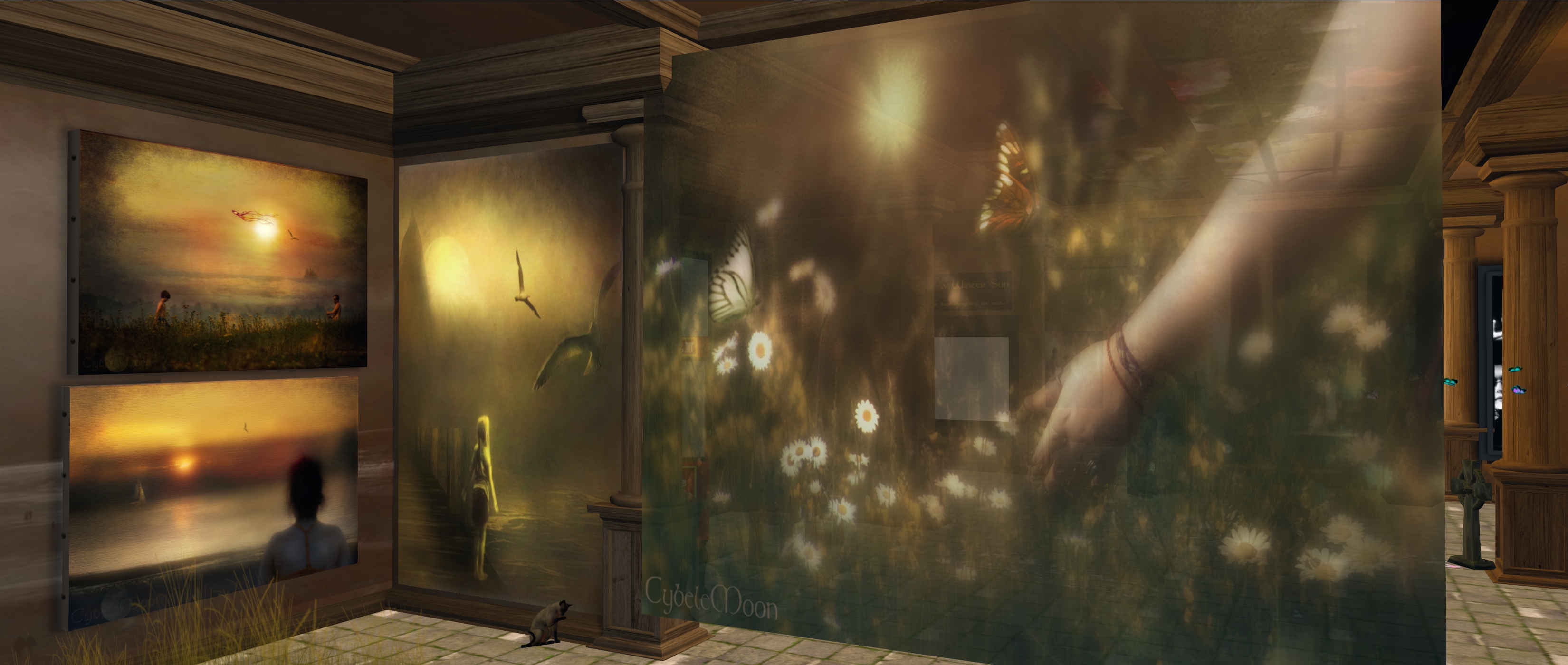
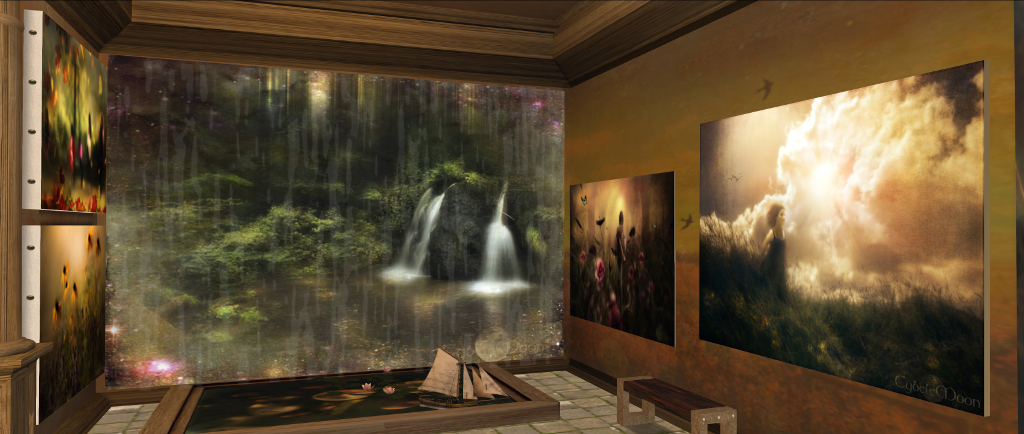
Now open at Savor Serenity is Dark Wood and Other Destinations, an exhibition of CybeleMoon’s always enchanting art. It offers a journey through her world, from woodland to coast, taking us past ethereal settings inhabited by children and creatures.
Cybele’s art ranges from portraits to landscapes, encompassing magical totems, hidden groves, wild glens, fairie circles, haunted woods, lonely shores and gardens of colour, light and shadow. Her palette offers us mixes of digital and real, gently mixed with tales and stories, children at play, picnic teas and enchanted children. All of which are offered within Dark Wood – and more besides.
CybeleMoon: Dark Woods and Other Destinations
Splitting the gallery into three spaces through the considered placement of wall hangings that carry images of their own, Cybele presents us with a gentle tour of her work. Within the centre area we are introduced to her waifs, a wonderful set of largely monochrome portraits of children, together with one of her marvellously layered digital pieces that comes landscape and child’s face to present a haunting story within, and video presentations of her work.
Bordering the central area are images of her woodlands and coastal scenes, her glades and more of her children – the latter often infusing several of her images with a sense of fae magic. For me, one of the attractive aspects of this exhibition is Cybele’s use of 3D elements with two of her pictures; these lead us into the art with which they are placed, making a part of their narrative. In this, it is exceptionally hard not to want to climb the wooden bridge in from of The Winter Path and attempt to follow the trail to see what lies beyond the distant bend that sees it pass behind shadowed trees.
CybeleMoon: Dark Wood and Other Destinations
Similarly, the use of a pool with small boat and lilies sitting upon the water that adjoins The Fairy Glen at Rosemarkie, adds a depth of narrative to the idea of fae folk the art presents, the face below the water suggesting a water nymph at play in the waters spreading outward from the glen and “into” the pool.
Evocative, rich in image, colour, tone and story, Cybele’s art is always a delight, and for those familiar with it or have yet to experience her work, Dark Wood and Other Destinations should not be missed.
Aoshima, February 2020 – click any image for full size
New Eldelyn is a garden world located on the far edge of the Circinus Stream. It is the new homeworld of the Kalimshari, following their exile from their home galaxy to the harrowing horrors of the void.
– from the “WikiDex, the free galactic codex”
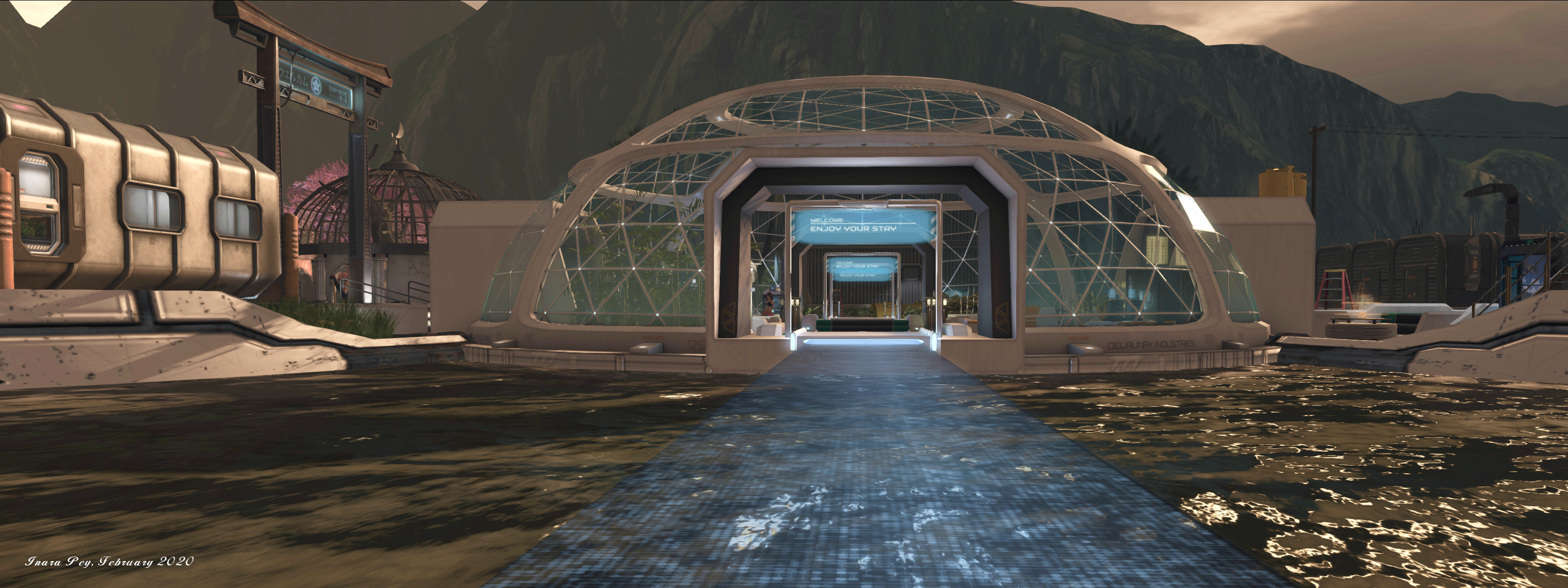
This is the informative greeting given (via a holographic sign board) to arrivals at the landing station at Aoshima, a homestead region designed by Rydia Lacombe that is both a private home and a public space in which visitors are welcome to spend time and explore.
Aoshima, February 2020
It’s a nicely presented setting, carefully considered and with a flow that makes exploration pleasantly relaxing, starting with the feeling of having just landed after a voyage through space. This is achieved by playing the landing point at the foot of the boarding / cargo ramp of a vehicle modelled after the Star Trek Online Delta Class of shuttle (which in turn was derived from the Delta Flyer from Star Trek Voyager). Around the landing pad are all the signs that this is a busy centre of operations: cargo bins and equipment sit to one side of pad, a storage unit on the other, while small drones periodically arrive to collect or deposit more cargo boxes and carry out repairs.
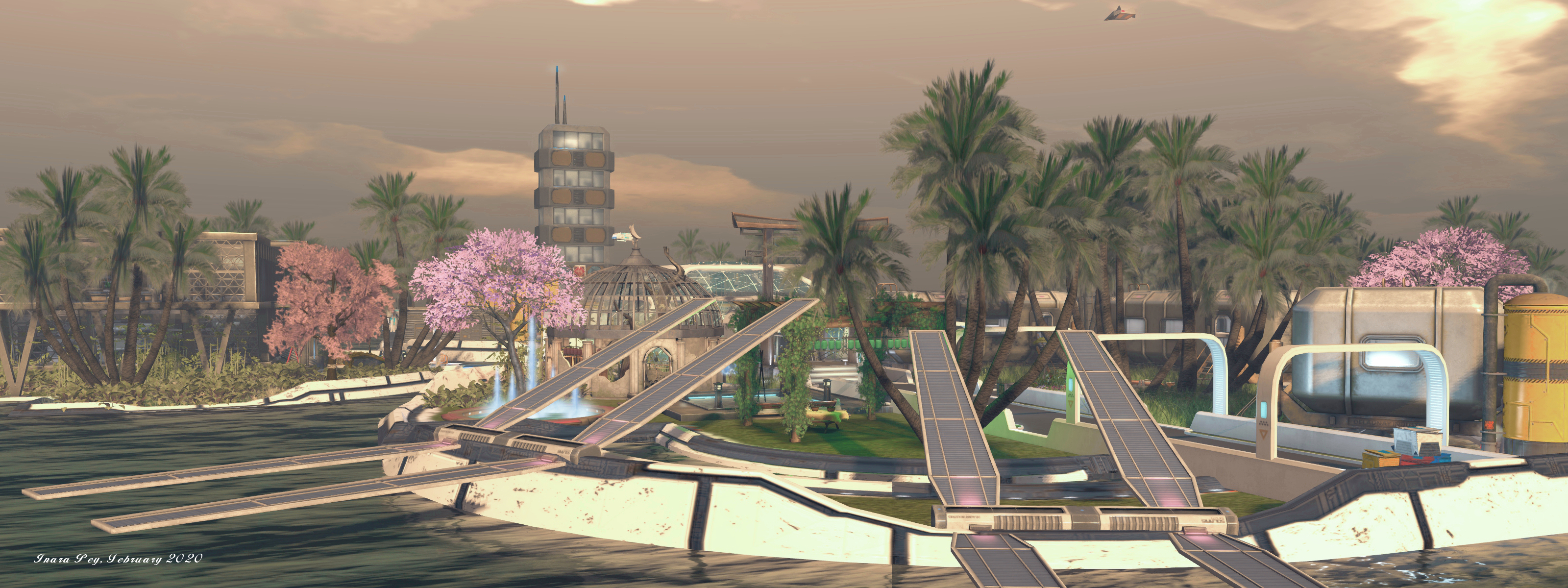
Beyond the landing pad gateway sits a raised walkway offering access to piers extend over the water, ready to receive water craft arriving from the seas that lie beyond the surrounding atoll hills. Beyond the piers, a series of habitat units have been stacked, awaiting occupancy.
Aoshima, February 2020
Like the rest of the station, the landing pay and the habitat modules sit on decks raised above the all-encompassing sea, suggesting that while the station sits within a bay formed by surrounding islands, the land is far too rugged to allow any form of homestead to be established on it. Instead, the rest of the facilities sit on five more such pontoons, three of which are directly connected one to another and linked to the landing pad by a low-slung light bridge – note that if this isn’t apparent, touch the blue pad on the lag of the white gate at the water’s edge and facing the central group of structures.
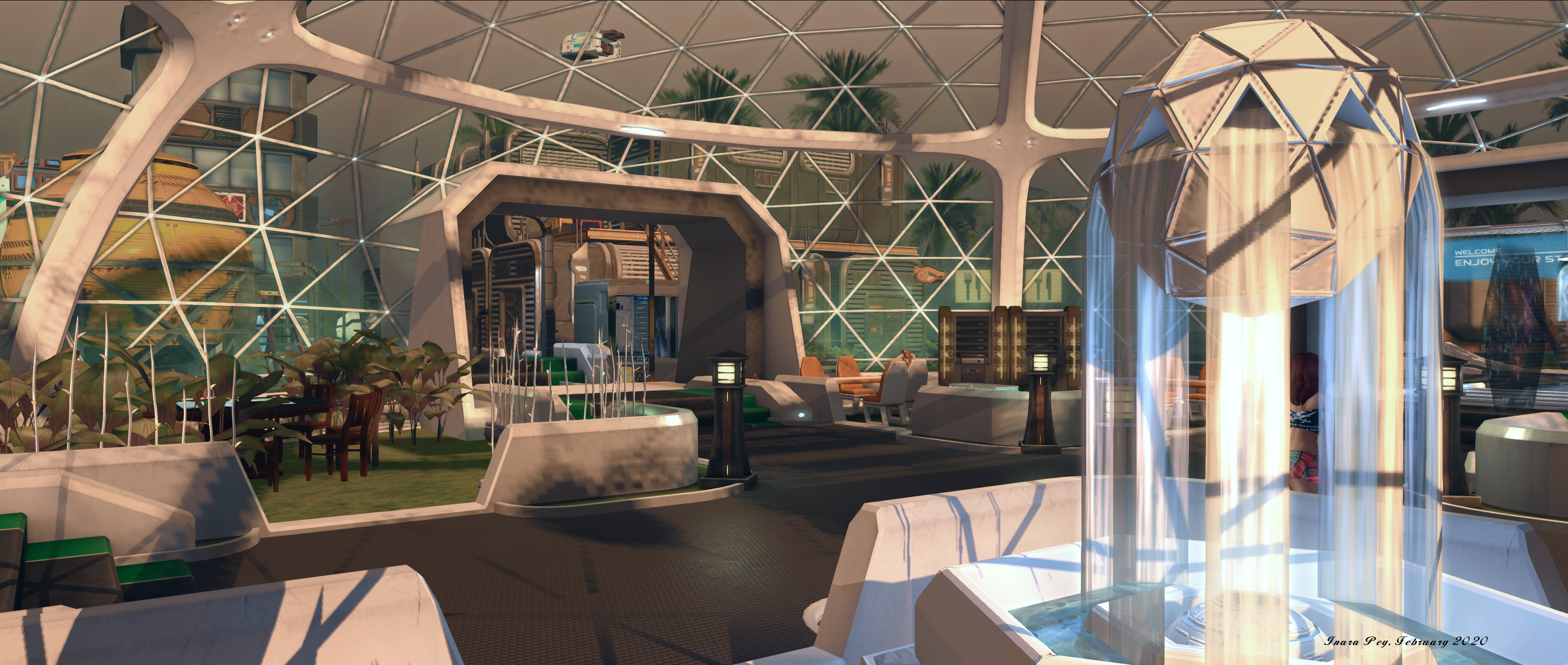
The middle island in this trio appears to be a domed recreational / refreshments centre for the station’s personnel. it is bracketed on one side by a garden area with further habitat modules waiting to be pressed into service, and which forms a home for solar arrays that help provide the station with power. Some of this may well go to the industrial facilities on the other side of the recreational pontoon. Within this workspace are more modules, a greenhouse and silos, all watched over by a – somewhat ominous – tower block. Lit from within but with frosted as if to hide whatever is going on inside, this sits on its own pontoon adjoining the industrial area, blue laser-like beams menacingly guarding the arched gateway between the two.
Aoshima, February 2020
The final pontoon sits beyond the recreational centre, another light bridge spanning the gap between the two. It presents a private dwelling surrounded by a garden of Earth-like plants combined with what appear to be local flora. Split over two floors, this accommodation is considerably larger than the modules found across the rest of the station, with plenty of space for those living within it.
Life is brought to the setting through the combined use of NPC characters that can be encountered while exploring – one of whom appears to subscribe to the idea that if it looks complicated, it probably needs a bigger hammer, – and by the numerous drones flying around the station, carrying boxes or welding equipment, together with the flyers that periodically pass overhead.
Aoshima, February 2020
Also overhead sits the ICV Kyrona, which appears to be a sublight cargo hauler (at least going by the stasis pods housed within it) that has been converted into something of a space-going home. Reached via a teleport disc within the cargo bay of the ground-level shuttle, the Kyrona is also open to exploration, the teleport disc in the stern compartment returning visitors to the shuttle when they have done so.
Aoshima makes for an engaging visit, with – as noted – plenty to capture the eye and camera. Finished with a suitable sound scape, it does have a smattering of adult items scattered around, but for the most part these are placed so as to be nicely tucked out of the way so as not to be obtrusive, and so should nod interfere with a visit.
Pearls of Wisdom is the title of an art exhibition currently available in its own space at ArtCare Gallery, curated by Carelyna, and which opened on February 7th.
Produced by Tansee, it is perhaps best described as an examination of some of the viewer’s advanced rendering capabilities, notably Advanced Lighting and lighting projectors, together with surface environment and shine effects available through the Build menu, through the medium of art. It utilises both 2D and 3D elements and allows for audience interaction.
ArtCare Gallery: Pearls of Wisdom
Given the above, it is necessary to have Advanced Lighting Model enabled in your viewer (Preferences→Graphics and check Advanced Lighting Model); failure to do so means that most of the exhibition will not work for you. Note that enabling ALM does not require enabling Shadows, which tend to have the most severe impact on viewer performance; however if you can run with shadows enabled, they do give additional depth to the 3D element of the exhibition.
This comprises a large hall with animated spheres – the pearls of the exhibit’s title, illuminated by projected lights and with shine applied together with animated textures. These are set against walls illuminated by projectors and a landscape of pearl-topped plants to create a soothing, alien-like setting in which visitors are invited to relax and spend time, either on the lidos on the floor or the floating cushions within an airborne sphere.
ArtCare Gallery: Pearls of Wisdom
The L-shaped hall leading to the 3D element of the installation offers a range of 2D art, some of it using layering techniques and transparency settings, lighting projections to great effect, with some mixing digital images and techniques with images taken in the physical world. These again offer a sense of alien environments and ideas. It also includes the introduction to Pearls of Wisdom which should be read not only for the instructions on how to best view it, but also things to look for whilst spending time visiting the installation.
These pointers include hints at some of the element hidden within the images, and one notes the glittering pearls scattered throughout the exhibition. Touching these will offer pearls of wisdom in local chat. Further large silver pearls are scattered around the floor that use projected lights and can be pushed around by avatars when visiting, so “personal” lighting effects can be created as a part of the exhibition.
ArtCare Gallery: Pearls of Wisdom
An eye-catching exercise in digital art, lighting and viewer capabilities, Pearls of Wisdom is an engaging installation to visit and witness.
The Muse – The Library, February 2020 – click any image for full size
The Muse is a new Homestead region design that has recently opened to the public to offer “a place to find your own muse”. It is a group build by the wonderfully named United Nerds of Building, led by FenrisJohnson, and offers a series of interlinked settings available for exploration, photography, romance, dancing and relaxation.
In all there are six core areas within the region to be explored, with the landing point – which is not enforced – routed to the region’s sky platform; the remaining five being at ground level within a contiguous landscape. These five locations are: the Library, the Elven Ballroom, Gypsy Lane, Nemo’s Rest and The Pond, and all of them are connected to one another and the sky platform via teleport boards – but exploration on foot is the best way to appreciate those on the ground.
The Muse – Elven Ballroom, February 2020
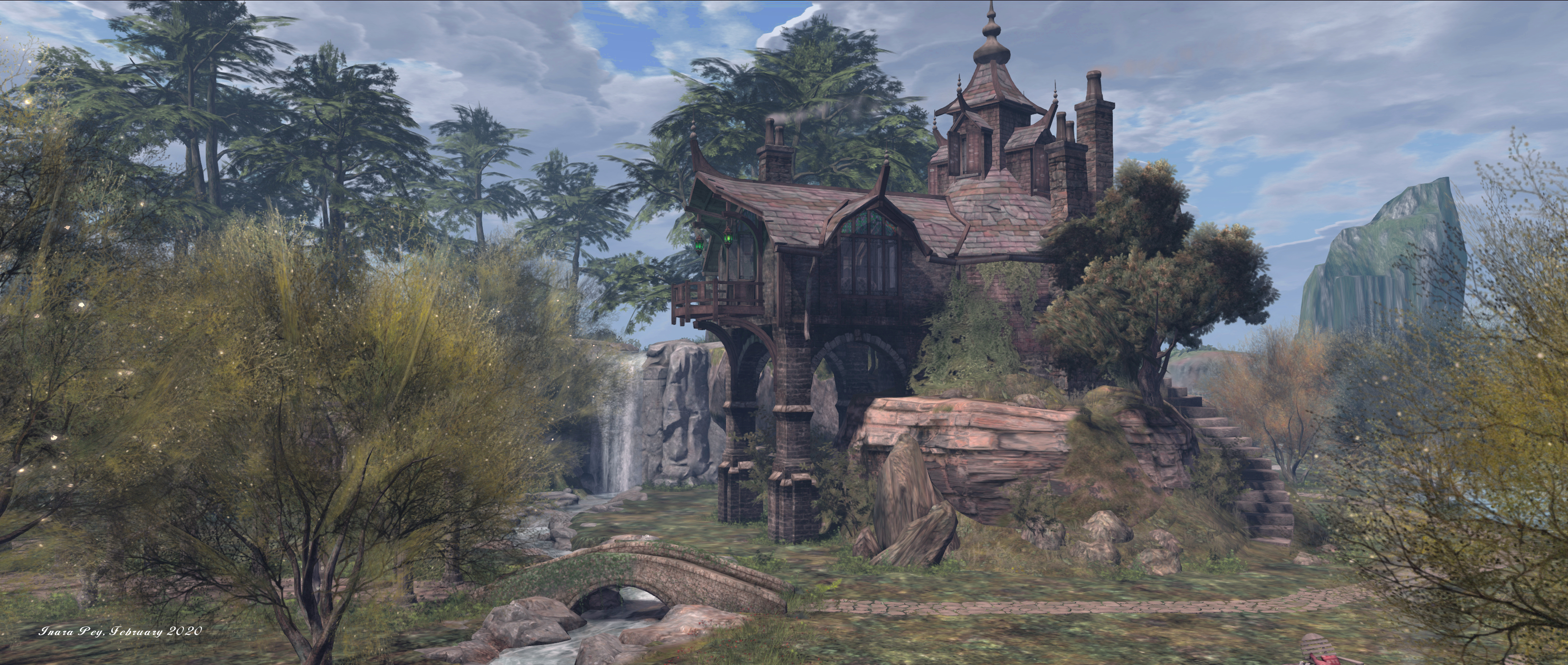
The Library sits close to the centre of the region, adjoining a mesa that rises above the otherwise flat terrain. It is reached via a curving stairway that rises from a point just around the corner from the teleport board serving it, the path to it running between the sheer face of the mesa and a fast-flowing stream that runs outward from it and to the sea. The building is one suggestive of great age and with a fantasy lean. And while the Library may not have a plethora of books for avid readers, it does present a cosy retreat with views out over the landscape to the surrounding off-shore (off-sim) islets.
A walk along a narrow viaduct to one side of the Library and then between tall trees, will bring you to the Pond, a broad body of water occupying the top of the plateau that feeds four falls that drop into narrow streams to cut the landscape into four unequal quarters, each stream crossed by an identical humpbacked bridge, a mix of footpath and rutted track connecting them.
The Muse – Nemo’s Rest, February 2020
Two of these bridges are reached from the steps leading up to the The Library. Go north along the west side of the path, and crossing the bridge in that direction will deliver you to the arches and circle of the Elven Ballroom, the arches forming a pair of walks leading to and from the circular stone dance floor that is ghost an ethereal light by spheres hanging within the boughs of the surrounding trees.
Eastwards from the Library’s steps, the path passes over another bridge and to low grasslands bordering Nemo’s Rest, the home to the grounded wreck of a submarine, its hollowed-out shell of its hull forming a cosy hideaway.
The Muse – Gypsy Row, February 2020
Beyond both Nemo’s Rest and the Elven Ballroom sits Gypsy Lane, a row of three large Romany caravans sitting under the lee of the plateau and between it and a coastal woodland running along the north-east side of the island. Each of the caravans offers another cosy place to spend time, each one far enough from its neighbour(s) to invoke a sense of privacy.
The skyborne part of the region offers a large dance floor encircled by floating islands set against a backdrop of deep space. The dance floor has an animated wave-like finish to it and coral garden at its centre, while the islands surrounding it are connected one to the next by rope bridges and steps leading down to the first from the dance area. Each of the islands has its own small attraction – places to sit, Tai Chi, etc., – whilst floating a short distance away is a little space station that presents a further private space, while the local blue whale offers rides around the platform for those so inclined.
The Muse – Space, February 2020
A setting that is ideal for easy exploration and offers much for avatar-related photography, The Muse is a nicely designed and serene in setting. Our thanks to Liss Beattie for pointing us to it!
SLurls
Peaceful Play, the home of The Muse is rated Adult.
In conversation with The Avatar’s Voice host, Erik Mondrian
The Avatar’s Voice is a video series of conversations hosted (and filmed / produced) by writer, artist, scholar, and virtual worlds thinker, Erik Mondrian. The third segment in the series, featuring an interview with Cubey Terra, recently launched on Erik’s You Tube channel, which further fuelled my interest in the series as a whole and how it came into being, and recently Erik kindly agreed to discuss the series with me – how it came about, his approach to it and future plans, as well as touching on his work in general.
However, before we get to that, some background on the series for those who may not have seen it.
The Avatar Voice, is an ongoing series of conversations between Erik and active virtual world residents, with each 30-minute segment focusing on a single guest (all of whom have thus far been Second Life residents, although Erik hopes to expand the series to cover other worlds), discussing their involvement in virtual environments, their interests, and their thoughts on a range of subject related to virtual living and virtuality.
In this, they are in many respects the virtual equivalent of interviews conducted by the likes of Larry King in his heyday or Christiane Amanpour; rather than being solely interrogatives, they are conversations wherein the host takes a back seat, gently offering up questions and occasional feedback while letting the guests tell their story and offer their views entirely in their own words, without the need for undue interjection. The 30-minute time length Erik has set for each segment allows for a more informative conversation to take place than a shorter format might allow, but without the audience ever feeling it is perhaps being drawn out or becoming stale, as might be the case with a longer time frame; instead, we are able to become quiet listeners as the discussion naturally flows between host and guest.
Erik with MangroveJane
In discussing the series with Erik, I started with perhaps the most obvious question: where the idea for the series originated.
Erik Mondrian (EM): Many years ago, I thought The Avatar’s Voice would be cool as the name of an on-line ‘zine I might eventually start about virtual worlds, pulling together stories/headlines from and about these worlds with “correspondents” from them working and writing together on the one site … I haven’t really done anything with that idea; but at some point I started thinking about it as a podcast instead, with the purpose being to go directly to the avatars themselves, to hear from them personally about what virtuality and their chosen virtual world(s) mean to them, what they’ve done and experienced there, and so on.
Inara Pey (IP): What in particular crystallised the idea of a podcast?
Erik Mondrian
EM: I think the idea for it as a podcast became more clearly defined and make sense to me because of my MFA¹ studies, and the fact that the one side of my multidisciplinary degree at CalArts was in what the Institute calls “voice arts”. So The Avatar’s Voice felt like it fit with the idea of actually hearing people’s voices – the people behind the avatars – in a format that’s not necessarily focused on any one topic or overarching goal, but allows people involved in virtual worlds to have more of their story to be told.
Also, while at CalArts and studying for my MFA,there was a call for graduate students to suggest and run courses during the two-week Interim sessions about anything that interests them. I presented two courses – Virtual Worlds, Real Artists and Virtual Worlds: Placemaking as Art Practice, in January 2017 and January 2018. In them, I attempted to show my students as many examples of virtual world creativity as I could, including having guests appear remotely from Second Life. I think teaching those two courses and especially, having those speakers share their perspectives, was crucial in leading up to the podcast, cementing my desire to try to start a project like this.
IP: Is there a particular fascination for you personally in setting up the series?
EM: I’ve always had a desire to learn more about what makes virtual worlds tick and why so many people, including myself, are drawn to them as places to “live”, often for years or decades. There is also a desire to preserve and document these worlds and their history by recording these conversations and hearing people’s perspectives.
IP: How do you select possible candidates for the series?
EM: I have a long list, even if just in my head, of people I’d love to interview. I’m sort of in a constant state of admiration for what people do in and with virtual worlds, even if it’s “just” living their lives there, building relationships and creating a home of some kind in a way that’s meaningful to them.
Since there are so many people I want to interview, the “who I select” is probably more a matter of scheduling and who’s available and willing; Groves [Mangrovejane] was the first both because I really admired her work and because we’d become good friends in SL, so she was willing to be my guinea pig for the very first interview. For that first session as well, I wanted to have a level of trust and comfort, as I was – and still am – learning by doing; so I wanted a guest who could be at ease with me and I with them.
I’m approaching people over time, and have a couple who have already said yes, and there are two more I haven’t asked yet but I think would do it. Ultimately, I want to have a variety of people, who’ve done different things, lived different virtual lives.
Erik with Cubey Terra
IP: Is there anyone in particular you’d like to interview?
EM: I would absolutely love to interview Steller Sunshine at some point, though I have no idea if she still logs in to SL or what she’s doing these days. I think it would be absolutely amazing to talk to her and hear at length about her experience, given she was the first non-Linden SL user, back in 2002.
IP: One of the attractions with The Avatar’s Voice is the relaxed approach you take with your interviewees. Is this a case of research only, or the result of an initial conversation with them, from which a core set of questions is formed, or a combination of both?
EM: I think it’s a mixture, and may change as I do more interviews and get a better feel for the process. I do try to have certain questions or topics in advance that, for that specific person, I know I’ll want to raise; but at the same time, I try to let things come up naturally during the conversation. How I ultimately edit that conversation’s recording down into the interview is another story; but even there, I try to maintain that sort of (hopefully) unforced flow, mixing thought-out questions with interesting little conversational tangents here and there, sometimes circling back around to cover a particular topic from another angle or in greater detail.
One little addition: I’m a big admirer of Syrmor and his VRChat video interviews. While his approach is to talk more about people’s lives as whole, I think his interviews are quite validating and inspirational as far as being able to use virtual existence and interaction to hear from people in this kind of way, although I don’t try to occupy his space, as The Avatar’s Voice is very much tied to virtuality, virtual worlds, and avatar-based identity as underlying driver of the discussion.
IP: Tell me more about the editing process.
EM: Editing those recordings down to fit that limit can be a challenge, to say the least! But I do find that certain things, certain topics, seem to fit together more easily. I try to also listen and “feel” for when a topic seems like it’s probably more important/personal for the interviewee, and leave those areas in as opposed to other parts of the recording where I can hear it’s [perhaps] less meaningful to them. [It’s] a question of palpable enthusiasm, maybe? Listening for even just a subtle sense of things that are unique to them, rather than being just a part of the conversation that could be seen as a little more generic and unfocused.
In conversation with Erik Mondrian
IP: Given you do have guests who have already committed to the series and have others in mind, how frequently are you hoping to produce segments of The Avatar’s Voice? Is it something you’re aiming to put out perhaps monthly, as with the Bizi and Cubey interviews, or will it be more a case of as time and commitments allow?
EM: I would say that while I would love to actually put out an episode weekly, it’s more likely to be closer to every few weeks or worst case even monthly, as you said, at least for the time being. As I do more of them, of course, I’ll hopefully not only get faster at the editing process but also be better with the planning beforehand and with the interviews themselves in the moment.
I have thought about the possibility of doing a sort of “interlude” episode every 4 or 5 interviews, to keep the momentum going whilst also involving more people. Rather than a whole 30-minute episode with one person [these “interludes”] would instead be me sharing responses from residents to a call I’ve made via Twitter or what-have-you [for thoughts and feedback], either with me giving their response in voice if they answered through text, or even letting them speak for themselves if they wanted to share a brief recording of themselves responding.
IP: In closing, is there anything your like to add concerning the series and your aspirations?
EM: I’m eager to hear what people have to say, whether in the full interviews or in the interlude submissions idea. I started this because I truly believe that there have been, and still very much are, many amazing people in virtual worlds of all kinds, [with] so many interesting things being done; this is a way for me to know more about them and to hear directly from them about why virtuality has been a meaningful part of their lives.
I should also mention that while I do expect the bulk of my interviewees, at least for the time being, to be SL Residents, I think much if not most of what they have to say is applicable to virtual worlds at large, and I do also hope to interview residents of other virtual worlds as well, to ultimately have that diversity of realities represented.
I’d also like to say that – time and money permitting – this is only one series, one facet, of the projects that I’d love to be able to do to show SL and virtuality in multiple ways. [For example] I also have in mind a video series exploring SL as a connected world, and another that would examine some of the activities therein. These would be in addition to the fly-throughs and music videos I’ve made to showcase places … [and] would sort-of complement the podcast by having a similar style or approach with a voice-over talking about them.
In conversation with Erik Mondrian
As noted towards the top of this article, the first three segments of The Avatar’s Voice are available via Erik’s You Tube channel, and are summarised below with links to them for viewing. I recommend anyone with an interest in virtual worlds, Second Life and virtual living take time out to listen to them; they are all equally fascinating.
The Avatar’s Voice 1 – Mangrovejane (August 2018): a visual artist who has been in Second Life since August of 2016, who discusses her time in Second Life, how she established it as her virtual home; the differences she’s noted between it and platforms like Sansar and High Fidelity; and the power (and peril) of avatar embodiment.
The Avatar’s Voice 2: Bizi Pfeffer (January 2020): a software engineering student and accomplished virtual explorer active in SL since early 2007, discussing his travels around the SL mainland and how having a contiguous world can help foster a sense of community and discovery, especially when the spaces there are user-created; the rewards and occasional challenges of sharing that world with a diverse population of people from around the globe; and the impact of decentralisation & open-source software development (or a lack thereof) on a virtual world platform’s evolution and survival.
The Avatars Voice 3: Cubey Terra (February 2020): an acclaimed content creator and pioneering virtual aviator active in SL since the latter half of 2003, discussing the history of the original Abbotts Aerodrome, which he co-founded; the value of SL’s in-world building tools and thoughts on the arrival of mesh in SL; and how Second Life, as a shared, user-built environment, still manages to pull people in and keep them engaged despite the platform’s limitations, visual and otherwise.
Also, if you would like to help support Erik in his work in producing The Avatar’s Voice and to help him with his other projects related to virtual worlds, please consider buying him a coffee via his ko-fi page – the donations made will directly support his work.
MFA: Master of Fine Arts, studies that saw The Avatar’s Voice interrupted between its first and second segments while Erik focused on producing his thesis, which included producing a fabulously engaging 11-part video series exploring matters of identity, life, emotions, desires, introspection and self-understanding as a part of his thesis for his Master of Fine Arts (MFA) in Voice Arts & Creative Writing (please read Erik Mondrian: master of fine arts in and beyond Second Life for more).
Cica Ghost opened her latest region-wide installation on Sunday, February 9th, and it is another absolute delight from an artist who can chase away the darkest clouds and turn the deepest frown into a smile.
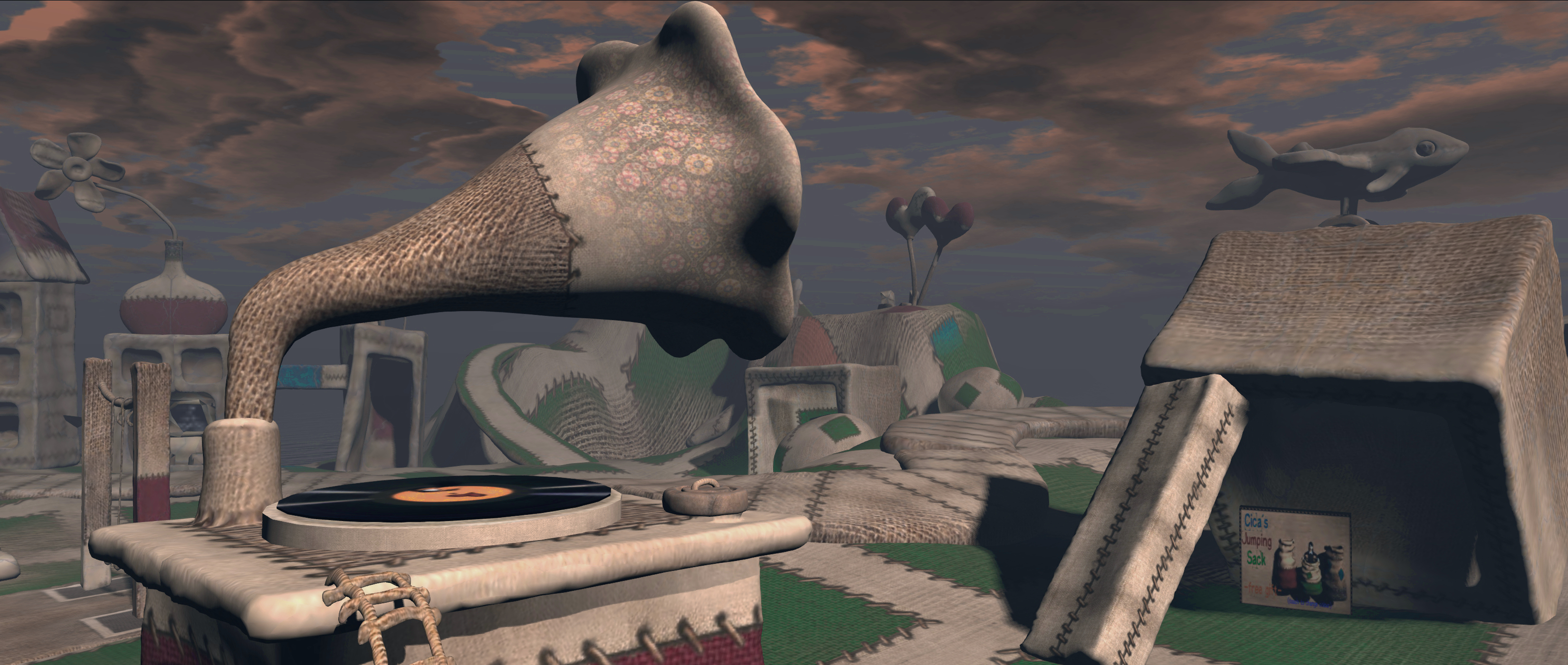
Burlap is a marvellous setting where just about everything is fashioned from that fabric (also known as hessian in some parts of the world). The ground is a stitched-together pattern of plain and coloured burlap swatches, the houses, vases, pots and boxes that lay scattered across it similarly so, while a ribbons the fabric forms a road that winds around and over the land. Even the posts and fences are made from the stuff, as are the flowers that sprout from vase and pot.
Cica Ghost, Burlap
The only real exception to the use of burlap and thread comes in the form of buttons. These not only secure the clothes of the local population – of which more in a moment, they also act as wheels on vehicles large and small, some mobile, some static, some apparently being pulled along. Wheels even sit at the four corners or on either side of some to the finger-like houses, suggesting that with a firm heave-ho, they could be set rolling across the quilted landscape.
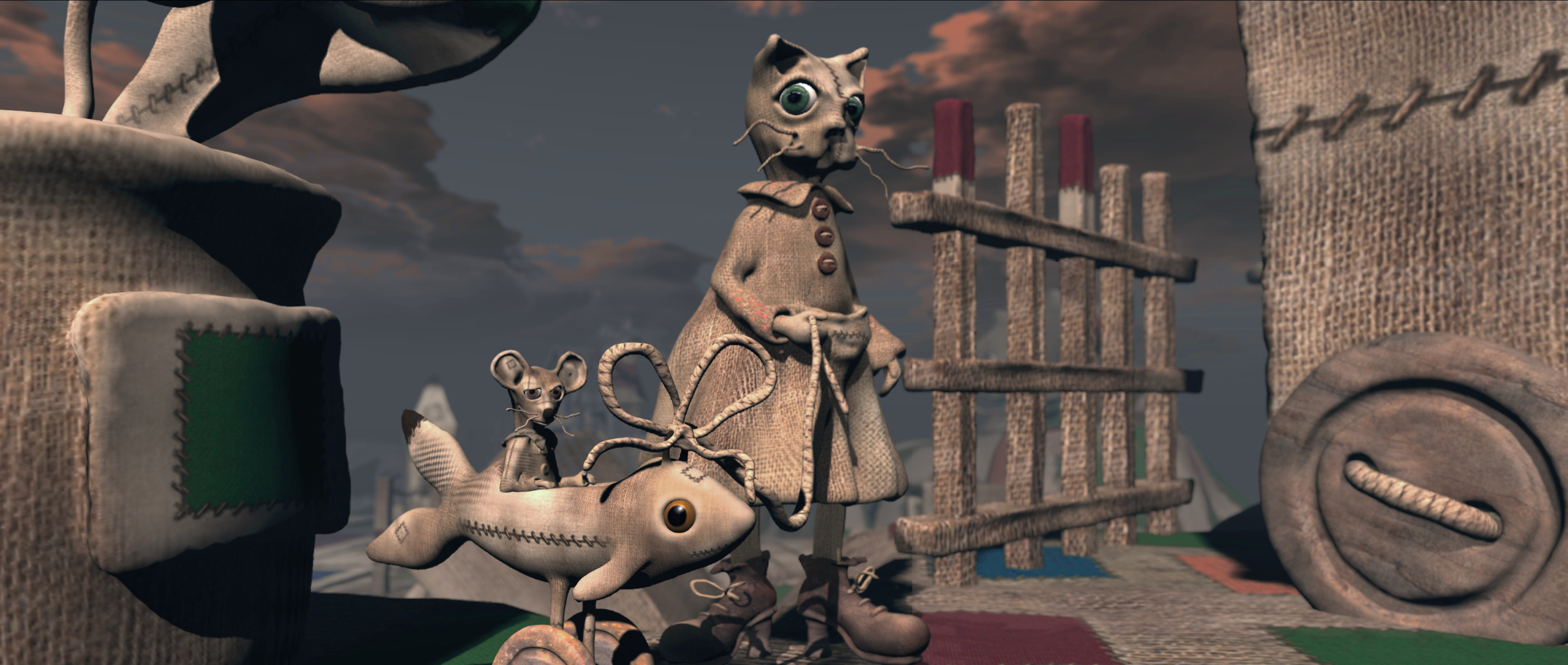
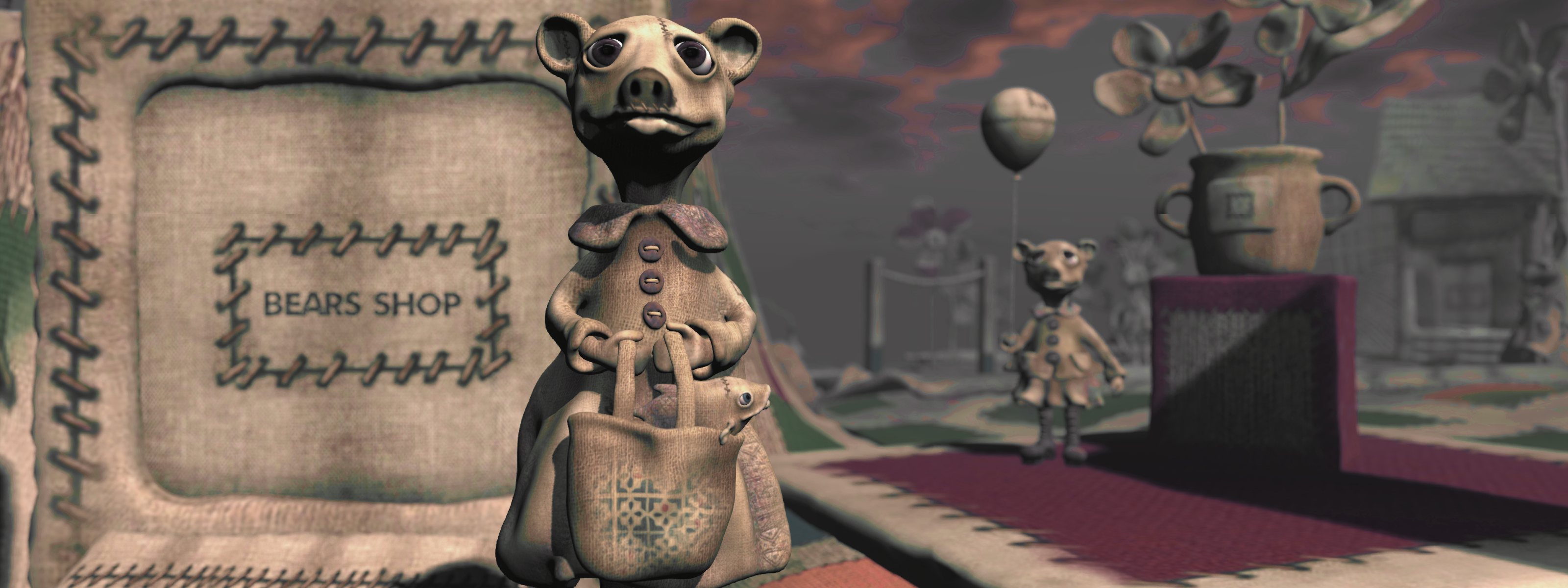
Within the setting, the local inhabitants watch the comings and goings of visitors with interest, forming a little community of burlap-dressed bears, rabbits, ducks, felines and mice (and even a giant fish apparently quite at home draped over a hill!). The bears, rabbits and ducks all have their own little neighbourhood areas, complete with their own burlap-fronted shop, while the felines – a lion jealously guarding his bag of potato chip (or crisps as we’re prone to call them in the UK), and a cat apparently out shopping with a little mouse literally in tow with her – stand apart from one another.
Touch the fronts of the shops, and the burlap “doors” will rise curtain-like, to reveal smaller versions of the locals available for purchase and display.
Cica Ghost – Burlap
As with all of Cica’s builds, Burlap includes a lot of places for avatar animation / interaction, with sits and dances to be found on multiple sufaces – just carefully mouse over things and watch for the Sit icon to appear. Some of the obvious places are the giant gramophone player, the swings and the chairs – but there are more that I’ll leave yo to discover 🙂 .
Also, keep an eye out for the gift giver – it’ll present you with your very own burlap sack you can use to hop around the installation and have sack races with friends. There is also a fish car rezzer sitting to one side of the region awaiting drivers (turn off your AO to sit within in properly). Do be warned, however, that it does tend to launch you and your car once you’re seated!
Cica Ghost – Burlap
Whimsical, fun and bright, Burlap will remain open for about a month. When visiting, do please consider making a donation towards Cica’s work, so we can all continue to enjoy her art in Second Life.