Currently on display at the Kultivate Signature Gallery, curated by Johannes Huntsman, and running through until the end of August 2020, is an exhibition of art from the physical world painted by KismaKSR – or Kisma K. Stepanich-Reidling as she is known outside of Second Life.
Defining Kisma isn’t easy, as she is a woman of many talents – artist, published author, curator (notably working with Reiner Schneiber, head curator for various worldwide Biennales), gamer, therapeutic art life coach, immersive 2D / 3D artist, and currently a creativity teacher-in-training! As an artist, she works in a range of mediums including acrylics, watercolours, gouache, pastels, coloured pencils, graphite, texture paste, stencils, and more.
I paint what I see inside. I love working in art journals, creating altered book art journals, and taking my creations from the page to the canvas… and on occasion from the canvas to the page! My creative journey is based in watercolours but has taken me into so many mediums that I believe I love acrylics the most.
I love working in layers… lots and lots of layers, distressing paintings, vibrant colourful paintings, collage paintings and sketch paintings. I also work with encaustic wax and fibres, throwing in the making of journals and fibre weaving to create embellished covers.
– Kisma K. Stepanich-Reidling
Kultivate Signature Gallery: KismaKSR
For her exhibition at Kultivate’s Signature gallery, Kisma presents 16 reproductions of her physical world art that fully embody her approach to her subject: all richly expressive, some offering hints of expressionism, others perhaps leaning a little towards surrealism and still others more abstracted in nature. Every piece speak of Kisma’s Intentional Creativity approach to her work: the act of being aware of thoughts, ideas, feelings, and of self, and allowing all of this to inform and shape whatever task is being undertaken – be it making a soup to writing a musical score or – as in this case – producing works of art.
These are pieces that also include subtle cultural undertones to them that can be form in form, style, colour and symbolism. These touches add further depth to Kisma’s work, infusing them with a sense of of humankind’s cultural heritage through the ages – something we tend to too easily lose sight of in the modern age of technology and bustle.
Mareea Farrasco is a Second Life photographer whose work covers a broad range, from avatar studies to landscapes – the latter oft processed to resemble paintings – and the literal to the metaphorical, producing images that can contain within them a rich narrative or which offer the confluence of shape and form to present a simple statement or comment.
Many of these elements are presented to us through her exhibition at Nitroglobus Roof Gallery, curated by Dido Haas, with the exception of examples of her landscape work – for reasons that will become clear. Entitled Claustrophobia, the exhibition takes as its theme the SARS-CoV-2 pandemic, but from an angle that perhaps has not gained the attention it deserves.
When asked to define “claustrophobia”, most people are liable to go with its more well-known meaning: an abnormal dread of being in closed or narrow spaces. However, the word has another meaning, one not so often considered and that is a feeling of discomfort or discontent caused by being in a limiting or restrictive situation or environment, and it is this second definition that Mareea focuses upon.
We live, these days, in a confined, pandemic universe of our own, and we are all more or less “claustrophobic”, even without suffering from this disorder in our normal, healthy lives. This exhibition is my metaphoric way to express those feelings, trying to rationalise them, in order to make them endurable.
– Mareea Farrasco, introducing Claustrophobia
Now to confess, on first seeing the 14 images presented for the exhibition, I fell into the trap of looking at them through the lens of that more popular definition of “claustrophobia”, and while there are one or two that contain elements that most certainly do convey a sense of physically restricted space and / or a sensation of the walls closing in (notably Claustrophobia (6) and Claustrophobia (7)), I initially felt the exhibit, focused as it is on studies of an individual avatar, could just as easily be called “solitude”, without any need to reference the pandemic.
It was only when I broadened my consideration to that second definition foe “claustrophobia” that I was struck by the manner in which Mareea has perfectly encompassed it through each of the pieces offered in this exhibit, and seamlessly linked them to offer expressions of how we have been forced into am artificial sense of “claustrophobic distancing” because of the pandemic. It doesn’t matter if we’re home alone or with family, we have been forced to artificially limit our environment and interactions to an extent that expressions of solitude are all we actually have left; circumstance demanding that as constrained as we are, we turn our thoughts inwards.
Seen it this light, all of the pieces here are subtle and evocative explorations of thoughts and feelings that reflect our desire – our longing – for more normal times. At the same time, there is perhaps a deeper aspect to be considered. Whilst physical distancing from friends, colleagues, neighbours and all might well be a requirement for all of us, many of us do at least have family with who we can at least find some release from that sense of isolation – but what of those who live alone? For them, the routine of isolation has potentially been amplified by the pandemic; through Mareea’s images, we perhaps catch a glimpse of all they face.
I’m totally up to my ears in a variety of things at the moment, which has had something of an impact on my ability to blog with the usual frequency. Hopefully, I’ll be all caught up over the next couple of days, but I didn’t want to mission the opportunity to write a few words about Swan, the Homestead region held by Keely Mistwood as her personal space, but which she has opened to the public to visit.
The landscaping for the region is by Tab Tatham, whose design work is always worth seeing as she has an considered eye for creating natural environments – as can instantly be seen with Swan.
Swan, July 2020
The region is largely given over to a mountainous off-sim surround that joins with the island to present a low-lying tongue of land extending out into the waters of a bay, several other peaked islands rising from the waters to suggest a coastal archipelago, while the the trees of the lowlands suggest this is somewhere in the northern latitudes.
Rocky in nature and split by a stream that issues from one of the landscape’s rocky faces, the landscape is rich in fir and oak and climbs back to a high table close to the mountain backdrop, a finger of rock connecting the two, a screen of trees helping to curtain the join between region landscape and surround.
Swan, July 2020
This high bluff has prevented the sea complete separating the headland from the mountain, and thus turning it into an island. To one side is a channel that has eaten its way between headland and mountains; on the other is a sheltered arc of beach reached by wooden steps that descend from the flat top of the rock and watched over by a wooden deck.
The top of the plateau is largely given over to Keely’s house, which like the rest of the region, is open to the public. It has a delightfully bohemian feel to it, the indoor spaces open and breezy, seamlessly with the decks around it, and a cool looking rocky pool alongside in place of a more traditional swimming pool.
Swan, July 2020
Packed with detail, the house looks down on a further curved bay, this one with shingle rather than sand, this one arcing to another, lower table of rock, home to a more traditional swimming pool. It can be reached via the wooden steps leading up to the house from the landing point or via one of two zip lines.
The second zip line descends to the north-east and the tip of the headline, where an old cabin, now converted into a hidden summer house – although be warned that the trip down the line will take you through the local fir trees, so you could end up getting a few slaps from the boughs!
Swan, July 2020
Between the cabin / summer house and the landing point, the land is again rich in detail beneath the canopy of trees. Here might be found an open-air theatre, old terraces, open walks, decks and more, all making for a richly photogenic setting – although you’ll need you own pose HUD for avatar photography, as Keely hasn’t opened rezzing the region to avoid littering.
Superbly made, packed with opportunities to wander and / or relax (including the little island off-shore, although you’ll have to fly to it), Swan is a perfect destination for the SL traveller. I’m not sure if Keely intends to keep it open to visitors or if it may be a limited time opportunity to make a visit; so if you’re interested, hopping over sooner rather than later might be the way to avoid disappointment.
Now open at the Hoot Suite Gallery, the boutique gallery in Bellisseria curated by Owl Dragonash, is an exhibition that reminds us that while getting out and about to enjoy the beauty of summer may not be easy because of a certain pandemic, better times will return for all of us to have the freedom to visit our favourite corner of a beach or wander through grassy meadows.
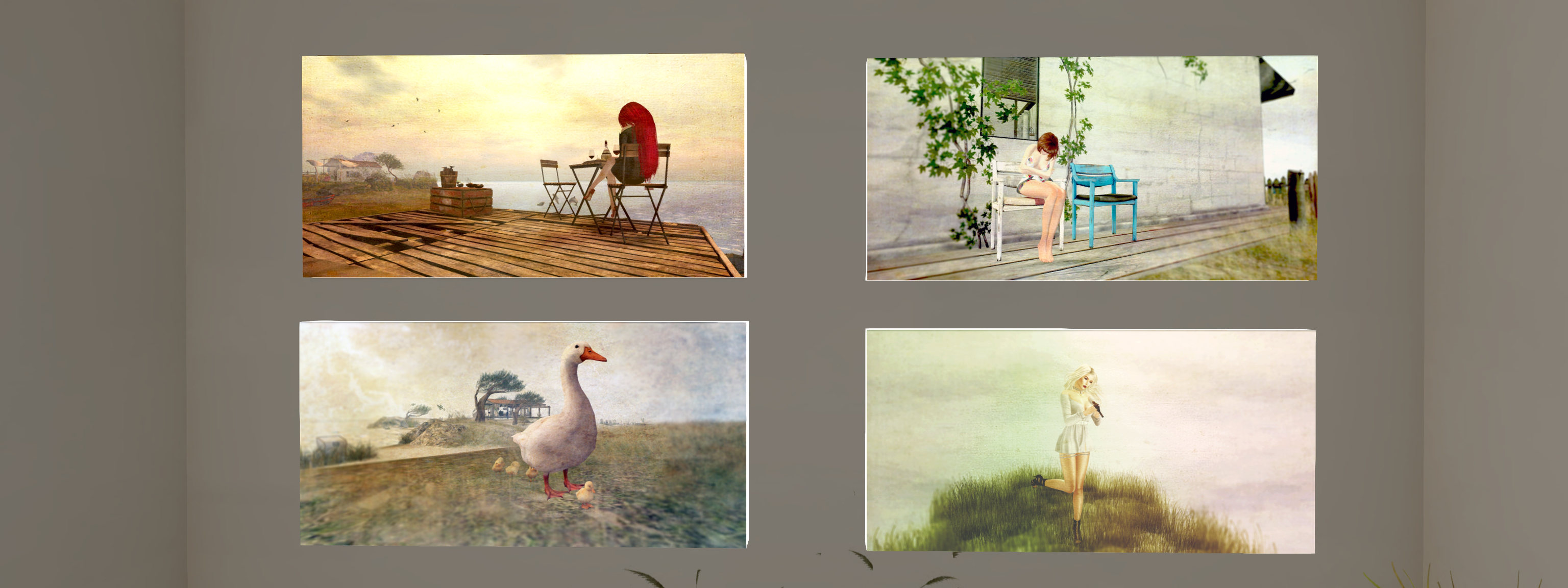
Painting the Summer is a charming exhibition of gently post-processed images by Mareea Farrasco that carries us away to that summer beach and those summer grasslands, and to coastal walks and more. views out over rolling surf to sail boats lying off the coast and geese waddling over course grass. Often framing her avatar in relaxed poses.
Hoot Suite Gallery: Mareea Farrasco
These are elegant images in their presentation and in the lightness of touch with post-processing tools, while Owl’s Hoot Suite offers the perfect cosy venue for their presentation. The exhibition will run through until August 23rd, 2020.
Dim Sum Gardens, July 2020 – click any image for full size
Dim Sum Gardens is a Full region on the Mainland that has been given over to a quite spectacular oriental themed public garden space that can be deceptive in its breadth and depth. Designed by Wee Willian Wylie, the gardens are built around a large lake, and are rich in features and details that can make any visit a voyage of discovery – although that said, it would be remiss of me not to note that such is the depth of detail within the gardens, a visit can take a lot out of older systems; so if you do tend to travel with a high draw distances or shadows always enabled, be prepared to make adjustments so that you might better enjoy things.
A visit commences on the south side of the gardens within a Japanese-style walled terrace area. Here, on a platform guarded by Japanese hunter / warriors and sinuous water dragons, sitting over a rectangular pool water and beneath a stylishly modern Torii gate, the landing point looks out across the lake as it spreads itself to the north, water falling from a low lip in the edge of the pool to add to the lake’s fill.
Dim Sum Gardens, July 2020
This is a place where the term here be dragons has genuine meaning: as well as the two water dragons busily keeping the pool under the landing point topped-up, dragon heads decorate a stone fountain on the terrace below, and two more are waiting to greet visitors as they descend the steps from the terrace to join the path that offer routes of exploration along the south side of the gardens. In addition, all of this – landing point, terrace and all – is watched over by a large water dragon that raises its head out of the lake to also examine arriving visitors.
Bracketed by trees and woods to the south, west and east, the lake reaches north to where the land rises in grass-topped bluffs that arc around the back of a large island that proudly rises from the waters, a couple of smaller, low-lying islands between it and the landing point to the south. This sheer-faced island is topped by a quite marvellous Japanese tea house that mixes modern and traditional design in a manner that delights the eye. Like the landing point, this tea house is also guarded by dragons as it sits over a water feature that is home to fountains and Japanese crane, whilst waters tumble from the rocks of its perch to also add to the lake below.
Dim Sum Gardens, July 2020
The tea house is just one of many buildings and structures to be found throughout the gardens, some of which may be easy to spot as they raise their roofs above screens of trees or sit out over the waters whilst others may only come into view as you wander, and some attempt to remain hidden right up until you are almost literally on top of them.
Most of the larger structures are distinctly oriental in design, although a further café, sitting on the north shore of the lake and tucked behind the bulk of the island tea house, is of western design, and several of the smaller hideaways and romantic spots could hail from anywhere around the globe, whilst a dance pavilion on an island tucked into the south-east of the lake carries an elven air about it.
Dim Sum Gardens, July 2020
But no matter what their heritage, the placement of all the structures, large and small, within these gardens means that they all simply work and come together with the landscaping to capture the eye and heart.
To get to all of them really is an exercise in exploration: whilst a trail runs east and west from the path leading outward from the landing point terrace, it quickly becomes sporadic and overgrown or broken, although in places fences and old wall may offer hints of where to go. This allows things like bridges out to islands or the rediscovery of the trail after losing it in long grass and wild flowers, to add to the sense of adventure – as can coming across the unexpected, near-unseen house and courtyard or Japanese pavilion hiding within a curtain of bamboo.
Dim Sum Gardens, July 2020
For those who tire of wandering – something hard to imagine here – or who simply want to sit and relax, Dim Sum Gardens again offers a lot, from simple benches in the shade of trees, to the aforementioned cafés and tea houses, to the many pavilions and picnic spots and decks built out over the water and rafts floating upon it.
Nor is the lake home to a lone dragon; ducks swim among the lily pads, puffins perch on rocks, and heron and pelicans keep an eye out for unwary fish that might stray too close to where they stand. rowing boats and lanterns also sit on the waters, whilst several pieces of art rise above the rippled surface. This is a place rich in the colours of nature: multiple hues of green from grass, flowers and trees, reds and pinks and whites of cherry trees, and where the reds and greys and browns of rooftops add their bursts of colour to the mix.
Dim Sum Gardens, July 2020
With something new to see wherever you look and surprises to be found wherever you wander, Dim Sum is a perfect setting (if, again being honest, a possible heavy load for some systems). Such is its design, more than one look might be required to find everything – as I found out when I returned to take photos and came across the orangery with its piano inside, so well hidden under the boughs of a cherry tree I’d completely missed during my first visit!
Winter Moon, July 2020 – click any image for full size
Annie Brightstar recently and indirectly reminded me that it’s been nigh-on two years since our last visit to Dream Shadowcry’s Homestead region, Winter Moon and that as such, a return visit was much overdue.
Dream’s designs are always places that draw lovers, romanticists, grid travellers and photographers; rich in detail, perfectly designed and steeped in evocative elements, they’ve never yet failed to capture the eye at the heart – and this latest iteration is no exception, returning as it does to one of Dream’s themes of balancing land and water in a way they is both natural and visually engaging.
Winter Moon, July 2020
For this build, Dream presents a circle of islands, each sitting between the surrounding sea and a broad lagoon caught within them. Such is the shape of the two larger islands that it’s hard not to see this as the rim of an ancient crater, the crown of a volcanic mound that once reared its head above the waves, only to fall silent at some point in the past, its walls then beaten down over the aeons by wind, rain and sea until in time they in part collapsed, allowing the sea to rush in and fill the extinct crater bowl, the last remnants of the one proud walls now restricted to the north and west of the setting, where high cliffs rise.
The landing point for the setting sits to the south-west, on a slender finger of an overgrown walkway that reaches out from the largest of the islands to tickle a low mound of rock that has been used as the foundation of a lighthouse (the lighthouse being something of a motif for several of Dream’s Winter Moon designs). A second walkway, this one with it paving still very much intact and resistant to the grasses that have overgrown its twin, points eastward to reach the second of the large islands at it arcs from south to north on the east side of the region.
Winter Moon, July 2020
Predominantly low-lying, the island raises a sinuous, wooded spine perhaps as much at 10 metres above the waters either side, prior to dipping down to a sand bar that shows every indication of being the next point where the sea will overcome the land and cut a new channel into the lagoon, running between the wooded spine and the narrow curtain of rock that risks above the sand at the island’s northern end.
Here, in a sign that the waters around the islands tend to be generally calm, a board walk steps out over the waters snaking over the shallows to pass around the sheer cliffs of the larger island’s northern extent to eventually meet with the beaches that hug the feet of those same cliffs. Passing around the northern side of the table cliffs, the path then proceeds onwards, using a more rudimentary board walk to step over the water flowing outside from the cliffs as it drops over a number of the great falls that adorn the high rocks.
Winter Moon, July 2020
From here it is possible to follow either the beach around the north and west sides of the major island and back to the old walkway, or pass over the centre of the island, taking the path through a strange ravine and the woodlands beyond to reach the same point. As simple as either route sounds, both are worth exploring because there is a wealth of detail to be found along both.
For the adventurous, a second board walk extends out over the eastern waters of the lagoon from a point close to the one mentioned above. this stretches to where a pair of narrow screens of rock rise from the water like the prow of a ship. they guard a narrow path that connects the board walk to a small island crowned by the spread of an ancient oak-like tree.
Winter Moon, July 2020
One of the great attractions of Dream’s builds is the sense of age and purpose given them – and this is again true here, particularly with regards the many aged stairways, complete with broken or damage balustrades, that help connect different parts of the islands. Their presence suggest that this place was once one to a people at peace with both lands and sea, with the many scattered statues and carvings adding to this feeling as one explores, together with the gentle ringing of wind chimes. Even the singing happiness of an old phonograph isn’t out of place, offering as it does and echo of more recent times past with some classic oldies being played.
With a well-rounded soundscape, lots of details I’ve barely touched upon (go fine the chandeliers and all the places to sit and relax- alone or with someone special) for yourself!), this iteration of Winter Moon is idyllically sublime.