The Tejo Power Station, located in the Belém district of Lisbon, Portugal, is regarded as one of the most beautiful examples of Portuguese industrial architecture from the first half of the 20th century.
Occupying the site of a thermoelectric plant first built in 1909 on the banks of the Rio Tejo, the building as it is seen today was first built in 1941, and provided power to the city through until the early 1970s, undergoing expansion over that time.
Kondor Art Centre: Hermes Kondor, July 2020
Encompassing architectural styles that run from art-nouveau to classicism, the power station was declared a major Portuguese heritage centre in 1986, and in 1990 became the home of the Electricity Museum, celebrating its role in bringing electrical power to Lisbon. It is in this capacity that Hermes Kondor visited it, along with his camera, returning with photographs of the building’s machinery, some 28 of which his has placed on display at the Kondor Art Centre.
And while this may sound like a boring subject – believe me it is not. The bunkers, pressure chambers, pipes, valves and metal walkways of the station’s machinery within the museum have been lovingly restored and maintained, and Hermes has captured all of this in incredible detail.
Kondor Art Centre: Hermes Kondor, July 2020
Through an exquisite use of depth-of field, macro focus, angle, framing and light, Hermes presents these machines and their individual part as living entities. From threaded nut to valves to pressure vessels to the complexity of the larger machines, the crisp detail found within each photograph is stunningly exceptional.
Displayed within a modern skybox setting that itself has a clean industrial feel to it and that perfectly complements the art on display, this is a genuinely engaging exhibition that fully captures the history and beauty of these remarkable machines.
Glitch Social, July 2020 – click any image for full size
Note: Glitch Social has closed; as such SLurls are removed from this post.
Glitch Social is a public space developed by KaidenTray, owner of the Glitch brand, and who is also a region designer / Second Life photographer. Located on a 1/4 region parcel within a Full region, it is offered as beach-front hang-out for people to enjoy, complete with a range of activities to partake and places to simply sit down and relax.
The landing point is located towards the southern edge of the parcel and sits above a fast-flowing stream and right on top of a little picnic area with a bonfire that may or may not be lit when you arrive. The stream is an odd little beast, lying as it does on a raised arc of land than falls away it either end such that the stream appears to be following both eat and north before dropped down into a depression fed on its far side by more waterfalls, and south and west to were it splashes down a lip of rock into a much wider, deeper pool of water that is also served by a series of large falls erupting from the surrounding rocky hills.
Glitch Social, July 2020
This large pool offers the first hint of recreational options in the parcel. Once you’ve passed the black bear and her cub as they stand on the far side of the stream, a structure somewhat like a diving board extends an arm over the water, dangling various rope climbs abov the waves, with poses available on them with a right-click. Rubber rings also float on the water for those who fancy a dip.
Just behind the landing point and hidden from it by bushes, a set of stone steps wind up the hill from the grassy knoll between “diving board” and picnic area. Rising along the slope in a gentle arc, it offers a way up to a large house and yard. While this may at first seem to be a private dwelling, it actually appears to be open to the public: a sign on one of the other routes up to it from the beach – of which more anon – offers a welcome to visitors as they approach the front yard area of the house.
Glitch Social, July 2020
A sprawling setting, the house squats rather uncomfortably on mesh landforms (and in one place is in need of a measure of support as it does so!) surrounded by a mix of gravel, vegetable garden, wild grass and chickens. The house is comfortably furnished, again with opportunities for couples and groups to gather, sit and chat indoors or out, those opting for the latter possibly coming under the watchful eyes of a heron perched at the edge of the large stone pond sitting on the front gravel.
Despite its elevation, the house is set far enough back on is perch so that a screen of weeping willow and maple trees hide it from the beach below, and vice versa – although admittedly the high dormer roof of the house does raise itself sufficiently enough to be seen through the trees and bushes from below. Three tiers of stone steps connect the front yard of the house with the beach, these being the way up to the house marked by a welcoming sign mentioned earlier.
Glitch Social, July 2020
A third way from / to the house sits on its north side, where a rock path slopes down to a cinder path and boats docks. The path pushes through a narrow ravine of rock to link up to a meadow sitting back from the beach as it curves east and north around the land. The north western end of the docks are marked by a squat lighthouse that appears to be hiding behind a tall shoulder of tock, rather than giving warning of its presence. Alongside of it, the cinder track turns sharply inland to climb up the hill before the cliffs, passing between them and the house.
The top of this climb is marked by a café / music venue built over a shelf of rock and looking down onto the large pool – so much so, in fact, that the daring can use the platform extending over the water from one side of the venue’s deck to do some spectacular high diving into the waters. For those less inclined to daring-do, the deck and café offer a further place for relaxation and passing the time.
Glitch Social, July 2020
With bumpers boats available in the waters by the beach, a camp site in the meadow and little details tucked away here and there, Glitch Social has much to recommend it, all wrapped in pleasing sound scape.
Now open at Club LA and Gallery, curated by Fuyuko Amano (Wintergeist) are two boutique exhibitions offer small selections of art by Renoir and Adder PxL (Z3NooBhasR3turn3D), two very distinctive and very different artists who together present two very different displays of art.
Renoir Adder is an artist who straddles genres. Within his pieces can be found elements of post-impressionism, potentially influenced by the like of Van Gogh; suggestions of Picasso; and surrealist leanings.
Club LA and Gallery: Renoir Adder
Here he presents a dozen paintings, some ten of which carry a strong hint of Van Gogh. Rich in colour, they present a range of landscapes and studies that might have been lifted from a gallery in the physical world and dropped into Second Life. The last two, meanwhile, lean more towards the surreal, with one in particular offering a nod and wink to the Belgian surrealist painter René Magritte.
Prior to this exhibition, I had not come across the work of PxL. Occupying the gallery’s north side, he offers 15 Second Life photographs that offer an enticing mix, in terms of their focus and style.
Club LA and Gallery: PxL
Mixing landscape image and avatar studies, they range of the delicately post-processed to those that have been heavily treated to offer the impression of painting as what I might describe as charcoal-like drawings.
These latter images are especially evocative, with a pair of images both called c3dots particularly capturing the eye – which is not to dismiss any of the others, I also found myself drawn to the darkly atmospheric Final Breath, together with Like a stone equally attractive.
Bellezzamora, July 2020 – click any image for full size
I recently received a personal invitation to visit Bellezzamora, the stately home of Crito Galtier, owner of The Grove Country Club Estate residential regions and his partner, Christian Galtier (Christian Q), and which they recently opened to the public.
Sitting in a Full region leveraging the LI bonus, this is an impressive sitting put together by Cristo and The Grove’s lead landscaper / designer Natalie Rives. At its heart lies a house design inspired by and modelled on Hatfield House, located in Hertfordshire, England (and coincidentally, a place with which I have some degree of familiarity for assorted reasons), located in the grounds once occupied by the former Royal Palace of Hatfield (elements of which still exist a short walk from the main house).
Bellezzamora, July 2020 – click any image for full size
A prime example of the Jacobian era prodigy house, the actual Hatfield estate is steeped in English history. The former royal palace was the home of the then Princess Elizabeth whilst her father, Henry VIII was still on the throne, for example. It became a centre of intrigue when her half-brother was crowned king and it was alleged she had illegally agreed to marry Thomas Seymour, which Seymour’s brother Edward saw as a threat to his role as Lord protector of England and the sway he held over the young Edward. It was also the place where Elizabeth received news of the death of her half-sister Queen Mary (who seized the throne following Edward’s death), and where she held her first Council of State as England’s new monarch.
Hatfield House itself came into being at the hands Robert Cecil, 1st Earl of Salisbury, who was given the royal palace and its ground by King James I of England and Ireland (James VI of Scotland) in 1607, and whose descendants have retained ownership of the property. After tearing down much of the palace, Cecil used the bricks to build the initial Hatfield House, which was extended over time. As an aside, one of those descendants, Robert Gascoyne-Cecil, 3rd Marquess of Salisbury, a 3-times prime minister in the later Victorian period, gave rise to the expression “Bob’s your uncle” on account of his habit of taking care of family members by appointing them to his governments, thereby ensuring everything turned out fine for them.
Bellezzamora – July 2020
The Second Life iteration of Hatfield House is a commercial build by Romin McDonnell (although I understand the version used at Bellezzamora is something of a customised version, modified with Romin’s help to specifically fit this setting). It reproduces many of the features found in the original, including its grand hall, chapel, its distinctive tiled floors, and more and exterior physical attributes such as the original’s southern aspect, although for this design it has been turned to face to the north and the courtyard within the two wings of the house have been converted into a garden with water features.
Within, the house is lavishly furnished, many of the rooms featuring suitable period designs, including pieces by Kaya Angel, himself an expert in period designs and furnishings. The grounds are more unique, offering a individual perspective in stately home landscaping and formal gardens rather than anything specific to Hatfield House. Found within them are terraces, summer houses, a pavilion, neatly laid paths, lawns and flower beds.
Bellezzamora – July 2020
A sense of history is imbued through the placement of statues through the grounds, whilst the one concession to the modern era – other that the roadway leading to the house and the cars parked before it – is a swimming pool that has been added to one terrace on the north side of the house, an orangery neatly converted to serve as a poolside lounge. To balance it, and facing it across a further, raised the terrace, is a more traditional hedge maze, which were a staple of some stately home designs.
The entire build is richly populated and detailed, making it ideal for photography. However, I would point out that such a rich environment comes at a cost, unless you are using a more high-end system. With my ageing i5 (Haswell) system and GTX 970 GPU, I had to disable shadows and drop my draw distance down to 128m or less to maintain a double-digit frame rate in the teens. So, if you are using a mid-level or below system, do be prepared to make some adjustments to your settings, particularly if you tend to prefer a higher draw distance or like to have shadows enabled when moving (rather than only enabling them for photography).
Currently on display at the Palazzo di Basilique, the skyborne gallery space at Basilique, is a joint exhibition by April (Agleo Runningbear) and Loegan Magic, two very different but very engaging artists.
Loegan has been active in Second Life for over a decade, but has been engaged in Second Life photography for the last two years – and has made a stunning impression on the scene in that time. His work is richly evocative and wrapped in narrative – often on a personal level, featuring as it can images of himself in setting that simply speak volumes.
Loegan Magic
For this exhibit, he provides a selection of monochrome images he refers to as Vintage Virtual, which he describes as, “photo’s taken in a virtual world using today’s technology with the purpose of creating something that has a nostalgic feel.” To call these enchanting pieces would be an understatement: each more than succeeds in Loegan’s aim, offering a picture that holds that sense of nostalgia / history; these are pieces that give the strongest impression of looking back into past times, times that might have been familiar to our grandparents.
Loegan Magic
They are also pieces that are personal in nature. Each is accompanied by a text element that offers words to the story found within the image. Most have been composed by Loegan, these are revealing in their depth, reflecting as several do on his own life and his relationship with his SL partner, Rachel Magic (larisalyn). Even those with a wider context – such as the lyrics from Pink Floyd’s Bike strongly suggest a personal element.
Known as April Louise Turner in the the physical world, Agleo is a woman of many colours – artist, shaman, teacher, poetess, to name but four – who presents her work under her own name and the title ArtShifter. She is a gifted portrait artist and caricaturist, as she demonstrates here with a selection of thirteen portraits of well-known celebrities, all of whom should be instantly familiar.
April (Agleo Runningbear)
With pieces created between 2013 and 2020, this an engaging series of images that capture the very essence of their subjects. From Argentinian surrealist painter, designer and author Leonor Fini, to a blue-tinted Yves Saint Laurent (a piece I’m still a little embarrassed to say put me in mind of Isaac Asimov when I first saw it from a reasonable distance at La Maison d’Aneli earlier in the year), they really are marvellous, graceful images, the majority of which prove the old saying that the eyes are the windows of the soul, the sense of depth within the eyes Bowie, Mercury, Dali, Nicholson and Fini is quite stunning.
Presented in collaboration with Focus Magazne and gallery, these are two very different displays of art from two very different artists that also perfectly compliment one another. Loegan’s art can be found at the front of the gallery ballroom, above the terrace, with April’s work on the terrace at the back of the gallery ballroom.
Now available at her Immersiva arts region, is Bryn Oh’s latest presentation Mythical Creatures, which is will have an official opening on Sunday, July 19th, 2020.
Perhaps the best way to describe this collection of 21 pieces is as a series of art collectibles, in that they come with a unique property, which I’ll get to shortly.
This was a fun project where I researched 20 legendary, mythical or creatures of folklore from around the world and re-imagined them. Some are well known such as the Dragon or Phoenix, but then there are more obscure ones like the Nariphon or the horrifying Manananngal.
– Bryn Oh on Mythical Creatures
Bryn Oh: Mythical Creatures
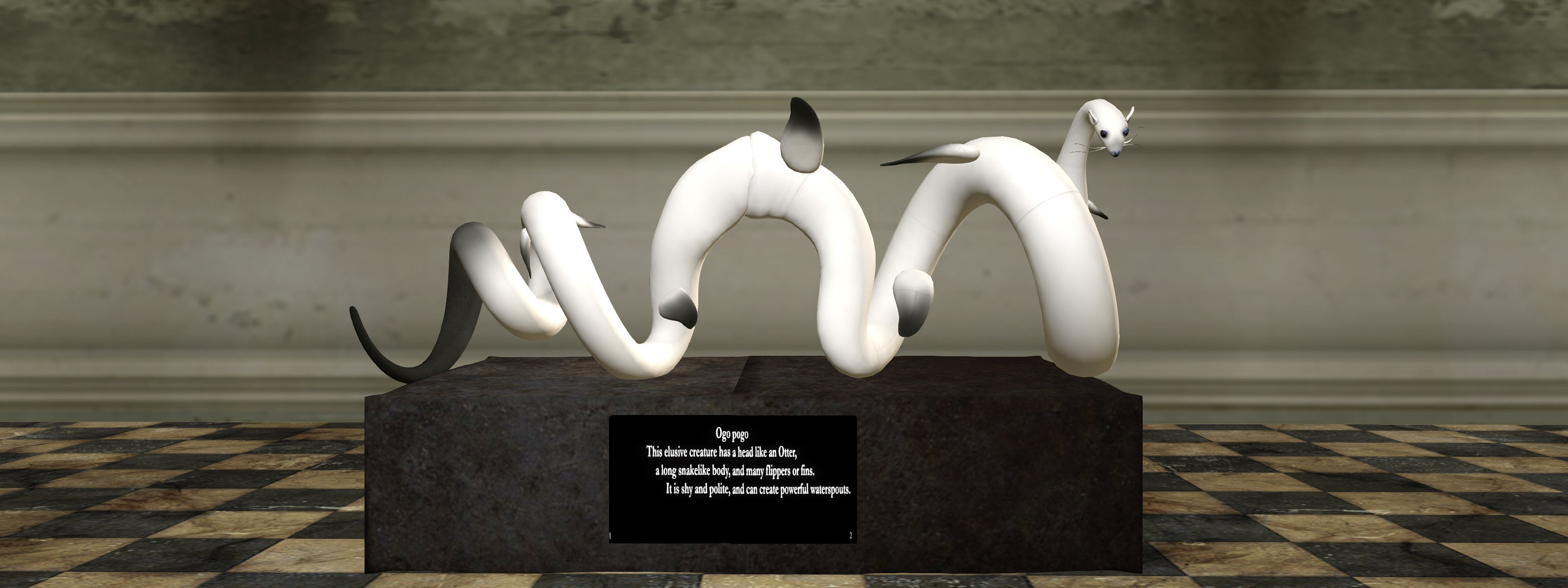
Each creature is presented as a 3D sculpture on a plinth bearing a brief description of the creature’s form. More detailed descriptions of the creatures and their histories, drawn from multiple sources, hang from the ceiling of the hall behind each of the sculptures. As Bryn notes, some of the creatures are very well known; others may ring bells without necessarily being something we’re actually deeply familiar with, whilst others are liable to be entirely new to us. For me, examples of the latter two would be the Baba Yaga – something I’d heard of, but not actually researched, and the Tatzelwurm, a creature I’d never heard of.
And in case you’re wondering why I reference 21 pieces, but only list 20 creatures, that’s because there is a bonus item in the collection, the Bryn Oh.
Bryn Oh is a pale white moth girl born on the Internet. She has curved glowing horns, cyberpunk interface plugs, wings or a neko tail. She is queen of the moths and creates stories and worlds with hidden meaning inside. She has magic and when threatened she can deform her enemies or launch them high in the air. She is drawn to music but often lurks on the outside listening and never dancing. Other creatures find her strange an melancholy.
– the description of the “Bryn Oh”
What is special about these creature is the manner in which they have been created in two parts: “left” and “right” as you look at each of them. Gacha machines within the exhibition halls allow visitors to obtain a random “left” or “right” half of a creature. Any “left” part of a creature can be combined with any “right” part of another creature to create an entirely new one. The clever part here is that whichever combination of to parts is put together, the descriptive text on the two plinth halves will always seamlessly combine to offer a description of the new creature.
Bryn’s own notes on combining a “left” and “right” half from two sculptures to creature a new creature
Thus, it is possible to creature any of the original creatures in the exhibition by collecting all of the different halves – with up to 441 combinations of creature to be created. Further, to help in the joining process, the individual halves have been scripted so that when placed together, they will correctly align and join.
Another interesting aspect of these creatures is the sources Bryn has drawn upon to creature their “mini biographies” hanging in the exhibition halls, and the manner in which set portrays some of them. With Medusa, for example, the focus is very much on her violation at the hands of Posidon – and for which Athena unfairly punished the young and beautiful girl, turning her into the monster with whom we are more familiar.
Bryn amongst her creations
As noted, Mythical Creatures officially opens on Sunday, July 19th, 2020, with a special event starting at 15:00 SLT. Skye Galaxy will be providing the music, supported by Semiiina. And when visiting, keep an eye open for Bryn’s flying machines that have appeared in her own mythologies and her floating / falling bricks that have also featured in her past work, and both of which – together with the design of the exhibition hall, very much hook Mythical Creatures into her universe.
SLurl Details
Mythical Creatures (Immersiva, rated Moderate) – follow the arrows on arrival.