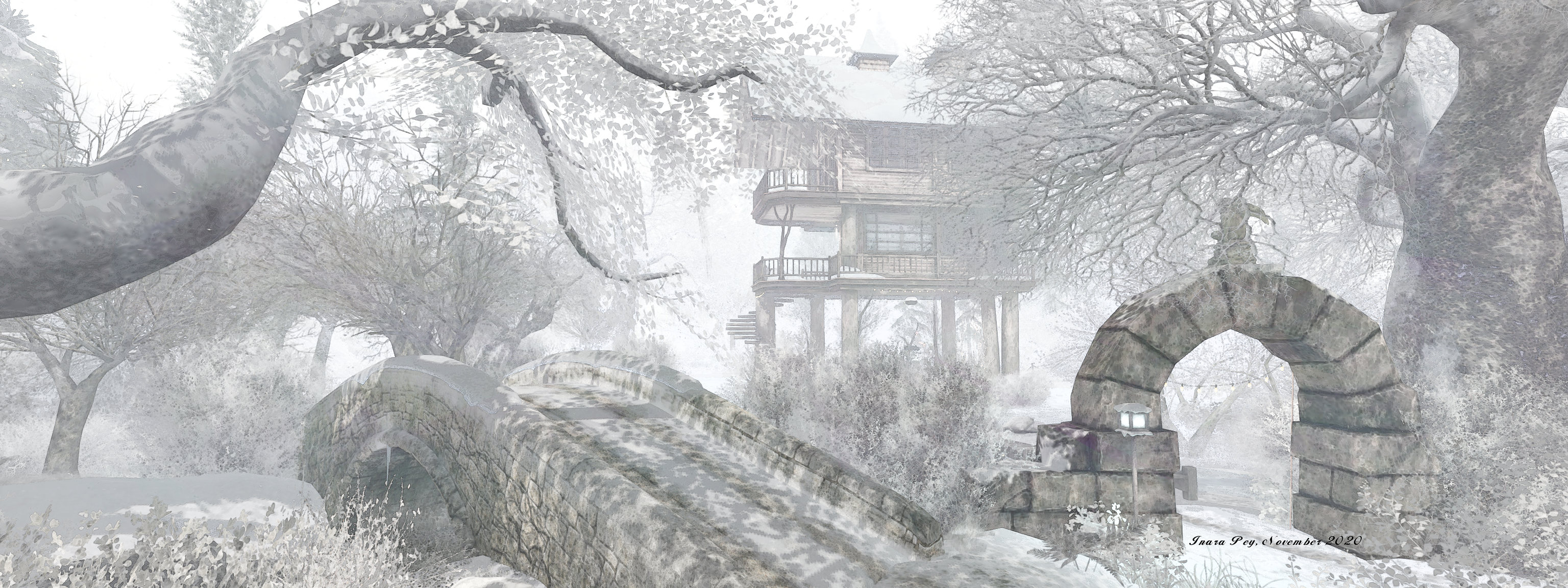
Those who fancy a little touch of winter / seasonal cheer and snow but who don’t fancy exploring a full region, might want to drop in Little Winter, Terrygold’s look at the season for 2020.
Terry has been offering these little winter scenes at the end of the year in Second Life for the last few years, and I’ve always enjoyed visiting them – although I will confess to missing her 2019 design.
Little Winter, November 2020
Located on a sky platform over Solo Arte, where Terrygold often displayed her art and immersive installations, Little Winter presents a simple, easy to appreciate outdoor setting that starts at a little chapel decorated with little stars, with an outhouse that might be the modern-day equivalent of a stable, housing as it does a tricycle and a motor scooter.
A path winds away from the chapel between shoulders and tables of rock and marked by silver birch trees, eventually arriving at a little cabin facing another barn. The cabin is cosy and warm, the barn a little grotto of waiting presents, guarded by large toy soldiers.
Little Winter, November 2020
Around these are lots of little details to be appreciated, from puppies playing with the reins of a sled to happy snowmen and strutting snow kiwis. As well as these, there are places to sit and cuddle, dances to be enjoyed and various opportunities for photography – or even to make a snow angel.
Watched over by deer, Little Winter is an easy to enjoy setting that doesn’t overly impact system performance or require a huge amount of time to explore and appreciate, making it a relaxing and engaging visit.
Trinity Yazimoto is an artist who at one time featured quite regularly in this blog after I came across her art. However, I’d managed to lose track of her in recent years, so it was with a good deal of pleasure that I received an invitation from Owl Dragonash to drop into her Hoot Suite Gallery to see a selection of Trinity’s work on display.
Having joined SL in 2009, Trinity started as a merchant-creator making women’s apparel “the old fashioned way” – using textures, system layers and flexiprims. Teaching herself GIMP and PhotoShop, circumstance saw her expand her skills to photography in 2013, as she started visiting regions and recording them via images.
As she candidly notes, the computer she was using at the time didn’t have the horsepower to allow her to use (what was then called) Deferred Rendering and shadows – but this didn’t deter her. Instead, after taking her pictures, Trinity turned to PhotoShop, adding the necessary shadows to her work as a part of her post-processing work – at least until she was able to provide herself with a computer with the power needed to allow her to use shadow rendering in-world.
Hoot Suite Gallery: Trinity Yazimoto
Gaining confidence, Trinity started exhibiting her work, first at her own gallery and then via invitations to display her work and through participating in various charity events, although more recently, she hasn’t – sadly – had the time to remain as immersed in SL art as she once was.
In Around the World With My Lil’ Friends, Trinity offers us a series of images – some new, some from her existing portfolio (although never previously published) – captured around Second Life that feature, as the title of the exhibition suggests, Trinity’s little animal friends enjoying various activities.
I started this project a few years ago. I always loved the lil bears from “Boogers” and the idea is to take them with me around the world. They are good company, you know?
P.S. There will probably some more pics to come in the future….
– Trinity on Around the World with My Lil’ Friends.
Hoot Suite Gallery: Trinity Yazimoto
This is a set of 11 pieces split between the two floors of the gallery that show Trinity’s bears and other little friends engaged in everything from a first romantic dinner for two through to racing go-karts and splashing around in a swimming pool or sitting in quiet contemplation, admiring nature – and more.
Each image offers a little story of its own, charmingly framed and easy to follow. Some of these actually spill out of the frame and into the 3D world of the gallery, with several little vignettes of these “lil’ people” set out in the various rooms and on the balcony, in either a continuance of a particular picture or in reflection of it.
This is a genuinely delightful selection of images, complete with engaging audience – and for those who want to see more of Trinity’s lil’ friends, make sure you wander the garden of the gallery.
Currently open – for a while longer, at least, given I’m getting to this piece very much on the late side! – are two exhibitions by artists I both appreciate and admire: Michiel Bechir and Sisi Biedermann, who between them present two very different, but equally captivating selections of images for visitors to appreciate and, if they so wish, purchase.
Anyone who is familiar with my coverage of the arts in Second Life knows I am enormously inspired by Sisi’s work, which I categorise as some of the most unique and captivating in Second Life. A digital mixed-media artist, Sisi’s subject matter tends to be wide-ranging, covering everything from the natural world through in-world settings to the fantastical and even touching on the abstract and the near-surreal. This is enough to make her work attention-holding, displaying as they do a richness of imagination, style and colour.
Kultivate Signature Gallery: Sisi Biedermann
However, what, for me, makes Sisi’s work doubly captivating is her ability to layer her pieces such that whilst each is a static piece, it has a sense of being alive; there is something inherently tactile about it that makes you want to run your fingers over it and feel the life within.
All of this is very much on display with her selection of art on display at the Kultivate Signature Gallery. There, spread over the three floors of the gallery space are 24 pieces that richly demonstrate Sisi’s artistry, including a ground-level display of six pieces celebrating her visits to a number of famous cities around the world. These are particularly engaging as the both capture the very essence of landmarks from the places Sisi has visited – The Elizabeth Tower (originally the Clock Tower) of London’s Palace of Westminster, The Golden Gate Bridge of San Francisco, and New York’s Empire State Building and Chrysler Building (appearing twice) should all be instantly recognisable.
Kultivate Signature Gallery: Sisi Biedermann
An aspect of these six in particular that I found particularly attractive is that five appear to suggest they have been physically etched rather than photo-layered, and the sixth – with Elizabeth Tower in the foreground – having an also embroidered look to it, thus making these pieces particularly organic in their styling.
The remaining two floors of the gallery hold further pieces of Sisi’s work waiting to engage and en trace. All are richly textured and coloured, inviting the imagination to take flight.
Kultivate Loft Gallery: Michiel BechirA short walk (or quick teleport) away is the Kultivate Loft Gallery, where Michiel Bechir is currently exhibiting some 32 pieces of his Second Life landscape art, including several in a panoramic format that truly captures the breadth of the regions they represent, whilst four offer a dip into combining landscape with with avatar studies, featuring a subject in period dress suggestive of a Victorian woman of means on her travels.
What I find attractive in Michiel’s work is the manner in which he brings a location to life through camera placement and use of camera angle, always presenting us with a unique view of a place that brings out its natural beauty. His use of post processing also demonstrates a constrained touch that is just sufficient enough to add an evocative edge to his work without becoming top-heavy.
Kultivate Loft Gallery: Michiel Bechir
For this exhibition, Michiel has taken the opportunity to present his pieces as collections: most of the the display areas between the building’s structural support offer three or four images from the same location – the aforementioned Victorian Lady images, for example, were all captured in Witchwood. Thus, these pieces become more than individual pieces (although they can be purchased as such), but also sets of images that can be purchased and displayed together at home, making them very collectable.
I admit to not being too sure as to how long Sisi and Michiel will remain on display at Kultivate – these were exhibitions that started in September, so I really would recommendation that if they tickle your artistic fancy, you hop over to Kultivate sooner rather than later.
With winter on our doorstep, Milly Sharple has once again opened her annual Let It Snow! winter / Christmas themed region for Second Life residents to enjoy, and Caitlyn and I once again received an invitation – although I’m still playing a lot of catch-up on general blogging due to the physical world occupying a lot of my time at the moment, so it has taken me a fair few days to get to the point of writing about it.
I’ve actually been covering Let It Snow! on an annual basis since 2014, only stopping during the years Milly took a break from presenting the region, and have always enjoyed our little pilgrimages to see what seasonal delights Milly has served up – as an artist, she has an eye for framing photogenic series of vignettes across her chosen region, often with touches of whimsy design to bring smiles to the faces of those visiting.
Let It Snow!, November 2020
A visit to the region starts on the north side, where a little village square awaits arrivals, a pavilion offering the warmth of an open fire, a gazebo a place for dancing and, for those seeking something a little warmer, a cosy cottage. Overlooked on one side by a large and warmly-furnished house atop a rocky table,the village is a short walk to a frozen pond ready for ice skaters.
Cut by channels of frozen water spanned by bridges, this year’s Let It Snow! follows Milly’s previous iterations of the region by presenting within its snow-covered landscape a series of interlinked vignettes and scenes, each of which stands on its own whilst also being linked to the rest of the region.
Let It Snow!, November 2020
To describe all of these settings here would be to spoil the opportunity for exploration and discovery, but there are various points within the region I found particularly attractive. Chief among these is the the manner in which Milly has combined The Chapel Ruins from The Looking Glass with pieces by Paco Pooley and Krystali Rabeni to create the site of a ruined chapel, complete with a stained glass window by Milly as a romantic setting with an ethereal edge to it.
Whimsy is added here and there, as with previous designs – such as the snowball-throwing snowman lurking under a tree, while seasonal touches come in the form of the decorations adorning the rooms of the large house, the lights hanging on the trees around the skating rink and so on.
Let It Snow!, November 2020
As well as ice skating, the region offers signs where sleds can be rezzed, plenty of opportunities for dancing, and even the opportunity to play chess with a companion.
The best way to explore the region is to go where your feet will take you – there are no formal paths (just steps to get up to and down from he raised portions of the landscape). However, when visiting I do recommend you use the region’s environment settings to appreciate i to the fullest – and the sky dome Milly has placed over it – to the fullest.
Let It Snow!, November 2020
With plenty to see and do, and with lots of opportunities for photography, 2020’s let It Snow is as captivating to the eye as past iterations, and more than worth the time taken in a visit.
Occupying half of a Full region, Yukina is the home of Namanax & Stella (Stella Mahogany), who is largely responsible for its design. Currently sitting within a winter setting, we were directed to it by Shawn Shakespeare, our resident region discoverer :).
The parcel runs north-south, with the eastern side open to the sea, and the west boundary marked by high cliffs separating it from the neighbouring parcel.
Yukina, November 2020
The southern end of the land is a actually the private home of Stella and Namanax, and while protected by ban lines to prevent trespass, leaving the garden open, it might be a good idea to avoid straying beyond the gabled gates leading up to the house (complete with stone lions guarding the path), in order to avoid the flick-knife armed squirrel patrols (you’ll have to visit and take a peek into the grounds of the house yo understand this comment 🙂 ).
The main house isn’t the only property on the parcel, however; the public area of the parcel are home to a number of houses and cabins large and small, including one particularly impressive structure rising from the small lake in the middle of the landscape. All of these appear to be open to the public and are furnished, giving each of them a cosy feel.
Yukina, November 2020
The landing point sits on the east side of the parcel on the dock alongside a boathouse. From here visitors have a choice of routes for exploration, most laid out in the form of snowy tracks that wind their way out and around the houses and cabins. The way around is also marked by by the local wildlife within the parcel, which ranges from the aforementioned squirrels (which are in fact more interested in playing than carrying weapons of any description!) through rabbits, cats, puppies, chipmunks and – most notably reindeer.
All of this makes for a lot to see, from the comfort and warmth of the houses to the scenes along the tracks to the decks that sit alongside a number of the houses (and which offer places for visitors to sit).
Yukina, November 2020
There are also some nice scenic touches waiting to be found – the Christmas tree shop operated by some nattily dressed gnomes being one of the more obvious, although I liked the little hump backed bridge over the still-flowing stream that feeds the (otherwise frozen) lake. And for those who like a little a little activity during their visits, the lake offers ice shaking; just look for the sign on one of the tracks that loops by it.
Overall, the setting is well presented and makes for an engaging visit. However, there is a lot packed into this half region, including falling mesh snow (that actually invites itself into one of the houses, drifting through the roof!), all of which can make for heavy going in places due to the volume of mesh, so some might want to tweak their viewer to get the most comfortable level of performance.
Yukina, November 2020
But that said, Yukina offers a rewarding wintertime visit.
On Friday, November 2020, the Second Life Endowment for the Arts (SLEA) announced the first group of artists who have been awarded grants to use the new SLEA art facilities in the first six months of 2021.
As I reported in September this year, the SLEA is the successor to the former Linden Endowment for the Arts, which ran from 2009 through until 2019, when the user committee responsible for running it decided to close it down. At the time of the closure announcement, moves were initiated to try to keep the LEA afloat, which transitioned into discussions with Linden Lab to develop a successor – the Second Life Endowments for the Arts.
Operating on a smaller scale than the original LEA, offering an initial group of five regions for art installations: four for region-wide installations and one offering quarter-region art spaces, all of which are supported by a central hub and a sandbox. Grants for the use of the spaces run for between one to six months in duration.
The seven SLEA regions. Image courtesy of SLEA / LL
The first set of artists selected for the opening round of installations are as per the table below, and include artists who will be also be presenting on the core SLEA region (“Region 7”) – presumably using the SLEA theatre or the Art Challenge space.
Commenting on the selection, Tansee Trillium stated:
Rather than filling out a specific form to apply for a grant, SLEA requested the artist respond in his or her own words the concept of the submission.
Upon the initial review it was realized that a grading system was not necessary as each essay was clear, concise and very detailed and equally befitting of a grant. As the process continued, it was noted that a very interesting pattern was evolving. Out of 19 applications no-one requested a one month grant which made that region flexible for a longer period. The majority of requests were made for 1/4 regions, 8 to be exact.
It was at this point as Coordinator of SLEA, I made what I believe to be a very balanced, mindful decision to fill the first 6 months from January 1, 2021 through June 30, 2021 giving each of the applicants the chance to show us their original creations to be on display for others to enjoy, appreciate, be inspired, learn from and most of all represent The Arts.
– Tansee Trillium, announcing the first SLEA grants
The first group of SLEA artists, the dates when they’ll be exhibiting and the regions in which they’ll be exhibiting. courtesy: SLEA
In addition to the awarding of the first grants, Tansee has announced that the SLEA regions will officially open to the public on New Year’s Eve, December 31st, 2020, with a special “ribbon cutting” event that will include fireworks and particle display, held simultaneously across five regions together with live music, DJ’s, and dancing.
There will also be a special SLEA Grand Opening on Sunday, January 24th, 2021, featuring a special 24-hour Celebration of the Arts. Any artists wishing to participate in this event should contact Tansee or Hannington Xeltentat.