Giovanna’s Traces at PAC in Second Life

PAC Featured Artist: Giovanna Cerise

Giovanna Cerise is an artist whom I’ve admired for years. Her work, which spans both the virtual and the physical, is exceptional, whether seen as an individual piece, or as a complete installation.

As I recently reported, she has recently returned to artistic expression through Second Life after a hiatus of several years, opening a studio gallery at Campbell Coast – and I’m particularly honoured and delighted to announce that Giovanna is the first artist to appear at the Phoenix Artists Collaboration as a Featured Artist.

PAC Featured Artist: Giovanna Cerise

Officially opening on Saturday, February 6th, 2021 at PAC, is a special display of art Giovanna has put together, entitled Traces. It marks her first formal exhibition since her return to Second Life – although it will obviously not be her last. It  presents a mix of her work, past and present;  however, I’ll let Giovanna describe Traces in her own words:

The exhibition traces some of the stages of the artist’s production.
The proposed works were made with various techniques and testify to the evolution of his artistic career. On the ground floor there are some works made only with prim, dating back to 2010-2011 and three unpublished works: two sculptures and an installation created for this occasion.
On the upper floor, one side of the gallery is dedicated to some works made in second life, but which were then exhibited some physically others with videos in the real world. The exhibition itinerary is completed with the proposal of some more recent works which were included in installations and which cannot be reproduced here.

– Giovanna Cerise, February 2021

PAC Featured Artists Gallery: Giovanna Cerise

Spread across the two floors of the gallery, commencing with the captivating Senza Titolo (“Without Title”),  this is an exhibition that is not just to be seen, but experienced, the pieces positioned through the gallery’s spaces in such a manner as to present the feeling the visitor is moving through them as much as the gallery itself; text elements on the floor before some of them adding to this sensation.

On the upper floor of the gallery is the opportunity to witness how Giovanna’s work has been celebrated in the physical world, where she has worked alongside other Second life and Physical world arts alumni such as Patrick Moya (Moya Janus in SL).

As well as the text elements on the gallery floor spaces, pieces may also be accompanied by information givers so that visitors can learn more about them, whilst several of the individual pieces are available to purchase for those who wish to add them to their collection.

PAC Featured Artist: Giovanna Cerise

The official opening of Traces will be marked at 13:00 SLT on Saturday, February 6th, with music by our friend and colleague, Joaquin Gustav from 13:15 SLT, at the event space immediately in front of the main gallery.  please do be sure to join us.

SLurl Details

Hilaire Beaumont at Monocle Man in Second Life

Monocle Man Gallery: Hilaire Beaumont

Currently available the Monocle Man Gallery, curated by Kit Boyd and Lynx Luga, is an outstanding exhibition by Hiliare Beaumont. Untitled, it presents a series of self-portrait avatar studies that are – despite the fact I often use this phrase with regards to art exhibitions in Second Life – genuinely rich in their depth of narrative and content.

These are piece that bring together a range of inspirations – literature, film, music, elements of fantasy, historical drama to present pieces that are evocative, layered and often highly emotive. Through their presentation, these are pieces that illustrate the fact that Hilaire was initially drawn to Second Life as a place of role-play, and has since grown towards photography as a means of expression and emotional release.

Monocle Man Gallery: Hilaire Beaumont

The role-play aspect can perhaps be seen in the likes of Le Fantome de l ‘Opera, Clown and Lullaby of Woe, together with Old Man, Diggin’ My Grave and The Wild Horde. These last three, intentionally or otherwise, sit together almost as three parts of an evolving story whilst also each standing in their own right; there is within each of them a wonderful sense of the classic western of the Ford or Leone eras.

Both Le Fantome and Clown have very defined origins, but bring with them a real sense of emotion about them that might not be quite in keeping with our usual thinking about the characters they represent: introspection in one, and a suggestion of unemotional, calculated logic with the other. However, of these particular images, Lullaby of Woe is the piece that most acutely caught my attention in the way the story it suggests seemed to flow between various characters, from Sherlock Holmes through to Dr. Jekyll and back, complete with hints of both James Moriarty and Mr. Hyde.

Monocle Man Gallery: Hilaire Beaumont

Other pieces may not directly draw thoughts toward fictional pieces or film, but their emotional content is just as incredibly captivating. Aux Sombres Heros de L’amer (taking its title from the song by French rock group Noir Désir?)  and Je ‘t en remets au vent, for example, are powerfully evocative of a broader story (as well as having a marvellous sense of the 19th century about them).

Alongside of these sit Sympathy and Mother, two pieces that are simply packed with expression and emotion, particularly for anyone who has recently lost a family member. Both are also a tour de force in framing, depth of field, image depth, and camera angle; each genuinely standing as a life study you do not so much view as step into.

Monocle Man Gallery: Hilaire Beaumont

The simple truth is that each and every one of these images has something to say, so much so that a book could easily be written about this exhibition. But equally, the fact that they do is more than adequate reason for going along to the gallery and view them for yourself; they demonstrate the truth of what can oft seem a tired adage: a picture is worth a thousand words. All of the pieces are offered for sale at an incredibly modest price, and I understand that all proceeds are going to support the gallery directly.

SLurl Details

A return to Tonarino in Second Life

Tonarino, February 2021

On February 1st, we dropped in on Tonarino, the Full region held and designed by 秋元のん (n0rik0). At the time, the focus of our visit was the region’s sky platform, Nekomachi Street (see: The cats of Tonarino in Second Life), but I noted we also hopped down to see what had changed within the region’s ground level design since our last visit in December 2019 (as recorded in Tonarino: an oriental curio in Second Life), and I promised to provide an update.

Well, truth be told, first looks tended to suggest not a lot had changed; the majority of the region is still given over to a large landmass in part cut through by the single line of a railway track that terminates abruptly alongside a little station building, while a small stream slices through the bedrock. Around both lies a landscape suggestive of the outskirts of a town somewhere; the kind of place most people only see whilst rapidly passing through with barely a thought for those whole live there.

Tonarino, February 2021

However, further examination revealed to us that things had changed since December 2019 – although obviously I cannot say quite when they changed; and changed enough to provide a reason for further exploration and looking around.

In this, the most noticeable change lay to the north-west. where the land rises in rocky steps to overlook the rest of the region and particularly overshadows the local school.

Tonarino, February 2021

When we visited in 2019, I noted this was the home of a temple sitting within  a small garden area and overlooking a large traditional Japanese house occupying a shoulder of rock below it. Well, the temple is still there, complete with its little refreshment stand for those needing sustenance after the climb up to it or after a period of sustained prayer. However, and if memory serves, it has now descended from the uppermost table of rock upon which it once sat, to occupy the same elevation as once was occupied by the large house.

Instead, the high table of rock that was once home to the temple is now a lookout point with vending machines and seating. Below it, the walled house has also gone, replaced by a group of restaurant stalls sharing a common outdoors space for patrons, who can be entertained by two more of the remarkable juggling cats by 丸角の人 (shiro0822), who also make up the inhabitants of Nekomachi Street up on the sky platform.

Tonarino, February 2021

I admit, I’m not totally convinced about the nature of the food being served in one of the restaurant stalls, given it is being prepared and offered for consumption by red-faced little demons, so the fact the area also has a little shrine of its own sitting within a bamboo fenced enclosure is perhaps handily placed for those wishing to ward of any wicked spirits that may have been delivered to them with their meal! The shrine and its Torii gate also mark the path to where a stone stairway descends the snowy slopes between the little houses that cling to them, offering a further route back to (or from) the lowlands.

Elsewhere are other subtle changes. One of the private islands to the west side of the island has been removed; elements within the building site have changed (although overall progress on whatever is to be built / installed appears to be a little slow!) an there is what appears to be some work to be finished off behind the school, although visitors can still cross the footbridge and visit the café – although I’m not sure if the quizzes there are still being held.

Tonarino, February 2021

What I find particularly engaging with Tonarino is the manner in which it naturally suggests it is a work-in-progress, so to speak, with the excavator and building blocks in a cleared field, etc..  At the same time the careworn look of the buildings and houses give them a lived-in feel that suggests that while they may be less than pristine, they have the comfortable look and feel to those living within the little town.

Certainly Tonarino remains a place with plenty of opportunities for photography under almost any environment settings, and which – again like so many careworn places in the physical world – has little spots of beauty that suddenly leap out at you as you explore. And that very much retains it as a place worth looking at.

Tonarino, February 2021

And for those who wish to see Nekomachi Street’s marvellous cats, just look for the kitty dancing at the mouth of a road tunnel. Pat his head gently and he’ll get you there 🙂 .

SLurl Details

Dya’s Little Jordan in Second Life

Dya’s Little Jordan, February 2021

The start of February saw me hop over to tour Dya OHare’s latest design at her homestead region after receiving an invitation from her to do so. It’s a setting that sees Dya move away from the Americas, which have been a focus for her last two designs (see:  Dya’s Scent of the Caribbean in Second Life and Dya’s Southern Twilight), and instead turn to the Middle East for inspiration.

As its name suggestions, Dya’s Little Jordan is a take on the Kingdom of Jordan, and it has quite a lot to offer Second Life photographers. However, I’ll state up-front that, thanks to past idiocy on the part of some visiting Dya’s builds, group membership (L$300, so not a fortune) is now required to access Dya’s region, so do keep that in mind. I’ll also confess that Jordan isn’t a country with which I’m overly familiar outside of reading about it, so I have no idea whether the entire setting is drawn from actual places to be found in that country, or just parts of it are, and the rest is down to Dya’s imagination.

Dya’s Little Jordan, February 2021

The landing point is located in a small waterfront area, the open waters before it suggestive, perhaps of the Dead Sea rather than the river Jordan itself. Here, with a souk to attract tourists, the promise of coffee and sea food all separated from the water by a curtain of palm trees, visitors might wander or sit, boats bobbing on the water just across the road.

The southern end of this road ends at a small motel, the hard surface giving way to a beach backed by a number of house built to traditional designs, but with modern trappings that include – for one at least – a swimming pool. Behind these houses sits a more desert-like landscape that runs eastwards away from the town, and northward behind it.

Dya’s Little Jordan, February 2021

A second road cuts through this desert, vanishing into a tunnel on the east side of the region, where an off-region surround takes over, extending the rugged landscape off to the horizon. Between the hills and the town, this desert area offers several points of interest, from dun-coloured houses belonging to the local livestock farmers, and the region’s take on the Al-Khazneh mausoleum in Petra, which lies tucked away behind curtains of rock that form narrow defiles that must be travelled to reach it.

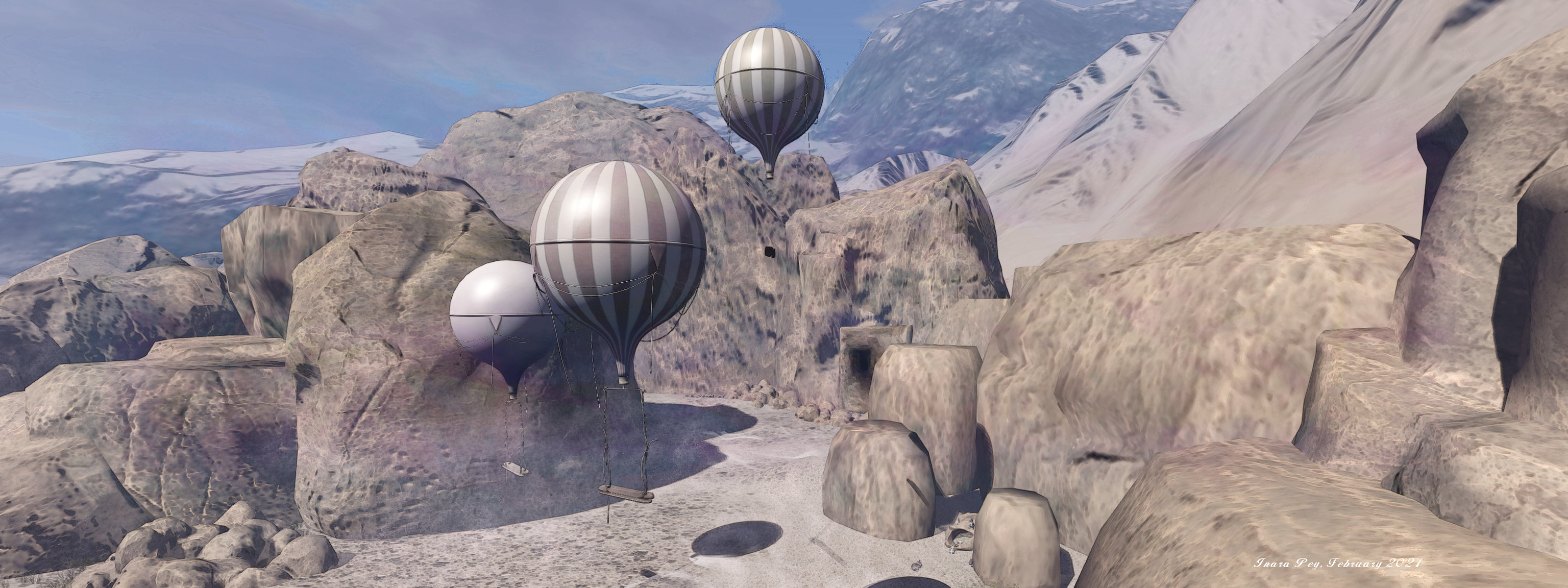
Elsewhere awaiting discovery is a camp site of traditional tents and, a little surprisingly, a trio of balloons that float within wind-blown sands and offer swings on which to sit as little shooting stars whip past. Goats and sheep are to be found across the landscape, together with a small train of  dromedary camels.

Dya’s Little Jordan, February 2021

Those who fancy may also find camel rezzers that allow them to take a ride around the region, whilst for the less adventurous, a little jeep rezzer offer the means to go for a drive and a bicycle rack at the information centre will provide visitors with a pedal bike. Dya also allows those with wearable horses, etc., to mount up and see the region by hoof or wheel. The information centre also provides a very short introduction to the Kingdom of Jordan, for those who would like to know a little more about the country, but who don’t necessarily want to wade through the minutiae of a Wikipedia entry!

As with all of Dya’s region builds, Little Jordan is very easy on the eye and the viewer. There are numerous things to see and enjoy, and a good number of opportunities for photography. Should you opt to enter the mosque, however, do follow the examples at the entrance and remember to remove your shoes!

Dya’s Little Jordan, February 20221

SLurl Details

Anouk Lefavre at Kultivate in Second Life

Kultivate Signature Gallery: Anouk LeFavre

Now open through most of February at the Kultivate Signature Gallery is an exhibition of Second Life landscape photography by Anouk Lefavre.

There is something intensely fascinating about Anouk’s images. Gently post-processed, they have the look and feel of having been painted. The colours are perhaps a little heavier than watercolours, but are lighter than oils, so presenting her work as sitting between the two in a balance that is in itself captivating.

Kultivate Signature Gallery: Anouk LeFavre

More than this, however, the the colours Anouk looks for in her images, together with her framing, means that her pieces are more than images of the places she has records, they are statements of the natural beauty of those places that draws you in. To quote SL photographer Brysen Miller when discussing Anouk’s work:

Truly thought provoking artwork, deep in rich colour tones [and] amazing capture that really make you feel as though you are there. Absolutely brilliant.

All of this is demonstrated in full in the twenty images offered at the Signature Gallery. Nineteen of them are landscape images, with the 20th touching on Anouk’s other focus for photography: avatar studies. All are pieces guaranteed to hold the attention and, with the help of their titles, offer individual narratives that provoke the imagination.

Kultivate Signature Gallery: Anouk LeFavre

However, I admit that of all the images presented, I found myself particularly drawn to the two central images, located on the second and upper floors of the gallery.Neatly split into three panels, they offer a form of latter-day triptych, the breaks between the panels offering an almost chapter-like view of each when viewed left-to-right, whilst equally presenting the complete picture / story when viewed as a whole, the divides between their panels barely interrupting the views they offer.

Which is not to say I in any way dismiss the other pieces; far from it – as noted above, all of them have a marvellous visual appeal.  It’s just that the triptych pieces would make for an ideal centrepiece in a home with a suitable fireplace and wall above it, while I am particularly drawn to the tighter focus and presentation of Behind Screen Memories.

Kultivate Signature Gallery: Anouk LeFavre

But whether drawn to Anouk’s work because of her use of colour, or for the way she balances land and water in creating a scene or for the way she breathes natural life into an image, this is a selection of pieces that will both please the eye and gladden the mind with thoughts of warmer happier days to come.

SLurl Details

The cats of Tonarino in Second Life

Nekomachi Street, Tonarino

This is the first of two pieces on  Tonarino, a Full region we originally visited just over a year ago in December 2019 (see: Tonarino: an oriental curio in Second Life). At that time, the region was a ground-level build, the work of 秋元のん (n0rik0), offering a Japanese urban design theme that was photogenic and fun to explore.

However, not long after our initial visit, n0rik0 extended the region design with the inclusion of a sky platform – Nekomachi Street – which we actually managed to miss at the time it was available. So, when I noted by way of Annie Brightstar’s Scoop-it pages that Nekomachi Street was back, I knew it was time for a return visit to Tonarino, starting with the sky platform lest it only be available for a limited time, and then progressing to the ground to see what has changed there.

Nekomachi Street, Tonarino

The clue to the theme of the sky platform, if the preceding shots above haven’t actually given it away, is in the name – neko, as in cat, so “Nekomachi” could be taken literally as “cat town” or “cat city”, with the setting itself being precisely that: a street scene featuring cats. However, these are not your average domesticated cats, as clever as they may be. These are cats that are completely anthropomorphic and who have overcome the limitations of not having an opposable thumb, in order to create a very human-like life for themselves in what is a delightful continuation of the overall Japanese theme for the region.

For those who visited the location in its past iteration, I understand that outside of the restaurant specialising in crab delicacies, not much has changed between this iteration of Nekomachi Street and the last. Which doesn’t mean it shouldn’t be re-visited; quite the reverse, I’d say: the entire setting is utterly adorable, whether or not you have seen it before.

Nekomachi Street, Tonarino

These feline characters – from sets by 丸角の人 (shiro0822), and sold under their Maru Kado brand (just search for “cats” to list the three sets) – are going about their daily lives just as we humans might. In this, n0rik0 has sown considerable creativity in how the various cats are presented and what they are doing.

Take the crab restaurant, which I’ve arbitrarily selected as a landing point for the article (the setting does have a more “formal” point of arrival / departure, but I’ll come to that later). Here, a kimono-wearing cat is clearly being tempted by the window display as she walks by – and is about to be further tempted by the platter (of samples?) a member of staff is holding by the entrance, whilst inside customers are happily eyeing their meals of fresh crab and supping beer.

Nekomachi Street, Tonarino

Further down the road from the restaurant, another cat is on his pizza delivery round, skilfully managing his bicycle while holding aloft a veritable tower of boxed pizzas, meals the group of cats and kittens putting on their own show outside the local cinema might actually enjoy, although they seem quite wrapped up in their dancing. Around a corner, meanwhile, another cat has stopped his little van above the local river to appreciate the view. A few metres away, another cat peruses the outdoor racks of the local bookshop while inside, the shop owner stands engrossed in one of his tomes.

Throughout the setting, around every corner and within many of the little shops and stores, similar scenes unfold, from the mechanic taking a break from work to enjoy and garden lunch and a read of a newspaper, to the baker and the happy-go-lucky delivery cats with their cart. Unsurprisingly, food does play a considerable role in daily life here – but name me a cat that doesn’t consider every minute of the day to be approximately half-past dinner time and therefore ideal for a snack?

Nekpmachi Street, Tonarino

However, the most endearing little scene awaits discovery along the eastern street.

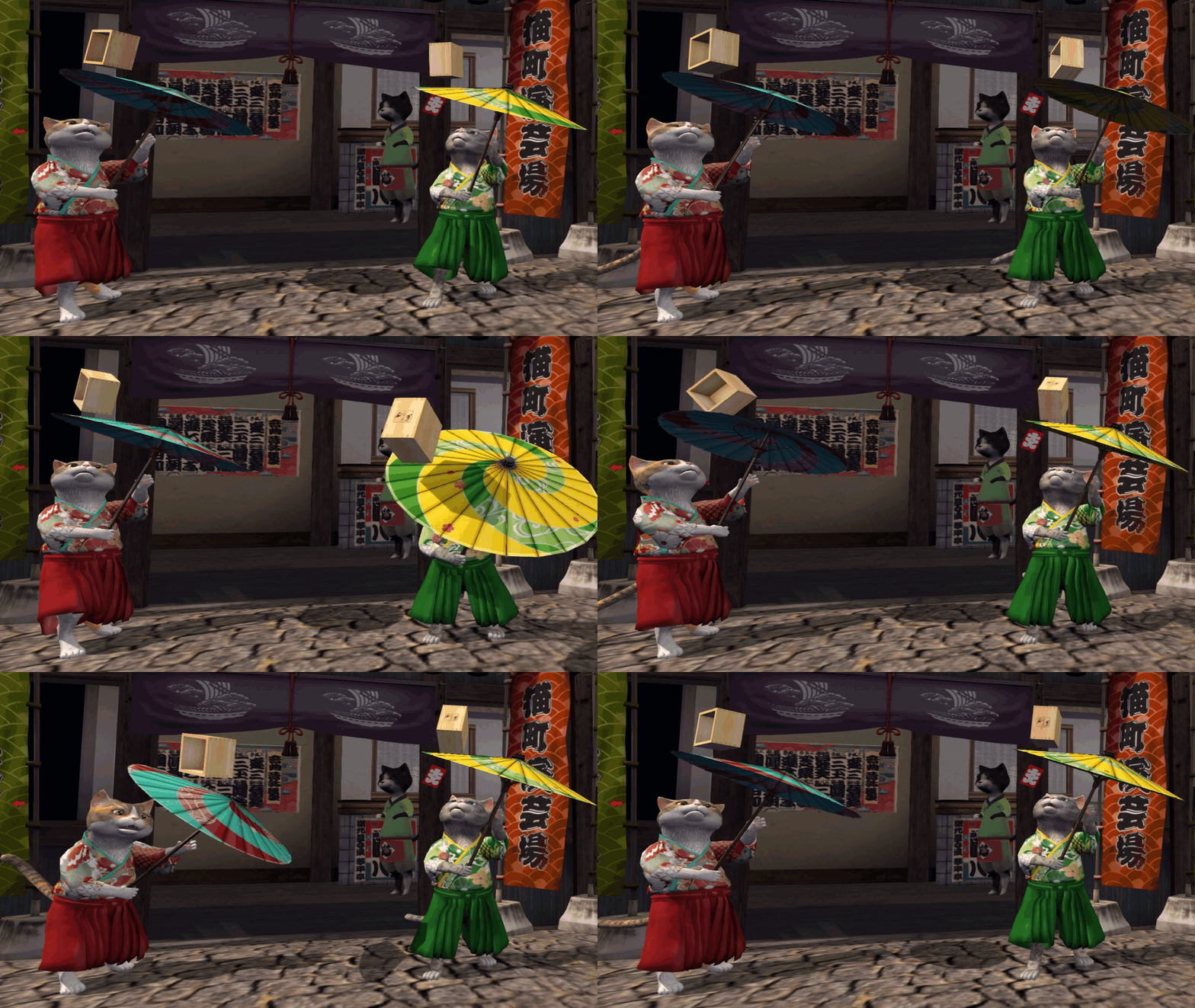
Here, outside the local theatre and before a growing crowd, two highly skilled jugglers put on a show intended to entice people into the theatre – and their use of parasols and little boxes is a delight to watch. Animesh in nature, these are part of a gacha set by shiro0822, items of which can be obtained from the Maru Kado in-world store.

Juggling Cats

Just across the road from the theatre is a little alley linking the street with another, and which is notable for the little work cat climbing out of the manhole there. However, more than just working, he offers the way down to the ground level, and forms the “official” landing point for Nekomachi Street – touching his head will deliver you to the ground-level town, but I’ll be covering that in the follow-up to this article in due course.

SLurl Details